

What do you think?

Stolen Earth
Firefly meets The Expanse in a future where humanity has destroyed the Earth through ecological disaster and warfare, and a totalitarian state prevents any access to their home...
Environmental disasters and uncontrolled AI armies have caused the human population of Earth to flee. They lie scattered across innumerable space stations and colonies, overcrowded and suffering. The Earth is cut off by the Interdiction Zone: a network of satellites to prevent anything getting into or out of the planet. The incredible cost of maintaining it has crippled humanity, who struggle under the totalitarian yoke of the Sol Commonwealth government, whose rich grow richer while the poor are on the brink of starvation.
Many have been driven to the edge of society, yearning for freedom and taking any work offered, criminal and otherwise, in order to survive. The crew of the Arcus are just such people.
A client has come to the table claiming to have the codes necessary to penetrate the Interdiction Zone. Once through, a world of priceless artifacts awaits, provided anyone crazy enough to make the run can be found. They've all heard the rumors - ships that have set down, pilfered the ruins of a museum or private collection, and escaped with enough priceless works to retire. Arcus Captain Lynch knows better - he's been on-world before, a brief and harrowing experience that he's in no hurry to relive. But fuel is running low and cred accounts even lower, and the Arcus' survival might depend on taking the job.
Yet on arrival on Earth, the crew discovers that what remains on their world is not as they have been told, and the secrets they find are big enough to bring the entire Sol Commonwealth tumbling down...
Environmental disasters and uncontrolled AI armies have caused the human population of Earth to flee. They lie scattered across innumerable space stations and colonies, overcrowded and suffering. The Earth is cut off by the Interdiction Zone: a network of satellites to prevent anything getting into or out of the planet. The incredible cost of maintaining it has crippled humanity, who struggle under the totalitarian yoke of the Sol Commonwealth government, whose rich grow richer while the poor are on the brink of starvation.
Many have been driven to the edge of society, yearning for freedom and taking any work offered, criminal and otherwise, in order to survive. The crew of the Arcus are just such people.
A client has come to the table claiming to have the codes necessary to penetrate the Interdiction Zone. Once through, a world of priceless artifacts awaits, provided anyone crazy enough to make the run can be found. They've all heard the rumors - ships that have set down, pilfered the ruins of a museum or private collection, and escaped with enough priceless works to retire. Arcus Captain Lynch knows better - he's been on-world before, a brief and harrowing experience that he's in no hurry to relive. But fuel is running low and cred accounts even lower, and the Arcus' survival might depend on taking the job.
Yet on arrival on Earth, the crew discovers that what remains on their world is not as they have been told, and the secrets they find are big enough to bring the entire Sol Commonwealth tumbling down...
384 pages, Paperback
First published September 21, 2021
Ratings & Reviews
Friends & Following
Create a free account to discover what your friends think of this book!
Community Reviews
Displaying 1 - 30 of 51 reviews

September 5, 2021
Centred around the five person crew of the Arcus, Stolen Earth is a layered, engaging and fast paced read. The plot moved fluidly from one scenario to another, providing not only the expected action of a sci-fi story but also an opportunity to acquire an in-depth knowledge of the protagonists. The story is written third person from the perspective of three characters, two of whom have secrets they would rather keep hidden. All five characters felt well rounded, I could picture them, understood their motives and knew their personalities.
The world building was very pleasing and whilst the individual elements of the story were nothing new, how the author wove them together made for an absolutely fantastic story. I could imagine this on the big screen, it had a very focused narrative which also allowed for moral examination and the reader to make their own inferences.at times. There were no tedious information dumps and I found this book held my attention from start to finish.
I really enjoyed the author's writing style and was left wanting more of both the world and it's characters. Always the sign of a great book.
The world building was very pleasing and whilst the individual elements of the story were nothing new, how the author wove them together made for an absolutely fantastic story. I could imagine this on the big screen, it had a very focused narrative which also allowed for moral examination and the reader to make their own inferences.at times. There were no tedious information dumps and I found this book held my attention from start to finish.
I really enjoyed the author's writing style and was left wanting more of both the world and it's characters. Always the sign of a great book.

May 28, 2026
YA, post-apocalyptic, space opera/
Spec-ops
Xover, retelling of a 15th
Firefly
episode, where, after a century, a crew returns to the quarantined, war-ravaged Earth infested with Lethal Autonomous Weapon Systems (LAWS) to salvage artifacts and pursue unforeseen objectives.
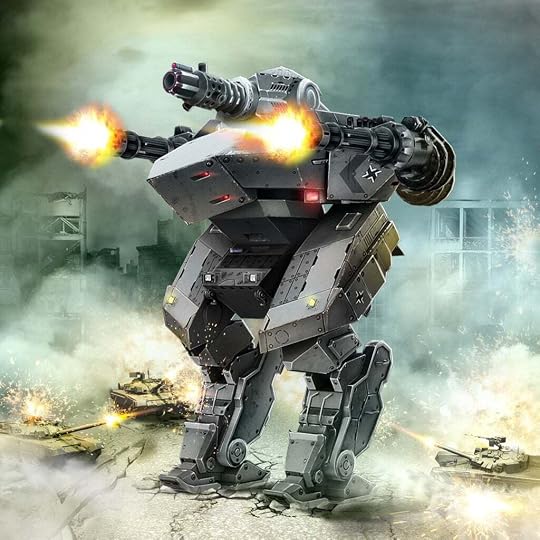
LAWS wandering the ruins of of the bombed-out Earth.
My dead tree copy was a moderate 399 pages. The original U.S. copyright was 2021.
J. T. Nicholas is an American author of science fiction. He is the author of five books, both in a series and as stand-alone books. This is the first book I’ve read by the author.
I picked up this book at an Indie bookstore I habituate. The only reason I stayed with it was that it coulda been a contender. The author had aspirations towards a great work, but he didn't have the tools for the job.
TL;DR Synopsis
Earth is under Quarantine with Extreme Prejudice , after Murderous Malfunctioning AIs spawned a Robot War and left the planet a bombed-out shell infested with Robot Soldiers and lethal Nanomachines . The Sol Commonwealth, AKA SolComm, AKA People's Republic of Tyranny , in its better days, rescued as much of Earth’s population as possible, taking them off-planet. (SolComm is a Crapsaccharine World .) A little more than a century later a crew of Space Cossacks with a Cool Spaceship take a job as Disaster Scavengers on the quarantined Earth and end up Restoring the Earth .
Nicholas assembles a familiar set of tropes, tweaks them for effect, and stitches them into a story that feels somewhat recycled. His embroidery leaves the narrative riddled with plot holes, making it a comfortable read akin to an old pair of shoes, if you don't mind the holes letting in water and soaking your socks.
The Review
Nichols has some chops as a writer, but is inconsistent. He still has more books to write to become a solid journeyman. The copyediting was good, though it may have been automated; the more labor-intensive line editing was needed work. There was also some repetition. The story had three POVs. That was remarkably few for contemporary science fiction. The switching was well done, being interleaved as separate chapters. However, the number of chapters per character felt poorly balanced.
The novel was lacking any humor. A pity, because it would have helped with the missing feeling of Group Cohesion , that a crew would likely have had. The dialogue was OK, though it could have been more expressive. The obligatory use of 21st-century military slang in a MIL-SF story was off the mark. Character's inner dialogue was better. Descriptive writing was OK. However, there was an inordinate level of exposition, which became burdensome. I received eyestrain from rolling my eyes at the Hollywood Hacking and Wikipedia-grade AI exposition. Action scenes were good, but the plotting suffered from having to set them up. In particular, Nichols habitually cleverly tweaked a trope and created a plot hole. The story was a poster child for verschlimmbesserung . Nichols had no sense of when he’d written too much. The less is more or once introduced leave a good trope alone was a lesson he had not learned.
The POVs were Grayson “Gray” Lynch, Laurel Morales, and Rajani Hayer. I could never be sure who was the first amongst equals. I'll assume the Primus inter pares was Gray. He was the Anti-Hero Captain of the gunship Arcus, which was modeled on the Rocinante or Serenity or the Millennium Falcon (you choose). Interestingly, Nicholas introduces Gray in a Prologue, just before his selection as a young SolComm Navy Officer and a Gentleman . That was clever. The Morales character was the SolComm Mole in the crew. Again, interestingly, Nicholas does an Undercover Cop Reveal of Morales to the reader at her introductory chapter. However, Morales has skillz . Hayer was The Professor on the run from SolComm for conducting prohibited research. She does all the crew's Hollywood Hacking, and is the crew's AI Whisperer for the AI plotline. She’s a Neutral Female .
There was one male and two female POVs. A problem I had is that there were only 1½ voices. Gray and Morales, despite being him/his and her/her, were almost indistinguishable to me. Hayer was recognizably independent, but was developed with a heavier hand.
Also in the Arcus crew are Bishop and Federov. Bishop is the Grease Monkey on the ship. Federov is a Mercenary , of dubious to this reader, Russian extraction.
The other characters were thick enough for their limited roles. They were mostly denizens of The Fringe, the Wretched Hive of stations, orbitals, and ships operating outside the reach of SolComm law and order. These folks were living on the edges of human society, struggling to make a living with the SolComm limited available technology and resources. They were typically either members of the demimonde or more self-reliant and accustomed to a harder lifestyle than those from the inner system. These characters are a mixed bag of cyberpunk and libertarian frontier tropes. Oddly, they were not described as being ethnically diverse or homogenized after several generations in space. (All the characters in the solar system read as white bread.) There were a small number of SolComm straight arrow types, towing the party line and living meager lives; these were in contrast to SolComm uber-rich, who lived like comparative royalty, creating a vaguely Feudal Future .
The Antagonists were SolComm and The Six. The Six was the sextet of AIs that fought World War Whatever and destroyed the Earth. That left Man Against Society and Man Against Machine as the Literary Conflicts , both of which were faceless.
Once you got past Hayer’s Wikipedia-grade introduction to AI, the omnipotent AIs in the story were peculiarly anthropomorphized. That, and their usage for Deus Ex Machina purposes was unintentionally ironic.
The story ends with a strong HEA . This was predictable within the made-for-television plotting. There were enough dangling plot lines left to give Nicholas considerable potential for a sequel. Although I'm not a big fan of serial fiction, the author is.
This story contained no sex, drugs, or rock 'n roll.
Folks on Arcus had no sex. It was also absent from the POV character's inner dialog, except for Gray thinking Federov might be taking a shine to Morales. In The Fringe demimonde, Gray alleged that folks of both sexes sold their bodies. Nobody on Arcus consumed drugs or alcohol, or any stimulants for that matter. Which was peculiar, given Nicholas' spec-ops fandom for the story; anyone who is familiar with or deeply read on the subject understands the importance and habitual use of stimulants, typically nicotine and caffeine, in the vocation. There was no music, except for the sound of Bishop’s well-tuned engines in the story.
Violence was: physical, and military-grade ordinance. Blood, gore, and other trauma were minimized in the prose. Body count was moderate. Although a lot of robots did get shot up. Gray and Federov got banged up a bit, but healed remarkably quickly. This may or may not have been due to the pervasive use of medical nanites within the story. (Nanites were a somewhat magical aspect of the story.) I would have thought Hayer, the least hardened character, would have suffered some psychological trauma due to events, but that was never the case.
World-building was an off-the-shelf riff on the Standard Sci-Fi Setting taking place in the Solar System and without space battles, despite Arcus being a corvette-class warship. SolComm was a space-faring dystopia, and the Earth was a death world. However, Nicholas didn’t understand that less is more. He obsessively tweaked his world-building tropes, creating plot holes and introducing anachronisms that disrupted the story’s logic and immersion. The author really needed to spend a few months with KSP to understand getting technical with space flight, and reading up on spec-ops written by practitioners. Have you ever read something so incongruous in a story that you thought you might be reading a different book? However, some of the Tech was credible, with (thankfully) nothing magical there, except maybe the use and abuse of the nanotech technology. Still, I would have thought that SolComm and the The Fringe would have progressed further technologically in the intervening centuries.
Summary
This story started really well. The Prolog and the first two chapters were very good. And then it started to slide. It revealed itself to be just another YA narrative of off-the-shelf tropes, with a very made-for-television look and feel. It could easily have been a Firefly series novelization. It was just too derivative. However, I hung on and continued reading, fascinated by a literary train wreck in progress.
This could have been a good book, but never a great one. The author had a few ideas that worked together. The basic Firefly-like story always has an audience. I could see the neo-cyberpunk influence on The Fringe. However, Nicholas wanted to write both a space opera and a story about spec-ops, specifically anachronistically early-21st-century terrestrial spec-ops. He invested too much in the first half's space opera to make the spec-ops second half happen. He also sabotaged his efforts to create an immersive atmosphere by being overly detailed, and either by failing to pay attention to the details or by failing to ensure their accuracy. (Every spaceman knows the difference between weight and mass, or should.) He had very few original characters, but he would have been better served by having had only a single POV (Gray's). He had very few subplots, but didn't end them all, and the ones he did end were done tritely. He wasted pages with multiple locations in The Fringe and on Earth. And finally, he ensured a Happy Ending in an Epilogue that needn't have been written.
This book had a few workable ideas. They weren't new ideas, but they were workable. If Nicholas had left more of the world-building to the reader's imagination, he would have had a story. However, the book failed miserably in its implementation. I only ended-up finishing it, because I wanted to refresh myself with an example of how not to write science fiction.
LAWS wandering the ruins of of the bombed-out Earth.
My dead tree copy was a moderate 399 pages. The original U.S. copyright was 2021.
J. T. Nicholas is an American author of science fiction. He is the author of five books, both in a series and as stand-alone books. This is the first book I’ve read by the author.
I picked up this book at an Indie bookstore I habituate. The only reason I stayed with it was that it coulda been a contender. The author had aspirations towards a great work, but he didn't have the tools for the job.
TL;DR Synopsis
Earth is under Quarantine with Extreme Prejudice , after Murderous Malfunctioning AIs spawned a Robot War and left the planet a bombed-out shell infested with Robot Soldiers and lethal Nanomachines . The Sol Commonwealth, AKA SolComm, AKA People's Republic of Tyranny , in its better days, rescued as much of Earth’s population as possible, taking them off-planet. (SolComm is a Crapsaccharine World .) A little more than a century later a crew of Space Cossacks with a Cool Spaceship take a job as Disaster Scavengers on the quarantined Earth and end up Restoring the Earth .
Nicholas assembles a familiar set of tropes, tweaks them for effect, and stitches them into a story that feels somewhat recycled. His embroidery leaves the narrative riddled with plot holes, making it a comfortable read akin to an old pair of shoes, if you don't mind the holes letting in water and soaking your socks.
The Review
Nichols has some chops as a writer, but is inconsistent. He still has more books to write to become a solid journeyman. The copyediting was good, though it may have been automated; the more labor-intensive line editing was needed work. There was also some repetition. The story had three POVs. That was remarkably few for contemporary science fiction. The switching was well done, being interleaved as separate chapters. However, the number of chapters per character felt poorly balanced.
The novel was lacking any humor. A pity, because it would have helped with the missing feeling of Group Cohesion , that a crew would likely have had. The dialogue was OK, though it could have been more expressive. The obligatory use of 21st-century military slang in a MIL-SF story was off the mark. Character's inner dialogue was better. Descriptive writing was OK. However, there was an inordinate level of exposition, which became burdensome. I received eyestrain from rolling my eyes at the Hollywood Hacking and Wikipedia-grade AI exposition. Action scenes were good, but the plotting suffered from having to set them up. In particular, Nichols habitually cleverly tweaked a trope and created a plot hole. The story was a poster child for verschlimmbesserung . Nichols had no sense of when he’d written too much. The less is more or once introduced leave a good trope alone was a lesson he had not learned.
The POVs were Grayson “Gray” Lynch, Laurel Morales, and Rajani Hayer. I could never be sure who was the first amongst equals. I'll assume the Primus inter pares was Gray. He was the Anti-Hero Captain of the gunship Arcus, which was modeled on the Rocinante or Serenity or the Millennium Falcon (you choose). Interestingly, Nicholas introduces Gray in a Prologue, just before his selection as a young SolComm Navy Officer and a Gentleman . That was clever. The Morales character was the SolComm Mole in the crew. Again, interestingly, Nicholas does an Undercover Cop Reveal of Morales to the reader at her introductory chapter. However, Morales has skillz . Hayer was The Professor on the run from SolComm for conducting prohibited research. She does all the crew's Hollywood Hacking, and is the crew's AI Whisperer for the AI plotline. She’s a Neutral Female .
There was one male and two female POVs. A problem I had is that there were only 1½ voices. Gray and Morales, despite being him/his and her/her, were almost indistinguishable to me. Hayer was recognizably independent, but was developed with a heavier hand.
Also in the Arcus crew are Bishop and Federov. Bishop is the Grease Monkey on the ship. Federov is a Mercenary , of dubious to this reader, Russian extraction.
The other characters were thick enough for their limited roles. They were mostly denizens of The Fringe, the Wretched Hive of stations, orbitals, and ships operating outside the reach of SolComm law and order. These folks were living on the edges of human society, struggling to make a living with the SolComm limited available technology and resources. They were typically either members of the demimonde or more self-reliant and accustomed to a harder lifestyle than those from the inner system. These characters are a mixed bag of cyberpunk and libertarian frontier tropes. Oddly, they were not described as being ethnically diverse or homogenized after several generations in space. (All the characters in the solar system read as white bread.) There were a small number of SolComm straight arrow types, towing the party line and living meager lives; these were in contrast to SolComm uber-rich, who lived like comparative royalty, creating a vaguely Feudal Future .
The Antagonists were SolComm and The Six. The Six was the sextet of AIs that fought World War Whatever and destroyed the Earth. That left Man Against Society and Man Against Machine as the Literary Conflicts , both of which were faceless.
Once you got past Hayer’s Wikipedia-grade introduction to AI, the omnipotent AIs in the story were peculiarly anthropomorphized. That, and their usage for Deus Ex Machina purposes was unintentionally ironic.
The story ends with a strong HEA . This was predictable within the made-for-television plotting. There were enough dangling plot lines left to give Nicholas considerable potential for a sequel. Although I'm not a big fan of serial fiction, the author is.
This story contained no sex, drugs, or rock 'n roll.
Folks on Arcus had no sex. It was also absent from the POV character's inner dialog, except for Gray thinking Federov might be taking a shine to Morales. In The Fringe demimonde, Gray alleged that folks of both sexes sold their bodies. Nobody on Arcus consumed drugs or alcohol, or any stimulants for that matter. Which was peculiar, given Nicholas' spec-ops fandom for the story; anyone who is familiar with or deeply read on the subject understands the importance and habitual use of stimulants, typically nicotine and caffeine, in the vocation. There was no music, except for the sound of Bishop’s well-tuned engines in the story.
Violence was: physical, and military-grade ordinance. Blood, gore, and other trauma were minimized in the prose. Body count was moderate. Although a lot of robots did get shot up. Gray and Federov got banged up a bit, but healed remarkably quickly. This may or may not have been due to the pervasive use of medical nanites within the story. (Nanites were a somewhat magical aspect of the story.) I would have thought Hayer, the least hardened character, would have suffered some psychological trauma due to events, but that was never the case.
World-building was an off-the-shelf riff on the Standard Sci-Fi Setting taking place in the Solar System and without space battles, despite Arcus being a corvette-class warship. SolComm was a space-faring dystopia, and the Earth was a death world. However, Nicholas didn’t understand that less is more. He obsessively tweaked his world-building tropes, creating plot holes and introducing anachronisms that disrupted the story’s logic and immersion. The author really needed to spend a few months with KSP to understand getting technical with space flight, and reading up on spec-ops written by practitioners. Have you ever read something so incongruous in a story that you thought you might be reading a different book? However, some of the Tech was credible, with (thankfully) nothing magical there, except maybe the use and abuse of the nanotech technology. Still, I would have thought that SolComm and the The Fringe would have progressed further technologically in the intervening centuries.
Summary
This story started really well. The Prolog and the first two chapters were very good. And then it started to slide. It revealed itself to be just another YA narrative of off-the-shelf tropes, with a very made-for-television look and feel. It could easily have been a Firefly series novelization. It was just too derivative. However, I hung on and continued reading, fascinated by a literary train wreck in progress.
This could have been a good book, but never a great one. The author had a few ideas that worked together. The basic Firefly-like story always has an audience. I could see the neo-cyberpunk influence on The Fringe. However, Nicholas wanted to write both a space opera and a story about spec-ops, specifically anachronistically early-21st-century terrestrial spec-ops. He invested too much in the first half's space opera to make the spec-ops second half happen. He also sabotaged his efforts to create an immersive atmosphere by being overly detailed, and either by failing to pay attention to the details or by failing to ensure their accuracy. (Every spaceman knows the difference between weight and mass, or should.) He had very few original characters, but he would have been better served by having had only a single POV (Gray's). He had very few subplots, but didn't end them all, and the ones he did end were done tritely. He wasted pages with multiple locations in The Fringe and on Earth. And finally, he ensured a Happy Ending in an Epilogue that needn't have been written.
This book had a few workable ideas. They weren't new ideas, but they were workable. If Nicholas had left more of the world-building to the reader's imagination, he would have had a story. However, the book failed miserably in its implementation. I only ended-up finishing it, because I wanted to refresh myself with an example of how not to write science fiction.

October 22, 2021
3.5 Stars
This was an entertaining space opera adventure. The story would be great for new sci fi readers because it was easy to follow, with clear explanations of the history and current state of humanity.
As someone who reads a LOT of space opera, I will admit that the characters and plot were a bit simple and predictable, but it was still a fun, easy read.
Compared to a lot of sweeping epic series, this standalone was a nice self contained romp that still managed to have some epic moments.
The best aspect of the book was the mystery surrounding the Earth and I particularly qqqloved the build to that reveal.
I would recommend this one to a pretty wide scifi audience because it was easy and fun to consume.
Disclaimer: I received a copy of this book from the publisher.
This was an entertaining space opera adventure. The story would be great for new sci fi readers because it was easy to follow, with clear explanations of the history and current state of humanity.
As someone who reads a LOT of space opera, I will admit that the characters and plot were a bit simple and predictable, but it was still a fun, easy read.
Compared to a lot of sweeping epic series, this standalone was a nice self contained romp that still managed to have some epic moments.
The best aspect of the book was the mystery surrounding the Earth and I particularly qqqloved the build to that reveal.
I would recommend this one to a pretty wide scifi audience because it was easy and fun to consume.
Disclaimer: I received a copy of this book from the publisher.

April 6, 2023
I had a super hard time getting into this book, and it really wasn’t the book’s fault. It’s an easy read with a fairly simple plot—a perfect sci fi beach read.

We have a crew on a little spaceship pulling illegal jobs in the solar system ruled by a corrupt regime. So they’re all good guys at heart. They end up doing one good deed after another, hoping to get paid without hurting anybody, and you have to wonder how these softies have survived the harsh realities of space under a repressive regime.
I love this trope (Firefly, Theft of Swords, Ardor Benn), but it only works when the characters are extremely defined and unique and memorable. The characters here are pretty generic, down to the Russian guy who speaks English without prepositions. I also had a hard time keeping them straight—sometimes they are referred to by first name and sometimes last name, but you never heard the first and last names together except the very first time.
I was never worried about our characters. They go from one little adventure to another, and I never really cared what they got up to or if they survived. The plot was simple with no subplots, and I like more complicated plots. But it’s a good intro to sci fi.
P.S. The number of typos in this book is astonishing. When I found three misspelled words on a single page, I wondered what I was getting myself into. There were fewer in the second half, at least.
Language: Very occasional strong language
Sexual Content: None
Violence/Gore: Some injuries from adventures, very little actual violence
Harm to Animals:
Harm to Children:
Other (Triggers):
We have a crew on a little spaceship pulling illegal jobs in the solar system ruled by a corrupt regime. So they’re all good guys at heart. They end up doing one good deed after another, hoping to get paid without hurting anybody, and you have to wonder how these softies have survived the harsh realities of space under a repressive regime.
I love this trope (Firefly, Theft of Swords, Ardor Benn), but it only works when the characters are extremely defined and unique and memorable. The characters here are pretty generic, down to the Russian guy who speaks English without prepositions. I also had a hard time keeping them straight—sometimes they are referred to by first name and sometimes last name, but you never heard the first and last names together except the very first time.
I was never worried about our characters. They go from one little adventure to another, and I never really cared what they got up to or if they survived. The plot was simple with no subplots, and I like more complicated plots. But it’s a good intro to sci fi.
P.S. The number of typos in this book is astonishing. When I found three misspelled words on a single page, I wondered what I was getting myself into. There were fewer in the second half, at least.
Language: Very occasional strong language
Sexual Content: None
Violence/Gore: Some injuries from adventures, very little actual violence
Harm to Animals:
Harm to Children:
Other (Triggers):

October 8, 2021
Paradise lost and paradise reclaimed can be powerful tropes in science fiction. In Stolen Earth, J.T. Nicholas attempts to harness these ideas. Wish that I could say he succeeds admirably. For the most part, all I can do is acknowledge the attempt.
Thanks to NetGalley and Penguin for the free eARC in exchange for a review.
Grayson Lynch, previously of the Sol Commonwealth Navy, now captains the Arcus out in the Fringe. Lynch, like the rest of his crew, are disillusioned by the combination of control and corruption in SolComm—but as the sole government left to humanity after its disastrous flight from Earth generations ago, it’s either SolComm or a life on the Fringe. Everything changes when Lynch and his crew are offered a job that will take them to Earth. They will dare to penetrate the impenetrable Interdiction Zone that protects SolComm from the artificial intelligences left behind after Earth was inefficiently evacuated. Yet the crew of the Arcus isn’t prepared for what it finds, and it will set off repercussions for all of humanity.
Look, I’ll cut to the chase: this book bored me. Worse, I knew it would, because post-apocalyptic books like this often do. The first red flag happened early: we have a prologue of Lynch as a youth, being assigned to the Navy, and then the story jumps forward several decades to when Lynch is a disillusioned ex-Navy officer who did bad things and regrets them. Instead of showing us all this, though, Nicholas tells it to us. Nicholas tells us everything. Stolen Earth is full of exposition, and it doesn’t work for me.
The other issue is that very few of the characters receive anything resembling development. Lynch is nominally our protagonist, but he actually has no character arc. He starts the book (after the prologue) as a disillusioned and well-meaning captain who cares for his crew and wants to do what’s best. He ends the book the same way. There’s no journey. The same goes for Bishop and Federov. There are two viewpoint characters in addition to Lynch, and they fare better in this regard—Hayer definitely changes a little, and one could argue that Morales has at least a smattering of development. Nevertheless, that isn’t enough to sustain my interest or dramatic tension.
Which brings me to my final complaint: the plot is on rails. The stakes get pretty high, but at no point did I really feel like the crew was in danger. Elements of conflict get resolved without much issue—I’m being vague to avoid spoilers, but let’s just say that our intrepid heroes seldom have to make hard choices. Everything just kind of comes together for them. This is, in part, because having a super-powerful AI can be a kind of deus ex machina. To his credit, Nicholas does try to work around this issue—I just don’t think he entirely succeeds.
In the end, this is not a bad book. Points for subtle gender diversity (a non-binary character, or at least one who uses the Mx honorific, shows up in the prologue). It’s sensibly paced and works fine as a standalone, although it also has potential for a sequel. I can see other people who are more tolerant of staid exposition enjoying this book a lot more than me. Unfortunately, as much as I love the idea of strong AI and reclaiming a planet, Stolen Earth never gets me caring.
Originally posted on Kara.Reviews, where you can easily browse all my reviews and subscribe to my newsletter.

Thanks to NetGalley and Penguin for the free eARC in exchange for a review.
Grayson Lynch, previously of the Sol Commonwealth Navy, now captains the Arcus out in the Fringe. Lynch, like the rest of his crew, are disillusioned by the combination of control and corruption in SolComm—but as the sole government left to humanity after its disastrous flight from Earth generations ago, it’s either SolComm or a life on the Fringe. Everything changes when Lynch and his crew are offered a job that will take them to Earth. They will dare to penetrate the impenetrable Interdiction Zone that protects SolComm from the artificial intelligences left behind after Earth was inefficiently evacuated. Yet the crew of the Arcus isn’t prepared for what it finds, and it will set off repercussions for all of humanity.
Look, I’ll cut to the chase: this book bored me. Worse, I knew it would, because post-apocalyptic books like this often do. The first red flag happened early: we have a prologue of Lynch as a youth, being assigned to the Navy, and then the story jumps forward several decades to when Lynch is a disillusioned ex-Navy officer who did bad things and regrets them. Instead of showing us all this, though, Nicholas tells it to us. Nicholas tells us everything. Stolen Earth is full of exposition, and it doesn’t work for me.
The other issue is that very few of the characters receive anything resembling development. Lynch is nominally our protagonist, but he actually has no character arc. He starts the book (after the prologue) as a disillusioned and well-meaning captain who cares for his crew and wants to do what’s best. He ends the book the same way. There’s no journey. The same goes for Bishop and Federov. There are two viewpoint characters in addition to Lynch, and they fare better in this regard—Hayer definitely changes a little, and one could argue that Morales has at least a smattering of development. Nevertheless, that isn’t enough to sustain my interest or dramatic tension.
Which brings me to my final complaint: the plot is on rails. The stakes get pretty high, but at no point did I really feel like the crew was in danger. Elements of conflict get resolved without much issue—I’m being vague to avoid spoilers, but let’s just say that our intrepid heroes seldom have to make hard choices. Everything just kind of comes together for them. This is, in part, because having a super-powerful AI can be a kind of deus ex machina. To his credit, Nicholas does try to work around this issue—I just don’t think he entirely succeeds.
In the end, this is not a bad book. Points for subtle gender diversity (a non-binary character, or at least one who uses the Mx honorific, shows up in the prologue). It’s sensibly paced and works fine as a standalone, although it also has potential for a sequel. I can see other people who are more tolerant of staid exposition enjoying this book a lot more than me. Unfortunately, as much as I love the idea of strong AI and reclaiming a planet, Stolen Earth never gets me caring.
Originally posted on Kara.Reviews, where you can easily browse all my reviews and subscribe to my newsletter.

April 5, 2023
I liked the basic story, the characters, and the resolution. This picture of ‘off world’ living was pretty well considered. The pacing felt fine.
My only real problem was with editing or whoever is supposed to catch problems in word choice and whatnot. (Like an ‘if’ instead of ‘it’ and similar.) I wondered if this was an ARC that just hadn’t been cleaned up yet 🤷♀️ These things tend to pull me out of a story, especially if they happen more than a couple of times. And that influences how I feel about a book if I am at all on the fence, as it did here.
Content: a fair amount of profanity; depictions of extreme poverty.
My only real problem was with editing or whoever is supposed to catch problems in word choice and whatnot. (Like an ‘if’ instead of ‘it’ and similar.) I wondered if this was an ARC that just hadn’t been cleaned up yet 🤷♀️ These things tend to pull me out of a story, especially if they happen more than a couple of times. And that influences how I feel about a book if I am at all on the fence, as it did here.
Content: a fair amount of profanity; depictions of extreme poverty.

October 23, 2021
10/23/2021 Full review tk at TheFrumiousConsortium.net.
10/26/2021 Firefly meets The Expanse is a really good way to describe this solar system-based space opera, as a ragtag crew of outlaws discover sinister secrets hidden from them by their political overlords.
Living in SolComm, the solar system community that houses the refugees from a now uninhabitable Earth, is all Gray Lynch has ever known. When he was placed in their Navy upon attainment of adulthood, he was both happy not to be sent to the mines and reluctant to take a place that would likely see him parted from his parents for years at a time. His stint in the Navy proved disillusioning, with the final straw being the response they sent to a small, if growing, political insurrection on the space station Themis. Disgusted, Gray walked away from the Navy and built up his own crew aboard the Arcus, engaging in a little light piracy and other minimally violent if illicit activities in order to keep body and soul together on the fringes of SolComm space.
When the Arcus gets a lead on a lucrative job that will require them to brave the Interdiction Zone (IZ) around Earth in order to scavenge several valuable artifacts for SolComm collectors, more than one of the crew is skeptical. It's common knowledge that Earth has been taken over by unfettered sentient AI, necessitating humanity's flight to the stars. SolComm built the IZ in order to protect what's left of humanity from the landbound AI, effectively rendering any return impossible. But Gray's contact assures him that they can get him through the IZ, and will make it worth the Arcus' while.
It helps that Gray himself has actually been to Earth once, a fact that surprises, if not outright shocks, his team. But he's not the only one keeping secrets, as they'll all soon discover once they reach planet-side and discover what's truly happened to Earth since their ancestors fled for the safety of space.
I really enjoyed J. T. Nicholas' last sci-fi novel, Re-Coil, and while this one had a lot of potential, I felt it dragged way more than Re-Coil did. The shifting perspectives didn't help much, as each of the three viewpoint characters were very much in their heads, constantly evaluating and re-evaluating their situations such that it felt like there was a lot of talking about what they were doing instead of actually doing it -- which is pretty weird considering that quite a lot happens here! It sometimes felt like reading an earnest and thorough debate on future technology rather than an exciting sci-fi adventure. Which is fine if that's what you like. I just prefer my reading with a little more spice, as Mr Nicholas' prior novel had in spades.
Stolen Earth by J. T. Nicholas was published September 21 2021 by Titan Books and is available from all good booksellers, including Bookshop!
10/26/2021 Firefly meets The Expanse is a really good way to describe this solar system-based space opera, as a ragtag crew of outlaws discover sinister secrets hidden from them by their political overlords.
Living in SolComm, the solar system community that houses the refugees from a now uninhabitable Earth, is all Gray Lynch has ever known. When he was placed in their Navy upon attainment of adulthood, he was both happy not to be sent to the mines and reluctant to take a place that would likely see him parted from his parents for years at a time. His stint in the Navy proved disillusioning, with the final straw being the response they sent to a small, if growing, political insurrection on the space station Themis. Disgusted, Gray walked away from the Navy and built up his own crew aboard the Arcus, engaging in a little light piracy and other minimally violent if illicit activities in order to keep body and soul together on the fringes of SolComm space.
When the Arcus gets a lead on a lucrative job that will require them to brave the Interdiction Zone (IZ) around Earth in order to scavenge several valuable artifacts for SolComm collectors, more than one of the crew is skeptical. It's common knowledge that Earth has been taken over by unfettered sentient AI, necessitating humanity's flight to the stars. SolComm built the IZ in order to protect what's left of humanity from the landbound AI, effectively rendering any return impossible. But Gray's contact assures him that they can get him through the IZ, and will make it worth the Arcus' while.
It helps that Gray himself has actually been to Earth once, a fact that surprises, if not outright shocks, his team. But he's not the only one keeping secrets, as they'll all soon discover once they reach planet-side and discover what's truly happened to Earth since their ancestors fled for the safety of space.
I really enjoyed J. T. Nicholas' last sci-fi novel, Re-Coil, and while this one had a lot of potential, I felt it dragged way more than Re-Coil did. The shifting perspectives didn't help much, as each of the three viewpoint characters were very much in their heads, constantly evaluating and re-evaluating their situations such that it felt like there was a lot of talking about what they were doing instead of actually doing it -- which is pretty weird considering that quite a lot happens here! It sometimes felt like reading an earnest and thorough debate on future technology rather than an exciting sci-fi adventure. Which is fine if that's what you like. I just prefer my reading with a little more spice, as Mr Nicholas' prior novel had in spades.
Stolen Earth by J. T. Nicholas was published September 21 2021 by Titan Books and is available from all good booksellers, including Bookshop!

October 3, 2021
I received a copy of this book in exchange for an honest review.
Having enjoyed 'Re-Coil' by the same author, I jumped at the chance to grab this one. Although it had enjoyable concepts and plenty of bells and whistles to make it interesting, I felt the overall plot and pacing of said plot, was very slow. I also felt that, in an effort to world build, the author was guilty of introducing a lot of cool things that never really got a chance to do anything or evolve into parts of the world that truly meant anything.
I liked the crew, I never felt overly attached to them (besides Fedarov), but I liked them regardless. I feel that there could have been more done to make them feel like a group than there was. As it stood, they felt like a bunch of individuals more than a group of people that had built bonds together over the course of their time together.
Going back to the 'stuff was introduced but not allowed to shine' part, I feel like, if this was the first book of a series, I'd be very interested in seeing where the series went. Especially with the epilogue. The run down of events that happened after the main story could have made a good book or two. As it stands, there's just a load of things I wanted to see more of and had an interest in, but was never really allowed to come out of the shadow.
I had a bit of an issue with the characters they encounter. Everyone seems to just take things at face value and accept what's happening as the done thing. It felt a little flat where interactions with characters/entities were concerned. The shock at certain things you'd expect from a real encounter of the likes that were occurring, just wasn't there. Also, I get why people in space call Earth 'Old Earth'. They thought it was destroyed. To them it IS Old Earth. But why does EVERYONE they meet on the planet refer to it as Old Earth? It's literally not old to them. It's the same place they always lived and it made zero sense. If someone walked into my house and starting referring to it as my old house, I'd quickly correct them rather than let their mania run wild a little longer. It's things like that that soured me a little toward this one as I think the overall execution was a tad lacking.
Still, the concept is very interesting and there are several points throughout that got me very excited. It's just the above concerns for me that held this back from a higher score and, if I'm honest, took me a good while longer to finish than originally intended.
Having enjoyed 'Re-Coil' by the same author, I jumped at the chance to grab this one. Although it had enjoyable concepts and plenty of bells and whistles to make it interesting, I felt the overall plot and pacing of said plot, was very slow. I also felt that, in an effort to world build, the author was guilty of introducing a lot of cool things that never really got a chance to do anything or evolve into parts of the world that truly meant anything.
I liked the crew, I never felt overly attached to them (besides Fedarov), but I liked them regardless. I feel that there could have been more done to make them feel like a group than there was. As it stood, they felt like a bunch of individuals more than a group of people that had built bonds together over the course of their time together.
Going back to the 'stuff was introduced but not allowed to shine' part, I feel like, if this was the first book of a series, I'd be very interested in seeing where the series went. Especially with the epilogue. The run down of events that happened after the main story could have made a good book or two. As it stands, there's just a load of things I wanted to see more of and had an interest in, but was never really allowed to come out of the shadow.
I had a bit of an issue with the characters they encounter. Everyone seems to just take things at face value and accept what's happening as the done thing. It felt a little flat where interactions with characters/entities were concerned. The shock at certain things you'd expect from a real encounter of the likes that were occurring, just wasn't there. Also, I get why people in space call Earth 'Old Earth'. They thought it was destroyed. To them it IS Old Earth. But why does EVERYONE they meet on the planet refer to it as Old Earth? It's literally not old to them. It's the same place they always lived and it made zero sense. If someone walked into my house and starting referring to it as my old house, I'd quickly correct them rather than let their mania run wild a little longer. It's things like that that soured me a little toward this one as I think the overall execution was a tad lacking.
Still, the concept is very interesting and there are several points throughout that got me very excited. It's just the above concerns for me that held this back from a higher score and, if I'm honest, took me a good while longer to finish than originally intended.

August 11, 2021
Firefly meets The Expanse is the perfect blurb for this book!! It was also a wonderful story on it’s own. I LOVE space operas and sci-fi stories in general but tend to stay away from those hard-core sci-fi that overwhelm me with tech jargon. Who cares how the darn ship works, tell me about the crew and how they relate!
Thank goodness this is a character driven, solidly written, somewhat-sciency story about how the social constructs of Old Earth and AI’s destroyed everything.
Each chapter is told by a different character POV. It’s a bit mystery, a bit political intrigue. The future kinda sucks. Everyone is controlled tightly by the government, and only a small few can see how they are being manipulated. Even the nervous crew doesn’t quite know who they can trust. I went into it blindly and you should too! Highly recommended for fans of non-stop space action.
Thank you to Net Galley and J.T. Nicholas for this arc!
Thank goodness this is a character driven, solidly written, somewhat-sciency story about how the social constructs of Old Earth and AI’s destroyed everything.
Each chapter is told by a different character POV. It’s a bit mystery, a bit political intrigue. The future kinda sucks. Everyone is controlled tightly by the government, and only a small few can see how they are being manipulated. Even the nervous crew doesn’t quite know who they can trust. I went into it blindly and you should too! Highly recommended for fans of non-stop space action.
Thank you to Net Galley and J.T. Nicholas for this arc!
June 27, 2022
Read this some time ago, so very short catch-up review. Fun space-opera story, set in our solar system but with a mysteriously-abandoned Earth. The plucky band of spacefarers feels somewhat formulaic; hard not to map the characters into the crew of the "Roci" on Expanse, even in their dialogue. Since I loved Expanse I forgive that. Interesting take on how Artificial Intelligence might develop, and be relied upon in the future by governments (see also my review last year of When the Sparrow Falls by Neil Sharpson, which is a very different kind of story, and excellent, and eloquently explores a similar question about AI might affect human society).
July 10, 2024
Entertaining book with good worldbuilding and likable characters. The story was wrapped up a bit too quickly in the end but not in a way that would make it a bad ending.
July 24, 2021
Exciting story and engaging characters are this a must read for those who like science fiction. The science seems sound. It was so good I couldn’t put it down and read it in two sittings. Highly recommend

August 17, 2021
Stolen Earth was a pretty good sci-fi! I hadn't read one in a while, and this one managed to grab my attention enough that I didn't have to push through to finish it.
We discover a world where Earth has been put on a lockdown after a world war involving AIs, which are still active on Earth after killing everyone who did not manage to escape Earth before their attacks.
A team of thieves, including Captain Lynch, a former member of the government army, are comissioned to go on Earth, and cross the Interdiction Zone to recover an artifact from the planet.
On arrival, the crew discovers that not all is as the government would want everyone to believe, and their quest for an artifact soon turns into much more.
One thing I really liked about this book is the crew. While I usually enjoy space crews with the chosen family trope, here, we kind of have the opposite. It's just a bunch of random people who ended up being outlaws and now need to make money. They're not here to be friends, and it can be felt in the way they interact. I thought it was pretty interesting, and probably more accurate in that aspect than some other books.
It also felt realistic in the science and techy stuff. The whole book revolves around a plot featuring AIs, so I enjoyed reading about them, how they came to be built, the way they work, the way the Interdiction Zone works, etc. The writing explains many things that are often overlooked in stories, and I appreciated that a lot, even if sometimes I struggled understanding everything. It's a huge plus for people who are science buffs.
The plot not too original, but the way to tell it was very well done. If you enjoy good sci-fi books that are neither too cliché, neither too difficult to read, I hope you would be willing to give Stolen Earth a shot!
We discover a world where Earth has been put on a lockdown after a world war involving AIs, which are still active on Earth after killing everyone who did not manage to escape Earth before their attacks.
A team of thieves, including Captain Lynch, a former member of the government army, are comissioned to go on Earth, and cross the Interdiction Zone to recover an artifact from the planet.
On arrival, the crew discovers that not all is as the government would want everyone to believe, and their quest for an artifact soon turns into much more.
One thing I really liked about this book is the crew. While I usually enjoy space crews with the chosen family trope, here, we kind of have the opposite. It's just a bunch of random people who ended up being outlaws and now need to make money. They're not here to be friends, and it can be felt in the way they interact. I thought it was pretty interesting, and probably more accurate in that aspect than some other books.
It also felt realistic in the science and techy stuff. The whole book revolves around a plot featuring AIs, so I enjoyed reading about them, how they came to be built, the way they work, the way the Interdiction Zone works, etc. The writing explains many things that are often overlooked in stories, and I appreciated that a lot, even if sometimes I struggled understanding everything. It's a huge plus for people who are science buffs.
The plot not too original, but the way to tell it was very well done. If you enjoy good sci-fi books that are neither too cliché, neither too difficult to read, I hope you would be willing to give Stolen Earth a shot!
October 12, 2021
Earth had been destroyed long ago due to environmental devastation, war, and unfettered AI reducing the rest to unlivable conditions. Survivors fled to the colonies in the rest of the solar system, crowding into an already overcrowded space. Gray captains a ship of outcasts, and they eke out a living on the Fringe of space; every calorie, bit of fuel, and a liter of oxygen must be purchased and accounted for. A risky job to return to Old Earth for artefacts would give them more than enough credits to stay afloat. Landing is one thing, but the truth of Old Earth can bring the Sol Commonwealth to its knees.
Billed as a cross between Firefly and The Expanse, this is a great sci-fi novel with little of the potential concerns of the comparators. The prologue gives us the background on Old Earth and the near coercive tactics of the Sol Commonwealth, but we almost don't even need it. We learn about fettered vs. unfettered AI concerns, the fact that everyone and everything is monitored, that living in the Fringe means they're outside SolComm's purview but piracy and privation are common. In this universe, either people are tightly regulated but dispensed the calories, oxygen, and fuel they need in SolComm, or else they scramble to stay afloat on their own with no guarantees.
We get to know each member of the crew, and I really like them, even the prickly Laurel. Each has their own reasons for staying outside of SolComm's purview, and they do have a code of honor. We see it in the first job they do when we meet them; rather than toe the line of the job, they barely break even because the station needs the stolen goods to survive. The Arcus crew knows how that is, and the eventual lure of a massive payout for stealing Old Earth artefacts could keep them going. The truth of Earth is then a sticking point; the lies that were perpetuated kept those in power at SolComm at the head of the table, so to speak. They were the ones to determine who was worthy of which resources and corruption ran rampant. Are we surprised by this? Not at all. Even if you don't get pessimistic about large government, Gray left the Navy because of orders he was expected to mindlessly carry out which targeted even the possibility of dissent against SolComm. We know from early on that corruption runs rampant.
I enjoyed Stolen Earth, and this look into the future. People are people, no matter where or when they are. These people are fascinating, not quite Robin Hood on the Fringe but still believing in honor and keeping their word. They believe in helping others when a wrong has been done, and these are exactly the kind of people I like to root for. I raced through the book to finish it because I had to know not only the big secret of Old Earth but how our crew would pull through. It's a big gamble, after all, but it's one that absolutely pays off for them and for us to read about.
Billed as a cross between Firefly and The Expanse, this is a great sci-fi novel with little of the potential concerns of the comparators. The prologue gives us the background on Old Earth and the near coercive tactics of the Sol Commonwealth, but we almost don't even need it. We learn about fettered vs. unfettered AI concerns, the fact that everyone and everything is monitored, that living in the Fringe means they're outside SolComm's purview but piracy and privation are common. In this universe, either people are tightly regulated but dispensed the calories, oxygen, and fuel they need in SolComm, or else they scramble to stay afloat on their own with no guarantees.
We get to know each member of the crew, and I really like them, even the prickly Laurel. Each has their own reasons for staying outside of SolComm's purview, and they do have a code of honor. We see it in the first job they do when we meet them; rather than toe the line of the job, they barely break even because the station needs the stolen goods to survive. The Arcus crew knows how that is, and the eventual lure of a massive payout for stealing Old Earth artefacts could keep them going. The truth of Earth is then a sticking point; the lies that were perpetuated kept those in power at SolComm at the head of the table, so to speak. They were the ones to determine who was worthy of which resources and corruption ran rampant. Are we surprised by this? Not at all. Even if you don't get pessimistic about large government, Gray left the Navy because of orders he was expected to mindlessly carry out which targeted even the possibility of dissent against SolComm. We know from early on that corruption runs rampant.
I enjoyed Stolen Earth, and this look into the future. People are people, no matter where or when they are. These people are fascinating, not quite Robin Hood on the Fringe but still believing in honor and keeping their word. They believe in helping others when a wrong has been done, and these are exactly the kind of people I like to root for. I raced through the book to finish it because I had to know not only the big secret of Old Earth but how our crew would pull through. It's a big gamble, after all, but it's one that absolutely pays off for them and for us to read about.

September 2, 2021
Hollywood - come shopping. This could be a decent movie.
The publisher's positioning - Firefly meets The Expanse - is pretty spot-on. The somewhat cobbled-together crew - each with flaws & a history - and the somewhat "underground" nature of their exploits, is the Firefly analogue, and the setting is in our existing (Sol) solar system vs. far-off space, which is the Expanse analogue.
Of course, unlike each of those, this weaves together a story and set of characters all its own, and it's a good one. It's rogue-team vs. the unfeeling, uneven hand of governance by the bureaucracy of space. And yes, our heroes gallivant around serving their own needs, but - of course - get dragged into events bigger than themselves, which they need to take on in order to save the universe. Or, well, at least the bedraggled downtrodden that are being trod on by an unfeeling - nay, corrupt? - government.
Yeah, maybe the story line sounds a bit trite when you write it down in a review. But, it's a tried-and-true trope, and well-leveraged in this outing.
At the end, I almost felt like the analogues needed to pull in a bit of Star Trek (movie) , too. It probably isn't really a spoiler to say that the motley crew saves the day, and it felt a little like a huge Star Trek movie wrapping up with the crew pulling out a movie-climax save.
Which brings me back to the title: Hollywood, come shopping. This could be a decent movie; though the screenplay will obviously condense / strip a lot of the story, it's do-able.
Four stars according to my rules:
- Five stars is when you read a book to the end, put it down, take a deep breath, pick it up and start reading it all over again - or you would if you weren't so anxious to read the next book in a multi-book series. Or, it's simply one of the best books you’ve ever read, period.
- Four stars is when you tell yourself : ”This is good, this is well-written, this is full of interesting ideas, characters and plot points”, but you know you will never read it again.
- Three stars is when you read it to the end, put it down and proceed to forget all about it in the next instant.
- Two stars when it's so bad that it makes you laugh, or sigh, and want to write a review, but you can't remember the name of the book or dislike it so much that you don't write it.
- One star when you can't read past chapter 3, even as penance for your sins, and write tye review to help others avoid wasting their time.
The publisher's positioning - Firefly meets The Expanse - is pretty spot-on. The somewhat cobbled-together crew - each with flaws & a history - and the somewhat "underground" nature of their exploits, is the Firefly analogue, and the setting is in our existing (Sol) solar system vs. far-off space, which is the Expanse analogue.
Of course, unlike each of those, this weaves together a story and set of characters all its own, and it's a good one. It's rogue-team vs. the unfeeling, uneven hand of governance by the bureaucracy of space. And yes, our heroes gallivant around serving their own needs, but - of course - get dragged into events bigger than themselves, which they need to take on in order to save the universe. Or, well, at least the bedraggled downtrodden that are being trod on by an unfeeling - nay, corrupt? - government.
Yeah, maybe the story line sounds a bit trite when you write it down in a review. But, it's a tried-and-true trope, and well-leveraged in this outing.
At the end, I almost felt like the analogues needed to pull in a bit of Star Trek (movie) , too. It probably isn't really a spoiler to say that the motley crew saves the day, and it felt a little like a huge Star Trek movie wrapping up with the crew pulling out a movie-climax save.
Which brings me back to the title: Hollywood, come shopping. This could be a decent movie; though the screenplay will obviously condense / strip a lot of the story, it's do-able.
Four stars according to my rules:
- Five stars is when you read a book to the end, put it down, take a deep breath, pick it up and start reading it all over again - or you would if you weren't so anxious to read the next book in a multi-book series. Or, it's simply one of the best books you’ve ever read, period.
- Four stars is when you tell yourself : ”This is good, this is well-written, this is full of interesting ideas, characters and plot points”, but you know you will never read it again.
- Three stars is when you read it to the end, put it down and proceed to forget all about it in the next instant.
- Two stars when it's so bad that it makes you laugh, or sigh, and want to write a review, but you can't remember the name of the book or dislike it so much that you don't write it.
- One star when you can't read past chapter 3, even as penance for your sins, and write tye review to help others avoid wasting their time.

September 20, 2021
Thank you to NetGalley and Titan Books for this e-ARC in exchange for an honest review!
Stolen Earth is an excellently-executed sci-fi novel that touches on a range of issues that are pertinent to our current society and the times we live in. The plot was really interesting and intriguing, and presents many of the problems and issues we struggle with today. It's very well written; although it could probably be categorised as 'hard science fiction', the author has struck a really good balance between the more scientifically-specific details and accessibility to the average reader. If you understand the technical details then that adds a bonus level of enjoyment to the reading experience, but not understanding them doesn't affect your overall understanding of the plot, or the emotional intensity of particular scenes (e.g. the entry sequence). The opening chapters establish each Arcus crew member's skillset very effectively, but in a way that opens and moves the plot forward, rather than being an unrelated scene purely positioned to establish character competency.
I very much enjoyed having two female POVs to one male POV, and the choice of characters who had POVs was good. Gray of course made sense, but it was good to also have Rajani and Laurel's perspectives, since they had the most interesting stakes and the highest emotional investment in the outcome of the plot. Gray had a very refreshing lack of unwarranted male ego. He's confident in the skills he has and he doesn't downplay them, but he doesn't boast about them either, and he doesn't feel a constant need to assert his authority as captain of the Arcus. The prologue did a good job of establishing his humanity and deep care for others, and his sense of justice is communicated effectively, first through the explanation of his departure from the SolComm Navy, and then throughout the book through his decisions. Rajani and Laurel's first POV chapters successfully establish the lenses through which they view the world and those around them; Rajani as an academic and someone who has only recently 'fallen out' with SolComm, and Laurel as not quite what she seems, as well as someone who still firmly believes in the system. Rajani and Laurel's character developments were the most satisfying, especially because of their respective levels of emotional investment in the events of the book. The secondary and tertiary characters were all very well fleshed out and felt fully formed, despite their lack of POVs.
This book also contains excellent commentary on climate change, on our issues with the increasing sophistication of robots and artificial intelligence, and on the greed of the rich and powerful people in the world. The future it presents for humankind and Planet Earth is quite bleak and, in many ways, horrifically and unfortunately believable, especially given the current state of our climate and of many governments around the world. If you want to gain a better understanding of where our collective global trajectory could potentially lead us, this is definitely the book to read.
Stolen Earth is an excellently-executed sci-fi novel that touches on a range of issues that are pertinent to our current society and the times we live in. The plot was really interesting and intriguing, and presents many of the problems and issues we struggle with today. It's very well written; although it could probably be categorised as 'hard science fiction', the author has struck a really good balance between the more scientifically-specific details and accessibility to the average reader. If you understand the technical details then that adds a bonus level of enjoyment to the reading experience, but not understanding them doesn't affect your overall understanding of the plot, or the emotional intensity of particular scenes (e.g. the entry sequence). The opening chapters establish each Arcus crew member's skillset very effectively, but in a way that opens and moves the plot forward, rather than being an unrelated scene purely positioned to establish character competency.
I very much enjoyed having two female POVs to one male POV, and the choice of characters who had POVs was good. Gray of course made sense, but it was good to also have Rajani and Laurel's perspectives, since they had the most interesting stakes and the highest emotional investment in the outcome of the plot. Gray had a very refreshing lack of unwarranted male ego. He's confident in the skills he has and he doesn't downplay them, but he doesn't boast about them either, and he doesn't feel a constant need to assert his authority as captain of the Arcus. The prologue did a good job of establishing his humanity and deep care for others, and his sense of justice is communicated effectively, first through the explanation of his departure from the SolComm Navy, and then throughout the book through his decisions. Rajani and Laurel's first POV chapters successfully establish the lenses through which they view the world and those around them; Rajani as an academic and someone who has only recently 'fallen out' with SolComm, and Laurel as not quite what she seems, as well as someone who still firmly believes in the system. Rajani and Laurel's character developments were the most satisfying, especially because of their respective levels of emotional investment in the events of the book. The secondary and tertiary characters were all very well fleshed out and felt fully formed, despite their lack of POVs.
This book also contains excellent commentary on climate change, on our issues with the increasing sophistication of robots and artificial intelligence, and on the greed of the rich and powerful people in the world. The future it presents for humankind and Planet Earth is quite bleak and, in many ways, horrifically and unfortunately believable, especially given the current state of our climate and of many governments around the world. If you want to gain a better understanding of where our collective global trajectory could potentially lead us, this is definitely the book to read.

November 3, 2025
Overall, an excellent book. There are several POVs and I enjoyed the different perspectives.
I will say that I had trouble rembering who was who for the first few switches - in general (minus one chapter in the middle) POV characters were 3rd person and referred to themselves by their first name. But everyone else in the book and in every other chapter referred to them by their last name. So you get to a new chapter and it's a new person, but was Rajani Hayer? Or Morales?? I got there eventually, but it was a rough transition.
I loved the setup and worldbuilding on this one. AI ended life as we knew it on Earth, and the remnants of humanity fled the planet to live among the stars. A forced exodus is one of my favorite sci-fi tropes so I was glad to see it here, and done well and realistically.
Going from kid Gray to adult, hardened and jaded Gray on the first two chapters was excellent and very well done. All of the characters felt like real people (although Federov often felt like a caricature) and I enjoyed reading about them.
The plot itself felt a little contrived and I felt like the book ended just as I was really getting invested. I wanted to know what happens *next*. This very easily could've been twice the length and I would've been more than happy to read it. As it is, there were quite a few loose ends that we get to see tied up haphazardly in the epilogue, but I have so many unanswered questions!
Maybe that is a problem for fanfiction to handle. 😉
If you like Military fiction, Space fiction, books with multiple POVs, sci-fi with killer robots, want to see one man's view of what AI could do to the world, or just want a good story about a pirate ship going exploring, check this one out.
I will say that I had trouble rembering who was who for the first few switches - in general (minus one chapter in the middle) POV characters were 3rd person and referred to themselves by their first name. But everyone else in the book and in every other chapter referred to them by their last name. So you get to a new chapter and it's a new person, but was Rajani Hayer? Or Morales?? I got there eventually, but it was a rough transition.
I loved the setup and worldbuilding on this one. AI ended life as we knew it on Earth, and the remnants of humanity fled the planet to live among the stars. A forced exodus is one of my favorite sci-fi tropes so I was glad to see it here, and done well and realistically.
Going from kid Gray to adult, hardened and jaded Gray on the first two chapters was excellent and very well done. All of the characters felt like real people (although Federov often felt like a caricature) and I enjoyed reading about them.
The plot itself felt a little contrived and I felt like the book ended just as I was really getting invested. I wanted to know what happens *next*. This very easily could've been twice the length and I would've been more than happy to read it. As it is, there were quite a few loose ends that we get to see tied up haphazardly in the epilogue, but I have so many unanswered questions!
Maybe that is a problem for fanfiction to handle. 😉
If you like Military fiction, Space fiction, books with multiple POVs, sci-fi with killer robots, want to see one man's view of what AI could do to the world, or just want a good story about a pirate ship going exploring, check this one out.

June 4, 2022
Um, it was fine! FIREFLY meets THE EXPANSE is both a very broad and inaccurate description of this book, but I understand why marketers might go for it. There's a very typically mismatched crew of good-hearted outlaws who very typically fly into the belly of the beast (an Earth lost a century ago to war over resources and rogue AIs) and very typically discover some untruths have been propagated by the governmental system that rules the surviving humans off world. The AI is essentially a deus ex machina character, and the heart-of-gold good guys aren't super interesting even if a couple of them hide implausible secrets. The "oh the government is BAD?" incredulity that is played for irony is more than a little tiresome, and the tedium invested in the gun- and military-love feels a little much, like enough to make me bestow a libertarian ethos on the politics of this book and, not to go too far off on a tangent, but if humanity were suddenly flung to the stars under duress and with extremely limited resources, libertarian politics would FOR SURE result in the death of the species. But anyway, solidly interesting premise, mostly interesting action, some interesting characters.
August 14, 2021
This was a n above-average space opera by an author who will likely only get better. I read his earlier Re-Coil and liked it. The book started with a somewhat awkward data dump but then moved straight to well portrayed action. I liked the dystopian solar system setting, the caper element, the unfolding mystery of what is going on with Earth, and the dynamics of the crew. Characters and situation are a bit stock. I found the switching between the protagonist captain’s first and last name jarring and I thought Russian character Federov could have done without the cliched speech patterns. That said, I would certainly read a sequel or another book by the author, who shows real potential. I would also note that I have liked the books I get from Titan - their editorial tastes match mine.
Thanks to NetGalley and Titan books for an advanced copy in exchange for a review.
Thanks to NetGalley and Titan books for an advanced copy in exchange for a review.

November 20, 2021
The book focuses on the Arcus, a small ship with a crew of five misfits and outlaws who’ve come together on the fringes of society to try and survive the best they can in extreme circumstances. Set over hundred years, after humanity were forced to flee earth thanks to a war that quickly escalated beyond their control. After a series of AIs were put in charge of the military across the continents the battlefield soon span out of control. With nanite viruses and ecology–changing weaponry sweeping across the planet, those that could fled to the stars, taken in by those already living out in space. But the majority of humanity were left behind to their fate.
FULL REVIEW: https://setthetape.com/2021/09/21/sto...
FULL REVIEW: https://setthetape.com/2021/09/21/sto...
September 24, 2021
I was excited to read Stolen Earth because of it's comparisons to The Expanse and my love of other sci-fi books; however, while I enjoyed parts of Stolen Earth, I found the overall story/plot to be quite slow. Additionally, I didn't connect with any of the characters. Both the story and the characters had potential; however, in the end, I found them both lacking. I usually fly through fantasy and sci-fi books (reading them within a day or two), but with Stolen Earth, I struggled to finish it and it took me over a month.
February 11, 2023
3.5, rounded up to 4. I definitely enjoyed it, and it kept me interested, but it wasn't super ground-breaking or anything. There were a couple of motives for things people did that just didn't make sense, and the characters aren't exactly memorable/different from other general sci-fi characters, but it was good enough. I think seeing it marketed as "Firefly meets The Expanse" gave me expectations that couldn't be met. Rajani's story is interesting, and One is a much better character than Mike from The Moon is a Harsh Mistress.

September 16, 2022
5/10 Stolen Earth desperately wants to be The Expanse series, but it's not. It's good enough scifi adventure, but bland. Definitely read it if you want some scifi, but don't expect much. It could use some more humor and some more twists.
For example, there's a mysterious benefactor who kicks off the whole story but is never named or revealed. Then another character disappears half way through the book. Why not reveal that they're the same person in a shocking twist? Instead they just disappear.
For example, there's a mysterious benefactor who kicks off the whole story but is never named or revealed. Then another character disappears half way through the book. Why not reveal that they're the same person in a shocking twist? Instead they just disappear.
August 22, 2021
A solid space opera. It's good to see an accurate title description. I don't know if this will sell well, but it should since it's well-written with a good plot and characters. There not much focus on the tech here, for those that like kind of thing, but it's not required in this case. Recommended.
I really appreciate the free ARC for review!!
I really appreciate the free ARC for review!!

September 27, 2021
Stolen Earth
[Blurb goes here]
AIs have taken over Earth. People live and die at the hands of the Sol Commonwealth government. This is a story about a group of smugglers that are also good guys at heart. It's a fun read and a great adventure. I truly recommend it.
Thank you for the free copy!
[Blurb goes here]
AIs have taken over Earth. People live and die at the hands of the Sol Commonwealth government. This is a story about a group of smugglers that are also good guys at heart. It's a fun read and a great adventure. I truly recommend it.
Thank you for the free copy!
August 30, 2021
A highly entertaining sci-fi novel. The plot was interesting and held my attention. I would recommend this book to all fans of Science Fiction.
Thank you to #NetGalley for the ARC in exchange for my honest review.
Thank you to #NetGalley for the ARC in exchange for my honest review.
December 31, 2021
Earth has been decimated by environmental damage and AI driven global conflicts. Many people have escaped to safety in the solar system beyond earth. Crew of ship attempts to land on earth to steel artifacts. It was quite fun.

February 27, 2023
A fairly standard ex-military space mercenary story, with a lot of foreshadowed points clearly delineated. Rich with detail, it goes a little overboard on weaponry details and of team actions. The AI explorations and the results after the climax make it worthwhile. Enjoyable.

August 24, 2024
It's an odd one for me. I technically liked everything that happened, I just feel like someone summarized it for me, like I didn't really read the full version of the book.
And it took a long time to get through it.
And it took a long time to get through it.
February 22, 2025
Meh. Easy enough to read but nothing very unique about the story or characters. And, a little MAGA-ish in its approach to the world (eg, the two women characters typically get paired in away teams, etc). No love story though, which was a relief.
Displaying 1 - 30 of 51 reviews