What do you think?
Rate this book


160 pages, Paperback
First published January 1, 1959
“... a couple of consumer principles we can kick around here at conference: one, the insatiate craving of the public for an absolute; and two, the modern failure of monotheism—that is to say, the failure of the notion that any absolute can be presented as one separate thing.”In other words, there is indeed an inherent contradiction within modern consumer society: the failure to deal adequately with the necessity for contradiction.
“Monotheism is shot to pieces on the one hand—dire craving for an absolute existing on the other. I submit to you staffers that the solution establishes itself before our very eyes: namely, that an absolute—in any particular field—must be presented as a dichotomy!... Now what we want is one product which we can present in the two forms—good and evil, old and new, primitive and civilized—two items designed for the same use but presented as completely antithetical, both morally and philosophically—not aesthetically, however . . .”Grand knows his market. Its most profound desire is to be subjugated but to call that subjugation freedom. The American aesthetic!
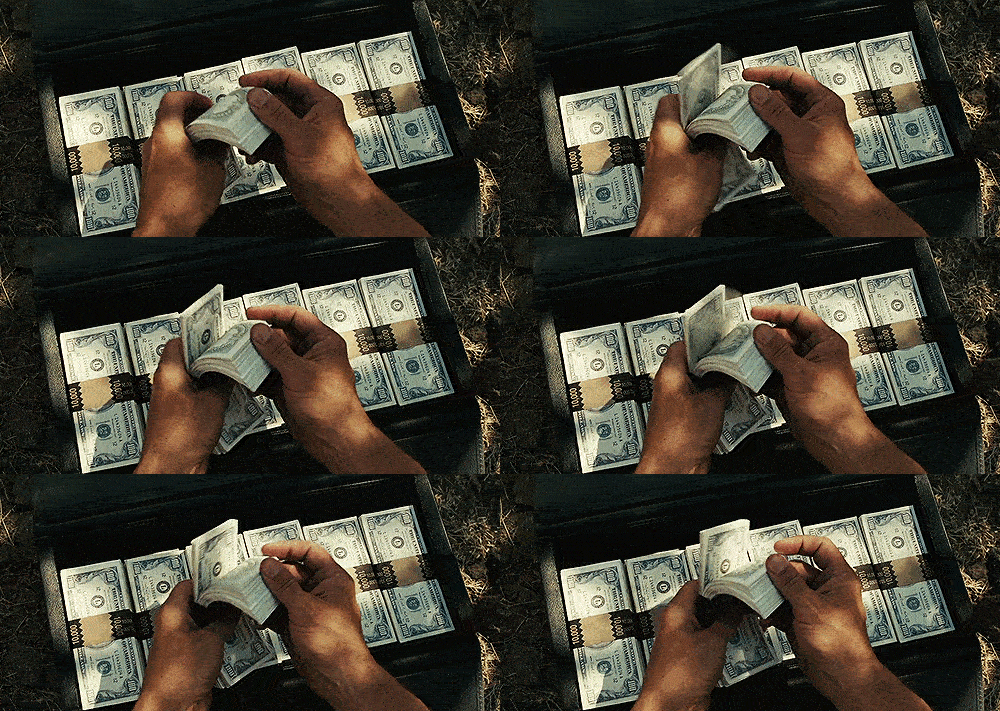


Back at the site, Grand Guy donned his mask again, and dumped the remaining contents of the brief case into the vat. Then he stepped down, opened the can of paint, gave it good stirring, and finally, using his left hand so that what resulted looked childish or illiterate, he scrawled across the vat FREE $ HERE in big black letters on the sides facing the street.He then leaves.
He climbed up for a final check on the work. Of the bills in the muck, the corners, edges, and denomination figures of about five hundred were visible.
The commotion that occurred a few hours later on that busy corner of the Loop in downtown Chicago was the first and, in a sense perhaps, the most deliberately literal of such projects eventually to be linked with the name of “Grand Guy” Guy Grand, provoking the wrath of the public press against him, and finally earning him the label, “Eccentric” and again towards the end, “Crackpot.”The premise of the novel is a very simple one: what would happen in a practical joker became a billionaire? It’s a good idea and the above chapter would’ve made a great short story but then we get the same again but different and then the same again but different. He manufactures a deodorant that does the very opposite. He takes over a newspaper and runs it into the ground. He introduces a panther to a dog show. He goes on safari with a howitzer. They’re all funny ideas. Like paying two boxers to fight “in the most flamboyantly homosexual manner possible”:
Fortunately, what did happen didn’t last too long. The Champ and the challenger capered out from their corners with a saucy mincing step, and, during the first cagey exchange—which on the part of each was like nothing so much as a young girl striking at a wasp with her left hand—uttered little cries of surprise and disdain. Then Texas Powell took the fight to the Champ, closed haughtily, and engaged him with a pesky windmill flurry which soon had the Champ covering up frantically, and finally shrieking, “I can’t stand it!” before succumbing beneath the vicious peck and flurry, to lie in a sobbing tantrum on the canvas, striking his fists against the floor of the ring—more the bad loser than one would have expected.In their day Spike Milligan or Monty Python would’ve had a field day with that; just think about Python’s Camp Marching sketch. The same goes for his scheme to issue a series of Do-It-Yourself Portables in which famous novels were republished “with certain words, images, bits of dialogue, and what have you, left blank . . . just spaces there, you see . . . which the reader fills in” for example Kafka’s Do-It-Yourself Trial:
‘Now you too can experience that same marvellous torment of ambiguity and haunting glimpse of eternal beauty which tore this strange artist’s soul apart and stalked him to his very grave! Complete with optional imagery selector, master word table and writer’s-special ball-point pen, thirty-five cents.’Most chapters end with Grand having to fork out a small fortune to smooth over the mess he’s just made. The problem is we never actually get any insight into why he’s doing what he’s doing. There’s no growth. He keeps going until he gets bored and then moves onto the next prank. And that’s the problem here: this is a sketch show masquerading as a novel. If he’s trying to teach people something they don’t get it and I do suppose that is the point to the whole book: people don’t learn. In that respect the book is quite vicious and yet there’s an apparent innocence to Grand, a rather disconcerting innocence, as if he really doesn’t see how insulting he’s being. A lot of his ideas sound funny but the reality of poor and/or greedy people fighting in a vat of shit for money is really rather sad at the end of the day.
The purpose of his con is to expose all other cons, to expose all beloved cultural poses and institutions as arbitrary illusions easily manipulated; to expose—in the true Decadent tradition, the “mad tradition”—that all culture is artifice, and the only truth is hungry, ravaging, abundant nature.I’m sure you can read that into the text but I suspect at the time Southern was just writing what he thought was funny. Offering a man $6,000 to eat a parking ticket isn’t funny though:
Everyone, Grand ultimately tells us, has an angle, a price—so don’t get suckered, cheated, manipulated or abused. Grand’s pranks demolish a culture of limitations, revealing a culture of possibilities and freedom. In perpetuating these acts, Grand becomes a quasi-Situationist. – p.75
“You needn’t actually eat the ticket,” he explained. “I was just curious to see if you had your price.” He gave a wink and a tolerant chuckle. “Most of us have, I suppose. Eh? Ho-ho.”This isn’t a bad book—far from it—but it is a little dated. The sad thing is nothing’s changed in fact I read an article recently in which Donald Trump was compared to Grand and it made me shudder.