

What do you think?
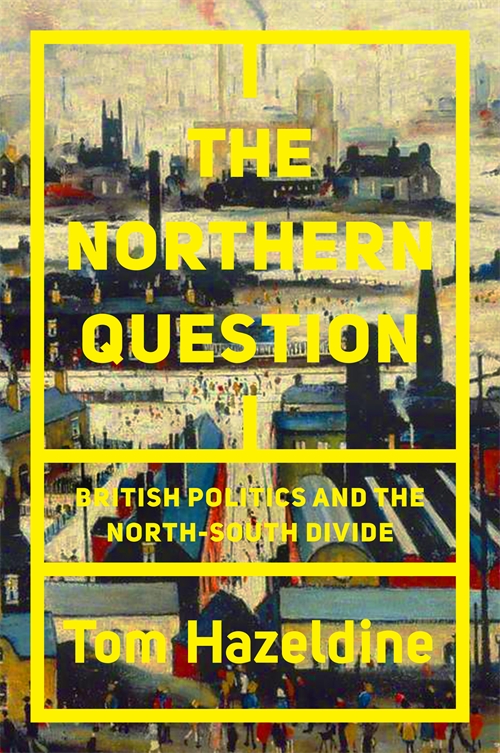
The Northern Question: A Political History of the North-South Divide
Britain has scarcely begun to come to terms with its recent upheavals, from the crisis over Brexit to the collapse of Labour’s “red wall.” What can explain such momentous shifts?
In this essential work, Tom Hazeldine excavates the history of a divided country: North and South, industry versus finance, Whitehall and the left-behind. Only by fully registering these deep-seated tensions, he argues, can we make sense of the present moment.
Hazeldine tracks the North-South divide over the longue durée, from the formation of an English state rooted in London and the south-east; the Industrial Revolution and the rise of provincial trade unions and the Labour party; the dashed hopes for regional economic renewal in the post-war years; the sharply contrasting fates of northern manufacturing and the City of London under Thatcher and New Labour; to the continuing repercussions of financial crisis and austerity.
The Northern Question is set to transform our understanding of the politics of Westminster—its purpose, according to Hazeldine, to stand English history on its head.
In this essential work, Tom Hazeldine excavates the history of a divided country: North and South, industry versus finance, Whitehall and the left-behind. Only by fully registering these deep-seated tensions, he argues, can we make sense of the present moment.
Hazeldine tracks the North-South divide over the longue durée, from the formation of an English state rooted in London and the south-east; the Industrial Revolution and the rise of provincial trade unions and the Labour party; the dashed hopes for regional economic renewal in the post-war years; the sharply contrasting fates of northern manufacturing and the City of London under Thatcher and New Labour; to the continuing repercussions of financial crisis and austerity.
The Northern Question is set to transform our understanding of the politics of Westminster—its purpose, according to Hazeldine, to stand English history on its head.
304 pages, Hardcover
First published October 6, 2020
Ratings & Reviews
Friends & Following
Create a free account to discover what your friends think of this book!
Community Reviews
Displaying 1 - 13 of 13 reviews

October 27, 2020
I wanted to like this, and I very much liked the first few chapters: history as a multifaceted beast, replete with grand sweeps, thorny questions, and the faint tinge of the romance of the return. Hazeldine does this adequately if perhaps a little woodenly, and you can feel that his concerns are for verification and not really illustrative majesty. Then it all devolves into a history of English Parliamentary decisions in the 20th century involving the north of England with a few entries - Arthur Scargill, for instance - from outside that rarefied realm of politics to round out the cast. This was interesting enough in its way, but also desperately dry and dusty no matter my interest in policy, northern issues, and regionalism. Ultimately disappointing, I am sad to say, but a useful book for niche enthusiasts.

February 20, 2021
A well researched but poorly written book. The author seems to lose his original point of contention mid-way through chapter two and contents himself instead with simply stringing together the minutiae detailing of fact, followed by name, date and a snippet of newspaper or parliamentary quote until we finally, laboriously, get to an end. The writing lacks flair and passion, theory and context leaving a stilted and dry monograph that’s just plain monotonous. I’m really disappointed. The north deserves better.

January 9, 2021
The book does a good job of giving a fairly detailed account of the major factors, people, and structures that result in the currently understood North/South divide. While it can be a little hard to parse when it's jumping between certain political figures in succession, the account given is a really good overview of how the North has evolved, the positions it has occupied in reference to the south, and the relevance this divide has had at differing times.
From the War of the Roses, its position as a frontier against Scotland, and its height of the first industrialized region in the world into neo-liberalism it can honestly serve as an introduction to British political attitudes around the industry, finance, and the city in general
From the War of the Roses, its position as a frontier against Scotland, and its height of the first industrialized region in the world into neo-liberalism it can honestly serve as an introduction to British political attitudes around the industry, finance, and the city in general

September 23, 2021
Poor relations: this is a timely reminder that, like the poor, the North-South divide has always been with us, and unless our political class can come up with something more sustained and imaginative than anything that’s been said or done in the last hundred years, probably always will be. Given Johnson’s record of being mainly about piss and wind (it would be schadenfreude to admit anything other than deep regret that he was basically told to sling his hook by President Biden when doing his “please sir, gimme a deal” act), it’s unlikely the Northern power cut house will deliver anything more than a few overpriced contracts handed out to mates.* But it’s of a piece - as Hazeldine argues, it’s not just the Conservatives but also Labour who have been content to let “Outer Britain” rot in the service of international capital keeping the pound nice. The possible solution - a genuine and radical rebalancing maybe with Dutch-style twin capitals in London and Manchester - seems as remote as when Mrs Gaskell was writing about these problems in North and South. Our state - in that it fails so many of its people so much of the time - is rotten and it is going to take more than a new railway line and some car battery factories to fix it. *Here’s the deal about trade, PM: the USA’s biggest partners are Canada and Mexico. The UK ranks near the bottom of the top 20, between Vietnam and Taiwan. Your biggest customers are usually your closest neighbours. It’s cheaper and more efficient that way. What part of this is hard to understand?

October 28, 2024
A decent attempt to write a history of the England's North-South divide since c.1800. As such, it is probably the best introduction to the topic currently available, as it is well-written and covers both the history and the current politics.
However, the book is marred by a teleological framework, common among some New Left Review-derived analysis. It is also never questions whether the 'North-South Divide ' might in fact be a simplistic concept that misleads as much as it reveals. This is becuase the book is innocent of alternative approaches, such as post-Hoskins' regional and landscape history, or Bulpitt's Territory and Power in the United Kingdom.
By only concentrating on England, the book doesn't really absorb the full implications of Tom Nairn's Breakup of Britain. Indeed some of the 18th and 19th century material Hazeldine quotes actually undermines his own argument in places. Ironically, a more literary and speculative book on the same question - Alex Niven's New Model Island - deals with this challenge much better.
However, the book is marred by a teleological framework, common among some New Left Review-derived analysis. It is also never questions whether the 'North-South Divide ' might in fact be a simplistic concept that misleads as much as it reveals. This is becuase the book is innocent of alternative approaches, such as post-Hoskins' regional and landscape history, or Bulpitt's Territory and Power in the United Kingdom.
By only concentrating on England, the book doesn't really absorb the full implications of Tom Nairn's Breakup of Britain. Indeed some of the 18th and 19th century material Hazeldine quotes actually undermines his own argument in places. Ironically, a more literary and speculative book on the same question - Alex Niven's New Model Island - deals with this challenge much better.
February 9, 2025
at 13, me and 4 of my closest friends did the cinnamon challenge on a field out the back of the estate in the post-industrial town in the north of england where I grew up
the experience was much like the experience of reading this book: an interesting and complex core subject matter/flavour which could be expediently put to use if the right context was found for it but, when taken alone, is nothing but dry dry dry
this was one of the least entertaining books I’ve read in a long time. this isn’t necessarily a bad thing (some of the best things are boring), however in this case, when the point of the book is actually quite unclear, it would have been nice to have a little more narrative than voting %s from various general elections and unemployment figures from around the country
i finished this not even really convinced there was a north-south divide worth addressing, and certainly without a sense of how to fix it, which was the saddest thing about this read
the experience was much like the experience of reading this book: an interesting and complex core subject matter/flavour which could be expediently put to use if the right context was found for it but, when taken alone, is nothing but dry dry dry
this was one of the least entertaining books I’ve read in a long time. this isn’t necessarily a bad thing (some of the best things are boring), however in this case, when the point of the book is actually quite unclear, it would have been nice to have a little more narrative than voting %s from various general elections and unemployment figures from around the country
i finished this not even really convinced there was a north-south divide worth addressing, and certainly without a sense of how to fix it, which was the saddest thing about this read

September 28, 2022
A swing and a miss was my overwhelming impression. The book meanders on for far too long with the history of Northern England at the expense of analysis of the region's current economic, political and social situation and frequently fails to provide a quantative grounding for the historical narrative. The writing itself is also a letdown by too often resorting to terms that the author assumes the reader is already familiar with, implications that are perhaps best understood by the author himself and names that are only introducted in passing. It feels like a fantasy novel too heavy on made-up words. One bright spot is finally discovering a left-wing academic work that doesn't treat Brexit as a crime against humanity. However, that cannot make up for the lack of focus in what is ultimately a mediocre book.

July 7, 2025
Book 2 of my TBR challenge
"Part of the problem in writing about the North is how to characterise a region which constitutionally doesn't exist." p.3
I liked the first half of this book that was pre-1945, that focused on the impacts of industrialisation on the North and references to older historical context of the Romans, War of the Roses and the English Civil War with the Royalists. It felt as though post-1945 with the first Labour government, the book lost a lot of steam and was more focused on Westminster and Whitehall antics, rather than the North-South divide that was promised at the start.
At the beginning one of Hazeldine's criticisms of histories of the North, is that they are dictated from the South, yet that is the history that he wrote within this book. Personal anecdotes and more insight into the North-South divide would have improved this book tenfold.
Brexit analysis at the end was brilliant, but felt like an abrupt stop with all of the current affairs situations that have happened since - but that's the issue with reading an 'out-of-date' political nonfiction book!
Overall: 3 stars.
For an analysis of class in the UK (half related to the North-South divide) I would really recommend:
Rural: The Lives of the Working Class Countryside
Wandering Souls
"Part of the problem in writing about the North is how to characterise a region which constitutionally doesn't exist." p.3
I liked the first half of this book that was pre-1945, that focused on the impacts of industrialisation on the North and references to older historical context of the Romans, War of the Roses and the English Civil War with the Royalists. It felt as though post-1945 with the first Labour government, the book lost a lot of steam and was more focused on Westminster and Whitehall antics, rather than the North-South divide that was promised at the start.
At the beginning one of Hazeldine's criticisms of histories of the North, is that they are dictated from the South, yet that is the history that he wrote within this book. Personal anecdotes and more insight into the North-South divide would have improved this book tenfold.
Brexit analysis at the end was brilliant, but felt like an abrupt stop with all of the current affairs situations that have happened since - but that's the issue with reading an 'out-of-date' political nonfiction book!
Overall: 3 stars.
For an analysis of class in the UK (half related to the North-South divide) I would really recommend:
Rural: The Lives of the Working Class Countryside
Wandering Souls

May 10, 2026
While the premise is intriguing and caught my attention after seeing a copy at the Manchester People's History Museum, this is a tough read. Much of the jargon is placed in the language of a historian researcher's dissertation, naming it difficult to passively read. If you're fully focused, comfortable reading passages over and over again, and keen to understand, it's definitely the book for you.
I found what I was able to digest very fascinating and useful, but it's definitely not a book to be reading casually in between your train commutes to and from work.
I found what I was able to digest very fascinating and useful, but it's definitely not a book to be reading casually in between your train commutes to and from work.
May 21, 2022
It's starts off well and is, overall, interesting but a lot of it is listing things and decisions - which can become a little tedious. I also found the handling of the different people and participants a little muddled at times.
That said, it gives good insights into various aspects of how the North has struggled against London and the South.
That said, it gives good insights into various aspects of how the North has struggled against London and the South.

April 10, 2021
Like wading through treacle.

May 26, 2021
A good historical material analysis of 'the northern question' but it ends up a bit of a dry commentary for most of it.

Read
March 18, 2022This book was a bit of a slog to get through but I think it grew my brain a bit about why the north of england is fucked up in the way it is... basically had the financial machinery of the british empire and then american neo imperialism standing on our heads since the 19th century... basically any time a Tory or labour politician promises anything about rebalancing the UK economy they are bullshitting you unless they are very very left wing
Displaying 1 - 13 of 13 reviews