Mars. The red planet. A new frontier for humanity, a civilization where humans can live in peace, lord and master of all they survey.
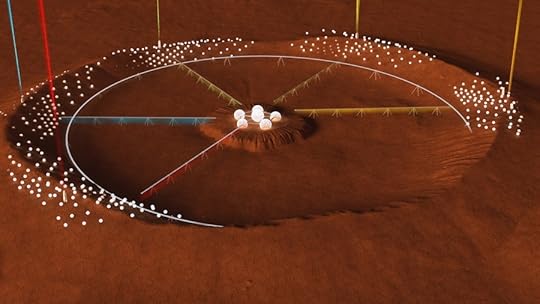
But this isn't Space City from those old science-fiction books. We live in Hell City, built into and from a huge subcontinent-sized crater. There's a big silk canopy over it, feeding out atmosphere as we generate it, little by little, until we can breathe the air.
It's a perfect place to live, if you actually want to live on Mars. I guess at some point I had actually wanted to live on Mars, because here I am. The money was supposed to be good, and how else was a working Joe like me supposed to get off-planet exactly? But I remember the videos they showed us – guys, not even in suits, watching robots and bees and Bioforms doing all the work – and they didn't quite get it right...
ADRIAN TCHAIKOVSKY was born in Lincolnshire and studied zoology and psychology at Reading, before practising law in Leeds. He is a keen live role-player and occasional amateur actor and is trained in stage-fighting. His literary influences include Gene Wolfe, Mervyn Peake, China Miéville, Mary Gently, Steven Erikson, Naomi Novak, Scott Lynch and Alan Campbell.
Decades past Dogs of War, we've got ourselves a very different situation. Indeed, we've got mars, animal-form bio-mod workers, and a funny little fascist problem that has been brewing.
Indeed, I just thought this was going to be a fairly light (for Tchaikovsky) adventure with some of the previous awesome aspects (and perhaps characters) taken in new, perhaps freakishly cool directions.
I didn't expect head man Thompson. I mean, he seemed to be a regular class-A A-hole that I would gleefully love to see mangled at the end of a great narrative. I didn't think I'd be laughing my head off with the great twists in store. But I did.
And between bees and bad news bears and those damnable dog collars, this Hard-SF treat is a real treat.
Oh, and I never would have thought that Tchaikovsky would have written a sharp satire meshing an iconic narcissist with the prisoner's dilemma, but he did.
Some authors have a „voice“ that just speaks to me, draws me in and makes me come back for more. Tchaikovsky has a host of such voices!
I loved the first book with Rex and his fight for freedom from his collar. Now, several decades later, Rex has died a natural death and even become a saint to other dog-bioforms while the Earth is deteriorating to such a degree that humanity wants/needs to terraform Mars. Honey, Rex's bear friend, is still alive (and not the only one left from the original team) and still fighting the good fight for freedom rights while getting one PhD after the other. But times are a-changing. Some fears never die and some people (especially those in front of the cameras) are very good at igniting and reinforcing them. Simultaneously, humanity has made it to Mars. Well, somewhat. Jimmy, working up there, suddenly finds himself stuck with a copy of Honey in his head and that is when a host (pun fully intended) of trouble starts - for everyone, even back on Earth.
The sheer amount of issues addressed in this book is once again staggering without being depressing or preachy. We get politics, incitement, (domestic) violence, sedition, slavery (sexual and economic), freedom rights, free will, and so much more! All of which is examined neatly, creatively, heartbreakingly and smartly.
In addition, the author knows how to pack that much philosophy and information into a kick-ass narrative that never slows down and keeps the reader at the edge of their seat. There was a moment in the first book that somewhat slowed everything down, but not so here. It was breathtaking from start to finish. The myriad twists and turns and reveals only added to that by keeping you guessing throughout.
A wonderfully smart and exciting book (even better than the first)!
Given the high productivity, it was only a matter of time before Tchaikovsky, one of the greats of today’s SF pantheon, would fire a blank. This book feels much more of a political scream fit more for Twitter than a fiction novel. While I agree that Trump and the like are taking the humanity to an end sooner than it should come, for the time being, society is so polarized that cries of this kind no longer reach the other side, but for own side are unnecessary. It is especially unfortunate that the author chose to send us this message using Rex universe. Very disappointing 5/10.
Ņemot vērā lielo ražīgumu, bija tikai laika jautājums, līdz mans mīļais Čaikovskis raidīs tukšu lodi. Šī grāmata ir daudz vairāk politisks kliedziens, kas vairāk iederētos tviterī, nevis fantastikas romāns. Lai arī es piekrītu, ka Tramps un viņam līdzīgie ved cilvēci uz galu ātrāk kā tam piedienētos, tomēr uz šo brīdi sabiedrība ir tā polarizējusies, ka šāda veida kliedzieni vairs nesasniedz otro krastu, bet savam krastam tādi ir lieki. Sevišķi žēl, ka autors šo ziņu izvēlējās mums nosūtīt izmantojot Rekša pasauli. Vilšanās -5/10.
Bear Head By Adrian Tchaikovsky I was excited to see a follow-up book to the series. But I was so happy to see Honey again! If you haven't read Dogs of War, do yourself a favor and read it. Then read this. A double pleasure. The book's timing was some time after book # 1. I'm not sure how long but enough time for public support for bioform (animal/human and tech manipulation) to be in favor and then fall out of favor. The book is told mostly from a Mars employee who had been altered physically for Mars and tech applied to his brain. Then, an employee of a narcissist politician that everyone caters to but he is a cruel, childish fiend. She, the employee, receives the wrath of the hateful boss. Honey also has some things to say. This was a timely read. You will understand when you read it. It was a smart, exciting, dark read that I loved completely.
A brilliant sequel to the equally impactful Dogs of War.
Bear Head picks up years after the events of Dogs of War, with the pendulum of popular opinion once again swinging away from recognition and protection of the rights of sentient animal Bioforms.
Pusher in Chief of that pendulum, Warner Thompson, has his sights nominally set on a World Senate seat, and actually on just getting control of the whole pie. Thompson is so clearly a reflection of Trump that at times, I just felt exhausted reading about him. That's not a fault of the book, but rather a product of my own feeling that I'm pretty emotionally spent on that whole scene.
But back to the book. Of course there are what I think of as the Tchaikovsky staples, which is wildly creative and excellent world-building paired with incredibly textured characters. Their voices practically leap off the page with seemingly little effort.
Overall, a great story that delves deep into the unpleasant sociopolitical realities inherent in a society that depends upon inequality of all kinds in order to survive and thrive.
[B]ecause effort spent on the metagame is focused entirely about the appearance of virtue, it overshadows those who are actually performing the primary task, it overshadows actual virtue. And this is how human hierarchical structures end up working. This is why the people who end up in authority are generally not those focused on whatever the purpose of the community is, but those who are focused on achieving positions of authority.
A megalomaniac politician on Earth; a colony being built on Mars; and biotechnology that can allow someone’s entire personality to be uploaded to anywhere with enough storage and processing power - the type of storage and processing power now being implanted in some people’s heads. These are the ingredients for this well executed, plot driven, sci-fi tale of control and loyalty.
The first book in the series, Dogs of War, was about the use of “Bioforms” - heavily genetically engineered animals designed to work in extreme conditions. And while the Bioforms still form a core part of this book, continuing the political and social fallout previously established, this second book is more about control and coercion of people - a theme that was touched on towards the end of Dogs of War. The same technology that was used to control the Bioforms is now gaining acceptance to be used on people. In certain, limited circumstances, of course.
Trigger warning: rape and sexual abuse.
For me, while Dogs of War had a beginning, middle and end, Bear Head is mostly “middle”. It’s engaging and fast paced, with excellent ideas and well formed characters - which is what I’ve come to expect from Tchaikovsky - but the overall situation at the end of the book is largely the same as the overall situation at the start of the book.
I was going to give it 3 stars, as a well executed action sci-fi story, but I found myself crying at three separate times in the closing chapters, as the outcomes for three significant characters in the book became clear. So that certainly deserves another star - I didn’t realise quite how invested I had become in those characters until that point, and I really appreciate that.
More of the same started in Dogs of War, so, if you like that, you will like Bear Head. I never achieved flow state, so it took some effort to read. And, I wanted more Bees.
I loved Tchaikovsky’s Dogs Of War. It stands on its own, so I haven’t expected the sequel. But here it is! And it’s great. You can read Bear Head without having read Dogs of War, but I don’t recommend it. First, Dogs of War is brilliant. Second, you don’t want to lose any nuances or call-outs.
Bear Head is a thrilling sci-fi with elements of a political thriller. It follows Jimmy, a construction worker on Mars, dealing with drug and cash-flow troubles that force him to accept an unusual side job. He agrees to keep a set of data in his head. Except, the set of data is actually a genetically engineered, and genius, bear. Things go off the rails quickly and Jimmy finds himself in the middle of political drama ha has no interest in.
Jimmy is no hero; He’s a wretched, untrustworthy, miserable drug-addict and street smart cynic. That makes his interaction with his unwanted guest humorous, and his perspective on the big picture entertaining. Jimmy wants another fix of Stinger (a Marsian drug); his “passenger” wants to solve the interplanetary conspiracy and will start a rebellion to unmask a devious politician, Warner S. Thompson. The stakes are high - they include the future of artificial intelligence, bio-enhancements, and freedom of choice.
The action develops at a breakneck pace on Mars, where Jimmy and Honey try to make sense of their situation, and on Earth, where we follow mentioned politician and his machinations through the eyes of his personal assistant. We get no unnecessary details, just enough to picture the world, its current state, and places visited by characters. I loved thrilling descriptions of life on Mars and its practicalities. I despised Warner S. Thompson. He’s a caricature, and I think it was a deliberate choice.
Besides providing thrilling action, Tchaikovsky looks at the tools of societal control - setting up structures, hierarchies, and class systems that force people below to act as machine pieces in someone else’s mechanism. The three viewpoints give us complementary perspectives on this subject. The most traumatic one is Warner’s PA, Carole, conditioned to fulfill her boss’ desires. All of them. She's wired to obey.
Bear Head is another must-read from Tchaikovsky. My advice? Read Dogs of War first, and then savor Bear Head.
Tchaikovsky became one of my favourite authors of fantasy after I read his amazing, and still not well-known enough (read it if you haven’t yet!) Shadows of the Apt. His Children of Time proved that he can easily deliver interesting, thought-provoking, emotional SF as well, and I’ve read enough of his short stories to know he can be a pro at writing these, too. In short, he’s a very well-rounded, very talented author, with unwavering focus on emotional development and a firm if understated ethical foundation. He has a knack for tackling difficult, often traumatic topics with tact and sensitivity, never going for cheap thrills or gratuitous exploitation. All in all, he’s one of the very few authors I keep constantly on my radar. Granted, there were a few a bit concerning reviews of his couple of books along the way that I haven’t gotten around to read, and I’m not certain I will – the sequel of Children of Time, Children of Ruin, springs to mind. But generally, with Tchaikovsky, I knew what to expect. Now, after reading Bear Head, I’m not so sure anymore. If anything, I’d venture an opinion that he had become the victim of his own success: writing too many books in too short a time, and none of the projects getting enough attention and polish and love to become a truly outstanding work, on par with Shadows of the Apt.
Because Bear Head is the worst of Tchaikovsky’s books I’ve read so far. It’s by no means bad; it’s still very engaging, well-written, fast-paced page-turner tackling ambitious problems in an interesting, thought-provoking way. Yet it also feels underdeveloped, rushed, and – surprisingly for Tchaikovsky – not entirely thought through. It has a more “paint-by-the-numbers” feel than the usual impression of a thoughtful creative work. It’s also, maybe most importantly, more of a political statement than a SF novel. Ah, all SF novels are political statements of one kind or another, I think we’d all agree on this. It’s just that in the case of Bear Head the layer of science is very thin, indeed – and whatever there is of it, it serves as a focus for the very concrete, very clearly defined “now,” in contrast to the previous concerns with more abstract ideas like “human nature” or “future,” which used to be the crux of his Children of Time, for example.
Bear Head is a loose sequel to 2018 Dogs of War; but as it’s happening twenty years after Dogs of War, and portrays a vastly changed reality, it can be treated as a stand-alone and read without any previous experience with the prequel – at least according to the publisher. And that’s what I did: having only rudimentary knowledge of Dogs of War premise, I embarked on the journey with Bear Head. A couple of the main characters appear in both books; the secondary cast is largely (almost entirely) different. Bear Head is certainly a sequel in terms of main themes and ideas: from artificial intelligence to neurological experimentation to forced sapienization of animals to neurobiological processes of limiting freedom – but they are explained here in enough detail that the previous knowledge of Dogs of War is indeed not necessary; though still, I’d wager, emotionally rewarding.
The main characters in Bear Head are Jimmy, a heavily modified human adapted to Mars conditions, and Honey, a sapienized bear, who as a result of convoluted and dangerous events happening on Earth, about which we’ll learn in due course, comes to share Jimmy’s head (and, at times, the rest of his body). The unlikely duo: the embittered, barely educated addict and the high-profile academic quickly realize that they need to learn to cooperate in order to survive. For while Mars might not be the best place in the Universe, what with one type of job, no prospects, lack of sun and constant seasonal depression, it’s still much safer – and saner – than Earth. Because Earth, as could have been expected, when faced with existential crisis caused by global warming, instead of working together to alleviate or solve the deadly problems turns toward populist distractions such as decades-old rights of sapienized animals and the issues of human Collaring (i.e. depriving them of free will).
Let’s be clear here: Jimmy and Honey parts of the novel are really pretty good. I really enjoyed their interactions, the slow puzzling out of Honey’s past, the mistakes and amends they make between them, the slow building of trust. This emotional layer sketched lightly in pencil and left to be filled by the reader is what Tchaikovsky does best. I also appreciated the small scale of Martian colonization and its Western feel with its petty drug lords, its lonely sheriff with his posse of dangerous sapienized animals, and the ever-present bureaucracy in the form of Admin.
[...]
What ultimately soured me on Bear Head was a two-fold problem. In focusing the book on the analysis of the current populist phenomenon Tchaikovsky made Bear Head dependent on the “now.” And so, in the understandable haste to get the book ready and out before it loses some of its relevance, and because of the laudable effort to create something more than just a parody, he didn’t spend nearly enough time on the plot. The ultimate motivations, the final reveals, and the climax as well the conclusion are simply subpar and unconvincing. In Jimmy’s words, they suck.
Would Bear Head be a better book with less current politics? I don’t know. I think we need to take a good look at what makes us – and the political systems we live in – so vulnerable to populism and easy answers. Tchaikovsky gives his suggestions, and they are certainly interesting, if flawed. As for Bear Head itself, however, I do know that it could’ve been much better with more focus on the plot and the character motivations.
I have received a copy of this novel from the publisher through NetGalley in exchange for an honest review. My sincere thanks.
This is one of Tchaikovsky's best. Very different from Dogs of War but builds off and expands on the themes of the previous books. Really awesome blend of great characters and cool ideas which is what made Dogs of War one of my all time favorite sci-fi books.
The political and social commentary isn't subtle here but I liked it even though it's clear what current political atmosphere he is commenting on, but I could see that bothering some people. It's easy to get inspiration from the real world for villains in a fictional book unfortunately for us.
Tchaikovsky is a massive talent and the extent of his imagination and creativity is mind blowing. Love his work.
Really, he has too much talent for one man. I'm starting to think that he's some sort of distributed intelligence, like his sentient swarm of bees in Dogs of War. It wouldn't surprise me if there were fifty identical cloned Adrians, all tapping away at laptops in some underground lab, their linked minds producing some of the most interesting SF of the 21st century. At the rate he publishes, it seems the hive mind is growing and I expect that in a century or so we will all be Adrain and we will be legion.
Anyway, the Tchaive-mind aside, Bear Head is another slam dunk from Tchaikovsky, a funny, entertaining and pacey follow up to his 2017 novel Dogs of War. Several of the characters from that book play central roles in the sequel. (Have you read Dogs of War? You really should. It's a kickass novel, and reading it prior to Bear Head is advisable.)
Most of the action in Bear Head takes place on Mars. Our protagonist there is Jimmy, a bioengineered worker building the Martian future, or at least that's what he is supposed to be doing. In reality he's a demotivated, drug-abusing slacker, more interested in his next hit than laying the foundations for future colonists.
No spoilers, but Honey, the bioform bear from Dogs of War features, as does Bees, the swarm of sentient bees that Tchaikovsky clearly based on his own literary hive mind. HumOS, and a few others play roles too.
The stakes are, of course, high.
Back on Earth a dangerous politician named Thompson - a Trump analogue as mendacious and sociopathic as the tangerine bell-end himself - and his evil machinations are threatening to bring back the worst of the anti-bioform bigotry of the past, along with fascistic mental shackles for normal human beings.
His nasty plans, and the Martian colony, will intersect in ways that will surprise and enthrall you.
This is a great read, and yet another standout novel from one of the great talents of contemporary SF.
This has to be the most explicitly political book I have read by Adrian Tchaikovsky, and that is definitely saying something, as all of his work is filled with social and political commentary… and I am here for it! Dogs of War ended with technology and humanity dancing on a knife’s edge, and this story shows the potential of when the optimistic-ish resolution isn’t balanced with enough caution, and humanity’s baser impulses gain ground. The story is told in a combination of first- and third-person narration, depending on whether we are on Mars or on Earth, and this combination is great. It makes the history grander and more epic feeling while the present moment is more invitational but also invasive, making the reader a co-conspirator, a confessor. The narrative is fast moving, filling in backstory as it relentlessly plunges forward, with pacing similar to the prior novel but without the time jumps between sections. There is less action in this novel, but perhaps more violence, not physical but emotional and conceptual, as technology, idealism, loneliness, and aimlessness are all weaponized by political actors against the populace. The writing is playful and descriptive, really inhabiting the different voices of the different POV characters, something exaggerated by the first-person narration, and it is a joy to read. It never lags or loiters but it manages to be full of nuance and pith at the same time, encouraging lingering over the ideas and observations throughout.
The world-building here is detailed and wonderful. On Earth we get a reflection of where contemporary society is headed, with oligarchs and megalomaniacs seizing power and exploiting the working class but doing so with smiles on their faces and promises on their lips, promises buffered through xenophobia and demonization. The main antagonist, a politician cut from the cloth of some very recognizable world leaders, is terrifying and painfully realistic, and the world-building on Earth centers around how individuals like him are able to, without genuine insight or intelligence but sheer charisma and force of will, bend social reality to fit their myopic lust for power. Meanwhile the world-building on Mars is incredible. Tchaikovsky has done serious work in terms of thinking through what would be necessary for a proper colony on Mars, the seemingly infinite variables to take into account, and the world he devises there feels realistic and achievable (even though it depends entirely on as-of-yet unrealized technologies).
As usual, the expansive and thoughtful world-building is really just offering a backdrop against which the characters can shine. We have mostly new characters, though there are some returning voices, and they are all great. They feel like everyday folk, neither particularly saintly nor wretched, just trying to eke out what counts for a life in a harsh and unforgiving world that doesn’t much care about them. The story mostly follows three POVs, two of them being new characters, and they both have complex and relatable inner lives, as well as inner journeys. All the ancillary characters are colorful and engaging and as usual they really make the world feel lived in and complete. I am not only entertained, but I actually care about them, as Tchaikovsky manages to make even the most ancillary character feel important and deserving of attention, each character full of details that aren’t necessary for the story but make it more robust as a consequence.
I said this is maybe his most explicitly political story that I have read, and that is true. He is dealing with greed and capitalism and corruption and has a dead-inside, power-hungry politician at the heart of it. Using that as his lens, though, he goes on to also explore what optimism and hope look like, pride in a day’s labor, and solidarity and companionship. There are characters who have to betray their long-held ideals for the greater good, and others who have no ideals but solipsistic lust for power and yet that seems to bring them pretty far. The characters and world get to be messy, and that lets Tchaikovsky entertain ideas of how society functions, and how, when we focus only on ourselves it may be possible to amass certain types of exterior indications of success but it is all doomed to fail; yet, when we focus on helping others, acting out of genuine concern for others’ well-being, we may not amass personal power but instead can contribute to a long-lasting communal prosperity. Idealism and exploitation meet head-to-head in this novel, along with dozens of other timely socio-political ideas, and it is a joy to have the chance to wrestle with them alongside our characters.
Trust Adrian Tchaikovsky to come up with a book that is just that bit more.
In the sequel to „Dogs of War“ Jimmy is an underpaid and overworked handyman with cyberimplants working for a luxury project on Mars where his kind never will profit from. To make ends meet he lents the free data space in his implants to clients who need to make certain data disappear from the screen for some time. One of this deals ends with him being possessed and partly overtaken by another personality and in consequence relutanctly pulled into a political intrigue. The vernacular workman way of Jimmy clashes with the well spoken, academical nature of the new persona in his head and leads to some verbally delightful dialogues, which lighten the general dark mood of this story about self-determination, slavery, the rights of bioforms and the careless privilege of the rich.
Some decades ago the villain in this story probably would have been marked as too unrealistically one-dimensional. But unfortunately in this time and day the only thought that comes to mind is ‚oh yeah, I know exactly who the model was‘. This makes ‚Bear Head‘ a not too subtle mirror of our current political and social situation – just like any good SF should be.
Once again Tchaikovsky manages to present a successful mix of hard SF, good character writing and social comment. Keep them coming!
I've loved a few of Tchaikovsky's works but I have equally been disappointed in as many. This is sadly one of them. I honestly didn't enjoy anything about this sequel to Dogs of War, which I really liked. I'm not going to go into it because I don't want to be unnecessarily sour and much of it is personal preference anyway. Bad luck for me.
Second book of a hardish, science fiction Mars Colonization/ Uplift/ Brain Uploading/ Artificial Intelligence/ Mind Control/ Autocratic Coup Conspiracy in a cyberpunkish future with climate change crossover series.
Building a city in the Hellas Crater on Mars, nicknamed Hell City.
My dead pixels version was a moderate 302 pages. It had a 2021 UK copyright.
Adrian Tchaikovsky is a British author of science fiction and fantasy novels. He has published more than twenty (20) novels in several series and standalone. In addition, he’s published several novellas and many short stories. This was the second book in the author’s Dogs of War series. This was the fifth book I've read by the author. The last book being Children of Time (my review).
Note this book was the second in the author’s Dogs of War series. I did not read the first book, Dogs of War. Although the books share characters, I had no problems with continuity.
Tchaikovsky is becoming my go to science fiction author. That is, when his fantasy writing does not intrude into his science fiction, and his science fiction is served al dente. Having written that, this was quite the mashup. I counted six (6) main tropes in play each contributing a theme. There was also both a cyberpunkish dystopia with climate change Earth and an even more dystopian frontier Mars setting. This was a very busy novel.
There are three main plot lines. From Dogs of War book, we have Uplifted Animals are People and that Mind Control in the form of medically induced Stockholm Syndrome of both uplifts and society’s worthless was perfectly legal. However, the Earth isn’t a happy place, and legal protections of both uplifts and the hoi polli have been seriously eroded.
On Earth, its a very cyberpunkish future. It’s good to be rich. It insulates you from the vagaries of climate change and creates a large number of refugees eager for employment. The new World Government wasn’t much of an improvement over the old multi-nation world. A lot of government functions have been outsourced to corporations with predictable effect. There, was also a sociopathic politician Warner S. Thompson who was on the verge of an autocratic coup. He’s the book’s antagonist. He vaguely reminds me of a Brit’s impression of a steroidal Donald J. Trump, the ex-US president. He's a populist, and anti-uplifter. He’s taking full advantage of the increasingly porous mind control laws. Mind Control, called "Collaring" allows for the development of loyalty, sympathy, or affection, even sexual attraction for an employer. His mind controlled Personal Assistant (PA), Springer was a co-Protagonist. Her POV describes the walking id of the antagonist, and her employer Thompson.
On Mars, the planet was being terraformed by proles genetically modified to tolerate the cold, dusty, surface and the developing, but still thin-atmosphere. Needless to say they’re not pretty. They’re knowingly building a Martian redoubt for the rich and famous. It’s there for the affluent to escape from the chaos and ecological devastation gripping the Earth for the newly minted clean air and abundant resources of Mars. That’s where we meet the: disillusioned, synthetic-drug addicted, climate-modified, slacker, working stiff Jimmy. He’s the nominal co-Protagonist. Jimmy reminds me of the Jesse Pinkman character in the television series Breaking Bad (2008-2013).
Finally, there was Honey. She’s an uplifted bear. She’s a carryover from the previous book. She’s an ex-soldier (uplifts were used as cannon-fodder), multiple-PhD recipient, and uplifted animal-rights activist. She’s also the other co-Protagonist. Honey falls afoul of Warner S. Thompson which eventually links her with her co-Protagonist Jimmy. If I do have an issue with the characters, it was that Honey was an unlikely master Hack0r. Her contribution reeked of Deus Ex Machina. Although she was more a bearish Mary Sue?
There were four (4) POVs. Jimmy, Honey and Springer are the mains. Their interleaving was technically well-handled.
The writing was very British. I could find no mistakes in the text. In places it was humorous, particularly the repartee between Honey and Jimmy.
There was sex, drugs, and no rock ‘n roll in the story. Although, only rich folks had sex, some of it forced. Cheap synthetic controlled substances were consumed by the masses to dull the pain and tedium. It reminded me of the soma used by the lower-castes in Brave New World? The rich consumed a better class of pharma. Intoxicating beverages are consumed. The working stiffs on Mars drank pruno or rotgut. The rich on Mars and Earth consumed fine wines and liquors. Nobody consumes any entertainment in-person or otherwise.
Violence was: physical, edged-weapon, and firearms. Major human characters, even those not biomodified had the constitution of a rhinoceros. Uplifted bears, dogs, serpents, weasels, etc. could take a lot of punishment too. Note, torture was described. Gore and trauma are moderately detailed. Body count was near-genocidal.
Plotting was good, but very busy. There were three main POVs and two main settings (Earth and Mars). The Honey POV appeared in the present on both Earth and Mars and in the Earthly past. There was also a certain amount of predictability to the plotting. Tchaikovsky loves his tropes. He riffs on them well-enough to make them interesting even to a tried and true trope-spotter. However, there are only so many ways they can end. For example, the much abused PA Springer character’s plotline was predictable from her second POV appearance.
World building was an update on the Old Skool cyberpunk genre. Tchaikovsky made modern embellishments like climate change and updated the distributed intelligences, self-replicating machines, and contemporary biological modification tech. I personally enjoyed the combination of lowlife both human and uplift and high tech on Earth and Mars. The artificial intelligences, hackers, and megacorporations fit me like an old pair of shoes. However, I thought the Martian terraforming was really good. Finally, the World Government's operation, organization and Thompson's rise prominence was shaky. It was too simple to be likely. I kept on looking for a PM Boris Johnson Brexit angle to it, but it wasn't that well developed to find one.
This wasn’t a great work, because of its dependence on too many tropes. However, it was a somewhat predictable good work. The author’s abilities shown through. In particular, with his mods of tired tropes and his humor. Although, its was not a sophisticated story, its worth a read. Cyberpunk was a genre I lurved, before its demise in its classical form. I'm giving this story a bump to four stars because it gave me (particularly the Martian setting) a walk down the Cyberpunk Memory Lane. Shortly, I’m going back to find and read, War Dogs the first book in the series.
An excellent follow-up to one of my favourite reads of last year ‘Dogs of War’, which centred on a cyborg dog leading a special ops team of other bio-forms. Like its predecessor, this sequel manages to pull off that rare feat of being thrilling and entertaining while also giving you plenty to think about. Although it didn’t tug at my heartstrings as much as Dogs of War (except for one tearjerker of a scene involving Honey), Bear Head again explores some fascinating themes relating to genetic engineering, the civil rights of non-human sentient beings, modern social attitudes, and the dangers of pushing the technology envelope too far.
Set 40 years after Dogs of War, the narrative shifts between various POVs on Mars and Earth. One of our main narrators is Jimmy, a human who is part of a construction team on Mars. Like the rest of his team, he’s been genetically and technologically enhanced in order to better cope with the atmospheric conditions on the red planet. Jimmy is a good-for-nothing washout and uses drugs to combat the monotony of Martian life. To support his addiction, he smuggles illegal data in his head. He’s more than a little shocked when the data starts talking to him, claiming to be the super-intelligent bear called Honey. We all know (and love) Honey from Dogs of War. She has a long history of fighting for the civil rights of bio-forms. For some reason, Honey’s consciousness has been transmitted into Jimmy’s headspace. Much of the book is about Honey trying to piece together what happened and why she’s suddenly inside Jimmy’s head. All she knows for sure is that she needs to contact her old teammate Bees, a distributed intelligence who has relocated to Mars where humans can't touch her. Bees has lost faith in humankind and fled after she’d been branded a terrorist trying shut down 17 of Earth’s most polluting manufacturing facilities.
Back on Earth, the chapters are told from the POV of Carole Springer, a PA for a depraved and highly manipulative politician called Warner Tompson. Tompson is portrayed as a Trump-like figure, a man who talks like a petulant child and throws temper tantrums when he doesn’t get his way. To ensure Springer’s compliance, he has had mind-controlling headware installed in her brain. This means that she has no choice but to say yes to anything Tompson wants, and keep him happy in any way she can. Besides his political aspirations, Tompson also funds a lab responsible for designing the headware; a facility which is now running shady experiments on felons. If Thompson wasn’t bad enough at the start, he becomes something truly frightening towards the end of the book. An example of what could happen if a powerful man’s ego is allowed to run riot. It's hard, therefore, not to draw the comparison between Tompson and Trump. This lends the book a strong satirical aspect, which is welcome considering it also imagines some horrifying things that our future might hold.
Like Dogs of War, Bear Head is an excellent novel and I think one of the best sequels I’ve had the pleasure of listening to. It's perhaps not as action-packed as its predecessor, leaning more towards political thriller, but it’s no less gripping and entertaining. In addition to being a thought-provoking read, Bear Head features a cast of fascinating and well-fleshed-out characters. I think Honey must be one of my favourite characters of all time, and the humorous exchanges between her and Jimmy truly are a delight.
If you liked Dogs of War, I’m pretty sure you’re going to like Bear Head too. However, I don’t think it’s strictly necessary to have read Dogs of War to enjoy this book. Although you may appreciate some of the backstory, this sequel works pretty well as a standalone. The Dogs of War universe is so interesting, however, that I really hope Tchaikovsky does another one.
Note on audio version: I'm so glad they brought back the same cast of narrators back for Bear Head, because they again did an amazing job breathing life into the various characters and really added to my enjoyment of the book.
The sequel to Dogs of War sees most of the same ensemble 30 years later battling a future villian so obviously based on Donald Trump that I was surprised my fingers didn't glow fake-tan orange after each page turn. The plot is even more preposterous than the 1st book but for this one there were too many inconsistencies to fully disengage the brain and freewheel with it. Not bad - 2.5 stars for this one.
Per mi la lectura és desconnexió. M'agrada la ficció perquè em fa escapar de la realitat que vivim, que sembla escrita pels millors autors de terror. Però de tant en tant també m'agrada tocar de peus a terra i entendre el món. Per exemple, llibres que reflexionin sobre els drets humans. O que retratin bé la discriminació que pateixen les minories. O els que expliquen com actua el poder i com n'abusen les classes dominants. També m'interessa la comunicació, les fake news. I temes que estan a l'ordre del dia, com els grans gegants tecnològics que manen més que els governs, el supremacisme o les guerres comercials.
"Meldecaps" tracta tots aquests temes i molts més. I sí, també té animals intel·ligents millorats cibernèticament i ens situa en un procés de colonització de Mart. Compta amb una trama trepidant on els avenços tecnològics juguen un paper principal i introdueix conceptes com el control de la voluntat o la intel·ligència distribuïda. Però no cal fer un gran exercici d'imaginació per veure que especula sobre el món actual i el que ve.
Trama i reflexió combinen perfectament i Tchaikovsky sobrepassa tot el que va mostrar a "Gossos de guerra". La colonització de Mart serà possible gràcies a les bioformes animals i també als humans modificats. Mentrestant, a la Terra, un polític amb idees retrògrades (per interès), gaudeix de gran popularitat, precisament, perquè clama en contra dels drets de les bioformes i vol mesures de control més dures.
Em va costar una mica situar-me, però un cop recuperat el fil i les sensacions de "Gossos de guerra", em va enganxar sense remei. Per mi, és ciència ficció del més alt nivell, de la que especula, inventa i reflexiona. I a sobre també té dosis d'humor! En Jimmy és el millor lubricant. Ha superat totes les expectatives. M'ha encantat.
Bear Head is a quasi-sequel to Dogs of War, a separate story set around twenty years after the events in the first book. While very different from its predecessor, it manages to feel connected in the extension of its worldbuilding and the themes it discusses — a fantastic read that complements and builds upon what Dogs of War accomplished.
The setting is Mars in the initial stages of its colonization, where humans modified to survive for a little while on the surface are workers constructing the first settlement for their company’s rich clients. The story follows Jimmy, one such average worker addicted to a common drug, who gets involved way over his head (literally) when the personality of an old Bioform bear named Honey is temporarily downloaded into his large headware.
The chapters on Mars alternate between Jimmy and Honey’s perspectives. Jimmy is a serviceable character who has some growth over the story, but he really functions as a vessel for Honey, who is a fantastic character. So it took a while for the book to really kick off — following Jimmy along for the first bit wasn’t as interesting as where the story would eventually go. Honey’s scholarly, erudite way of speaking and thinking contrasted with Jimmy’s more street-smart, unrefined thoughts, so their interactions and trying to effectively communicate and work together was great.
What this book does amazingly well is explore the consequences of the events of Dogs of War in a way that feels very realistic. For example, Rex becoming a symbol to Dog Bioforms and them living by a set of moralistic rules inspired by what they think Rex stood for. It also expertly displayed how tenuous positive change can be, instantly regressed and overturned by events spun to a certain narrative to suit other people’s self-interest. The regression of certain Bioform laws, how even if one Bioform does something wrong, it will change the narrative to make them look dangerous and be used against them to further restrict Bioform rights. There is a disturbing realism to the exploration of how discrimination never really goes away just because there is new legislation introduced and how volatile such situations can be.
This is demonstrated through Honey’s reminiscences of her post-Dogs of War days. She found herself being put into a box, only allowed to speak about her identity as a Bioform and related topics, politely rebuffed at every turn when she tried to talk about her other scholarly interests. Besides the focus on Bioforms, there is also strong commentary about social hierarchy and corporate exploitation — the metagame, as it is referred to. The worst aspects of this system are embodied by the politician Thompson, seen through the eyes of his secretary Carole. His character can veer into caricature on occasion, but that isn’t an issue since he’s meant to be representative of the worst of what can be possible by gaming the social hierarchy, some strong parallels to real-life issues and its political landscape.
While not as emotionally compelling as Dogs of War was (since it had Rex as a central perspective), Bear Head was a fascinating look at the complicated future of Bioforms and the exploitation of such technology for selfish benefit — a thematically heavy book that discusses and breaks down a lot of interesting and relevant topics while retaining the engaging science fiction elements and slowly ramping up the political thriller story thread on Mars. It worked very well as a follow-up to the first entry: it is different while feeling like an organic continuation of the first book’s story and themes. Tchaikovsky continues to cement his place as one of my absolute favourite science-fiction writers.
4.5 stars. Picking up many years after book one, we find that public opinion has swung again, and bioforms and distributed intelligences are mistrusted much as they were prior to Morrow’s trial. In book one So Distributed intelligences (DisInt) like Bees and HumOs are hunted and eradicated wherever they are found. It’s many years later when this book opens. We have a World Senate now, an evolution of the UN, and the author’s analogue for former Grifter-in-Chief Cheato, called Warner Thompson here, is gunning for a seat as a Senator, taking money in secret from numerous lobbyists and special interest groups with contradictory aims, and sliming, raping and lying his way into ever more privileged access and authority. He’s out for himself, and no one seems to understand how he’s aiming to destroy everything and everyone he can, because he can and it makes him happy. Meanwhile, construction worker Jimmy Marten on Mars is looking for his next hit of Stringer, his drug of choice, even though he’s low on cash. He and his fellow workers are heavily biomodded humans so they can function on Mars. To make some quick money, he agrees to hold a data package in his headspace. Turns out, this is a very special package, and it wakes up in Jimmy’s head and starts talking to him: it’s our favourite genius and biomod rights activist, Honey. How these three are brought together in humourous and horrifying style by author Adrian Tchaikovsky is so entertaining. Tchaikovsky switches perspectives amongst Jimmy, Honey, and Thompson’s Collared Personal Assistant, showing us how far public opinion has gone anti-biomod, with only Collared (a programmatic encoding known previously as a Hierarchy in book one) bioforms permissible on Earth. How Thompson manipulates and abuses the Collared individuals on his staff is a commentary, no doubt, on the use, abuse and disposability of the economically depressed classes by the privileged. Tchaikovsky keeps the pace moving well, with Jimmy providing much needed humour and profanity to every situation he’s in. (His petulance is a great contrast to the long-suffering, brilliant, bioform bear.) I was so glad to see the wonderful Honey back in action, though under radically different circumstances. She’s older, wiser, and sadder, and dealing with trauma, even while gearing up for combat against Thompson with a reluctant Jimmy. It’s dark, great fun.
Ottimo seguito dell'eccellente Dogs of War, ovviamente ci coglie in contropiede sull'argomento, sull'ambientazione e pure sullo status di alcuni personaggi.
Si svolge qualche decennio dopo gli eventi del primo libro, che ci lasciavano qualche spiraglio di speranza per un futuro "inclusivo" nei confronti delle Bioforme e delle DisInt... ma come ci insegna Kitoh, con un filo di speranza viene benissimo il cappio da mettersi attorno al collo.
Infatti in qualche momento tra la fine del primo libro e l'inizio del secondo è andato tutto alla malora: le Intelligenze Distribuite (come la nostra HumInt, o come Bees) sono diventate il nemico numero uno e il Grande Spauracchio, mentre le Bioforme, dopo essere state mostrate come "umane quanto noi", fanno ancora più paura: se sono come gli umani, ma più forti e dotati, possono quindi dedicarsi agli stessi vizi e alle stesse violenze, ma senza che si possano agilmente fermare? Da qui, una certa corrente di politici globali (che almeno questo passo in avanti è stato fatto, tra crisi politiche, militari, etiche ed ecologiche: abbiamo un Senato Globale) ha cavalcato l'onda dell'odio e della paura, alimentandola e scavando nel torbido a piene mani per creare un clima di terrore sul quale prosperare. Ogni riferimento a cose, situazioni o persone attualmente interessate alla politica immagino sia puramente voluto. E soprattutto all'inizio colpisce benissimo, questo pugno di realtà nella fantascienza di Tchaikovsky.
Poi però si alza l'asticella. Scopriamo di più su Thompson, scopriamo di più su chi gli sta intorno e su cosa stia facendo questo politico rampante. Scopriamo di più su Honey, su cosa abbia fatto finora e come sia finita nella situazione in cui la ritroviamo. Scopriamo di più su Bees, su cosa abbia fatto dalla fine del primo libro e come abbia fatto a guadagnarsi lo status non invidiabile di nemico pubblico per l'intera umanità. E scopriamo come vadano le cose su Marte, dopo che in chiusura del primo libro ci eravamo lasciati con quella che sembrava una nota secondaria nel flusso di traguardi ottenuti, la missione sul pianeta Rosso per stabilire una testa di ponte in attesa della colonizzazione terrestre.
Geniale come sempre, spaventoso nella rappresentazione politica, accurato sul come quanto visto (e già enormemente pervertito e compromesso allora) nel primo volume possa essere ulteriormente contorto e sfruttato per fini personali e abominevoli. Affascinante come sempre la sua visione delle intelligenze distribuite. Doloroso il finale (ma non solo, eh). E riusciamo ad affezionarci anche a Sugar e a Jimmy, a Scout e Boyo...
Però l'ho trovato comunque un pelo sotto il primo. Un po' l'effetto novità che è svanito, un po' che questo volume è più condensato, più ligio a una storia ben delineata, mentre il primo ci mostra più storie in una storia, più situazioni che evolvono, appariva come molto più grande di quanto realmente fosse. Pur sempre un ottimo sequel, eh. E ora chissà che non arrivi un terzo e ultimo volume con protagonista Bees...
This is a follow-up to Dogs of War and it definitely would benefit anyone to read that one first as the mentions of characters from that book which start to appear - Bees, for example - make a lot more sense if you've read the first book. The viewpoint characters are Jimmy, a lowly construction worker in the Mars colony, Carol, the long-suffering PA to a very unpleasant politician, and Honey, the genetically engineered bear from book one.
Like all human workers on Mars, Jimmy has had modifications which enable him to survive in lower air pressure and on lower oxygen levels (which would kill an ordinary person) for short periods at least: modifications which he has been promised will be reversed when he returns to Earth at the end of his contract. Initially keen, he has become disillusioned and bored with the tedious repetitive work and resorts to a drug to give him artificial feelings of self assurance and control.
One of the modifications made to both human and Bioform workers on Mars include headware which allow direct thought communication. It transpires in the course of the story that the headware given to the humans, unlike that incorporated into Bioforms, is over-engineered in capacity, something later revealed to have sinister implications. Lacking cash to buy drugs due to his salary being taken to make loan payments, Jimmy approaches a local petty crook who pays him to rent his headspace and house software which promptly comes to life as an uploaded personality. Said personality is a key character from the first book, and gradually the story unfolds of what happened in the intervening decades since the end of book one.
The sections from Carol's viewpoint are horrific: despite the supposed outlawing of technology to render human beings into slaves after Rex's self-sacrifice in book one, her employer funds its development at a lab he controls and has had it installed into his assistant as well as into his dog-Bioform bodyguard. Not only can Carol refuse him nothing, including enduring rape by him, but her own feelings are pushed down and denied and she is made to hero worship him, punished by the software for any negative thoughts. It was quite a strain to read about this man who was an obvious analogue of the ex-president of the USA, and this and the fate of Honey were my principle reasons for not enjoying this book as much as 'Dogs of War'. Therefore, I rate it at 3 stars.
Solid 4 stars 🌟...More quality writing and storytelling from Mr. Tchaikovsky...continues the story started in "Dogs of War," although some years in the future and centered mostly on a Mars colony of "humans" and other than human...the story kept me engaged, however I did enjoy "Dogs" a bit better, probably since all the sciency stuff was so fresh...
Otro libro de Adrian Tchaikovsky que se suma a la lista de libros suyos que nos están llegando traducidos. Gossos de Guerra me encantó, así que, como es lógico, en cuanto se publicó esta segunda parte, me lancé de cabeza a por él.
Si bien es una continuación de la historia narrada en Gossos de Guerra y se disfruta mucho más habiendola leído primero, es un libro que se podría considerar una novela independiente y que se puede disfrutar sin haber leído el primero (eso sí, es recomendable hacerlo para acabar de entender todos los detalles).
Siguiendo la estela especulativa del primero, Tchaikovsky nos traslada a Marte durante el proceso de colonización del planeta a través de bioformas animales y humanos modificados, planteando, una vez más, un futuro que bien podría suceder realmente. Jimmy Marten, es uno de estos humanos modificados, depende de las drogas para no perder la cabeza, pero por culpa de una de sus transacciones ilegales se verà envuelto en una conspiración que podría convertirle en la única persona de cambiar el rumbo de la humanidad.
Aunque al principio me costó un poco ubicarme, en cuanto le cogí el punto a la historia me vi inmerso de lleno en ella. Con un buen elenco de personajes y una trama trepidante, Tchaikovsky consigue de nuevo crear otra historia de esas que te hacen disfrutar y reflexionar a partes iguales.
Bear Head is the second book in the Dogs of War series by Adrian Tchaikovsky. Two small provisos before starting this review. First, Do I think this can be read as a standalone? Yes, I’m confident that readers could pick this up without having read the first. Of course, having thoroughly enjoyed Dogs of War I obviously recommend you read it as it will provide a deeper strength of feeling for the characters who appear here. Second, if you are intending to read Dogs of War then you should probably avoid this review as it will contain spoilers (I do of course try to avoid spoilers but just seeing certain names appearing in a second instalment can sometimes give away plot points for the first book). So, you have been warned.
Space: the final frontier. Bear Head jumps forward by a few years following the conclusion of Dogs of War and we follow a new character named Jimmy. Jimmy was wowed by the thoughts of getting off earth and having a fresh start and jumped at the chance of a job on Mars. A few genetic modifications and a little space travel later and Jimmy is working on a new project – the building of a city (fondly known as Hell City), set in a crater covered with a silk membrane (that will eventually lead to a more livable atmosphere. Of course, the grass isn’t always greener and building luxurious accommodations for the elite is not quite as glamorous as living in them. Jimmy is at the bottom of the food chain. He’s trapped really, underpaid, overworked and has fallen into a few money pits. In desperation he turns to a last resort and this is when he ends up with a different personality inside his head, talking to him, nay arguing with him, and in fact exerting some firm control.
I enjoyed Bear Head. It’s a little crazy at times, it can also be a bunch of fun with Jimmy and his ‘head’ passenger exchanging some amusing banter as they wrestle for control. It’s also quite shocking and a little sad at times but still manages to give off a message of hope.
Following Dogs of War the rights of bio-engineered animals are once again coming under threat. Some people think they should be collared and controlled whilst others actively speak out against such measures. Honey (a modified Bear from book No.1) is now something of a celebrity. She’s intelligent and frequently invited to public events and functions however, she soon realises that her status is little more than a sham. On the face of it she has a good life but scratch the surface and she’s really little more than a performing bear who is rolled out as the occasion warrants to demonstrate ‘good behaviour’. She becomes very aware of this the moment she actually speaks her mind and draws some very unwelcome attention.
Now, as the story begins there is a little jumping back and forth between Mars and Earth and also a slight disparity with the timeline but eventually things escalate and the two storylines come together.
Jimmy and Honey are the central characters and then there are various others split between the two locations. Back on Earth we have a corrupt politician called Thompson who is very interested in mind control and we follow his story which involves his assistant and the doctor he regularly meets with – I’m not going to lie, this particular thread can be decidedly unpleasant, probably made more so because without the very thin veil it wears it’s rather uncomfortably close to the current political climate. I don’t mention this as a negative, just to alert readers more than anything else. On Mars the characters are Jimmy, Honey. a self-styled ‘gangster’ called Sugar and her two modified bears, a bunch of people on the periphery and also ‘Bees’. Now if you’ve read Dogs of War you’ll know exactly who that character is and you’ll also probably be jumping for joy. I won’t spoil the fun though. You can discover about Bees for yourself.
I won’t elaborate too much on setting. We have the earth setting, which very much revolves around the political situation and the way things escalate dramatically and of course the Red Planet. Thankfully the author writes this as a fairly small, self contained city and it’s tight confines and almost claustrophobic feel are easy to imagine and to work with in terms of the scope of the story.
I wasn’t expecting to read more from this particular world and so it was a lovely surprise to find a second instalment that returned me to a few of the characters I’d already formed attachments to. This is a fairly fast paced story from an author that I always enjoy. I must say that Tchaikovsky can really pull on the heart strings and he has this talent to describe a situation so well and yet in such an easy manner that the scene just springs to life. This is also a story that takes the opportunity to look at some deep issues (exploitation, oppression and illegal experimentation to name but a few). Plenty of food for thought here and a book that definitely left me with much to think about.
I received a copy through Netgalley, courtesy of the publisher, for which my thanks. The above is my own opinion.
This is a sequel to Dogs of War, a novel about bioforms – modified sapient animals used as supersoldiers, my review of which can be found here. Now, thirty years have passed and just like the mood shifts between a honeymoon and divorce, so the former desire to glorify the diversity of sapient life turns into hostility toward the ‘other’.
The story starts with Jimmy, a heavily modified human, who works on Mars, preparing it for ordinary humans. They are located in Hellas Planatia, where the Hell City is located, on the bottom of a subcontinent-sized crater, and people like Jimmy together with bioforms create a kind of roof, which will allow to keep a denser atmosphere inside. Jimmy is a Martian in the sense that his modifications allow him to survive if not on an open Martian plain, than at least within the crater without any need for a space suit. Their economic system is a typical company town with workers paid in scrip that is served in company’s shops. However, as usual there is a shadow economy and Jimmy uses it to get Stringer – some kind of illegal drug. To pay for a doze, he follows the path of Johnny Mnemonic, selling his excessive storage space for some kind of data. All is fine till data starts talking to him.
The second plot line follows Springer, a young woman working as a PA to a candidate to the World Senate Warner S. Thompson. Thompson is an ardent conservator, wanting to curtail liberties for bioforms, to Collar them with a system making them de facto slaves. There is a definite pun with ‘Collared people’ and ‘colored people’, a second class citizens, bioforms who should ‘know their place’. While being ignorant of almost everything, Thompson is a person, who can charm practically anyone… here author follows the long literary tradition of sociopathic politicians which sadly has some relevance in the real life.
We will meet Honey, HumOS and Bees from the first book, as well as witness a cult emerged from what Rex has done. A worthy sequel!
I rather enjoyed Dogs of War, it was a cools tory with some really interesting ideas. But DAMN I was not expecting it to lead to this gem. I loved Bear Head. Very cool characters, oh Jimmy.... And the resurgence of a few favourites from the first book. But the whole Mars thing was just great. I loved it so much. And I loved Werner S Thomson. This was a damn great book.
Tchaikovsky really is my favourite modern author. He keeps delivering stellar stories all over the genre spectrum, and each one of solid build quality and at a fast enough pace that I can read a new one every few months. Please can the National Guard set up a perimeter around his house, keep him safe and writing.
Sequel to Dogs of War, but could be a standalone, if you don‘t mind missing some backstory. We move on to Mars and eventually meet Honey, Bees and HumOS again. A revolution is brewing on the Red Planet.
Being in the head of the other, new main character, Jimmy, was fun.
This is mostly about uploaded intelligences, distributed intelligence, body modifications, free will or the lack thereof… very entertaining.
The main antagonist reminded me very strongly of Donald Trump. I wonder if that was the intention? It was definitely creepy.