

What do you think?
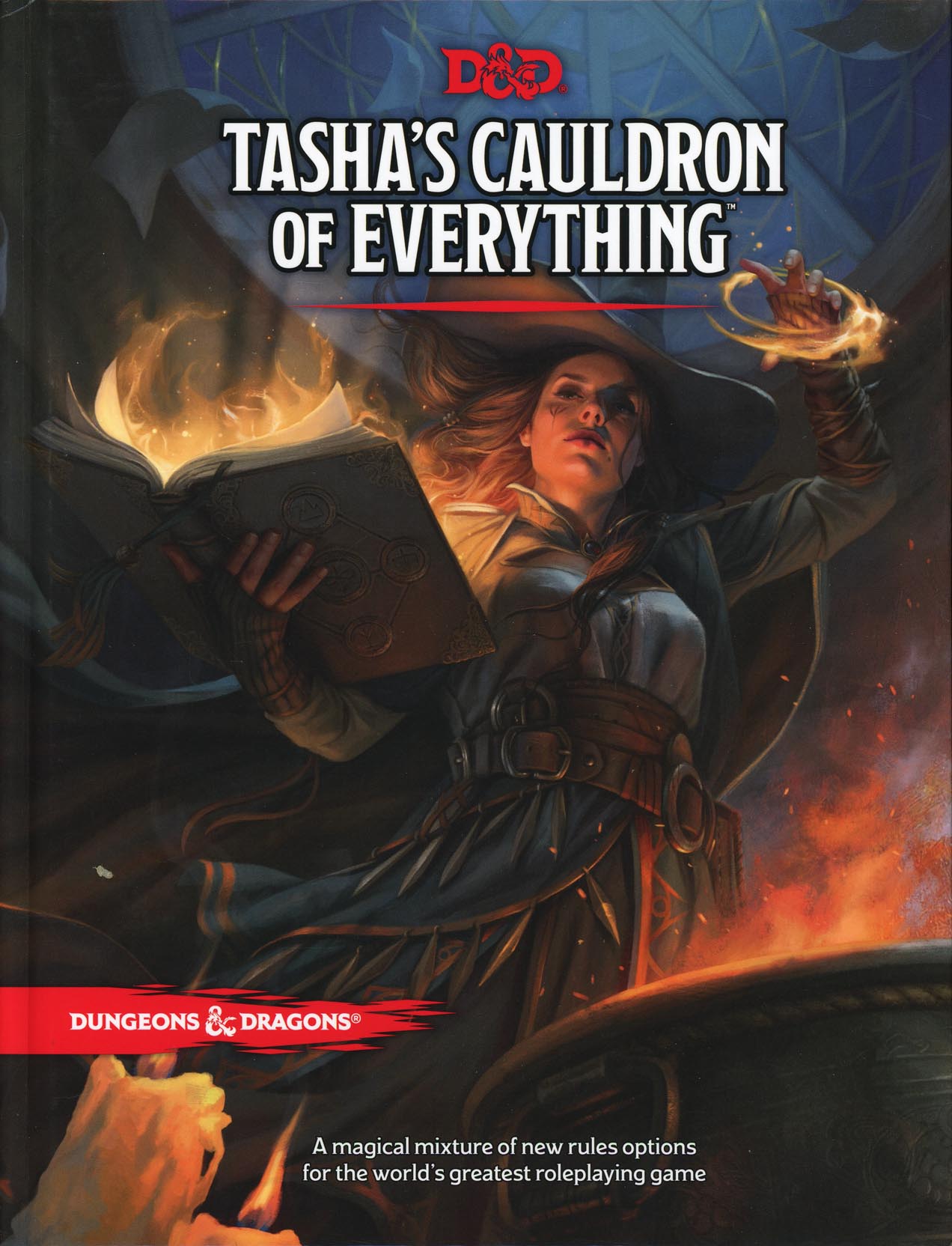
Dungeons & Dragons, 5th Edition
Tasha’s Cauldron of Everything
A magical mixture of rules options for the world's greatest roleplaying game.
The wizard Tasha, whose great works include the spell Tasha's hideous laughter, has gathered bits and bobs of precious lore during her illustrious career as an adventurer. Her enemies wouldn't want these treasured secrets scattered across the multiverse, so in defiance, she has collected and codified these tidbits for the enrichment of all.
EXPANDED SUBCLASSES. Try out subclass options for every Dungeons & Dragons class, including the artificer, which appears in the book.
MORE CHARACTER OPTIONS. Tasha's Cauldron of Everything introduces a host of class features and feats, plus straightforward rules for modifying a character's racial traits and customizing their origin.
INTRODUCING GROUP PATRONS. Whether you're part of the same criminal syndicate or working for an ancient dragon, each group patron option comes with its own perks and types of assignments.
SPELLS, ARTIFACTS & MAGIC TATTOOS. Discover more spells, as well as magic tattoos, artifacts, and other magic items for your campaign.
EXPANDED RULES OPTIONS. Try out rules for sidekicks, supernatural environments, natural hazards, and parleying with monsters, and gain guidance on running a session zero.
A PLETHORA OF PUZZLES. Ready to be dropped into any D&D adventure, puzzles of varied difficulty await your adventurers, complete with traps and guidance on using the puzzles in a campaign.
Full of expanded content for players and Dungeon Masters alike, this book is a great addition to the Player's Handbook. Baked in you'll find more rule options for all the character classes in the Player's Handbook, including more subclass options. Thrown in for good measure is the artificer class, a master of magical invention. And this witch's brew wouldn't be complete without a dash of added artifacts, spellbook options, spells for both player characters and monsters, magical tattoos, group patrons, and other tasty goodies.
The wizard Tasha, whose great works include the spell Tasha's hideous laughter, has gathered bits and bobs of precious lore during her illustrious career as an adventurer. Her enemies wouldn't want these treasured secrets scattered across the multiverse, so in defiance, she has collected and codified these tidbits for the enrichment of all.
EXPANDED SUBCLASSES. Try out subclass options for every Dungeons & Dragons class, including the artificer, which appears in the book.
MORE CHARACTER OPTIONS. Tasha's Cauldron of Everything introduces a host of class features and feats, plus straightforward rules for modifying a character's racial traits and customizing their origin.
INTRODUCING GROUP PATRONS. Whether you're part of the same criminal syndicate or working for an ancient dragon, each group patron option comes with its own perks and types of assignments.
SPELLS, ARTIFACTS & MAGIC TATTOOS. Discover more spells, as well as magic tattoos, artifacts, and other magic items for your campaign.
EXPANDED RULES OPTIONS. Try out rules for sidekicks, supernatural environments, natural hazards, and parleying with monsters, and gain guidance on running a session zero.
A PLETHORA OF PUZZLES. Ready to be dropped into any D&D adventure, puzzles of varied difficulty await your adventurers, complete with traps and guidance on using the puzzles in a campaign.
Full of expanded content for players and Dungeon Masters alike, this book is a great addition to the Player's Handbook. Baked in you'll find more rule options for all the character classes in the Player's Handbook, including more subclass options. Thrown in for good measure is the artificer class, a master of magical invention. And this witch's brew wouldn't be complete without a dash of added artifacts, spellbook options, spells for both player characters and monsters, magical tattoos, group patrons, and other tasty goodies.
192 pages, Hardcover
First published November 17, 2020
About the author
Wizards of the Coast
424 books461 followersWizards of the Coast LLC (often referred to as WotC /ˈwɒtˌsiː/ or simply Wizards) is an American publisher of games, primarily based on fantasy and science fiction themes, and formerly an operator of retail stores for games. Originally a basement-run role-playing game publisher, the company popularized the collectible card game genre with Magic: The Gathering in the mid-1990s, acquired the popular Dungeons & Dragons role-playing game by purchasing the failing company TSR, and experienced tremendous success by publishing the licensed Pokémon Trading Card Game. The company's corporate headquarters are located in Renton, Washington in the United States.[1]
Wizards of the Coast publishes role-playing games, board games, and collectible card games. They have received numerous awards, including several Origins Awards. The company has been a subsidiary of Hasbro since 1999. All Wizards of the Coast stores were closed in 2004.
Wizards of the Coast publishes role-playing games, board games, and collectible card games. They have received numerous awards, including several Origins Awards. The company has been a subsidiary of Hasbro since 1999. All Wizards of the Coast stores were closed in 2004.
Ratings & Reviews
Friends & Following
Create a free account to discover what your friends think of this book!
Community Reviews
Displaying 1 - 30 of 127 reviews

December 28, 2022
I skimmed this last night. Basically, it's a collection of bells and whistles, both for the players and the DM. The players get new subclasses, class features, and class paths. The DM gets more spells, more magic items, and more tools to use for crafting adventures.
Honestly, I'm not sure how much use I'll get out of this since I'll mostly be doing done and one adventures at irregular intervals. On the other hand, some things are really interesting, like the new class paths for the Rogue.
I wouldn't say this is an essential 5e book but it definitely has some things people can get some use out of in it. Sadly, I will not likely be playing enough to do so.
Honestly, I'm not sure how much use I'll get out of this since I'll mostly be doing done and one adventures at irregular intervals. On the other hand, some things are really interesting, like the new class paths for the Rogue.
I wouldn't say this is an essential 5e book but it definitely has some things people can get some use out of in it. Sadly, I will not likely be playing enough to do so.

January 28, 2023
There's a real hodge-podge of ideas in this supplement for the 5th Edition Dungeons and Dragons game, a little something for everyone.
It kicks off with some new options for character classes, many of them variations on the more familiar ones. I particularly liked the section on Artificers, which bring a bit of steampunk flavor to the table. The Armorer variant of the Artificer practically turns the character into a fantasy version of Iron Man. There are definitely some cool possibilities there.
The second section covers group patrons, should the adventuring party wish to have some person or group backing their exploits. There are some nice options for continuing campaigns in here.
Next is magic items and spells, because one can never have too many of those.
And the book concludes with a section for game masters intended for spicing up their adventures. It adds options for parleying with monsters among other goodies.
Although this is a game manual, I could also see it being useful if one is writing a fantasy novel or some other endeavor where the ideas could spark something. I haven't played D&D in ages, and am unlikely to pick it up again anytime soon. But this was a fun read.
It kicks off with some new options for character classes, many of them variations on the more familiar ones. I particularly liked the section on Artificers, which bring a bit of steampunk flavor to the table. The Armorer variant of the Artificer practically turns the character into a fantasy version of Iron Man. There are definitely some cool possibilities there.
The second section covers group patrons, should the adventuring party wish to have some person or group backing their exploits. There are some nice options for continuing campaigns in here.
Next is magic items and spells, because one can never have too many of those.
And the book concludes with a section for game masters intended for spicing up their adventures. It adds options for parleying with monsters among other goodies.
Although this is a game manual, I could also see it being useful if one is writing a fantasy novel or some other endeavor where the ideas could spark something. I haven't played D&D in ages, and am unlikely to pick it up again anytime soon. But this was a fun read.
December 27, 2020
This book provides additional character options and rules for Dungeons & Dragon campaigns similar to Xanathar's Guide to Everything. It's always nice to have more subclasses, which provides more character diversity in games. Other things that I liked in this book were the sections on running a session zero, the addition of patrons, and options for the effects of supernatural regions.
There was some chatter on the internet that this book would resolve some of the problematic issues surrounding race in the game (for example, some races always being evil). The section is actually very brief and it feels like an afterthought. It would have been better to devote more pages to this. For example, they could have described some more characters and settings that break the stereotypes of the genre. That would have inspired players more to try out the rules. Anyway, there are third-party sources that are available that do this better. In other words, if you are buying this for the revised racial system, you might be better off buying something else.
One thing that I didn't like about this book was the flavor text. In past books, Xanathar and Mordenkainen's running commentary on the contents of their books was slightly entertaining. However, Tasha comes across as snarky and basically dismisses everything that appears in the book, which is a real mood killer.
There was some chatter on the internet that this book would resolve some of the problematic issues surrounding race in the game (for example, some races always being evil). The section is actually very brief and it feels like an afterthought. It would have been better to devote more pages to this. For example, they could have described some more characters and settings that break the stereotypes of the genre. That would have inspired players more to try out the rules. Anyway, there are third-party sources that are available that do this better. In other words, if you are buying this for the revised racial system, you might be better off buying something else.
One thing that I didn't like about this book was the flavor text. In past books, Xanathar and Mordenkainen's running commentary on the contents of their books was slightly entertaining. However, Tasha comes across as snarky and basically dismisses everything that appears in the book, which is a real mood killer.

August 19, 2022
The highlights were the Twilight Cleric and the Magic Tattoos.

January 1, 2021
Tasha's Cauldron of Everything offers some great tools to further customize a group's DnD experience. I found many of this new, optional rules (such as the reallocation of racial characteristics, new base class features) useful to integrate into my existing campaign. The added spells, feats, classes, and subclasses are always a welcomed addition. But what this book does best, in my opinion, is give the DM additional tools to flesh out their world. From side kicks to patron mechanics to regional affects form various supernatural phenomenon Tasha's really opens the world up in fun and challenging ways for all involved. This is a good addition to an existing DnD library and offers plenty of fun tools and options for players and DMs alike.

November 24, 2022
I've only used a couple of the class variants out of this, as well as the Artificer, but they have all been great.
Most importantly, I'm pretty sure this book is where my DM got the "sidekick" feature from, and he is making such amazing use of it in our long-running campaign that I will forever be grateful to this book for existing.
Most importantly, I'm pretty sure this book is where my DM got the "sidekick" feature from, and he is making such amazing use of it in our long-running campaign that I will forever be grateful to this book for existing.

November 18, 2020
This is a lot like Xanathar's Guide to Everything with fun new stuff. I genuinely prefer how XGTE and, now, this book are organized over some of the other supplemental books from Wizards of the Coast. I was able to read through quickly, find what I wanted, and know that I'll be able to find it again easily.
There are several things I really love including the tattoo spells, quite a few of the new sub-class choices, etc. A whole section on puzzles may or may not get used often, but when I need a puzzle on the fly I know that's going to be handy. Solid supplement with some fun stuff I can't wait to explore.
There are several things I really love including the tattoo spells, quite a few of the new sub-class choices, etc. A whole section on puzzles may or may not get used often, but when I need a puzzle on the fly I know that's going to be handy. Solid supplement with some fun stuff I can't wait to explore.

Read
May 2, 2025Tasha’s Cauldron of Everything is the next big expansion to D&D 5e. Not an adventure path or a subset of obscure rules, Tasha’s is a genuine update and expansion that will invariably change the way we play D&D at least a little bit. This time around we’re focused almost entirely on the classes and every class in Dungeons and Dragons has been dabbled with, fiddled with, and dare I say, improved. Grab some eye of newt and a big stirring spoon as we dive into Tasha’s Cauldron of Everything and go through everything you need to know.
Tasha’s Cauldron of Everything 5e
What’s in the Book?
Tasha’s is comparatively a little lite at 192 pages, it’s about 30 pages shy of Volo’s but on par with Xanathar’s. It’s priced accordingly and every place I looked was selling it for around $29.99 which is in line with the prices of the previous “expansion” books. What you’re getting mainly revolves around the classes, their archetypes, and new “optional rules” for each class that we’ll get to in a minute. Beyond that we do get a slew of new spells, feats, and some interesting DM resources in environmental encounters, rule guidelines for group patrons and a few puzzles for good measure. All told the book includes:
Origin Customization Options.
30 “New” Class Archetypes.
Optional Class Features for Each Class.
15 New Feats.
Group Patron Rules.
21 “New” Spells.
47 New Magic Items, Including 10 Magical Tattoos.
Session Zero Guidelines.
Sidekick Rules and Classes.
Parlaying with Monster Rules.
Environmental Hazard Rules.
13 Puzzles.
Origin Customization Options
This is the feature that I think got the most players excited for the book and sadly I think it’s the feature that will be the most disappointing. Boiled down, these rules allow you to swap out most of the key features of your race with equivalent features, particularly their ability score increases. Do you want your dwarf to be smart and charismatic rather than tough and wise? Go for it. Really though, this feels more like the writers threw their hands up and shouted, “do whatever, I don’t care” rather than a proper character creation option. It feels lazy to me. I was hoping to fully represent characters like dragonborn-aasimar, or half elves, half dwarves. Instead I get to swap some ability points and proficiencies, woo.
30 “New” Class Archetypes
30 is a lot, and this is a breath of fresh air when it comes to character customization but the word “new” is in quotation marks for a reason. Every class archetype in Tasha’s came from unearthed arcanas or from previous setting books like the Guildmaster’s Guide to Ravnica. So, while these archetypes are newly “official” they’re likely class archetypes you’ve seen or played before. I personally discovered that one of these “new” archetypes was an unearthed arcana patron I’d been playing for months. They’re still great archetypes though, even if they aren’t exactly “new”. Many of them have also been tweaked and shifted for the better as well, most notably the psionic dice for all the psionic classes was reworked into something that I expect will be less unique but far more balanced.
Optional Class Features for Each Class
Every class section in Tasha’s includes a set of “optional class options”. Boiled down, these are class buffs. Every spellcasting class got additional spells added to their spell lists, and the “weaker” classes got a ton of new and replacement features, most notably rangers. This more than anything is WotC implementing a soft “update patch” for all the classes, addressing some gaps and issues in some classes and reworking things that needed fixing. Because this is all left to “DM option” though, it creates a strange dichotomy.
Every DM is now going to have to choose between allowing these class upgrades or not. I don’t think the projected power level for most characters will change too much, but DMs you have been warned. Be prepared to accept and internalize these changes or be branded as a “mean DM”.
15 New Feats
This collection of new feats seems bent on destroying multiclassing as a good chunk of them allow you to “dip into” other classes and gain key features without the level dip. I also applaud finally rewarding a bit of “weapon specialization” with the Crusher, Piercer, and Slasher feats. The Gunner feat finally answers the firearms issue, and Poisoner finally allows for a viable poison build. Everything here seems designed to address a prior build problem, and that’s a good thing. Also, you can just be a chef now, which is absolutely adorable.
Group Patron Rules
Tasha’s introduces the concept of a “group patron”, which equates to the “main quest giver” for a campaign. Everything here is really a DM tool, but in a good way. It streamlines an aspect of many games that has previously been left to DMs entirely. It specifically spells out what the players can expect to gain from their aristocrat’s favor, or the good graces of the dark lord they serve. It’s quite nice to have these guidelines, especially for newer DMs. I expect a lot of veteran DMs will gloss over this section, but it’ll be a lifeline for rookies.
21 “New” Spells
The word “new” is in quotation marks again because 5 of these spells are the reprinted “sword cantrips” we saw back in the Sword Coast Adventurer’s Guide. The actual new spells largely consist of a TON of new summoning spells, which will make any aspiring summoner very happy. Overall, even with the reprints I’m extremely happy with this spell set and I anticipate casting a lot of them in the future. Especially Tasha’s Caustic Brew which is already competing as my favorite 1st level damage dealing spell.
47 New Magic Items, Including 10 Magical Tattoos
This collection has some magic items that were sorely needed, like the amulet of the devout and arcane grimoire that act as simple attack and damage bonus items for divine and arcane casters. You also get some ridiculous over the top artifacts like Baba Yaga’s Mortar and Pestle. The magical tattoos got a lot of attention and while they’re definitely stylish they don’t actually act all that different from regular magic items except they’re uniquely difficult to steal off you. Overall, I was very happy with this magic item set and a few of them will definitely be cropping up in my home brew games.
Session Zero Guidelines
This is another section I expect veteran DM’s will flip past but it can be very useful to a newbie. There’re no rules here exactly, instead this section is basically just a condensed collection of good advice for DMs starting up new campaigns. Simple stuff like setting up solid origins for the party coming together, limits on what the players want to deal with, and whether the players are looking for more combat, exploration, mystery, Etc.
Sidekick Rules and Classes
The idea of NPC sidekicks for the party is nothing new, but this section irons out all the wrinkles that come along with it. It introduces three “sidekick classes” that encompass a lot of the general archetypes and sets them up to progress alongside the party. These “classes” are fully functional but comparatively simple, allowing you to have fully functional NPC sidekicks without nearly as much work as you’d need designing a full character. I love this section, and plan on using it as soon as possible in my campaigns.
Parlaying with Monster Rules
A neat idea that streamlines the diplomatic option when it comes to random monsters. It can be tough to roleplay out diplomacy when you just threw a random monster at the party and this section gives you a bunch of routes to go for each of the creature type categories. Definitely not hard and fast rules but I like having this in my pocket if my players unexpectedly try talking to the owlbear instead of just attacking it.
Environmental Hazard Rules
Further evidence that we may be getting a Spelljammer book sometime soon, this collection of strange environments and their hazards covers a good chunk of potential locales. Each one presents a bunch of potential triggers that result in rolling on long tables that vary from simple weather changes, to combats, to reality warping magics. These random encounter tables have a lot of uses, I especially enjoyed the haunted “environment” and can’t wait to spring some of those encounters on my players.
13 Puzzles
Puzzles are tough. They should technically be a regular component of D&D but I find they’re comparatively rarely used. Puzzles are innately consumable (can’t run the same one twice) and they take a lot of work to build from scratch. These puzzles are clever, can be easily reworked into similar puzzles for reusability, and some even come with handouts. I found it odd to see them here, but one or two may be making their way into my future games.
What’s Good About the Book?
Tasha’s Cauldron of Everything is the update/expansion 5e desperately needed but in ways I didn’t expect. The “optional class features” function as a major system update that fixes what needed fixing and balanced the unbalanced (it even finally balanced rangers). The 30 class archetypes, 15 feats, 21 spells, and the optional class features themselves, are all about to collide with the 5e community to create countless new character options. This is the biggest expansion to your 5e character creation options since Volo’s. As a DM I’m excited to try out the environmental hazards and implement a new group patron, as a player my mind is brimming with new character ideas and concepts that simply wouldn’t be possible without this book.
What’s Bad About the Book?
There’s not a whole lot that’s actually “new” here, unless you’ve staunchly been avoiding unearthed arcana content the bulk of this book are the “finalized” versions of things we’ve had for months or even years. Moving from unearthed arcana is reasonable, but I groaned a bit when I discovered just how many archetypes and spells were reprints from earlier books just made “official” now with this printing. Also, the “customizing your origin” section felt very lazy. It can’t be used (satisfyingly anyway) to create half-races or anything custom beyond swapping ability points and proficiencies around. Finally, while the “optional class features” are technically new and exciting toys to play with, when you boil it down, they’re errata. These new features are the fixes to the classes through extensive playtesting, which is a good thing, but I’m not sure I enjoy buying a book to gain what is essentially FAQ and updates.
Conclusions
I have no doubt that Tasha’s contains the expansions we wanted and the updates we needed, but in many ways, it feels like a book-length FAQ. It fixes a lot of problems that 5e had and fills the gaps in character creation we’ve been missing. But a good chunk of the content is literally reprinted from earlier books, and a lot of the “new content” is just officially accepting the unearthed arcanas we’ve had for a long time. The feats, spells, and magic items make up for a lot of it though as they’re properly new and amazing content. Tasha’s is here to stay, and just like Volo and Xanathar before her, Tasha and her cauldron are now an indispensable book for playing 5th edition D&D. If you’re playing 5e, you’re going to need this book. I just wish it had been less lazy with the custom origins and had more new content instead of reprinted content so that I’d want this book as well as need it.
Tasha’s Cauldron of Everything 5e
What’s in the Book?
Tasha’s is comparatively a little lite at 192 pages, it’s about 30 pages shy of Volo’s but on par with Xanathar’s. It’s priced accordingly and every place I looked was selling it for around $29.99 which is in line with the prices of the previous “expansion” books. What you’re getting mainly revolves around the classes, their archetypes, and new “optional rules” for each class that we’ll get to in a minute. Beyond that we do get a slew of new spells, feats, and some interesting DM resources in environmental encounters, rule guidelines for group patrons and a few puzzles for good measure. All told the book includes:
Origin Customization Options.
30 “New” Class Archetypes.
Optional Class Features for Each Class.
15 New Feats.
Group Patron Rules.
21 “New” Spells.
47 New Magic Items, Including 10 Magical Tattoos.
Session Zero Guidelines.
Sidekick Rules and Classes.
Parlaying with Monster Rules.
Environmental Hazard Rules.
13 Puzzles.
Origin Customization Options
This is the feature that I think got the most players excited for the book and sadly I think it’s the feature that will be the most disappointing. Boiled down, these rules allow you to swap out most of the key features of your race with equivalent features, particularly their ability score increases. Do you want your dwarf to be smart and charismatic rather than tough and wise? Go for it. Really though, this feels more like the writers threw their hands up and shouted, “do whatever, I don’t care” rather than a proper character creation option. It feels lazy to me. I was hoping to fully represent characters like dragonborn-aasimar, or half elves, half dwarves. Instead I get to swap some ability points and proficiencies, woo.
30 “New” Class Archetypes
30 is a lot, and this is a breath of fresh air when it comes to character customization but the word “new” is in quotation marks for a reason. Every class archetype in Tasha’s came from unearthed arcanas or from previous setting books like the Guildmaster’s Guide to Ravnica. So, while these archetypes are newly “official” they’re likely class archetypes you’ve seen or played before. I personally discovered that one of these “new” archetypes was an unearthed arcana patron I’d been playing for months. They’re still great archetypes though, even if they aren’t exactly “new”. Many of them have also been tweaked and shifted for the better as well, most notably the psionic dice for all the psionic classes was reworked into something that I expect will be less unique but far more balanced.
Optional Class Features for Each Class
Every class section in Tasha’s includes a set of “optional class options”. Boiled down, these are class buffs. Every spellcasting class got additional spells added to their spell lists, and the “weaker” classes got a ton of new and replacement features, most notably rangers. This more than anything is WotC implementing a soft “update patch” for all the classes, addressing some gaps and issues in some classes and reworking things that needed fixing. Because this is all left to “DM option” though, it creates a strange dichotomy.
Every DM is now going to have to choose between allowing these class upgrades or not. I don’t think the projected power level for most characters will change too much, but DMs you have been warned. Be prepared to accept and internalize these changes or be branded as a “mean DM”.
15 New Feats
This collection of new feats seems bent on destroying multiclassing as a good chunk of them allow you to “dip into” other classes and gain key features without the level dip. I also applaud finally rewarding a bit of “weapon specialization” with the Crusher, Piercer, and Slasher feats. The Gunner feat finally answers the firearms issue, and Poisoner finally allows for a viable poison build. Everything here seems designed to address a prior build problem, and that’s a good thing. Also, you can just be a chef now, which is absolutely adorable.
Group Patron Rules
Tasha’s introduces the concept of a “group patron”, which equates to the “main quest giver” for a campaign. Everything here is really a DM tool, but in a good way. It streamlines an aspect of many games that has previously been left to DMs entirely. It specifically spells out what the players can expect to gain from their aristocrat’s favor, or the good graces of the dark lord they serve. It’s quite nice to have these guidelines, especially for newer DMs. I expect a lot of veteran DMs will gloss over this section, but it’ll be a lifeline for rookies.
21 “New” Spells
The word “new” is in quotation marks again because 5 of these spells are the reprinted “sword cantrips” we saw back in the Sword Coast Adventurer’s Guide. The actual new spells largely consist of a TON of new summoning spells, which will make any aspiring summoner very happy. Overall, even with the reprints I’m extremely happy with this spell set and I anticipate casting a lot of them in the future. Especially Tasha’s Caustic Brew which is already competing as my favorite 1st level damage dealing spell.
47 New Magic Items, Including 10 Magical Tattoos
This collection has some magic items that were sorely needed, like the amulet of the devout and arcane grimoire that act as simple attack and damage bonus items for divine and arcane casters. You also get some ridiculous over the top artifacts like Baba Yaga’s Mortar and Pestle. The magical tattoos got a lot of attention and while they’re definitely stylish they don’t actually act all that different from regular magic items except they’re uniquely difficult to steal off you. Overall, I was very happy with this magic item set and a few of them will definitely be cropping up in my home brew games.
Session Zero Guidelines
This is another section I expect veteran DM’s will flip past but it can be very useful to a newbie. There’re no rules here exactly, instead this section is basically just a condensed collection of good advice for DMs starting up new campaigns. Simple stuff like setting up solid origins for the party coming together, limits on what the players want to deal with, and whether the players are looking for more combat, exploration, mystery, Etc.
Sidekick Rules and Classes
The idea of NPC sidekicks for the party is nothing new, but this section irons out all the wrinkles that come along with it. It introduces three “sidekick classes” that encompass a lot of the general archetypes and sets them up to progress alongside the party. These “classes” are fully functional but comparatively simple, allowing you to have fully functional NPC sidekicks without nearly as much work as you’d need designing a full character. I love this section, and plan on using it as soon as possible in my campaigns.
Parlaying with Monster Rules
A neat idea that streamlines the diplomatic option when it comes to random monsters. It can be tough to roleplay out diplomacy when you just threw a random monster at the party and this section gives you a bunch of routes to go for each of the creature type categories. Definitely not hard and fast rules but I like having this in my pocket if my players unexpectedly try talking to the owlbear instead of just attacking it.
Environmental Hazard Rules
Further evidence that we may be getting a Spelljammer book sometime soon, this collection of strange environments and their hazards covers a good chunk of potential locales. Each one presents a bunch of potential triggers that result in rolling on long tables that vary from simple weather changes, to combats, to reality warping magics. These random encounter tables have a lot of uses, I especially enjoyed the haunted “environment” and can’t wait to spring some of those encounters on my players.
13 Puzzles
Puzzles are tough. They should technically be a regular component of D&D but I find they’re comparatively rarely used. Puzzles are innately consumable (can’t run the same one twice) and they take a lot of work to build from scratch. These puzzles are clever, can be easily reworked into similar puzzles for reusability, and some even come with handouts. I found it odd to see them here, but one or two may be making their way into my future games.
What’s Good About the Book?
Tasha’s Cauldron of Everything is the update/expansion 5e desperately needed but in ways I didn’t expect. The “optional class features” function as a major system update that fixes what needed fixing and balanced the unbalanced (it even finally balanced rangers). The 30 class archetypes, 15 feats, 21 spells, and the optional class features themselves, are all about to collide with the 5e community to create countless new character options. This is the biggest expansion to your 5e character creation options since Volo’s. As a DM I’m excited to try out the environmental hazards and implement a new group patron, as a player my mind is brimming with new character ideas and concepts that simply wouldn’t be possible without this book.
What’s Bad About the Book?
There’s not a whole lot that’s actually “new” here, unless you’ve staunchly been avoiding unearthed arcana content the bulk of this book are the “finalized” versions of things we’ve had for months or even years. Moving from unearthed arcana is reasonable, but I groaned a bit when I discovered just how many archetypes and spells were reprints from earlier books just made “official” now with this printing. Also, the “customizing your origin” section felt very lazy. It can’t be used (satisfyingly anyway) to create half-races or anything custom beyond swapping ability points and proficiencies around. Finally, while the “optional class features” are technically new and exciting toys to play with, when you boil it down, they’re errata. These new features are the fixes to the classes through extensive playtesting, which is a good thing, but I’m not sure I enjoy buying a book to gain what is essentially FAQ and updates.
Conclusions
I have no doubt that Tasha’s contains the expansions we wanted and the updates we needed, but in many ways, it feels like a book-length FAQ. It fixes a lot of problems that 5e had and fills the gaps in character creation we’ve been missing. But a good chunk of the content is literally reprinted from earlier books, and a lot of the “new content” is just officially accepting the unearthed arcanas we’ve had for a long time. The feats, spells, and magic items make up for a lot of it though as they’re properly new and amazing content. Tasha’s is here to stay, and just like Volo and Xanathar before her, Tasha and her cauldron are now an indispensable book for playing 5th edition D&D. If you’re playing 5e, you’re going to need this book. I just wish it had been less lazy with the custom origins and had more new content instead of reprinted content so that I’d want this book as well as need it.

December 29, 2020
Got this for xmas, finished already. That should sum up the review.
I feel like this is definitely aimed at players who didn't start just a few months ago who had already seen (if not played) almost every variant of each class. I already feel overwhelmed with choice, and honestly react with "oh fuck even more subclasses to stress over not picking" to most of the first section. When you can barely get one campaign meeting once a week, it's just something that takes a LONG time to explore and get to play with everything. This kind of overabundance of choice honestly stresses me out a bit.
That said, the changes to the classes were fantastic and I'm going to have a second "session zero" for my campaign that is on hiatus after the players reached 5th level and completed the prefab module we were doing where they can retroactively apply some of the new features (looking at you, Steady Aim for our Rogue so we don't have any more, "I shoot my crossbow...it misses? Ok I'm done," turns). We'll also be converting the adopted Goblin into a sidekick and turning their new business partners into patrons.
The rules for those last few things are great and make a few very common scenarios easier on DMs. You're not going to say "no you can't keep the goblin" to the players, instead you have to scramble to figure out how to make it work. Having that defined ahead of time simplifies things, since it's basically a running joke in the community that parties will always adopt the NPC that was supposed to have a single line to point them in the right direction.
The patron system in particular is a godsend right now. It would have been awkward to convert this to an Acquisitions Inc. franchise campaign at this point and I don't want to add in a ton of overhead and baggage that comes with that. The patron model, however, lets me easily convert interactions with two NPCs who gave them a 10% stake in their business into very convenient sources of questlines to get the business up and running.
The last section of random phenomena related to some sort of triggers is the one thing I'm undecided if I'll use. It definitely shakes things up in terms of filling in random encounters; it's good to have another option instead of just always having another trash mob appear.
I feel like this is definitely aimed at players who didn't start just a few months ago who had already seen (if not played) almost every variant of each class. I already feel overwhelmed with choice, and honestly react with "oh fuck even more subclasses to stress over not picking" to most of the first section. When you can barely get one campaign meeting once a week, it's just something that takes a LONG time to explore and get to play with everything. This kind of overabundance of choice honestly stresses me out a bit.
That said, the changes to the classes were fantastic and I'm going to have a second "session zero" for my campaign that is on hiatus after the players reached 5th level and completed the prefab module we were doing where they can retroactively apply some of the new features (looking at you, Steady Aim for our Rogue so we don't have any more, "I shoot my crossbow...it misses? Ok I'm done," turns). We'll also be converting the adopted Goblin into a sidekick and turning their new business partners into patrons.
The rules for those last few things are great and make a few very common scenarios easier on DMs. You're not going to say "no you can't keep the goblin" to the players, instead you have to scramble to figure out how to make it work. Having that defined ahead of time simplifies things, since it's basically a running joke in the community that parties will always adopt the NPC that was supposed to have a single line to point them in the right direction.
The patron system in particular is a godsend right now. It would have been awkward to convert this to an Acquisitions Inc. franchise campaign at this point and I don't want to add in a ton of overhead and baggage that comes with that. The patron model, however, lets me easily convert interactions with two NPCs who gave them a 10% stake in their business into very convenient sources of questlines to get the business up and running.
The last section of random phenomena related to some sort of triggers is the one thing I'm undecided if I'll use. It definitely shakes things up in terms of filling in random encounters; it's good to have another option instead of just always having another trash mob appear.

January 2, 2021
The latest sourcebook for 5th edition follows the style of Xanathar's Guide as an optional expansion of material for players and DMs. Essentially selected articles from WotC's unearthed arcana playtest material this may be repetition for some.
The content has a good variety, and you'd be challenged not to find anything of use here. The new subclasses increase the variety available now to bewildering levels, and there's some great ones here. The three new Psi subclasses are fun, as are the druid subclasses. It also offers an option to change subclass during campaign, which at first I was uncertain, but offers an alternate to multi classes.
The optional change to race bonuses was fairly small print for me, and felt a little tacked on. Probably won't use that.
The patrons section was surprisingly good, with some excellent ideas that made me think a lot of books I've read or series I've watched. Some fun flavour there for my next campaign.
The spells and magic items are always welcome, and the environmental rules/ magic zones could be situationally useful. Finally the puzzles section provides some clever structures (and cheats/hints) that will probably need adapting as your players will have read them all before you put it into a dungeon!
My only gripe is that despite the quality of the content it felt rather thin for the cost. Might be me getting miserly, but the prior book (Rime of the Frost Maiden) was a beast in size.
Anyhow, worth a look in my opinion.
The content has a good variety, and you'd be challenged not to find anything of use here. The new subclasses increase the variety available now to bewildering levels, and there's some great ones here. The three new Psi subclasses are fun, as are the druid subclasses. It also offers an option to change subclass during campaign, which at first I was uncertain, but offers an alternate to multi classes.
The optional change to race bonuses was fairly small print for me, and felt a little tacked on. Probably won't use that.
The patrons section was surprisingly good, with some excellent ideas that made me think a lot of books I've read or series I've watched. Some fun flavour there for my next campaign.
The spells and magic items are always welcome, and the environmental rules/ magic zones could be situationally useful. Finally the puzzles section provides some clever structures (and cheats/hints) that will probably need adapting as your players will have read them all before you put it into a dungeon!
My only gripe is that despite the quality of the content it felt rather thin for the cost. Might be me getting miserly, but the prior book (Rime of the Frost Maiden) was a beast in size.
Anyhow, worth a look in my opinion.

May 31, 2021
Lots of fun extras in here, but mostly I just wanted to read up about all the new subclasses. While this wouldn't be a good starter book for a new DnD player, it's essential reading for anyone who wants to get the most out of their character building.

March 20, 2024
زندگیم دو درجه بهتر شد

November 18, 2020
There are certainly a lot of new fun subclasses and items to add to gameplay in here. Also, I got the alternative cover and it is beautiful.

November 21, 2020
TCOE gives a lot of great subclasses and has quite a few quality of life improvements to make the game more approachable and lean more towards role play. The social contract fully stated, flexibility In character creation, and progression as well as more access to magic for all classes.
Beyond these generalities I love the tattoos adding depth to the whole world, the artificer finally feels viable as well as addressing how much the spirit & psionics for players has been ignored.
That all being said this book lacks the meat to add to my regular session bag but is still useful. As expected it's more XGtE than Volos.
Beyond these generalities I love the tattoos adding depth to the whole world, the artificer finally feels viable as well as addressing how much the spirit & psionics for players has been ignored.
That all being said this book lacks the meat to add to my regular session bag but is still useful. As expected it's more XGtE than Volos.

December 3, 2020
There are definitely some options in here I could see myself using. And others that seem pretty underwhelming. Also, a lot of very similar options for different classes. In the end though, it's still D&D5E and there are no significant changes here. Even the much-praised optional rules for making the different races less monolithic really don't go far enough.

June 5, 2021
Depth, not breadth seems to be how Wizards of the Coast is approaching their D&D5e books, and I heartily approve. Tasha's Cauldron is in the same spirit as Xanathar's Guide to Everything, giving new options and advice for players and Dungeon Masters alike.
The first chapter is filled with new options for characters. New specialties, optional rules, and the official debut of the Artificer class. While I find some of the options to be a bit overpowered, some like the Bladesinger for wizards and the Rune Knight path for fighters to be very interesting. As with anything, groups need to decide what they want to use. The one real disappointment for me in this chapter was the Fathomless patron for warlocks. It could be better labeled as the Hentail patron. Tentacles everywhere!
Chapter 2 is all about patrons, Those institutions of powerful individuals who might sponsor an adventuring party. This is a very good chapter, filled with all sorts of great campaign hooks. The party could be hired by a mysterious agent of an arcane society and sent to retrieve objects, or by a scheming noble to carry out missions to weaken his enemies. The chapter is a little table-happy, but still excellent.
It would be a D&D book without magic stuff, and that's what Chapter 3 is all about. We get a good number of new spells; a long list of new magic items, including magic tattoos, and a nice little essay about customizing spells. This bit reminded me of Ars Magica's spell signature. In short, it encourages players running arcane spellcasters to add a signature to their spells. A Hexblade Warlock might have "ravens" as his signature. His Eldritch Blast would be a stream of spectral ravens shooting out at the target. It's a good idea.
Finally, Chapter 4 is the Dungeon Master's toolkit. It starts with a great section on how to run "Session Zero," the first meeting of players and GM. How to build a party, defining hard and soft limits for actions in the game, things like that. Really good advice. Following this is a short section on sidekicks, where we finally get NPC advancement blocks. A very good section on how to parley and bribe monsters is followed by sections on supernatural regions, magical phenomena, and natural hazards, all of which will make any game better.
Finally, there is a short section of puzzles, including several excellent examples of puzzles to use in games with handouts.
Tasha's Cauldron should be on every Dungeon Master's shelf.
The first chapter is filled with new options for characters. New specialties, optional rules, and the official debut of the Artificer class. While I find some of the options to be a bit overpowered, some like the Bladesinger for wizards and the Rune Knight path for fighters to be very interesting. As with anything, groups need to decide what they want to use. The one real disappointment for me in this chapter was the Fathomless patron for warlocks. It could be better labeled as the Hentail patron. Tentacles everywhere!
Chapter 2 is all about patrons, Those institutions of powerful individuals who might sponsor an adventuring party. This is a very good chapter, filled with all sorts of great campaign hooks. The party could be hired by a mysterious agent of an arcane society and sent to retrieve objects, or by a scheming noble to carry out missions to weaken his enemies. The chapter is a little table-happy, but still excellent.
It would be a D&D book without magic stuff, and that's what Chapter 3 is all about. We get a good number of new spells; a long list of new magic items, including magic tattoos, and a nice little essay about customizing spells. This bit reminded me of Ars Magica's spell signature. In short, it encourages players running arcane spellcasters to add a signature to their spells. A Hexblade Warlock might have "ravens" as his signature. His Eldritch Blast would be a stream of spectral ravens shooting out at the target. It's a good idea.
Finally, Chapter 4 is the Dungeon Master's toolkit. It starts with a great section on how to run "Session Zero," the first meeting of players and GM. How to build a party, defining hard and soft limits for actions in the game, things like that. Really good advice. Following this is a short section on sidekicks, where we finally get NPC advancement blocks. A very good section on how to parley and bribe monsters is followed by sections on supernatural regions, magical phenomena, and natural hazards, all of which will make any game better.
Finally, there is a short section of puzzles, including several excellent examples of puzzles to use in games with handouts.
Tasha's Cauldron should be on every Dungeon Master's shelf.

January 2, 2024
Tasha’s Cauldron of Everything contains several fantastic subclasses: Eloquence Bard, Twilight Cleric, Phantom & Soulknife Rouge, Aberrant Mind & Clockwork Soul Sorcerer, Fathomless Warlock, Bladesinger Wizard, etc. They make great additions to the classes presented in the Player's Handbook.
The book contains a good number of new spells and magic items. I was less interested in the Group Patron section, though I imagine this comes in very handy for people who want to create their own campaign from scratch. Same goes for the more obscure tools in the Dungeon Master's section. The chapter on sidekicks is great and a perfect expansion on the sidekicks offered as part of the Essentials Kit.
The book contains a good number of new spells and magic items. I was less interested in the Group Patron section, though I imagine this comes in very handy for people who want to create their own campaign from scratch. Same goes for the more obscure tools in the Dungeon Master's section. The chapter on sidekicks is great and a perfect expansion on the sidekicks offered as part of the Essentials Kit.
March 16, 2023
I’m reviewing this as a DM. This additional sourcebook is awesome. It offers a multitude of new character options, DM tools, and magic items/spells. Already it’s given me so much inspiration for new NPCs, quests and locations for my players. Also it’s unlikely my players will ever use all the character subclass options presented in the book, but that doesn’t mean they’ll go to waste. I’m thinking of using some of the more niche ones as building blocks of new NPCs. My only gripe is with the puzzles section. It has several premade puzzles to present during a game, but nothing in the realm of ideas for creating your own which I would’ve greatly appreciated.

May 10, 2021
Really nice fleshed out additions to D&D. The class stuff alone is worth it, but you get so much more, including magical tattoos! Good stuff.

August 7, 2022
Muy buen libro en su conjunto, que permite ampliar el sistema, con ayudas para el master y mejoras en la personalización del juego y de los personajes. Muy satisfecho con esta lectura. Le daré uso a buen seguro.

August 13, 2023
Plenty of new classes and features to try out. Some very unique magic items. I like the concept of a group patron.

Read
July 26, 2024Blazed through the last chapter of this book because my players could spend 2 hours on the easiest of puzzles.
May 10, 2026
Tasha's Cauldron of Everything is a book of content for Dungeons and Dragons, adding a new class, new subclasses, new spells and much more.
It's fine, but this book suffers from being kind essential. There's not really anything groundbreaking or all that exciting in this book, it's just more stuff that might just as well have been in the Dungeon Master's Guide. The content is good, but not that good.
I'm giving the book 2 stars.
It's fine, but this book suffers from being kind essential. There's not really anything groundbreaking or all that exciting in this book, it's just more stuff that might just as well have been in the Dungeon Master's Guide. The content is good, but not that good.
I'm giving the book 2 stars.
February 2, 2021
Tasha's Cauldron of Everything is essentially a sequel to Xanathar's Guide to Everything, in that both provide a bunch of new rules options for players and some additional tools for DMs. Also like Xanathar's, much of the material had previously appeared in playtest form as part of the Unearthed Arcana web column. The narrator of this tome is Tasha, previously better known in D&D lore as the evil Iggwilv, though she comes across here as more just a sassy sorceress (who makes a number of modern-sounding references in her quips). I think it would have been more fun to keep her more on the menacing, villainous side, but oh well.
(One other minor quibble - the page count was slightly down from other D&D books, and the font size was slightly up, but the price tag was the same. It's how these things go, I know, but I still noticed.)
Tasha's is broken into four chapters - one for character options (nearly half the book), a much shorter chapter on group patrons, another short chapter with new spells and magic items, and a final chapter on DM tools. Going through each chapter...
There's a lot of useful material in Tasha's, though it's actually the DM material that is more broadly useful - the player options are interesting, but many won't fit into every campaign. Folks who were expecting this to be a massive game-changer for D&D will also be disappointed. Still, while this isn't quite an essential buy, it's worth checking out. (A-)
(One other minor quibble - the page count was slightly down from other D&D books, and the font size was slightly up, but the price tag was the same. It's how these things go, I know, but I still noticed.)
Tasha's is broken into four chapters - one for character options (nearly half the book), a much shorter chapter on group patrons, another short chapter with new spells and magic items, and a final chapter on DM tools. Going through each chapter...
There's a lot of useful material in Tasha's, though it's actually the DM material that is more broadly useful - the player options are interesting, but many won't fit into every campaign. Folks who were expecting this to be a massive game-changer for D&D will also be disappointed. Still, while this isn't quite an essential buy, it's worth checking out. (A-)

Read
June 29, 2022Приятно е тежките и сериозни четива да се разреждат с малко подсилващи въображението книги. Tasha’s Cauldron of Everything предлага редица интересни опции както за играчите, така и за водещите на ролевата игра, като най-значителен принос има с въвеждането на псиониката (колко ми липсваше досега!), сподвижниците на героите и отдаването на особено внимание на околната среда, примесена с магия. Отлагах я дълго, но после я изчетох на един дъх.

February 25, 2023
Extremely useful. A lot of my players use or have used stuff from it, and I plan to do the same as a Dungeon Master.

December 9, 2020
Although definitely a must buy/read for 5e, I’m disappointed in this super hyped expansion. The new subclasses/player options are great and inspired. Lots of good stuff here. That, combined with the new spells and magic items, make up the bulk of the actual good stuff of this book.
Unfortunately, that’s only like half of the book. The rest of it seems almost superfluous to me. The patron stuff could be created by any experienced DM. The Parleying with Monsters stuff is also not all that useful/original. Honestly, the only thing that is really interesting in the whole second half are the sidekick rules and that will only apply to a few groups.
Overall, it’s a decent book that could have been amazing if there was less filler content.
Unfortunately, that’s only like half of the book. The rest of it seems almost superfluous to me. The patron stuff could be created by any experienced DM. The Parleying with Monsters stuff is also not all that useful/original. Honestly, the only thing that is really interesting in the whole second half are the sidekick rules and that will only apply to a few groups.
Overall, it’s a decent book that could have been amazing if there was less filler content.

June 9, 2021
A cool book, there are lots of interesting things in here for the DM, plus some subclasses. The artwork is gorgeous throughout.
The one negative thing I have to say is about the magic items, there's a ton of them in this book but many of them basically have stats that are cookie-cutter. Then again it's not likely that a party will ever have more than one or two of these, so it's not a deal breaker. And this flaw is overshadowed by seeing the return of old AD&D edition artifacts in 5th edition.
The one negative thing I have to say is about the magic items, there's a ton of them in this book but many of them basically have stats that are cookie-cutter. Then again it's not likely that a party will ever have more than one or two of these, so it's not a deal breaker. And this flaw is overshadowed by seeing the return of old AD&D edition artifacts in 5th edition.

October 31, 2023
Tasha's Cauldron of Everything is the fourth rules supplement for 5th edition Dungeons and Dragons. It features the Artificer class and many subclasses, some of which were printed earlier in setting-specific books but are now updated and presented for general 5th edition. It has several new spells and awesome magic items and artifacts as well, giving me inspiration for cool new adventures. It also has suggestions and rules for DM's on the use of group patrons (like a thieves' guild), sidekicks (for NPC party members with more room for growth than regular stat blocks give), and puzzles (with several great examples). Even though my experience tells me groups are usually stumped by all but the most trivial puzzles...
Another great addition, especially for player characters!
Another great addition, especially for player characters!

February 23, 2021
A fun mix of new material to sprinkle into campaigns. Nothing too earthshaking.
Displaying 1 - 30 of 127 reviews