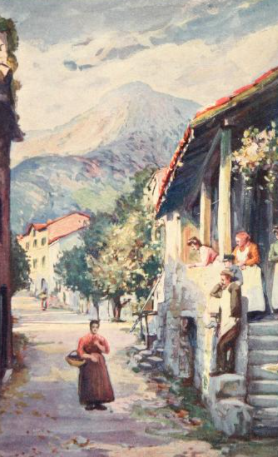
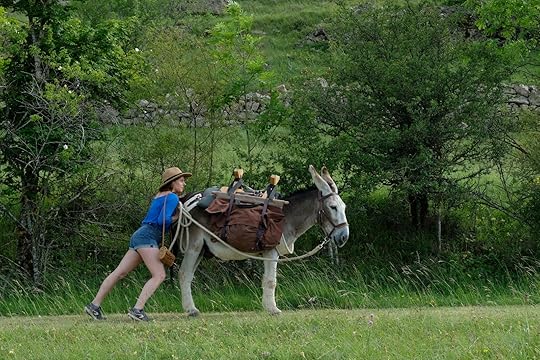
Robert Louis Stevenson (yes, that Robert Louis Stevenson) travels for twelve days and a hundred and twenty miles across France to the Cevennes on a donkey, Modestine. At first, Stevenson hates Modestine, with her balkiness and her slowness, but when he finally completes his journey, he finds he is unexpectedly missing her. Stevenson talks to people along the way, mostly about Catholicism versus Protestantism, and now and then he writes something quite profound and beautiful.
For my part, I travel not to go anywhere, but to go. I travel for travel’s sake. The great affair is to move; to feel the needs and hitches of our life more nearly; to come down off this feather-bed of civilisation, and find the globe granite underfoot and strewn with cutting flints.
Stevenson, Robert Louis. Travels with a Donkey in the Cevennes, p. 21. Kindle Edition.
Night is a dead monotonous period under a roof; but in the open world it passes lightly, with its stars and dews and perfumes, and the hours are marked by changes in the face of Nature. What seems a kind of temporal death to people choked between walls and curtains, is only a light and living slumber to the man who sleeps afield. All night long he can hear Nature breathing deeply and freely; even as she takes her rest, she turns and smiles; and there is one stirring hour unknown to those who dwell in houses, when a wakeful influence goes abroad over the sleeping hemisphere, and all the outdoor world are on their feet.
Stevenson, Robert Louis. Travels with a Donkey in the Cevennes, p. 35. Kindle Edition.
No one knows the stars who has not slept, as the French happily put it, à la belle étoile. He may know all their names and distances and magnitudes, and yet be ignorant of what alone concerns mankind,—their serene and gladsome influence on the mind. The greater part of poetry is about the stars; and very justly, for they are themselves the most classical of poets. These same far-away worlds, sprinkled like tapers or shaken together like a diamond dust upon the sky, had looked not otherwise to Roland or Cavalier, when, in the words of the latter, they had ‘no other tent but the sky, and no other bed than my mother earth.’
Stevenson, Robert Louis. Travels with a Donkey in the Cevennes, p. 51. Kindle Edition.
For some thoughts, which sure would be the most beautiful, vanish before we can rightly scan their features; as though a god, travelling by our green highways, should but ope the door, give one smiling look into the house, and go again for ever. Was it Apollo, or Mercury, or Love with folded wings? Who shall say? But we go the lighter about our business, and feel peace and pleasure in our hearts.
Stevenson, Robert Louis. Travels with a Donkey in the Cevennes, p. 57. Kindle Edition.