Jump to ratings and reviews
Rate this book

Iron City #3

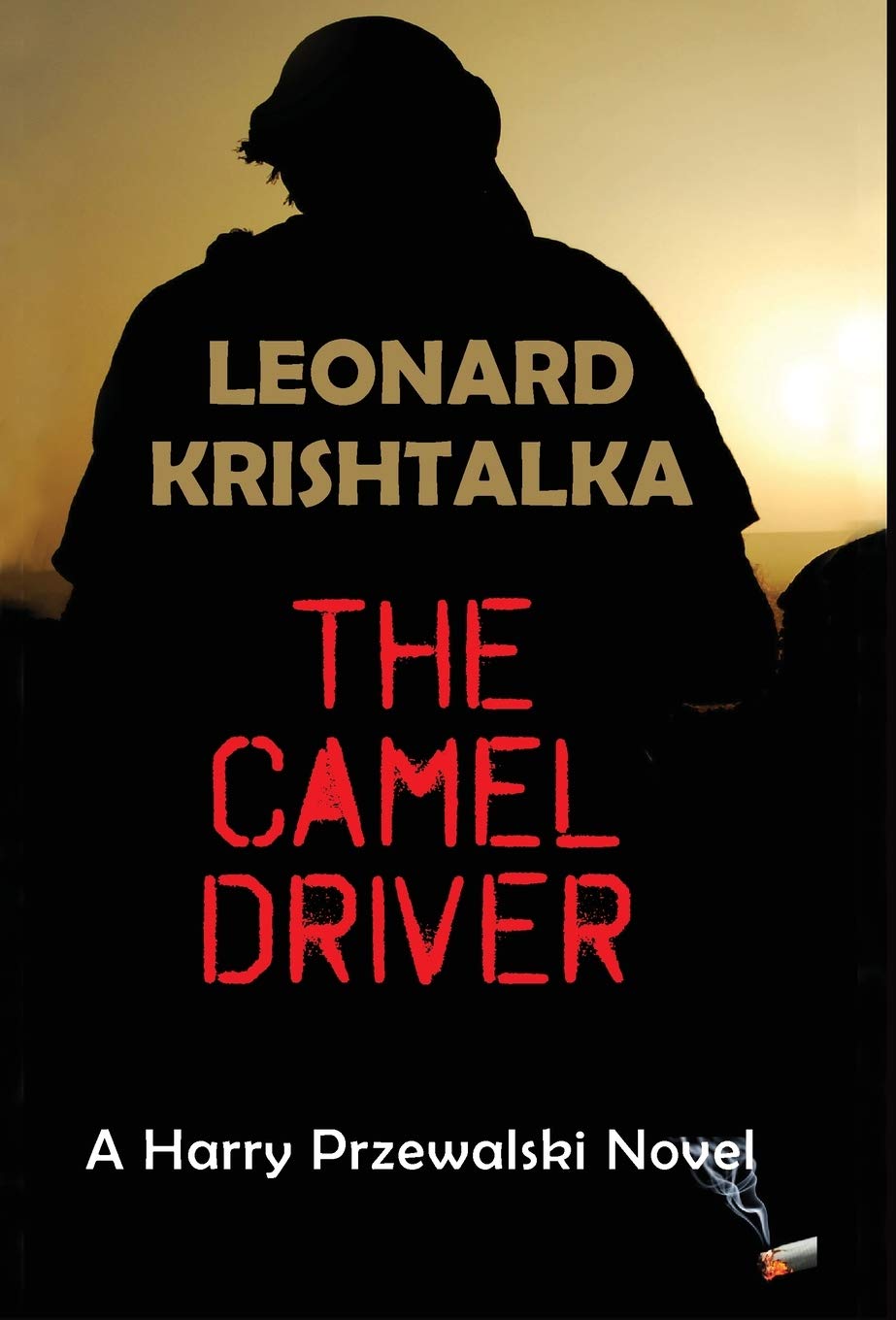
The Camel Driver

Rate this book
New Hard-Boiled Detective Series Uncovers Bones, Bodies and Murder!

"A fiercely intelligent crime drama as emotionally sharp as it is historically inventive. Krishtalka's prose is powerfully versatile, alternating between the sort of terse, unsentimental phrasing that one would expect from a detective story and poetical elegance."
Kirkus Reviews

Paleontologist turned private investigator, Harry Przewalski, excavates the dirty underbelly of people's lives, unearthing sexual betrayals, treachery, fraud and murder buried beneath the science of petrified shards, skin and bones. Ultimately, he must face a brutal killing in his own past, when he fled to a desert war and came back with a gun and a license to detect.
A famous, 140-year-old museum diorama is vandalized--it depicts the ferocious attack by two lions on a North African courier crossing the Sahara on a dromedary. The belly of the taxidermied camel has been sliced open and a bundle removed, shedding bits of flesh from a child. Harry is hired to investigate the macabre history of the exhibit. The taxidermist has a grisly past: a sexual affair, a lover's betrayal, a lurid trial, and graves in Botswana and Tunisia plundered for human dioramas. The camel driver's skull and skin are mounted under his clothing. In a Paris museum, a dead archaeologist, a bloodstained journal, and the theft of a Neanderthal child's skull and teeth lead Harry to the stolen bundle--a scientific bombshell worth killing for in a murderous race for fame.

292 pages, Hardcover

First published November 29, 2020

2 people are currently reading
31 people want to read

About the author

Leonard Krishtalka

13 books32 followers
Leonard Krishtalka has enjoyed two parallel careers––professional paleontologist, and author/novelist. As a paleontologist he has led and worked on expeditions throughout the fossil-rich badlands of western Canada and the US, Patagonia, Europe, China, Kenya and Ethiopia, excavating and studying the past life and cultures of the planet. He has held academic posts at the Carnegie Museum of Natural History, the University of Pittsburgh, the National Science Foundation, Washington, DC, and The University of Kansas, Lawrence.

As a novelist, Krishtalka uses the mystery genre to explore the human condition. He is the author of the award-winning Harry Przewalski novels: The Bone Field, Death Spoke, The Camel Driver, and the forthcoming Native Blood (Dec. 6, 2023). His fifth novel, The Body on the Bed, is historical fiction that investigates a murder and sensational trial in 1871 amid the social upheaval of post-Civil War Lawrence, Kansas.

Krishtalka is also an op-ed contributor to the Lawrence Journal-World, a past columnist for Carnegie Magazine, and author of the acclaimed book, Dinosaur Plots.

Ratings & Reviews

What do you think?
Rate this book

Friends & Following

Create a free account to discover what your friends think of this book!

Community Reviews

5 stars
11 (40%)
4 stars
9 (33%)
3 stars
5 (18%)
2 stars
2 (7%)
1 star
0 (0%)
Displaying 1 - 14 of 14 reviews
Profile Image for Richard Derus.
4,162 reviews2,260 followers
November 13, 2022
Pearl Rule #46

Pearl Ruled at 15%

Rating: 2* of five

The Publisher Says: Paleontologist turned private investigator, Harry Przewalski, excavates the dirty underbelly of people's lives, unearthing sexual betrayals, treachery, fraud and murder buried beneath the science of petrified shards, skin and bones. Ultimately, he must face a brutal killing in his own past, when he fled to a desert war and came back with a gun and a license to detect.

A famous, 140-year-old museum diorama is vandalized—it depicts the ferocious attack by two lions on a North African courier crossing the Sahara on a dromedary. The belly of the taxidermied camel has been sliced open and a bundle removed, shedding bits of flesh from a child. Harry is hired to investigate the macabre history of the exhibit. The taxidermist has a grisly past: a sexual affair, a lover's betrayal, a lurid trial, and graves in Botswana and Tunisia plundered for human dioramas. The camel driver's skull and skin are mounted under his clothing. In a Paris museum, a dead archaeologist, a bloodstained journal, and the theft of a Neanderthal child's skull and teeth lead Harry to the stolen bundle—a scientific bombshell worth killing for in a murderous race for fame.

I RECEIVED A DRC FROM THE PUBLISHER VIA NETGALLEY. THANK YOU.

My Review
: First, read this:
I knew the end had begun. I knew she had conceived in the night, that hours after our uncontrollable pleasure the milky seed would plow its inexorable route, intent of consummating the act.

I don't even care what comes after this. It can not justify my continued eyeblinks.
Profile Image for Dave.
3,655 reviews449 followers
November 15, 2020
"The Camel Driver" is the third book in the Harry Prezewalski detective series, which is set in Pittsburgh, although this novel takes us on a journey through France and South Africa. It is an archeological mystery, which begins with a theft from an exhibit in the Carnegie Museum. When Prezewalski investigates the odd mystery, he dives into a world of a taxidermist from the 1800's and the taxidermist's scandalous life in South Africa retold through trial transcripts from a suit to enforce a promise of marriage. With very little violence and little in the way of action packed sequences, the author manages to present a fascinating tale.
Profile Image for Richard.
2,308 reviews192 followers
November 13, 2020
This is an important book.
The world of fiction is awash with novels that seek to entertain and provide glimpses into new realities. Crime fiction adds mystery, puzzles and a range of thrilling action.
Leonard Krishtalka is a new author to me, and his detective series set in Pittsburgh a city in western Pennsylvania, USA is my best find of 2020.
His detective, Harry Przewalski is a wonderful down to earth private eye. He is methodical, hardworking and determined. He is also a man who can get things wrong, especially where women are concerned.
This is the third book in this series that continues to develop and surprise me. The plots are original and largely based in the academic worlds of archaeology and anthropology.
Because of the author’s background this isn’t dead science but a dramatic backdrop to greed, academic recognition and ultimately murder.

It is an important book since it is taking the genre further than the private eye or police procedural.

It is combining the world today with a discoverable past to enlighten and educate beyond normal historical crime thrillers.

In this way these books excite me, how they study the past, the development of life and human existence only to reveal that murder still lies close to the preferred options to resolve problems.

I love the links with the past the author utilises to cast his storytelling across time and was interested to read in his afterword where fact and fiction overlapped.
I also like the unresolved past; Harry’s lack of success with women and the desperate need for parental approval. His strained links with his parents, a love of cycling and his place within the city he loves.
Looking for something different - look no further.
Profile Image for Jerry Masinton.
Author 1 book7 followers
September 17, 2020
Leonard Krishtalka's Iron City detective series, featuring PI Harry Przewalski, might be the most significant advance in hard-boiled fiction in our time. But Krishtalka, an internationally recognized paleontologist and for many years the director of the Natural History Museum at the University of Kansas, calls these books "novels of intrigue" rather than "crime stories." It's a useful distinction. His novels use the detective-story framework to investigate larger questions than simply the whodunnit of mystery stories. He takes us into the supposedly rarefied worlds of academic life and museums of natural history to reveal the perennial drama of unbridled ambition, professional envy, and of course murder. In addition, Krishtalka's books show us how paleontologists work (The Bone Field), take us to the ancient cave art at Lascaux (Death Spoke), and in The Camel Driver acquaint us with the history of taxidermy.
All this learning is not decorative scientific and historical background or filler. It's necessary information that Harry needs to discover the truth behind the crimes he's hired to investigate. And it's all fascinatingly presented by Krishtalka. There's nothing quite like his mixture of science, history, and present-day sleuthing of other hard-boiled writers. So let me emphasize: Krishtalka's fundamental subject is the human condition. As Harry discovers truths underlying crimes, the author simultaneously lead us to contemplate the mind and soul of human beings--and in particular the triggering of base motives and violent crime. A first-rae intelligence informs these books, and a remarkable literary talent shapes them. (Death Spoke has recently been awarded a Gold Medal in the Midwest Books Awards competition.) And they're dynamite to read: every page is exciting.
Harry, who is some ways is an alter ego of the author, trained at the Carnegie Institute to be a paleontologist, but left the field after a tragic personal loss and eventually ended up a PI in Pittsburgh. (His name is the same as that of a stubby Mongolian horse, which is pronounced "Shu-VAL-ski.) Harry is well suited to investigate the murders in The Bone Field and Death Spoke, both of which require his scientific knowledge. In The Camel Driver, the Carnegie asks him to find out why their famous diorama--formerly called "Arab Courier Attacked by Lions" and now designated as "Lion Attacking a Dromedary"--has been vandalized. In the belly of the taxidermied dromedary, a pouch with the skull and teeth of a child had been hidden. Now it's missing.
Who was the child? How long has it been in the belly of the dromedary? Who razored it out? And why? Answering these questions takes Harry to museums in South Africa and Paris. One of the many pleasures of reading this brilliantly constructed and written novel is being immersed in the actual life and times of the 19th-century French taxidermist Jules Verreaux, who created Courier Attacked by Lions." In Verreaux's journals--an invention by Krishtalka--Harry discovers an epiphany that came to Verreaux after years of performing taxidermies not only on animals but on human individuals as well.
Verreaux's insight upends the accepted science of his time. And we ourselves are propelled forward into the questions of racism and the phony claims of racial superiority that vex us today. The Camel Driver, it should be noted, arrives at the very moment the Carnegie Museum is embroiled in a public controversy dealing with the way race is represented in dioramas. The source of this controversy? It's "Arab Courier Attacked by Lions." Talk about a timely and significant work: The Camel Driver brings us to the very heart of our violent social unrest and challenges us to understand it.
--Jerry Masinton

624 reviews10 followers
July 17, 2020
Writing historical fiction offers a challenge to an author, trying to retain known points in history, while using imagination to create a story that includes those points. The author of “The Camel Driver” has done an excellent job blending history (a renown 19th century biologist and natural history collector and taxidermist, Jules Verreaux [FN1] ; a legal case in Cape Town South Africa); current “surprise” revelations about a well-known exhibit, “Arab Courier Attacked by Lions,” undergoing restoration at the Carnegie Natural History Museum of Pittsburgh [FN2] ; an exciting and deadly mystery; and sights and sounds from three key locations (Pittsburgh, Paris and Cape Town) and two epochs (late 1820 and today).

The plot starts with a vandalism of the diorama of “Arab Courier Attacked by Lions” at the Carnegie Museum of Natural History. The underside of the camel has been sliced open. Interestingly, in the wake of this attack, more than straw was found around the exhibit, leading the police to think that something had been taken. The police, overwhelmed with other issues, requested the museum administration to engage Harry Przewalski to learn more about what might have been taken from the camel. This led Harry to do research about the Jules Pierre Verreaux, the person attributed with creating the exhibit. Harry first goes to South Africa, where he learns more of the trial of Verreaux for reneging on a marriage proposition, which left Elisabeth Greef pregnant with a child (1820’s). It is also the location where Verreaux and his brother Edouard make many of their collections (including that of an African man that became another famous exhibit, “Negro de Banyoles”). Then Harry travels to Paris, where Verreaux lived (when not traveling and collecting), and gains insights into Verreaux’ life by the journal he left at the Muséum Nationale d’Histoire Naturelle. Finally, Harry returns to Pittsburgh for the climax.

The novel is presented in four sections: The Taxidermist, The Trial, The Camel Driver, and The Package. I liked the author’s approach to present the trial via a series of transcript of court records (reprinted verbatim) as well as contemporaneous discussions by an editor of the local paper (developed from detailed accounts in the South African Commercial Advertizer). Also I enjoyed the use of presenting portions of the Verreaux’ journal (invented by the author) to help piece together some of the surprises in the story and to reveal Verreaux’ epiphany through his own work that contemporaneous views of “race and white racial superiority was complete invention about indigenous peoples from the European colonies.” [FN3]

The story reflects a different, perhaps more sophisticated, approach by the author than in previous stories. In the earlier books there was more physical violence suffered by Harry. In this story, there are still deaths (murders), but Harry plays a different, more overtly cerebral role.

Having read all three of the Harry Przewalski stories, I see and like the growth in the author’s writing. The book is great as just a mystery (be ready for surprises), but it excels as a unified work by linking the real events (the trial, the diorama, the way taxidermist collected) with the mystery (why cut up an exhibit, and why the suicide of a curator around the time of the vandalism). For those interested in knowing the history, the author has provided some details in the book’s “Afterword” section.

As I will write on Facebook: An exceedingly well written historical fiction that is blended with science and mystery! This book is the third in a series of mysteries, with science at its core, featuring private detective Harry Przewalski. This book represents the author’s most ambitious and sophisticated work to date, retaining the surprise climax.


Disclaimer: I have known the author since the early 1990’s when we worked together as scientists. I have received a pre-publication copy of the book from him. I have reviewed both of his previous Harry Prezwalski books and posted reviews on Goodreads.

FN1: See the following for a short reference for Jules Verreaux, and an image for the diorama Arab Courier Attacked by Lions https://en.wikipedia.org/wiki/Jules_V...

FN2: See article from January 27, 2017, http://www.digitaljournal.com/tech-an...

FN3: ndence with L. Krishtalka 2020.07.16

Profile Image for Maxine.
1,516 reviews67 followers
April 29, 2021
Pittsburg's Carnegie Museum is the latest museum to be hit by a series of robberies. A popular exhibit, Arab Courier Attacked by Lions, has been damaged and the belly of the camel ripped open. Strangely, it appears something has been stolen from inside the camel, leaving behind a small bit of cloth and a mummified hand. After investigation, it appears the cloth was wrapped around the body of a small child.

Given the nature of the crime, the police call in Harry Przewalski, once a Paleontologist, now a private investigator. When it becomes clear the body is very old, they suggest Harry investigate that mystery while the police continue investigating the break-in. This will take Harry to Africa and France and the journal of taxidermist Jules Verreaux who had built the original diorama 150 years ago and the more Harry learns about the man, the more intrigued he becomes. He learns that Verreaux had seduced a young woman in South Africa who became pregnant. The woman had sued him for refusing to marry her but, for some reason, Harry can find no record of the child. Was she the baby entombed in the camel's belly and, if so, was the theft the result of a descendant of the mother still seeking revenge after all these years? Or is the story much bigger than that?

The Camel Driver is the third addition to the Harry Przewalski series by Leonard Krishtalka and it confirms my belief that this is one of the best mystery series around today. It combines a hard-boiled detective story seamlessly entwined with real history, in this case, the history of Verreaux, a brilliant taxidermist but a flawed man who, in fact, was the creator of the original and very real diorama, Lion Attacking Dromedary, that was years later discovered to contain human skull with teeth - I was so intrigued by the story that I looked it up which is just one of the reasons why I am such a fan of this series. it is also smart, compelling, pretty much unputdownable despite being more cerebral than action, and, while loving the mysteries, they make me want to learn more about the history they're based around. All I can say, if you love smart, well-written mysteries with a bit of the hard-boiled detective combined with actual history, this one's for you.

Thanks to Netgalley and Anamcara Press for the opportunity to read this book in exchange for an honest review
Profile Image for Gary Hoover.
Author 3 books181 followers
December 29, 2020
In a sentence, this is an excellent book.
The story is based on an iconic, intense (some say overly theatric) display at the Carnegie Museum in Pittsburgh – Lion Attacking a Dromedary.
It isn’t necessary to be familiar with the diorama, or Pittsburgh to enjoy the story, but readers who are familiar with either or both will find an extra level of fulfillment (I would suggest if the reader is completely unfamiliar with the display, they google some images before starting).
Primarily a noir detective story but with sections that are period pieces along with some courtroom drama, the story drives, inexorably, from beginning to end. No contrived false leads, no far-fetched conspiracies, no murderous albino zealots - just pieces of the puzzle placed page by page until the full picture becomes clear.
Overall, it’s very balanced. Descriptions, prose, humor etc. are neither over-done nor underdone. That may seem like a simple thing, but it’s relatively rare. Most authors seem to have quirks that send them off on self-indulgent tangents at times, and that tends to take the reader out of the story as they become overly aware of the author and no longer immersed in the story.
Thoroughly enjoyable from beginning to end.
1,018 reviews13 followers
November 9, 2020
Thank you to the author, Anamcara Press and NetGalley for an ARC in exchange for an honest review.

This is the third book in a series involving the detective Harry Przewalski, and the first book I've read by this author. It took me a bit to get into the story, as there are some abrupt shifts in the narrative, as well as a bit of a lack of setting the scene for those who did not read the previous books. However, the story drew me in - particularly when I realized it was at least two stories within the main story. The author does a great job of incorporating a historical narrative into the very current issues the detective is dealing with, and giving insight into the development of biology and natural history - fascinating!
Profile Image for Heather Duris.
58 reviews2 followers
January 5, 2025
I couldn’t put this down, and I didn’t skim over any part of it as I do with most books honestly, because none of it is filler. This is not your average detective novel. It is perfectly balanced between Harry’s private life, the case he’s working on and historical events that connect to the case. This is the third book I’ve read in this series and I continue to enjoy Mr Kristalka’s writing style. It’s so well researched, every sentence well crafted and the storyline just keeps pulling you along.
1,681 reviews12 followers
June 23, 2021
2 stories that intersect. The first is an old true story from the 1800s. I man uses an old law to get around marrying a gal. This story is told via a court case. The second part of the book is when Harry makes his appearance. A museum has a thief. The part that most interests me is how Harry gathers clues and solves the crime. Not that the first story isn't interesting. It just didn't grab me like the second story did. Overall a good story with a satisfactory ending.
Profile Image for Brian.
48 reviews
February 26, 2024
Another Strong Mystery

I found it a less gripping read than the first two in the four book series, but it was still excellent. The legal aspects of a court case in Capetown South Africa in the 19th century were essential to the novel but brought a bit of PTSD from my law school era.
Profile Image for Matt.
151 reviews10 followers
December 10, 2022
An engrossing mystery written very skillfully, interweaving actual historical events with a keen eye to science, museum curation, and ethics. I would recommend it to anyone that wonders how museum exhibits come about, and the true origins of specimens on display.
Profile Image for Leonard Krishtalka.
Author 13 books32 followers
February 11, 2021

Honored that Mystery Tribune magazine named The Camel Driver one of the 14 best crime/mystery/thriller books of November 2020
Displaying 1 - 14 of 14 reviews

Can't find what you're looking for?

Get help and learn more about the design.