Livy (Titus Livius), the great Roman historian, was born at or near Patavium (Padua) in 64 or 59 BCE; he may have lived mostly in Rome but died at Patavium, in 12 or 17 CE.
Livy's only extant work is part of his history of Rome from the foundation of the city to 9 BCE. Of its 142 books, we have just 35, and short summaries of all the rest except two. The whole work was, long after his death, divided into Decades or series of ten. Books 1-10 we have entire; books 11-20 are lost; books 21-45 are entire, except parts of 41 and 43-45. Of the rest only fragments and the summaries remain. In splendid style Livy, a man of wide sympathies and proud of Rome's past, presented an uncritical but clear and living narrative of the rise of Rome to greatness.
The Loeb Classical Library edition of Livy is in fourteen volumes. The last volume includes a comprehensive index.
Titus Livius (Patavinus) (64 or 59 BC – AD 17)—known as Livy in English, and Tite-Live in French—was a Roman historian who wrote a monumental history of Rome and the Roman people – Ab Urbe Condita Libri (Books from the Foundation of the City) – covering the period from the earliest legends of Rome before the traditional foundation in 753 BC through the reign of Augustus in Livy's own time. He was on familiar terms with the Julio-Claudian dynasty, advising Augustus's grandnephew, the future emperor Claudius, as a young man not long before 14 AD in a letter to take up the writing of history. Livy and Augustus's wife, Livia, were from the same clan in different locations, although not related by blood.
"A truly glorious victory, they added, was won by defeating men in battle, not by torturing the distressed." - Livy, History of Rome, XLII, viii
Books 40-42 of Livy's History of Rome detail the period right leading upto and during the The Third Macedonian War.
Book 40 sees Philip, king of Macedonia, struggle with the paranoia of a king with two ambitious sons, hemmed in by Rome, and bucking against the contraints of Roman power. Book 4o begins with King Philip ordering the kids of the nobles he had in prison be put to death (sounds a bit New Testament to me).
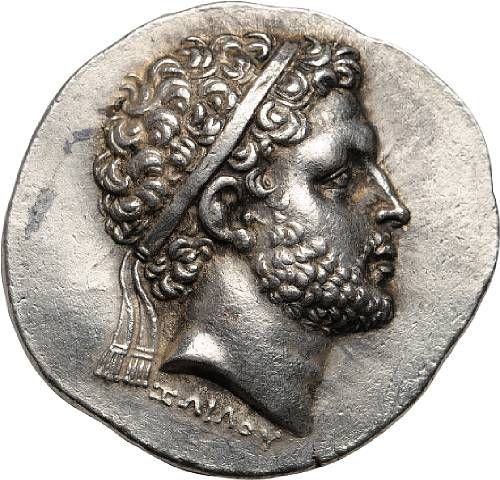
The sibling rivalry between Perseus and Demetrius culminates in Perseus accusing Demetrius on a false charge of parricide (among others) and an attempt to seize the throne. Demetrius, was done in by both his paranoid father, his unkind brother, and good relationship to the Roman people.
Philip, old and overcome by grief (I guess that happens to people when the kill theirj "good" kid), because he killed Demetrius plans for the punishment of Perseus and desires for his friend Antigonus to succeed to the Macedonian throne, but he dies too soon and Perseus becomes the new king of Macedonia.
Book 41 sees the fire in temple of Vesta going out. Livy LOVES auspices, omens, portents, and signs. Rome fights and subdues a bunch of people (the Celtiberians, Ligurians, Histrians, Sardinians, [and in Spain] the Vaccaei and Lusitanians).
In Macedonian King Perseus, son of Philip, sends an embassy to the Carthaginians and making diplomatic overtures to the other states of Greece.
Book 42 sees Q. Fulvius Flaccus stripping the temple of Juno Lacinia of its marble tiles, in order to roof a temple which he was dedicating. The senate orders the tiles to be taken back (but nobody knows how to put them back on, so they just leave them in the temple). Eumenes, king of Asia, complains about Perseus. Rome declares war against Perseus and Macedonia. P. Licinius Crassus, the new consul, is placed in command. He goes to Macedonia and fights with Perseus in Thessaly. Envoys from Rome are to request the allied states and kings remain loyal, the Rhodians waver. Book 42 details the campaigns against the Corsicans and Ligurians (think Genoa).
One thing I love (in this book and others) is how fixated Livy is with auspices, portents, three-legged cows, and the drowning of hermaphrodite babies. I think part of it goes back to understanding Livy was writing from a period in Roman History where Rome was starting to become fairly superficial with its practice of religous rites and was trying to encourage his modern readers to take some of the sacred (temples, gods, rites) more serious.
Well written book about the story of Rome. Livy does a good job in being a humble author who tries to give several accounts about controversial topics within Rome's history. The book is genuinely a book about "collections of the Town".
This volume has the crescendo of one pentad and the start of another. Ignore the volume divisions in this edition and just read pentad by pentad. So just looking at books 41 & 42 things are relatively quiet. It deals with the preparations of Perseus and the Romans for the 3rd Macedonian War and the first clashes of the conflict. There’s a particularly fine description of Perseus’ army. As is usual with Livy I expect things to escalate quickly in the next volume.