

What do you think?

The World Wars #2
The Second World War
In this comprehensive history, John Keegan explores both the technical and the human impact of the greatest war of all time. He focuses on five crucial battles and offers new insights into the distinctive methods and motivations of modern warfare. In knowledgable, perceptive analysis of the airborne battle of Crete, the carrier battle of Midway, the tank battle of Falaise, the city battle of Berlin, and the amphibious battle of Okinawa, Keegan illuminates the strategic dilemmas faced by the leaders and the consequences of their decisions on the fighting men and the course of the war as a whole.
608 pages, Paperback
First published January 1, 1990
About the author
John Keegan
138 books817 followersSir John Desmond Patrick Keegan, OBE, FRSL was a British military historian, lecturer and journalist. He published many works on the nature of combat between the 14th and 21st centuries concerning land, air, maritime and intelligence warfare as well as the psychology of battle.
Ratings & Reviews
Friends & Following
Create a free account to discover what your friends think of this book!
Community Reviews
Displaying 1 - 30 of 164 reviews

December 6, 2012
This book has sometimes been viewed as the best one volume history of World War II.
Well, I wouldn't argue with that, at least regarding readability. There is no doubt that Keegan is one of the best military historians of the second half of the last century, particularly in the area of “accessible” books. He avoids writing thousand-page tomes in which every other sentence is foot-noted, instead using a style which is appealing to those readers, like me, who are more interested in the big story than in the minutiae. (This is not to slight Keegan’s academic credentials. But rather than a “research” historian, he is a teacher who is also a very fine writer; he held a lectureship at the Royal Military Academy Sandhurst (the British West Point) for many years. Thus Keegan is not only familiar with military history, but also with the modern military itself.)
The book is divided into a Prologue and six Parts. The Prologue (over 40 pages) is comprised of two chapters, Every man a soldier and Fomenting world war. In the former, Keegan examines not the causes of the war (actually, of both World Wars), but rather the nature of these conflicts (the most destructive wars in human history), and the factors which, during the 19th century, led to the rise of the military establishments in place at the end of that century. The second chapter examines events in Europe (primarily in Germany) in the years immediately preceding the outbreak of the War. (This chapter, curiously, has no reference whatsoever to the Spanish Civil War!)
The Parts of the book (each of which is made up of from three to seven chapters) treat the three main theaters of the war (Western Europe, Eastern Europe, and the Pacific) in two time periods: first all three theaters in the years up to 1943, then each theater from 1943 to 1945. Parts II through VI (East 1, Pacific 1, West 2, East 2, Pacific 2) are introduced with a chapter about the "strategic dilemma" faced by one of the supreme leaders. These chapters are insightful summaries of the choices that had to be made at that stage of the war by that particular leader. The leaders featured in these introductory chapters are Hitler, Tojo, Churchill, Stalin and Roosevelt, respectively.
Clearly, the narratives of these Parts are lacking in some detail, since at an average of less than 100 pages each, and with quite a few maps and (excellent) photographs thrown in, there simply isn't room for massive detail. But Keegan, being a teacher, is a very good summarizer; and he does selectively delve into specific theater-level battles and other themes in more depth. In the next section we’ll see an example of the sort of detail that Keegan presents when he feels it’s needed.
Stalingrad
In Part II (Eastern front, 1941-43), Keegan covers the siege of Stalingrad (August ’42 to January ’43) in a brief ten pages. But in these pages he is able to convey the enormity of the event, and to detail the specific blunders attributable to Hitler which led to the debacle for the Axis armies. Stalingrad was, of course, the single conflict which most sealed the fate of the Axis on that front of the war. I’ve read both non-fiction (Stalingrad The fateful siege) and fictional (Life and Fate) accounts of Stalingrad, and while these books tell the story in far more detail, Keegan’s account is still a very good one.
I find it both interesting and likeable that Keegan is not above using quotes from other sources. For example, to convey the horror of the struggle in the city, he offers this from the writing of an officer of the 24th Panzer Division, referring to the October fighting:
We have fought for fifteen days for a single house with mortars, grenades, machine-guns and bayonets. Already by the third day fifty-four German corpses are strewn in the cellars, on the landings, and the staircases. The front is a corridor between burnt-out rooms; it is the thin ceiling between two floors. Help comes from neighboring houses by fire-escapes and chimneys. There is a ceaseless struggle from noon to night. From storey to storey, faces black with sweat, we bombed each other with grenades in the middle of explosions, clouds of dust and smoke … Ask any soldier what hand-to-hand struggle means in such a fight. … Stalingrad is no longer a town. By day it is an enormous cloud of burning, blinding smoke ... when night arrives ... the dogs plunge into the Volga and swim desperately to gain the other bank. The nights of Stalingrad are a terror for them. Animals flee this hell; the hardest storms cannot bear it for long; only men endure.Keegan comments that, apart from the “Nietzschean-Nazi rhetoric”, this is not an exaggerated picture, and follows up with a quote from Chuikov, the commander of the Soviet 66th Army:
On October 14 the Germans struck out; that day will go down as the bloodiest and most ferocious of the whole battle. Along a narrow front of four or five kilometers the Germans threw in five infantry divisions and two tank divisions supported by masses of artillery and planes … during the day there were over two thousand Luftwaffe sorties. That morning you could not hear the separate shots or explosions, the whole merged into one continuous deafening roar. At five yards you could no longer distinguish anything, so thick were the dust and the smoke … That day sixty-one men in my headquarters were killed. After four or five hours of this stunning barrage, the Germans started to attack …”
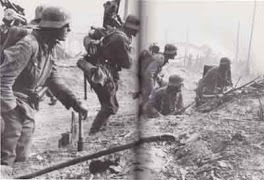
I find the following photo, which appears on the entirety of a two page spread, striking. It shows a German mortar crew preparing to advance during the Stalingrad battle. This photo has quite obviously not been staged, it was taken by some Army photographer during the battle. Particularly interesting is the soldier in the foreground. On his face you can read apprehension, a certain determination, and perhaps a sort of blank awe at what they are about to embark on. I wonder … how long did these men live? Which one of them died first? Did any survive the war? If so, what would they have remembered of this episode in their lives? Would I have ever enjoyed sitting down with a mug of beer and listening to them talk about it? Or would their brutal words have disgusted and horrified me? Somehow all I see in the picture is soldiers; but cameras sometimes lie, don't they?!
A little further on is this iconic looking photo
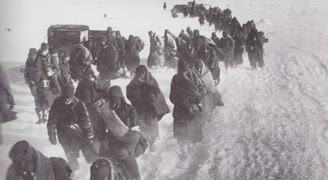
which shows some of the 110,000 remnants of the Sixth Army marching into “captivity” in January 1943. Few of these men survived transport and imprisonment. The official reaction in Germany was “measured”. Keegan notes that for three days normal broadcasting by German state radio was suspended, with the solemnity of Bruckner’s Seventh Symphony being transmitted instead; and he concludes by observing “When next Chuikov and his soldiers fought a battle for a city, it would be in the streets of Berlin.”
Wrap up
In summation, this is a great, and very readable, overview of World War II. At over 500 pages it isn’t a short read, but I don’t recall slogging through this at all. It carries you along pretty nicely, even though much of the narrative is not exactly suspenseful. As hopefully shown above, there are great photos in the book. The index is serviceable, and the many maps are usually helpful. (Personally, I thought that some of the maps could have stood a bit of redesign by Edward Tufte, but what couldn’t?)

November 14, 2019
Historian John Keegan packed all of the Second World War in one book of 595 pages and did it well. Granted, there were certain battles that were shortchanged or not mentioned at all but that is bound to happen when both the European and Pacific theaters are being covered. He divides the book into each theater and gives fairly short but concise histories of how Germany and Japan planned for war and why. And, thank heavens, he provides maps for the major events such as Operation Barbarossa and the Japanese southern drive.
This is a book which should be read as a preface for books on specific aspects of WWII and is a good place for the novice to begin. It is the "big picture" of the war and the writing is fluid and interesting. I would recommend it.
This is a book which should be read as a preface for books on specific aspects of WWII and is a good place for the novice to begin. It is the "big picture" of the war and the writing is fluid and interesting. I would recommend it.

October 9, 2015
My first serious introduction to WWII, read in 2015. John Keegan in The Second World War gives the reader an excellent and balanced one-volume analysis of this crucial historical conflict. At 500 plus pages, it is not a short read. However, it is presented with a clear prose and provided me, as a beginner, enough material to understand the events and inspired me for further readings.

June 19, 2014
John Keegan gives a clear, comprehensive survey of WWII. If you're unclear about the era of WWII, read Keegan's Second World War before going to Rick Atkinson's Liberation Trilogy, which is much more detailed. Then go to the biographies of world leaders of the time. Finally, study individual battles and other aspects of the war. Such a study is essential for all students of history, and everyone should be a lifelong student of history.

March 1, 2008
This is an excellent one volume telling of the Second World War, within its historical context, with a heavy emphasis on the strategic questions and decisions faced by the political and military high commands of the five major powers (Keegan doesn't consider Italy a major power). A long-time instructor at Sandhurst in Britain, Keegan brings to this work an ability to link the conflict within the historical flow of Europe and modern Asia, going as far back as time of Charlemagne, but especially emphasizing how the rise of Prussia in the 1700's led to the awful events of 1939 - 1945.
The center of the conflict, for Keegan, especially to the awful nature that led all sides to jump all in the worst war in human history, was with Hitler. While German militarism and its failure after World War I was the fuel for WWII, it simply would not have happened were it not for Hitler's fantasies of German expansion and superiority. Told in about 600 pages, the writing is tight and points, loaded with meaning are made so quickly and often so well, that the reader does not notice until later. That the Nazi's rose so quickly and led a populace so willing seemed surprising at the time, but in the context that Keegan puts it into, does not seem surprising at all.
The book is divided into five sections, with initial section chapters about the strategic dilemmas faced by the leaders of the five great powers at different phases of the war. As a result, Keegan places a heavy emphasis on strategy, command and control, supply chain management and home front economics and he makes all of that very interesting. So the reader will not get a shot by shot retelling of every battle. For example, the month long blood bath on Iwo Jima gets just a couple of paragraphs, but the reader will come away with a greater understanding of why Iwo Jima was fought, and what its fall to the Americans meant to the rest of the war.
Some reviewers have criticized Keegan for writing too much about the European War, in comparison to the Pacific War, and in a one volume, six hundred page book, choices did have to be made. But in this case, it seems a proportional emphasis on Europe, especially the Eastern front war between the Soviets and the Germans was right. Over 600 armed divisions fought between 1941 and 1945 in the east, with over 10 million dead. Excluding the Japanese military occupation of China, less than 20 total armed divisions fought the Pacific War, not including naval forces.
For a reader wanting a well-written, one volume account of World War II, where the conflict is placed in historical conflict, Keegan's book cannot be more highly recommended.
The center of the conflict, for Keegan, especially to the awful nature that led all sides to jump all in the worst war in human history, was with Hitler. While German militarism and its failure after World War I was the fuel for WWII, it simply would not have happened were it not for Hitler's fantasies of German expansion and superiority. Told in about 600 pages, the writing is tight and points, loaded with meaning are made so quickly and often so well, that the reader does not notice until later. That the Nazi's rose so quickly and led a populace so willing seemed surprising at the time, but in the context that Keegan puts it into, does not seem surprising at all.
The book is divided into five sections, with initial section chapters about the strategic dilemmas faced by the leaders of the five great powers at different phases of the war. As a result, Keegan places a heavy emphasis on strategy, command and control, supply chain management and home front economics and he makes all of that very interesting. So the reader will not get a shot by shot retelling of every battle. For example, the month long blood bath on Iwo Jima gets just a couple of paragraphs, but the reader will come away with a greater understanding of why Iwo Jima was fought, and what its fall to the Americans meant to the rest of the war.
Some reviewers have criticized Keegan for writing too much about the European War, in comparison to the Pacific War, and in a one volume, six hundred page book, choices did have to be made. But in this case, it seems a proportional emphasis on Europe, especially the Eastern front war between the Soviets and the Germans was right. Over 600 armed divisions fought between 1941 and 1945 in the east, with over 10 million dead. Excluding the Japanese military occupation of China, less than 20 total armed divisions fought the Pacific War, not including naval forces.
For a reader wanting a well-written, one volume account of World War II, where the conflict is placed in historical conflict, Keegan's book cannot be more highly recommended.

October 26, 2011
This would be the text to start finding out about WW2 if you knew absolutely nothing about the subject. Unfortunately people under the age of 30, 35 (?) haven't got a clue so that's a lot of people.
With such a broad topic and many historical controversies faced head on by Keegan this book could have had a nightmare structure. It could have been rambling, discursive mess. The book is superbly paced and structured. The controversies such as why Hitler attacked the USSR, failure or success of strategic bombing, why the second front took so long and how the strategic aims of the Axis were bound to fail are all discussed and analyzed.
I would have given this 5 stars except that Keegan has an occasional lapse of prose style. It only happened 2 or 3 times but the passages in question I had to read several times to get the full meaning.
There is another bigger problem. Although Keegan gives a generally fair summation of the various historical schools of thought about the war he really falls down in not giving a political and/or economic explanation. The periodic economic crises of European capitalism are not by themselves an explanation. There is a lame attempt to connect the Napoleonic Wars with economic change. Too bad the most dynamic economic power, namely Great Britain was not the most politically revolutionary power namely France.
He generally comes down on the side that says that WW2 was a continuation of WW1. There was nothing inevitable about WW2 though. Germany could have, and the allies were willing, to let her be the dominant but not dominating state in Europe. Instead there is a long bow drawn from the citizen soldier armies created by Napoleon and copied by the rest of Europe and the orgy of destruction visited upon the continent between 1914 and 1945.
There was a failure of politics, particularly Liberal politics and how creaking multinational empires did not deal adequately with the nationality question. In the twenties and thirties discredited ruling classes (yes I am looking at you Italy and Germany) threw in their lot with what they considered to be controllable radical right parties. Too bad they took over the state and either sidelined the traditional ruling classes or cowered them into acquiescence. This should have been addressed by Keegan.
Maybe my generation and older should just stop about the war. Our world was created by the war but so often the wrong conclusions are drawn. "Lets attack Iran". "He is just like Hitler" etc. I have read a lot about WW2 the last year and I am a little bit over it, so no more for me.
With such a broad topic and many historical controversies faced head on by Keegan this book could have had a nightmare structure. It could have been rambling, discursive mess. The book is superbly paced and structured. The controversies such as why Hitler attacked the USSR, failure or success of strategic bombing, why the second front took so long and how the strategic aims of the Axis were bound to fail are all discussed and analyzed.
I would have given this 5 stars except that Keegan has an occasional lapse of prose style. It only happened 2 or 3 times but the passages in question I had to read several times to get the full meaning.
There is another bigger problem. Although Keegan gives a generally fair summation of the various historical schools of thought about the war he really falls down in not giving a political and/or economic explanation. The periodic economic crises of European capitalism are not by themselves an explanation. There is a lame attempt to connect the Napoleonic Wars with economic change. Too bad the most dynamic economic power, namely Great Britain was not the most politically revolutionary power namely France.
He generally comes down on the side that says that WW2 was a continuation of WW1. There was nothing inevitable about WW2 though. Germany could have, and the allies were willing, to let her be the dominant but not dominating state in Europe. Instead there is a long bow drawn from the citizen soldier armies created by Napoleon and copied by the rest of Europe and the orgy of destruction visited upon the continent between 1914 and 1945.
There was a failure of politics, particularly Liberal politics and how creaking multinational empires did not deal adequately with the nationality question. In the twenties and thirties discredited ruling classes (yes I am looking at you Italy and Germany) threw in their lot with what they considered to be controllable radical right parties. Too bad they took over the state and either sidelined the traditional ruling classes or cowered them into acquiescence. This should have been addressed by Keegan.
Maybe my generation and older should just stop about the war. Our world was created by the war but so often the wrong conclusions are drawn. "Lets attack Iran". "He is just like Hitler" etc. I have read a lot about WW2 the last year and I am a little bit over it, so no more for me.

November 10, 2015
John Keegan is most likely the pre-eminent military historian in the English speaking world. One of the things I appreciate, about his writing, is he does not try to overwhelm the reader with details. Many historians seem to want to impress the reader with their research. Even Keegan's bibliography is limited to 50 books which he describes in a three page summary at the back of the book.
I thought I knew all there was to know about WWII. Wrong! I learned more about the Eastern Front between Russia and Germany than I expected to. I also was exposed to Keegan's insights on a number of events that I had the wrong idea about. Among the myths about the war that Keegan explodes are the battle for Crete, the Japanese allocation of troops to China versus the islands, Hitler's Balkan strategy, the effectiveness of carpet bombing, the contribution of the various resistance movements to the war effort, Roosevelt's war management style, the reasons for the decision to drop the atomic bomb and others. One of the most surprising conclusions is how much less energy was put into the War against Japan than against Germany. Not that I didn't know that "Germany First" was the Allies, over-all strategy but I had no idea how big the difference was in the allocation of resources and the scope of the war effort.
If you are interested in a manageable, well written, accurate history of WWII, you will find it in this book.
I thought I knew all there was to know about WWII. Wrong! I learned more about the Eastern Front between Russia and Germany than I expected to. I also was exposed to Keegan's insights on a number of events that I had the wrong idea about. Among the myths about the war that Keegan explodes are the battle for Crete, the Japanese allocation of troops to China versus the islands, Hitler's Balkan strategy, the effectiveness of carpet bombing, the contribution of the various resistance movements to the war effort, Roosevelt's war management style, the reasons for the decision to drop the atomic bomb and others. One of the most surprising conclusions is how much less energy was put into the War against Japan than against Germany. Not that I didn't know that "Germany First" was the Allies, over-all strategy but I had no idea how big the difference was in the allocation of resources and the scope of the war effort.
If you are interested in a manageable, well written, accurate history of WWII, you will find it in this book.

January 18, 2018
Picked this up at the sale room at the Hayward, Wisconsin public library last summer.
John Keegan is primarily a military historian, someone familiar to me from other publications. He writes, in my experience, at a level above that of popular historians while still remaining accessible to lay readers willing to think a little bit. This survey of both theatres of WWII does a remarkably good job of outlining the war in only 600 pages. Although English, Keegan impresses me with his relative impartiality in describing the motives and mindsets of the war's principals. He is critical of the German and Soviet dictatorships as such, but such occasional criticism is muted. This truly is a creditable attempt at objective scholarship.
Personally, I found the descriptions of military operations to be often tedious, but such must be expected of an author who teaches at a military academy. More interesting are his treatments of the economic and technological factors of the war.
John Keegan is primarily a military historian, someone familiar to me from other publications. He writes, in my experience, at a level above that of popular historians while still remaining accessible to lay readers willing to think a little bit. This survey of both theatres of WWII does a remarkably good job of outlining the war in only 600 pages. Although English, Keegan impresses me with his relative impartiality in describing the motives and mindsets of the war's principals. He is critical of the German and Soviet dictatorships as such, but such occasional criticism is muted. This truly is a creditable attempt at objective scholarship.
Personally, I found the descriptions of military operations to be often tedious, but such must be expected of an author who teaches at a military academy. More interesting are his treatments of the economic and technological factors of the war.

Want to Read
February 3, 2014http://www.telegraph.co.uk/news/world...
Description: This is the unabridged reading of "The Second World War" by John Keegan. The book was published in 1989, and this audio book was produced by Books on Tape, Inc in 1990 and has 6 parts and 33 chapters. Read by Bill Kelsey.
TABLE OF CONTENTS
PROLOGUE
Chapter 1: Every Man a Soldier
Chapter 2: Fomenting World War
PART I: THE WAR IN THE WEST 1940-1943
Chapter 3: The Triumph of Blitzkrieg
Chapter 4: Air Battle: The Battle of Britain
Chapter 5: War Supply and the Battle of the Atlantic
PART II: THE WAR IN THE EAST 1941-1943
Chapter 6: Hitler's Strategic Dilemma
Chapter 7: Securing the Eastern Springboard
Chapter 8: Airborne Battle: Crete
Chapter 9: Barbarossa
Chapter 10: War Production
Chapter 11: Crimean Summer, Stalingrad Winter
PART III: THE WAR IN THE PACIFIC 1941-1943
Chapter 12: Tojo's Strategic Dilemma
Chapter 13: From Pearl Harbor to Midway
Chapter 14: Carrier Battle: Midway
Chapter 15: Occupation and Repression
Chapter 16: The War for the Islands
PART IV: THE WAR IN THE WEST 1943-1945
Chapter 17: Churchill's Strategic Dilemma
Chapter 18: Three Wars in Africa
Chapter 19: Italy and the Balkans
Chapter 20: Overlord
Chapter 21: Tank Battle: Falaise
Chapter 22: Strategic Bombing
Chapter 23: The Ardennes and the Rhine
PART V: THE WAR IN THE EAST 1943-1945
Chapter 24: Stalin's Strategic Dilemma
Chapter 25: Kursk and the Recapture of Western Russia
Chapter 26: Resistance and Espionage
Chapter 27: The Vistula and the Danube
Chapter 28: City Battle: The Siege of Berlin
PART VI: THE WAR IN THE PACIFIC 1943-1945
Chapter 29: Roosevelt's Strategic Dilemma
Chapter 30: Japan's Defeat in the South
Chapter 31: Amphibious Battle: Okinawa
Chapter 32: Super-Weapons and the Defeat of Japan
Chapter 33: The Legacy of the Second World War
Description: This is the unabridged reading of "The Second World War" by John Keegan. The book was published in 1989, and this audio book was produced by Books on Tape, Inc in 1990 and has 6 parts and 33 chapters. Read by Bill Kelsey.
TABLE OF CONTENTS
PROLOGUE
Chapter 1: Every Man a Soldier
Chapter 2: Fomenting World War
PART I: THE WAR IN THE WEST 1940-1943
Chapter 3: The Triumph of Blitzkrieg
Chapter 4: Air Battle: The Battle of Britain
Chapter 5: War Supply and the Battle of the Atlantic
PART II: THE WAR IN THE EAST 1941-1943
Chapter 6: Hitler's Strategic Dilemma
Chapter 7: Securing the Eastern Springboard
Chapter 8: Airborne Battle: Crete
Chapter 9: Barbarossa
Chapter 10: War Production
Chapter 11: Crimean Summer, Stalingrad Winter
PART III: THE WAR IN THE PACIFIC 1941-1943
Chapter 12: Tojo's Strategic Dilemma
Chapter 13: From Pearl Harbor to Midway
Chapter 14: Carrier Battle: Midway
Chapter 15: Occupation and Repression
Chapter 16: The War for the Islands
PART IV: THE WAR IN THE WEST 1943-1945
Chapter 17: Churchill's Strategic Dilemma
Chapter 18: Three Wars in Africa
Chapter 19: Italy and the Balkans
Chapter 20: Overlord
Chapter 21: Tank Battle: Falaise
Chapter 22: Strategic Bombing
Chapter 23: The Ardennes and the Rhine
PART V: THE WAR IN THE EAST 1943-1945
Chapter 24: Stalin's Strategic Dilemma
Chapter 25: Kursk and the Recapture of Western Russia
Chapter 26: Resistance and Espionage
Chapter 27: The Vistula and the Danube
Chapter 28: City Battle: The Siege of Berlin
PART VI: THE WAR IN THE PACIFIC 1943-1945
Chapter 29: Roosevelt's Strategic Dilemma
Chapter 30: Japan's Defeat in the South
Chapter 31: Amphibious Battle: Okinawa
Chapter 32: Super-Weapons and the Defeat of Japan
Chapter 33: The Legacy of the Second World War

May 12, 2009
This book's a brick but Keegan gives the heavy matter readability with clear prose and the right amount of jargon for non-war buffs such as myself. It is a great, balanced, one-volume description of WWII which provides enough material for the reader to understand the events and gives plenty of ideas for further reading on the subject.
It was exactly what I was after: a comprehensive history of the war with details of the political strategies of the heavyweights and details of indicative battles, with a few splashes of what was happening on the ground to keep it in context. I loved the anecdotes and excerpts from diaries and other sources. The only time the pace slackened for me was during the descriptions of movements in Russian territories that my lack of geog knowledge couldn't picture. Perhaps a couple more maps would not have gone astray?
Highly recommended.
It was exactly what I was after: a comprehensive history of the war with details of the political strategies of the heavyweights and details of indicative battles, with a few splashes of what was happening on the ground to keep it in context. I loved the anecdotes and excerpts from diaries and other sources. The only time the pace slackened for me was during the descriptions of movements in Russian territories that my lack of geog knowledge couldn't picture. Perhaps a couple more maps would not have gone astray?
Highly recommended.

November 30, 2017
I was expecting a general history of world war 2 but it is a military history which is difficult to understand.

June 5, 2021
A detailed and a balanced book on WW2. I had bought this book from US way back in 2007. I finally started reading it at the start of this year and just finished it today. It is indeed a comprehensive book detailing one of the most devastating events of the 20th century.
The only thing I found strangely missing from this book was that there wasn't much information on the holocaust. It's strange as this heinous act was one on which hundreds of books have been written about, directly or indirectly. Probably the reason why it was left out from this one.
I would recommend this book to people who want to understand the battle tactics in some detail. For others who may want in overview of the who, what and where...look somewhere else.
The only thing I found strangely missing from this book was that there wasn't much information on the holocaust. It's strange as this heinous act was one on which hundreds of books have been written about, directly or indirectly. Probably the reason why it was left out from this one.
I would recommend this book to people who want to understand the battle tactics in some detail. For others who may want in overview of the who, what and where...look somewhere else.

May 31, 2018
Wow! This was not the book I had in mind for learning more about WWII. For some reason I thought it was 150 pages, not 600. However, I muddled through and sometimes skimmed a bit. There was far more detail than I was even interested in but occasionally that was good as I learned quite a bit. In the end I was astonished that any writer would undertake such a task. Just a bit of heavy reading to start the summer. Now on to lighter things ....

December 18, 2020
This was one of the best general overviews of the Second World War that I have read. When it comes to military history, you can't go wrong with John Keegan.

December 21, 2024
Eine sehr lesbare einbändige Übersichtdarstellung des zweiten Weltkrieges.

December 30, 2010
All right. I now know much more about WWII than I did previously. What is really interesting about this book is how unromantic it is for the most part--a lot of the rhetoric about WWII is uber-romantic, and perhaps deservedly so, but Keegan hammers home again and again (and again) that won is really won by the cold hard realities of who has the most men, the biggest guns, the best tanks (there is a LOT of writing about tanks in this book) and the best strategies. Reading about the strategies was the best part, although I was lost during many of the sections when he was describing troops movements and who flanked whom, etc. But interesting to learn about why Churchill and Roosevelt and Stalin made some of the decisions they did, and exactly how and why Hitler had his meltdown, and the very very sad fate of Japan. This is a monster of a book, and I eventually decided that trying to read it before bed was not good for me. Now I will give it back to my father and perhaps choose one of the other 100 books he has about WWII to read. Or perhaps not.
August 12, 2009
Usual Keegan, which is not a bad thing, but this seemed a weaker (or perhaps just more hurried?) effort than his other books. The first couple of chapters are amazing in setting a broad scope for exactly how a terrible event such as the second World War can come about in civilization. The rest was a good overview of the conflict in general. While some subjects, either ignored or poorly reviewed in other works, were covered in satisfying detail (although still brief given the overall scope of the work), such as the impact of partisans on the war, other sectors of the conflict seemed to get pushed aside - for example, more details on events in China and Burma would have been appreciated. Finally, what holds this book (or at least this edition) back were numerous, obvious typographical errors, and the occasional confusion of facts (e.g., the Ploesti oil fields are in Romania, not Hungary).
September 4, 2009
This is a 600-page summary of the most important conflict in modern history, so it's bound to disappoint some. Iwo Jima and Okinawa are dealt with in a few pages; The Battle of the Bulge gets five. But the opening chapters describing the factors leading up to the war are an invaluable synopsis. My biggest complaint is that Keegan spends too much time on less interesting, and arguably less important theaters of war, like North Africa, and too little on topics like the Manhattan Project and the Holocaust. But if you're looking for an easy-to-read refresher course on World War II, like I was, I'm not sure there are better options than this.

June 16, 2020
On the advice of my ex-Marine father and a variety of friends, I picked this as the one-volume history of WWII to dive into, and with some significant reservations, I'd say their advice was sound. Keegan takes an extraordinarily complex subject and devises a clear and engaging strategy for presenting it to a lay audience. After offering a prologue to explain the war's causes and Hitler's opening advances, he divides the war in half chronologically (1940-43 in the first half, 1943-45 in the second) and considers three theaters in each time period: Western Europe, Eastern Europe, and the Pacific. Within each section, he takes a chapter to address the strategic concerns of a major leader (Hitler, Tojo, Churchill, Stalin, and FDR) and others to consider related conflicts (Africa, the Balkans) and broader topics (industrial supply, strategic bombing, espionage, occupation, etc.). In addition, each section has a chapter focusing on a single battle of a particular type: the aerial conflict of the Battle of Britain, the carrier engagement of Midway, the airborne battle of Crete, etc.
It's a sound strategy, providing a clear context and a view of the interrelations between the elements, which is ideal for a reader like me who has studied the broadest strokes of WWII but has read in depth about only certain elements of the war (such as the Holocaust, the Battle of Britain, the bombing of Dresden, or the sinking of the USS Indianapolis.) Getting all of this boiled down into a single volume of 600 pages, with plentiful photos and maps, is extraordinarily helpful, and there are times (the chapter on Midway, for example) when Keegan is able to engage the reader with a closer look at a key moment in order to keep his momentum through the enormous sea of details in which he must swim.
But as I said, I do have a few reservations. One is not at all Keegan's fault: the maps provided have only limited connections to the text. Often the narrative will mention a particular town or region as a place of significance, but that place will not be shown on the accompanying map. There is, for example, a large map of Okinawa, but the inset that is supposed to show the island's position relative to Japan does not indicate which of the tiny white dots below Japan is Okinawa. Most frustrating is the placement of lines and arrows, which are supposed to show the positions and movements of the opposing forces. The lines are plentiful, but again, not always clearly linked to the events described, and the arrows are all but useless because the maps are in black and white. The Axis movements are printed in black, the Allied movements in very dark grey; if you're not reading under the brightest of lights, you will have difficulty distinguishing them.
The other issues, however, are entirely Keegan's responsibility. The first involves the final section on the Pacific War, which has none of the vigor of the earlier sections. You can almost feel his enthusiasm waning after the fall of Berlin. It's also a bit annoying that while he's able to devote several pages to the siege of Berlin, Hitler's final days in the Bunker, and even the fate of the city's zoo animals, when it comes to the crucial amphibious battle of Okinawa, Keegan musters barely a dozen pages, nearly half devoted to maps and photos.
There's also the matter of Keegan's prose style, which might politely be called "Dickensian." Intervening phrases and clauses are the norm, semicolons are plentiful, and on occasion a verb and its subject may find themselves not only some distance apart, but quite possibly in different theaters of the war. For example, consider this sentence from Chapter 1:
It was not at all unusual for me to find myself re-reading a sentence several times in order to coax out its meaning, which was not always a welcome development. I was also frustrated by Keegan's tendency to identify or even list specific military units by number rather than name, leadership, or location; this might have been a great tool for establishing accuracy (especially if good maps had been provided) but not always for understanding. This numerical style may be common practice for professional military historians, but for a lay reader, it can be like a summary of a football game where all the players are identified only by jersey number, not by name or even team. "With 22 seconds left, 12 attempted a pass to 33, who was defended by 31; the ball bounced off either the helmet of 31 or the hands of 33, only to be caught by 32, who ran it in for a touchdown." That wouldn't be the most memorable or stirring account of the Immaculate Reception.
All in all, I'm glad to have read Keegan's history, which has certainly helped me to understand WWII in far greater depth and breadth than before. I do think there are reasons why a reader might search for a different history, but at the very least, this one will give you an idea of which topics to study in the future.
It's a sound strategy, providing a clear context and a view of the interrelations between the elements, which is ideal for a reader like me who has studied the broadest strokes of WWII but has read in depth about only certain elements of the war (such as the Holocaust, the Battle of Britain, the bombing of Dresden, or the sinking of the USS Indianapolis.) Getting all of this boiled down into a single volume of 600 pages, with plentiful photos and maps, is extraordinarily helpful, and there are times (the chapter on Midway, for example) when Keegan is able to engage the reader with a closer look at a key moment in order to keep his momentum through the enormous sea of details in which he must swim.
But as I said, I do have a few reservations. One is not at all Keegan's fault: the maps provided have only limited connections to the text. Often the narrative will mention a particular town or region as a place of significance, but that place will not be shown on the accompanying map. There is, for example, a large map of Okinawa, but the inset that is supposed to show the island's position relative to Japan does not indicate which of the tiny white dots below Japan is Okinawa. Most frustrating is the placement of lines and arrows, which are supposed to show the positions and movements of the opposing forces. The lines are plentiful, but again, not always clearly linked to the events described, and the arrows are all but useless because the maps are in black and white. The Axis movements are printed in black, the Allied movements in very dark grey; if you're not reading under the brightest of lights, you will have difficulty distinguishing them.
The other issues, however, are entirely Keegan's responsibility. The first involves the final section on the Pacific War, which has none of the vigor of the earlier sections. You can almost feel his enthusiasm waning after the fall of Berlin. It's also a bit annoying that while he's able to devote several pages to the siege of Berlin, Hitler's final days in the Bunker, and even the fate of the city's zoo animals, when it comes to the crucial amphibious battle of Okinawa, Keegan musters barely a dozen pages, nearly half devoted to maps and photos.
There's also the matter of Keegan's prose style, which might politely be called "Dickensian." Intervening phrases and clauses are the norm, semicolons are plentiful, and on occasion a verb and its subject may find themselves not only some distance apart, but quite possibly in different theaters of the war. For example, consider this sentence from Chapter 1:
Extraneous factors--gross disparity in the opposed technologies of war-making or in the dynamism of opposed ideologies, or, as Professor William McNeill has suggested, susceptibility to unfamiliar germ strains transported by an aggressor--had usually explained one society's triumph over another; and they certainly underlay such military sensations as the Spanish destruction of the Aztec and Inca empires, the Islamic conquests of the seventh century and the American extinction of Red Indian warriordom.
It was not at all unusual for me to find myself re-reading a sentence several times in order to coax out its meaning, which was not always a welcome development. I was also frustrated by Keegan's tendency to identify or even list specific military units by number rather than name, leadership, or location; this might have been a great tool for establishing accuracy (especially if good maps had been provided) but not always for understanding. This numerical style may be common practice for professional military historians, but for a lay reader, it can be like a summary of a football game where all the players are identified only by jersey number, not by name or even team. "With 22 seconds left, 12 attempted a pass to 33, who was defended by 31; the ball bounced off either the helmet of 31 or the hands of 33, only to be caught by 32, who ran it in for a touchdown." That wouldn't be the most memorable or stirring account of the Immaculate Reception.
All in all, I'm glad to have read Keegan's history, which has certainly helped me to understand WWII in far greater depth and breadth than before. I do think there are reasons why a reader might search for a different history, but at the very least, this one will give you an idea of which topics to study in the future.

November 24, 2007
A magisterial work. The only thing I would have liked from the book was more discussion of the Battle of the Atlantic, but otherwise I have no complaints. The framing of the book as a series of strategic dilemmas for the major leaders is a simple but effective way of bringing order to a notoriously complex period in history. I can tell why this book made Keegan's career, and it's considerably better than his history of the First World War.

July 30, 2009
John Keegan is a much better historian than this book would suggest. It seemed to me as if it had been thrown together in a weekend to catch the 50th anniversary of WW II celebration and sales bonanza. It is a tired rehash of every bit of conventional wisdom and popular legend about the war, many of which have been discarded by the historical community for decades. It's disheartening that Keegan didn't notice that.
September 10, 2013
A brilliant book that got bogged down midway, somewhat akin to Montgomery`s ponderous assault on Sicily. I simply can`t believe that Keegan rewrote history by leaving out Patton`s assault on Berlin completely out of the picture. Granted he did not like the General, but such an injudicious deletion is inexcusable.
March 28, 2023
It is a classic of WW2 history. Lots of military and political strategy but very little on the social or domestic side of things. Maybe 2 pages about the Holocaust but I could be wrong. Prose is a bit stuffy so the voice in my head that I used when I read it was of an upper crust white Englishman.
October 16, 2017
First and foremost about John Keegan's volume on WWII is that, for him, WWII is a continuation of the first. In the first book I found this comparison annoying as the first war was not dependent on the second. Of course, because the second started from irrationally pursuing a means of reversing the outcome of the first world war, this notion was more appropriate in the second volume.
The book itself flows somewhat smoothly and does cover the fronts in the west, the east, and Pacific. The broad overview covered quite a sum of information presents a somewhat contiguous timeline. However, I did have a few hangups about this text.
Firstly, like his WWI book, he presents the information from a British perspective. At first, I assumed this was solely because he had certain biases, but perhaps it is because his expertise really is just his native country's role. That said, he tends to overestimate his country's role, especially in the Pacific (the battle of Britain was a huge success that they deserve every credit for). However, he does otherwise stay relatively unbiased even toward combatants typically seen as despots even giving Stalin and Hitler their fair share of credit.
Another thing I would've liked to have been present is a much larger "implications and legacies of ww2" section. The entirety of the Holocaust was explained in just a few sentences and minimized to the "20th century germans really hated Jews" factoid. The Russian policy of killing their own was covered in a one sentence summation. The Japanese habit of mutilating the Chinese wasn't talked about. Likewise, the American internment of its own Japanese heritage citizens was not even mentioned. All of these attrocities were pivotal to how war should henceforth be viewed, but Keegan often summarizes these events with the words "brutal mistreatment".
Overall, a good book but some major events and key components saw very little explanation.
The book itself flows somewhat smoothly and does cover the fronts in the west, the east, and Pacific. The broad overview covered quite a sum of information presents a somewhat contiguous timeline. However, I did have a few hangups about this text.
Firstly, like his WWI book, he presents the information from a British perspective. At first, I assumed this was solely because he had certain biases, but perhaps it is because his expertise really is just his native country's role. That said, he tends to overestimate his country's role, especially in the Pacific (the battle of Britain was a huge success that they deserve every credit for). However, he does otherwise stay relatively unbiased even toward combatants typically seen as despots even giving Stalin and Hitler their fair share of credit.
Another thing I would've liked to have been present is a much larger "implications and legacies of ww2" section. The entirety of the Holocaust was explained in just a few sentences and minimized to the "20th century germans really hated Jews" factoid. The Russian policy of killing their own was covered in a one sentence summation. The Japanese habit of mutilating the Chinese wasn't talked about. Likewise, the American internment of its own Japanese heritage citizens was not even mentioned. All of these attrocities were pivotal to how war should henceforth be viewed, but Keegan often summarizes these events with the words "brutal mistreatment".
Overall, a good book but some major events and key components saw very little explanation.
May 24, 2023
Just finished reading "WW2" by John Keegan. A dear friend of mine recommended this book and at one point I realised why (hint: its laborious to read at first)
Now, i am not usually into these types of books.
I am I glad I did.
The part about the Siege of Berlin was particularly intense and vivid.
It reminded me of the times when I used to play "Call of Duty: World at War," reliving those heart-pounding moments.
I could still remember the quotes that used to flash once you used to die.
....'only dead have seen the end of war'...
From diffusing V2 rockets to experiencing the Normandy landing, it was like stepping back into those virtual battles. Once those flashbacks came, the read became so much more immersive. I felt like I was there. It made me appretiate the writing style of Keegan I could not have done before.
What amazed me even more were the lesser-known aspects of the war that Keegan brought to light. The relentless Kamikaze attacks and the Okinawa offensive.
Additionally, the book explored the scientific advancements that emerged from the war. Did you know the Germans were on the verge of developing advanced aircraft like the A10s? And get this, it took only three weeks from the first nuclear weapon test to its actual detonation. Talk about speed and excitement!
Sure, there were moments where the book slowed down a bit, and I found myself eager to move forward. But completing "WW2" left me with a sense of fulfillment and a newfound appreciation for history. It even sparked the desire to revisit the virtual battlefields of "Call of Duty: World at War" once again.
Now, i am not usually into these types of books.
I am I glad I did.
The part about the Siege of Berlin was particularly intense and vivid.
It reminded me of the times when I used to play "Call of Duty: World at War," reliving those heart-pounding moments.
I could still remember the quotes that used to flash once you used to die.
....'only dead have seen the end of war'...
From diffusing V2 rockets to experiencing the Normandy landing, it was like stepping back into those virtual battles. Once those flashbacks came, the read became so much more immersive. I felt like I was there. It made me appretiate the writing style of Keegan I could not have done before.
What amazed me even more were the lesser-known aspects of the war that Keegan brought to light. The relentless Kamikaze attacks and the Okinawa offensive.
Additionally, the book explored the scientific advancements that emerged from the war. Did you know the Germans were on the verge of developing advanced aircraft like the A10s? And get this, it took only three weeks from the first nuclear weapon test to its actual detonation. Talk about speed and excitement!
Sure, there were moments where the book slowed down a bit, and I found myself eager to move forward. But completing "WW2" left me with a sense of fulfillment and a newfound appreciation for history. It even sparked the desire to revisit the virtual battlefields of "Call of Duty: World at War" once again.

Read
January 16, 2018Having just seen the movie Darkest Hour, and after unpacking the history section of my library after having it stored away in boxes for ten months, I thought I'd jump right into this long, heavy single volume history of World War II. It was given to me as a gift last year, and it's been on my mind since I've been wanting to do a bit of refresher reading with regard to the War.
But. Man. Oh. Man. I made it ten pages in before dropping to my knees in exhaustion. This book is the literary equivalent of molasses. I was reminded of Paul Johnson's A History of the American People. I just couldn't catch the rhythm of the author's writing. His syntax is...let's just say formidable. Clause after clause after clause, strung together in an endless chain of verbosity. I understand that is sort of writing is academic English from the land of the mother tongue, but I find it impossible to read. The thought of wading through 700 pages is simply too overwhelming.
In the old PBS series I, Claudius, young Claudius is sitting between two Roman historians, Pollio and Livy. Pressed by the two men for which he prefers, the stuttering proto-emperor says he read Pollio for interpretation of facts and Livy for beauty of language. It's a funny scene (if you are a history nerd), and I was thinking of poor Claudius as I tried to fight through the first chapter of this book.
But. Man. Oh. Man. I made it ten pages in before dropping to my knees in exhaustion. This book is the literary equivalent of molasses. I was reminded of Paul Johnson's A History of the American People. I just couldn't catch the rhythm of the author's writing. His syntax is...let's just say formidable. Clause after clause after clause, strung together in an endless chain of verbosity. I understand that is sort of writing is academic English from the land of the mother tongue, but I find it impossible to read. The thought of wading through 700 pages is simply too overwhelming.
In the old PBS series I, Claudius, young Claudius is sitting between two Roman historians, Pollio and Livy. Pressed by the two men for which he prefers, the stuttering proto-emperor says he read Pollio for interpretation of facts and Livy for beauty of language. It's a funny scene (if you are a history nerd), and I was thinking of poor Claudius as I tried to fight through the first chapter of this book.

June 1, 2020
What a fantastic one-volume summary! All three theaters (the Western, Eastern and Pacific Fronts) are detailed in a readable and informative manner. You will get a clear sense from reading this as to why the outcome of WWII was the way it was, as John Keegan details the stark contrast between the Allies and the Axis' war economies and industrial efficiency. He also offers well-reasoned challenges to some common though flawed interpretations of the war (did the Ultra intelligence really reduce the length of the war, as is often claimed? did Mussolini really offset Hitler's chances of successfully invading Russia with his own bungled invasion of Greece?) And lastly, there are a couple good etymology lessons here: how grand it is to know that "snorkeling," which we now enjoy for fun at the beach, is a term that originated from the devices used on German U-Boats!
One quick word: if you are a big buff of any one part of the war (D-Day, Iwo Jima, etc.) then you may find that the book doesn't go into that figure or episode as much as you may have hoped. That's simply the result of the task Keegan has taken on by choosing to chronicle the entire war. Still, just about everybody is sure to learn a lot about and get a clearer understanding of World War II by engaging in this fabulous overview.
One quick word: if you are a big buff of any one part of the war (D-Day, Iwo Jima, etc.) then you may find that the book doesn't go into that figure or episode as much as you may have hoped. That's simply the result of the task Keegan has taken on by choosing to chronicle the entire war. Still, just about everybody is sure to learn a lot about and get a clearer understanding of World War II by engaging in this fabulous overview.
May 16, 2019
The Second World War, the very war which entirely changed the world and led to where we are today. The book was excellently written and displayed all of the horrendous events which led up to and occurred during the war. It was very interesting getting to know about all the strings being played in the background as the war was waging, and all the logistic issues pertaining to the Germans on the Eastern Front. I don't think that you could write a book about any other time period in history and make it more interesting than this book now, unless of course John Keegan decided to write about another historical time period. I was able to follow along and actually take in information efficiently, it wasn't all jammed into my head but it told a story to me. One I have always heard again again, but this time it was a new experience, giving me a whole different look of The Second World War. God bless to all the men and women who died serving their country, ally or not innocent people died.
Read
November 13, 2019Aiming for an credible and balanced overview of WWII military events, I completed the reading without alarms going off that my choice had missed the mark. I guess just starting out reading on the subject I really won't know for awhile, nevertheless it was reassuring to think I wasn't distracted by the writing or research (yet). What I did expect to find and what I realized is that I did have many gaps in my understanding of the conflict at even the broadest level. I was glad to read in what was effectively overview of topics avoided elsewhere that touched upon controversial decisions such as the limits of aerial bombardment or sacrificing lives for the greater good. References to available information and relevant commentary, especially contemporary accounts, all of which must be very time-consuming, seemed substantial at this first reading. So I think it was a good choice and I'm glad at this point that I started here.
November 29, 2023
John Keegan tries to tackle the impossible here, and does an admirable job. A complete, in depth history of every aspect of the Second World War would stretch for thousands, if not tens of thousands, of pages. The work on subjects such as the Holocaust alone could fill libraries. With that caveat, John Keegan does well. He keeps himself to 600 pages, divided into five sections. Each section centers around a specific battle and theatre. John Keegan also finds room to devote the occasional chapter to other topics of interest, such as the resistance movement. I particularly appreciated some of John Keegan's insights into the various economies, a topic that can be overlooked.
In short, this is a great book if you want a broad overview of the war or as an introduction for the uninitiated. For in-depth coverage of any particular sub-interest such submarine warfare, the fall of France, or the Manhattan Project, you should choose a more specialized book.
In short, this is a great book if you want a broad overview of the war or as an introduction for the uninitiated. For in-depth coverage of any particular sub-interest such submarine warfare, the fall of France, or the Manhattan Project, you should choose a more specialized book.
Displaying 1 - 30 of 164 reviews