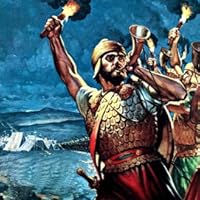
The breathtaking, epic story of the greatest nation in the Forgotten Realms. As Azoun IV, crowned head of Cormyr, lies dying from an assassin's ambush, the political and magical forces of the nation spar to determine the country's future. Agasint the backdrop of impending catastrophe, the history of Cormyr and its ruling family is revealed.
Ed Greenwood is the creator of the Forgotten Realms fantasy world, which became the setting for his home D&D game in 1975. Play still continues in this long-running campaign, and Ed also keeps busy producing Realmslore for various TSR publications.
Ed has published over two hundred articles in Dragon magazine and Polyhedron newszine, is a lifetime charter member of the Role Playing Game Associaton (RPGA) network, has written over thirty books and modules for TSR, and been Gen Con Game Fair guest of honor several times.
In addition to all these activities, Ed works as a library clerk and has edited over a dozen small press magazines.
Invented the character Elminster from the popular Forgotten Realms RPG series. Currently resides in an old farmhouse in the countryside of Ontario, Canada.
Co-authored by Jeff Grubb and Ed Greenwood. When I saw this, I thought, "Please let it be actually written by Grubb, based on Greenwood's concept and that's the only reason why Greenwood got co-billing," but no. It was written half and half. By chapter 4 I'd figured out the pattern: the book alternates chapters between a "present day" storyline and a series of chronological vignettes highlighting key points in the formation and growth of the human kingdom of Cormyr, from a time when the land was ruled by dragons, to the time of the elves, to the earliest human settlements that eventually grew into a proper kingdom, always ruled by the Obarskyr line and supported by a wizard.
The "past" chapters were quite good. Grubb was one of the better TSR staple writers, responsible along with his wife Kate Novak for Azure Bonds, The Wyvern's Spur and others. These linked short stories were varied, fun, and reasonably poignant.
The "present day" storyline was bloated and interminable. Greenwood is in his usual form here with his relentlessly irritating Renaissance Faire style, with the same stock weeping hero and sneering villain personalities that appear in all of his books. Vangerdahast is less bombastic than Elminster but otherwise there's not much space between them. Every magical secret has to have seven layers to it, every scabby noble is overconfident and easily manipulated, and almost every one of his chapters could have been cut. So much time wasted on gossip, incessantly sobbing princesses, shadowy plotting, and goofy unnecessary heroics by third-tier characters. On one level I enjoy how terrible Greenwood's books are, but in the moment they are mostly unbearable.
Or should I say, un-Baerauble? That's just one of hundreds of overwrought character names. Names like Faerlthann Obarskyr; Vangerdahast; the sword Ansrivarr; Darlutheene Ambershields; Blaerla Roaringhorn. At one point the names of 23 noble houses appeared on a single page. It's indistinguishable from Antigua: The Land of Fairies, Wizards and Heroes for the sheer number of named characters and the excessive vowels and awkward letter R in many of them. You might think that since the book covers multiple time periods that of course there would be many characters, but the biggest culprit is simply Greenwood's present time chapters.
There's an easy way to fix this book: limit the present-time chapters to three, five at most. Open with the king having fallen victim to the deadly magical illness; use that to frame the chapters that move through Cormyr's history. Have just one or a couple chapters as interludes detailing the major events in the kingdom brought on by the king's looming expected death. Then when the historical chapters catch up to present time, resolve the story. Greenwood could even still write those parts and it would be tolerable (not that he has shown any ability to write succinctly as this would require).
But no, instead we get by far the longest TSR Forgotten Realms novel up to that point, surpassed only by Evermeet: Island of Elves three years later. Those 100 pages really could have been cut.
At least the next book in my Forgotten Realms novel reading project is one by R.A. Salvatore, the only one in a four-year span because Brian Thomsen alienated most of TSR's writers. If only Ed Greenwood had had anywhere else to go.
Unless you are a AD&D die hard fan... avoid this book at all cost. The plot is UBER repetitive here, basically the history of the Cormyr kingdom thru different generations and all the conspiracies that several noblemen do upon each king. And it is the same again again and again. On parallel there goes the current story about... you guessed it, a conspiracy against king Azoun.
I made the mistake of reading another book from Ed Greenwood, this guy should be banned from writing. And I just want to make people aware to avoid any form of literary piece written by him. Honestly, I felt I wasted my time... don't waste yours!!!!!!!
A decent start to what I hope is a fun trilogy. By no means was this a bad book. Just not what I was looking for at the moment. I know not every "D&d" book is going to be a fighter, cleric, wizard, and rogue busting up goblins and evil cultists but it's what I'm craving. This read more like a history book with every other chapter being in Cormyr's past. Just a tad too much cloak and dagger and not enough sword and sorcery. Would recommend.
There are some good forgotten realms books, and some bad forgotten realms books. The same can be said of the writings of Ed Greenwood. On both counts, this was a solid one.
This first novel in The Cormyr Saga chronicles the history of the Kingdom of Cormyr, and tells the story of the poisoning of King Azoun IV. There are two narratives in this novel. The first is a Edward Rutherford style series of vignettes which highlights important moments in Cormyr's history. The second narrative is a mystery involving the poisoning of the King, and the court intrigues that tale place subsequent. I'd honestly like more epic fantasies to use this technique, it gives you the history of the world, while telling a compelling story.
All the characters are classic Greenwood. there are thrilling dancehall girls, foolishly imperious nobles, and mysterious wizards. There's nowhere near enough character development, but I suspected that there wouldn't be. Greenwood rarely gives his characters enough flesh, but at least in this case the main characters are well known from other Forgotten realms books that preceded this one.
I'm looking forward to the next book, Beyond The High Road, by Troy Denning, an author I'm much more fond of in the Realms in particular, and Sword and Sorcery in general.
Imaginary conversation between TSP and Ed Greenwood.
TSP -- Ed we want to tap into the D & D market.
TSP -- Can you write a history of Comyr and its ruling family.
Ed -- Thats a great idea. I'll write a book about the background of a popular D & D game.
Thats all this novel really is. Its well written because Greenwood and Grubb are good writers but its not a story per se. Its kind of like McCaffrey writing the story of Robinton's life or Eddings writing about Belgarath and Polgara.
I'm not sure how I missed adding this book review when I read it.
I don't recall everything, and I will say that while I've read many of his books and short stories in an attempt to fully immerse myself in Forgotten Realms, I am not a fan of Greenwood's writing.
With that said, I recall really enjoying this book. Some of his best work, as it is choke full of history of Cormyr and a great intro to the rest of the series that takes place in this kingdom.
If you are going to read anything by Greenwood, read this.
This has some very interesting openings. Between dragon and kingdom.
Yet prove to be a very frustrating read. It serves as a current storyline for Cormyr. Then at the same time. Provides a historical timeline for the kingdom.
Which results in a back and forth tale. One chapter current story. Next chapter short story from the past. It bounces back and forth like this. Through the entire novel. Most past tales single or two chapters.
Each introducing new characters. That likely have no bearing on anything. So main story. New characters, setting and time. Next chapter.
Many of these could be very interesting reads. Set up this way makes it a jumble. You just try and keep set apart. Intent may have been to give gamers, a more in depth sketch. Of the characters they may encounter in the game settings.
From a readers stand point. Just made it take longer to get into and read.
Hopefully the next volume in this arc. Will be single story. They have some good concepts of magic, king, and kingdom started. That could pay off very well, as things move forward.
I enjoyed reading this book. It combined the elements of mystery and fantasy literature very well. The book had me spellbound and sitting at the edge of my seat. It was a real page turner.
Unfortunately, this book suffered from two minor flaws. The first flaw was that the book shifted back and forth every chapter between a historic story and the main story. I found myself confused a number of times, thinking that I was reading about one time line, but I was reading about another. The second flaw was that the writing became sloppy towards the end of the book, and the ending itself was truly disappointing and "unbelievable" and there were many loose ends that were left undone.
I just remembered that I read this, back when I was hugely into big, fat fantasy books. However, I don't think I can recall a single character, event, or scene from the whole thing--which is particularly odd for me, since with every other book I've ever read, I at least remember the basic plot and a few choice moments. Clearly this one, beyond all others, was entirely unremarkable.
Es un libro muy interesante de Reinos Olvidados que habla sobre Cormyr, desde que se fundó, hasta el "año presente". Lleno de intrigas políticas, batallas, magos y mucho lore del lugar. Me ha encantado. Si tengo que ponerle una pega es que, a veces, alguna parte se hacía un poco densa, pero eran escasas.
For a story, and book, that I wasn't looking for, by an author I have only barely read from (like one Elminster book), in a genre that I am familiar with thru EVERY R. A. Salvatore Drizzt title, this one stands out as highly engaging and thoroughly insightful.
While political intrigue probably isn't everyone's favorite thing to read about, not so much mine to be honest, Vangerdahast's deft manipulations are masterful. And Greenwood and Grubb interplay a kingly attempt at overthrowing the government as they give what one could consider a history lesson of the lands created by Greenwood for D&D.
Each jump back into time reveals a story, of sorts, that paints a necessary picture for the present situation or element thereof. From a black/purple dragon (and other colors) and elves, to an abraxus and venomous murder, to a weretiger that "haunts" a farm, there was much to read about and enjoy.
The political grumblings almost reached a tedium but held firm to an actual plot, as the historical stories and main plot converged into a nice resolution that felt satisfying.
At no time did I feel overwhelmed by minutiae of the D&D world (requiring any guidebook for reference) nor under engaged, due to the numerous characters participating in this adventure. Although the plot revolves around a few key figures, we meet a cast of veritable thousands that prompt inquiry to other stories in the canon of Cormyr (should they even come to be or exist.)
One could read this tome and immediately feel a part of Greenwood's universe. Highly recommend for fantasy fans at a minimum.
Although this book had everything that could make it truly great, I really disliked it. First of all half the book is about a dying king and the conspiracies that develop, nobles trying to grab as much as they can once the king is dead. This was endless pages with politics, intrigues and such. It got very boring, the few times there was some action couldn't save it. Secondly the other part of the book is the whole history of cormyr, told in interrupting chapters with huge time jumps. Why, oh why would you do this?? What does the story gain from it? It's just bits and pieces of a great history, that could fill some twenty books or so! How unsatisfying. You get a glimpse of an interesting part in the history just to leave you hanging and the story picks up 200 years later. Well, great. Also I was wishing for a broader spectrum of other creature characters. There are elves, orcs, goblins and dragons, but in the end all these great strands of lore and myth are lost. The beginning is so dragon centered and then it's completely dropped. Too bad. I'll never understand why the writers thought this is a good idea, to cram so much into this book and the main story to be dull and full of endless dialogues.
Great little introduction to Cormyr. I didn't know much about this part of faerun until this book. It's written in an interesting episodic format. There is the main storyline in the current year, but every other chapter is an episode from Cormyr's history which takes place in the distant past moving up in time (until it reaches the current year). So you both get a historical idea of the evolution of the kingdom, while getting a normal storyline full of murder, court intrigue, suspicious nobles and magicians, etc.
I found it to be interesting, but I will recommend reading it in a book and not listening to an audiobook. The episodic format can be a bit confusing in audiobook. (I listened to the first half on a road trip, and read the second half in a book, the episodic format made so much more sense when I started reading in the book).
I'm short this is not the best forgotten realms book I've read, but it was a good book, and is a great intro to Cormyr!
Not as bad as I expected it to be. I liked the returning characters from finders stone trilogy. The time timejumps were a little annoying the first few times because the past timeline goes by a little to fast to even get to properly know the characters.Vangerdahast was fine but there isnt any development with him throughout all the books with him (that I've read)it's always the same storyline on repeat.
Ed Greenwood is a wonderful creator but he needs the "traffic cop" of Jeff Grubb to keep things on track, and I enjoyed this trip through the history of Cormyr.
The perfect one stop shop for the history of Comyr from its founding until the late 1300s DR. The book switches between the long tale of Cormyr and a "current" tale throughout the book. The current tale while good is overshadowed by the history of Cormyr through the ages.
An actual epic, detailing a crisis in Cormyr but amid the backdrop of its founding and following crises. Not a bad place for people to start with Forgotten Realms novels either.
Now this was a real Forgotten Realms book (not like that travesty that called itself the Netheril Triology)! Full of good lore and the best kind of balance between D&D high magic and pseudo-medieval roll-and-play adventure. Thanks, Ed!
Although an avid D&D player, I've never actually read any of the fiction surrounding it apart from the Dragonlance Chronicles. This hit the nail on the head in terms of world - place names cropped up I knew, races acted as I expected, the names were utterly unpronouncable, and so on. The book had me gripped until about halfway through.
The problem with the ending is that rather than continuing to be a play by play of how epic the world had been up until this point - the trials and tribulations of the current king mixed with the founding of the realm as the characters knew it - it turned into a crime/thriller novel.
And unlike a crime/thriller novel it spent so long in the current day chapters being mysterious that the ending was a bit 'where the hell did this come from'. The hints were so subtle I had to go back to find out which left field this plot twist came from. What made it even worse is that between those chapters you had the steadily more and more boring 'past' narrative slowing catching up to current day, so by the time the plot got back on track you'd forgotten who the hell was who, what was going on, and why all these previously loyal families were doing their evil thing.
It's well written, and not a bad plot by any means, but the ending was such a disspointing rush after the epic sprawl of the first few chapters.