The fantastic new collection of stories from the Pulitzer Prize-winning author of ‘The Shipping News’ and ‘Brokeback Mountain’.‘Fine Just The Way It Is’ marks Annie Proulx's return to the Wyoming of ‘Brokeback Mountain’ and the familiar cast of hardy, unsentimental prairie folk. The stories are cast over centuries, and capture the voices and lives of the settlers this sagebrushed and weatherworn country has known, from the native Indian tribes to the modern day ranch owners and politicians, and their cowboy forebears.In ‘A Family Man’, an old man nearing the end of his life unburdens himself of the weighty family secrets that were his father’s unwelcome legacy. ‘Them Old Cowboy Songs’ follows Archie and Rosie, a young pioneer couple, and their hardships in their attempt to homestead in the exposed wintry expanses of the prairie, and ‘Testimony of the Donkey’ finds a young international couple, Marc and Caitlin, struggling with much more modern concerns, and confronting uncertainty as their relationship comes to its end.These are stories of desperation and hard times, often marked by an inescapable sadness, set in a landscape both brutal and magnificent. Enlivened by folk tales, flights of fancy, and details of ranch and rural work, they juxtapose Wyoming’s traditional character and attitudes – confrontation of tough problems, prejudice, persistence in the face of difficulty – with the more benign values of the new west. These are bold, elegant and memorable pieces, and once more confirm Annie Proulx as one of the most talented, unique short story writers in the language.
Edna Annie Proulx (Chinese:安妮 普鲁) is an American journalist and author. Her second novel, The Shipping News (1993), won the Pulitzer Prize for Fiction and the National Book Award for fiction in 1994. Her short story "Brokeback Mountain" was adapted as an Academy Award, BAFTA and Golden Globe Award-winning major motion picture released in 2005. Brokeback Mountain received massive critical acclaim and went on to be nominated for a leading eight Academy Awards, winning three of them. (However, the movie did not win Best Picture, a situation with which Proulx made public her disappointment.) She won the PEN/Faulkner Award for Fiction for her first novel, Postcards.
She has written most of her stories and books simply as Annie Proulx, but has also used the names E. Annie Proulx and E.A. Proulx.
C'è la natura selvaggia in questi nove racconti di Proulx, la wilderness coi suoi panorami mozzafiato e la lotta quotidiana per domarla e sopravviverle, gli spazi sconfinati e le vite solitarie di chi la abita. Gli indiani, i cowboy, i pionieri. L'America di frontiera, il West, e anche le trivelle in cerca del primo petrolio. I pickup. La violenza che si confonde con la sopravvivenza (in un racconto una donna seppellisce il feto del figlio che non è riuscita ad avere, e poco dopo si accorge che i coyote lo stanno mangiando - in un altro c'è una donna che partecipa a una caccia al bisonte, affettava e tagliava, tagliava gole palpitanti e raccoglieva il sangue dentro sacche di pelle.)
”Brokeback Mountain – I segreti di Brokeback Mountain” di Ang Lee. Nel 2006 il film si aggiudicò 3 Oscar.
E una indimenticabile macchia di sudore sul cappello che ricordava le mura di Gerico.
Passioni grandi e infelici, l’amore non porta niente di buono. E quando qualcuno sta per incontrare un momento di serenità o spensieratezza, il destino ineluttabile piomba implacabile, prova tangibile della severità di una natura eterna, silenziosa e implacabile. La natura è indifferente al dolore umano.
”Brokeback Mountain”: Jake Gyllenhaal e Heath Ledger.
Un mondo che sembra di conoscere bene, grazie alle varie rappresentazioni artistiche, o perché ci vivevamo anche noi in una vita precedente, o perché Proulx scrive le verità eterne. Un mondo che da queste pagine emerge nitido, tagliente, seducente, terribile. Proulx non usa mai una parola di troppo, e neppure una di meno.
Peccato le due brevi divagazioni sul Diavolo, fuori registro rispetto al resto (una delle quali regala il titolo alla raccolta di racconti), dove la Proulx tenta un tono meno tragico, ma con effetto discutibile.
”Brokeback Mountain”. Nel cast anche Michelle William, Anne Hathaway, Randy Quaid, Linda Cardellini.
È curiosa questa Annie Proulx: perché ha cominciato a scrivere tardi, dopo i cinquanta, ma ha già portato a casa un Pulitzer e un film pluripremiato dagli Oscar. Perché con il racconto Brokeback Mountain nella raccolta Close Range: Wyoming Stories è andata a toccare corde sulle quali non sembra più voler tornare: non credo si sia fatta molti amici in Wyoming, dove vive in un ranch, con la sua storia di cowboy gay.
This is Annie Proulx's third collection of short stories in her Wyoming series. She surprises us by leaving the Western setting and including two stories set in Hell. My favorite stories were "Family Man," "Them Old Cowboy Songs," and "Tits-Up in a Ditch."
"Family Man" - An elderly man is recording his family history for his granddaughter, and reveals a secret about his father who he had loved.
"I've Always Loved This Place" - The Devil decides to "redecorate" the rings of Hell with new horrors. I really didn't feel that Dante's "Inferno" needed improvement, and the story didn't fit well with the rest of the collection.
"Them Old Cowboy Songs" - A young couple is hit by tragedy. They are alone in the West without someone to help them. The story is a tribute to forgotten pioneers, and had characters that you could care about.
"The Sagebrush Kid" - A childless couple raises a sagebrush with care and good food, pretending that it is a child. But the kid has a diabolical side.
"The Great Divide" - A couple moves from place to place in the West during the early 20th Century. Everyone wants to get rich quick, but success eludes them. The husband enjoys a job with horses, but it has its dangers.
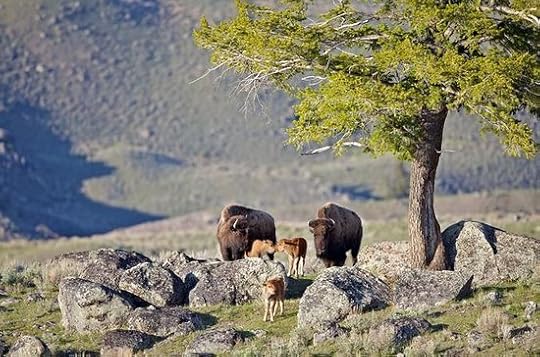
"Deep-Blood-Greasy-Bowl" - A bison hunt by Indians 2,500 years ago, driving the animals over a limestone cliff.
"Swamp Mischief" - The Devil decides to have some fun after reading the e-mails of an ornithologist working at a Western park. He introduces a prehistoric flying creature into the national park in an amusing story.
"Testimony of the Donkey" - A woman hikes alone in an isolated area after a fight with her boyfriend. Humans are small compared to the power of Nature.
"Tits-Up in a Ditch" - The daughter of a teen mother is left with her uncaring grandparents. After a hard childhood and a difficult marriage, she enlists in the military and is deployed to Iraq. The title comes from a description of an unfortunate cow who fell into a ditch.
When I lived in Laramie and taught at the university, I knew several people who might have stepped right out of the pages of Fine Just the Way It Is. True, that was pretty much their philosophy. But never has it been so apparent to me all the suffering that lies under that grin up and bear it facade. And never have I read a more depressing story than “Tits-Up in a Ditch.” I’m not sure I’ll ever recover. To be born into such a family, then to meet a few people capable of expressing true thoughts and feelings, then to be yanked back home in grief, all that you loved wasted and ruined out of the same brute ignorance that killed your youth, and discover that you’ll spend the rest of your life caring for the war-ravaged body of a man you didn’t love in the first place? What makes the story worth the toll of anguish it takes on its readers is knowing that this really is life for many people, and no matter how much they claim it’s fine, it is not. This dose of reality reminds me that I don’t have it so bad right now. But things could get worse. It challenges my complacency. Life must be—must be!—about something other than winning at the game of it. We all lose in the end. But oh the journey when you’re riding along with Annie Prouxl! I know Wyoming, and now I’ve seen it rendered in all its dimensions in two-dimensional words.
I love fiction which evokes particular cultures in a way that captures the essence of a particular place or region. Here in nine stories Proulx eloquently does that for the semi-desert plains of Wyoming, spanning timepoints from the 1880’s to the current era, from a time of the open range and homesteading, to a time of farming growth wrought by the arrival of the railroads, to the current period of oil schemes and cowboys mostly confined to rodeos.
Several traditional stories focus on people whose schemes and dreams for carving out a life there inevitably succumb to derailment due to unexpected shifts in weather, economic downturns, foolish choices, and fickle life partners. One tall tale depicts a lonely woman who, after losing a child, takes to treating various pets or farm animals as her baby, then when they die or disappear she makes a sagebrush bush the target of her affections. Over the decades, in a wry approach to magical realism on Proulx’s part, this bush takes on a life of its own in resisting change. Another two stories move even further over the top in depicting the Devil updating his torments for the dead in one case and the living in another. This provides some imaginative comic relief to the darker tales of struggle.
Throughout these tales I enjoyed her clear action oriented prose, revealing dialog, and breakouts into lyrical depictions of the beauties and harshness of the environment. If you haven’t read Proulx, some of these aspects, as well as the integration of the comic and the tragic, shine through in the film versions of her novella “Brokeback Mountain” and novel “The Shipping News.” Here are a couple of examples of how she harnesses language:
The sky dropped over the undulating prairie like unrolled bolts of dirty wool, and even inside the car they could smell the coming snow.
‘Didn’t you say we were going to have trees?’ Her voice was so light she seemed to have inhaled a ribbon of cloud and to float out her words on its gauzy remnants. But her face was pinched and yellow, and she kept her hands under her buffalo robe. He thought she had taken on a Chinese look.
Il selvaggio west del mio immaginario non era duro come questi racconti. Lasciate ogni speranza, o voi che leggete. Non c’è nessun lieto fine per i protagonisti di Annie Proulx, siano essi i primi avventurieri del Wyoming o personaggi contemporanei: la vita è dura, soprattutto per i più poveri. La scrittura di Annie Proulx è così vivida da segnare profondamente e questi racconti vanno letti con moderazione, un po’ alla volta.
Secondo la leggenda, i pionieri entravano nel paese, si facevano assegnare un pezzo di terra, vivevano di stenti, crescevano nidiate di bambini scalzi e fondavano dinastie di rancher. Per alcuni fu così. Ma molti ebbero vita breve e vennero presto dimenticati.
I struggled with rating this collection. Do I rate on the quality of writing, the quality of the stories, or how they made me feel?
Proulx excels at writing about rural life—in describing the environment, people and regional dialects whether on the shores of Newfoundland in The Shipping News, Texas and Oklahoma in That Old Ace in the Hole, or rural Wyoming of her Wyoming Tales. For example, in this collection describing the drought of a Wyoming summer in Them Old Cowboy Songs she writes: "July was hot, the air vibrating, the land dry like a scraped sheep’s hoof. The sun drew the color from everything and the Little Weed trickled through dull stones. In month even that trickle would be dried by the hot river rocks, the grass parched and preachers praying for rain."
In the same story she describes some of the cowboys of the Karok ranch: "Men raised from infancy around horses could identify salient differences with a glance, but some had a keener talent for understanding equine temperament the others. Sink Gatrell was one of the those, the polar opposite of Montana bronc-buster Wally Finch, who used a secret ghost cord and made unrideable outlaws of the horses he was breaking. Sink gave off a hard air of competence. On roundup the elegant Brit remittance man Morton Frewen had once noticed him handling a nervous cloud-watcher horse and remarked that the rider had “divine hands.”
Finally, Family Man gives a feel for Proulx command of dialect: “One time Joe knocked Harry out, kicked him into he Platte. He could of drowned, probably would of but Dave Arthur was riding along the river, seen this bundle of rags snarled up in the cottonwood sweeper—it had fell in the river and caught up all sorts of river trash...Harry was about three-quarter dead, never was right after that, neither. But right enough to know his own brother had meant to kill him. How couldn’t never tell if Harry was going to be around the next corner with a chunk of wood or a gun.”
It’s no surprise that this the awarding winning writer can write. Why then in this collection of essentially old west tales does she choose to include three throw away tales completely out of character with the rest of the collection, that read like jokes vs serious writing. Two feature the Devil planning updates to Hell:
“Construction workers!” the Devil shouted. “Their hard hats will melt, the scaffolds collapse unceasingly. Ice cream truck vendors? A hot coal in each scoop of vanilla.”
The third, a carnivorous cactus.
Really?
And then there is the utter despair with which each of the real stories ends.
Family Man—The elderly Ray Forkenbrock laments his father allowing he and mother to live in poverty while fathering and supporting families with several other women across the region.
Them Old Cowboy Songs—Young couple homesteading on the Wyoming frontier is forced to separate so the husband can find work. The husband freezes to death trying to return to his wife while the wife dies in child birth.
The Great Divide—Proverty stricken family loses father to kick by a horse.
Testimony of the Donkey—Hiker becomes trapped and dies of exposure on an abandoned trail.
And the most miserable of the bunch, Tits Up in a Ditch—Improvished woman marries slacker who abandons her while pregnant to join the military. She later joins leaving her son with her parents. Has her arm blown off in Iraq and returns home to find her son dead and her disfigured and vegetative husband dropped on her doorstep to care for.
Proulx needs a chill pill.
Bottomline: Threeish stars for the collection in total—the serious stories are each three to four stars, the throw ways ones and twos. Downgrade by one star for the hopelessness in each of the serious works and complete stupidity of the the throw aways. Net two stars for me, one for each dollar I spent on this book. I would have regretted spending more.
I’m such a lazy person. Too often I write really quite the best reviews in the world in my head – and that’s enough for me. I move on. They never see the light of day.
I read this at the same time as I read my first book of Alice Munro stories and my first inclination was to write something where something of a shadow cast over Munro would be to the benefit of Proulx, a writer who has never disappointed me and I’ve read all of them. Checking, I see that I’m talking about early 2014 – over four years ago, and this book by Proulx has been sitting in my queue, waiting for a mention and she’s coming out now, courtesy of my spring clean.
It has been said that the selection committee for the winner of the Nobel prize for literature is biased against American writers. For the most part I think those critics do not really appreciate the breadth of writing talent that exists globally. However, each time I read one of Annie Proulx's works I move closer to the sentiment that those critics may be correct. Within six months after each years winner is announced, I read one of the recipient's books. Most times I am moved by the richness of the stories and the quality of writing. While indeed great, they do not stand out against her work. She composes in this rarified league. This collection of stories shares the bleakness of her other Wyoming Stories and each page is ripe with the twists of humanity that are both cruel and humorous. If nothing else, read the last short story in this book. The final four paragraphs are among the best I have ever read to complete any work of fiction.
Nyt hieman surettaa, että tämä trilogia on luettu. Proulx'n Wyoming-novellit ovat olleet lohduttomuudessaan ihanaa luettavaa, tässäkin oli monia mainioita tarinoita. Riipiviä, synkkiä ihmiskohtaloita, periksiantamattomuutta, ihmisten ja luonnon karuutta. Myös synkkää huumoria ja mainioita nimiä – Annie Proulx on erinomainen nimien keksijä.
Nää oli ihania. Karuja, traagisia, periamerikkalaisia tarinoita Wyomingin karjatiloilta (ja pari Helvetistä myös). Hieno kokonaisuus, täytyy lukea muutkin osat.
E' il mio primo approccio ad Annie Proulx. Conoscevo l'autrice perché sapevo che da uno dei suoi racconti di Storie del Wyoming è stato tratto il film I segreti di Brokeback Mountain e, siccome sono affezionata in particolar modo a questo film, ho voluto leggere qualcosa di sua creazione.
Ho sempre amato questo posto è una breve raccolta di racconti ambientati perlopiù nel Wyoming, terra indomabile, selvaggia e abitata da persone semplici che conducono una vita abbastanza ordinaria. Le descrizioni del paesaggio sono la cosa che più ho amato di questo libro - sarà dovuto anche alla mia predilezione per la montagna in generale. Si tratta di grandi campi brulli, rocce, cieli colorati, arbusti tra i quali si muovono bisonti, donnole, cavalli e ogni altro animale libero e selvaggio. Essi, infatti, occupano un ruolo di rilievo in alcuni di questi racconti, perché sono legati alle persone da un rapporto di vita e morte. I protagonisti sono donne e uomini semplici, la cui unica ambizione è quella di poter vivere una vita rispettabile, senza troppe pretese, ma felice. Essi si adoperano per "costruire" la tanto agognata felicità, ma il destino bussa sempre alla porta delle loro povere case e crea scompiglio. Il loro modo di agire, il più delle volte, provoca un sorriso nel lettore.
C'è un filo conduttore comune che lega quasi tutti i racconti anche se ambientati in decenni diversi. L'unica nota stonata sono i due in cui protagonista è il diavolo: è come se fossero stati inseriti forzatamente nella raccolta per donarle forse un inutile aspetto di leggerezza.
Well, these are not happy stories. I'll get that out of the way. But man can this woman write. I've read everything she has written starting back with The Shipping News. Actually not. She had a couple of lesser known efforts before that and some works of non fiction. But all the fiction since The Shipping News. I've been hoping she would come out with a new novel. I don't remember her novels as being this dark. (And I believe she has something being released in 2015. Don't know if it is a novel. I hope so.) This is the third book of Wyoming stories. Her use of language is astonishing. Her feel for the landscape and understanding of the people she writes about are remarkable. When I think of Mississippi I think immediately of Faulkner. When I think of Wyoming I think of Proulx. And even with the darkness of the subject matter there is a wry sardonic sense of humor in the work as well. She is one of those few American writers that if she brings out a new book I have to read it. I don't know why it took me so long to get to this one. Slipped under my radar somehow. (My wife's theory is that she is working clandestinely for the Wyoming Chamber of Commerce. Her mission being to discourage people from moving there. The title of this collection: "Fine Just the Way It Is" might support that argument.)
Following on my short story kick, I read Alice Munro then Annie Proulx. At the end of that journey I'd like say that I think I'd prefer if these two authors were actually one author. Munro has a tendency to describe the most minute variegates of emotion in a single social interaction. The way someone turns their head creates rippled of emotions. On the other side of that, Annie P will tell the story of a girl ignored and abused by her grandparents, yet just allude to the emotional interior of her character.
I think I'd like more of a balance from both authors, hence the Frankenstein blend I'm proposing. I found Proulx's plots better, but I preferred some of the emotional depth Munro gives her characters. I genuinely love Proulx's novels, and I think in a larger narrative she allows more space for that internal exploration. Is anybody reading something that feels like good blend of these two? I'm still on a short story quest ... I'm going to have to just keep reading.
Furthermore, what was with two Devil stories? They didn't really fit the theme of Wyoming Stories. Cue the Sesame Street song, "Which one of these is not like the others?"
I thought I would really like this book, first because I began it, coincidentally, just after I finished watching the TV series, Longmire, in which place, Wyoming, plays such a central role, as it does in Fine Just the Way It Is: Wyoming Stories 3. Second, the audiobook was read by Will Patton, my favorite reader of most of James Lee Burke's audiobooks. Third, though I didn't read Brokeback Mountain, I loved the movie. So, I was all set to get into this book. Though I really tried, I could not follow the stories. They weren't making any sense to me. I couldn't get the plot or meaning and the characters seemed forgettable. I know Annie Proulx is considered a fine writer, so I would rewind and listen again, but in the end, I finished maybe 4 of the 6 short stories and I couldn't really tell you about any of them. In reading reviews, the one that most got my attention was "Who needs hell when you've got Wyoming?"
"Bill Fur had to ride into Rawlins and ask for a replacment for 'the bible thumpin, damn old goggle-eyed snappin turtle who run off.' The replacement, plucked from a Front Street saloon, was a tough drunk who lit his morning fires with pages from the former operator's bible and ate one pronghorn a week, scorching the meat in a never-washed skillet."
Novellit joko kertoivat Wyomingista tai wyomingilaisista - mielipideasia. Wyoming veti puoleensa hyväuskoisia seikkailijoita, viimeisiä cowboyta sekä miehiä ja nuoria pareja työn perässä.
Proulxin novelleissa on parhaimmillaan jännittävää uudisraivaajahenkeä. Heikoimpina hetkinä joutui uupumaan näiden kaikkien sukujen ja sukulaisten erämaassa. Pohjanoteeraus olivat silti "helvetilliset tarinat" - eivät kuuluneet näihin kansiin eikä tähän tunnelmaan.
Proulx saa vaivatta samaistumaan heihin, joille jokaisen lantin ansaitseminen ja jokaisen talven selätys on saavutus. Ja heihin, joille aron viima, maiseman avaruus ja villi luonto päihittävät muut elämykset.
Lisäksi hehkutan Proulxin lopetuksia. Sitä, kun uskaltaa antaa tarinan kantaa eikä lopussa enää tarvita sanaakaan.
Lopetusten lisäksi kirjasta jäi mieleen maruna (ilm. wormwood?). Proulxin omaa marskimaata löytyi vähän joka novellista - Marunalapsi -nimisestä tuli jo yliannostus.
“That was the trouble with Wyoming; everything you ever did or said kept pace with you right to the end.”
When it comes to description, Annie Proulx is undoubtedly one of the best and most unique writers out there. With her blunt, unsparing prose, a fierce intellect and a coal black sense of humor, Proulx can paint a vivid and stark portrait of American life, and nowhere is this on better display than in her Wyoming Stories, where the hardscrabble existences of her characters go hand in hand with the bleak words used to describe them. Here’s how she introduces one of her characters in “Them Old Cowboy Songs”: “Archie had a face as smooth as a skinned aspen, his lips barely incised on the surface as though scratched in with a knife.” There’s a paragraph from “The Half-Skinned Steer” in Close Range , the first installment of the Wyoming series, which still gives me the chills years after I first read it.
Proulx’s descriptive power is, primarily, what keeps me coming back to the Wyoming stories, even though neither of the sequels has been able to match the power of Close Range (which also has the distinction of birthing “Brokeback Mountain,” the story the movie was based on). To tell the truth, each installment pales in comparison to the one that preceded it. Proulx has a fascination for fantasy elements that pop up in her stories that doesn’t entirely suit her style (at least not when she’s writing about the devil, who puts in a whopping two appearances in Fine Just the Way it is ). “The Sagebrush Kid,” about a man-eating, giant-size sage plant, captures something of a Twilight Zone vibe that makes it work, and still almost the entire middle section of this collection is taken up with the weakest form of Proulx’s writing. Compare this to only one out-there story in Bad Dirt , and hardly any in Close Range.
The bookends of Fine Just the Way it is are where it truly shines, and sure enough those stories are the ones that play to the intention of the Wyoming stories the best: slice-of-life vignettes that capture the essence of the hard living in such a violent, unpredictable location and the tough breed of human that it takes to live there. “Family Man” opens the collection by spotlighting Ray Forkenbrock, closing out his life in a retirement home and wondering just where the honor in his existence has gone, if there ever was any. Proulx closes it with “Tits-up in a Ditch” (which just might be the best name of a short story ever, although the meaning behind the title makes you feel bad for the immature giggle it gives you when you first catch sight of it), about naïve young Dakotah Lister, who enlists in the army and gets sent to Iraq after a failed marriage leaves her with no job prospects and no way to pay for the son her soon-to-be-ex husband left her with. While there are some winning moments in between, it is these stories that are the real winners in this collection. Aside from the fantasy element that bogs down at least three of the stories, “Deep-Blood-Greasy-Bowl” feels like a research project more than a story (indeed, Proulx pauses to explain that the impetus of the story was the discovery of an ancient fire-pit on her property and the research into Indian buffalo hunting that followed).
All in all, this is an uneven collection for Proulx, a supremely talented writer who may have been looking to shake things up a touch in her third visit to the Wyoming territory.
Annie Proulx continues her mastery of the short story.
In Fine Just the Way It Is: Wyoming Stories 3, Proulx once again gives us stories primarily taking place in or associated with Wyoming. Her characters are terribly human--warts and all--and her stories are typically blunt, to the point, and full of (sometimes brief) life.
But, as straightforward as her stories are with their plainspoken characters, Proulx also delivers stunningly beautiful narrative language when detailing landscapes, flora, and animal life. Some of her imagery literally astounded me it was so well crafted and provocative.
However, unlike previous Wyoming volumes, this addition to the series is far more brutal to its characters. Now Proulx has never occurred to me as a woman who gets overly sentimental about her creations, but I was surprised at the tragedies she forced her men and women to endure. That being said, she certainly did not cross the line into sensationalism; everything she threw at her characters was well within reality's parameters.
Well, for the most part.
I was especially happy that in three stories in particular, Proulx exits her normally grounded repertoire and gives us something bordering fantasy. Now, because it's Proulx, we're not talking Tolkien here, but two of her stories hilariously focus on the devil and the other, well, I don't want to spoil anything, but it features a sagebrush where mysterious disappearances persist. I think that with her particular style and sensibilities, calling them tall tales may be more appropriate than fantasy.
Consequently, I sensed a real sense of dark humor in these stories, and I loved it! While most of the stories were very serious in terms of subject matter, they all utilized a morose fun that--unless happening to us--demanded a chuckle or two.
All in all, this collection was a bit of a break from Proulx in terms of style, especially when read between the lines, but every bit as exquisitely written and enjoyable as past works.
Proulx's talent is unrelenting with each new work she releases.
I lived in Wyoming for a long time and enjoyed exactly none of it. I tried and failed to read this for years, only because Annie Proulx so perfectly captures that environment that I remember with disdain. Poor Wyoming, reviled in my esteem. Anyone with an apathetic to positive view of the place will likely love this collection; the problem of place is fully my own. But returning to that Red Red Wasteland, where the wind never stops howling, and people really do say, “Cowboy Up!” wasn’t the most pleasant journey for me. I love Annie Proulx; I have no love lost for Wyoming.
I listened to this book on CD, and enjoyed it. I like everything by Annie Proulx. I can't say I enjoyed this one as much as some previous collections and novels; some of the stories were very dark. Well written, but downers. Still, the portrayal of Wyoming ranch life and life in the west rings very true. Definitely worth reading.
After reading "Close Range", Proulx's brilliant short story collection that included "Brokeback Mountain" you can't help but think that the stories in "Bad Dirt 2" and now "Fine Just The Way Is" are not up to the same level of quality,
Tak krásne napísané poviedky som už dlho nečítala. Annie si ma podmanila štýlom, Wyoming opísala nádherne, z rôznych uhlov a v rôznych časoch a podobách, jeho krása ma uchvátila. Charaktery hrdinov boli veľmi ľudské! Presne tak. Človečina, nekompromisná sila prírody a príbehu v každej jednej poviedke.
My first Proulx, and not disappointed. Full of nicely drawn characters who are of their time and place (Wyoming, mainly), and evocative of the same. But not much to envy, and the net effect is pretty bleak - no happy endings here, ever!
The third volume of Proulx's Wyoming stories. Her characters live hard lives, bleak, even brutal. The stories aren't happy but they are extremely well told.
Rather a downer of subject material but readable. Series of short stories. I don’t think any has a happy ending, but that doesn’t detract from the stories.
A challenging collection of stories. As a portrayal of characters living in an unforgiving landscape this works. However, the stories come across as slight and the character don't seem to have space to breathe. It's well worth reading but not the best of her writing.