Jump to ratings and reviews
Rate this book

On The Pleasure of Hating

Rate this book
Essays:

- The Fight

- The Indian Jugglers

- On the Spirit of Monarchy

- What is the People?

- On Reason and Imagination

- On the Pleasure of Hating

128 pages, Paperback

First published January 1, 1826

113 people are currently reading
3362 people want to read

About the author

William Hazlitt

1,083 books176 followers
William Hazlitt (1778-1830) was an English writer, remembered for his humanistic essays and literary criticism, and as a grammarian and philosopher. He is now considered one of the great critics and essayists of the English language, placed in the company of Samuel Johnson and George Orwell, but his work is currently little-read and mostly out of print. During his lifetime, he befriended many people who are now part of the 19th-century literary canon, including Charles and Mary Lamb, Stendhal, Samuel Taylor Coleridge and William Wordsworth.

Hazlitt was the son of the Unitarian minister and writer, William Hazlitt, who greatly influenced his work. Hazlitt's son, also called William Hazlitt, and grandson, William Carew Hazlitt, were also writers.

Librarian Note: There is more than one author by this name on Goodreads.

Ratings & Reviews

What do you think?
Rate this book

Friends & Following

Create a free account to discover what your friends think of this book!

Community Reviews

5 stars
191 (19%)
4 stars
364 (36%)
3 stars
310 (31%)
2 stars
111 (11%)
1 star
24 (2%)
Displaying 1 - 30 of 118 reviews
Profile Image for Esteban del Mal.
192 reviews61 followers
February 15, 2011
Photobucket

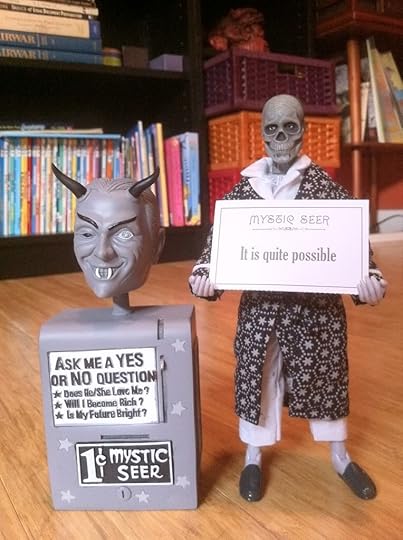
"All traces of life, of natural expression, were gone from him. His face was like a human skull, a death's head...He was not like an actual man, but like a preternatural, spectral appearance." -- The Fight

Photobucket

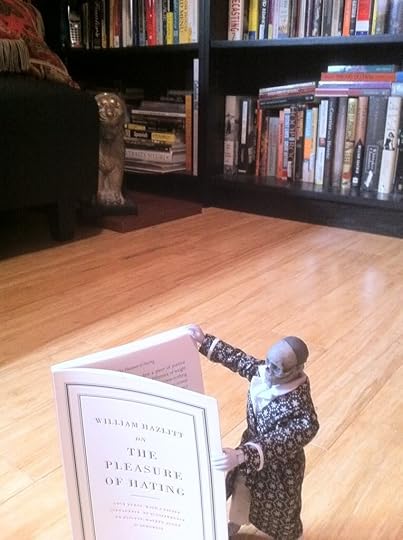
"Man, thou art a wonderful animal, and thy ways past finding out! Thou canst do strange things, but thou turnest them to little account!" -- The Indian Jugglers

Photobucket

"He who has the greatest power put into his hands, will only become more impatient of any restraint in the use of it." -- On Monarchy

Photobucket

"The power of an arbitrary King or an aspiring Minister does not increase with the liberty of the subject, but must be circumscribed by it." -- What is the People?

Photobucket

"I hate people who have no notion of any thing but generalities, and forms, and creeds, and naked propositions, even worse than I dislike those who cannot for the soul of them arrive at the comprehension of an abstract idea." -- On Reason and Imagination

Photobucket

"What chance is there of the success of real passion? What certainty of its continuance? Seeing all this as I do, and unravelling the web of human life into its various threads of meanness, spite, cowardice, want of feeling, and want of understanding, of indifference towards others and ignorance of ourselves -- seeing custom prevail over all excellence, itself giving way to infamy -- mistaken as I have been in my public and private hopes, calculating others from myself, and calculating wrong; always disappointed where I placed most reliance; the dupe of friendship, and the fool of love; have I not reason to hate and to despise myself? Indeed I do; and chiefly for not having hated and despised the world enough." -- On the Pleasure of Hating
Profile Image for Jenn Avery.
56 reviews18 followers
October 31, 2011
William Hazlitt is notorious for writing criticism that doesn't hold back. A kind of rogue who received a large number of threats for his blatant opinions concerning authorship and culture, Hazlitt ruminated about the darker aspects of human experience.

In his best-known work, The Spirit of the Age, he appears more tame than in other essays, such as "Reason and Imagination." Although he does frequently praise his contemporaries for certain noble attributes, Hazlitt is much more in the habit of ripping them to shreds.

Yet, he rarely elevates himself above these decapitated philosophers.

In "The Pleasure of Hating," I find Hazlitt at his best. I also ponder about the function of hating in Victorian society, and its use today.

Hazlitt values a marriage between reason and imagination, viewing neither as superior yet both absolutely necessary to happiness -- if happiness can be had. When reading "The Pleasure of Hating," I wonder if he thought such a complicated enterprise -- of striking the balance between reason and imagination -- was worthwhile at all. If happiness was possible.

He argues that we -- humans -- "cannot part with the essence or principal of hostility:" the "brute violence." The "cure" has been sought through "fine" writing, yet somehow it continues to fail or evade writers. The natural world is against us: it is made up of "antipathies." He posits that "without something to hate,we should lose the very spring of thought and action. Life would turn to a stagnant pool, were it not ruffled by the jarring interests, the unruly passions of men." Hazlitt believes that we "hanker" after hatred because "hatred alone is immortal."

What strikes me first about Hazlitt's philosophy is, of course, how it reflects the Victorian Age. Most critical essays and books written by Victorians about their own period tend to praise it as the center of civilization and progress. So Hazlitt -- and essayists like him -- offers some refreshment that breaks up the common flat-liner response to such a changing world. On the other hand, he also conforms to Victorian norms, calling humans "wild beasts" that have truths that "no Jermemy Bentham Panopticons" can survey. He finds that "the pleasure of hating [...] eats into the heart of religion." At last, we "come to hate ourselves." Hatred does, indeed, seem to be just as integral of component of civilization and progress as, say, the train. Hazlitt contextualizes it through evolution, religion, and law.

Despite his stalwart call-to arms in support of hatred, he ends his essay sounding like a wounded child: "It is because pleasure asks a greater effort of the mind to support it than pain; and we turn, after a little idle dalliance, from what we love to what we hate!"

I can almost feel Hazlitt sobbing into his cuffs.

He bawls: "What chance is there of the success of real passion? [...] Have I not reason to hate and to despise myself? Indeed, I do; and chiefly for not having hated and despised the world enough."

Phew!

I mean, Hazlitt degenerates in this essay from soldier-like philosopher to scared and disappointed child hiding under the bed crying until he chokes himself.

He is disappointed. Frustrated for harboring hope.

He, tellingly, never admits that he DOES harbor hope. This is partially what makes it so apparent.

He is mad at himself for being too trusting, too hopeful, too loving. And he wants to kill these feelings through rationalizing that they do not do him good.

I think about the way that hatred functions today. Don't you?
Profile Image for Peter Weissman.
Author 6 books12 followers
June 8, 2009
This little book of essays left me eager to read more of Hazlitt, and punctured my reluctance to tackle anything written more than a hundred years ago. What a foolish prejudice! Reading this collection, it's clear I've been indulging in what today might be called, and fairly put down, as chronologism.

From the "Indian Jugglers": "No man is truly great, who is great only in his lifetime." Consider modern celebrity and the petty inflations of the media, as Hazlitt discusses and dissects the great and ungreat personages of his time, and the qualities that make them so, and not.

From "On the Spirit of Monarchy": "The right and the wrong are of little consequence, compared to the in and the out." About courts and kings, but who can't see the contemporary (if not the enduring state of social affirs in whatever age) in this acerbic essay?

From "Reason and Imagination": A biting commentary on detached reasoning versus "natural feeling," with examples that bring to mind the ongoing excrescence of "enhanced interrogation"/torture, about which Hazlitt writes (while discussing slavery): "Practices, the mention of which make the flesh creep, and that affront the light of day, ought to be put down the instant they are known, without inquiry and without repeal."

And the remarkable title essay, "On the Pleasure of Hating," which is so consistent and high-flying throughout that every phrase could be quoted and ruminated upon for its insight and application.
Profile Image for Andrew.
2,258 reviews928 followers
Read
March 14, 2017
William Hazlitt, destined to become one of the also-rans of the romantic era. You may remember him as a footnote in some old Norton reader, or a casual mention in a class on English literature in the romantic era, without ever having had to look into him.

Please do so.

Please read The Indian Jugglers, and think how well it would fit into a magical realist novel. Please read On Reason and Imagination, and try to find a better summation of the romantic ethos. And please read the title essay, as soon as you can, and think of your own life, think of the idiocy of the new nationalism, think of reality TV, think how fucking contemporary this 200 year old essay about the human tendency to be a little bitch is.

Do it.
Profile Image for Liz.
598 reviews632 followers
April 22, 2017
While I didn't find the first two essays of this small book very intellectually engaging, all the following ones compensated for them. Hazlitt, in this collection, addresses topics like monarchy/the government in general, what makes a person great (and for how long), the people, reason vs. passion and lastly the "pleasure of hating".
After this collection I genuinly wonder how hate was perceived and depicted in the society Hazlitt lived in vs. how it is now.
Generally, I think this collection applies as much to the contemporary life as it did to Hazlitt's own century. Yes, we evolved, we have the media now, globalisation, etc. but in the end hardly anything changed. We still debate about reason/logic vs. passion/imagination and still, mostly, arrive at the wrong conclusions and the immortal problem of a corrupt, powerhungry government is everpresent *eyes the leading politicians of several countries*.
One could quote the entire essays rather than just a few phrases out of them for Hazlitt is succinct, understandable and intellectually engaging.
Highly recommended to the point that I wish this was part of the school/college/university syllabus.
Profile Image for Bumbles.
271 reviews26 followers
July 13, 2023
This man hates life as much as I do. A fantastically alive essay written with a gusto I have scarcely ever seen in any other text.

1. "Love turns, with a little indulgence, to indifference or disgust: hatred alone is immortal."

2. “We hate old friends: we hate old books: we hate old opinions; and at last we come to hate ourselves.”

3. "What chance is there of the success of real passion? What certainty of its continuance? Seeing all this as I do, and unravelling the web of human life into its various threads of meanness, spite, cowardice, want of feeling, and want of understanding, of indifference towards others, and ignorance of ourselves, – seeing custom prevail over all excellence, itself giving way to infamy – mistaken as I have been in my public and private hopes, calculating others from myself, and calculating wrong; always disappointed where I placed most reliance; the dupe of friendship, and the fool of love; – have I not reason to hate and to despise myself? Indeed I do; and chiefly for not having hated and despised the world enough."
Profile Image for Ira Therebel.
731 reviews47 followers
June 8, 2021
A nice collection of essays by Hazlitt about people and society.

Those thoughts aren't very extraordinary this days but I wonder what it was like when they were published like for example his essay on monarchy.

I did like the one on the pleasure of hating and on reason and imagination. I can't say that I loved his writing very much. It reads easier than most philosophy essays but it feels like some rambling even though there are some nice quotes and some humor in between.
Profile Image for Ahmed Rashwan.
Author 1 book33 followers
November 12, 2018
"Love turns, with a little indulgence, to indifference or disgust: hatred alone is immortal"

As a self proclaimed intellectual, I am not one to believe in such trivial matters as fate or destiny. But having had this book fall on my lap at this most opportune time makes me inclined to perhaps surrender a point to the supernatural; it is simply too coincidental that I am to finish reading this book at a time that I find myself yet again questioning the concept and notion of love. It fascinates me how a sentence could resonate so strongly with me and my current state of mind and opinion; as I do indeed find this striking statement to be an absolute truth.

It is not so much the talent and style of Hazlitt that I critique in a positive light here, but rather the subjects he chose to explore in this fine booklet. Initially, and almost more than half way through this book, I was intending on rating it poorly, but the last two articles in the book, which are both from his greatest collection of essays "Plain Speaker", significantly changed my mind as Hazlitt delved into philosophical subjects that are of great concern to me and that, to my amusement, he seemed to entirely share the exact same opinions I held regarding them; I found myself agreeing with almost every single word.

Perhaps the only flaw I can conjure regarding this book is that Hazlitt's style varies greatly depending on the subject he is discussing and also on the seriousness with which he chooses to discuss them. This left me with the sensation that I was reading a book by various writers, and this specific style also left me slightly disoriented at times.

Nevertheless, I implore readers to pick this book up, even if only for the last two articles contained within it. Concluding this review, I leave you with another sentence in the book, from the same article, that resonated strongly with me.

"- mistaken as I have been in my public and private hopes, calculating others from myself, and calculating wrong; always disappointed where I placed most reliance; the dupe of friendship, and the fool of love; have I not reason to hate and to despise myself? Indeed I do; and chiefly for not having hated and despised the world enough"
52 reviews2 followers
August 23, 2023
(Probably pushing a 7/10)

Unfortunately not entirely about hating, but a series of essays from the critic's various literary publications. Some of them REALLY drag - absolutely cba with a lot of the middle - but they're mostly good and sharply written, and the ones that bookend, the essay about going to a boxing match and the titular essay on hating, are excellent. I don't know how much more Hazlitt I'll read but this was a worthy introduction to a clearly strong-headed writer. Thanks for the gift Alex!
Profile Image for Reet.
1,458 reviews9 followers
March 9, 2018
William Hazlitt--a kindred soul. Maybe I can meet him in the afterlife.
On the pleasure of hating:
The Fight: p.1-- Do English People ever eat vegetables? I wonder how long they take in the ladies' room? A loathsome subject, so I don't enjoy the story.
On the Spirit of Monarchy: p.47-- Making fun of royalty. "... whatever suffers oppression, They think deserves it.They are ever ready to side with the strong, to insult and trample on the weak." All power is but an unabated nuisance, a barbarous assumption, an aggravated Injustice, that is not directed to the common good: all Grandeur that has not something corresponding to it in personal Merit and heroic acts, is a deliberate burlesque, and an insult on common sense and human nature."
On Reason and Imagination: p. 84--"a spectacle of deliberate cruelty, that shocks everyone that sees and hears of it, is not to be justified by any calculations of cold-blooded self-interest-- is not to be permitted in any case... necessity has been therefore justly called "The tyrant's plea." (Slaughterhouse footage--veganism) There are two classes whom I have found given to this kind of reasoning, against the use of our senses and feelings and what concerns human nature, viz. knaves and fools. The last do it because they think their own shallow Dogma settle all questions best without any farther appeal and the first do it because they know that the refinements of the head are more easily got rid of than the suggestions of the heart and that a strong sense of Injustice, excited by a particular case in all its aggravations, tells more against them than all the distinctions of the jurist.... Thou Hast no speculation in those eyes that thou Dost glare with: thy bones are marrowless, thy blood is cold.
On the Pleasure of Hating: p.104--how long did the Pope, the Bourbons and the Inquisition keep the people of England in breath and Supply them with nicknames to vent their spleen upon? (Trumpudo) .... The pleasure of hating, like a poisonous mineral, eats Into the Heart of religion, and turns it to rankling spleen and bigotry; it makes patriotism an excuse for carrying fire, pestilence, and famine into other lands: it leaves to Virtue nothing but the spirit of censoriousness, and the narrow, jealous, inquisitorial watchfulness over the actions and motives of others..... The only way to be reconciled to Old Friends is to part with them for good: at a distance we may chance to be thrown back(in a waking dream)upon old times and old feelings: or at any rate, we should not think of renewing our intimacy, till we have fairly spit our spite, or said, thought, and felt all the ill we can of each other.(Mary Munro)... I care little what anyone says of me, particularly behind my back, and in the way of critical and analytical discussion - it is looks of dislike and Scorn, that I answered with the worst Venom of my pen. the expression of the face wounds me more than the expression of the tongue.(the Vietnamese women on the next street who follow me to see if my doggies go potty in their yards, despite the fact that I hold up my poo-poo bag for them to see. The next time I'm going to give them a piece of my mind, in Spanish--so there!)... I have seen all that had been done by the mighty yearnings of the spirit and intellect of men, of whom the world was not worthy, and that promised a proud opening to truth and good through the Vista of future years, undone by one man, with just glimmering of understanding enough to feel that he was a king, but not to comprehend how he could be king of a free people! (Obama>Trumpudo)... It has become an understood thing that no one can live by his talents or knowledge who is not ready to prostitute those talents and that knowledge to betray his species, and prey upon his fellow - man.
Profile Image for David Williamson.
170 reviews16 followers
September 17, 2011
The Pleasure of Hating by Hazlitt, does tend to have a very dated feel about it and I found myself skim reading most of the book, as it does feel like reading journalism, good quality journalism, but journalism non the less. The beginning article on witnessing a bare knuckle boxing match is wonderful and the last article that titles the book, is deliciously pessimistic with a jolly but stinging tone.


"Love turns, with a little indulgence, to indifference or disgust: hatred alone is immortal."


And his knockout punch to Bentham's Utilitarianism is very sweet.


"Thus, for example, an infinite number of lumps of sugar put into Mr Bentham's artificial ethical scales would never weigh against the pounds of human flesh, or drops of human blood, that are sacrificed to produce them."


However, his thoughts, theories, comments, feel like they've been heard before and been done better, if not corrected and surpassed. His prose are slightly scattered and confusing, but do at times turn a wonderful phrase, its just not enough to raise itself out of journalism. A light read with moments of quality.
Profile Image for Eric.
6 reviews3 followers
January 24, 2012
I first encountered Hazlitt as a supporting character in the life stories of English literature giants like Lamb and Coleridge (especially through the essays of Anne Fadiman). Though not exhaustive by any means, The Pleasure of Hating serves as a nice introduction to the work of one of the great journalists of the 19th century, with the added benefits of extreme portability and elegant design (always among the hallmarks of Penguin's Great Ideas series). Over the course of six essays, the reader gains a good feel for the engaging and surprisingly relevant style of an important figure in English literary history.

For a more extensive look at Hazlitt's output, I recommend The Fight and Other Writings from Penguin Classics. Charles Lamb, Samuel Taylor Coleridge, Anne Fadiman, The Fight and Other Writings
Profile Image for Francisco.
561 reviews18 followers
March 2, 2018
A collection of writings by Hazlitt, mainly journalistic writings. He was in the early 1800s one of the great journalists, art critics and observers of life in general. That comes through in his writing but unfortunately it is a writing which is very much tied to particular temporal circumstances. Yes, he is quite radical and sometimes funny but he is those things for 1817, which is not the same to say that it translates that well to our times. It's the journalistic quality of his writings that have this effect, when he takes on more general and abstract subjects such as the title essay On the Pleasure of Hating, it is considerably more fun to read.

I'm sure many monocles were popped when reading this, but now it comes off as a somewhat witty, somewhat conceited historical artifact, in that sense it is interesting.
130 reviews2 followers
January 14, 2018
The title is misleading, probably due to marketing reasons (everybody loves to hate) - "On the Pleasure of Hating" is just one of 6 essays present in the book, and definitely not the best one - despite some glorious misanthropic indulgence.

The chapter which stuck out for me was "What is a People?" with its brilliant, anarcho-libertarian views and genuine contempt for all self-proclaimed "legitimate" government. Lovely, lovely political philosophy.

As one would expect for a book from this age, the language and style are pretty heavy and require full concentration, especially for a non-native in English.
Profile Image for Amy.
756 reviews43 followers
May 10, 2019
A couple of great ideas and a few stellar phrases such as ‘Old friendships are like meats served up repeatedly, cold, comfortless, and distasteful.’

Another delicious phrase ‘All power is but an unabated nuisance, a barbarous assumption, an aggravated injustice, that is not directed to the common good: all grandeur that has not something corresponding to it in personal merit and heroic acts, is a deliberate burlesque, and an insult on common sense and human nature.’
Profile Image for K. Anna Kraft.
1,175 reviews38 followers
June 11, 2024
I'll admit this one feels a bit simple for an essay that attempts to go so deep, but I did my best to arrange my thoughts into a little haiku, as is my habit:

"Complex as a wine,
How hates dull and sharp shore up,
Just aging inside."
Profile Image for Kokelector.
1,085 reviews105 followers
March 18, 2019
Hay libros a lo que se les hace un excelente trabajo de Mercado: se venden por todos los comentarios que existen a su alrededor. Y este libro del siglo XIX, pareciera ser un muy buen ejemplo. La pluma inglesa de Hazlitt se entorna a pensar sobre que produce odio y qué personas (personajes); son dignos de no tener en alta estima. Así en dos ensayos, se dedica a despotricar en favor de tener sentada la felicidad en torno a denunciar lo que está mal. Propio de un narciso, que aquí es definido en el prólogo, y de alguien que sufre el desprecio por si mismo, genera un entretenida lectura a favor de saber que no ser positivo siempre no te hace infeliz, sino que más bien son las pequeñas válvulas de escape que permite soportar la vida. Prolijo con su pluma, en un lenguaje clásico; hace la invención de los “haters” de Twitter en pleno siglo XIX. Una pequeña lectura para reflexionar en torno a la agresividad que significa respirar junto a otras personas.

(...) “Odianos a los viejos amigos, adiamos a los viejos libros, odiamos nuestras viejas opiniones y terminamos odiándonos a nosotros mismos.” “Pero ocurre que en la mente humana existe una afinidad secreta, un ansia por el mal, que se deleita con perversidad en la vileza, esa fuente segura de satisfacción.” (...)
Profile Image for Claire.
292 reviews
December 21, 2020
There are various perspectives in these essays that must have ruffled a few feathers around the 1820s. I didn't find all the essays engrossing, but the ones I did threw up some wonderful nuggets that are as relevant today as 200 years ago.

My favourite essays were The Fight, The Indian Jugglers and On The Pleasure of Hating. The last essay had me laughing - Hazlett was humourous and cutting on a range of subjects, and I particularly enjoyed his take on gossiping and his attitiude to old friendships.

Some of his writing is circuitous and harder to access, but overall I found this collection of essays an opportunity to time travel back to the 1800s and learn a bit more about radical thoughts and perspectives of the day.
Profile Image for Elizabeth.
211 reviews
Read
November 21, 2025
very demanding but rewarding text that encompasses so much: sports journalism; political philosophy, a lot of which felt relevant with today’s billionaire political catastrophes; art theory; philosophy of mind; anti-slavery polemics; refutations of utilitarianism; what distinguishes the great man from the merely skilled one; sparing a spider but still feeling horror and loathing. worth a read, and probably more than one
Profile Image for Emilia.
612 reviews137 followers
December 29, 2018
Me gustó mucho el placer de odiar pero no tanto la gente desagradable. Entré a este libro esperando un poco de reafirmacion frente a mucha gente a mi alrededor que no le gusta odiar cosas/gente cuando para mi esta bien (y mejora la vida jiji). Tuve una reafirmacion de este sentimiento y marque muchas frasesitas buenas.
Profile Image for izabella.
143 reviews1 follower
February 12, 2025
a really solid read. my fave wasnt the hating essay, rather 'what are the people'; charity is not just for the individual home, but for the government at home too, you tell em king! this guy was lowkey so cunty, the kinda philosopher writer artist type i can get behind. alas it is a series of essays so it wouldve had to be really good to breach into 4 star territory, but nonetheless very good.
This entire review has been hidden because of spoilers.
Profile Image for Richard.
113 reviews
Read
January 17, 2020
Such a radical progressive that his criticism of monarchy and religion (for example) is still relevant today, 200 years after he wrote it. Slightly hard work until you get used to the rhythm of his writing.
Profile Image for alicia.
144 reviews8 followers
September 2, 2024
3,25|5 - non-fiction, essays, 19th century philosophy, political ramblings but generally entertaining, british literature
Profile Image for Nick.
924 reviews16 followers
February 23, 2023

On the Pleasure of Hating caught my eye, displayed as it was beside other, less titularly-charged works in an Edinburgh charity shop. I bought it, stuffed it away, and didn't get around to reading it for many months. At the time, I was on a grand adventure -- a three month bicycle voyage around Europe, and hatred, though often not too far from my mind back home, had much less place in my heart... though even then I was cursing out the Europeans in their diesel cars and their stupid 'campgrounds' on a regular basis... etc.

Then, inevitably, my fantastic voyage concluded, and standard reality set in once more.

Months of being back home, in a large city full of aggressive, self-centred, and often not very intelligent motor vehicle drivers, constantly endangering other people's lives while spewing pollution and ruining community; the god-awful local police force; our horrible failing healthcare system; things I buy breaking far too soon; the price of everything going up while my salary stays the same as it was 10 years ago; constant exposure to corruption, hypocrisy, all the horrible events in the news every single day, unbridled censorship, dark histories, and endless examples of apathy, selfishness, sloth, ignorance, shallowness, and an utter lack of fairness in the world, combined with my own various personal struggles, personal failings, and frustrations -- all coalesced to push this small book of early 19th century essays to the top of my 'to-read' stack.

Contrary to the title, the book itself initially contains scant bits of hatred -- much less indeed than On the Suffering of the World by Arthur Schopenhauer, a book in the same series I recently read and mostly enjoyed. In the first essay, 'The Fight', Hazlitt spends almost the entirety prattling breathlessly on like an energetic early 1800s hipster on his way to a boxing match in colourful language which often requires reaching for a dictionary. He does manage to include one of the most fantastic descriptions of a boxing match perhaps ever written (16-20), as well as poignant reflections on great occasions and friendship (2). He then goes on to discuss physical, or as he terms it, mechanical success versus intellectual success in a self-effacing British manner, seemingly diminishing his own written accomplishments in the impressive face of 'The Indian Jugglers' -- noting how his own work is easily reproducible and never achieves perfection, while theirs is excellence personified. Danger is a great teacher, he likewise opines to notable effect (31).

'On the Spirit of the Monarchy', the third essay, does contain some dollops of hatred. Hazlitt craps all over the Monarchy as an institution in an entertaining if repetitive way (EG 60), while arguing that the common people love kings and queens because they can see themselves in that role, and because people don't want truth -- just the right image. He also rails against the "stream of corruption" at royal courts, before turning his sights on corrupt and dishonest politics and politicians.

In 'What is the People?', Hazlitt continues his rant against the monarchy (including the British monarchy, and the tendency of local critics to only criticize foreign monarchies), the corrupt government, and tyranny. In my mind, this solidifies his status as very pro liberty and someone fighting for brilliant intellectuals trapped in an unfair system of mediocrity and theft. He defines 'The People' as ...the hand, heart, and head of the whole community acting to one purpose, and with a mutual and thorough consent (81), which is quite progressive. He even comes forth as a champion of the common man perhaps, sounding downright socialist revolutionary at times:
They who get wealth and power from the people, who drive them like cattle to slaughter or to market, 'and levy cruel wars, wasting the earth', they who wallow in luxury, while the people are 'steeped in poverty to the very lips', and bowed to sympathy with those whose loss of liberty and property is their gain. What is it that the wealth of thousands is composed of? The tears, the sweat, and blood of millions. What is it that constitutes the glory of the sovereign of the earth? To have millions of men their slaves.
- 77

In the penultimate essay, 'On Reason and Imagination', Hazlitt, again with verbal flourish and wit, gets the hatred ball rolling in the first sentence: I hate people who have no notion of any thing but generalities, and forms, and creeds, and naked propositions, even worse than I dislike those who cannot for the soul of them arrive at the comprehension of an abstract idea (84). He seems to be focusing on dismissive, educated, know-it-all generalizers as opposed to common folk, and in his view, we must look at problems and ideas from close-up as well -- not just from a distance. Emotion and passion are essential to the conveyance of facts and arguments (sometimes), he goes on to say (88-89), and to expand upon later (101) in an appeal to the essential consideration of feelings in the attempted expression of the overwhelming weight of the human condition. The hatred this essay began with then surprisingly morphs into messages of love and kindness. For starters, Hazlitt makes no secret of his utter hatred of slavery and the African slave trade. His empathy for the plight of the African slaves and former slaves shines through strongly here. Hazlitt, in an incredible appeal to Love, Empathy and Humanity -- which goes to show that often those who hate the most are also those capable of loving the most, and hate so much because they feel betrayed by a world that doesn't seem to love as they can -- concludes the essay with the following:
Man is (so to speak) an endless and infinitely varied repetition: and if we know waht one man feels, we so far know what a thousand feel in the sanctuary of their being. Our feeling of general humanity is at once an aggregate of a thousand different truths, and it is also the same truth a thousand times told. As is our perception of this original truth, the root of our imagination, so will the force and richness of the general impression proceeding from it be. The boundary of our sympathy is a circle which enlarges itself according to its propulsion from the centre -- the heart. If we are imbued with a deep sense of individual weal or woe, we shall be awe-struck at the idea of humanity in general. If we know little of it but its abstract and common properties, without their particular application, their force or degrees, we shall care just as little as we know either about the whole or the individuals...

...Indeed, the object and end of playing, 'both at the first and now, is to hold the mirror up to nature', to enable us to feel for others as for ourselves, or to embody a distinct interest out of ourselves by the force of imagination and passion. This is summed up in the wish of the poet -- "To feel what others are, and know myself a man."
-102-103

In the final, titular essay of the book, the hate valves are opened and the vitriol spilleth forth. Hazlitt notes how we (meaning early 1800s Europeans, or perhaps just British people) long ago tamed the violent physical impulses of hatred -- to do direct harm to others and things we dislike (which is not exactly true) -- but we kept the mental impulses and use them regularly. On (105) he postulates that in another 100 years, after writing and thinking hard on things, we might all be cured of hateful thoughts as well. Unfortunately, that would have been right around the time of World War I, one of the most hateful and destructive periods of all history. Not missing a beat, Hazlitt argues that we all secretly, or openly, enjoy hating, and enjoy having enemies and targets. The darkness of the other, makes our own brightness so much brighter he shares (105). Still on the same page, in a very metal and cynical downward-sloping sting of text, he adds: ...there is a secret affinity, a hankering after evil in the human mind, and that it takes a perverse, but a fortunate delight in mischief, since it is a never-failing source of satisfaction. Pure good soon grows insipid, wants variety and spirit. Pain is a bitter-sweet, which never surfeits. Love turns, with a little indulgence, to indifference or disgust: hatred alone is immortal. Incredible, and hard to argue with. How else can one explain the shocking popularity of all things Jeffery Dahmer, or serial killers and action movies and villains, or gladiator combats, fighting, bullying, accidents, pain, suffering, and disasters? Or, perhaps more in line with the overall essay, how we all seem to love to hate. Whether it's the rich, or the poor, or your neighbour, or your ex, or the government, or traffic, or dogs, or cats, or prettier people, or fitter people, or fashionable people, or unfashionable people or Russia or China or America or broccoli, or squats or vegans, or carnivores or other religions or other political views -- it seems like, to some extent, everybody hates more than they might care to admit.

Hazlitt makes special note of the hatred in religion on (108), though he perhaps does not go far enough in describing the thousands of years of hatred religion has inspired and fuelled. Continuing his avalanche, Hazlitt accuses us (or, again early 1800s British people) of hating others but ignoring our own vices, of seeking vengeance for every slight, of repaying kindness with ingratitude, hating old friends, old books, old opinions, and, finally, of hating ourselves (109). The next four pages are devoted to a reflection on Old Friends, and, at least in Hazlitt's case, how old friendships can rot and turn sour. How they can become full of awkwardness, misunderstanding, resentment, and pining for the good old days or for leaving the room as soon as possible.
...Times are changed; we cannot revive our old feelings; and we avoid the sight and are uneasy in the presence of those, who remind us of our infirmity, and put us upon an effort at seeming cordiality, which embarrasses ourselves... Old friendships are like meats served up repeatedly, cold, comfortless, and distasteful... Either constant intercourse and familiarity breed weariness and contempt; or if we meet again after an interval of absence, we appear no longer the same. One is too wise, another too foolish for us; and we wonder why we did not find this out before. We are disconcerted and kept in a state of continual alarm by the wit of one, or tired to death of the dullness of another...
-110

The final pages of this essay (an essay written four years before his death) are an epic culmination and a fitting landslide of hatred, disillusionment, bitterness and despair. Hazlitt (117-119) states he has grown sick of his old opinions, and he has learned that genius, virtue, liberty and love are all lies. All relationships involve tyrants and slaves. The people are led by stupidity and deceptive meddling. Revolutions fail and power always falls back into the same hands. Hazlitt, no slouch, finishes this unique and bloody piece off in brutal fashion:
Seeing all this as I do, and unravelling the web of human life into its various threads of meanness, spite, cowardice, want of feeling, and want of understanding, of indifference towards others and ignorance of ourselves -- seeing custom prevail over all excellence, itself giving way to infamy -- mistaken as I have been in my public and private hopes, calculating others from myself, and calculating wrong; always disappointed where I placed most reliance; the dupe of friendship, and the fool of love; have I not reason to hate and to despise myself? Indeed I do; and chiefly for not having hated and despised the world enough.
-119

Carrying this book on my local subway was worth the wary stares, in the end. Understandably, people glancing may have misinterpreted the title to be something in line with modern suspicious accusations pertaining to racism or gender or some-such -- yet I'm glad I took the risk. The reading experience here was explorational, educational, and, rather than fuelling me with even more hate and resentment -- calming and cathartic. These things just need to be said from time-to-time, and we live in a world which is simultaneously beautiful and horrible, simple and incredibly-complex.
7 reviews1 follower
December 23, 2014
The Fight: * *
The Indian Jugglers: * * *
On the Spirit of Monarchy: * *
What is the People?: * *
On Reason and Imagination: * * * -> The best
On the Pleasure of Hating: * * *
(Any three-stars have been given with much ambivalence and consideration of its relativity to the two-star essays. Those three-star essays had much up and downs, rather than general liking. Also, there are definitely many books I gave three-stars that were better liked.)

A pretty bitchy review, now that I reflect upon it.

Overall, pretty disappointing. Hazlitt's rambling style and rather enjoyable (at times tad incomprehensible) prose aside, his essays were too whiny(*cough cough* bitchy) and shallow. It's not "bad", but some of those thoughts surely could have been expressed with less words and more details/thoughts. One can find something better in NY Times Opinion section, really.
He is an ideal with a dash of romanticism--worshipping morality, liberty, and all things that one can love about "humanity". But there certainly is an admiration of the individual time to time.
He hates the hell out of monarchy too. What basis, such as real laws passed and events, does he provide? None, really. His words are outraged enough, and that supposedly is enough for readers to agree with him. (I must say that his description of the monarchy seemed to describe full Orwellian 1984. If this were true, I would understand. But if my world history knowledge is any indication, it wasn't that bad. But, well, society at such times is known to repress. Who knows? But I need something more concrete.)

Penguin did a lovely job in arranging the essays. "The Fight" and "The Indian Jugglers" go in pairs, "On the Spirit of Monarchy" and "What is the People" go in pairs, and so on. It's just that the essays themselves were sucky and not "Great Ideas" at all. It's a pity, because "On the Pleasure of Hating" captured my fascination for long, leading me to buy this book. I must say though, that Dostoyevsky has spoiled me in these kind of literature... I have come to expect too much.
Hazlitt is one of the greatest critics and essayists. From some I've read, I can imagine arrogant somewhat-intelletuals enjoying his essays, feeling superior for hating society/government/life or for Hazlitt's few bright points. I hope his reputation wasn't built on such masses, and that there are better essays than these.

p.s. A lot of my annotations are now gone because of some wetness. Goddamnit. And it wasn't even the fountain pen inks' fault! It was the normal pens!
10 reviews20 followers
December 23, 2014
The Fight: * *
The Indian Jugglers: * * *
On the Spirit of Monarchy: * *
What is the People?: * *
On Reason and Imagination: * * * -> The best
On the Pleasure of Hating: * * *
(Any three-stars have been given with much ambivalence and consideration of its relativity to the two-star essays. Those three-star essays had much up and downs, rather than general liking. Also, there are definitely many books I gave three-stars that were better liked.)

A pretty bitchy review, now that I reflect upon it.

Overall, pretty disappointing. Hazlitt's rambling style and rather enjoyable (at times tad incomprehensible) prose aside, his essays were too whiny(*cough cough* bitchy) and shallow. It's not "bad", but some of those thoughts surely could have been expressed with less words and more details/thoughts. One can find something better in NY Times Opinion section, really.
He is an ideal with a dash of romanticism--worshipping morality, liberty, and all things that one can love about "humanity". But there certainly is an admiration of the individual time to time.
He hates the hell out of monarchy too. What basis, such as real laws passed and events, does he provide? None, really. His words are outraged enough, and that supposedly is enough for readers to agree with him. (I must say that his description of the monarchy seemed to describe full Orwellian 1984. If this were true, I would understand. But if my world history knowledge is any indication, it wasn't that bad. But, well, society at such times is known to repress. Who knows? But I need something more concrete.)

Penguin did a lovely job in arranging the essays. "The Fight" and "The Indian Jugglers" go in pairs, "On the Spirit of Monarchy" and "What is the People" go in pairs, and so on. It's just that the essays themselves were sucky and not "Great Ideas" at all. It's a pity, because "On the Pleasure of Hating" captured my fascination for long, leading me to buy this book. I must say though, that Dostoyevsky has spoiled me in these kind of literature... I have come to expect too much.
Hazlitt is one of the greatest critics and essayists. From some I've read, I can imagine arrogant somewhat-intelletuals enjoying his essays, feeling superior for hating society/government/life or for Hazlitt's few bright points. I hope his reputation wasn't built on such masses, and that there are better essays than these.

p.s. A lot of my annotations are now gone because of some wetness. Goddamnit. And it wasn't even the fountain pen inks' fault! It was the normal pens!
Profile Image for dangerous at every speed.
389 reviews33 followers
January 2, 2019
Some thoughts were interesting, but overall was too flowery and not on topic enough for me to really get into. As a result, I think this would be much easier to read and like if you were reading it for university - having the opportunity to air this out would probably help the digestion of it too. There were moments it definitely felt like 'entitled-white-guy-who-has-had-too-much-of-an-ego-boost' just writing anything, and knowing that it would be lapped up and adored (that isn't to say he knew that some people's monocles would slide of their noses in disgust. I'm sure he expected that too).
I definitely think these essays would've read better in their respective publications, rather than in a bind-up.
And, perhaps more pressingly, the title is somewhat misleading. There were themes of hatred, but it was largely an aside, a consequence of the subject matter, rather than the subject matter itself. That was somewhat disappointing, and why it took me so long to finish this. So, if you're looking for some (easily digestible) philosophy about hatred and humanity, this isn't it.
Profile Image for Dana.
2 reviews1 follower
February 14, 2018
"Seeing all this as I do, and unravelling the web of human life into its various threads of meanness, spite, cowardice, want of feeling, and want of understanding, of indifference towards others and ignorance of ourselves - seeing custom prevail over excellence, itself giving way to infamy - mistaken as I have been in my public and private hopes, calculating others from myself, and calculating wrong; always disappointed where I placed most reliance; the dupe of friendship, and the fool of love; have I not reason to hate and to despise myself? Indeed I do; and chiefly for not having hated and despised the world enough."
Profile Image for Chris.
50 reviews
March 10, 2019
Before Orwell, there was Hazlitt.

A rare breed of English liberal writer, Hazlitt's essays are some of the most inspiring accounts of all time. Common seeds planted and grown into large, imposing trees with branches that veer into this and that direction.

The Fight, in particular, is wonderful. Much to love here.

Hazlitt is best when he is being honest, or telling a story. The more philosophical essays can be a bit boggling. But ride it out and, like Montaigne or Orwell, you will have discovered a comforting companion to be read and enjoyed when you need them most.
Displaying 1 - 30 of 118 reviews

Can't find what you're looking for?

Get help and learn more about the design.