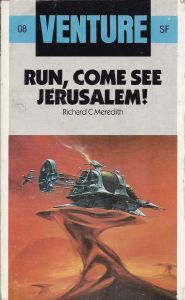
Centuries before, New Jerusalem had been Chicago. Now it was ruled by the World Ecumenical Church...a repressive theocracy founded by one Allen Howard Dover and governed by fear.
Eugene Stillman didn't like his world. But he was a law-abiding government time traveler, not a radical—at least not until he met Melanie. She introduced him to the delights of proscribed sex, brought him into the underground, and presented him with a plan to prevent the birth of Allen Howard Dover. All it involved was murder...and a little trip.
BECAUSE OF MELANIE, STILLMAN AGREED.
BECAUSE OF MELANIE, THE CHURCH MADE STILLMAN A HUNTED CRIMINAL.
And because of Melanie, Stillman suddenly found himself on a horrifying flight through time, running back and forth through centuries to escape pursuers who were determined to follow him all the lives of his days...forever!
Richard Carlton Meredith was an American writer, illustrator and graphic designer, best known as the author of science fiction short stories and novels including "We All Died at Breakaway Station" and The Timeliner Trilogy.
Meredith's works give unfamiliar twists to many familiar SF themes: A human Galactic empire and its struggle with a non-human rival (We All Died at Breakaway Station) or with independence-seeking human subjects (The Sky Is Filled with Ships); a theocratic dictatorship, nuclear and biological warfare, and the effort to change history by time travel (Run, Come See Jerusalem!); or the "sidewise" travel into alternate histories and the struggle for control over a multitude of divergent timelines (The Timeliner Trilogy).
Meredith's protagonists tend to be highly motivated and devoted people, wholeheartedly taking up Earth- or Universe-shaking causes to which they give their all - and often discovering that they had been duped into serving an evil cause, or that an action taken with the best of intentions actually makes a bad situation worse. A reader opening a Meredith book can by no means count on a happy ending - indeed, some of the books can be classed as dystopias.
In the preface to Breakaway Station, before the reader had yet met the protagonists, Meredith already tells that all of them would eventually die heroic deaths comparable to those of Leonidas and his three hundred at the Battle of Thermopylae — and indeed, the book duly comes to precisely that ending.
Meredith died unexpectedly on 8 March 1979, aged only 41, following a stroke brought on by a brain hemorrhage.He was survived by his wife and four children.
It's 2032 and the country is in control of the World Ecumenical Church, a fringe cult that grew, taking a few elections, expanding, getting one elected as President, then a manufactured emergency got the Constitution "temporarily" suspended until order was restored.
Order never seemed to get restored.
The President is a figurehead, the country controlled from New Jerusalem, formerly Chicago, where the founder, "The Anointed One," grew up. Threats of nuclear war and biologics had allowed Mexico and Canada to be annexed.
The Proctors were the secret police, the Lay Brothers of St. Wilson the enforcement arm. Blueshirts they were called. And hated.
Our hero, Dr. Eugene Stillman, is a scholar and a chronalnaut, one of those that use the time machine to record historical events. The Crucifixion had been recorded, as had been Martin Luther nailing his article to the Catholic Church door. Stillman was an expert in Shakespeare and was headed back to observe the man.
There was an underground, The Cell, that wanted to overturn the WEC and restore the Constitution. Stillman didn't like things as they were, but he was a loyal, law-abiding citizen.
Until he met a young woman named Melanie.
Beautiful and, despite her VV badge, for victorious virgin, was a hot-blooded young woman he began an affair with. She soon revealed she was a member of the Cell and wanted his help. He wasn't interested, but she could be persuasive. They had got hold of a copy of the Anointed One's mother's diary, knew the history that no one else did, and wanted him to kill the mother while she was just a few weeks into her pregnancy. They had dates and everything.
Once he arrived in Shakespeare's time, he would have control of the chronalcage and could go where he wanted.
He was still unsure about changing time.
But when a Proctor and a band of blueshirts broke into the lab just as the countdown was started to arrest him and Melanie, he hit the emergency downtime button.
And so began his odyssey, a chase through time from prehistoric times to Chicago at various dates, and the folly of trying to change time.
The book held up on this reread after thirty-five years.
Venture SF #8. A story of time travel, with the requisite loops and meeting ones-self, and so on.
First published 1976, which makes it a later Meredith; having said that, I do not think it as good as We All Died at breakaway Station.
Well, the underlying time-travel story has some nice elements. There's a twist in the tail, of the kind where you know something is coming, but you're not sure what. Nothing blind-sides you, though, and seems ridiculous or too contrived (given the basic setup). The structure of the book is that it begins with a flurry of action, then there's a longish, slowish section, then it ends with a flurry of action and explanations.
The opening drops us into our hero fighting his way through a tight spot. Then we go back to what got him into the spot -- the world he came from, a dystopia ruled by religious zealots who happen to develop a time machine. Much action ensues.
Then there's a long, relatively slow section in the middle, when our hero, very badly injured (as often happened to Meredith's heroes -- his books often have figures who have been patched up and are, frequently literally, soldiering on) has been taken in by a friendly family in 1871 Chicago. They nurse him most of the way back to health. Eventually, the pursuers with their own time machines catch up with him, and so that leads into...
...a frantic, relatively short closing section that wraps it all up, not wholly for the best.
Eugene Stillman is a flawed hero. How you feel about his flaws may affect how you respond to the book.
I think the book is a success on its own terms. Time travel tales like this are generally carefully constructed to make the twists and turns and paradoxes all fit together, and sometimes that places strain on narrative credibility. There's a little of that here, but not excessive. The action is well described. Meredith's prose is usually essentially functional and is generally effectively unobtrusive, though I found it clunkier here than in some of his other work, at least in the opening sections.
Definitely a strong book within the context of Venture SF (but, then, the previous one in the series was a High)...
If you like twisty-turny time travel tales, it's not bad, and its age (50 years old, now) does not show too badly.
Awash with large slabs of American history, this book left me really disliking the main character and his self centred approach to life. But the ending is neat.
Women are relegated this time to the secondary role of serving the main character’s lust and pleasure.
This was a typical "man trapped in the past" type story, but the amount of time travel / paradoxes are so limited it's hard to really call this a "time travel" story - except, of course, that the situation wouldn't exist without the "time travel" part.
Not only was there nothing really new about it, the paradox stuff was NOT really what I'd call paradoxes - can't say too much without using spoilers, but with a "time travel" story, I really do expect a lot more... well... actual "time traveling"... You know - the looping back, see yourself but do something different (or not). Not just going somewhere and sitting...
There seemed to be lots of detail that just filled the pages (HOW does the life story of the _butler_ move the plot forward again?).
I'm utterly baffled by all the 4 and 5 star reviews. There are WAY better time travel books out there!
Door into Summer, Timescape, Thrice upon a Time, Man who folded himself, etc. How do we score those? 9 out of 5?
This book is NOT in the same league. I gave 2 stars since I didn't "hate" the book, but I certainly wish I'd not spent the time it took to read it.
I re-read the reviews when I was 30 pages into the book and soldiered on because of them. I wish I had quit then as there are better choices.
I first read this book in the '80s—a couple of times, since I thought it was one of the better time travel stories I had read. I recently blew the dust off and read it again. It was a little slower in the middle than I remembered, and I had completely forgotten the twist at the end, which was nice because it made it like reading it for the first time all over again; but overall, it held up very well and I still claim it's one of the best of the time-travel oeuvre. I think it would make a smashing film. Better that than another superhero reboot.
You can read some of the other reviews if you want to get an idea of the plot (and risk spoilers). Suffice it to say that Richard Meredith (from West Virginia; not to be confused with the British adventure travel writer of the same name) should be better known, based on the merits of this book alone, which is not even the best known of his works. Perhaps he would have achieved greater fame had he not died of a brain hemorrhage at the age of 41, just three years after Run, Come See Jerusalem was published.