Marisel Vera emerges as a major new voice in contemporary fiction with this “capacious” (The New Yorker) novel set in Puerto Rico on the eve of the Spanish-American War. Up in the mountainous region of Utuado, Vicente Vega and Valentina Sanchez labor to keep their coffee farm from the creditors. When the great San Ciriaco hurricane of 1899 brings devastating upheaval, the young couple is lured along with thousands of other puertorriquenos to the sugar plantations of Hawaii, where they are confronted by the hollowness of America’s promises of prosperity. Depicting the roots of Puerto Rican alienation and exodus, which resonates especially today, The Taste of Sugar is “a gorgeous feat of storytelling” (Tayari Jones).
Marisel Vera’s new novel The Taste of Sugar – a tale of love and endurance set in Puerto Rico on the eve of the Spanish-American War – will be published by Liveright Publishing (a division of W.W. Norton & Company) in 2020.
Marisel’s first novel If I Bring You Roses was published by Hachette Book Group in 2011. If I Bring You Roses is about a Puerto Rican couple who migrates to Chicago during Operation Bootstrap.
Vera grew up in the barrio in Chicago’s Humboldt Park neighborhood. Vera studied writing with Paulette Roeske, Margaret Gibson, Jonis Agee, Rosellen Brown, and Cristina Garcia. Vera won the Willow Review literary magazine’s fiction prize for two of her short stories in 2000 ("The Liberation of Carmela Lopez") and 2003 ("Shoes for Cuba").
More recent outrages have obscured the special punishment that Donald Trump meted out to Puerto Rico early in his presidency. You may remember that he’d been in office less than a year when Hurricane Maria laid waste to the island. As local officials pleaded for help, the White House concentrated on defending its slow, chaotic relief efforts. Then Trump stopped by for a photo op and tossed paper towel rolls to desperate survivors. Finding San Juan Mayor Carmen Yulín Cruz insufficiently sycophantic, he began whining about the cost of saving the island. Puerto Ricans “want everything to be done for them,” he tweeted as residents searched for their loved ones’ bodies. Later, he slowed the flow of aid approved by Congress and even claimed that the death toll estimates were just a Democratic conspiracy designed to make him look bad.
As Marisel Vera shows in her enthralling new novel, “The Taste of Sugar,” there’s nothing particularly original about Trump’s abuse of Puerto Rico. In fact, the U.S. response to Hurricane Maria was a grim echo of the U.S. response to Hurricane San Ciriaco more than a century ago. In 1899, that record-breaking storm decimated the island just a year after the Americans “liberated” Puerto Rico from Spain. With thousands dead and the food infrastructure in ruins. . . .
Vera takes us on an unforgettable heart-wrenching journey that shines light on the human spirit
The Taste of Sugar is spans over seven decades, starting in 1825 in Puerto Rico and finishing in 1902 in Hawaii, Marisel Vera takes us on an unforgettable journey. Opening in 1825 we are taken to a small coffee farm in Utuado that is owned by the Vega family. Raul Vega is a womanizer in every sense of the word, he has two sons by his wife and another by a local girl. Raul’s son’s Vicente follows his footsteps and become a coffee farmer. Vicente grew up on the farm and plans to spend his life growing in the coffee trade, despite being in debt and the fluctuating price of coffee and tax. Times are hard but Vicente believes if he works hard, things will get better and he will end up living comfortably off the land.
Meanwhile in the town of Ponce nineteen-year-old Valentina Sanchez dreams of marrying a handsome man and heading off to Paris to live a life of luxury. The Sanchez family is middle class, but still feels pinch at times, they are banking on Valentina marrying a 50-year-old widow. When Valentina’s upper-class friend sends her a wedding invitation, the Sanchez family pulls out all the stops to see to it that Valentina catches the eye of the rich suitor. Instead of a rich suitor, Valentina ends up in the grasp of a handsome coffee farmer.
While Vicente doesn’t promise Valentina a life of luxury, he does promise he will love and treat her kindly, come what may. Nothing could prepare this bright eyed coupled for what may. From the torturous journey from Pone to Utuado, to Valentina climatizing to farming life, to the farm being in severe debt, to Raul lusting and being inappropriate to Valentina, to the death of a child, to the great San Ciriaco hurricane that left the farm in shambles in 1899, to trying to rebuild but there is the upheaval with Puerto Rico moving from Spanish to US ownership… this couple will go through a lot. Even with all of that they still manage to stick with each other.
After the hurricane of 1899 Vicente proposed that they go to Hawaii to work on the sugar plantation. There is the offer of a new life, school for the children, higher pay in USD, a decent house and transportation to and from Puerto Rico, Vicente and Valentina jumps at the chance for a new life. They set out on their journey to Hawaii, nothing could prepare Valentina and Vicente for what is to come…
This book is a WORLD WIND! In the acknowledgements the author said she’s always been obsessed with learning about her heritage and “one day, stumbled upon the fact that over five thousand Puerto Ricans had gone to work on the sugar plantations of Hawaii after the US invasion and the San Ciriaco hurricane…” this led to her researching more and what led to her writing this book, which I am so happy she wrote.
I spent a weekend reading this book because I absolutely had to know what happens for Valentina and Vicente. There are so many positives in this book:
I loved learning more about Puerto Rico’s history. It is clear the author did her research and presented a solid look into life in Puerto Rico during the 1800s and early 1900s. I learned so much reading this book and if you are interested in Puerto Rican history, I strong suggest you pick this one up.
The writer was able to show how the human spirit can rise above a lot of depressing circumstances. Honestly at times I thought “lawd a massy, how much this couple gonna go through!!! Yah guh kill dem off Vera, ease dem up!” but I think that is what made the book so unforgettable. You were taken on a journey with these two people who promised to love and go through it all.
The author manages to cover a wide time period without it being a dense or boring read. I think the use of letters to move the plot along worked greatly. I loved reading the communication between Valentina and her sister which continued for the entire book. Kudos to Vera for doing this!
The character development in this book was exceptional- we meet Valentina as a young, shallow 19-year-old young girl and we are taken a journey where we are shown what made her into the very strong, unwavering, sexually secure woman she turns out to be. I really enjoyed how the author wrote Valentina’s character.
Overall, this was such a well written, strong, really insightful read that I want a lot more of you to read.
"That's what they want-Governor Allen and all the Americans- they want Puerto Ricans to leave Puerto Rico so that they can have the island for themselves. It's all there in the newspaper. All the reasons why the Americans want us to leave. All the reasons we shouldn't."
I am still reeling from the emotions I am still feeling as I write this. I have been searching for a book that feels like the heartbeat of Puerto Rico and that embodies the spirit of what it means to be Puerto Rican. The Taste of Sugar is it. It is raw, honest, emotional, and most of all necessary and required reading. This one completely rocked me to my core and made me sit with the truth of what it means to be unapologetically Puerto Rican. I found every single part of my identity within these pages. I cried and cried until I couldn't anymore but I'm left with this renewed spirit of ovetwhelming pride and hope for my people.
Vera holds nothing back and she speaks truth to power. She bares the soul of Puerto Rico naked on the pages for all to see. She leaves no room or doubt as to who is to blame for the exploitation and destruction of my beautiful island. Although this story is full of immense pain there are moments of joy bursting at the seams that remind me where I come from, who came before me, what they did for me and why we are still here. It reminds me of what is at the core of who we are and we have continued to survive: love, family and community. Our history is not lost and it is still relevant today because the oppression and abuse continue. Vera gives us the good, the bad and the ugly but reminds us that better is always on the horizon as long as we hold on to each other and let the spirit of our ancestors guide us. 'Trabajo y tristeza', colonialism, racism, colorism, patriarchy, violence against women, homophobia, infant mortality, and poverty are just chapters but the story of Puerto Rico is still a work in progress. Being Puerto Rican means "siguiendo la lucha pa'lante" carrying your homeland in your heart wherever you lay your head.
A coffee with sugar and a piece of bread will never taste the same. "El Cafe es brujo" while at the same time sustaining generations and whenever the taste of sugar touches my lips it will always taste bitter because it cost my people everything. Thanks to @writingbee2 for writing our story and letting the world know that we will still stand. Soy boricua hasta la muerte. In the words of Lolita Lebron: "There is no victory without pain."
I don't usually read books this "new". Just came out this past summer. Good, not great.
The good: compelling, epic/saga story. I like those, and it's been a while since I read one. I also enjoy historical fiction. This was set in 1890s Puerto Rico. Interesting backdrop of the Spanish American War, an infamous hurricane, early years of coffee bean plantations, and most importantly how all of that shaped Puerto Rico - the results of which can still be seen today with the poverty, and lack of humanitarian interest from the United States.
The bad: a bit "soap opera-ish". One page someone dies, then someone marries, then another death, etc. Lots of shockers thrown in to keep interest going. I understand that with a saga-style story you're going to get some of that, but it was bordering on silly. Also, the author included not just random Spanish "words", but long Spanish sentences. And unlike what I read one reviewer said, you would NOT have gotten the meaning through context! I know Spanish and I read the Spanish sentences and they were not always understood through context at all! I was grateful I knew Spanish. If that same scenario had occurred in German I would have been quite annoyed. Some inaccuracies - the Golden Gate Bridge wasn't even built until the 1930s. Some character development was lacking. And a completely unfinished ending. If you need - not a "happy" ending, but SOME kind of ending - don't even start this one! I was fine, but it was jarring when I saw I was at the last page.
All in all, a quick, mostly interesting read. Another sad reminder of how the U.S. government bungled many of the "get-rich" schemes in those Latin American islands and Central American countries.
The book tells a sad story. The sentences are short and simple. The subject verbed. Then, an event happened. Sometimes there is a conjunction, perhaps a simile, and the reader—eager for a compound sentence—stumbles at first before greedily devouring it, not even savoring it, too starved to remember that the next one will be a long time coming. There are declarative sentences for many more pages. The majority of the pages have such sentences.
I'm not entirely sure how or why I made it through. The characters are unidimensional, the chemistry between them unexplained, their relationships simply narrative devices with no depth of feeling. Vera has a story to tell, and it's a fine one, just not very engaging. I got the sense that she learned a lot during her research and wanted to cram every last bit in: history, landscape, idioms, politics, oppression, tragedy... leaving little room for depth or emotion.
OKAY OKAY just hear me out. Marisel Vera’s prose is so atmosphere, and I learned so much about late 19th century Puerto Rican history by reading this book (specifically regarding the Spanish-American, Hurricane Ciriaco, and Hawaiian Sugar Plantations). However, I felt like the fraction of the book was spent on its namesake—Hawaiian Sugar Plantations, was incomplete. Just as the horrible working conditions on these plantations led workers to band together and strike, with Valentine and Vicente leading the efforts, as well as Raulito getting forced to be on a chain-gang working in the dangerous quarries, the book cuts off. Then, it skips ahead of time to Valentina and Vicente’s lives once these demands have been met, which left me really unsatisfied. As a union organizer, I thought the workers’ strike would’ve been the center of this narrative, and it is somewhat, but the omission of the actual striking and organizing process was a pretty big issue for me. I think that it’s necessary to show how hard organizing work can be, but that eventually the entire system will fall if workers refuse to work. I don’t think that it makes sense to show the outcomes of unionizing and organizing without showing the process itself. If this book was ~100 pgs longer and detailed the striking process as well as Raulito’s efforts to escape the chain-gang, this would’ve likely been a 4/5 star read
I really can't say enough good things about this book. I loved everything about it, especially the writing style. The mix of English and Spanish really set the scene for the story and made the characters come alive. The novel opens in 1898 and follows the family of Vicente Vega as they navigate a challenging life as coffee farmers under Spanish rule, the Spanish-American War and Puerto Rico's change to American rule, a devastating hurricane, and finally as immigrants to Hawaii. The writing is rich and descriptive and the characters well developed and believable. I will not soon forget this novel of strength, survival, and family.
Many thanks to NetGalley, the publisher, and Marisel Vera for the privilege of reading an advanced digital copy of this wonderful book.
Marisel Vera shines a light on a little-known aspect of U.S. history in THE TASTE OF SUGAR. At the turn of the 20th century, thousands of people from the recently acquired territory of Puerto Rico traveled halfway around the world to work on sugarcane plantations in Hawaii. Vera’s moving novel --- her second after IF I BRING YOU ROSES --- explores the forces that led one family to leave their beloved homeland and seek out a new start in an unfamiliar and unwelcoming land.
To understand why Vicente Vega, his wife Valentina and Vicente’s half-brother Raulito make the arduous journey to Hawaii, Vera (who is of Puerto Rican heritage) first turns the clock back to the mid-19th century, when the Spanish still ruled over the Caribbean island. Slavery remains legal (it would not end until 1873), and extreme poverty is endemic. Even after abolition, many on the island are no better than serfs, living “la vida de perro.” (Spanish is interwoven throughout the text.) In contrast, Vicente’s grandfather is a moderately well-off owner of a coffee plantation in the mountainous region of Utuado. But the family’s fortunes decline over the years. By the time Vicente grows to manhood, they are humble farmers, though they are better off than the peones who “are lucky if they eat once a day.”
On a trip to Ponce to attend a wealthy cousin’s wedding, Vicente meets the lovely young Valentina. The smitten girl “wishing for romance and adventure” gives up her romantic dreams of Paris to marry Vicente, not realizing that being “a proper ama de casa” on the farm is nothing like being a housewife in Ponce. Still, she vows to “devote herself to her family and put away all childish dreams,” as she writes in a letter to her sister Elena after her marriage. Their life, though hard, is not without its joys. Things change when the U.S. ousts the Spanish in 1898. When Hurricane Ciríaco hits a year later, the disaster is immense. The inadequate American approach to handling the crisis is depressingly similar to the bungled response to Hurricane Maria more than a century later.
Vicente, Valentina and Raulito make a wrenching decision to leave Puerto Rico behind and seek a better life elsewhere. But the Hawaiian Sugar Planters’ Association’s promises to the puertorriqueños prove empty. Instead of decent homes, they live in cheap, cramped shanties. Wages are paid in scrip instead of cash. The schools they were told their children could attend don’t exist. It’s a familiar yet devastating story of exploitation, as the Puerto Ricans discover they’ve traded one bleak situation for another that’s somehow even worse, where even the small comforts of home have been stripped away.
Vera’s well-researched book is a valuable lesson in Puerto Rican history and an eye-opening glimpse at the ugly reality behind the U.S.’s often overlooked history as a colonial power. This tale interrogates the surprising connections between two outposts of the country’s imperial empire. Hawaii’s own complex history of colonization isn’t explored in the same detailed way as is Puerto Rico’s, but we get a sense of the disparate forces at work in the Polynesian archipelago. Workers like Valentina and Vicente live in shacks once occupied by Portuguese sugarcane workers and work alongside Japanese immigrants, whom they view with suspicion. Who is really in charge in the territory is clear in a brief scene that occurs after Raulito is sentenced to three years of hard labor for a minor crime. The sheriff pours the judge in the case a class of pineapple juice “sent to him specially by his pal Dole, the owner of the biggest pineapple plantation in all of Hawaii.”
But Vera delivers a more than necessary corrective to history. The book is also the story of a young woman’s loss of innocence, as Valentina slowly sheds her girlish naivete, and a succession of tragedies and hardships sharpen her into a harder, less sentimental person. And there is a real and heartbreaking sense of loss among the immigrants when they arrive in Hawaii. “I miss Puerto Rico and Ponce…and even the mountain in Utuado,” Valentina writes in a letter to her sister, whom she has not seen since she was married. Raulito laments that he will “never hear coquís again” before telling himself that “it was ridiculous to cry over frogs.”
Vivid details help the story come alive. Vicente charms Valentina when he tells her that her “eyes shine like roasted coffee beans.” After the hurricane, he observes that the storm “had picked up the coffee trees and shaken them like maracas.” But in the grand sweep of history, some smaller dramas are swept away. A long-simmering tension between Vicente’s lecherous father Raul and Valentina threatens to cause trouble in the couple’s marriage, but ultimately the conflict comes to nothing. Toward the novel’s end, Vera seems to run out of steam, and the story concludes in an abrupt, not altogether satisfying way. But as a vibrant portrait of a family struggling to survive against the odds, THE TASTE OF SUGAR never fails to fascinate.
3.5 stars. The Taste of Sugar is historical fiction, set in Puerto Rico and then Hawaii around the time of the Spanish-American War. I knew next to nothing about the history that provides the framework for the novel, and learning more about conditions in Puerto Rico under both the Spanish and then under the Americans was one of the standout elements of the reading experience for me. The novel centers on the Vega family and their life as coffee farmers struggling to get by. When the Americans take over the country and then a hurricane hits with substantial destruction and little help is provided by the American government (talk about history repeating itself), the family makes the difficult decision to go to Hawaii along with thousands of others from Puerto Rico in order to find work on the sugar plantations. Not surprisingly, the promises made the by the government and the corporations aren't kept and the family struggles to find their way. The beginning of the novel felt a little clunky to me, but once I got into the story, it moved quickly.
I enjoyed A Taste of Sugar by Marisel Vera and appreciate Net Galley allowing me to read an advanced copy in exchange for an honest review. I have traveled several times to Puerto Rico and have loved visiting there each time. When I saw a book about Puerto Rico I knew I had to read it. It's the story of Vicente Vera's family and their changing fortunes as the island of Puerto Rico changes from the hands of Spain to those of the United States. I never knew that workers left Puerto Rico to go work in Hawaii. It's a tale of hardship, loss, and perseverance that is heart-warming and heartbreaking at the same time.
Engrossing historical fiction about a rarely-acknowledged episode in the story of US imperialism. It begins with a poor coffee-farming family in colonial Spanish-ruled Puerto Rico and ends with the family toiling alongside many other Puerto Rican and Japanese migrants in debt peonage in the Hawaiian cane fields. The year 1898 is pivotal to the story. That year, Puerto Rico became a US colony after the Spanish-American war and the United States also formally annexed Hawaii (following the US-backed coup of 1893 that overthrew the Hawaiian monarchy). Reading this was an education about a place and period I had little knowledge about. But the drama itself was also very moving. Now it's over I'm strangely worried about what happened next with Vicente, Valentina and Raulito. I'd love to read a sequel.
"There is a very subtle sweetness, just a hint of the taste of sugar that only those who live for coffee can taste," Vicente told him. "That only people who need coffee as they do water can know."
I am editing my review to write a little more because I just really enjoyed this book, and if you like historical fiction, you really should give this a read. I only heard about it because I follow Book of Cinz on Instagram and she has talked about it several times, which convinced me to read it. So READ THIS, even if it wasn't on your radar before!
This book was wonderful— it had a sweeping level of detail about a part of history I really had no knowledge of: the fact that thousands of Puerto Ricans traveled to Hawaii to work on sugar cane plantations on the promise of a better life, only to become forced into indentured servitude.
Most of the novel precedes this event though, laying the background of why the family at the center of the story decides to leave their home behind and set out for an unknown land in the first place.
The novel opens during the early 19th century, when the Spanish government's imposed sharecropper system has consigned workers into virtual slavery. After fleshing out this backdrop, Vera introduces our main characters: Vincente Vega and Valentina Sanchez. The two meet at the wedding of Valentina's friend and Vicente's distant cousin. Valentina's family wants her to marry an older widower who can offer her stability, but Valentina is a naive and overly romantic teenager, and dreams of marrying a handsome suitor and living a life like those of the characters in the French novels she loves to read. She meets 21-year-old Vincente, a coffee farmer of modest means with beautiful eyes who is smitten with her beauty and how she smells of strawberries. The two eventually marry, despite reservations from both their families, and Valentina moves to the country.
From there, we watch the couple grow, both separately and independently, as they each have to adjust their dreams in the face of the many challenges the world throws at them: poverty that is exacerbated by war and then tariffs imposed as the Americans "liberate" Puerto Rico, profound personal losses, a hurricane that decimates the island, and inept aid relief by the U.S. government (sound familiar?). Thereafter, the family makes the journey to Hawaii, in hopes of a better life.
One of the core parts of this novel are Valentina and Vincente, as individual characters and as a unit. I particularly enjoyed watching Valentina grow from a naive young woman to a strong and outspoken mother, friend, and partner. I also loved the marriage at the core of the story, and watching the strength of their resolve and their love through so many hardships. The title of the novel is so fitting — there’s a lot to be bitter about for these characters, but they find that subtle sweetness whenever they can. I won't spoil the ending, but the novel ends with the couple still dreaming, still hoping, still tasting the sweetness through the bitter, and there was something really beautiful about that to me.
Cons: beginning of the novel was a little clunky for me (though it quickly picked up once we got to Valentina and Vincente) and I wish the Raulito storyline had been better developed- that part of the ending felt abrupt without intentionality.
[4 stars] Multigenerational historical fiction of family, feminism, and survival set during Puerto Rico and Hawaii's colonial occupations of the late 1800's and early 1900's. Marisel Vera's prose is rich with anti-colonial history and spunk. With its own destructive hurricanes and subsequent failed government responses, The Taste of Sugar shows that resistance against militarization and neoliberalism on the island is not a new phenomenon. I enjoyed the way she layered characters' early lives throughout the exposition, moving back and forth through the family tree's multiple branches and roots. Her portrayal of a romantic relationship that lasted rather than lost its passion was also an unexpected addition, since it's often the opposite. I wanted more of the last third of the story after they reached Hawai'i; Raulito's self-discovery felt unfinished and Valentina's transformation into having the language and radicalization of a worker organizer felt rushed. Recommended for fans of Monique Truong's and/or Ingrid Rojas Contreras' prose, those interested in a love story that doesn't require a young woman to totally lose her sense of self, and anyone who wants a little anti-imperialism thrown in to their period piece (you know, as a treat).
Goodreads Challenge: 8/60 Reading Women Challenge: rural setting Popsugar Reading Challenge: includes a family tree Bookriot Read Harder Challenge: historical fiction with a POC and/or LGBTQ character
A historical novel filled with hope, family relationships, and the struggles of Puerto Rican ancestors throughout the late 20th and early 21st centuries. This story makes you reflect on our Puerto Rican heritage and the many hardships our ancestors endured. It also explores significant events in Puerto Rico’s history that I wasn’t familiar with, making the book both enjoyable and educational. Although I noticed a few historical inconsistencies, some details that seemed out of place, and a handful of misspelled words, overall, I found it to be an engaging and worthwhile read. I truly hope there will be a sequel!
A really interesting story about parts of the world and history that get overlooked. I really like how the author used letters written from one character to another to bridge time gaps that way the story continued to be told by skipping months, but still gave the reader background information as to what was transpiring in their lives.
However, this book was incredibly depressing. I guess the take away (emotionally) was how the two main characters remained optimistic after all the years of setbacks and despair.
3.5 I enjoyed this and learned from it (the plus to reading good historical fiction). It's maybe the last of the historical novels set in Puerto Rico that I will read; this one set on coffee farm up in the mountains, beginning in the early 1800s and ending in 1900, soon after the family emigrates to Hawaii after a massive hurricane to work in the sugar cane fields.
The two main characters are good people, who love one another through good times and great tragedies, which makes the sad times of the story easier to bear.
It is a first novel, which may be why some of the plotting and storytelling devices don't work well. Author tries to keep us up to date on the American take over, seen from San Juan, through letters from the coffee farm wife's sister but those just seem very unreal.
This book was rough and unrelenting, but Vera clearly did her research and left me wanting to read much more about Puerto Rico. The seamless movement between English and untranslated Spanish was beautiful and effective--I've never read a book that managed to pull that off so well. While I did not connect with the main characters as much as I would have liked, this was a valuable read and underscored for me how little consideration I often give to Puerto Rico, despite it being a U.S. territory. I would recommend this book and hope to read others by Puerto Rican writers more intentionally in the future.
My favorite history teacher was a machetero, for goodness sake. And yet there was so much in THE TASTE OF SUGAR that I didn't know. So much that I was never taught, both about our time as a Spanish colony and our later transition into an American one.
I am not a historical fiction kind of reader, but I'll be honest - I might need to commit to being one. If it wasn't for Vera I don't think I'd ever have stumbled across the information I know hold in my hands.
I'm ashamed at my lack of knowing. At all the PR coffee farms I've visited and drank coffee at without knowing what their predecessors had to endure. At the heaping tablespoons of sugar I've stirred into my mugs without a second thought as to the labor involved.
Thank you for putting this on my radar, @bookdragon217 . Seriously. I will definitely be gifting copies of it for Christmas.
A great adventure full of heartbreak, unforgettable characters and vivid landscapes. I couldn’t put this book down. Truly felt like I took an adventure with this book.
Beginning on the eve of the Spanish American war and continuing into the early years of the twentieth century, this work follows the story of Vicente Vega and Valentina Sanchez and Vicente's brother Raulito. The political situation and a hurricane in Puerto Rico makes it impossible for them to stay afloat with their small coffee plantation. After the war, many Puerto Ricans are promised a better outlook if they will go to Hawaii to work on the sugar cane plantations. Suffering many hardships along the way, the group lands in Hawaii where families are split apart by uncaring plantation management. Vicente and Valentina end up on the big island while Raulito lands in Oahu. They are treated little better than slaves. While promised payment in dollars, they are paid in scrip. The lunas whip the men even for any infraction including the need to pee. Unable to communicate with non-Spanish speaking plantation management, the situation sometimes seems hopeless. The shanties in which they live are poor excuses for homes. The description reminds me of Sugar Ditch, a poverty-stricken Mississippi area which gained national attention in the 1980s. Both Vicente and Raulito are jailed and sentenced to labor camps or chain gangs when they attempt to do something about their situation. The Japanese are in a similar situation as the Puerto Ricans, and Vicente and Valentina attempt to find a way to bridge the communication gap so the two groups can band together to obtain improvements. I didn't know much about the situations in Puerto Rico and Hawaii at this time prior to reading this novel. I wish the novel included a little more resolution in the story line, but not everything has a storybook ending.
Valentina's story - long and dramatic. She wants her story to be about love, and she finds Vincente who dreams of having a coffee farm of his own - she thinks he has one, but he's good at hiding his poverty.
The first part of their story is set in Puerto Rico before the catastrophic Hurricane San Ciriaco of 1899, which drastically affects their family, goals and dreams. Because of this, they must find a way to make a living and Hawaii sugar plantations are looking for workers - and so they go. Everyday is dreadful, and it seems that every child dies. . .which is not to say that doesn't truly happen, but I wanted to care more than I did.
The characters are well-drawn, and the story is stitched together with random community items, bulletins and letters. A tale that taught me more than I know about that part of the world and during that time. . .but overall, and the ending, where the characters are left, left me rather deflated.
Still, it may be me in my own unreasonableness. I will try another of this author's books.
NO: A book I borrowed from the library to try before I buy (tired buying hundreds books and hating half)
I do not rate these “tested” books. This is really for me. I will not be buying, reading borrowing this book.
I read first ch or more -first 10-100 pages skim around at times. I read many of my GR friend’s reviews. This is what I did and didn’t like:
I really wanted to read a Book about the hx of PR. I’m very disappointed. There are chunks of sentences in Spanish w no translation- not words sentences. I have no clue what is going on. And whats with all The letters?! Yuck not for me!
"But Valentina, Raul might throw you and Vincente out, and then what would you do?" "We could go back to Ponce, live with my family," Valentina dropped the shells in a second bowl. "Vincente in a city? He'll never leave the countryside, and I can't see him living in someone else's house." Ines paused in her work. "I'm living in his parents' house," Valentina said. "I don't see why. My father could help him get a job someplace." [...] "Vicente lives for coffee," Ines said. "Maybe he'll have to live for me instead," Valentina said.
There is a very subtle sweetness, just a hint of the taste of sugar that only those who live for coffee can taste," Vincente told him. "That only people who need coffee as they do water can know."
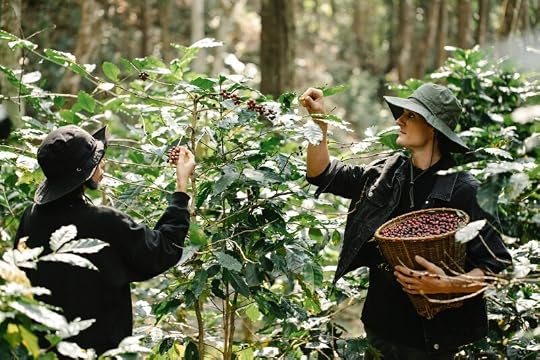
~~Modern era farmers pick coffee beans on a Puerto Rican Hacienda. I drink coffee every day, but until reading this novel, I pictured beans on the plants looking much as whole beans do in an upscale shop. They're actually reddish in color (which makes sense before they're dried...I just never thought it through). And they have just a taste of sugar to them. As I read the lush descriptions by Marisel Vera, I pictured Vincente's plants looking similar to this photograph.
First two sentences: Years before Vicente's grandfather migrated to Utuado, la familia Cortes was a prominent landowning family. Like so many of the pioneer families, los Corteses were analfabetos--they couldn't read or write or do simple arithmetic, and were easily swindled by ladrones, the merchants and government officials who could.
The year is 1898, and the place is Puerto Rico. The island is under the control of Spain, and conditions are dire for the poor people (or peons) who work the land. Valentina comes from a family in the tiny middle class. Her father is a store clerk. Her mother wants her to marry well, but she can't stomach the thought of yoking herself to an aging man three times her age. Instead, she accepts the marriage proposal of Vicente, a young coffee farmer a mere 4 years older than her. Indeed, he is still so young (at 21) that he cannot yet strike out on his own. Puerto Rican custom dictates that sons continue to help their fathers until the age of 25. So Valentina moves into the home of Vincente's family, and finds a lukewarm welcome there. Over time she develops a loving relationship with the maid, Gloria, and her mother-in-law's friend, Ines. She even grows fond of her prickly mother-in-law.
Then in 1899 two events change life for all Puerto Ricans. The Americans fight the Spanish, win, and take over the island. And Hurricane San Ciriaco devastates Puerto Rico, killing 3,369 people, and ruining crops and infrastructure. It's a cruel blow to Vincente and his budding farm. They try to rebuild, but are lured to the sugar plantations of Hawaii by promises of better housing, decent wages, and education for their children. Will they find the hope they're looking for? Read this lovely historic novel to find out.
My two cents: Vera does an amazing job developing the relationship between Valentina and Vincente. The romance between them is the best I've read this year...possibly the past couple years. And while I labeled the book kick-butt female protagonist in honor of Valentina, Vincente is just as strong a character. It's a pleasure to root for both of them. The secondary characters are also developed well. The story arc is compelling, and the descriptions of place are lush. Given 4.5 stars or a rating of "Outstanding." I really, really enjoyed this novel. Highly recommended as a library check-out for all, and recommended as a purchase for those of you who love historic novels set in diverse locations.
Further Reading: An article describing life on Hawaiian sugar plantations at the beginning of the 20th century, from a Japanese perspective. https://www.loc.gov/classroom-materia...
Other favorite quotes: She'd woken up to nurse their daughter, and Vicente had woken up, too, looking at her in a way that made her feel a little shy--that someone could love her like that.
~~The Puerto Ricans danced because they wanted to forget the cane, because it gave their hard lives joy, because they were young, because they were old, because the sun was bright, because the moon shone, because the stars twinkled and the sea was blue, because the music allowed them to pretend that they were still in Puerto Rico.
~~One day in late November, Vicente brought home a newspaper and asked Valentina to read it aloud because her voice was so lovely it even made bad news sound good. She announced that Governor Allen had decreed a holiday in Puerto Rico called "Thanksgiving." Governor Allen reminded Puerto Ricans to give thanks that all was right in their world: in the last twelve months, under the influence of good government, the crops had improved, the farmland had recovered, industrial and financial interests had become more profitable. Aside from the hurricanes, the island hadn't been visited by pestilence or other calamities, and the general health of the public was excellent. Valentina looked up from the newspaper and found everyone staring at her.
Really glad I came across this book at a thrift store. I hadn’t heard of it before, but it should be more popular. I learned a lot about the history of Puerto Rico through this engaging story. I thought it would be a little dry considering how much history it aimed to cover, but that was not the case at all. It started off really strong for me, but it tapered off slightly towards the end, hence the rating. Still a really great read and another one to add to my recent run of historical fiction.
Interesting book. Not at all enjoyable to read but taught me alot and was intelllectually stimulating and provocative on many fronts. I encourage people who finish the book to revisit the prologue at the end. I think it adds to the experience/helps illuminate a key point of the book. Cannot rate. Audible narrator tough to stomach.
This is a must-read for any Puerto Ricans who have grown up in the diaspora and need to bolster their own historical knowledge. It’s also a must-read for anyone who is unaware of the injustices suffered by the Puerto Rican people at the hands of the Americans. Wonderful storytelling but be sure to have your tissues handy.
The cursed Spanish! The cursed Americans! Vera chisels out a section of Puerto Rico's history that I knew nothing about. In 1899 after the Americans had supposedly "liberated" the island from the Spain's oppression, a big hurricane struck the island, leaving many destitute. However, its new leaders, America, did not step up to the plate for the majority of the population. How this rings of Trump's recent grim and insensitive response . Then there was exploitation of families as they were told of better lives cutting cane in Hawaii with free medical care and schools for their children. Only the Puerto Ricans were subjected to one physical and emotional insult after another with no signs of relief. This history is wrapped around a love story through Valentina and Vicente, he a coffee farmer and she a dreamer of Paris and romanticism. They fall madly in love, but soon she discovers that the wife of a coffee farmer is far from her fantasies.Their struggles through the insults of life, difficulties with children and being treated like"cattle" stirs the reader into rage and pity while concurrently admiring their strength in the midst of these obstacles. My only complaint is the use of so many Spanish words and phrases that I did not know. I would have appreciated a glossary to help round out my experience. That said, it was a superb chronicle of Puerto Rico's history and an engrossing love story as the characters attempted to weather through life.