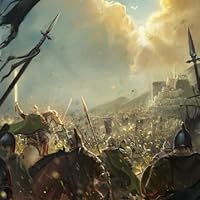
D-Day, June 6, 1944: the most expansive military endeavor in history. No less than world cooperation would bring down Hitler and the Axis powers. And so people—and kids—across the globe lent their part. From the young US soldiers in the boats to spies in the French countryside, the coordination of thousands came together. Alan Gratz, author of the New York Times bestselling Refugee, explores the necessity of teamwork and heroism in dismantling tyranny in this epic, yet personal, look at D-Day in time for the 75th anniversary of the operation.
Alan Gratz is the bestselling author of a number of novels for young readers. His 2017 novel Refugee has spent more than two years on the New York Times bestseller list, and is the winner of 14 state awards. Its other accolades include the Sydney Taylor Book Award, the National Jewish Book Award, the Cybils Middle Grade Fiction Award, a Charlotte Huck Award Honor, and a Malka Penn Award for Human Rights Honor. Refugee was also a Global Read Aloud Book for 2018.
Alan’s novel Grenade debuted at number three on the New York Times bestseller list, and his most recent book, Allies, debuted at number two on the list and received four starred reviews. His other books include Prisoner B-3087, which was a YALSA Best Fiction for Young Readers pick and winner of eight state awards; Projekt 1065, a Kirkus Best Middle Grade Book of 2016 and winner of five state awards; Code of Honor, a YALSA Quick Pick for Young Readers; and Ban This Book, which was featured by Whoopi Goldberg on The View.
Alan has traveled extensively to talk about his books, appearing at schools and book festivals in 39 states and a half-dozen countries, including Brazil, Canada, China, Indonesia, Japan, and Switzerland, and has been a Writer in Residence at Tokyo’s American School in Japan, the James Thurber House in Columbus, Ohio, and the Jakarta Intercultural School in Indonesia.
Alan was born and raised in Knoxville, Tennessee, home of the 1982 World’s Fair. After a carefree but humid childhood, Alan attended the University of Tennessee, where he earned a College Scholars degree with a specialization in creative writing, and, later, a Master’s degree in English education. He now lives with his family in Asheville, North Carolina, where he enjoys playing games, eating pizza, and, perhaps not too surprisingly, reading books.
Having done several previous successful junior novels about World War II, Alan Gratz released Allies in 2019, taking us into the heat of battle on June 6, 1944 at Normandy. Through the eyes of a cast of characters ranging from civilians to soldiers, spies to medics, we witness the twenty-four hours that turned the tide of war against Adolf Hitler's Nazi Germany. The story begins with Dee Carpenter, his boisterous friend Sid Jacobstein, and their brigade of fellow American soldiers traveling by boat to Normandy. Dee and Sid are antsy to plunge into the action and punish some Nazis, but Dee has a secret: his real name is Dietrich Zimmerman, a born and raised German. His parents, uncomfortable with the Führer's ethnic nationalism, left Germany for the United States when Dee was five years old. Now sixteen, he enlisted in the U.S. military under an assumed name, hoping his comrades won't discover his origins. Would any of them regard him as an ally if they find out he's a "kraut?"
In a quiet village of German-occupied France, eleven-year-old Samira Zidane and her mother are on a mission for the French Resistance. Algerian by nationality, they hope to oust Hitler so they can concentrate on earning Algeria's independence from France after the war. Samira's father is dead, a victim of the Führer's backlash against political dissenters, but Samira and her mother's defiance of Nazi tyranny burns brighter than ever. Samira suddenly faces the prospect of losing a second parent when German soldiers abduct her mother, planning to execute her as part of a mass punitive gleaning at the commune of Bayeux. Frantic, Samira teams up with a network of anti-Nazi forces to stymie the Germans until the Allies attack Normandy. She can only pray her mother won't be another casualty in the war against fascism.
Every few chapters the narrative shifts between points of view as Allies and allies band together against the German war machine. There's nineteen-year-old Lance Corporal James McKay of Canada, a parachuter about to leap from a plane into Nazi territory. He and his Cree Indian friend Sam Tremblay know they likely won't survive D-Day, but they refuse to let Naziism spread across the Atlantic to Canada, not while they're alive to oppose it. An extended portion of Allies chronicles their adventure after parachuting into Germany as support troops for the Normandy invasion. Elsewhere, we meet Private Bill Richards, a nineteen-year-old ready to storm the beaches as part of a company of Sherman tanks. Bill's tank is the Achilles, a vehicle designed for modern warfare, but Bill has all he can handle once he emerges at Normandy into the spray of German gunfire. Bill's ultimate goal is to make it to Bayeux, where his father carved his own name into a rock as a soldier in World War I, but what are the odds that Bill will survive to do the same? Another courageous American we meet is Corporal Henry Allen, a medic who can't rest for a moment once the surge at Normandy commences and Allied bodies start to fall. Henry faced plenty of discrimination back home because he's a young black man, but even racist soldiers are thrilled to accept his help if they've been shot. Countless lives are saved by Henry on this fateful day.
Omaha Beach, where many American soldiers landed at Normandy, is a failed maneuver. Approximately 2,000 are killed. The evening of June 6, after the fighting is over, thirteen-year-old Monique Marchand comes for a closer look. She can't bring herself to leave the scene as hordes of Allied soldiers writhe in agony on the beach, with too few medics for them all. Aided by American journalist Dorothy Powell, Monique ministers to the tortured young men, forgoing rest and nourishment to save as many as possible. Monique wants to be a nurse or doctor when she grows up, and tending the wounded at Normandy is a severe test of her commitment. The lives of all these main characters intersect for prolonged periods or fleeting interactions that will barely be remembered, but the story circles back to where it began with Dee and Sid, their lives now dramatically different than before the day's tribulation at Normandy. If the world is saved from Hitler, will other problems fade too, or is life always defined by hardships? The young people who survive D-Day have decades to mull over these questions in a world almost ready to begin recovering from one of the most traumatic periods in human history.
Much of Allies takes place on the front lines of war, but the effect is surprisingly subdued. I never felt immersed, as though I were experiencing combat in person; it felt like a story retold at a great distance. More comfortable, yes, but Allies is less memorable for its lack of intensity. Even main characters die, though, so nobody in the story is safe; military combat is a melee of randomness. We see this reality in Dee's thoughts as he prepares to dash through a hazard zone, praying that German guns won't fire on him: "Who lived through this hell and who died, and why? Was it veteran experience? Divine providence? Dumb luck?" There's virtually no order to be discerned from individual outcomes of soldiers in battle, and surviving to resume civilian life often is a mixed blessing. I would consider rating Allies two and a half stars; I prefer a more visceral war experience—akin to Walter Dean Myers's 1988 YA novel Fallen Angels—but Alan Gratz's writing is smooth and moves at a good clip. It may be just what the doctor ordered for a preteen boy reluctant to engage with literature.
I love historical fiction for kids. It’s such a great way for them to learn and read simultaneously—and in regard to books about wars, help kids understand the sacrifices their ancestors made so that they could live in peace and freedom. This story focuses on World War II, specifically D-Day in Normandy. The book is well-written and appropriate for kids, tastefully writing about a tragic and horrible subject without graphically adding scenes of violence that was present everywhere.
I appreciate that the chapters are short, which helps kids feel like their making progress. But the publisher says this book is good for readers aged 9-12. I would say 10 and up, adding the caveat that readers at age nine could enjoy this book if they’re a strong reader or have an interest in war history. I loaned this to a boy in my fourth grade class (nine years old), and while it is taking him forever to read it (he’s had it for over a month now), he refuses to trade it for another book that is, perhaps, more at his reading level. His interest in the subject matter continually overcomes his reading hurdle. He is determined to finish it, and I love to see that in a student.
This book is a good one for adults too, so if you like historical fiction about World War II, add this one to your list.
3 1/2 stars for this newest title of Gratz’s. I know many students who will eagerly devour this book. For me, it was a bit too violent (it’s about D-Day - I know I should expect that), but there were so many characters to follow. Note to teachers: have students keep a list of characters and what we know about them, as an organizational tool.
The author’s notes at the back of the book are very interesting, but there is one error. Gratz writes that many Canadians looking for battle chose to enlist with the Americans as “Canada was slow to send its soldiers into war.” However Canada entered the war more than 2 years before the US. I’ve contacted the author and he says that subsequent editions on the author’s notes will be rectified.
Another exciting historical YA novel from Alan Gratz, this one about the D-Day invasion.
As usual with Gratz's books, the heroes are teenagers caught up in military/life-or-death situations. In this case, the text follows several protagonists, each of whom plays their own important role in the fighting. Each also has their own personal struggles, often revolving around racism, nationalism, or sexism. These issues add to the tensions of the story in significant ways, though they are sometimes rather cursorily covered.
That being said, the stories of all the characters are gripping and moving, and the historical details are fascinating. I’ve heard it said that if you want to learn about a topic, start by reading kids books about it. That certainly applies here, where there are lots of interesting insights into the planning and carrying out of D-Day, as well as what actually took place that first day.
Sure, I have a few nits to pick: The writing can be a bit simplistic (e.g., Gratz does love his sound effects 🙂), which may annoy some adult readers, but which also helps explain why Gratz is popular with his young target audience, even middle-/high-schoolers who don’t normally like to read. Also, many of the main characters somewhat artificially cross paths at the end of the book, which makes for a tidy tying up of loose ends, but feels a bit forced and summarized.
Overall, the book is action and emotion packed; you never know who is going to live or die, so you are constantly on the edge of your seat and frequently shocked by unexpected events.
Quick, interesting, moving, educational, and satisfying!
Okay, I loved the history I learned in this book. I learned some really cool things I didn't know about such as 'If Day'. But the language was what made me rate this so low and the history is what's keeping me from going lower. H-e-double ll was used a lot! Like quite a bit, and I get that there was, I'm not even gonna say probably, language used on D-Day, but this was written, it says for Middle Graders...so I feel like the language should have been left out. Just giving anyone after me a heads up that there is quite a bit...nobody else who reviewed this was mentioning the language, not even teachers. So, there's that. ~Kayti
My students who are obsessed with D-Day and war in general are probably going to love this book. I’ll be interested to hear what other librarians think of this one. I usually LOVE Gratz’s books, but this one missed the mark for me. There are over 5 character perspectives and a couple of them were adults. It was interesting to see the war from the perspective of Dee (age 16), who was German-born, but whose family left Germany as political dissidents when he was young. Henry, a Black medic, was my very favorite character. I didn’t feel attached to any of the characters except for Dee and Henry, however.
Can one day, one 24-hour period, effect the course of the entire world? With this historical fiction book about the events of of June 6, 1944, Alan Gratz answers that question. He introduces four main young-adult characters from very different backgrounds, but all with the same goal; to defeat the Nazis at all costs. Their stories of the responsibilities they take upon themselves on D-Day are woven together with the themes of loyalty and courage in the midst of horrific events. I think this book belongs in every middle-grade and Y.A. history classroom. The intended audience is middle-grade, but many of the characters are young adult age. Boys and girls alike will be drawn to this book because of how the author shows throughout that young people can make a great difference in their world. I’ve read many books about D-Day, and this was one of the very best. I learned many fascinating things that I had not heard about before, such as “If Day”. The author’s notes at the end were very helpful in extinguishing the factual events from the fiction. Memorable Quotes: (Pg 132)-“Nobody should have to live like this, under the boot of Nazi rule, anywhere in the world, James thought. A deep, freeing calm came over James, and suddenly he understood why he was here. He was going to keep fighting the Nazis as hard as he could until all of France was liberated. And then he was going to move on to free Belgium, and the Netherlands, and everywhere else the Nazis had conquered. He was going to free every last country where If Day had come horribly true....But he couldn’t do it alone.”
I really enjoy his books. I learn so much! I didn’t really connect with any characters individually. I did love their intertwining stories and the history learned here about D-day. Each character from a different background and country all working for the same cause. I had never heard about “IF day” in Winnipeg. So interesting!
Allies is another masterful historical fiction novel from Alan Gratz for middle grade and young adult readers. This novel’s tight focus is D-Day–June 6, 1944–and the Allied invasion of Normandy that turned the tide against the Germans in World War II. As in other Gratz books, multiple characters tell the story. With his audience in mind, Gratz creates authentic narrators that are the age of his most likely readers, which is hard to do for a story about D-Day. Every class seems to have at least one military history buff, and they will be especially drawn to Allies because Gratz includes interesting details about the artillery and weaponry involved in D-Day. In his Author’s Note, Gratz explains how and why he deviated from historical accuracy in places to create a more satisfying narrative. Allies is an excellent choice for independent reading, book clubs, or whole-class novel study for middle grade or early high school classes.
307 action-packed pages covering one single day in history: D-Day. Told predominantly from the perspectives of a 16 year old German immigrant to the US who became a soldier in the army, a young Canadian paratrooper, a child with parents active in the French Resistance, and a barely teenaged French girl with a penchant for medicine, Alan Gratz immerses the reader into the grim realities of the invasion and gives only a few, brief breaks in the intensity of that very real bloodbath. In particular, the descriptions of the violent deaths of thousands upon thousands of multi-national soldiers on Omaha Beach may be far too vivid for those 4th and 5th grade students who learned so much from Gratz’s “Refugee” and “Grenade” books. For those who do read “Allies,” it is more than just a war story. Intertwined among the scenes of sabotage, tanks, sky-diving, and bombs, there are examples of friendship and family, dreams of a future without prejudice or stereotyping, and a message of fighting for what is worthwhile, regardless of whether that fight is against people or their erroneous thinking. Librarians may want to wait on professional reviews before purchasing for upper elementary aged readers, but “Allies” should be on the shelves of all readers grade 6 and up, especially those who appreciate WWII historical fiction. For full disclosure, there are two instances of profanity (no F-bombs) and extreme violence, but no sexual content. Thanks for the dARC, Edelweiss.
I finished it!!! (About time lmao) 3 stars because I felt like I didn't really connect to the characters as much, probably because the perspective changed a lot. I did really enjoy it and I was very interesting and educational. Most of the info I already knew, but seeing it presented like this was great! I'd recommend it to anyone who is just getting into WWII.
I thought this was a pretty interesting read for my 10 year old to go through with me. We’ve had a hard time getting him to read things other than Diary of a Wimpy Kid, graphic novels, or just rereading things he’s already read. He’s always hesitant to get into something new until his friends are talking about it (I tried getting him into the Warrior series that Camille flew through, and he’s been fighting it for two years… until last week when suddenly that’s all he wants to get at the library because his friends are into it now…ugh, kids….) But as soon as we started Chapter 1 of this, he was hooked and wanted to keep going.
Gratz has a good way of tackling intense subject matter, moments in history, and putting it into terms that both grasp the gravity of the situation and are age-appropriate for YA readers. He could follow the plot, the characters were younger individuals caught up in the war, and while he portrayed the action and deaths truthfully it wasn’t gratuitous and/or disturbing. It led to some good conversations, mini-research moments where I pulled up pictures of the beaches, of tanks, so he could appreciate the tumultuous events without having nightmares. He even asked if there was a movie that showed D-Day, and I was like, “Well, yeah, but I think you’re a couple years away from the opening of Saving Private Ryan….”
I liked how the book took the structure of alternating characters, showing the multiple sides of what it took for the invasion to be successful. The story opens on a character on a boat that’s ready to pull up on the beach, then after 50 pages or so we bounce to a section revolving around a girl who’s searching for her mother in the French Resistance. We get a section that focuses on a Canadian paratrooper, see him in the moment as well as his backstory, then bounce back to the girl on a sabotage mission, then to a new character, a black medic; and the characters are all nuanced and complex as Gratz digs into bigger ideas (in an age-appropriate way) like how Dee is of German origin but he changes his name so he can fight the country his parents left without his squad treating him like a spy, or how the medic is treated in training and then the actual war differently because he’s black in 1944. In the second half of the book you see the characters converge and interact as things come to a head and all the moving parts are necessary to secure the overall mission. And the book even ends with a nice section, an “Author’s Note,” that explains the inspiration behind each portrayal, so it’s kind of a nice little history lesson tied in with the fictional narrative.
And now Brennan is asking for more Gratz books, so I’m kind of excited myself to see what some of these others are all about. Apparently they’re all equally heavy, one focusing on refugees, one on 9/11, one on the Holocaust, among others.
Would I read them myself for funsies? Probably not, but I’m glad he’s into them, and I’m glad I’m not reading Explorer Academy or Science Comics for the umpteenth time.
Allies, written by Alan Gratz, is a very interesting book. It talks about World War I, and I really like how the author changes perspectives throughout the story. This way we are able to tell what is happening in a different place at the same time, which is vital in understanding World War I as it is a complicated subject. I also like how the author made the story fun to read. World War I was an event that consisted of many facts. At first thought, World War I may even seem boring, but the author wrote Allies in such a way that we can understand easily. Overall, I really enjoyed reading Allies and would recommend it for others to read. - Maahin
I thought this book was very educational and was fun to read. I have visited Normandy and the beaches where this awful war happened. It is extremely sad that this actually happened and that so many soldiers had died that day. I thought the characters that were introduced throughout the story were all very brave and heroic people, with a lot of strength. I would recommend this book to any reader who enjoys Historial Fiction. Overall it was a very good book, with great detail!
Beginning just before dawn on June 6th, 1944 and ending close to midnight on the same day, Gratz weaves together six unrelated perspectives that bring the D-Day landings to life in all its chaotic, grim reality.
Private Dee Carpenter is a 16-year-old who lied about his age to get into the Army, but since they needed soldiers, the Army looked the other way. Dee and Sid Jacobstein became friends right from the start in boot camp. But Dee wonders what Sid, a Jewish American, would think if he found out Dee's truth.
Samira Zidane, 11, and her mother Kenza are French Algerians working in the French Resistance. Six hours before the invasion begins, mother and daughter are on their way to deliver an important message about the invasion to the Resistance when Kenza is arrested and taken into custody by the Nazis. Samira delivers the message, and is determined to find and help her mother escape her captors.
James McKay, 19 and Sam Tremblay, a Cree Indian, are in the 1st Canadian Parachute Battalion and about to jump into the midst of the invasion. James decided to join the army after his home town of Winnipeg staged a mock Nazi invasion. Now, though, he is wondering what he is doing parachuting into France on D-Day. His pal Sam, despite being promoted to Lance Corporal, still faces insults and microaggressions as a First Person from the other men, who are white.
Bill Richards, 19, from Liverpool, England is a Private in the Royal Dragoons, and a tank driver just like his dad was in WWI. Bill was named after and is obsessed with William the Conquerer and determined to get to get to Bayeux, France to see the famous Bayeux Tapestry. But he was also obsessed with getting to Amiens, France where his father had carved "Jack Richards was here 1918" on a stone, and Bill was determined to add his name underneath.
Corporal Henry Allen, 20, is an African American medic in the 320th Barrage Balloon Battalion. And even though the United States military is segregated, Henry is on Omaha Beach, risking his life, dodging bullets and racist comments to save the lives of the mostly white soldiers shot and injured as the D-Day landings happen.
Monique Marchand, a 13-year-old French girl with an interest in medicine, was swimming with friends on Normandy Beach the day before the D-Day and ended up in the swimming hut on the beach during the invasion because of a forgotten bathing suit. When she notices an injured soldier, she leaves the hut to help him and that's when she meets Dorothy Powell, an American journalist for Collier's Magazine, there to write about the invasion.
There's not much more to say about this incredible book without giving too much away. Some of the people will live to see the end of the day, others won't, but all contribute to giving a broad view of this important day and what it was like. And Gratz doesn't hold back, so just know this is not a book for the faint at heart.
One of the things I really liked was how Gratz divided the day into the names of different operations. He explains in the back matter that some of the operation names are real, and some he made up to fit the story. Either way, it gives the reader a real sense of time passing and what might have happened. But be sure to read the Back Matter where you will find so much more information.
Gratz also includes a map to give readers a sense of place, since some of the landing units ended up in the wrong beach in all the chaos.
WOW! Allies is a great work of historical fiction by a great storyteller. I found myself spellbound from the first word of Allies to the last, but then again, I had the same experience with Gratz's other books, namely Prisoner 1065, Refugee, and Grenade.
This book is recommended for readers age 9+ Thank you, Scholastic Press, for providing me with a copy of this book.
I have to thank Alan again for the trip. It was a short trip but it was definitely worth it, as I was walked along beside a handful of young individuals who were out to make a difference in the world in 1944. They each had their own agenda for how they were about to beat the Nazi’s, their own energy, and their own history which powered them. I was only there because Alan allowed me to be. This book, along with many others that he has written, put me on the front lines with these individuals and let me see firsthand, the amazing journey that these individuals experienced, that I myself, only felt.
If I haven’t said this before, I will say it now, you need to read one of Alan Gratz’s books. Geared towards young readers, Alan is an amazing writer that has won numerous awards and has been on the NY Times best sellers list. I, as a grandmother, love his books and can testify that from the beginning pages, I’m hooked. Alan stories includes topics such as honor, love, and family, just to name a few and once you read one, you’ll want to binge read the rest.
In this book, each of these individuals are fighting the Nazi’s with their own personal agenda. Every few chapters we are introduced to a new individual until we meet them all and then, during the rest of the book, we follow their involvement in the war. There were many times, I couldn’t wait to get back to a certain character but I enjoyed every character in this book. I enjoyed their different perspectives and motives for their involvement.
I can’t tell you how many times, I caught myself holding my breath or I found myself sitting at the edge of the couch, while reading this book. This is not a relaxing read. The intensity, the emotions, and the images that went on inside my head were intense. Struggling to stay afloat in the water as the floating dead bodies hit up against them, their heavy gear weighing them down, where do they go from here? The bullets hitting the water and the boats, they’re all around them. Dang, I was shouting at the book by this time and my heart was racing. Then, we had the medic who made light of the discrimination some soldiers threw at him while later, we really saw how he really felt about it and what he did when faced with these individuals again. The author includes some notes in the back of this book and you really need to read them. This book, what else can I say besides, read it. Take the journey and see 1944 through the eyes of these individuals. 5 stars!
Trigger warnings: death, war, explosions, gun violence, racism, racial slurs, antisemitism, bullying, train accident, mass slaughter, medical procedures.
The first Alan Gratz book I ever read was Refugee, and it absolutely blew me away. But honestly? I think I started with his best book and as a result, all of the others have been good but not as amazing as I wanted them to be.
This was fast-paced and action-packed and did a reasonable job of showing how many moving parts were involved in D-Day. But at the same time, it's so short - 288 pages - and there are so many characters that it ultimately didn't do any of them justice. There were some protagonists who felt like they were added to the story solely so that Gratz could include some little piece of information that he'd found while researching, like the Canadian paratrooper whose name I've already forgotten and who felt like he was only in the story so that Gratz could talk about Winnepeg's If Day (it's bonkers, btw. Look it up on Wikipedia).
And there were characters whose stories felt like they could have been a hundred pages longer than they were or linked up to the stories of other characters somehow. Henry, the Black medic whose work is distrusted by white soldiers. Samira, the French-Algerian 11 year old helping the French resistance. The female journalist who disguised herself as a soldier in order to get an eyewitness perspective on D-Day.
There were so many pieces on the gameboard here and I didn't feel like they were QUITE done the justice they deserved. So it was definitely a compelling story and I flew through it. But at the same time, I wanted MORE. You know?
First off I love that hot new releases such as this one from @alangratz_bestauthor are available as audiobooks via @stoonlibrary So enjoying the many Cdn connections especially James from my hometown of Winnipeg. Fans of Gratz is earlier novels on the topic of war will not be disappointed. Told from multiple perspectives we hear about various operations on D Day June 6 1994 and how allies from different countries, gender, and race are stronger together.
The audio version was well done with different voices for the many different characters in the book. The narration was easy to follow and entertaining. My one wish would have been to have titles for the various chapters. Personally, I appreciated the diversity of characters and the and the inclusion of Cree officer Sam although I wished his role in the book would have been larger. The author includes information about the research put into the book and I even learned something new about my hometown of Winnipeg. Given the popularity of Refugee, Grenada and Code of Honour this is another must have book for libraries and classroom. It won’t stay on your shelves but will be passed around.
An intense and fast paced sprint that unravels over the course of just one day! That day is: June 6, 1944 otherwise known as D-Day. This title has multiple points of view wound through an alternating narrative. Characters are very real as you are reading and developed past the crisis and drama of the setting. This book touches on sexism and racism as well as the violence or war. My favorite thing is the end of the book where Gratz discusses the sources and the facts versus his fictional narrative - it was fascinating. The AR book level is 5.6. If you enjoyed this book check out: "Resistance" by Jennifer Nielsen or "White Bird" by R. J. Palacio. - Alexis S.
I have been to Omaha Beach, Bayeux, and many of the tiny villages in the area. I have been inside bunkers I have been to Pointe du Hoc where so many Americans lost their lives. I have visited the American Cemetery to pay honor to the thousands of heroes. I have watched many documentaries about WWII. So I can imagine D-Day very vividly. This book, while fiction, gives the reader insight into that pivotal event in the war. That said, at times I felt like I was reading a YA novel. It was too simple, too predictable, too romanticized for me.
Wow, wow, wow. Alan Gratz does it again. Was lucky enough to get an ARC from a bookstore employee friend. This book will be devoured by all of my readers who love reading about World War II.
Although there were many plot twists that made the story interesting, I would probably want to know more about Dee and Sid's background as citizens of the United States.
Here is a story for readers who may not know what D-Day really meant in all its horror, yet triumph, too. The relationships already there, then made during the battle are not as deeply shown. After all, it is only the description of one day. Yet the gathering together of all the parts, all the people who fought, perhaps fell, perhaps survived, beautifully exemplifies the definition of 'allies', which is "to unite or form a connection or relation between". The code name examples like "Operation Overlord" for the entire operation are used and Gratz further explains the background of some of his own invented names, like "Operation Bathing Suit", based on some truths. He manages to include areas not always included like the prejudicial treatment of black soldiers and the exclusion of women on that day. Many, many parts make the whole and while I'm glad they were included, sometimes I wished for more of the stories. It is a good introduction to that important day in history.
The stories in this book were compelling and my boys were eager to listen in the car. It does a nice job of showing how many people came together on D-day to turn the tide of WWII.
The internal monologues of the characters were painful. They are repetitive and leave no room for the reader to infer or do the work of reading well. I didn’t say anything, but the boys would audibly groan when these monologues would happen.
Beautifully written and describes everything the people endured during the second World War. It was heartbreaking to read that many soldiers were teenagers and what the Nazis were doing to innocent French civilians during their occupation of France. Really opens up your mind and makes you think about what could've been if it the Allies haven't succeeded. Lest we forget. 💔❤️🩹
This was GREAT but I needed SO much more…. Way too short! I know it’s a middle grade but it was brilliantly woven together, and I loved all the characters - I wanted so so much more of everyone! Felt not done…