Throughout his life, Abraham Lincoln tried to make life easier for others. Then during the darkest days of the Civil War, when everyone needed hope, President Lincoln cleared a path for all Americans to a better future.
As a boy, Abraham Lincoln helped his family break through the wilderness and struggle on a frontier farm. When Lincoln was a young man, friends made it easier for him to get a better education and become a lawyer, so as a politician he paved the way for better schools and roads. President Lincoln cleared a path to better farming, improved transportation, accessible education, and most importantly, freedom. Author Peggy Thomas uncovers Abraham Lincoln's passion for agriculture and his country while illustrator Stacy Innerst cleverly provides a clear look as President Lincoln strives for positive change.
This is an inspirational picture book depicting some of the hard work and good deeds that Lincoln did throughout his childhood and life, with the metaphor of clearing brush like what he had to do growing up. Another reviewer has pointed out that it glosses over the bad that resulted from some of his good deeds like the Homestead Act, which did help many poor Americans but also harmed many Native Americans who were living on those lands. This is an important point but it is discussed in the longer text at the end and that may be better suited for discussion afterwards with a parent or teacher rather than in the midst of a rather short picture book. It is certainly an important point, though.
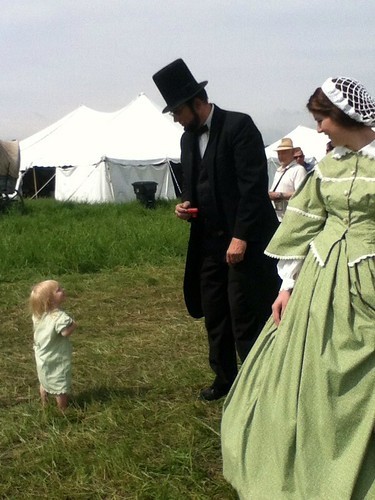
My youngest daughter has always had a soft spot for Abraham Lincoln, partly because she grew up volunteering at historic reenacting events with our family and frequently encountered some favorite reenactors who played Lincoln and partly because she was inspired by many of his words and deeds. When Fiona was a toddler, she used to say that her best friend was Abraham Lincoln. :)
This book is novel in that it doesn't focus only on slavery and the Emancipation Proclamation but also on his work to help farmers and other struggling people. The illustrations are well done but a little dark, and may not appeal to kids as much as adults. The story is inspirational and end notes talk more about Lincoln's life and what we can do ourselves to "clear a path." I'm looking forward to reading this book with Fiona, while also discussing the larger issues beyond the story.
I read a temporary digital ARC of this book via Net Galley.
I'm a bit torn on this book. While it is a very good introduction to the good that Lincoln did, it glosses over the bad that resulted from the same acts. What the author was showing in this very interesting, well researched book was that Lincoln carried very much about farmers and farm life, and felt that there should be more help for them, and so set out to make it easier for them. He started land grand colleges to teach agriculture. And he started the homestead act to give Native people's land to white settlers, and he started the USDA to help farmers find the best seeds and equipment to use.
Oh, did I mention how he gave land that was being used by the indigenous people's to white settlers? How generous of him. While this problem isn't mentioned in the picture book text, it is brought up in the longer text at the back, that goes into more depth. My problem is that most chiclren won't read the more dense text at the back.
So, while I like how the book brought up the good that Lincoln did, and how he got where he was and why he wanted to help the farmers, I just have a hard time with this white washing.
So, I would support giving this to children with a grain of salt, or at least having the discussion come up as to what all of the actions did.
Thanks to Netgalley for making this book available for an honest review.
In Lincoln Clears A Path (Calkins Creek, 2021) a new picture book by talented picture book author Peggy Thomas, our 16th president's accomplishments are presented from a different perspective. Although he is known for his stance against slavery, how many students know about his agricultural legacy? In a book well-suited for home and classroom libraries, readers from 7-10 years of age are introduced to the many other paths which Lincoln cleared.
The book opens with seven-year old Abe arriving in the middle of the Indiana wilderness. "This was not a farm. Not yet. His family got to work."
Along with his father, Abe felled trees, cleared brush, pulled stumps and plowed fields. At night he studied stars, math and poetry..."Abe marveled at how the founding fathers--Thwack! Swish! Thwump Yah!--cleared a path for folks like him."
In New Orleans Abe saw how slaves were auctioned off and he wondered, Could anyone clear a path for them?
Back home in Illinois, his friends urged their talented friend to run for office. He was poor and uneducated. But his friends provided books to read, tutoring in math, and even a suit to wear.
In the Illinois legislature he cleared paths for better schools and more roads. He stood against slavery. "There is no reason in this world why the negro is not entitled to all the natural rights enumerated in the Declaration of Independence, the right to life, liberty, and the pursuit of happiness."
But soon after he was elected president, South Carolina seceded and the Civil War began (see this timeline for more information.)
In the middle of the war, Lincoln did something that was seemingly unrelated to the North-South conflict. He created the United States Department of Agriculture to support the farmers who were supporting the troops.
But that was not all.
With a stroke of his pen, he signed the Homestead Act and cleared a path west. "New free States are the places for poor people to go to and better their condition," he wrote.
Then he signed the Pacific Railway Act and cleared a path across the nation.
In addition, Lincoln created land-grant colleges which cleared a path for students to learn more about agriculture.
He cleared a final path when he signed the Emancipation Proclamation and created a path to freedom for slaves.
"'Liberty to all'....clears the path for all--gives hope to all."
The onomatopoeia of the four words--Thwack! Swish! Thwump! and Yah! which repeat throughout the story will keep even younger readers engaged. The simple, yet profound message of what Abraham Lincoln accomplished is communicated through the text, his quotes, and interesting facts distributed throughout the book.
Nine pages of back matter include highlights from Abraham's childhood and adult years; how the Civil War affected U.S. agriculture; and a bibliography. There is additional information about the four acts; the author made sure to show how Native Americans were unfairly impacted by these acts.
I was particularly impressed with how Thomas discovered the theme by noticing Lincoln's phrase "clearing the path" in his writing. She writes, "Sometimes he was referring to the removal of rocks and stumps so a wagon could pass, but other times he was thinking about ways to remove much bigger obstacles like poverty, racism, and ignorance so that all Americans could lead a better life." She challenges readers by asking, "How could you clear a path?"
Illustrator Stacy Innerst's sepia watercolors evoke an "old-timey" feel which lends a distinct flavor to this historical picture book biography.
This unconventional picture book biography of Abraham Lincoln focuses on his agricultural background, civic engagement, and work to improve life for farmers throughout the United States. As other reviewers have mentioned, the book does not address the negative consequences of the Homestead Act until the author's note, which some children may not read at all. However, even though I wish that the author had mentioned the negative impact for indigenous people in the book's main text, this is a very engaging and educational source that provides a different perspective on a familiar figure.
The book addresses the Civil War and the Emancipation Proclamation as well, including this as part of its metaphor of Lincoln "clearing a path," but the book's primary focus is on his connection to agriculture. The main text explains how he supported farmers during the presidency, and the author's note in the back includes additional context and details about groundbreaking changes that he made. Because Lincoln is often singularly associated with the Civil War, and understandably so, I am glad that this book provides additional information about his life and presidential legacy.
I would recommend this to classrooms and families who are interested in Lincoln's life and in this era of American history. This would tie in well with reading Little House on the Prairie or other books about pioneers, and can also open discussions about how governmental policy can support some while marginalizing others. This book can be a great jumping off point for discussing a variety of different historical issues.
I received a temporary digital copy through NetGalley in exchange for an honest review.
Full of onomatopoeia, this book talks about Lincolns life and how he literally and figuratively cleared paths in his time. It touches on much more than his fight against slavery, but his fight for agriculture, America's expansion, and education. A great educational book.
Thank you to NetGalley and Astra Publishing House, Calkins Creek for a free digital copy for my review.
I read this one aloud with our six year old grandson who is fascinated with our 16th president. He studies all things Lincoln. I would recommend this for young readers, although the historical information at the end of the book is necessary for the reader so that the big gaps might be explained. I found the presentation of narrative to be random and difficult to follow.
The author uses notations written in the first person that I assume she found in Lincoln’s writing. The font was print that looked like that of a 21st century child. I wondered why she didn’t use the script that was typical of the 19th century. Minor detail but this sort of thing bugs me.
The illustrations, particularly the portraits of Lincoln, are unique and definitely make this a worthwhile read.
I learned about Lincoln’s establishment of Land Grant colleges of which I knew very little. This a good take-away.
I always enjoy learning more about Lincoln. He is a fascinating man in history. This book was equally interesting, and I learned something new about Lincoln (I didn't realize he started land grant colleges for agriculture!). However, the facts and historical events were very spread out and explained sparingly. The ending historical information felt much better researched and explained than the major content of the picture book. Nonetheless, this would still be a great addition to picture books about Lincoln's life.
The art work in this book is great, and unusual for a children’s book. But that is the best part. This is a basic history of Abe Lincoln. The subtitle is “Abraham Lincoln’s Agricultural Legacy” but much of this is not about agriculture. Plus the author has added in these action works like “Twack”, “swish”, “thwump” that seem very out of place. This reader who lives in the “Land of Lincoln” would not add this book to their collection.
Most folks know Lincoln’s biggest legacy as president: holding the nation together during the Civil War and freeing the slaves. I didn’t realize he did so much for agriculture. Interesting text, fully realized back matter includes source material for all the direct quotes. Color palette suits the book.
A picture book that explores Abraham Lincoln’s life using the metaphor of agriculture. I learned some interesting things about Lincoln that I did not know. This was a great way to look closer at Lincoln’s love of agriculture and country.
While there are countless picture books about president Lincoln, this one has the unique twist of focusing on his Agricultural legacy, including the development of the USDA. Might not hold the interest of younger children, but a good read for an older child looking to learn more about Lincoln.
You know what I love about biographical picture books? They're concise and exciting, but even crusty old ladies can learn from them. I certainly learned from this one. And the "Thwack! Swish! Thump! Yah!" really got my inner child invested.