Harriet Pringle is newly arrived in Athens. Having fled Nazi-occupied Romania, she anxiously awaits news of her husband Guy, trapped in the spoilt city of Bucharest.
Like the other two books, I found this (mildly) entertaining but if you consider this trilogy runs to over a thousand pages you do find yourself realising that Olivia Manning, though a good writer, doesn't have an awful lot to say about life. She lucks out to some extent in that she finds herself living through a moment of history that has few chroniclers. But there's also the strong suspicion she's seeing it all through a distorted lens. Manning clearly takes all her material directly from life without much of a filter. Little attention is paid to architectural artistry. She throws in everything she experienced as if one thing is as relevant as another. She also repeats herself a lot. A habit ex-pats who have a tendency to repeat the same daily cycles over and over resort to. Essentially these books are about living in an ex-pat community as much, if not more, than they are about the second world war. Having had some experience of the ex-pat community in Florence I sense as communities they haven't changed much through the years. The members tend to stick tightly together as a means of keeping everything foreign at bay. They rarely learn the language. Which means the language they have is staunchly self-protective and neurotic. And this is the world Olivia Manning's cast of characters form. Poor Harriet, Manning's heroine, has far more to fear from the benumbing mediocrity of her company than the Nazis. No wonder she's always moaning. First and foremost, her manchild husband who, like perhaps like every other character in this book is running away from reality rather than fascism. I realised at the end of this trilogy that it's doubtful if a single one of Manning's English characters would even be capable of producing a child. Such a band of hapless misfits might provide a high dosage of whimsical humour but I'm not sure they provide much reality. The Rumanians first and then the Greeks are little more than local colour in Manning's books. Forget empires, the English, as represented here, would struggle to organise a jumble sale. You almost begin to sympathise with the Germans (certainly a new and disturbing experience, though clearly unintended). Perhaps it would be better if this old world of unearned and condescending entitlement ceased to exist. Which is why this is one of the most eccentric literary depictions of WW2, as if it was some kind of social experiment which all Manning's characters dismally fail.
As we continue in the third volume of the Balkan trilogy with the expat experiences of the couple Harriet and Guy Pringle, we move from a quasi-Elysian existence in Athens, in which Harriet as Euridice has rescued her Orpheus from the claws of the Nazi takeover of Rumania, to a hellish situation in which Greece falls also under a German occupation.
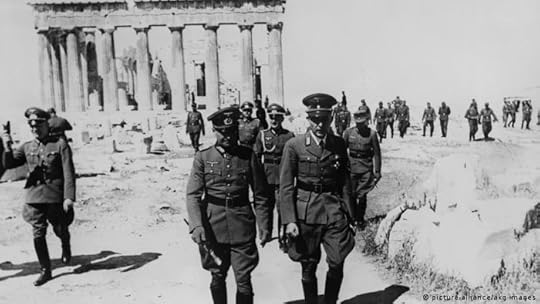
The historical setting unfolds in less than a year. They arrive sometime around October 1940, when Mussolini’s troops attempt to occupy Greece, an attempt that is portrayed as a farce worth of Aristophanes, until April 1941 when the Germans break through the Greek defence lines, and the Brits together with the Aussies and New Zealanders must withdraw and evacuate the British population to Cairo.
In the background to these two invasions, we hear what was happening in Yugoslavia, with the coup in March 1941 that resulted after the country joined the Tripartite Act in which Bulgaria, Hungary and Romania (it was when the last country joined it that the Pringles had to leave Bucharest), and the Brits in Athens keep wondering whether it will be Paul (the prince Regent, pro-Germans) or Peter (the young king, pro Allied) who would take the upper hand.
War is beginning to weigh on the Pringles. Guy has nothing to do to distract him, and Harriet has ..had enough of disorder and had seen that in war there was anxiety instead of expectation, exhaustion instead of profit, and one burnt one’s emotions to extract from life nothing but the waste products: insecurity and fear.
As I am reading this trilogy during the time when we are following the current conflict between Russia and Ukraine, I found myself particularly sensitive to the portrayal of this horrifying anxiety. A couple of days ago I communicated through Skype with a friend who has gone to Kiev to check on her family and bring over some aid.
The expat atmosphere is different in this third volume. In Romania, the British were people with jobs, while in Greece, they are – as Harriet notes- and except for the refugees from Bucharest, people who live abroad unoccupied. Except for the very sympathetic character Alan Frewen, who absolutely adores both ancient and modern Greece, the rest are all self-absorbed people who spend their life bickering and ignoring the locals.
The other thread of these novels, the character study of each of the Pringles, expectedly continues in the last volume. As Harriet is the narrator, we hear of her frustration with Guy. For the reader, the two present almost opposite viewpoints of life. He is confident and has a simple materialist viewpoint but lacks realism. She is a realist but feels somewhat lost because she entered marriage hoping this would bring liberation from herself.
The reader cannot but feel sorry for these two young people, who have to grow in an environment in which they keep feeling that life, during war, is continuously postponed.
What first attracted me to this trilogy was the history woven into the story. WW2 in Bucharest and Athens. The trilogy starts in the fall of 1939 and ends in the spring of 1941. You watch the fall of first Romania and then Greece. No, you don't watch, you live it along with a group characters that you come to know intimately. A close group of both friends and foes. The central protagonists are Harriet and Guy Pringle, but they are by no means the only characters. There are many and it takes a while to really get to know each of them. What is important to stress is that it is the story of these people that is the central focus of the book. Their relationships are what the book is about. History is merely the backdrop.
The writing is superb. Consistently, Manning draws places and people and events with a perfect string of words. You are there and see through the eyes of the characters.
What each character says and thinks and does is what they would say and think and do. There is humor. Other times you get annoyed at the choices made. Each character is complex. There are no simple solutions; what is described is real life.
As stated in an earlier review, the six books of the Balkan and Levant Trilogies are based on the author's own experiences. In 1939 she married a British Council lecturer posted in Bucharest, Romania, and subsequently traveled with him to Greece, Egypt and Palestine as WW2 engulfed Europe.
Harriet's view of her husband, of herself and the other characters gives food for thought. I could relate to Harriet very easily. I came to understand her and the compromises she made. Is the author speaking of her own relationship with her husband? Reading this book you cannot help but pose this question.
The book is exciting. Why? Because you come to care for the characters. Because you understand them and don’t want harm to come to them.
I guess you could say I am a bit annoyed. On completing this, the third book of the The Balkan Trilogy, I don't feel the story is complete! Unfortunately, the The Levant Trilogy which follows the Balkan Trilogy, is not available in audio format! I have requested this at Audible emphasizing that the same narrator should be used, i.e. Harriet Walter. I believe that listening to this may actually have improved my appreciation of the story. Through Walter's narration each character gains an even fuller identity. You should meet Prince Yakimov, as Walter intones his dialect. He is a wonderful, crazy character. I dare you to read this book and not fall in love with him. He is a Russian emigre, but not any Russian emigre. He traipses around in a long fur-lined coat which he tells everyone umpteen times his father got as a gift from the czar! What happens to him will bring tears to your eyes. In the beginning you smile at his antics, his storytelling, his drinking, his borrowing and insatiable hunger. By the end you love him.
I highly recommend the Balkan Trilogy - for its history, for its character portrayals and for its vivid depictions of people and places and events. If it were only to record the historical events it could have been much shorter, but in this book the point is to understand people and the choices they make.
One should read the entire trilogy from start to finish in one go.
This is the third in Olivia Manning’s Balkan Trilogy and follows on from “The Great Fortune,” and “The Spoilt City.” The first two volumes of the trilogy saw Guy and Harriet Pringle in Bucharest – newly married and coping in a Europe newly at war. This book sees Harriet travel to Athens alone and awaiting Guy’s arrival. Many of the characters who populated the first two novels also appear here, including Dubedat, Lush and Prince Yakimov. Indeed, so isolated is Harriet when she arrives that Yakimov, previously despised by her as an unwanted presence in her life, and her apartment, now becomes a friendly face in an unknown city.
It is fair to say that Guy Pringle is one of the most frustrating characters in any novel and his arrival, as expected, does not improve Harriet’s life noticeably. Politically naïve, emotionally warm and gregarious; Guy spends his time thinking the best of everyone despite the reality of his situation and unwilling to face reality. Guy had worked in the English department of the University in Bucharest, but, once in Greece, he finds that Dubedat, Lush and Professor Pinkrose are unwilling to help Guy with work – as he once helped them. Harriet is constantly frustrated by her husband’s unwillingness to see anything but the best about everyone and begins to feel more and more neglected as these books continue. Indeed, this novel sees her attracted to Charles Warden, as she feels her marriage means little to Guy, who has time for everyone but her, in a life taken up by providing entertainment for the troops and pouring his attention on students and friends.
As with the other novels, this is largely based on Olivia Manning’s experiences as a young wife during wartime and paints an evocative image of life during that period. Harriet believes she has escaped the danger and upheaval of Bucharest for a better life in Athens. However, as optimism in Greece turns again to disquiet, rumour and encroaching danger, you worry that Harriet will never find her feet in a constantly unstable Europe – mirrored in her rocky, unsteady marriage. She wants certainty and safety and had hoped to find that within her marriage, but now she is unsure whether Guy is the man to provide that for her. This story continues in “The Levant Trilogy” - consisting of, “The Danger Tree,” “The Battle Lost and Won,” and “The Sum of Things.” Although I have read these books before, man years ago, I am enjoying re-reading these novels very much and look forward to reading on.
After almost 1000 pages I came away from this trilogy with mixed but mostly positive feelings. The Pringles, the British couple at the center of this story, felt real. The husband, Guy, was naive and idealistic, an extrovert who yearned for social interaction and attention. The wife, Harriet, was almost the opposite of her spouse. Pragmatic, somewhat shy, and suspicious in nature, she could see through the vain, pompous, inane actions of many of her fellow expatriate countrymen. First, in Bucharest and later, in Athens. Throughout the books, the rumblings of war, of attack by Italian and then German troops are always there in the background. That said, there is very little actual violence visited upon this community. The novels focus mainly on the varied relationships that develop under the stress of political upheaval, dwindling food supplies and a pending attack. If you were expecting something like Herman Wouk's "The Winds of War", this is not like that. Cheers!
The last book in this trilogy follows on from events in 'The Spoilt City'. Harriet is now in Athens desperately awaiting news of Guy, who had stayed behind in Bucharest. Yakimov, who she has now befriended in her loneliness, is the one to bring it to her. Unfortunately she soon discovers that Guy's arrival will do little to alleviate her loneliness as he immediately throws himself into trying to find work and helping out in the community; as in Bucharest, he has little time to spare for her. On the surface, Guy is in affable and warmhearted; eager to believe the best of people, but in reality, one of the most thoughtless and irritating characters; beaten only by Pinkrose, who has this time, overtaken Yakimov to the title.
In the beginning of this book, Athens seems to be a pretty safe bet, and the Pringles, meet up with most of their friends from the previous novels, and a few new ones, but as the war progresses, the situation in Greece becomes increasingly volatile.
I did start to run out of steam a little with this last book, but that is probably more to do with me not always being all that keen on long books. While I would like to carry on and read the Levant Trilogy as well, I think I'll leave it for a little while..
*Many thanks to Netgalley and the publishers for a copy of this book to read in exchange for an honest opinion*
In the last volume of this wonderful trilogy, the young married couple, the Pringles, among other characters we've grown to know, are in Bucharest, Romania when the Germans march in. Their flat is ransacked, the Jewish boy staying with them has, they believe, been kidnapped or arrested. Romania is falling and Harriet leaves for safety in Athens, relieved when Guy arrives. Their time in Athens will bring to the fore, for Harriet, the nature of her husband, forever outward looking, friend to all, focused on the general and not the individual, and she will find herself attracted to someone else. And the halcyon nature of Athens will not last long, as the Germans again advance. All I can say is that the Balkan Trilogy is marvelous, and through all 917 pages of it, I was thoroughly enthralled, and will continue on to Manning's Levant Trilogy, which, I think, follows the Pringles after they leave Athens.
I give this trilogy four stars overall because of the unique perspective it offers on the approaching catastrophe of WWII as it was experienced by middle-class people in Europe at the time. Although I admit I had not heard of Manning until recently, it seems that her novels are largely fictionalized memoirs and contain her first-hand observations of the people and events she writes about. At any rate, like Harriet, the main character in the "Balkan Trilogy" novels, she was married to an English instructor assigned to various foreign posts.
In the first two novels in the series, Harriet and her increasingly disappointing husband begin their married life in Bucharest and watch it slowly fall to fascist militias controlled by Hitler. They escape, at virtually the last moment, to Athens, where "Friends and Heroes" is set. At first, their sojourn in this beautiful, ancient city is refreshing-- although Harriet's principal refreshment is flirtation with a handsome British officer. But the Nazi noose slowly tightens around Greece as well and, despite the heroic resistance of the Greek army, siege-like conditions finally give way to blitzkrieg.
I can understand why some reviewers felt the pace of these novels was too slow and meandering, with too few sympathetic characters and too much attention to the heroine's personal life. I too think that a couple hundred pages could have been edited out of the trilogy. On the other hand, the personal details and the understated description of the big international events also made the story more credible as an historical account. We often wonder why people living in Europe in the 1930s didn't "see things coming" or just "get out in time." Manning's novels suggest it was because people then were just like people now-- absorbed in their personal lives and hoping for the best until hope became denial. The novels also demonstrate how the war developed slowly -- with isolated acts of violence and political coups that could be ignored or explained away. And the final chapters of "Friends and Heroes," which are some of the best in the whole series, convey the overwhelming nature of the full Nazi onslaught when it finally came.
The final instalment of the Balkan Trilogy was my favourite. Married Guy and Harriet have escaped from Romania and arrived in Athens. Against the backdrop of Greece's early military success against Italy and final defeat once Germany invaded, the couple continue to struggle with their marriage, friends and career. Manning's affection for Greece shines through and gives the book a warmer glow then the abhorred Romanians. There is an undramatic verisimilitude to the preoccupations of the characters during the war period, of course they on a day to day basis are more interested in how their husband sabotages himself or where the next meal is coming from. In stripping her characters of a clichéd nobility, the reader receives a deeper insight in what the war meant for ordinary civilians. Finally there is just that little bit more of plot allowing one to get that more engrossed in the events. A slog of a read but one which eventually provided rich reward.
3.5 stars really. I've enjoyed the Balkan Trilogy, with its cast of eccentric expat characters. But think I've reached the end of the road with Guy and Harriet Pringle's lives and won't be following their journey into the Levant Trilogy just yet.
Following on from the events in the previous novel, Harriet Pringle is newly arrived in Athens, her husband Guy has stayed behind in Bucharest. Rumania – where the Pringles have been living since their marriage at the start of the war is under German occupation, and most of the ex-pat community have left or are in the process of leaving. Harriet is in a fever of anticipation waiting for Guy to arrive in Athens. Yakimov, and his sable lined greatcoat is already in Athens, and despite previously having disliked him Harriet has become much fonder of him, and it is Yakimov who first brings Harriet news of Guy.
Guy arrives in Athens much to Harriet’s relief – who is eager for them to visit the Parthenon together – but in typical Guy fashion he wants to immediately find himself something to do. Always rushing about somewhere – although not always where Harriet wants to rush off to – Guy can’t easily sit still.
I adore Olivia Manning's Balkan and Levant Trilogies, and highly recommend them as great literature and history. I have re-read them so often, that I have lost count. In this third installment, I become more reconciled with my annoyances toward Guy and Yaki, and appreciate the complexities and vulnerability of Harriet even more. The panoply of characters are deftly drawn.
Manning is marvelously skilled at depicting the extra-ordinariness of ordinary people. I recently read some rather nasty comments Lawrence Durrell made about Manning, contemporaneously, but I feel Olivia Manning is the one history favours...while he is also in print, her novels are much more widely read and appreciated.
More of the same. Guy is busy all the time. Harriett plays around with other young men but never commits. The Germans make life difficult and the war gets too close for comfort. The same cast of insufferable British ex-pats create minor intrigues and petty squabbles. I’m going to say adieu, and leave them all approaching Egypt, where, I’m sure they’ll carry on just the same. I did enjoy Manning’s beautiful descriptions of Athens and the surrounding countryside, but her characters are dreadfully tedious.
The final instalment sees Harriet and Guy in Athens where they meet up again with the inveterate sponger Yakimov. The cloak-and-dagger stuff is still going on amid expat intrigue and love affairs. The series as a whole is great, like some sort of papery soap opera happening in your hands as the whole continent slides closer to the brink.
This third book of the series gets into the real situation in the Balkans during WWII. This is a story that so on many of us never encountered -- the pushing out of all the British and the slower encroachment of German forces into the Balkan states. Looking forward to the next trilogy to pick up with these characters as ND this story.
The last book in this trilogy moves the action to Athens, where things are as uncertain as they were in Rumania. There are new and old friends, all waiting for something to happen as food gradually becomes scarce. It's hard to convey how much I've loved these books and their very human and personal approach to war.
A wonderful last novel of the first trilogy. The writing was consistent throughout. I felt like I was living with the characters in their world. I can't wait to read The Levant Trilogy which follows the same characters in Cairo near the end of WW11.
This 3rd volume of Manning’s Balkan Trilogy takes Guy and Harriet Pringle from 1940 Romania to 1940 Greece, Athens in particular. In Athens, Guy attempts to get work at the Legation school and Harriet spends time experiencing Athens and even gets a job with the British Information service working alongside the series’ third protagonist, Prince Yakimov. To his immense pleasure, Guy gets to put on another show. As in Bucharest, evenings and free time are spent socializing and sharing stories of intrigue at restaurants and bars with many old acquaintances and all sorts of new acquaintances working as Legation and school employees, journalists, military officers, expatriates and hangers-on.
The main plot events include some intrigue over who will be in the top positions at the British Council school, some societal intrigue with groups loyal to either a wealthy “Major” or the former School head’s widow and some personal intrigue with Harriet’s flirtation with a young handsome British officer. As the novel proceeds, these plots diminish in significance to the British citizens decisions over when and how to leave in the face of the advancing German troops.
While much of the action and feeling were similar to that of the second volume, there was not the same level of tension that I experienced while reading the second volume. I felt that to be a natural reaction as it is hard to replicate that same tension level when going through the same process a second time in another country. But I still very much enjoyed this reading experience, just not up to the 5-star reading experience of The Spoilt City. I rate Friends and Heroes as 4 + stars. The Balkan Trilogy as a whole is a solid 5-star read, one of my top 3 reading experiences of the year.
1941. English who have escaped Bucharest find themselves in Athens. Guy Pringle--friend to many, perhaps too many--is trying to work through the petty politics of academia. He's trusting and quick to forgive. Wife Harriet feels neglected, taken for granted . . . falls in love with Charles . . . affair never happens due to circumstance, not her decision. English come to help Greeks fight Italians; instead, they bring Germany down upon the Greeks. English soldiers retreat. Guy & Harriet and most of their circle are evacuated to Egypt. Intrigues on small scale and large scale. Characters Guy & Harriet Pinkrose--pompous lecturer who gets himself appointed head of the school Toby Lusch & Dubodeau (guessing on spelling--I listened on Audible) snakes in the grass Yakimov--Russian/English prince very much down on his luck, but muddles through to the (unexpected) end.
Not quite as good as Book II of the series. A little too much on Harriet's angst over her possible affair. Ending is very strong, though, and that matters
This entire review has been hidden because of spoilers.
My favorite of the three! All of Olivia Manning's incredible characters reach their zenith in this final installment. Dear old Yaki is tooling around Athens on a bicycle delivering the bulletins from the Information Office and constantly on the lookout for the next person to stand him a glass of ouzo; Pinkrose is at his most reptilian as he wheedles his way into the Directorship and finally gives his long awaited Byron lecture that he believes to be critical to Allied war effort; and all the while Harriet keeps waiting for Guy while Guy keeps failing to notice.
But we also meet a wonderful new cast of kooks from the Grecopholic Alan and his dog Diocletian to the boisterous Mrs. Brett to the ever-scandalized Twocurry sisters ("two old trouts" as Yakimov calls them). The pacing, the characters, and the slow unwinding of the fall of Greece are terrific. This is a splendid finale to a series I'll return to many times I'm sure.
Сбежав из Бухареста, захваченного немцами и местными фашистами, релоканты оказываются в Афинах. Вторая мировая война продолжается - чуть ли не на следующий день после их приезда Италия объявляет ультиматум Греции, - но колония британских экспатов занята разборками, дрязгами и интригами внутри себя. Принглы отдаляются друг от друга, и Гарриет даже слегка увлекается молодым британским офицером, но из этого ничего не выходит, кроме выедания друг другу мозга чайной ложечкой. Персонажи начинают раздражать еще больше, чем в предыдущих двух книжках, и сочувствовать им с их ограниченным имперским взглядом на мир и бытовой ксенофобией хочется все меньше. В финале разражается очередная катастрофа, но это все еще только 1941 год, и худшее для Греции и остального мира впереди. Наши герои встретят следующие плохие новости уже в Египте, про который Мэннинг написала еще одну трилогию, но пока хочется от них немного отдохнуть.
This entire review has been hidden because of spoilers.
Bok blurb: Harriet Pringle is newly arrived in Athens. Having fled Nazi-occupied Romania, she anxiously awaits news of her husband Guy, trapped in the spoilt city of Bucharest.
This is the third installment in the Fortunes of War series - over 1000 pages in total - that I read as part of a group read hosted by Sarah of Hardcover Hearts.
I chalk the low rating to my mood more than anything. The writing continued to be good, if anything, Manning gets more assured with each installment. As with the previous book I flew through the pages I was reading, but after putting it down found myself reluctant to pick it back up. I did find the slice of life in Greece during this period interesting, but overall this felt more of a slog to get through.
Cuplul Pringle ajunge pe rand (prima Harriet, urmata de Guy) la Atena prin octombrie 1940 cand trupele lui Mussolini atacau Grecia. In acest volum viata comunitatii britanice din Athena este diferita fata de cea din Bucuresti. Cu totii se chinuie sa aiba un serviciu si sunt complet absorbiti de lumea lor - sunt foarte putine detalii despre greci sau chiar despre oras. Relatia dintre Harriet si Guy devine mai distanta, el incercand sa-si ocupe viata din timpul razboiului si sa-i dea un sens, cu si prin viata profesionala. Harriet este absorbita de Charles, noul ei prieten din Athena. Volumul 3 mi se pare cel mai chinuit, care spune cele mai putine lucruri despre personaje, mediul in care se invart ele, sau calitatile scriitoricesti ale autoarei.
In this third book of the Balkan Trilogy – Guy and Harriet try to start their married lives again in Athens – having been chased out of Romania. I felt this book gave a huge insight to what it is like to be in a foreign country when war/enemy are hard on your heels and trying to take over the country you are in. Harriet seemed to find her voice in this book – but she realises that her husband is a politically naive man who cannot handle the reality of what is happening to him and seeks permanent escapism. I didn’t realise this trilogy leads on to the Levant Trilogy – I will go on to read about them in Cairo (but after a break).
This continued the story of Harriet and Guy Pringle. They are forced to leave Bucharest because of the escalating war plus the fact that the German army are expected there any day, so they move to Athens, along with their friends, including Yakimov. At first things are a little difficult for Guy, as his job as a university lecturer seems to be at an end, but things do get sorted out. However, it seems that war is following them there, and there are increasing worries and tensions about what to do. This autobiographical tale by Olivia Manning then carried on in The Levant Trilogy.
When last we saw Harriet Pringle, she was arriving in Athens, upset that she was forced to flee Romania without her husband, Guy. This cliffhanger turns out to be a big nothing as Guy arrives a couple of days later.
The problem is that Guy and Harriet left Romania without much money. Guy can’t get work at the English school because a couple of dubious characters from the second novel have taken over. Thus, Guy spends a lot of time playing office politics, which is just as entrancing in WWII Greece as it is when depicted in an episode of The Office. Finally, shut out of doing any teaching, Guy puts on another play.
Meanwhile, Harriet forms an attachment (no sex please, they’re British) with a handsome and surly British officer. Guy’s friends annoy her; his capacity for expending himself on trivia annoys her; his likely lack of a brilliant future annoys her.
In the background, there is war and all the characters from the prior two books. Greece beating Italy makes everyone happy. When Germany attacks, the book gets better and even manages some good chapters featuring Prince Yakimov. (Yaki is often a dreadful person to spend reading time with, but seems to inspire this author’s better plotting and writing.)
After finishing this, I question whether reading all three books of the trilogy all at once was a good idea. These characters don’t do much growing and changing and book three repeats a lot of the themes of book two. I find I have no appetite for the second trilogy featuring this pair. I think it will be the same trivial expat existence set in a time of war.
"War meant a perpetual postponement of life, yet one did not cease to grow old."
5 stars. The Balkan Trilogy is a new all time favorite
It is rare to mourn the end of a book after almost a thousand pages, but somehow Manning has managed that. She was a master at character and storytelling. I was completely sucked into Harriet and Guy's world. I look forward to reading more by this author (I was thrilled when I learned there is another trilogy that continues to follow the Pringles as they navigate their way through WWII) and will certainly reread this trilogy.