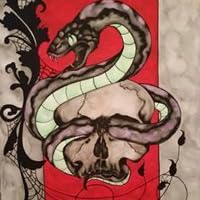
When Carrie reclaims her body after being possessed by a hedonistic gang of dark spirits, life as she knew it is over. Before, she was a thirty-something data analyst who enjoyed preparing vegetarian meals, decorating her vintage home, and training for marathons. Now, she’s lost everything—her savings, friends, career, and reputation. The police want to question her for an array of crimes. Homeless and diseased, she’s also the star of her own mortifying viral video.
That’s not all that’s changed. She can now see ghosts, though not the traditional specters from books and films. These earthbound souls exist at the mercy of the physical world, where grass impales their feet and rain riddles their astral bodies like bullets. When she meets Daniel—who first encountered her body on a one night stand during the spirits’ debaucherous joy ride, they forge a friendship rooted in home-cooking and bondage. Just as Carrie finds a new normal, she discovers that sinister spirits have possessed another victim.
Will she risk everything she’s rebuilt to save a stranger?
Rob E. Boley likes to make blank pages darker. He lives with his wife and his daughter in Dayton, Ohio. By day, he manages and analyzes big data. Yet each morning before sunrise, he rises to strike terror into the hearts of the unfortunate characters dwelling in his novels, stories, and poems. His fiction has been seen lurking in places such as A cappella Zoo, Pseudopod, Clackamas Literary Review, and Best New Werewolf Tales. His poetry has been known to prowl in publications such as Wild Goose Poetry Review, California Quarterly, Horror Writers’ Association Poetry Showcase, and Undead: A Poetry Anthology of Ghosts and Ghouls. He co-founded Howling Unicorn Press with his wife, author Megan Hart, to conjure tales that thrill, chill, and fulfill. You can learn more about this weird figure of the dark by visiting his website at www.robboley.com.
I really liked the cover and all the discussion around the book. It started very compelling with a wife named Carr being in all kind of debauchery. She is possessed by "The Wishes" some kind of ghosts making her do all possible sexual acts. Well, the narration and prose are very good but with all the inner thoughts of the main character the storyline soon turns a bit long winded and tedious. Who led the ghosts to Carr? What about her friends and her relationship to Daniel? She has all kind of venereal diseases and tries to hunt down the evil man who mainly abused her. What about the woman who healed her? The very character based story was confusing at parts and the compelling element soon wore off. Very artificially composed and very modern horror story. I could only be convinced in parts. To me it was a bit too long and long winded. It dragged a bit. But if you want to have an unusual modern horror story you could risk a glance!
I've long thought that the novella is the perfect delivery device for a horror story. Short enough that every word has to count and long enough to fill out all the characters. Somewhere in the last third of this, I lost my way.
It's difficult to say much because I don't want to spoil anything. We join Carrie in the middle of things and the story goes back at a certain point and fills us in. You and she both are in for a ride! Everything is moving quickly and the reader is almost dazed with Carrie's frenetic schedule. Later on, when the reader is more well informed, we join up with Cassie again as she searches for answers. In between, we learn she had a small group of friends, which included a gay couple. She liked to run. She liked to cook. I learned these things...but it didn't make me care more for her.
I was on board with this story all the way up to the last third or so and then things became a bit muddled for me. It was difficult to picture in my head what was being described and when that happens it interrupts and takes my mind out of the story. I also felt that the denouement was a bit disappointing...which I know is very general, but...spoilers.
I'm aware of some buzzing going on regarding this book but I can only speak for myself. The Body Will Follow is full of promiscuity, violence, rape, S & M, STDs, and more. If you are triggered by these things, you should call a hard pass. I started reading horror in the late 70's or so, and at that time, a lot of horror books contained all those things plus some. That's not to say the attitudes toward woman, homosexuals etc... was right, but it's what it was and it's what I grew up with. The first 2/3 of this novel felt exactly like that to me, and that inspired a...longing for those times when I just discovered what horror could do. Bravo to Mr. Boley for bringing me back there.
My rating here and now is how I felt about the book, which is what it's supposed to be. I enjoyed the prose and the pacing, for what it was and for how it swept me along, but I lost my way somewhere in that last third and it just didn't work. Your mileage may vary.
I'm willing to check out Mr. Boley's other work in the future because for the most part, I did enjoy his style of writing.
I turned my review into SCREAM Magazine this morning! There is a fanbase for every kind of story and my goal (MY goal. I'm not speaking for any other reviewer's goals) as a reviewer is to articulate my personal reading experience while also preserving the integrity of the book so as not to shame any reader's preferences or enjoyment. I think SCREAM fans might dig this one and I'm excited to get it on their radar, but this book didn't do it for me.
This is a fantastic novella that I almost passed on due to some of the low and/or tepid reviews. In case you haven’t read those reviews, there is some controversy surrounding the plot of this book—specifically the idea that a woman is possessed and the possessing spirits force her body to do things to which she hasn’t consented. This has been, obviously, triggering to some readers. If you are concerned about this aspect, as I was, let me reassure you that that is NOT the plot of the entire book; in fact, that element of the story is not treated in a prurient manner and ends after the first chapter. By the end of the second chapter, the possession itself is history. If you are thinking of skipping this one because of the reviews that emphasize this plot point, as I was, please don’t; you’ll be missing out on an excellent reading experience.
(Another reviewer has written with regard to The Body Will Follow, and I’m paraphrasing, “If you read horror and are upset that you are horrified, then maybe you should read something else.” It’s a fair point. I wonder how many of the reviewers who have been extremely angry about this have been just as angry about the exact same thing happening to a male character in the new Wonder Woman movie, a character who is possessed by the ghost of Wonder Woman’s love interest.)
(I also suspect that if the plot had been that the woman had been forced to commit gruesome murders by the possessing spirits, then there would have been no controversy at all—which, as always, says a lot about our society in general.)
So yes, that element is awful, purposely so. However, the seed is planted at the end of the first chapter that this is actually going to be a story of inner strength, of reclaiming one’s power and finding a new purpose in life, and if you continue reading you’ll see that that is exactly what happens.
I found this to be an extremely effective and scary novella. It is also surprisingly funny. So if you are having second or third thoughts about trying this, let me encourage you to go ahead.
*****I received a free copy of this book from Netgalley in exchange for an honest review. This is it.*****
This is the only book I've ever DNF'd in my life. This is laughably terrible, and I genuinely can't fathom why this was released. The topics, writing, and dialogue all made me incredibly uncomfortable - a book written by a man in which the main character (a woman) is forced to have sex with multiple people against her will throughout the entirety?? This is not okay.
Is 'rape fiction' seriously what we're going for these days? Are folks still under the belief that they're "pushing boundaries" by writing about women being brutally victimized repeatedly? Come on.
Very disappointed with this, and it's a shining example on why having women on your editing/publishing team & sensitivity readers are a valuable part of the book industry and process.
Write what you want, but if you're going to PUBLISH IT, you need to be more responsible for what you're putting into the world - this is not a good look.
The cover is great. Everything else is problematic, harmful, and bad. Come at me for this negative review, I don't care. The book is not good.
Believe it or not, I have read very, very few stories about possession. As such, I don’t know what parts of The Body Will Follow were influenced by possession tropes (or common knowledge on the matter) and which are fresh and unique to Boley’s ideas. I just thought I should preface that for those of you who may know a ton about possession and find me odd for comments I may make in this review.
Now that we have that out of the way, I want to start this by saying I found this story very original and enticing. I normally don’t care for a lot of sexual content in my reading - of which there is a lot in this story, especially in the beginning - but I wasn’t put off by it really in The Body Will Follow. Though I couldn’t fathom taking in a homeless girl (wanted by the police) just because she introduced you to bondage, that aspect of the story didn’t make me uncomfortable or anything. The sex had its part and point to play and was important in many regards, so it mostly worked. I only found some of the details to be padding and unnecessary.
But I digress. Back to how I found myself easily invested and interested in what was happening. Again, knowing little about possession, I found it rather engrossing seeing how Carrie’s possession not only wrecked her life in so many ways, but put her in so many uncomfortable situations. Generally, when I think about possession, I have that image of a person bound to a bed or room where they scream curses and climb walls. Here, Carrie is sort of leading a life, but not under her control. She is fooling people into thinking she is “normal,” in other words - she’s not being looked at it like, “Demon! The demon has her!” You know what I mean? No, instead she acts like a self-destructive teen. She’s out there having parties and orgies, destroying stuff, acting unruly, and eating like a pig. That was the other aspect I found amusing - the way her Whispers (as she called them) used her for earthly pleasures, things they miss from being alive (especially sex and food). Not only did it make perfect sense, it provided the avenue for destroying Carrie’s personal life with ease, ruining relationships left and right, and getting her beyond fired from work.
So, the story opens up with her possession. You get the tail end of it, right before someone frees her of her ghosts (I’m going to keep light on the details to avoid spoilers). The rest of the story focuses on the aftermath of what her possession has done to her life. As previously noted, it’s practically gone. Ruined beyond repair. We then follow her recovery - through the help of one of her later lovers while under possession - and then get to the point where she is seeing ghosts. Boley’s take on this is also original to me, as the spirits that roam the world are affected by everything around them (despite their inability to act upon them on their own). For example, the rain cuts them apart. Doors swinging open can bash their faces. But can they open the door themselves? No. I liked this idea and wanted more inclusion of it.
Now, let’s move into some of the flaws. I never actually liked Carrie’s character, but I didn’t dislike her either. I guess, more or less, I was indifferent to her. I enjoyed her journey, though. As for Daniel - her aforementioned lover that takes her in and helps heal her - he was a nice guy with a kind heart. However, his actions really didn’t make sense. Again, why would you take in a homeless, wanted-by-police stranger that has done a lot of crazy things as of late and given you STD’s along the way? I couldn’t get my head around that. There’s being a nice guy and then there’s being an idiot. I just didn’t find that aspect very plausible. I also mentioned before that I loved the way the ghosts are portrayed in this story, but wanted more of it. That plotline is used pretty briefly, whereas it could have carried the rest of the story. Instead, the third act involves Carrie and Daniel trying to save another possessed college student. That was all well and good, but I can’t help but feel that it would have worked better as a cliffhanger ending (rather than being told as a third act). I would have preferred to see Carrie interact more with the ghosts and learn what other new abilities she may have now. Also, how did she expect to fix her life in that town considering all that happened? In reality, she would really just need to leave and adopt a new identity, I think. I mean, the police should have at least picked her up at some point during this story. Lastly, her “confrontation” with the person who set her up was very weak and anticlimactic. I didn’t even rightfully understand the “why” of it all.
Complaints aside, I was sucked into this story early on. It kept me hooked from beginning to end, and did enough to fuel my attention throughout. I never felt like I was hitting a low or petering out into boredom. The Body Will Follow is not only an amusing take on possession, but also a wonderful companion to what follows next. It definitely took me down new roads in my reading, and I expect to read more of Boley as a result. Review by Aiden Merchant www.aidenmerchant.com (Also on Instagram, Twitter, Goodreads, and Amazon) contact@aidenmerchant.com (Message for review consideration)
This entire review has been hidden because of spoilers.
3.5 out of 5 for this one. A take on the possession sub-genre that is scary, creepy, funny, charming and a dash perverted; usually all at the exact same moments.
This was a quirky little story. It reminded me a bit of Mira Grant’s “Closer”, which I really liked. “The Body Will Follow” was definitely more graphic, but also fell into the category of comedic horror, which made it more of a fun read towards the end. If you like Boley’s other books (I do), then you’ll like this one as well!
Fair warning though: If you’re a snowflake this story will most likely offend you in some way or another and you should probably avoid it. It’s a story about ghostly/demonic POSSESSION, wth do you expect?!
I preface almost all of my reviews with this, but I'm not great at writing reviews, so bare with me here. I'm part of author Rob E Boley's newsletter, and a few weeks ago he sent out an email asking anyone if they wanted to read this novella before official publication, with the intention of leaving an honest review. I jumped on that, since I really wanted to read this anyway. This is an extremely unique, interesting take on the possession sub-genre of horror. This story has some legitimate creepy moments, but it is also a fun romp. The main character, Carrie, is likeable, although some might be put off by her hipster/pretentiousness a bit. Besides the creepy moments, this book holds a number of disgusting moments too (the first "exorcism" scene is fairly memorable). We aren't talking Edward Lee here, but it would make most normal people squirm somewhat. The story is told in first person, and Carrie is a funny narrator. What I really appreciated about this story that maybe doesn't get touched upon in the few other possession stories I've read is just how incredibly being possessed could absolutely destroy your life, relationships, career, and mental-, physical-, and emotional-health. The possessors ravage everything in Carrie's life, and she's left with nothing but hurt, destruction, and bugs. My only real two complaints are the ending and character decisions. About halfway through, a new key character is introduced, and I feel like he made some incredibly questionable/casual (read: bad) decisions about things. I won't go deeper, because I don't want to spoil anything. On the heels of that, while the ending was good and unexpected, it also sort of left a lot of things hanging. Two minor nitpicks, because overall I absolutely loved this novella. Oh, and that cover! One of the most stunning, awesome book covers I've ever seen. But it's by Kealan Patrick Burke, so what would you expect? Anyway, I would suggest this to any horror fan, and especially if you're predisposed to possession tales. Thanks again to Rob for sending this over for review! Phew, that was short.
I struggled to really know what this book was, and I don’t think the book knew who it was either - but that is kind of in keeping with the story at hand. A possession novella that only really scratches that inch early on.
The opening possession parts were well written, how our protagonist wasn’t in control of her own body / mind (that’s scary right) this opening also sees a lot of sexual references, acts carried out on our thirty year old protagonist and the Wishes (ghosts) that live inside her. It was crossing a line but clung to it with almost broken fingers - but I read on.
But then the book spliced humour into the story and for me it didn’t work, although with graphic scenes and R rated content at times, it did feel as if the book was aimed at a YA audience and didn’t take seriously the ominous dread and horror that was sewn into the first few chapters and what could have been horrific and scary ended up being lost to cheap one lines and silly humour (which I feel didn’t suite the tone of the novel from the blistering outset). Also I don’t know, there was something off about how our protagonist talked - she seemed much younger in her references and how she saw life and her lot.
The second half of the book just became rather silly as the possession was ditch to become an almost adventure story - where our no longer possessed lead set about tracking down others that suffered her affliction - the pace and dread and horror was drained out of the book and as I said it ended like I was reading a YA book (not that that’s bad, I love a good YA book from time to time - but this was billed as horrific, I just didn’t get that after the first few chapters).
When the author was writing the first few chapters I was impressed with his writing, the images he conjured and his style - but again that dwindled as the book progressed, and turned almost into a romcom with a bit of horror attached here and there.
There are other reviews that go on to talk about the sex and the other parts of the book that have done a better job than I at discussing these - see Well Read Beards review. So read those if you want more of an overview there.
But for me it wasn’t what I was expecting - glad I read it as I’m researching for my next project that features possession. But will it live long in the memory - probably not!
The ‘Body Will Follow’ opens with Carrie, a fairly normal thirtysomething with a nice house, good friends and a boring job.
Oh yes, and Carrie is possessed.
She has lost all control of her body to malevolent spirits (who Carrie refer to as ‘the Wishes), who use her for their own debauched purposes. When Carrie finally escapes their clutches, she finds her life in tatters. She’s lost her job, her friends, her house is a wreck, and she has police banging on her door to answer for crimes she has no recollection of.
She soon finds herself on the streets with nobody to turn to for help, except for Daniel, a one-night stand of the Wishes. Their friendship will take them on a journey with ghosts, zombies, bondage and rituals, while Carrie tries to rebuild the life that she once had.
When I review a new book, I usually like to leave a day between finishing the book and writing a review, so I have a chance to reflect on what I want to say. It has been a week since I read ‘The Body Will Follow’ and I find I’m still conflicted by what I’ve read.
On the one hand, Rob E. Boley is a hell of a writer. His prose is strong, and you quickly get swept up in the story on the strength of the writing alone. There are also a lot of ideas here and there were some I really enjoyed and would like to see more of. I particularly liked the way ghosts were portrayed. Here, the ghosts can interact with the physical world around them, but it is inherently dangerous for them. A blade of grass can cut them, and a bout of rain is like a hail of bullets. They can still suffer and feel pain but can’t die (again). It’s an intriguing premise and one that I wished was explored further.
My main issue with the book is its tone. There are a lot of intense themes and some will likely put a lot of potential readers off, but there is also an undercurrent of humour and the two don’t always mesh well, either leaving the humour to fall flat, or to make light of the more serious subjects. I also didn’t find any of the characters especially likeable. Carrie in particular comes across as emotionally detached and indifferent. This may be a stylistic choice, given the theme of possession and loss of self, but, if so, it didn’t work for me. She never seems affected by the terrible things that happen to her and while there is a lot of time spent on the consequences of the things she experiences, we are told about them so matter of factly, it never really connects in the way it should.
There was a lot about this book I loved, and a lot I had issues with. If nothing else, it’s a very ambitious and unique book and, love it or hate it, I’m still thinking about it long after I read it, which feels like a recommendation in and of itself.
Definitely...different. The ending is a happy ending of sorts considering how dark and bleak the book starts out. I am surprised she did not take stronger revenge on her friend, the nerve, would have been nice to see stronger karma in that regard. A companion she picks up along the way keeps the second half of the story firmer. Full review to come
*Thank you to NetGalley for providing me with a copy in exchange for an honest review.*
So I got about 50% into this book and just couldn’t finish it. I hardly ever DNF books, like ever. I’m just someone who thinks they have to finish a book once they start it, but I’m trying to work on that because why waste your time on a book you don’t like? So, I didn’t like this book. It made me feel uncomfortable, and not the kind of uncomfortable that’s thought provoking or making a statement. It just made me feel weird.
The story starts off with Carrie who is possessed by, what she calls, The Wishes. With no control over her body, they force her to have sex with random people. Like a lot of people. Including: men, women, and underage teens. Carrie is then exorcised and given back control over her body, but not without consequences. The Wishes have drained her back account, ruined her house, lost her her job, ruined her relationships, and even gotten her into legal trouble. With the help of Daniel, one of the men she had been forced to have sex with, she starts trying to piece her life together.
I’m a big fan of possession stories, I find them to be fascinating and I really thought this one was going to be a fresh outlook on the trope given the plot. I like the idea that the majority of the book focuses on the aftermath of the possession. It’s not something I’ve seen and I think it could’ve been done really well, but it’s just the beginning of the book that ruined everything for me. I found the first few chapters to come across very insensitive and off putting. I really don’t know why the possession had to be centered around rape. I’m not opposed to triggering ideas being written into books, but there needs to be a purpose for it. This felt like rape for no reason or purpose. If the rape had been exchanged for something else, I think it would’ve had the same, or even better, affect. It also put me off that there had been non consensual sex with minors. It was all just too much for me. I wanted to give the book a fair chance, so I kept reading, but I just couldn’t get into it. I think the rape had just really left a bad taste in my mouth. Now, I’m not going to tell someone what they can or can’t write about, horror is horror and authors should be allowed to write what they want. However, it should be handled with sensitivity and carefulness. This didn’t feel like that. As a woman, I just couldn’t stomach this and I don’t know if the author spoke to any women or let them read this beforehand. If not, it’s something I would highly encourage them to do in the future. Male authors who write sensitive topics from the perspective of women need to be talking to women. If they don’t, it comes across very poorly and uneducated. I’m sure there will be people who don’t feel the same way, but this is just my personal opinion on this book and how it made me feel while reading it.
3 stars--I liked the book. 5 stars for the cover though--I really love the vintage pulp look. Trigger warnings for rape, STDs, possession/body horror.
This was a quick and surprisingly humorous book of body horror. In fact, I think it was a little too quick--we barely got to know the characters (but then again, could this breezy plot hold up to a longer narrative? Probably not). I think the book really wants to be edgy, but it's not really. If you set aside all the gross bodily fluids, a lot of this book is urban fantasy, where the narrator sees and tries to comfort ghosts and performs exorcisms using weird magic.
Occasionally the story veers into cringey "men writing women" territory, but overall I had fun.
I received this review copy from the publisher on NetGalley. Thanks for the opportunity to read and review; I appreciate it!
Love the cover. I enjoyed the story as well. I just was not as engaged as I wanted to. I was looking for scary moments but the novel failed to deliver big time on that part. However, THE BODY WILL FOLLOWS is still quite original. Sexually explicit in some parts but it is more character driven than anything else, besides involving one of the gross out moment focusing on an exorcism. Had the Dell Abyss line still existed I would have easily seen this novel as part of its available titles. All in all, good stuff if not great.
A novella is full of potential. To get an insight into a new author and/or embrace a little explored genre is what a short story can offer.
The Body Will Follow by Rob E Boley provided such an opportunity for me. To read some horror; and meet a new writer comfortable in telling scary tales. Here then was more than a ghost story. A shocking tale, of possession and dehumanisation by the lack of control and consciousness in one’s actions and body’s desires. Since they are driven by nefarious spirits craving perverse sexual encounters and physical pleasure. This is the story of Carrie, a normal career minded woman with friends and close family relationships. We first meet, Carrie the possessed, a carnal being, who in lucid moments is aware of her lack of control and personal depravity. Somehow she must wrestle back control but salvation comes from an unexpected source, leading to a brutal exorcism. She is offered hope but feels lost and empty. Returning to her home, she finds her home destroyed, her credit maxed out. Listening to her unanswered phone messages she realises she has no-one left among family and friends to turn to and without a job. With the police after her she is forced to go on the run and live on the streets.
A clever story about what we value in life; like how we perhaps we don’t appreciate stuff until we lose it. How controlling some folk can be of others and how we can easily fall between the cracks in life as Carrie becomes a homeless person with all her bridges burned. By chance she meets Daniel, who she remembers showed her some humanity when she was possessed and out of control. He perhaps has other motives. I was hooked with the journey Carrie had to make to find answers and make amends. If she could rebuild relationships or would just have to start again by re-inventing herself. This begs the question if we lie to others and cease to be ourselves are we not again allowing external factors to control our lives. Nothing though may be more damaging than the physical possession she endured, as we see Carrie’s life continue to unravel with the challenge multiple partners and risky unprotected sex. Humour is a constant source of balance, to offset the darkness and an introduction to the alternative reality in which Carrie finds herself, for now she can now see ghosts. I particularly loved the reading of auras in the people she encountered and the colours as described by their association with familiar hues - this was a constant theme which I never grew tired of reading. Ultimately it is a book about the human spirit; our need to communicate and be more honest with others. We might not be able to see ghosts but many people pass by others as though they were invisible, or because of shame or a sense of feeling better than others, so just fail to engage with them. I loved the story as a simple story of fantasy. Where imagination can be allowed to explore and discover alternative realities. But for me, at the same time within the make believe I had a sense of reality. The need for restoration, fixing things, helping out, being less judgement and seeing things from another’s perspective.
First off, let me say, "The Body Will Follow" is not your average possession story. Rob E. Boley has taken the average possession and pulled a lime and coconut type of situation, for a new type of story that's twice as bizarre!
"The Body Will Follow" revolves around Carrie, a middle aged woman who once had everything she could have wanted, but has been posted by not one or two, but an entire GANG of ghosts! These ghosts have two goals: eating and fornicating as much as (inhumanely) possible.
Eventually herself again, but a homeless, sick, friendless, jobless, moneyless, no family, clothes or car, etc. version of herself, Carrie comes to rely on an unlikely character for the remainder of the book, eventually forming a bond.
Taking her own experiences into account, and the tremendous aftermath she deals with, Carrie stumbles upon the gang's next victim, and is faced with a difficult decision, help or keep it moving. Finally, after a wild trip, we get a little closure, and it was the good kind, not the gross "awwww" kind! Boley literally added a tiny bit of romance to a POSSESSION NOVEL and it actually worked!!!
I absolutely loved this story. It was well written, the storyline was amazing, the plot moved at the perfect pace, and the characters were so real and well developed. I didn't expect some of the twists AT ALL, and both the cover art (done by Kealan Patrick Burke) and the interior art (done by Bob Veon), were to die for! Like I said, this is not your run of the mill possession story. Rob E. Boley really hit it out of the park! This is definitely one I'll read again.
Wow! What a wild ride. If the reader can get past the grotesque opening scene, what follows is a somewhat bizarre, yet very enjoyable, mashup of genres.
While "The Body Will Follow" starts off as disturbing body horror, somehow along the way it transforms into something that is a few steps short of a romantic comedy. Needless to say, I enjoyed every minute of it. The author does a great job of creating a believable, yet macabre, world in which ghosts and humans alike co-exist and interact in unexpected ways. I found myself laughing more often at the one-liners, than cringing at the disgustingly delightful descriptions of the protagonist’s predicaments.
My main critique is that the scariest and goriest parts happen so early in the novel, that it feels like the author saved the best horror for first, instead of for last. For people like myself who enjoy what others might find too squeamish to bear, we might want more and be left dissatisfied.
Overall, fans of novels such as "The Hellbound Heart", or those looking for a lighter and more comedic entry into body horror, will find in this novel a new pleasure for their enjoyment.
*I received a complimentary copy of this book on NetGalley and have provided an honest review.*
Not going to bother with summarizing the plot, as many others have.
I let this one gestate a bit after reading, despite knowing my thoughts on it from about the halfway point. The only word I can think of to describe my experience with this novella is "Frustrating".
Much like Carrie and Binkertell (what an awful name) I am in two minds--er, perhaps, bodies--of thought. On the one hand, the story is an absolutely unique take on possession, turning the usual elements on their head with a perverse bent. The way Boley writes possession is interesting and engaging, and, despite my dislike of the story, I was compelled to read--so much so that I devoured it in a single day. There's something to be said about an author who can keep a reader not only engaged, but grapple with the content throughout the day when reading and away. The story, much like the Wishes, burrowed into my mind and nagged me in a good way. For that, I give Boley praise. I appreciated the upbeat ending and Daniel was by far my favorite character. There were moments of great suspense and anxiety--those exorcisms, whew--but it was always undermined by a joke which fell flat. Nothing is more disorienting than someone fishing a scrotum out of your stomach moments after such well-written horror.
It didn't work for even me, and that's my type of stupid humor. It's just not fun to read about sex the way Boley has presented it. The narrator's harsh language in regards to sex is distasteful--and I understand it was meant to be this way, I simply didn't care for it. I also didn't care for Carrie, she's shallow and annoying and it wasn't nice being inside of her head. Some scenes encroach on the 'men writing women' cliche, but not completely. There are moments where Boley renders Carrie quite well (as a man, I suppose I can't really say definitively), but it usually comes off as a false, hyper caricature of women and what the author thinks they'd be like during *certain* situations. Plainly, I think Boley was out of his depth with the subject matter of the Wishes and having a female protagonist. The humor didn't land well, either, which was a shame. Some sections were so mishandled that I could only shake my head.
All of that said, there were moments which shined above the bad bits--Boley's imagining of ghosts and how they interact with the living world was fascinating. The clarity and conveying of a sensation of dual consciousness in both the possession of the Wishes and when Carrie pilots the Binkertell meat-mech was fantastic. Sensory description was apt (unfortunately, in some cases) and the dialogue read well. The language itself was a pleasure to read, when Boley cut loose of the sex and focuses on the prose--until it falls off track again, that is.
There's a bit of depth here, too, with the story approaching allegorical discussion of addiction or complacency. It's easy to give in to carnal desires and waste away, and sometimes, it can feel as if you're not in control of your actions. But the allegory is half-baked, a jumble of thoughts and intention that never coalesces into something meaningful. If anything, it's an exercise in mindfulness, a warning that letting yourself fall into autopilot can bring ruination, but this is tenuous, at best.
I wanted to give this 2 stars, but I feel it deserves 2.5, simply because of how the story turned itself around in the end. I'm not completely satisfied but I am content, and perhaps I'll just have to reconcile that literary Slack in myself eventually.
In summary--Boley, if you're reading this review, you’ve tackled a very difficult subject matter and, while you missed the mark, you have crafted a story which burrows into the reader's skull, making them think about the story and its implications. No story is perfect, but you have a lot of good going for you. Keep writing, keep at your craft. This is one of those novellas where you can tell there was a flash of brilliance in the writer's mind, but it escaped them, in the end.
I recommend this book simply because it's a thinker, one that will challenge you as a reader and make you think long after you've set it down. Whether this is a good thing, well, the jury is still out on that one.
This entire review has been hidden because of spoilers.
The Body will follow...WOW! Rob Boley is a proficient storyteller! He has characters that, though often strange or damaged, are terribly relatable! The Body will Follow is a weird and wonderful departure from the usual "possession " theme. The first I have read in a long time that has left me NEEDING MORE!!
I’ve opted not to rate this book. I pushed myself to finish, though I didn’t really care for it, and let it sit and gestate for a few days. Here we are and I’m not feeling all that much clearer regarding my opinions of The Body Will Follow. I’m mostly mixed because there’s an original idea and some powerful themes here. The story follows Carrie who has been possessed by a group of ghosts. The story essentially begins with her recovery, and the possibility of exploring the aftermath and the potential effects of dealing with something this big and life changing were definitely there.
The issues begin with the fact that none of the characters, from Carrie to the man that helps her through the transition back to some semblance of a normal life, are that likeable. Then there’s the fact that the ghosts thrive on overindulgence. In and of itself, that’s fine - there’s something that rings true about the dead wanting to indulge in earthly temptations, but it seems like it’s mainly sex. Like almost all sex. To the point that the ghosts seem to be contained within some kind of scrotum. This is one of the main reasons I opted not to leave a rating, it’s not because I didn’t expect it. After all, the cover does tell you this is a tale of perversion. It just felt forced, and wasn’t for me. This may work for some readers. I’m just not one of them.
I mentioned earlier the book deals with some heavy themes, a fair few actually, but what makes it awkward, is the way it attempts to do so using humor. There’s a lot of humor here that seems misplaced, or simply doesn’t land.
I found a fair few issues here that limited my enjoyment of the book, but I recognize that I am not every reader, and some people may enjoy this book. You may read this review and decide that ghosts who debase a young woman, resulting in graphically described STD’s is your cup of tea. If so, add sugar and enjoy.
I received a copy from the publisher for review consideration.
First, Silver Shamrock Publishing is releasing some absolutely amazing books and I’m always excited to get a new book from them to review. This is another one! Written by new to me author Rob E. Boley and the story is fascinating!
Carrie has lost herself, her life, friends and any total control of her actions. She calls these voices that are compelling her do unspeakable acts as The Wishes. Almost on the edge of total ruin and sure death until something happens and she is freed of her possession by a mysterious savior but at what cost? She finds support from one of her victims, Daniel, as she tries to piece her life back together.
But sometimes when you are saved you are also changed.
No spoilers and I may have already said to much but this redemption journey from evil possession is anything but easy and you will enjoy this ride. Plenty of humor, uncomfortable situations, ghosts and minimal gore and a perfect if not leading ending sets the perfect read for this Halloween season. I’m hoping for a book 2 as there is plenty of things going on so that this adventure can continue. Grab a copy and let me know!
The premise of this book hooked me very early on. The main character Carrie's POV of being possessed, what the ghosts were using her for, her sense of helplessness and fear - all of it is frightening and interesting. I haven't read a lot of books where the perspective is that of the person being possessed, so I found it to be pretty engaging. There were other ideas/situations that I also liked: the ghosts completely wrecking Carrie's life so that even when she is free of them she still has very real problems to deal with; the presence of other friendlier spirits, and the ways in which they can and can't interact with the world; sometimes even Daniel, and the dark humor they share together. There's definitely a lot to like here and some neat ideas. I also thought the writing was very good for the most part. Unfortunately, the aspects I enjoyed were burdened by several things I didn't care for.
I get the ghosts are using Carrie to fulfil their bodily desires, but the amount of sex and bodily fluids made me a little uncomfortable. Especially considering Carrie's helplessness in all of it, it just comes across as icky (and not in a good way). There's a lot of abuse, in many forms, to the female body and I wasn't crazy about it. And this may sound wrong after saying all that, but I didn't really connect at all with Carrie. I certainly sympathized with all the horrible things happening to her, but apart from that the other aspects of her life and personality felt flat. I certainly don't understand her relationship with Daniel, and the mystery element thrown in at the very end was a little strange.
This book came into my life last month. I saw some readers discussing it here on goodreads and the title and cover art immediately drew me in. Even though I was in Christmas horror reading mode, I picked it up and started reading immediately. There seem to be many differing and divisive feelings about this book and now, I will offer mine.
I loved this book. I thought it was amazing, beautiful, sincere, and heartbreaking. As a recovering drug addict and alcoholic, this book resonated very strongly with me. Sobriety brings with it a special kind of pain. I can say that for myself, when I truly saw, and recognized, all the damage I had caused during my years of active use, it was very similar to Carrie awakening to the reality of her life, post-possession. I am grateful that this book examined that wreckage and told a story of a person doing what they can, a step at a time, to climb out of it and rebuild what they could. I also feel that Carrie's story was told with compassion and empathy, and I do not feel that it was exploitative. I guess that from what I'd heard about it, I did expect this book to be way more nasty and not nearly as poetic and emotionally stirring. I'm so thankful that it was the latter. If you're looking for a different kind of possession story, or something that is dark and beautiful and has some deeper meaning to it, definitely check this one out.
My most recent silver shamrock fix, the body will follow by Rob Boley is a book that I’m glad I went into without reading the back cover copy. I had zero expectations and was able to take this book for exactly what it was.
This is going to be a book that I feel you’re either going to love or hate. I love the way that Boley Mixed horror with black humor. It’s a twist on a possession tale, told from the first person. There is a lot of sexual content in here that may put some people off. A lot of talk of consensual sex and rape, a lot of talk of STD’s. So if that is going to be an issue for you to read, than this likely isn’t for you. This book deals a lot with what may happen AFTER a possession, rather than the lead up to it, and the duration of it followed by the conclusion. We start off possessed and what follows is everything after. I don’t want to say anymore because I think Boley did a lot here to differentiate his work from other possession tales.
My only complaint here is the ending. What the author was selling, I wasn’t buying. It wrapped up too neatly for me, and the “mystery” portion of this book felt like too much of a stretch for me to believe once it had been revealed at the end. That was the sole reason for me taking a half star from this.
If you’re looking for a possession story that is shocking, gross, horrific, and don’t mind the explicit and disturbing nature of the sexual stuff within. This is for you. I’ll be on the lookout for more by the author. Props to Silver shamrock for once again finding something that stands out and putting together an excellent package.
This entire review has been hidden because of spoilers.
A gruesome horror story about the aftershock of possession. This is one part comedy, one part dead bodies, one part intense BDSM & another part descriptive gore.
It’s actually a “realistic” portrayal of post-possession: stds, jobless, lice, poor, no friends etc.
Oh My! Rob has definitely gone into the dark with this one! There were times I felt like I WAS the main character, going through her trials and tribulations. Not often that happens for me. And the trip down memory lane with the landmarks of Dayton, and the pizza (OH!! THE PIZZA!!) that I miss from home. Rob injects some humor towards the end, which lightens up your journey a bit and makes you feel like you've survived. Trigger warning: violence and dubcon/noncon (what can you expect from demon/ghost possession???). If these things bother you greatly, please don't read. If they just make you mildly uncomfortable, give it a try. The overall story is fantastic. 10 Zombie thumbs up!
Carrie has been possessed by spirits and we see the tail end of that and the hideous self destruction it entails. Honestly, at this stage it was so saddening that I couldn’t tell if this was going to be a book about mental illness and was tempted to give it a miss rather than put myself through the turmoil but I’m glad I stuck with it.
Carrie loses pretty much everything as a result of the things she’s been doing while possessed, her friends gave up on her suspiciously quickly which was disheartening but someone she met during the possession takes her in and takes care of her while she works out what to do with her life.
There’s some gross body horror in this book. Including anti-possession razor testicles (it’s hard to explain, just read it for yourself and all will be revealed) and genital sores. It should also be noted that the consensuality of her sexual activity while being possessed is very dubious - if this may well be a trigger for some readers.
I loved Carrie as a characters and the plot itself, but my reservations were Daniel as a character – his motivations didn’t make a huge amount of sense, even if he does have a submissive personality, I wasn’t able to get a read on him to work out why he’d take in a complete stranger and clothe/feed/care for her on such an intimate level with sweet FA in return, and also that the solution to the mystery of how Carrie came to be possessed is cast aside really quickly.
The writing style is brilliant and the plot unfolds at a rapid pace, taking us from one unexpected event to another with some flashbacks to bring it all together.
I’d recommend this to horror fans but be aware of the sexual nature of some of the scenes and the consequences thereof.
(I received a copy of this title via NetGalley in exchange for an honest review)