
What do you think?
Rate this book


224 pages, Mass Market Paperback
Published March 30, 2021


...who loves a good book every bit as much as I do.Bit = not a lot
Goshen, Indiana, was a beautiful place to be in April.Okay, fine. But further down on that same page is the exact same description.
In Grace's opinion, they'd already passed that point, but no use bringing it up on a beautiful April morning.Given that we already know those three things—it's morning, it's April, and it's beautiful outside—you can just omit the description entirely and state that "there was no use bringing it up." This is called redundancy, and it drives me crazy.
 Grace, are you stupid? Are you incapable of being an adult and saying, "I don't want to cook for your tourists, and I'm not going to do it"? Adrian, are you incapable of finding a competent cook who won't ruin your reputation?
 Though she had to admit that her behavior had been less than stellar. In fact, she wasn't proud of the steps that she'd taken to put a stop to the tours. They had seemed necessary at the time. Had they truly been necessary? She'd been quite conflicted about her sabotage efforts before as she'd read her Bible. She'd been working her way through the gospels, and the twelfth chapter of Mark seemed to be written specifically to her. Love thy neighbor as thyself. That was the problem with the Bible. It was so black-and-white. It didn't leave much room for justifying her actions. Still, she could defend what she'd done. She was protecting her child. What if Nicole's father showed up out of the blue and demanded joint custody? What would she do then?Let me repeat that: "That was the problem with the Bible. It was so black-and-white. It didn't leave much room for justifying her actions." I'm pretty sure that this is supposed to come off as sarcastic and joking, but still... To hear that coming from an Amish woman is mildly concerning, to put it lightly. And she still tries to justify her childish antics by bringing up her child's father, which means nothing to us as readers because we know nothing about him.

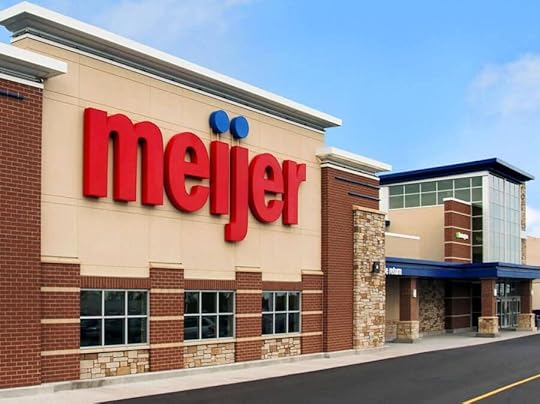 Is there an "s" anywhere in there? No. It is Meijer. Not Meijers. I know that this is absolutely a nitpick, but my family goes to shop at Meijer all the time and it drives me crazy how everyone pluralizes the name. It's just Meijer.
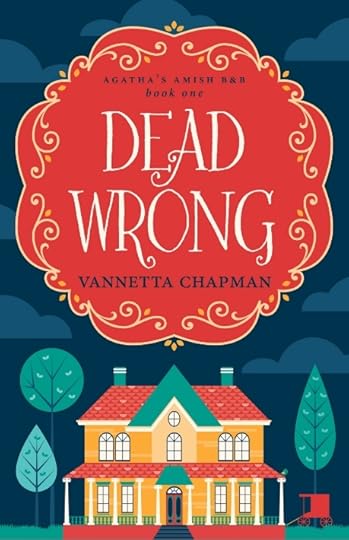
In the end, [Grace] chose three books—a picture book for Nicole, a historical romance with a picture of a castle on the front for Georgia, and a murder mystery with a drawing of an Amish B&B on the cover for herself.First, more filler. Wonderful. Second, I see what you did there, Mrs. Chapman. I'll just leave this here.
A more recent change to their Ordnung had been to allow the gradual adoption of solar power. Some Englischers saw that as hypocritical, since they didn’t use electrical power. Amish didn’t believe in being connected to the grid. They were supposed to live their lives separate, set apart. Could someone live set apart with electricity in their home? Possibly, but with that electricity would come many temptations—television, radio and even the Internet.It was a massive infodump that didn't hold my interest at all, and it disrupted the flow of the story by randomly switching gears to "research essay" instead of "novel."
Solar power, on the other hand, allowed them to be separate but with some of the conveniences of modern life. They still wouldn’t have a television or a radio or a computer, but they would be able to charge their tools and batteries, possibly even hook their refrigerator and stove up to it. Solar power would be much simpler and cheaper than propane. Plus solar power was basically free once the panels were set up. The sun was a part of Gotte’s creation. The Amish saw it as using Gotte’s natural resources.
...for what amounted to less than two hours work.No. Two hours of work.


