From a celebrated documentary artist, twelve portraits from the front lines of migration form an intimate record of why people leave behind the places they call home.
It is an unusual feeling to walk into a place that everyone is leaving . . .
Resisting his own urge to walk away, award-winning artist George Butler took his sketchbook and made, over the course of a decade, a series of remarkable pen-and-ink and watercolor portraits in war zones, refugee camps, and on the move. While he worked, his subjects—migrants and refugees in the Middle East, Europe, Africa, and Asia—shared their stories. Theirs are the human stories behind the headlines that tell of fleeing poverty, disaster, and war, and of venturing into the unknown in search of jobs, education, and security. Whether sketching by the hospital bed of a ten-year-old Syrian boy who survived an airstrike, drawing the doll of a little Palestinian girl with big questions, or talking with a Masai herdsman forced to abandon his rural Kenyan home for the Kibera slums, George Butler turns reflective art and sensitive reportage into an eloquent cry for understanding and empathy. Taken together and elegantly packaged, his beautiful portraits form a moving testament to our shared humanity—and the universal urge for safety and a better life.
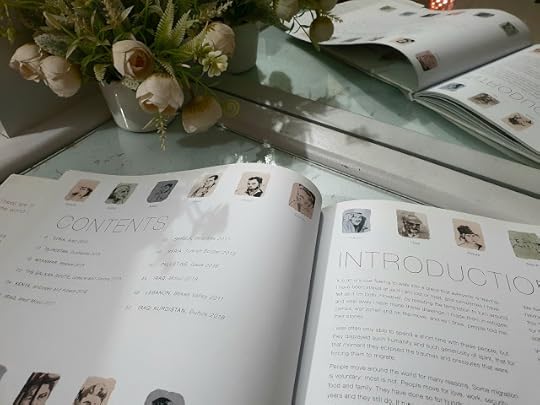
Syria, Azaz 2012 -- Tajikistan, Dushanbe 2015 -- Myanmar, Magwe 2015 -- The Balkan route, Greece and Serbia 2015 -- Kenya, Amboseli and Kibera 2018 -- Iraq, West Mosul 2017 -- Serbia, Belgrade 2017 -- Syria, Turkish border 2013 -- Palestine, Gaza 2016 -- Iraq, Mosul 2018 -- Lebanon, Bekaa Valley 2011 -- Iraqi Kurdistan, Duhok 2018
Moving solemn account of an artist who travels the world visiting migrants in refugee camps and draws and interviews them. In this book, George Butler visits Syria, Tajikistan, Myanmar, Kenya, and other countries and regions. He interviews the migrants who are moving due to war, terrorism, climate change snd better opportunities.
Over the course of seven years, journalist/ artist George Butler travelled to twelve areas of conflict to observe, sketch and interview refugees. The result is this work of art. Spare, yet emotionally resonant accounts are illustrated with equally spare pen, ink and watercolor illustrations that invite lingering. The narratives also invite further inquiry.
This book releases this week and belongs in all public, middle and high school libraries.
It’s always a pleasure to roam inside a book shop and discover a book that is promising for your reading taste. Through my first glance at this white hardcover, it looked like a perfect living room table’s art. Then I approached the book and voila, it’s about immigration! One of my recent interests.
Happily, I purchased the book, feeling like trading a rare gem, which is true. Drawn Across Borders is George Butler’s collection of sketches of immigrants. He drew them in the front line of war, in the abandoned war cities, in refugee camps, in borders and in re-established cities. However critical a war or a crisis is, through George’s sketches we see how simple these immigrant people are, how they struggle and accept life. The resilience of these people amazed me!
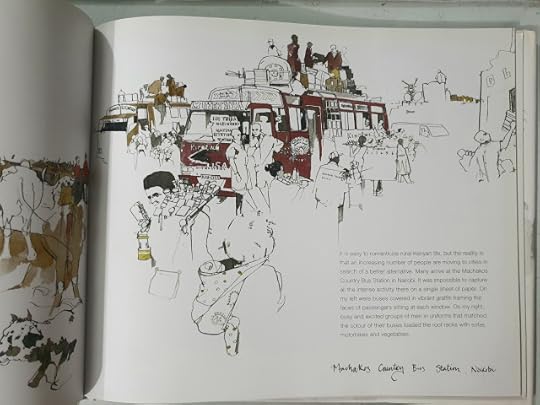
Some immigration were not about fleeing a regime or crossing a border. They were immigration from rural villages to cities for want of work.
The drawing of Kenya reminded me so much of Bangladesh. You can see hawkers selling cheap plastic toys, the roof of a bus stuffed with luggage- overpopulated crowd. For want of work this extra population comes to the city and they have very limited space to sleep at night, very limited wage for manual labor and their family are separated from them most of the year.
Often we forget to realize behind the heavy figure of war casualties or refugees that there are individuals and each of them has a unique story. George Butler presents us some of those stories with few words and vivid portraits and sketches in this book and makes us think, how heavy it is to leave a home against your choice.
Between 2011 and 2018, British artist and reporter Butler traveled to a dozen locations where people have been forced by circumstances beyond their control to leave their homes, documenting in words and pictures the individuals and environments he encountered. The result is an elegant, spare, and moving collection of profiles coupled with muted pen-and-ink and watercolor images. Each account includes a snippet of conversation with someone Butler met: children and adults displaced by war and politics--but never abject victims. His subjects have dignity, humor, and names.
It's a special book from cover (inside the paper cover, a line of people waiting, waiting) to cover (inside them - small sketches of things among the larger stories). Resisting the wish to not see what was going on in our world, artist George Butler, over the course of a decade created pen-and-ink and watercolor portraits in war zones, refugee camps, and on the move. There are brief explanations of where he is, some background of the place and the people, most always a focus and a small sketch of one person. The twelve places include Myanmar, Kenya, Iraq, and Serbia. It's a poignant capture of these most recent years, but none of it is over as I hope everyone knows. Thanks to Candlewick Press for the copy!
A non fiction picture book that tells the stories of migrant people. It's not an easy read but an essential one for understanding especially given the current situation in Ukraine.
Drawn Across Borders was also another amazing book I found on Waketet under Middle East category. The book narrates the stories of many people who had to leave their countries due to terrorism, political conflicts, or war. The author, George Butler, visited refugees camps where he had the opportunity to interview many people as well as to capture some important moments with a pencil and a paper. He not only recounts the sad stories behind each family but also draws some events that speak more than words. Butler visited refugees camps and cities that were totally destroyed in Syria, Tajikistan, Myanmar, Kenya, Iraq, Serbia, and Palestine. In these camps, Butler documented how families were leaving their countries without anything just looking for a place to be safe. In one of the refugee camps, the author draw a picture of kids playing on on burnt-out government tanks while men were looking at the destruction of the city. His drawings portrayed the reality and the pain of thousands of people walking on a journey with their children on the backs leaving a whole life behind without any certainty of their future life. George Butler's stories and drawings transported me two years ago when our school started receiving students from Ukraine. Their stories were similar to the ones in this book. I was astonished when my students were narrating how they were scared to die when they hear bombs and explosions close to their houses. Many families were divided because the whole family was not able to escape together. Fortunately many families were able to find a safe place here in the US, and soon our schools become part of their stories too. I remembered I celebrated with one of my students when one day he said Mrs. Perez, my father is finally here. I will never forget his joyful face. Therefore, this book I recommend for grades 4th-6th since many students can feel identify with the theme and also other students can learn the challenges and pain some students have to go through.
This is an interesting book showing the different types of migration that happen in the world. ‘Drawn Across Borders’ is a little bigger than A4 in size and is filled with thick matt pages of illustrations and text. The book is filled with quick sketches and paintings that the author has created while on his travels to places where people have been in migration such as Syria, Iraq and Palestine.
The book begins with a brief introduction explaining how the author, as a journalist, has had the opportunity to visit places like warn torn Syria, Iraq, etc. And how he has met various immigrants along the way and the stories behind their lives. I like how this book is presented with different forms of immigration including economic migration and not just all about the migration from war torn areas. The author speaks from his point of view, explaining some of the things he saw while going to these places and talking about the various people he met who shared their stories with him. Throughout his visits to these places, certain images of the places or people have been sketched by him and I do like the style of these sketches and paintings.
There are various tales from different parts of the world. Some of the most obvious examples of migration are those people moving from countries like Syria due to war, or Iraq as I’ve said, but what I found more fascinating was the forgotten stories of people who move for other reasons like for work, such as those in Kenya and I was especially fascinated by the story of the couple who were farmers but who now dig for oil instead. I had no idea ordinary small groups of people worked in the way described and it was interesting also to read how the author found certain places in some countries, like getting on a motorbike, and what people were doing there.
Each short section of the book features a different country, though some like Syria are re-visited in later chapters too. The text isn’t too difficult to read and you can get through this book quite quickly, but it’s the illustrations that accompany the book that are interesting to look at. Each double page or page has sketches by the author, some in what looks like pencil and others in watercolours too. There is a simplicity to the images, many of the people’s faces in the scenes are not seen and each picture feels unfinished, like it was sketched in a hurry before the author had to move on, which in a way represents the fleeting moments in the lives of the people he has sketched. I like some of the illustrations, certain faces are quite detailed and I like some of the detail in some images such as the Maasai man with his cows. Some of the images also have quite a dramatic impact on you when you look at them, like the boy in the hospital. But although the illustrations are interesting, I can’t help but feel like I would have liked some more colour in them, like their unfinished nature might work against interesting some children.
Overall this book is interesting, I found the stories of why the people are migrating fascinating and it was interesting to see the images that accompany the stories. This is definitely a good book for teens and older to read and I do think it would have a good impact on these ages. The book is actually aimed at children aged ten and above which I think may or may not be interesting for those who are younger based on how much they enjoy this subject or the impact of the pictures. Overall I do think it’s an interesting book for teens and older though, and a great, if brief, introduction to the lives of some of the reasons behind migration and the people who are a part of it. -Thanks to Walker Books for a free copy.
While stories about refugees have been reported in newspapers and television broadcasts, it's often possible to miss the humans behind those stories of mass migration. This book offers 12 different portraits, drawn in pen and ink and watercolor, at some of those individuals while sharing their reasons for leaving (and sometimes returning) home. The vignettes range from 2011 in Lebanon to 2018 in Kenya, Iraq, and Kurdistan. Illustrator George Butler effectively captures what life is like in a warzone as well as how humans make do when their homes have been destroyed or they've fled elsewhere in order to survive. His images and text reveal families eking out a living by digging for crude oil or traveling many miles away from their families by train to do hard labor. Through all of the images and stories, though, it is clear that humans are resilient and manage to make the best of horrendous conditions, somehow summoning compassion toward others despite the way they themselves have been treated. I was especially touched by one Syrian family's assembly of what they brought with them when they fled to Lebanon, toys grabbed quickly by the children and a box of mostly useless household items including a television remote. But there wasn't time to pack or find more. This book speaks volumes about the variety of reasons humans today move from one place to another while hinting that this sort of migration is likely to become even more common in future times. Questions concerning these individuals' future and that of others will surely swirl in readers' thoughts as they close the book.
This book is created by artist George Butler who has travelled the world documenting people and events. As a reporter would use words to tell a story, Butler uses his illustrations. This book does provide some text, but the illustrations tell the story as well. Butler has spent time in places that most people are leaving-- war zones, refugee camps, and people fleeing their homes due to violence. Instead of seeking refuge himself, Butler decided to capture their stories through his illustrations. This book features stories from Kenya, Syria, Lebanon, and Myanmar, just to name a few places. Through his experience, he was able to talk with a family fleeing Syria, a young man in Tajikistan whose father was killed in the civil war, a geography teacher who lost her job because she would not join the Ba’ath Party, and a young boy named Ibrahim who lost both of his parents. Butler notes that Ibrahim wants to be either a policeman or a doctor when he grows up so he can either protect or heal the people he loves. Through the text and the illustrations, Butler is able to capture the tragedies and triumphs of people all around the world trying to flee violence and destruction and have a better life.
His illustrations show children playing in a burned-out tank, people waiting in line for meager food rations, refugees huddled near open fires trying to stay warm, and people peering out from behind prison bars. The illustrations are so detailed that the reader really needs to take some time to absorb every detail.
This book is perfect for middle and high school aged children.
Iraq: “Talking to Abdul, I saw so clearly how civilians suffer in war. They are left with little choice: either move to an unfriendly but slightly safer internal displacement camp or stay at home, in the firing line.”
Syria: “ my first assignment was at a children’s ward in a field hospital inside Syria, near the border with Turkey. I drew Bassam, who was 10. Three days earlier he had lost his brother, his mother, and his left leg in an airstrike. The nurse came in and pulled the blankets from Bassam‘s bed to reveal his injury. She said nothing but I knew what she was telling me - if you want to know what really happens here, look at this… Bassam‘s father, Abid, sat at the foot of his bed… occasionally putting a reassuring hand on his son’s foot as he struggled through the painkillers. “Art cannot change anything“ he said to me, and in this moment I believed him.… But another man in the corner said passionately, “these are the sorts of scenes that the world should see. They are important to show the people what is going on here.“
Lebanon: “ I drew the doll of a little Palestinian girl called Rania who had fled from Syria. She watched me and asked if the unfinished drawing had no legs because the doll had lost them in the war. I realized the things that children learn to consider ordinary in war are sometimes the most terrifying to witness“
This is a stunning work - sparingly illustrated by award-winning artist and journalist, George Butler - that provides a visual and personal account on a dozen locations where migration and refugee journeys have played out in recent times, many in war-torn and ravaged locations. Simple, sketchy water colour illustrations of camps, queues, destroyed buildings and more have poignant and expressive cameo portraits interspersed to firmly cement that Butler is recounting the lives of real people living/surviving in difficult circumstances. The text is personal - providing a context - the location, a war or event and what brought him to that location and to then recount the stories told by the subjects of his portraits. These personal stories rarely emerge from the news and headlines to tell of people fleeing poverty, disaster, and war; to seek a better and safer future, or to return to a ravaged home, because it is, after all, the only home they have.
This is moving, engaging and very important book that speaks to adults and adolescents to better understand and connect to the events we witness daily on the news but rarely consider the human impact. It would be an excellent support for studies of migration and people movements by adding a humanitarian perspective.
Author, George Butler, travels to refugee camps and war-torn areas with his drawing board, pen and ink and captures stories and scenery like nothing I’ve ever seen before. Drawn Across Borders is full of his watercolor drawings, accompanied by history, background and personal stories from several different countries known for their human migration.
Primarily telling the story through watercolor and drawings, readers are given a secondhand look at the real-life scenery encountered by Butler throughout his journey. In each city, Butler came across unique experiences and human stories, from residents cleaning the rubble of what was once their home to the hospital ward of a child who lost most of his family and a leg. He speaks of trembling while drawing with bombs falling around him, to the smiles in an otherwise desolate place, as well as the hostility from some, saying “art won’t fix this.” Drawn Across Borders is an incredibly eye opening, heart breaking journey through the unimaginable realities many face.
*Disclaimer: a review copy was provided by the publisher; all opinions are my own.
I think I expected this to be a children's book? I'm not sure. What it is is beautiful pen and ink art, to distract you while Butler takes a very sharp knife and cuts your heart out. My first impulse is to take this book and beat people with it until they first read it, and then sign over all their worldly goods to any of a number of highly ranked organizations fighting for the safety, dignity, and future of all people who lose their homes due to war, conflict, violence, persecution.
Obviously assault with lovely book is not a rational or useful plan. But I don't understand how people can continue to be this horrible, to deny others' humanity, to inflict cruel and unusual punishments such as family separation and sterilization on people who have already lost so much and endured such trauma. There is no place on earth that isn't currently occupied by immigrants or their descendants. How do people rationalize their inhumanity? How do they live with themselves? Surely the urge to protect and aid other humans is older than any religion, older than language, more instinctual than breathing. How is it possible to not care?
This nonfiction picture book for older readers provides sketches of immigrants from countries in peril, giving a small glimpse into their lives and often harsh conditions. A scattershot approach, the drawings and accompanying stories are organized by country, as outlined in the table of contents. The text includes narratives and direct quotes from the people involved, giving readers a true sense of their lives; still, the stories are sometimes too brief to be impactful. The ink and watercolor illustrations are quick impressions in time – they literally fade into the white background of the pages, faces are sometimes left out, settings half-drawn. Much like the stories, their impact is limited due to their brevity and murkiness. This book may be best for classroom use in grades 5 and up, as its difficult topics may need more context than what is provided in the text.
We must have more books like this, I can't recommend it highly enough. This book and others made by the hand and pen of extraordinary talented George Butler are incredibly important in educating ourselves of realities beyond our own in an accessible and personal way. I absolutely love the brief length of this book. It's so clever to make this just under 50 pages, and yet have each page communicate personal and meaningful stories of one or just a few people. It is so well done and reminds me that quality reporting and artistry and telling of stories that need and must be told can be done and can be done exquisitely. I love everything that George Butler stands for and brings to life in these exceedingly moving books. Its a must read and I can't wait to get my hands on his next book about Ukraine.
This is an example of the kind of journalism the general public needs to be seeing. George Butler has cleverly collected stories of remarkable men and women migrating or surviving as refugees across the Globe. Their stories come to life in hand-drawn illustrations, showcasing the appalling conditions and incredible bravery of so many.
In truth, this captures very few stories of this nature but my goodness does it shine a light on how important it is that any and all of them are shared at all. A testament to humanity - in its most beautiful and ugliest forms. I can't fault it - a drawing apparently speaks far louder than a photograph ever could.
Touching, heartbreaking and heartwarming all at once.
ARC provided from the publishers in exchange for an honest review.
This was a powerful collection of the author/artists experiences with migrating people around the world, some forced into it through conflicts, others due to economic necessity. They are snapshots captured along with his sketches, that brings these individuals to life and helps the reader connect to them as real people. There was a lot here I didn't know and I think it will be a great book to share with young readers to help them gain a greater understanding of the issue and the people caught up in it. My only problem with it was the text itself. I personally found this very hard to read, a light grey text on white, which I needed extra light to read clearly.
George Butler's book showcases his talent for blending concise paragraphs with pen-and-ink and watercolor illustrations, capturing the essence of the people and places he has encountered. Through this unique approach, the book offers a personal touch, allowing readers to gain a deeper understanding of the experiences of migrants. By depicting the surrounding environments and locations in his drawings, Butler provides a more immersive and visual perspective. Moreover, the book highlights the remarkable resilience, hope, and warmth that can be found in the most unexpected of places, such as war-stricken zones and camps.
The reason I gave this book a rating of three stars is through its ability to communicate how I think I've seen broadcasts. And why I didn't rate it higher is since I have studied a bit of how to draw and I'm reluctant to do anything similar.
Although the author says that he was not attacked, I was, when I was trying to travel from the US to the UK. And I lost an expensive instrument.
However, that is not in this book, that is something different. Butler's artwork and descriptions seem like all the other things I've researched about these areas.
This ripped my heart out. George Butler makes these stories real through his narrative and drawings. Never have I learned so much in such a short book. The crisis of humanity is real, it is harmful and destroys the human spirit. I am humbled by my existence on this planet and reflect often on my fortune. Be grateful, choose love over hate, and realise the world has so many millions of people who are immersed in suffering by no choice of their own. 5/5
I'm really having trouble finding words to describe this book perhaps because it is EMOTIONS that I'm feeling more than any word to describe it. I'm sure I will have to read this again maybe even more before I can truly put words to it. Right now the one word that keeps coming to my mind is ASTONISHING!
This book was in the juvenile section in my library. And sometimes it takes putting things into simpler terms to realize that these problems truly are so tragic. I mourn with anyone who has ever been forced to leave home or lost the people who are their homes. A half inch of rain came down the day I sat down to read this book, and I can't help but feel it was a storm of tears.
A good time to come across this, I found it a beautiful work of art and words: the stories of different migrants, with even some of the notionally 'economic' in practice fleeing conflict or the consequences of it... including those commuting to work in Russia for many months, Syria and Iraq, those constrained by circumstance or government from their previous freedom of movement.
Moving illustrated snapshots of humanity in the most difficult of circumstances, depicted with huge empathy. Excellent reportage. If only more politicians (especially the Tories here in the UK) would read these kinds of books and have their views tempered and hostility dampened by the needs & care that refugees, as depicted here, desperately require not just to survive, but to thrive...
The content did not seem to match the medium. If it had been a thin book in the adult section of the library it would have made more sense. Or maybe this book could be presented as a coffee table book...with more substance.
I'm glad I read this, but I would probably not read it to children younger than 6th grade. I was filling in a lot of holes with my own content knowledge in order to understand what he was talking about. If I read this with kids ages 12+, I would want to explain a lot.
Copyright date: 2021 Star rating: 5 Award: Notable social studies book, Middle East book award Genre: Nonfiction Summary w/ themes: This book is written by a journalist who went to many different war stricken countries to get stories from displaced people as well as to draw them and their surroundings. This book has themes of hope and immigration. Use for future classroom: This would be a book to discuss journalism Thoughts of book: This was a really heavy book with some good information.