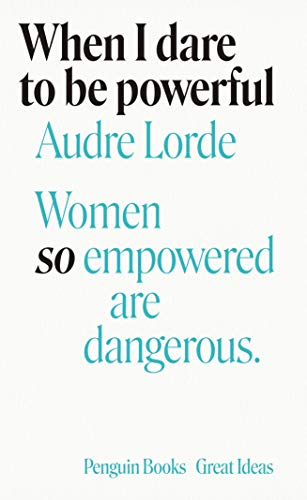
Written with a 'black woman's anger' and the precision of a poet, these searing pieces by the groundbreaking writer Audre Lorde are a celebration of female strength and solidarity, and a cry to speak out against those who seek to silence anyone they see as 'other'.
One of twenty new books in the bestselling Penguin Great Ideas series. This new selection showcases a diverse list of thinkers who have helped shape our world today, from anarchists to stoics, feminists to prophets, satirists to Zen Buddhists.
Audre Lorde was a revolutionary Black feminist. Lorde's poetry was published very regularly during the 1960s — in Langston Hughes' 1962 New Negro Poets, USA; in several foreign anthologies; and in black literary magazines. During this time, she was politically active in civil rights, anti-war, and feminist movements. Her first volume of poetry, The First Cities (1968), was published by the Poet's Press and edited by Diane di Prima, a former classmate and friend from Hunter College High School. Dudley Randall, a poet and critic, asserted in his review of the book that Lorde "does not wave a black flag, but her blackness is there, implicit, in the bone."
Her second volume, Cables to Rage (1970), which was mainly written during her tenure at Tougaloo College in Mississippi, addressed themes of love, betrayal, childbirth and the complexities of raising children. It is particularly noteworthy for the poem "Martha", in which Lorde poetically confirms her homosexuality: "[W]e shall love each other here if ever at all." Later books continued her political aims in lesbian and gay rights, and feminism. In 1980, together with Barbara Smith and Cherríe Moraga, she co-founded Kitchen Table: Women of Color Press, the first U.S. publisher for women of colour. Lorde was State Poet of New York from 1991 to 1992.
i am both addicted to projects and very into short books that make me look smart, so this project (which i continually forget about, as part of my distracted poetic hugh grant-like charm) is a perfect fit.
i have acquired a couple dozen penguin great ideas installments, and i will be attempting to read them until i get bored, catch up, or reach spiritual fulfillment!
Ja jums dzīvē ir laiks tikai vienai grāmatai par rasismu, tad iesaku šo - amerikāņu rakstnieces, dzejnieces, feministes un tiesību aizstāves Audre Lorde eseju izlasi. Ja līdz šim man labākā grāmata par tēmu šķita Why I'm No Longer Talking to White People About Race, tad tagad tā šķiet vien bērna šļupsti vai ļoti laipnā versija priekš 21. gs. sniegpārsliņām. Audre esejas tapušas pārsvarā 80. tajos, bet savu aktualitāti nav zaudējušas. Viņa ļoti nesaudzīgi atsedz tumšādaino cilvēku, īpaši sieviešu, situāciju, dilemmas un uzvedības modeļus, kuriem paldies var lielākoties teikt, protams, baltajiem vīriešiem. Bet viņa ne tikai konstatē problēmas, bet piedāvā arī risinājumus un iedvesmo. Te ir tik daudz, ko ņemt un mācīties, bet mani mēģinājumi to kaut kā sakarīgi izteikt vienā teikumā ir kaut kādi savārstījumi. Es noteikti šo pārlasīšu un jau drīz. Tik jaudīgi!
“The fear that we cannot grow beyond whatever distortions we may find within ourselves keeps us docile and loyal and obedient, externally defined, and leads us to accept many facets of our oppression as women.”
Viena plāna grāmatiņa, kas liek daudz domāt. Kopš Audre šo sarakstījusi, pagājis diezgan daudz laika, bet viss šeit minētais joprojām ir aktuāls. Diemžēl. “rape is not aggressive sexuality, it is sexualized aggression.”
me ha flipado, es una colección breve de artículos o discursos que ha dado. hay uno en concreto que es una carta abierta a una feminista blanca que le pidió su participación en su libro y pfffff la pone verde a unos niveles. perfecta, ahora quiero leer Zami o your silence will not protect you que me lo prestó un amigo jeje
this book helped me to understand many aspects of black womanhood in the usa and the feelings behind it from a black lesbian woman‘s perspective. these collected articles are beautifully written and powerful, i have a lot to highlight and to think through for myself. anger, women‘s anger and especially black women‘s anger are so interesting to analyse, because it‘s something so suppressed and something thats not taken seriously far too often.
Gorgeous. I’d read ‘poetry is not a luxury’ and ‘uses of the erotic’ previously, but re reading them in this collection only furthered my love and adoration for them, and for Audre.
The first chapter ‘The transformation of Silence into Language and Action’ taken from a paper she delivered at a panel in Chicago, is particularly beautiful. Every word is so carefully crafted and thoughtful. Every sentiment so important. Her writing really means a lot to me.
That it can make me want to dive deep into my innermost feelings and explore them, to be more in touch with myself and my surroundings, more present and attentive in my interactions is such a feat. Especially in only 118 pages. She never misses, and was truly something special
when I read Audre Lorde I imagine her talking to me directly. Watching her, mesmerized, on a big stage. Sitting across from her at a dinner table, or next to her on a sofa. Curled up in her lap or walking with her hand in hand through nature. If there is one person I‘d let explain the entire world to me it would be her. Her words are deeply true, like a prophecy, like a testament, like an assurance. I learn from her experiences and am inspired by how she expresses them. She echoes through me, and I want her words to bounce off the walls of my brain forever.
”I know the anger that lies inside of me like I know the beat of my heart and the taste of my spit. It is easier to be angry than to hurt. Anger is what I do best. It is easier to be furious than to be yearning.”
This is why the answer to the question, “Who, dead or alive, would you most like to have dinner with?”, will always be Audre Lorde for me. This little book is filled to the brim with the greatest depths of thought, empathy, kindness, strength and intelligence. Her letter to white feminist Mary Daly, her analysis of the relationships between Black women and her input on the importance of language and using you voice.
The iconic line “your silence will not protect you” comes from her essay titled “The transformation of silence into language and action” and it is a perfect bridge between all of Lorde’s ideas. She is referring to the political here, certainly, but she does not limit herself to this. Silence is harmful in the face of inequality, but it is harmful for us, for our souls themselves. She reminds us that not expressing, but supressing is a mistake, always.
I wish I could read and listen to her words forever, because not only are they wise and challenging, but they are also so beautiful. There are many artists without political depth and breadth. There are certainly many political philosophers without artisitc talent. Audre Lorde has it all.
Institutionalised rejection of difference is an absolute necessity in a profit economy which needs outsiders as surplus people.
These essays felt less like the typical essays I read (Critical Essays on Keats or Ways of Seeing), both with dialogue with fixed ideas and a threading argument throughout each essay. In turn, it's unsurprising that the essays I gravitated towards and connected with in this collection, were those of the same format.
This collection felt more similar to ‘Notes on:’ formats, just as valid, but with less argument and reference. As an example, the essay that brought the rating for this collection down is ‘Eye to Eye: Black Women, Hatred, and Anger’. It seems to me that this essay suffered with it being too long (it making up just under half of the book length), meaning its ideas, while profound and emotive, appeared unfocused and, in turn, unengaging.
However, this did not retract from the insightful power of other essays (my favourites being 'Age, Race, Class, and Sex: Women Redefinining Difference' and 'Uses of the Erotic'), with the writing highlighting Lorde’s amazing creative talent in articulating ideas anyone else would wish to be able to.
A necessary read for an insight into the beginnings of intersectional feminism and race from a lesbian Black woman’s perspective.
Audre Lorde kann einfach wunderbar schreiben. Die Übertragung von Poesie in eine andere Sprache ist natürlich eine Herausforderung. Marion Kraft hat hier ihr Möglichstes versucht und schafft es oft, gute Übersetzungen zu finden. Manchen Kniffe lassen sich aber einfach nicht übersetzen. Insofern war es toll, das Original neben der Übersetzung zu haben. Ich kann diese zweisprachige Ausgabe sehr empfehlen.
black lesbian women’s stories can be and should be fundamental feminist literature; without erasing their unique experiences, without weaponising and tokenising the intersectional focal points for egotistical intellectualism and without sifting through to only grasp onto what applies to ‘normative’ white feministic ideology.
this is so wonderful to read however it does require me to re read because there are concepts that i haven’t quite wrapped my head around yet either because of my own distractedness or just because sometimes clarity comes with a second chance
i told myself recently that i would stop giving books five stars blatantly, but this rating is so deserved. audre lorde is such a powerful force in literature, and i beg of everyone to read ‘poetry is not a luxury’ and ‘uses of the erotic’; two essays in this collection which i have already re-read more than once.
Madre de dios, vaya LIBRAZO. Audre Lorde no puedo explicar lo mucho mucho que me has marcado después de leer este libro. Ya no solamente me ha ayudado personalmente sino que lo empecé a leer justo en un punto de mi vida donde estaba aprendiendo sobre el término 'intersecionalidad' y por este libro entendí a la perfección esta teoría, chef kiss.
heel mooi boek over belangrijke thema’s als intersectionaliteit en racisme ! Vooral de directe en urgente maar toch respectvolle brief van Lorde aan Mary Daly vond ik erg mooi. ik raad het zeker aan :)
“As we learn to bear the intimacy of scrutiny and to flourish within it, as we learn to use the products of that scrutiny for power within our living, those fears which rule our lives and form our silences begin to lose their control over us.”
A collection of essays. Ughhhh. Soooo good. Just really really good. If you’re into feminism, poetry, the experience of Black Americans, or just want to expand your horizons, this book is for you. It’s a quick read. Would give it more stars if I could.
This collection of Audre Lorde's essays provide both an historic insight the into early 1980s, and an intellectual stimulus with regards to sexism and racism and their possible solutions. One helpful thought is that black women should not hold each other to impossible standards imposed by patriarchal culture. A movement that seeks emancipation will fail if it merely aids oppression of another kind.
Lorde's writing is powerful and moves quickly and most times easily between the abstract, the concrete and the emotional. When she remains abstract, however, her writing falls apart a bit. And essays being essays, I would have preferred more references.
However I was positively surprised about the last two essays, about poetry and the erotic. Lorde urges black women to be in touch with their deepest feelings and use poetry to express new ideas. Before they turn into poetry (or, I suppose, into language of whatever kind) thoughts cannot be used to alter the racist and sexist world. To Lorde, writing a poem is not different from lying next to a loved one (p. 116).
In that sense she wasn't so differently oriented towards poetry as I am towards history, my discipline. There is a tendency to think of it as merely fun or a hobby or leisure. That annoys me. Instead it is a requirement for a society that accepts diversity. History and poetry should be exercised by a vast amount of people. Otherwise the shaping of political ideology, social norms, and feelings, and whether you are allowed to have them or not, is in the hands of a select few (read arrogant old white dudes).
"That visibility which makes us most vulnerable is that which also is the source of our greatest strength. Because the machine will try to grind you into dust anyway, whether or not we speak. We can sit in our corners mute forever while our sisters and our selves are wasted, while our children are distorted and destroyed, while our earth is poisoned; we can sit in our safe corners mute as bottles, and we will still be no less afraid." (5)
"There is a distinction I am beginning to make in my living between pain and suffering. Pain is an event, an experience that must be recognized, named, and then used in some way in order for the experience to change, to be transformed into something else, strength or knowledge or action.
Suffering, on the other hand, is the nightmare reliving of unscrutinized and unmetabolized pain. When I live through pain without recognizing it, self-consciously, I rob myself of the power that can come from using that pain, the power to fuel some movement beyond it. I condemn myself to reliving that pain over and over and over whenever some thing close triggers it. And that is suffering, a seemingly inescapable cycle." (63-4)
"I see it, I record it, I do not name it, so the experience is incomplete. It is not pain; it becomes suffering." (65)
"If we do not define ourselves for ourselves, we will be defined by others" (89)
"We can train ourselves to respect our feelings and to transpose them into a language so they can be shared. And where that language does not yet exist, it is our poetry which helps to fashion it." (104)
“Of all the art forms, poetry is the most economical. It is the one which is the most secret, which requires the least physical labor, the least material, and the one which can be done between shifts, in the hospital pantry, on the subway, and on scraps of surplus paper. Over the last few years, writing a novel on tight finances, I came to appreciate the enormous differences in the material demands between poetry and prose. As we reclaim our literature, poetry has been the major voice of poor, working class, and Colored women. A room of one’s own may be a necessity for writing prose, but so are reams of paper, a typewriter, and plenty of time.”(74-75) From the piece “Poetry Is Not A Luxury”—what an epic way to call in Virginia like, paper is expensive girl😆and who are the ladies that get to sit in their room all day?!
How someone can be this highly intellectual and expressive in language while so deeply feeling is a mystery to me! Audre Lorde talks about feeling—“For within living structures defined by profit, by linear power, by institutional dehumanization, our feelings were not meant to survive. Kept around as unavoidable adjuncts or pleasant pastimes, feelings were expected to kneel to thought as women were expected to kneel to men.”(106)
Lorde discusses intersectionality, homophobia, relationships between Black women, FEELINGS, “Uses of the erotic,” all with her very Lorde-ian spot-on, hopeful but wary view of all topics through the lens of class inequality and the capitalism we continue to live under. SO ahead of her time, as usual.
"If we do not define ourselves for ourselves, we will be defined by others - for their use and for our detriment."
I truly believe that the right books find you at the right time. Had I tried to read this sooner I don't think I would have had the proper presence of mind to appreciate it as fully. I'd been going back and forth with myself about silences. Caught between voicing something or keeping it close. Torn between if it will matter. Who it will matter to. But it matters to ME. Silence is the great immobilizer and the machine will grind you into dust anyway, I'd rather not take my silences with me.
Lorde brings our attention to women, Black and POC, and these systems which have them strive to prove their humanity to others. How can we come into our empowerment? How can we connect with each other, how can we distinguish pain from suffering, cherish our feelings and respect our hidden sources of power?
"Feelings were expected to kneel to thought as women were expected to kneel to men. But women have survived. As poets."