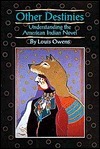
This first book-length critical analysis of the full range of novels written between 1854 and today by American Indian authors takes as its theme the search for self-discovery and cultural recovery. In his introduction, Louis Owens places the novels in context by considering their relationships to traditional American Indian oral literature as well as their differences from mainstream Euroamerican literature. In the following chapters he looks at the novels of John Rollin Ridge, Mourning Dove, John Joseph Mathews, Dâ Arcy McNickle, N. Scott Momaday, James Welch, Leslie Marmon Silko, Louise Erdrich, Michael Dorris, and Gerald Vizenor.
Other Destinies provides invaluable perspectives on much of the first written Native American literature compiled by various Indigenous authors. At times it was a bit of a slog and other times I found it completely compelling. So, fair warning, this isn’t for everyone.
Owens does an excellent job in introducing readers to important and original Native American works from the 1930s to 1990s. Each chapter is dedicated to an author or two and examines several popular works and the significance of its time. As a non-indigenous settler occupier, many of the elements/ meanings within these stories would not be interpreted or comprehended appropriately. Therefore, Owens sheds some light on the themes and issues scattered throughout each of these works by bringing meaning to Indigenous voices.
Some common themes covered within the works included:
the struggle of mixed-blood indigenous peoples while traversing in both the opposed Euroamerican and native worlds
finding one’s identity and purpose
ceremony and indigenous practices
loss of culture, family, land, language, and life, due to dispossession, displacement, and colonization
and various others that were deeply interconnected with the spirit of being indigenous.
I’ve added so many books to my want-to-read list just from this one alone! It was interesting to recognize some of the authors and the works I’ve already read, gaining further insights and perspectives. While this book reveals plot lines and story elements throughout , you’ll have a greater appreciation for what the authors were trying to convey and how the tales are interrelated.
Louis Owens makes a fairly straightforward argument about Native American literature and what common themes and concerns it may have. He says, “The recovering or rearticulation of an identity, a process dependent upon a rediscovered sense of place as well as community, becomes in the face of such obstacles a truly enormous undertaking. This attempt is at the center of American Indian fiction” (5).
Furthermore, he argues, “One of the requisites for a Native American literature, Dorris suggested [in 1979], was a reflection of ‘a shared consciousness, an inherently identifiable world-view.’ More than a decade later, it seems that there is indeed such a thing as Native American literature, and I would argue that it is found most clearly in novels written by Native Americans about the Native American experience. For, in spite of the fact that Indian authors write from very diverse tribal and cultural backgrounds, there is to a remarkable degree a shared consciousness and identifiable worldview reflected in novels by American Indian authors, a consciousness and worldview defined primarily by a quest for identity: What does it mean to be ‘Indian’—or mixedblood—in contemporary America?” (20).
To support his argument, he analyzes texts by John Rollin Ridge and Mourning Dove, John Joseph Mathews and D'Arcy McNickle, N. Scott Momaday, Leslie Marmon Silko, Louise Erdrich and Michael Dorris, and Gerald Vizenor, tracing the shifts in the perception and representation of mixedbloods in particular, tracing the ways in which Native American literature has opened up ever greater possibilities for seeing the mixedblood as a site of possibility rather than merely a source of tragedy.