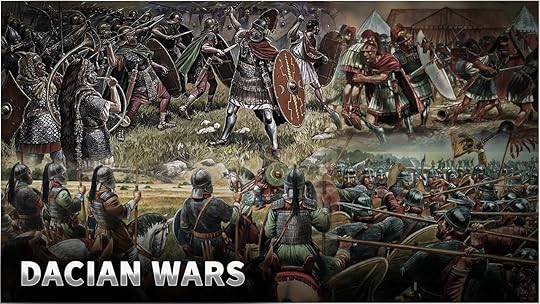
85 A.D. The Roman Empire expanded its conquered territories north to the Danubius (Danube) River. One kingdom is still a serious threat – the third most powerful military power in Europe and the richest nation in the region. That nation is Dacia, led by its young and brilliant military leader King Decebal.
Decebal Triumphant is the story of the early days (85 – 99 A.D.) of the Roman – Dacian wars. It is told from the point of view of King Decebal and the Dacian people fighting for their freedom and survival, and also examines the intrigues of Emperor Domitian, a rising military star named Trajan, and the Roman nobility fighting for power. Going beyond historical myths and Hollywood stereotypes, this novel tells the rich story of an epic clash of cultures and of brutal military conflicts that shaped the future of two nations.
Peter Jaksa, Ph.D. is a psychologist and author living in Chicago, Illinois, U.S.A. His historical fiction novels focus on life in the 1st century C.E., particularly ancient Galilee in the time of Jesus of Nazareth, and life in the Roman Empire.
Roman Empire was going through a hard time with Emperor Domitian spending money on games and luxury and trying to extend the territory of the Empire to the East, to Dacia - one of the wealthiest kingdoms of the time. Dacians are led by a young and talented general Decebal, who soon becomes the king.
Peter Jaksa is a specialist in Dacian wars and presents the story from the point of view of Dacia. Traditions, political matters, religion and the situation of the Dacebal Court are described in detail and the reader can see that the author prefers Dacia to Rome.
I like books that describe big battles and this book ultimately met my expectations. I read before about Roman Legions and their war tactics and it is interesting to see how Dacians used the disadvantages of it in their wars.
We don't know a lot about our past and the history of our countries, about the political map of the beginning of the AD era and this book is closing some lapses in our knowledge.
The book is very enjoyable and the narration is good. I can recommend it to anyone who wants to know more about the history of Europe.
Loved this one - writing closer to a history manual than to a literary novel in many ways and the description of the battles somewhat vague, but the novel has that "energy" that is hard to define and makes one turn pages, while not being able to put it down until finished - which however polished prose may fail to do it so often - while remaining eager to read more.
Of course, what attracted me was the subject and I found the depictions of Dacia under Decebal very flattering - maybe a bit too good to be true but so what.
A big bonus was the Dacian naming which sounded very appropriate with traditional names
This wasn't a war story as such, although we had numerous battles between Dacian warriors and Roman legionaries. Brutal clashes with huge casualties on both sides but, in the case of the Dacians at least, respect for their enemy and magnanimity shown to the defeated. This Dacian trait led to many former legionaries changing sides and fighting for Dacia. That is according to the author, who clearly favoured the Dacian people and culture over Roman civilisation. Dacia was portrayed as a beacon of tolerance and justice while Rome was shown as a corrupt, violent and treacherous society. Comparison between the two civilisations, in terms of social justice, political intrigue, tolerance of minority groups and expansionist ideals was enlightening. Whether life was really like that is, of course, open to debate. Still, it was a jolly good read.
An excellent book illustrating the best attributes of why national sovereignty is the best form of government for the people.
Tolerance for others and their beliefs are well described - showing how perceived “barbarians” of 2,000 years ago are more in tune with liberty and freedom than the Marxist dictators who came onto the modern scene (20th century and currently in Europe & NA).
It wraps up with the end if a strong leader’s successful run bu a national hero who remained the hero for current nation of Romania.
⚔️The book - 1st in the Rome: Dacia Wars series - is a historical fiction that follows the Rome-Dacia wars that for the first time represent the Dacian side in the war through King Decebal's perspective.
85 A.D. As the Roman Empire expanded its northern territories beyond the Danubius River, Dacia, one of the most wealthiest and powerful kingdoms of that time refused to bend its knee before the Roman might. When emperor Domitian sends large Roman forces to conquer Dacia's lush green lands, riches, and gold mines, a young and brilliant Dacian military general, Decebal gives them a tough fight. This was his story - his rise from being a prince to general and finally king of the entire Dacia.
⚔️This was my first read by Peter and I'm quite impressed by his simple, lucid, and crisp writing. The Dacian wars are a rarely-covered topic in historical novels and Peter had beautifully portrayed this clash of two civilizations in terms of social justice, political intrigue, tolerance of minority groups, and expansionist ideals, which shows how well he had done his research.
⚔️The story follows Decebal and the Dacian people fighting for their freedom and survival and also examines the intrigues of Emperor Domitian, and the Roman nobility such as Trajan and Nerva fighting for power. It answered the question of how those millions of people popularly known to be conquered and civilized by Rome felt about being “civilized” by them.
⚔️All the characters are well-crafted and developed. The portrayal of Decebal as a military genius was top-notch. Other characters like his brother Drilgisa, his wife Andrada, high priest Vezina, general Diegis, Emperor Domitian, Spaniard general Trajan, etc were apt. I easily get connected with them. A character list would've been helpful as it has a large cast of characters.
⚔️The climax was satisfactory. The book ends with Domitian's Dacian war and the shameful treaty that the Roman empire had to sign to save its face, leading to Domitian's downfall. I'm eager to know what's going to happen in the next.
Overall, Decebal Triumphant is a very enjoyable read. Perfect for the fans of Conn Iggulden, Simon Turney, and Steven A. McKay. If you like historical fiction, military, and Roman history then go for it. Highly recommended.
It is a great start to presenting the history of Dacia. It is unknown to many, being hidden or destroyed. However, new archaeological discoveries and access to more manuscripts are starting to shed more light on the Dacian people and their culture. Many historians, many cultures, and countries are not easy with what it is being said. How is one of the "greatest languages in the world" that is the root source of many languages spoken today it is not actually provided by Romans? Yes, I am referring to Latin. In truth, it is the Dacian language that is the real language tree, and every day, there are more people who acknowledge this. I will let you investigate this and gather your conclusions.
The only complaint I have is that the book is highly prejudiced against the Romans and makes Dacia out to be innocent and moral. No doubt that the author is telling the truth in both cases, but the opposite must also be true. There was a grand side to Rome, and must have been a dark side to Dacia. Regardless. The novel was good. I only hope future books are more intricate and intensely written. The writing was simple, which is not bad, but more depth would be appreciated.
Another author to add to my must read list. Great characters and a different view of history set in the Roman era. Dacia was a huge and powerful nation, and like many not the backward and barbaric(although this term is often used to refer to any one none Roman) often portrayed by Roman chroniclers. Given the wealth in Dacia and greed within Rome it makes me question if nations like Dacia actually bribed Roman senator's to create unrest and instability.
I expressly like the history of the Dacian side more than from the Roman side of view. Most people never realize the the contributions that these tribes hand on that era. Too Bad More attention and credit wasn’t attributed too them.
I have read a lot of historical novels. I was happy for the way you spent time looking at the issues from another perspective. Looking forward to reading the next book.
Very strong start with fantastically descriptive battle scenes but loses pace with more mundane narrative surrounding every day life and the more political areas. A pretty good start to a new series and encouraging enough for me to pursue.
This is the first book about Roman history that I've read that gave me a different outlook on the Roman army and life. Read quite a few books (novels) and enjoyed , but really enjoyed reading about the other side. Can't wait to start on the 2nd.
Biased review since I’m not a historical girly. Didn’t grab my attention, finished it more so because my bfs mom recommended and wanted me to read it. She’s huge on historical books and raved about this one. Just not my Genre