From the author of William Shakespeare's Star Wars and the Pop Shakespeare Series comes Mary Shelley's classic tale in the style of the Bard. William Shakespeare's Tragical History of Frankenstein tells the familiar story of Victor Frankenstein, his creation, and his tragic downfall. In five acts—with Shakespearean soliloquies and asides, literary conventions and more—you’ll revel in the Gothic tale given the Elizabethan treatment. Forsooth—’tis alive!
Ian is the author of the William Shakespeare Star Wars series and the Pop Shakespeare series, and other books. He's a Portland native, and lives in Portland with his family.
Over the years, I've recommended English teachers read Ian Doescher’s Shakespearean five-act plays in iambic pentameter with their classes as readers theater and watch the movies, scene by corresponding scene.
William Shakespeare’s Tragical History of Frankenstein is the first of his plays that’s a little – no, a lot – different.
It doesn’t correspond to a movie. It’s an adaptation of the book.
If you’ve read Mary Shelley’s book, Frankenstein; or, The Modern Prometheus, you’ll know that Hollywood turned “Frankenstein” into the monster.
This is Doescher’s first play that you can use to show the differences in how popular media – the movie industry, specifically – takes liberties when portraying major characters, like Shelley’s monster. It’s ripe for opening conversations and dialogue with your class about how and why the movie industry did this to her characters. And, unlike Shelley's first pass, it is mercifully short. Perfect for an in-class readers theater.
Looking for more book suggestions for your 7th/8th grade classroom and students?
Visit my blog, The Fabric of Words, for more great middle grade book recommendations, free teaching materials and fiction writing tips: https://amb.mystrikingly.com/
I really hate to say it, but I enjoyed this more than Mary Shelley's original which I haven't read in six years. Please don't stone me. Or, I guess you can if you want to, but it won't change my mind. I found hers to be rather tedious even though I like the story. I fully intend to revisit it again one day to see if I feel any different about it, probably on audiobook since I already have a copy in that format, but I just haven't been able to make myself take the plunge. Ian's version is succinct. The story clips right along, and Victor's constant whining actually works well with Shakespearean dialogue. It's like his emo carping was always intended to be intoned in iambic pentameter.
I won't say much more about the story since I go into it in my review of the original linked above. The text for this is half Shelley's words barded up Billy Shakes style and the other half is all Ian. It seemed to flow seamlessly to me, so if you're as ignorant as I am about the source material and Shakespeare in general, there shouldn't be any jarring transitions or anything. If you're of a more literary bent of mind, you might see it differently.
As with all of Ian's works, one should always read the afterword first so you know what Easter Eggs to look out for. He didn't give very many hints for this one, but he did mention there were three acrostics. I won't put them down here, but I will tell you where they start since I went through so much trouble to find them; I don't mind taking one for the team.
Act II, Scene 1, Line 23 Act IV, Scene 1, Line 69 Act V, Scene 3, Line 314
As for the rest, there were few, if any, pop culture references. At least I didn't catch any, but that works in the book's favor. Get Thee Back to the Future and the Star Wars... nonet? ennead? whatever... were loaded with them, but this is a more serious work. It's also horror, so it's good to be light on the levity. There were, however, several literary or historical references which fit the tone, e.g. lines from Edgar Allan Poe and pals. I'm sure there were nods to several Shakespearean plays as well, but I didn't catch any of them since my knowledge of Shakespeare is pretty pathetic. In fact, Ian's much more educated than I, so I'm pretty sure I missed a ton of stuff.
In spite of all that, I thoroughly enjoyed this, and I'm looking forward to his other two horror plays. (That makes this set a trilogy. I'm not confused about that word.)
Spooktober reading is off to a great start!
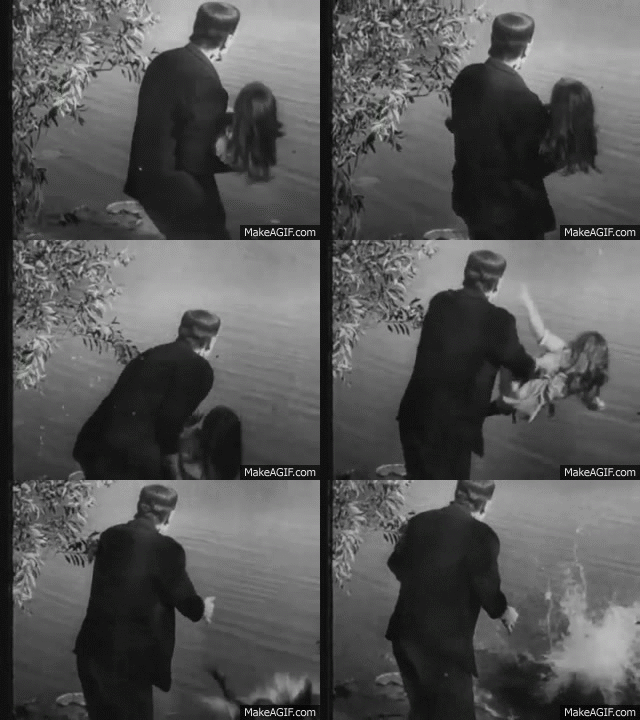
Okay, book review is over, but I need to vent my spleen on a scene in the original 1931 movie starring Boris Karloff because I've kept it pent up within my breast for too many years, and it's just about to tear me apart. Maria. The little girl. What the hell is the matter with her? Big, ugly, scary creature comes out of the woods and approaches her. Not only does she have no sense of stranger danger, she doesn't even ask for the family safe word! She just takes the monster by the hand and invites him to throw pretty things in the water and watch them float.
Right. Anyway, he takes her up on the offer, and after they run out of flowers, he tosses her in.
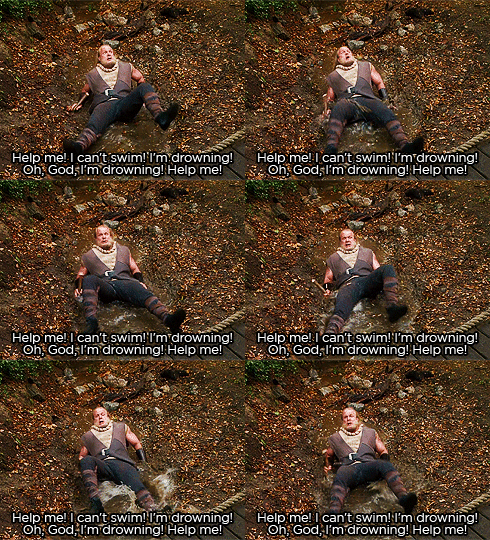
But she don't float. This brings me to my second gripe. The girl lives on a lake. The kitchen window is like three feet away from the thing. Did it never occur to the parents to teach the girl how to swim? You know, just in case she accidentally fell in when she wandered out into the back yard? No. Worst parents ever.
Thirdly, the lake, or pond, or whatever it is. You can tell by looking at it that it's the kind of pond that has a gentle slope running to the shore. He tosses her about three feet away from the shore. This means she drowned in like two feet of water.
Any lake sporting an abyss that close to the shore with that kind of surrounding topography ought to explain itself!
Thank you for hearing me out. I would love to have seen Ian's Shakespearean treatment of this scene, but alas, it doesn't happen in the book, and therefore neither does it occur in the play.
This is my favorite of all this author's books. I am a serious fan of the original book, and his retelling of it as a Shakespeare Tragedy proves that Mister Doescher is a master of his craft. He has captured all the important points and events in the book and crafted it so well that you will feel as if you are in a Shakespeare Theater and witnessing a most excellent performance.