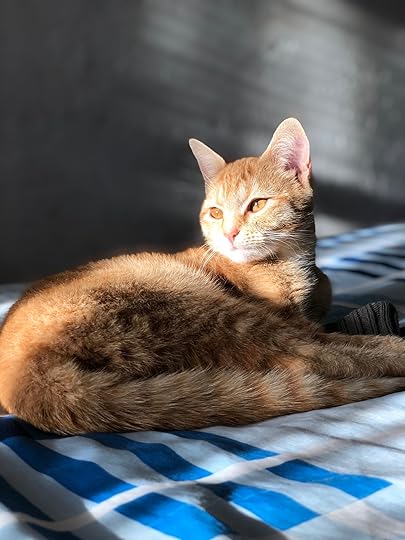
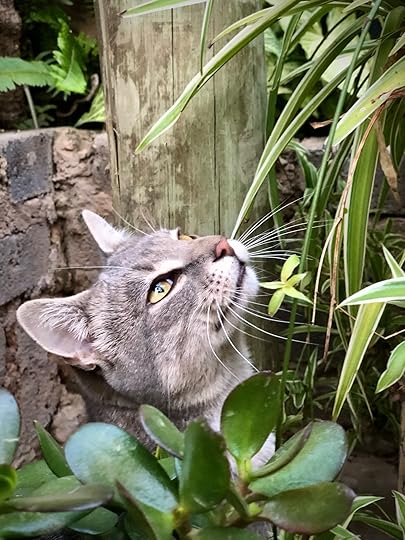
One minute they’re purring next to us, the next they’re attacking our toes, yet for all their mysterious and quirky ways, we can’t help but love these little lions we’ve let into our homes and our hearts.
Whether you’re a cat mom or dad or just want to know more about the way domesticated animals evolved, think, and behave, join Dr. Kristyn Vitale, a researcher in the Human-Animal Interaction Lab at Oregon State University, to get inside the mind of the curious, the cute, and sometimes seemingly crazy cat.
Over 10 lectures. Dr. Vitale will take you through the inscrutable characteristics of cat behavior. She’ll introduce you to cat activities - cat’tivities! - such as socialization and enrichment, which can help to increase your cat’s well-being. She’ll also dispel the common myth that you can’t train a cat - showing you how to both train your cat to do the behaviors you want and correct behaviors you don’t want your cat doing. And she’ll guide you through the evolution of this purrfect pet - from a wild animal to how it become the unique house cat sleeping on your bed.
You’ll find that the more you can decode your cat’s behavior, the stronger your bond with them will be.
Not a deep dive, but a fun listen if you love cats. And what kind of a monster doesn't love cats?
Ok, before you answer that, Vitale's lecture does a lot to dispel the myth that cats are aloof, uncaring, and not interested in interaction with us lowly humans. It seems as though when a lot of people think of a loving pet, dogs spring to mind. And dogs are great. Please don't get me wrong, just because I don't have a dog doesn't mean I hate dogs. Again, what kind of a monster would you have to be? They're adorable and have earned all the pets and smooches they so richly deserve. And if a dog wanders too close to me, that's exactly what they will get.
But they all have individual personalities. Some of them are aggressive, some of them are high-strung, some of them are easygoing, some of them are incredibly intelligent, and some of them do goofy things on the regular. And cats are like that, too.
I have one that follows directions and comes when I call, one that taps me on my leg when he wants to be brushed (and tap-tap-taps when I stop), and one that jumps away from me like I'm his sneaky side chick the minute my daughter comes in the room. Their personalities are all different, and the way they show their affection is different. For example, Kevin always looks like he's grudgingly making biscuits while he plumps my lap up sufficiently enough to lie down, as though the act is some kind of forced labor on my part.
One thing Vitale pointed out is that cats are expected to be less loving than dogs and are therefore sometimes treated as though they want to be left alone. Spoiler alert: They really do like their humans, and they love to interact with us. And while they aren't like dogs in that most dogs will run up to anyone and ask for all the pets, they are just as interested in being social. In fact, since reading this, I've noticed that Viatle is right in that cats will usually gravitate to the room their person is in and sit, if not on them, then near them.
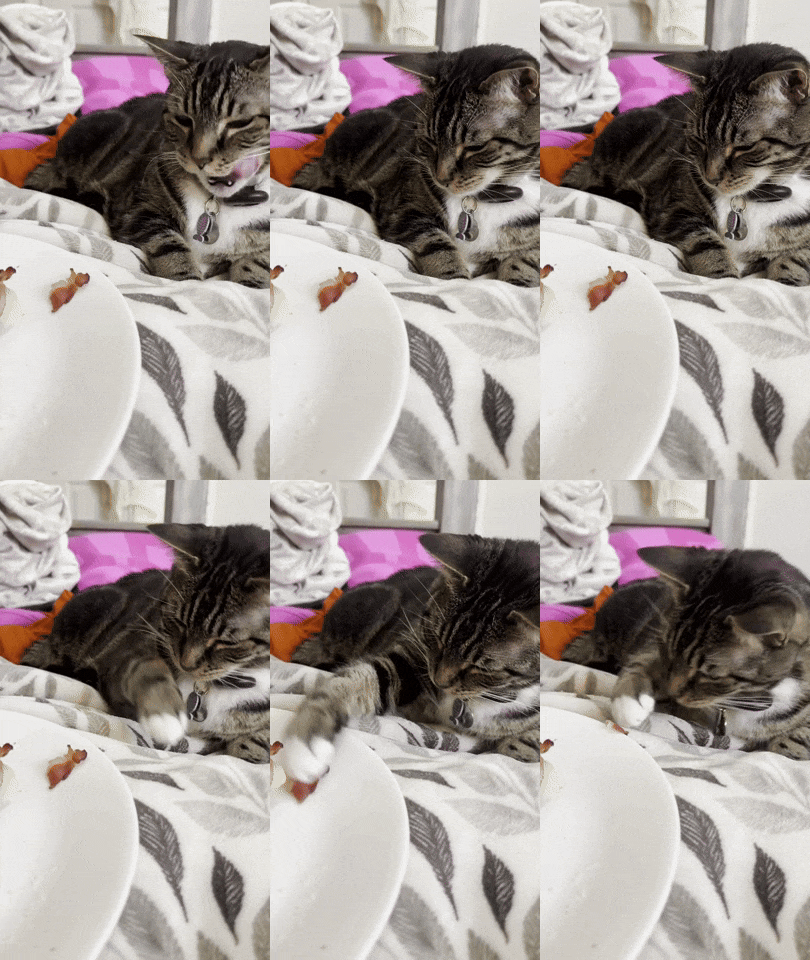
Some cats are clingier than others. My oldest daughter's cat, Dog (pictured above stealing bacon), will sit by the door and cry when she leaves for work, and gets actively depressed when she's gone for long stretches of time. <--we all know that when she's spending the night out of town, you can't leave an article of clothing or a towel on the floor, or the little bastard will pee on it. Bless his heart.
And since cats doing their thing make up some of the most watched video content on the internet, I know I'm definitely not alone in my love of watching cats be cats. Kittens? Getouttahere. I can actually feel my blood pressure go down as the dopamine floods through my body.
If you're like me (and if the online stats are right, you more than likely are), then this lecture is for you. Also, if you're like me, you might end up purchasing a bunch of new interactive cat toys to make up for the guilt of leaving your home during the day.
PS -Anyone else turn cat tv on YouTube when they leave? Asking for a friend, of course.
On January 24, 2025, as I walked home through the scorching summer heat, a flicker of movement between two pillars of the bridge caught my eye. Tucked away in the meager shade, a tiny kitten was seeking refuge from the relentless sun.
I paused, and it let out a small meow. "Hello," I replied, extending my hand cautiously, fully expecting it to bolt, bite, or scratch. To my surprise, it allowed me to gently stroke its fur. The moment I picked it up, I knew. Her thin frame confirmed my decision – she was coming home with me. (At the time, I did not know it's gender. It took me nearly three days, and a good deal of Googling, to confidently determine she was a girl!)
Since the day I brought her home, my life has been a whirlwind of cat research. I find myself on Google, TikTok, YouTube, or even AI apps at least five times a day, constantly seeking information about my feline companions. While I wasn't a complete novice when I started Kristyn Vitale's audiobook, Decoding Cats: Inside the Feline Mind, this Great Course significantly deepened my understanding. It answered pressing questions I had and even some I hadn't considered yet, leaving me much better equipped to provide my cats the life they deserve.
Oh, did I say "cats"? Yes, it's plural now! On June 2nd, another cat unexpectedly entered my life. He'd been roaming the street for at least two days before making his way into my yard. Since then, he's established a routine: he sleeps in my yard for at least 10 hours a day, then disappears for the entire night, only to return the next morning. It's a rhythm I've grown accustomed to.
This audiobook taught me so much about cat "personalities," which has been incredibly helpful because Kitty and Allan are complete opposites! However, one thing they both share is their affectionate nature and desire to be around people. Kitty, especially, has developed a "sweet habit" of sleeping on my chest whenever I doze off.
And a big shout-out to my dog, Cody, the real MVP! She's been incredibly tolerant, allowing both these feline strangers into her home even though she's quite protective of her space. She still growls when they get too close to her face, a typical cat move, I guess!
This book isn't a thorough guide to feline behavior, but I'm glad to know that my black cat's faults are entirely normal. There's a lot of discussion about cats APPEARING aloof and disinterested in their owners, but my cat smothers me with unwanted attention, almost like a hyperactive Labrador!
As a life-long cat lover and a recent cat owner, I have read and listened to many articles, books, treaties and series on cats. And so far, this is my favourite one, mainly due to the author - Kristyn Vitale. She is knowledgeable and thorough, using an academic approach while infusing it with her humane and sincere love for cats. Certainly recommend!
A very informative book for someone like me, who wants to adopt a cat but has little experience with them. In the meantime, I can probably be a better cat sitter for my friends now than before I have read the book :)
I listened to this on audiobook format. This is a good one to read if you are new or fairly new to cats as there’s plenty of good advice and insight to cat behaviour. Unfortunately, cats are often misunderstood- even by those that love them. Personally, I found I was already familiar with a lot of the content, but I did pick up some new to me information.
More of a "how to train your cat" manual than a book about cats, it was still very interesting. I have had the privilege of being owned by many cats through my life so, anything about cats is fascinating.
An interesting audiobook about cats, communication with them, their wellbeing and how their humans can give them the best life possible. Once more, I'll relisten to take notes, but I came out of it with new ideas to help my own cats have the best environment possible.
This is a short little Great Courses audiobook (just under 4 and a half hrs.) that is a free offering from Audible for its members. It isn't meant to be a complete book of cat care or an exhaustive discussion of feline behavior and cognition. Instead it is a survey of these topics and would serve as a introduction to cat owners of some of the new research results. It totally debunks the unfortunate common myth that cats are aloof and detached low-maintenance pets perfect for the busy owner.
Cats are complex, sentient beings. Kristyn Vitale, the presenter, wants her listeners to learn that above all else from her personable lectures. For many, this information may be just enough to encourage more sensitivity to their cats' physical and emotional needs. And that is a very good thing! I wish we had been aware of this information all those years ago when we had our first cat.
For other listeners this will awaken their curiosity and encourage further research into their cats' lives, and that is even better. This audiobook can serve as a gateway to a far richer, deeper understanding of this beautiful alien creature they have chosen to live with. And more importantly, their cats will benefit greatly as well.
I strongly recommend that every cat owner listen to this audiobook. The time investment is modest, and the financial cost is nothing for Audible members, modest for everyone else. Not all important areas are covered, but many are...and there are more complete sources easily available to those who wish to learn beyond this.
Good listen. Learned a lot and the material is presented very well. Minus one star for some things not mentioned. No mention of dealing with cats in heat, spays, neuters etc. No mention of or tips about claw trimming. Almost everything else is mentioned. This work didnt owe me those things it missed but i would have liked more.
I listened to this book because I’m fascinated by cats and it did not disappoint. I don’t currently have a cat but kept listening anyways, even when it got into cat training.
Dr. Kristyn Vitale's areas of specialization are animal behavior, animal cognition, and human-animal interaction. Her research focuses specifically on domestic cat behavior and the cat-human relationship. I found most interesting the history of cat domestication from the African wildcat including evidence of co-burial with a human 9,500 years ago in Cyprus. In Cyprus, an African wildcat was found in a burial site next to a human skeleton in the Pre-Pottery Neolithic B settlement Shillourokambos. The graves are estimated to have been established by Neolithic farmers about 9,500 years ago, and are the earliest known evidence for a close association between a cat and a human. It was interesting to me that in plate tectonics, the southern margin of the Anatolian Plate is in collision with the African Plate, which has created the uplift of the Cyprus arc and Cyprus itself. So, it the burial was telling as the human and the wildcat had to travel to Cyprus.
Much of the content seems to be a mission to dispel notions that cats are not affectionate toward humans or otherwise aloof. There is plenty of advice on modifying cat behavior in the home.
This was a really great thing to listen to. I've learned more about cats which is exactly what I wanted! I'm already a dog trainer so a lot of the terminology Kristyn Vitale uses are things I use on a daily basis.
My only complaint is that she got the story of Pavlov's dogs wrong. She says they were conditioned to salivate at the sight of the white lab coats, this is in fact incorrect. Pavlov conditioned then to salivate at the sound of a bell going off. She also mentioned the 4 quadrants, which was great! I was not expecting her to go over them! But when talking about Negative Reinforcement and Negative Punishment (R- and P-) she used the exact same analogy to describe both. R- and P- are two very different things and cannot have the same analogy used for them.
Other than these two things I really enjoyed this book and will definitely refer back to it more! I've been looking for good books to learn more about cat behavior and this definitely helped! I highly suggest it!
This lecture series meets the consistently high standards of The Great Courses, offering clear, well-structured insights into feline behavior and cognition. While it doesn’t dive extremely deep into every topic, it provides solid, reliable information that feels grounded and thoughtfully presented rather than sensational.
One of the most refreshing aspects is its commitment to empirical research. Vitale avoids some of the more questionable or exaggerated claims often made by popular cat behaviorists and instead focuses on evidence-based explanations of how cats think, communicate, and interact with humans. The result is an accessible yet trustworthy exploration of the feline mind—informative for curious cat owners while still intellectually satisfying.
Overall, Decoding Cats is a strong, engaging introduction to modern feline science. It may not be the most exhaustive deep dive, but its clarity, credibility, and measured tone make it well worth the listen.
This was very interesting. In addition to some background on the history of the evolution of wild cats to our present domestic cats, the lectures included some scientific studies comparing house cats and dogs and their interactions with their own humans and other humans. I was not surprised, but happy to have official confirmation that my present cat's strong attachment and affection, so similar to that of the many dogs I've shared my home with, is nothing unusual. The experimental designs were quite intriguing, and the author even gave examples of how some could be replicated at home. Now I need a friend as an assistant who will be available when my contentedly lazy cat is awake! Or maybe it just isn't worth the bother. I know he is the most well-adjusted cat going, so much so that while I'm sure he loves me best, he also assumes everyone who sits down in his presence is presenting a lap for his comfort.
This was quite the educational listen. Having just gotten a cat myself and wanting to sharpen my mind on their behaviors and such, I thought this would be a good way to stay informed. The author was well-informed but it was easy to tell that the whole lecture itself was being read word-for-word off a script which killed the tone a little bit. There was also a lot of extra scientific wording that had my mind reeling in trying to comprehend it so perhaps it either wasn't entirely necessary or could have been labeled as something more layman term like so those of us who aren't scientists can understand what's being said. However that is just my opinion as I'm more of a social science interest. Still a great way to kill some time and stay informed about some of the things my Nala does and why.
Why do domestic cats have fur in so many patterns and colors? How have cats changed genetically from their wild roots? Can cats be trained? How can you keep cats from clawing your furniture? What are good ways to provide an enriched environment for a cat? How can you introduce a new cat to a home with existing cats? Are cats domesticated, not domesticated, or semi-domesticated?
The lecturer, who apparently studies cat behavior professionally at Oregon State University, goes into some interesting background (such as the famous study on breeding foxes with the goal of domestication) and provides solid information for those who love cats, or perhaps those who wants to become cat owners. Recommended.
Dr. Kristyn Vitale at Oregon State University presents a course on cat behavior and human interaction via ten lectures. The Dr. will discuss and educate on stereotypes, training, and differences between wild and domestic. Such as the Feliss lineage, African, and the significance to humans. Free roaming, feral, and domestic. The history of, and the domestication process. The Farm Fox Experiment, vocalizations, colorizations; piebald versus blending with the environment, maturity, litter, and body proportions. It’s an excellent read and well worth your time.
A short but fairly enjoyable book about cats - how to train them (primarily if you intent to keep them indoors all the time, which I never have or ever would do), how to read their emotions, and how to foster closer relationships with them. I like how Vitale writes in opposition to the common myth that cats are aloof and do not care for their human servants at all. I get on great with my parents' cat, even though she is kind of evil as well.
Having recently listened to an audiobook that focused a lot on the cognitive abilities of dogs that didn't bother to mention cats, I had a desire to listen to something about cats, instead. This fit the bill well. It is a broad selection of lectures on feline behavior, covering their history of domestication, and some pointers about how to get cats to behave in your home by giving them outlets for natural behaviors. I got this as a freebie from Audible, and if you have cats and want to understand them better, this is a great listen.
These are not in-depth, expert-level lectures. The target audience here is the more casual cat owner (or even people who don't have cats). However, it was still interesting for the involved, experienced cat owner – with good reminders, tips, and brief descriptions of studies to back up what we already know.
I am allergic to cats... not a lot, but enough so that I cannot live with a cat. That might have some influence on my review because a large part of this audio course is about solving problems with cats as household pets. Since that is not going to happen with me, I found those parts tedious. Your mileage may vary.
An audiobook packed with information about your cat. This is especially helpful if you are a new cat owner. Proudly, I felt as though I didn't learn anything new about my floofster, but thats more because I've done a bunch of research rather than the book not containing useful tidbits. I would definitely recommend.
If you can tolerate awkward and inefficient content delivery and have an interest in cats, this course may be for you. The shortcomings are unfortunately fairly common for the Audible exclusive Great Courses.
I wish the best for Vitale as she finds her voice in her role as an assistant professor.
Although I don’t currently have any cats, I didn’t have at least two over all of my life until 4 years ago. After 47 years with cats around a lot of this info rings true. Cats are wonderful animals and seemingly get a bad rap, but it seems things are changing.
I really enjoyed this lecture series. The first few were particularly interesting about how cats see/understand the world. As a cat mom, there was still loads of new information in this audiobook. Highly recommend it if you're thinking of adopting a cat or are a recent cat parent yourself.