A funny, eye-opening story about the challenges of growing up with an unfamiliar name and learning to be true to yourself, new from the critically acclaimed Thao Lam
Even though it's only four simple, familiar letters long, nobody can ever pronounce Thao's name. She's been called Theo, Tail, even Towel! But the teasing names—Tofu, Tiny, China Girl—are worse. Maybe it's time to be someone else? Thao decides to try on a different name, something easy, like Jennifer.
It works, but only until she opens her lunchbox to find her mother's Vietnamese spring rolls, gỏi cuốn—Thao's favorite! Now, it feels a lot more comfortable to be herself.
Simple on the surface, this story inspired by Thao's own childhood is full of humor, heart, and important ideas of diversity, inclusion, and cultural pride. The story will be instantly relatable to readers who have ever felt different.
Designed with a playful emphasis on typography, and Thao's own childhood photos added to her signature cut-paper collage, Thao champions being true to yourself and your background, and being empathetic towards others. It is a celebration of all that's in a name and the power of owning your identity.
Thao Lam has been creating pictures for as long as she can remember. For her, drawing has always felt as natural as breathing. She has an insatiable love for coloured and textured papers, which she uses to create her exuberant collages.
Passionate about children’s books, Thao is especially interested in visual storytelling. She draws inspiration from the stories she hears, from the beauty in everyday things, and from the work of the many illustrators she admires. As an art buyer for an educational publishing company, she has the opportunity to work with thousands of different artists from all around the world.
Since studying illustration for three years at Sheridan College in Toronto, Thao has developed her dual careers of illustrating and art buying. Her art works have appeared in publications such as Cricket and Highlight magazines. In 2008, she won the Highlights Five Pewter Plate award for verse illustration of the year. She has twice been chosen for the American Illustration Awards.
4/3/2021 3.5 stars, and am still waffling as to whether it deserves to be rounded up instead of down. Full review tk at TheFrumiousConsortium.net.
4/15/2021 This is a beautiful children's picture book that tackles a topic very near to my heart, seeing as I'm only now embracing my own Asian-inspired name in favor of the Anglo one I've used professionally since I started getting paid to review books. In my case, however, the Asian-inspired name is a weird mess my parents made up, hippie-style: even they caved and have been calling me Doreen for as long as I can remember. My real first name, Edaureen, is distinctive and, IMO, looks pretty on the page. It's pronounced ee-DOW-reen but not even my best friend from grade school could get it right, so I've never minded being called Doreen, since that is essentially what I've been called since birth. Plus, it kinda stings whenever people pronounce it wrong (or when they think it's a variant on Eduardo, like, wat?) so I actively encourage the nickname in social settings.
It's my last name I've always felt bad about eliding. My parents shortened it from Muhamad Nor (my dad's given name, as is tradition in my culture) to just Nor when I enrolled in American kindergarten, and I've pretty much gone by Doreen Nor when in the west, sometimes adding M as a pretend middle initial, a defiant reminder that I'm Muslim even if I don't look it. I adopted Doreen Sheridan as my professional name after I married, tho I never changed it legally. Being both Muslim and Malaysian, the patriarchal adoption of a male spouse's family name feels like an unnecessary erasure of my own identity. I was willing to go along with name changes socially and professionally, but legally just felt like too much of a negation of who I am, where I come from and what I believe.
Which is why I found this book exceedingly relatable. Telling the autobiographical story of the author as a little girl, trying to get people to call her by her actual name instead of a weird or even racist variant, this book is gorgeously designed and presented in a way that makes it easy for young readers to digest and empathize with. I've always been a fan of Thao Lam's collage art, and love the incorporation of her own childhood photos here.
But I found it baffling that she doesn't actually explain how to say her name. In the book, she shows a lot of the mispronunciations -- several of which I'd guessed were how I was supposed to pronounce her name -- but not the actual way to say it. And that's a huge letdown. The name Thao and its correct pronunciation are uncommon knowledge. Readers likely picked up this book because they're open to learning how to say it correctly. I get that Ms Lam might not have wanted to go into greater detail here about how to have that conversation in general -- tho that's a hugely useful topic for young readers, IMO! -- but there's a weird undercurrent of "if you can't say my name correctly then you're the one who's deficient, not me."
First of all, no one is deficient for having an unusual name nor for lacking an innate understanding as to how to say it. Not knowing how to pronounce things is both common and not inherently racist. Encouraging people to ask politely instead of assuming only works if you're not going to be weird, or worse, about answering the question. People with entitlement issues deserve to be knocked down a peg, but people who don't know but would like to learn should be taught what they need. If you're going to write an entire book lamenting the mispronunciation of your name, it's bizarre that you wouldn't also use that book to tell people how to say your name correctly.
Another reviewer on Goodreads very helpfully found this link as to how Ms Lam pronounces it. Being Malaysian, I didn't even know the correct pronunciation of her last name, as we default to a different "a" sound, as with the one Malaysian Lam I know in real life. All that said, I'm glad this book is now a part of the conversation, even if I think it could have contributed more. It's another visually beautiful addition to Ms Lam's canon, even if it falls short in talking about how we can all respectfully learn to address one another.
Thao by Thao Lam was published today April 15th 2021 by Owlkids Press and is available from all good booksellers, including Bookshop! Want it now? For the Kindle version, click here.
Thanks to NetGalley for the opportunity to read and review this book. It will be released April 15, 2021 by Owlkids Books. Renowned Canadian author, Thao Lam, tells the story of growing against the backdrop of a culture that doesn't deal well with difference.
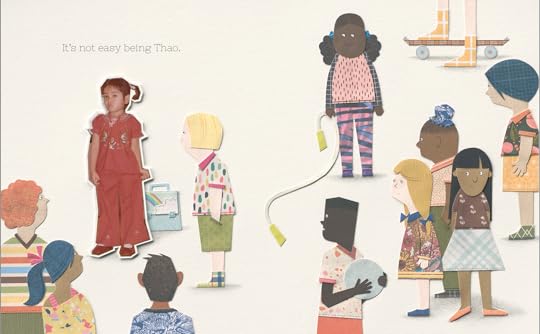
It begins with an adorable photograph of the author as a young girl. The next page shows her surrounded by a diverse group of students - all of them staring at her. The text reads, It's not easy being Thao.
What follows is a description of her name and the issues she had to deal with because of it. It's regularly misspelled. Sometimes it is accidentally mispronounced, but more often, other children make fun of her because of it.
Life with an English name would have been easier. At one point Thao contemplated becoming Jennifer. There is a page of text with a Jennifer doing all the things Thao would do during a day. Then she imagines her mother's gỏi cuốn (spring rolls), and leaves off wanting to be someone else. At the end of the book she finally teaches us to say and spell her name properly.
The artwork, a combination of childhood photographs and cut paper collage, is full of angst, tenderness, and humour. This important book teaches readers awareness and empathy. It encourages other new immigrants to take pride in their own names and identity.
I love the tone of this book, and the mixed media collage-style illustrations are delightful, poignant even, but I felt like it all ended so abruptly! I wanted more! I guess I was looking for some sort of narrative arc, some resolution (even if imperfect), but the book legit feels like it's missing some pages. It ends on a joke, but that's not the emotional note that resonates with me after the funny, yes, but also earnest and frustrated, pages that precede it.
كتاب قصير جدا جدا للأطفال عن العنصرية، وتستخدم المؤلفة نفسها مثالا، لأن اسمها كان صعب النطق لخلفيتها الآسيوية وسط زملائها. ارتبطت بقصتها لأن اسمي كان صعب النطق على كل ألجانب الذين أقابلهم. كتاب لطيف للأطفال لتحذيرهم من العنصرية، التي قد لا يفهمون أنها عنصرية في هذا العمر، ولكن عيبه أنه قصير جدا جدا.
This is a very short book targeting kids teaching them about racism, the author uses her name as an example and how she was bullied because no one could pronounce it correctly. I could relate to her, because my name is hard to pronounce for some foreigners, and it can get awkward.
It's a good book for kids, but it's too short, It should've been longer.
I thank Netgalley and Owlkids for the digital ARC.
As someone whose name gets butchered almost always for the past twenty years this book spoke to me. It brought back memories from when I entered my first classroom in Canada when I was 7 and had to accept my teacher’s pronunciation of my name because I was too shy and quiet to fix it.
Thao is about the Lam’s own experience with navigating spaces where her name becomes a source of ridicule and unfamiliarity that makes her want to adapt to her surroundings. Thao decides to change her name to Jennifer so it’s easier and less likely to be made fun of, but when she opens her lunch box to her favourite Vietnamese food she’s more comfortable as Thao. Lam’s use of her own childhood photos, creative typography, and her signature papercut style art brings forth a personal touch and as a reader feels closer to the story and the author.
It’s an important story of diversity, racism, and acceptance. The importance of self-identity and being proud of your heritage is an meaningful aspect of this book and illuminates on the ways your name is not just what is used to call you but also a story of who you are.
There are not many picture-book memoirs that I am aware of. This story is brilliant in its ingenious mixed-media illustration style and the direct honesty of its text.
This brief nonfiction picture book shares the author's story of coming to terms with her Vietnamese name in an American school. The story addresses both blundering mispronunciations and racist name-calling, and shows how she was able to embrace her identity anyway. This book will be encouraging to other children who have culturally different names, or even those whose names are simply hard to pronounce or spell. However, I was expecting a lot more from this, and found it somewhat disappointing.
The collage-style illustrations include actual photographs of the author as a child, and I thought that was cool, but some of the pages just have words drawn out in large letters, and the story is short, simplistic, and ends abruptly. I would have been interested in greater detail, and the author never included a pronunciation guide to her name, at the beginning or the end. I looked her up on an author pronunciation website, and was able to learn how to say her name there (https://www.teachingbooks.net/pronoun...), but many people are not aware that this resource exists, and would have a hard time knowing how to read this aloud correctly to children.
I get that part of the book's message is that it frustrates people to have to explain to others how to say their name, but as long as someone is willing to make a true and earnest effort, they should have the opportunity to figure it out. I'm not sure if the author left out a pronunciation guide on purpose to be subversive, but if so, that will make it more difficult for people to share her story, and makes the book more guilt-inducing than educational for children and adults who have no idea how to pronounce Thao.
I received a temporary digital copy through NetGalley in exchange for an honest review.
This cute picture book addresses the concept of diversity through the medium of names. Thao Lam includes pictures of herself and lots of experiences she had growing up that made her feel different - focusing on her name. Her signature collage art is wonderful and diverse and really illustrates her feelings of otherness well. This would make a good one-on-one read as a conversation starter with a child on how differences are great and what make us human - but focusing on differences or making others feel less than because of them is harmful. It would also make a good group read aloud for the same reasons.
One thing I would change if I could - I wish the author had actually told us very specifically how to pronounce her name! There was one page where she said to leave out the "h" when saying it, but don't forget the "h" when writing it. So, does that mean it's pronounced like adding a "t" to the beginning of the word "ow" (like you say when you get hurt)? That's my assumption, but it's left unclear in the book, which seems weird since the point of the book was to help us understand the author's feelings about her name and familiarize us with it. Still, I recommend this book and will check the author's website and try and find out exactly how to say her name before I read it to any kids.
Disclaimer: I received a free electronic copy of this book from OwlKids through Netgalley.com in exchange for an honest review. All opinions are my own.
It's a cute picture book. I think the Photo of the kid is real, maybe the author herself. The art in this book is a bit different than other kid's books. This book is about racism, and how kids with different names are teased and made fun of mostly by white kids. This is a good book for kids and for schools.
This book should have been longer. It was ok nothing great. I would have liked more pictures as kids engage with more pictures than words. This book is good if you want kids to be more aware.
I love this. Thao Lam writes about being othered in school because of her name, an experience that many young children will be able to relate to. As always, I love Lam's art and use of mixed media. I really recommend this highly.
A clever, honest, funny, and affirming picture book in which Lam, who immigrated from Vietnam to Canada as a young girl, recounts how difficult it was growing up with a name that is unfamiliar to the kids around you, and sometimes makes you the target of teasing and bullying.
I really wish I could rate this higher, because the representation is important (seems autobiographical) and I like the art style. Unfortunately there isn't any actual story and then the book just... ends. Very strange.
Fabulous!! Simple in text, but powerful in impact. And the cut paper + text design illustration adds to the impact and engagement. Add to text sets about names & identity.
Thank you to Netgalley and Owlkids Books for access to a copy of this ebook in exchange for an honest review.
Thao: A Picture Book is a deceptively simple story that perfectly conveys how it feels to be othered because of a name. It’s simple enough to share with little ones who still need an adult to read aloud, but it will resonate with early elementary readers as well.
The book features beautiful cut-paper collages by author Thao Lam. They drew me into the story, inspiring wonder and creativity. (I definitely wanted to collage when I finished reading!) It’s fitting that only Thao is represented by an actual childhood photo, emphasizing how her identity is viewed and treated differently by adults and kids at her school.
Her name is mercilessly and consistently mispronounced by adults and children, leading her to resignedly respond to anything even close to Thao. “Letters get added, scrambled, and left behind.” Her teachers call her Thou, Theo, or Towel. Her classmates not only butcher her name but call her racist nicknames like Tofu and China Girl.
Thao longs for an “easier” name and finally decides to be called Jennifer. The book’s artwork disappears as “Jennifer” goes about her day and Thao disappears into a new identity. But at lunchtime, “Jennifer’s” mom sends Thao’s favorite — gỏi cuốn — and her face lights up. I loved that her mother’s cooking reconnected her to her culture and family, returning her name to her.
As someone who’s gone through life with a ‘hard to pronounce’ last name (and even my own family members are confounded now that I’ve hyphenated), I took special joy in this book. If you enjoy it, visit Thao Lam’s website to view more of her joyful art.
Thao: A Picture Book is available to purchase now.
I loved this book! The artwork is colorful and beautiful. Really unique. The story resonated so much with me. The feeling of being different is something so many people go through. Racism is prevalent, and many children experience it daily. I am glad to see a children’s story talk about this topic in a gentle way. Even as an adult I enjoyed this sweet and diverse read. I would for sure purchase this book for children I know. Thank you NetGalley for allowing me to read this book in exchange for my honest opinion.
Names are important. I enjoyed Thao in part because I have a name that is mispronounced and misspelled. Taking the time to learn how to pronounce words and names that are unfamiliar to us is a worthy endeavor and this picture book--with the "just-right" bit of annoyance and sass--will help get that point across to readers. I especially love that this is autobiographical from an award-winning author.
A great story about what it's like growing up with a "different" name. This would be a great book to use at the beginning of the year with others like The Name Jar and Your Name is a Song and something like Everyone is Welcome. Love the amazing artwork for this one too! There are references to other differences as well like food.
Love the back page as well with illustrations of many kids with a wide variety of names! So good!
I liked how this book was short, sweet, funny, and to the point. Thao Lam recounts her childhood struggles with others mispronouncing or making fun of her name. Great for seeing from Thao's perspective! The illustrations creatively combine actual photos of Thao with paper-cutout style illustrations of all the other characters/classmates.
I really loved everything about this one. The art style was experimental yet had a classic look, the story was fantastic, the message was powerful. For fans of Your name is a Song by Jamilah Hompkins-Bigelow and other stories about celebrating difference and respecting others' cultural heritage (i.e., learning how to pronounce names properly).
I can't imagine what it would be like growing up with an unusual name, or finding that people had trouble spelling or pronouncing your name, or coming up with really odd twists, nor can I imagine what other kids might do if you had an unusual-to-them name or what it would be like going to school in a place you were not from.
I received an electronic ARC from OwlKids Books through NetGalley. Lam shares her own story. She shares about how difficult it was when people mispronounced her name. She even went through a time when she wanted to be called Jennifer instead. Readers will connect with her journey and find someone they can identify with. The story is told with minimal words and fully detailed illustrations.
Oh. Gosh. This short, simple book grabbed my heart. Such a reminder of what people from different cultures go through daily. What it must feel like to constantly correct the pronunciation of the the first thing ever given to them, their name.... or to be shy and not able to make it right.
What a fun and honest book. It is relatable and reflects what so many kids experience. Our names are unique and so cherished. So clearly conveyed to kids.
A beautiful picture book for young kids with collage art and a child’s writing in crayon throughout.
Thao is about the harm and trauma BIPOC children go through when their names are mispronounced because they aren’t “normal” white American (Anglo-American) names. The author shows how kids and adults alike, will say anything that they think sounds like their name, make up words, make jokes, say a name different each time, and even give a child an Anglo-American nickname to make it easier (easier for white people). Which leads Thao to want to change her own name to fit in and feel more American.
Thao is one way to teach children about racism and xenophobia. It’s a book that shows how non-westerners are bullied and harmed by the micro aggressions of mispronouncing names, and most importantly, a book for BIPOC kids to read, to see themselves, and to be seen and heard.
I feel that books like Thao are more impactful because it’s about one person’s experience, an experience that many BIPOC people go through. First person experiences are easier for most to connect to, rather than a concept. It leads to being able to understand bigger concepts and the harm they cause to marginalized communities.
This is a perfect simple book to help explain simple cultural differences to kids. Thao is used to being called anything but her name. Her name is unusual in american culture, because it is an asian culture name. Thao. They really wish they had a more normal name, but goes on to esplan how to say it. And then mentions her lunch which looks delicious. It’s the simplicity of this book that makes it perfect. It’s the simplicity of the illustrations. All the characters except Thao are paper dolls, while Thao is a real picture of the author as a child. It shows the differences between the author and the rest of her class that make them stand out. I just love it.
Thao is upset that no one makes an effort to pronounce her name correctly, so she decides to change it, but a surprise lunch that her mom made makes Thao reconsider her plan.
“It helps if you take out the H when you say it. But remember to put it back when you spell it.
Thao
Hong
Lam”
This story of young Thao Lam depicts her as an outcast because of her name and shows her struggle to fit in among the “Toms” and “Melissas” of the world. It shows her as she gets called various names, like “Towel,” “Toe,” or even “Tail.” Thao eventually tries to change her name to Jennifer to fit in with everyone else’s easier-to-pronounce names. Thao tells the story of a girl who is trying to find her place in the world.
Thao’s journey throughout the book intricately weaves bits of humor and joy into an ultimately vulnerable tale that shows the difficulties of being young and finding out how one fits into the world. Thao opens up a conversation about identity and how it can be difficult to accept yourself when no one around you seems to understand you or your roots. The beauty of this story is that Thao realizes she doesn’t need to be Jennifer to fit in, or be important. She just needs to be herself and embrace her own name and identity.
Along with the incredibly relatable storyline, Lam marries this story with jaw-dropping illustrations that portray the difficulties she is facing. The collage-style artwork shows how all the other students look in comparison to the cutout photograph of young Thao. The intricately designed illustrations portray how alienated Thao feels. They are colorful and engaging for any young reader. This story is classic and vulnerable at its core. Thao Lam has told a story that will stand the test of time, and surely warm your heart.
Follow us on Instagram, Twitter, and Facebook @pinereadsreview and check out our website at www.pinereadsreview.com for reviews, author interviews, blogs, podcast episodes, and more!
Summary: Thao has a short name made up of the same letters found in many other names like Tom, Henry, Amy, and Olivia, yet it is constantly misspelled, mispronounced, and misunderstood. Frustrated by this, she decides to try using a new name, Jennifer, hoping it will be easier for others to say and understand. At first the new name seems to work, but when she opens her lunch and sees her favorite food, she realizes that Jennifer does not truly feel like her. In that moment, Thao proudly reclaims her name and explains that it helps to take out the “h” when saying it but to keep it when spelling it. Notable High-Quality Elements: •Dust Jacket and Book Casing: The dust jacket features a wraparound design resembling grid paper, with writing that appears retraced in orange and emphasized in bold red, visually echoing the theme of writing and rewriting names. In contrast, the book casing is entirely red and minimalist, displaying a single Polaroid-style photograph of Thao on the front with simple white text for identifiers, creating a striking and personal presentation. •Endpapers: The endpapers resemble a yearbook-style collage of various children paired with their names, reinforcing the book’s central focus on names and identity while visually emphasizing community and individuality. •Typography: The typography incorporates a wide variety of fonts, colors, and sizes to highlight important aspects of names throughout the story. Word art in a doodle-like style appears throughout the pages, and speech bubbles are used when dialogue is depicted directly, adding a playful and expressive quality to the narrative. •Photography and Illustrations: The visual style combines photography with collage. All characters except for Thao are illustrated using a unique collage approach, while Thao herself is represented through photographs of the author/illustrator taken from her childhood, reflecting the story’s connection to lived experience and adding a deeply personal element to the narrative.