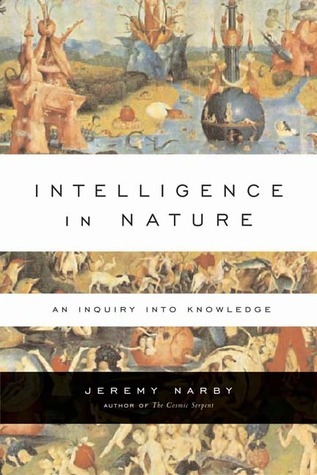
When I was in grad school in the early 2000s, I had a colleague who referred to a certain kind of ostentatiously intellectual, but otherwise shallow conversation as "big bang chromosomes touching." That phrase kept coming back to me as I read Jeremy Narby's 2005 travelogue of shamanic frameworks for understanding nature-cum-survey of the research on information processing by (non-human) living systems, "Intelligence in Nature." Think late-night in a dorm room with a dude who has completed a few survey courses in comparative religion, philosophy, and ecology, taken several bong rips, and wants you to understand how "it's all connected."
I use "information processing" here, rather than intelligence, because it's clear that Narby doesn't have a clean definition of intelligence (which is fine, no one really does), and ultimately offers up the Japanese term chisei (知性) as an alternative. Chisei might be closer to "smart," and carries less anthropocentric freight than "intelligence." Western notions of intelligence as something that separates man from the rest of the natural world come in for justified criticism, and I liked the concept of chisei as a shorthand for the unexpected elegance of how living systems solve novel problems.
But Narby clearly wants to have his cake and eat it too, switching freely between chisei and intelligence in the later chapters of the book to describe everything from bee navigation in novel environments, to ant social organization, to the ability of slime molds to "solve" a maze† to the ability of proteins to "respond" appropriately within a complex cellular milieu††. The uncanny ability of non-human complex systems–biofilms, forest communities, bees, and beyond–to respond flexibly and "intelligently" to their environments is a theme that has resurfaced in the years since in books like Megan O'Ghieblyn's "God, Human, Animal, Machine" (2021), Eduardo Kohn's "How Forests Think" (2013), and Jeremy Lent's "The Web of Meaning" (2021) are a few examples that spring readily to mind. Carl Safina's "Beyond Words" (2015) and Frans de Waals' "Are We Smart Enough to Know how Smart Animals Are?" (2016) tackle the subject with more wit than Narby.
Writing in 2005, Narby presents his ideas as a new and radical departure from previous mechanistic conceptions of biology rooted in Descartes, but many of the examples he presents were standard fare for biology education in the mid 1990s when I was in college. I recognize that as an anthropologist Narby is a disciplinary outsider, but he writes about biology as though between Darwin and the 1990s the field utterly forgot about organismal biology and ethology, everything became biochemistry and molecular biology and reductionism, and only at the dawn of a new millennium were a few brave souls willing to talk about complex behaviors in living systems. Scientific fashions may come and go, but even at peak reductionism in the golden age of biochemistry and molecular genetics (about 1953-1983), there were scientists thinking about the interesting integrative behaviors living things are capable of, and performing interdisciplinary and holistic research.
A big motivation for "Intelligence in Nature" seems to be Narby's disappointment that his previous book, "The Cosmic Serpent" was not the smash hit he expected. I haven't read it yet, but given how Narby relates that one of the core arguments in that book was that ayahuasca hallucinations give shamans direct comprehension of DNA "on a molecular level," I understand why it probably came in for a solid dose of ridicule. To address this, part of "Intelligence in Nature" describes taking some biophysicists to the jungle for an ayahuasca ceremony. As their doors of perception were opened, they were asked to think about their research, and they claimed to experience relevant insights mediated by the psychoactive compounds. Narby expects the reader to see this as a vindication of his prior claims about shamanic ways of knowing, but I don't buy that, for a few reasons:
First, we bring our prior experiences into any hallucinatory adventure, and the biophysicists were intentionally primed to think about their research. It would be more compelling if he had people with no experience of molecular biology go through the ayahuasca ritual, ask if they had any insights about DNA, or the actin cytoskeleton, or central carbon metabolism, or whatever, and then take those insights to experts in the field for verification.
Second, narrative descriptions of hallucinations tend to be imprecise anecdotes; it's easy enough to squish a vision of two snakes coiled around each other into a metaphor for DNA (people have been connecting the coiled snakes of Mercury's caduceus to DNA since 1953 without the benefit of ayahuasca), or to use motivated reasoning to map a hallucination-created metaphor onto a subject of your particular expertise. That a college professor in the 1990s heard about "two snakes at the heart of life," or whatever, and thinks "ah, they are obviously talking about the DNA double helix" is pretty weak tea. Even historical records of similar hallucinatory anecdotes from before 1953 would be hard to take seriously as evidence of direct knowledge of molecular biology, since two snakes might just be an idiomatic trope on the lines of "wine-dark sea."
Third, insisting that shamanic ritual is merely a "different way" of attaining scientific knowledge maintains the privileging of western science over those other ways of knowing. It's saying "look ma, ayahuasca can science, too," rather than acknowledging that hallucinations (and meditation, and mindfulness, and music, and exercise) are complementary ways of exploring reality, each with unique advantages and limitations.
Luckily, this book was short. I'm not sure I could have survived a higher dose of Narby's self indulgent pontification.
---------
† I've read Nakagaki et al.'s 2000 Nature paper, and slime molds "solve" the maze only in a very technical sense. At the start of the experiment, the slime mold occupies the full extent of the maze. The experimenters then place nutrients at the "start" and "end" of the maze, and the slime mold withdraws from the rest of the maze, minimizing the area it occupies until it lies along shortest path between the two nutrient sources. It's not navigating the maze from start to end. Theseus it ain't.
†† Of course, this is a wishful thinking, on at least two levels: first, the protein sequences we have access to in the present are those that survived billions of years of purifying selection precisely for the ability to function in the complex environments wherein we observe them; second, a given protein, even if it has multiple modes of regulation, has a very narrow repertoire of "behaviors," and doesn't "learn" new things.