

What do you think?
A Song of Frutas
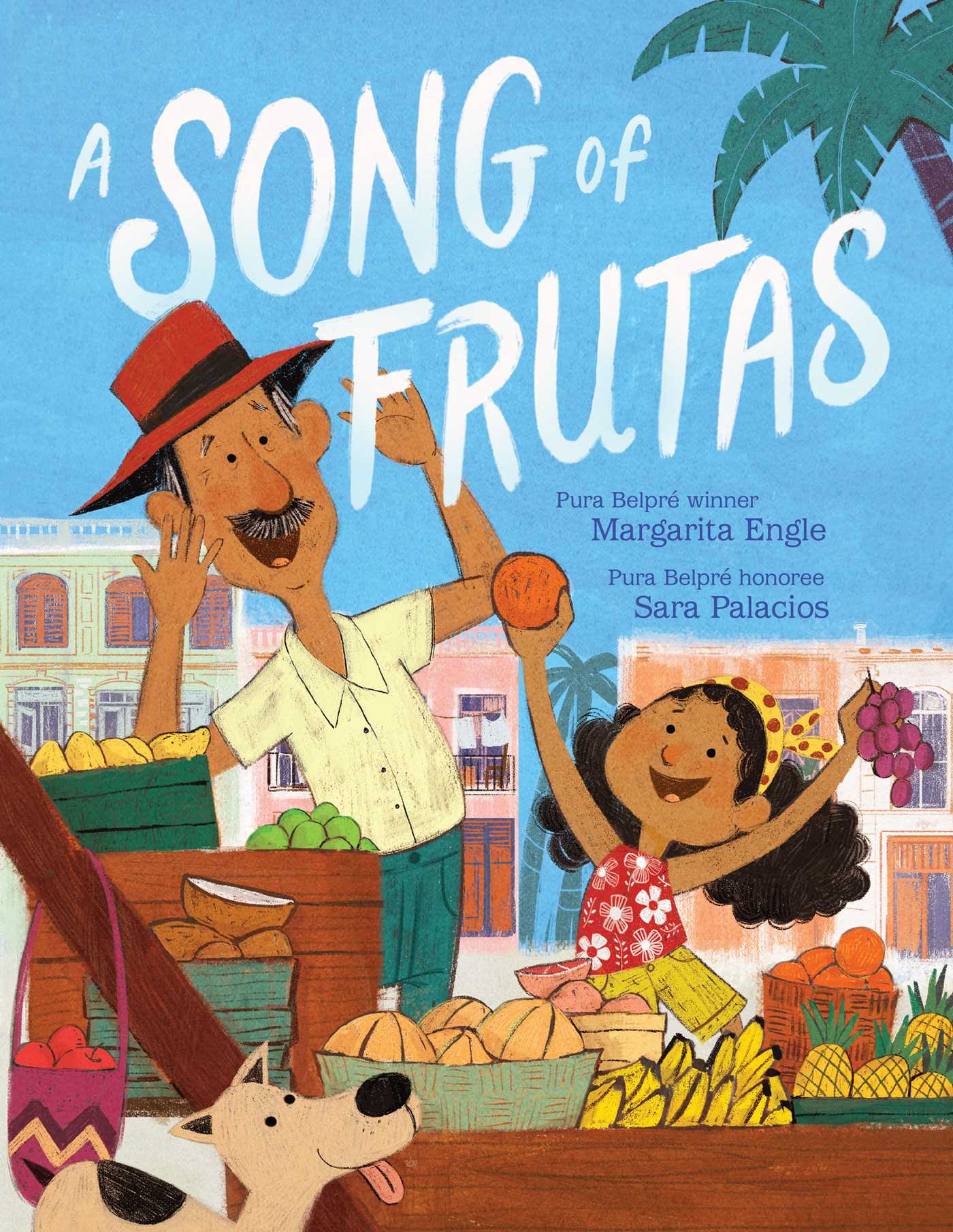
From Pura Belpré Award–winning author Margarita Engle comes a lively, rhythmic picture book about a little girl visiting her grandfather who is a pregonero —a singing street vendor in Cuba—and helping him sell his frutas .
When we visit mi abuelo , I help him sell
frutas , singing the names of each fruit
as we walk, our footsteps like drumbeats,
our hands like maracas, shaking…
The little girl loves visiting her grandfather in Cuba and singing his special songs to sell all kinds of mango , limón , naranja , piña , and more! Even when they’re apart, grandfather and granddaughter can share rhymes between their countries like un abrazo —a hug—made of words carried on letters that soar across the distance like songbirds.
When we visit mi abuelo , I help him sell
frutas , singing the names of each fruit
as we walk, our footsteps like drumbeats,
our hands like maracas, shaking…
The little girl loves visiting her grandfather in Cuba and singing his special songs to sell all kinds of mango , limón , naranja , piña , and more! Even when they’re apart, grandfather and granddaughter can share rhymes between their countries like un abrazo —a hug—made of words carried on letters that soar across the distance like songbirds.
40 pages, Hardcover
First published August 3, 2021
About the author
Margarita Engle
82 books397 followersMargarita Engle is a Cuban-American poet, novelist, and journalist whose work has been published in many countries. She lives with her husband in northern California.
Ratings & Reviews
Friends & Following
Create a free account to discover what your friends think of this book!
Community Reviews
Displaying 1 - 30 of 81 reviews

September 2, 2022
The pregon is a tradition of singing about goods that are being sold by vendors. It is a very old tradition in Cuba; but it stagnated after the 1959 revolution took a less than approving view of free enterprise. This is a wonderful book about a young girl connecting with her grandfather through these songs; how they stay connected even though they live far away from each other. Vibrant illustrations that complement this heartwarming tale of family and tradition.

July 2, 2026
Oh, to lower a basket from a balcony and pull it up brimming with fresh fruit sold to you by a singing vendor. DoorDash could never.
This picture book follows a little girl visiting her grandpa in Cuba. While there, she helps him sell fruit, and sales really pick up when people buy grapes on New Year's Eve, following a tradition where you eat one grape per month of the coming year while making 12 wishes. The little girl does not see her grandpa as often as she likes, but takes comfort in sending letters back and forth after she goes back home, creating "a hug made of words." Like if you cry everytime.
This was a colorful and informative book about different ways of making and honoring family and community. I really enjoyed it. For fans of Homeland: My Father Dreams of Palestine, Paletero Man, and Love in the Library.
This picture book follows a little girl visiting her grandpa in Cuba. While there, she helps him sell fruit, and sales really pick up when people buy grapes on New Year's Eve, following a tradition where you eat one grape per month of the coming year while making 12 wishes. The little girl does not see her grandpa as often as she likes, but takes comfort in sending letters back and forth after she goes back home, creating "a hug made of words." Like if you cry everytime.
This was a colorful and informative book about different ways of making and honoring family and community. I really enjoyed it. For fans of Homeland: My Father Dreams of Palestine, Paletero Man, and Love in the Library.

Read
June 12, 2022I haven't come across a Sara Palacios illustration I didn't love, and this book was no different.

September 16, 2021
This review was originally written for The Baby Bookworm. Visit us for new picture books reviews daily!
Hello, friends! Our book today is A Song of Frutas, written by Margarita Engle and illustrated by Sara Palacios, a heartwarming love letter to family and Cuban culture.
The young narrator opens the story by enthusiastically recounting the delights of visiting her Abuelo and helping him sell frutas – fruits – in the marketplace. When she visits him in Cuba, she relishes the chance to sing out the names of the fruits, haggle prices, and watch the other pregoneros (singing vendors) sell their own exciting wares and treats. Her favorite visits are on the eve of el año nuevo, when she sells grapes and partakes of the tradition of eating all twelve at midnight, making wishes for each. She always saves a wish that friendship between Cuba and the US will grow, so that someday her Abuelo can visit her home as well.
Sweet, immersive, and touching. Engle’s text perfectly captures the colorful and exciting narrative through a child’s eyes, mixing guileless sincerity with fancy and wonder and creating everyday magic on every page. The gorgeous artwork adds to this immensely, filling the scenes with color, atmosphere, and a diverse cast of characters; the little girl and Abuelo are particularly charming. The choice to include Spanglish in the text adds authenticity, as many dual-language Spanish/English speakers use this blended dialect. Backmatter features author’s notes on the Cuban traditions and current travel restrictions mentioned in the story, which are edifying for readers young and old. The length was great for a storytime, and JJ loved this one. Overall, a heartfelt treat, and it’s Baby Bookworm approved!
(Note: A copy of this book was provided to The Baby Bookworm by the publisher in exchange for an honest review.)
Be sure to check out The Baby Bookworm for more reviews!

August 5, 2021
A little girl tells of visiting her Abuelo in Cuba. When she is there, she helps him sell fruit from his small cart on the street. Together they sing the names of the fruits they have for sale, walking in beat to the song and shaking their hands like maracas. Their voices reach up the tall buildings around them and some people purchase fruit using a basket they lower down on a rope. There are other vendors on the street shouting or singing about their wares too, and that’s when Abuelo has to sing even louder to be heard. It’s most special to visit Abuelo at the new year when everyone wants to purchase 12 grapes per person to have good luck when they eat them at midnight. If only visiting Cuba was simpler and they could go more often!
Engle is an award-winning author of books for all ages of children. This picture book uses a mix of English and Spanish called Spanglish that is used both in the United States and Cuba. The songs that the girl and her grandfather sing together are done in rhyme while the rest of the picture book displays Engle’s skills with verse in a different way. Her paragraphs of free verse still play with rhythm and form, inviting readers to experience Cuba and their lively street vendors.
Palacios’ illustrations are bright and merry. They show the dynamic urban Cuban street scene that is full of colorful buildings and equally colorful people. The illustrations share that same inherent happiness as the words.
Bright and energetic, this picture book offers a glimpse of Cuba. Appropriate for ages 4-6.
Engle is an award-winning author of books for all ages of children. This picture book uses a mix of English and Spanish called Spanglish that is used both in the United States and Cuba. The songs that the girl and her grandfather sing together are done in rhyme while the rest of the picture book displays Engle’s skills with verse in a different way. Her paragraphs of free verse still play with rhythm and form, inviting readers to experience Cuba and their lively street vendors.
Palacios’ illustrations are bright and merry. They show the dynamic urban Cuban street scene that is full of colorful buildings and equally colorful people. The illustrations share that same inherent happiness as the words.
Bright and energetic, this picture book offers a glimpse of Cuba. Appropriate for ages 4-6.

August 21, 2021
Colorful, magical and musical, A Song of Frutas is a joy to read!
Margarita Engle weaves English and Spanish text together she explains in her author's note, "...because that is the way people talk on both shores of the strip of sea that separates Cuban and Cuban American family members." A Song of Frutas is a love poem to Cuba and Engle's abuelo (grandfather) who sold fruit from his cart always singing the names of the fruit he has for sale: mångo, limæon, piña, coco and plæatano. Young Margarita would walk with him taking in the sights and sounds of a vibrant city scene. Women are hanging laundry out to dry, other vendors are singing their own songs to sell their wares.
Every New Year's Eve there's a celebration where they eat twelve grapes and make a wish for each month of the coming year. Now that an ocean separates her from her abuelo she wishes for a day both countries can be friends and open up. She misses her abuelo and his songs of frutas, but she writes poems and verses in her letters to him and imagines birds carrying her letters to her beloved grandfather.
Also in the author's note is information about travel restrictions between America and Cuba that made it hard for Cuban Americans to visit their homeland. Engle states that she began returning to see her family in 1991. This is an important book for all collections. Palacios' illustrations are wonderfully rendered capturing the heart and soul of Cuba.
Highly, highly recommended. This book WILL win multiple awards for both Engle and Palacios.
Margarita Engle weaves English and Spanish text together she explains in her author's note, "...because that is the way people talk on both shores of the strip of sea that separates Cuban and Cuban American family members." A Song of Frutas is a love poem to Cuba and Engle's abuelo (grandfather) who sold fruit from his cart always singing the names of the fruit he has for sale: mångo, limæon, piña, coco and plæatano. Young Margarita would walk with him taking in the sights and sounds of a vibrant city scene. Women are hanging laundry out to dry, other vendors are singing their own songs to sell their wares.
Every New Year's Eve there's a celebration where they eat twelve grapes and make a wish for each month of the coming year. Now that an ocean separates her from her abuelo she wishes for a day both countries can be friends and open up. She misses her abuelo and his songs of frutas, but she writes poems and verses in her letters to him and imagines birds carrying her letters to her beloved grandfather.
Also in the author's note is information about travel restrictions between America and Cuba that made it hard for Cuban Americans to visit their homeland. Engle states that she began returning to see her family in 1991. This is an important book for all collections. Palacios' illustrations are wonderfully rendered capturing the heart and soul of Cuba.
Highly, highly recommended. This book WILL win multiple awards for both Engle and Palacios.

September 13, 2021
I loved this book so much. I loved the author's note even more and I think it's important to share it when reading this one to your kids as it makes the story much more meaningful and real. A Song of Frutas is about a little girl who sells fruit with her grandpa when she goes to visit him in Cuba. She is sad when she has to return home to America because she knows that the two countries don't get along and there are travel restrictions. She finds comfort in writing him letters. This would be a great read aloud for January as there is a mention of a Cuban/Latin America tradition of eating 12 grapes at midnight and making one wish per month.
Perfect for:
Figurative Language (similes and metaphor)
Context Clues
Learning new Spanish words
Plot
Setting
Main Idea
Thanks for my early copy, Simon and Schuster
Perfect for:
Figurative Language (similes and metaphor)
Context Clues
Learning new Spanish words
Plot
Setting
Main Idea
Thanks for my early copy, Simon and Schuster
February 12, 2022
A young girl enjoys visiting her Grandfather in Cuba and walking the streets with him singing about the fruit they have to sell. Every New Year she wishes for friendship between countries so he may visit her some day. Meanwhile they share letters when she has to return home.
Author's Note includes information about Spanglish, travel restrictions separating families, Los Pregoneros (Cuba's singing street vendors) and the New Year's Eve tradition of gobbling 12 grapes at midnight and making a wish for each month of the coming year.
Author's Note includes information about Spanglish, travel restrictions separating families, Los Pregoneros (Cuba's singing street vendors) and the New Year's Eve tradition of gobbling 12 grapes at midnight and making a wish for each month of the coming year.

September 5, 2021
A young girl helps her grandfather sell fruit when she visits him in Cuba. Don't miss the author's note at the end which gives great background on what inspired the author to write the book in Spanglish from the travel restrictions that families must endure as a result of our strained relationship with Cuba.

Read
December 6, 2023I read this book for my graduate course. Written by Margarita Engle and illustrated by Sara Palacios. The text has received the following awards, ALA Notable Children's Books, CCBC Choices (Cooperative Children's Book Council), Kansas NEA Reading Circle List Primary Title, Red Clover Book Award (VT),
North Dakota Children's Book Award, and Bank Street Best Children's Book of the Year Selection Title.
The story/narrative poetry begins as the granddaughter recalls her time with her grandfather in Cuba. Her grandfather sells fruit and he goes from place to place, using his voice to announce her merchandise. He sells fruta, mango, coco, limon, melon, toronja, naranja, planatano, y pina. On the next pages it lets you know what each fruit is in English. The use of rhyme and both languages flows throughout the pages. The use of color within the text and the use of slanted words. Interesting how they mention the 12 grapes per person on New Year's Eve, it is a tradition that each person eat them to bring new luck in the upcoming year. As the story develops we come to find out that due to the lack of friendship between the United States and Cuba, being able to travel between both countries is difficult. She would like for her abuelo to come visit her. As she exchanges letters with her abuelo she feels that she goes between two countries at once.
As for the illustrations there are vibrant colors that are used. There are labels for the fruta and you can see the townspeople trying to sell their own goods on the street as well. The detail art of each page, you can see the people and their expressions. They can see how the people interact and how free the people seem. The use of flowers and birds to describe the flow of rhymes going back and forth between abuelo and her. As she mentions, "like un abrazo made of words."
One could use this text as a way to explain how relationships with other countries can sometimes affect how we can interact with family from other countries. Now it is rare for people to use mail as in sending a letter, we are used to sending an email or text. However, a letter can be powerful and one is able to keep those memories. Perhaps also use as a writing text to encourage students to write a letter to someone special.
North Dakota Children's Book Award, and Bank Street Best Children's Book of the Year Selection Title.
The story/narrative poetry begins as the granddaughter recalls her time with her grandfather in Cuba. Her grandfather sells fruit and he goes from place to place, using his voice to announce her merchandise. He sells fruta, mango, coco, limon, melon, toronja, naranja, planatano, y pina. On the next pages it lets you know what each fruit is in English. The use of rhyme and both languages flows throughout the pages. The use of color within the text and the use of slanted words. Interesting how they mention the 12 grapes per person on New Year's Eve, it is a tradition that each person eat them to bring new luck in the upcoming year. As the story develops we come to find out that due to the lack of friendship between the United States and Cuba, being able to travel between both countries is difficult. She would like for her abuelo to come visit her. As she exchanges letters with her abuelo she feels that she goes between two countries at once.
As for the illustrations there are vibrant colors that are used. There are labels for the fruta and you can see the townspeople trying to sell their own goods on the street as well. The detail art of each page, you can see the people and their expressions. They can see how the people interact and how free the people seem. The use of flowers and birds to describe the flow of rhymes going back and forth between abuelo and her. As she mentions, "like un abrazo made of words."
One could use this text as a way to explain how relationships with other countries can sometimes affect how we can interact with family from other countries. Now it is rare for people to use mail as in sending a letter, we are used to sending an email or text. However, a letter can be powerful and one is able to keep those memories. Perhaps also use as a writing text to encourage students to write a letter to someone special.

February 15, 2022
Margarita Engle has written many books, often sad, that are based on the history of Cuba. She is a Cuban American who says in her author's note that she visits as often as she can, despite restrictions. In this book, she tells of a young girl who loves visiting her abuelo and helping him sell his frutas, singing the names of each fruta: "mango, limón, coco, melón, naranja, toronja, plátano, and piña". They happily move along, selling to those upstairs who lower baskets, singing louder when other 'pregoneros' all chant at the same time, like tamales, roasted peanuts, and la dulcera (chocolates and candies). She includes the celebration of the new year by eating twelve grapes, making a wish for every month in the new year. In poetic text, a mix of Spanish and English, the happiness shows on every page, until the end when the visit is over. The young girl wishes her abuelo could visit her but travel is forbidden for him to go to America. The ending is sweet, showing their substitute for real visits, writing letters to each other. The happiness of this visit shows in every colorful, illustrated page by Sara Palacios. Be sure to read Margarita's note at the back about the plight of these 'pregoneros' who were forbidden after the revolution. That changed, according to the extra information, in 2010. When children can learn about other cultures they might never encounter, it's a wonderful thing. This will be a wonderful book to share.
My only experience of so many vendors has been in Mexico and Costa Rica. One can find a few on busy city streets here in Denver, but they disappeared during the Pandemic, are only now slowly coming back.
My only experience of so many vendors has been in Mexico and Costa Rica. One can find a few on busy city streets here in Denver, but they disappeared during the Pandemic, are only now slowly coming back.

December 16, 2021
‘A Song of Frutas’ by Margarita Engle, illustrated by Sara Palacios, is a sweet tale of a granddaughter and her grandfather as they sell fruit on the streets of Cuba. The illustrations are vibrant and exude the beauty of the location and the relationship between a granddaughter and her abuelo (grandfather).
Despite the fact that they live in different countries, they do visit each other, and when they can’t be together in person, they write letters, which makes them feel just as close. The fact that the author has made it clear that their words back and forth serve as a hug, ensuring they are always connected.
The author’s note in the back of the book mentions the mixture of English and Spanish, or Spanglish, that is used throughout the story, along with more details about travel restrictions between Cuba and America, New Year’s Eve traditions, and los pregoneros (singing vendors), who describe the things they sell poetically, as a means of attracting customers to purchase their wares.
Children and adults alike will enjoy this book that will enhance their understanding of Spanish words and phrases, and teach about traditions that may not be so familiar.
Beth Rodgers, Author of ‘Welcome to Chanu-Con!,’ a Children's Picture Book, and ‘Freshman Fourteen’ and ‘Sweet Fifteen,’ Young Adult Novels
*Review originally posted at YABooksCentral.com*
Despite the fact that they live in different countries, they do visit each other, and when they can’t be together in person, they write letters, which makes them feel just as close. The fact that the author has made it clear that their words back and forth serve as a hug, ensuring they are always connected.
The author’s note in the back of the book mentions the mixture of English and Spanish, or Spanglish, that is used throughout the story, along with more details about travel restrictions between Cuba and America, New Year’s Eve traditions, and los pregoneros (singing vendors), who describe the things they sell poetically, as a means of attracting customers to purchase their wares.
Children and adults alike will enjoy this book that will enhance their understanding of Spanish words and phrases, and teach about traditions that may not be so familiar.
Beth Rodgers, Author of ‘Welcome to Chanu-Con!,’ a Children's Picture Book, and ‘Freshman Fourteen’ and ‘Sweet Fifteen,’ Young Adult Novels
*Review originally posted at YABooksCentral.com*

June 23, 2023
Pre-K-2. Children will delight in this warm-hearted story about an American girl's visit to see her Cuban grandfather, a fruit seller in Havana. His tuneful chant to passersby about his wares begs to be repeated in a youthful chorus – "Mango, limon, coco, melon..." Sara Palacios' rollicking illustrations in sun-bright colors reflect the flavor of the Caribbean, further making readers feel like they're part of the action. Spanish words abound, breezily described as part of the text. But there's a deeper side to this story, too, as Pura Belpré-winning author Margarita Engle explains in an author's note: Travel restrictions in both countries prevent many Cuban Americans from visiting their ancestral island, separating families and causing mutual heartbreak. Find discussion questions and related resources, including an activity sheet, curriculum guide, and songs from actual street vendors on "Read Across America" at https://www.nea.org/professional-exce...

October 20, 2022
The narrator reminisces Papa and granddaughter strolling the streets selling frutas to the community, announcing the fruit in an operatic rhythmic chant where "our voices are bridges that reach up to windows." A glorious wealth of gastronomic delights are shared in this community-building, uplifting story. The favored ano nuevo (new year) celebration offers particularly special treats for good luck. The narrator's poignant final wish for, "friendship between countries" cements this story as a truly upbeat cultural Cuban feast, though she lives in U.S. and he in Cuba. Wonderful use of white spaces sets each character's unique produce and personality apart, while conveying the communal joy of the marketplace in vivid tropical colors and expressive visages. Author's notes at the end explain travel restrictions between U.S. and Cuba, enacted by adults who "care more about politics than people."

April 15, 2024
I liked this book a lot! It reminded me a lot of my own childhood in Dhaka and while the situations were very different, I also struggled to see my grandparents after moving to Canada. I remember running to the balcony because I would hear people selling fruits, ice cream, toys, etc. and more often than not, this was also done in song like in the book. (Sidenote, the song is absolutely stuck in my head.)
As for the art of the book, my favourite page is where the little girl is making her final wish for New Year and there's just a slight smile drawn on her face in contrast to how she was drawn before because she's talking about how her last wish is always for her abuelo to finally be able to visit her in the states.
I also think that this is one of my favourite author's notes because I love learning details about an author's process and their reasoning and history, and you rarely get that in books like this.
As for the art of the book, my favourite page is where the little girl is making her final wish for New Year and there's just a slight smile drawn on her face in contrast to how she was drawn before because she's talking about how her last wish is always for her abuelo to finally be able to visit her in the states.
I also think that this is one of my favourite author's notes because I love learning details about an author's process and their reasoning and history, and you rarely get that in books like this.

October 20, 2021
I remember being a child in Puerto Rico and hearing the pregoneros walking down the street in front of my abuela's house on their way to the centro comercial. This book instantly took me to those moments and I got a little choked up as turned each page realizing that while my experience was different (having been born in an American colony without travel restrictions) for so many children with family in Cuba, the exchange of letters may be the only way they'll get to experience life together.
This book is joyful visually and narratively (love that it's in Spanglish!) while also addressing the reality of being a family split by a large body of water, political upheaval, and travel bans. It's truly a visual representation of the resilience and exuberance of Latinidad. ¡Que maravilla!
This book is joyful visually and narratively (love that it's in Spanglish!) while also addressing the reality of being a family split by a large body of water, political upheaval, and travel bans. It's truly a visual representation of the resilience and exuberance of Latinidad. ¡Que maravilla!
February 2, 2024
I recommend A Song of Frutas to young children of all ages. Margarita Engle is Cuban-American and wrote this tale in Spanglish (Spanish and English). Therefore, if you are to read this book aloud to any children, be sure to study the Spanish words if needed. The tale is based on a young girl and her grandfather bonding while going about the Cuban tradition of selling goods to the community. The book also mentions New Year's/New Year's traditions. Some parts of the story are broken into poems with fun and colorful fonts. The illustrations are also very vibrant! Some themes this book would fit into are love, giving, and Latin.

September 3, 2021
Engle captures the energy and colorful atmosphere of the Cuban marketplace. This young girl loves being with her grandfather as he sells fruit. Readers can hear the merchants' songs in their minds and may create their own tunes to sing along. Engle applies a gentle touch to the difficulty of the relationship between the United States and Cuba as the young girl shares the pain she feels that he cannot visit where she lives and hopes that will change. She provides informative text at the end explaining the markets and the relationship between the countries.
October 20, 2022
Wonderful, vibrant story written in a mixture of English and Spanish about a girl who visits her grandfather who lives in Cuba. She helps him sell his fruit from his cart as they walk through the town. Who can sing the loudest? Is it the tamale vendor, the herb vendor or the cucuruchos vendor? No! It’s this girl and her abuelo, singing in rhyme, chanting in rhythm. A touching and heartwarming (and a little heartbreaking) reminder of how some families are countries apart and really cherish the short periods of time they have together.

August 12, 2021
This is a vibrant and colorful book that dances with music and culture. I once read a humorous essay in which the expat writer did not appreciate the fruit vendors in his newfound home because the ever-escalating noise disturbed him so! This is a much more positive view of noisy venders.
Humane families note: A vendor in the market is shown selling songbirds in cages (this is not remarked upon in the text. )
Humane families note: A vendor in the market is shown selling songbirds in cages (this is not remarked upon in the text. )

December 22, 2021
A Song of Frutas is yet another adorable picture book from Margarita Engle. The story of a girl getting to spend a rare bit of time with her Abuelo and helping him sell fruit is super cute, and any children who live far away from their beloved grandparents will find the story relatable. The Spanglish is a nice touch that suits the story. The art is gorgeous, Palacios has done a fantastic job bringing the story to life visually. Overall it's a great little book and I'd definitely recommend it.

December 28, 2021
This was a very interesting look at the Cuban culture, particularly the open-air markets. There are lots of things to learn, and new words to discover. In the back matter the author talks about why they wrote the book in a mix of English and Spanish, and about where the story comes from, travel restrictions, and the custom of eating 12 grapes on New Year’s Eve. It was a wonderfully entertaining and educational story.
October 7, 2023
This was a fun lyrical story to read about a young girl who visits her Cuban abuelo and partakes in the tradition of helping him sell fruit on the streets. While they don't live close, they stay connected through letters to one another and through their strong love and heritage. It was a colorful read aloud emphasizing the values of family and traditions. My son loved singing the fruits in Spanish with me and making up the music together. <3

November 6, 2023
The main character visits her abuelo in Cuba. He is a fruit vendor and sings a song of frutas as he walks up and down streets. Women lower baskets with money, he takes the money and places fruit in their baskets: mango, coco, naranja, y toronjas are among the fruits he sells. When the character returns to her home in the US, she and her abuelo write poems and letters to one another. This is a sweet story of a family separated by distance, but seeking to maintain love and connection.

April 30, 2025
A little girl goes to Cuba to visit her Abuelo and shares the experience of helping him sell frutas in the street. Through lyrical text and colorful illustrations, the reader discovers the different vendors and what they sell. Some of the traditions of the Caribbean island are presented. A lovely book that not only shows the beauty of the relationship between grandfather and grandchild, but, also, the value of work, no matter how humble.

September 23, 2021
This was a very fun introduction to the singing vendors of Cuba, what a neat tradition! The text is written in Spanglish because the author says that is how they talk in the area the book is portraying. There are so many good foods found in these pages that you may get hungry as you're reading through! :)

November 13, 2021
With sweet, colorful illustrations and poetic text, we see a young girl visiting her grandfather in Cuba and helping him sell his frutas with other los pregoneros, singing vendors who walk the streets of Cuba describing the things they sell in poetic ways to attract customers. I love picture books that preserve and share cultural traditions. This was sweet and beautiful!

September 22, 2022
This is a book featuring a family who pushes a cart filled with fruit for sale through the streets of Cuba. The illustrations are colorful and portray a happy time selling fruit to the people in tall apartment buildings. Highly recommended for Grades K-3. This book includes Spanish words throughout.

September 3, 2024
I love books with home languages mixed in. This one introduces simple fruit and vendor vocab in Spanish in a way that makes sense for speakers of other languages. The author’s note at the end was also interesting, but I wish the story was a bit longer to capture some of that additional info for the kids who don’t want to hear the author’s note.

July 2, 2025
It’s fun to experience this lively street, filled with street vendors selling food. In this book a young girl sells fruit with her grandpa, but she is only visiting and readers soon learn that it’s tough to visit her grandpa because he lives in Cuba and she lives in the USA. Good thing there are letters!
Displaying 1 - 30 of 81 reviews