

What do you think?

After Cooling: On Freon, Global Warming, and the Terrible Cost of Comfort
This “ambitious [and] delightful” (The New York Times) work of literary nonfiction interweaves the science and history of the powerful refrigerant (and dangerous greenhouse gas) Freon with a haunting meditation on how to live meaningfully and morally in a rapidly heating world.In After Cooling, Eric Dean Wilson braids together air-conditioning history, climate science, road trips, and philosophy to tell the story of the birth, life, and afterlife of Freon, the refrigerant that ripped a hole larger than the continental United States in the ozone layer. As he traces the refrigerant’s life span from its invention in the 1920s—when it was hailed as a miracle of scientific progress—to efforts in the 1980s to ban the chemical (and the resulting political backlash), Wilson finds himself on a journey through the American heartland, trailing a man who buys up old tanks of Freon stockpiled in attics and basements to destroy what remains of the chemical before it can do further harm. Wilson is at heart an essayist, looking far and wide to tease out what particular forces in American culture—in capitalism, in systemic racism, in our values—combined to lead us into the Freon crisis and then out. “Meticulously researched and engagingly written” (Amitav Ghosh), this “knockout debut” (New York Journal of Books) offers a rare glimpse of environmental hope, suggesting that maybe the vast and terrifying problem of global warming is not beyond our grasp to face.
480 pages, Hardcover
First published July 6, 2021
Ratings & Reviews
Friends & Following
Create a free account to discover what your friends think of this book!
Community Reviews
Displaying 1 - 30 of 45 reviews

December 28, 2021
In a time that seems ripe for change, it felt right to read After Cooling: On Freon, Global Warming, and the Terrible Cost of Comfort. I feel like I have been reading a fair number of books urging major re-thinks lately, and it is worth the effort. Otherwise, how am I to learn or grow as a person?
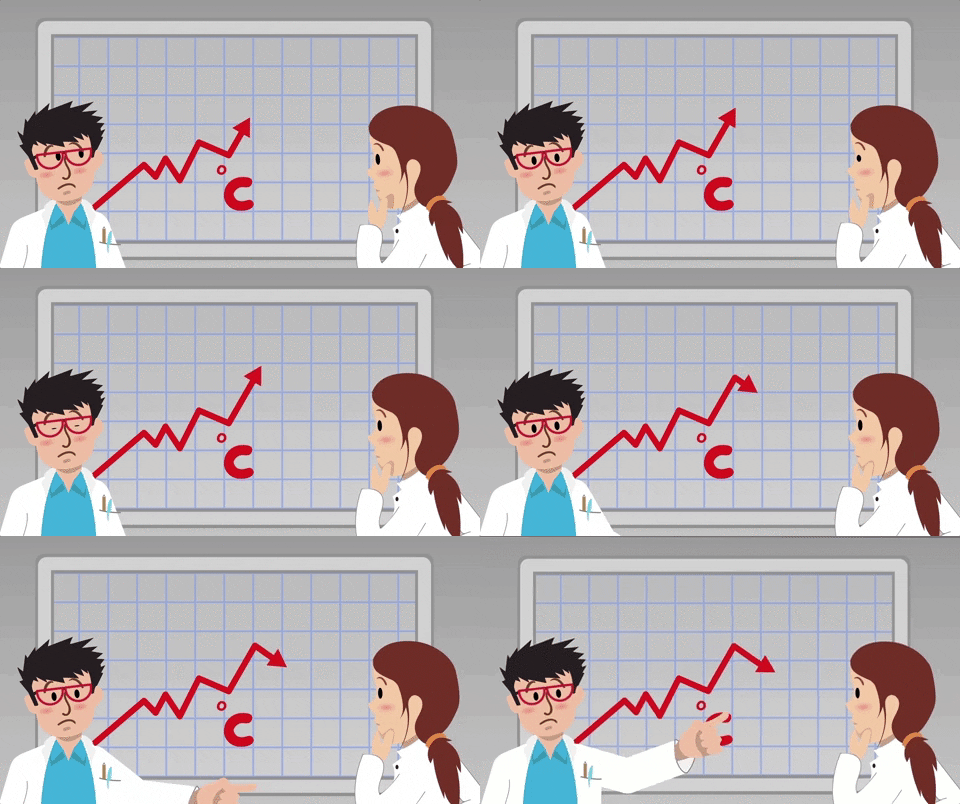
After Cooling's main topic is the history of air conditioning and refrigerants in general and how it's contributed to our current climate crisis. Previously, the most I had been exposed to of the latter was learning of the ozone crisis in school.
Like most history lessons, it felt distant to me, a crisis that once happened, but was now over, solved by the world banding together in the form of the Montreal Protocol treaty to phase down and ban ozone-destroying CFCs for the good of everyone. The ozone layer was now regenerating and should be completely whole again by 2070; a major bullet had been dodged to life on Earth. We were safe now.
Color me surprised then to learn through this book that the ozone layer issue is an ongoing crisis, and that ozone layer depletion is very much connected with our current climate change crisis. (In retrospect, it should not have surprised me as much.)
As global of a problem as ozone depletion and climate change are, it is even more alarming to me that it is a symptom of a larger issue of our collective culture, institutions, and mindsets. A mindset and accompanying culture and institutions that the West has exported to more areas of the world.
But let us back up for a second from the present to contextualize the current moment.
Artificial cooling did not really take on until business realized it could be useful to increase productivity--the first major application being on facilitating increased trade on the New York Stock Exchange in 1902. It allowed for the seeming insulation of delicate manufacturing processes and workers from the whims of the weather, allowing for stable, predictable conditions in which to work (which led to profit).
It slowly spread to other businesses and then to the public on the backs of an industry-defined set of standards around comfort that translated into a powerful cultural ideal, a veritable symbol of a certain type of middle-class lifestyle. One of material comfort and insulation from the hazards of the world, an illusion of individualized safety that not everyone had access to.
Of course, there is no way to completely isolate yourself from the world. Because you are still a part of the world, there's consequences to your actions.

These consequences became apparent when it became apparent that CFCs--in particular, Freon--were destroying the ozone layer. The ozone layer is a very thin layer in the stratosphere that protects us from the most harmful of UV radiation. It very much makes life possible. (UV radiation can impair immune functions, damage DNA, and trigger cancers. Not ideal conditions for any life to survive. Maybe tardigrades could survive in such a world, but not much else.)
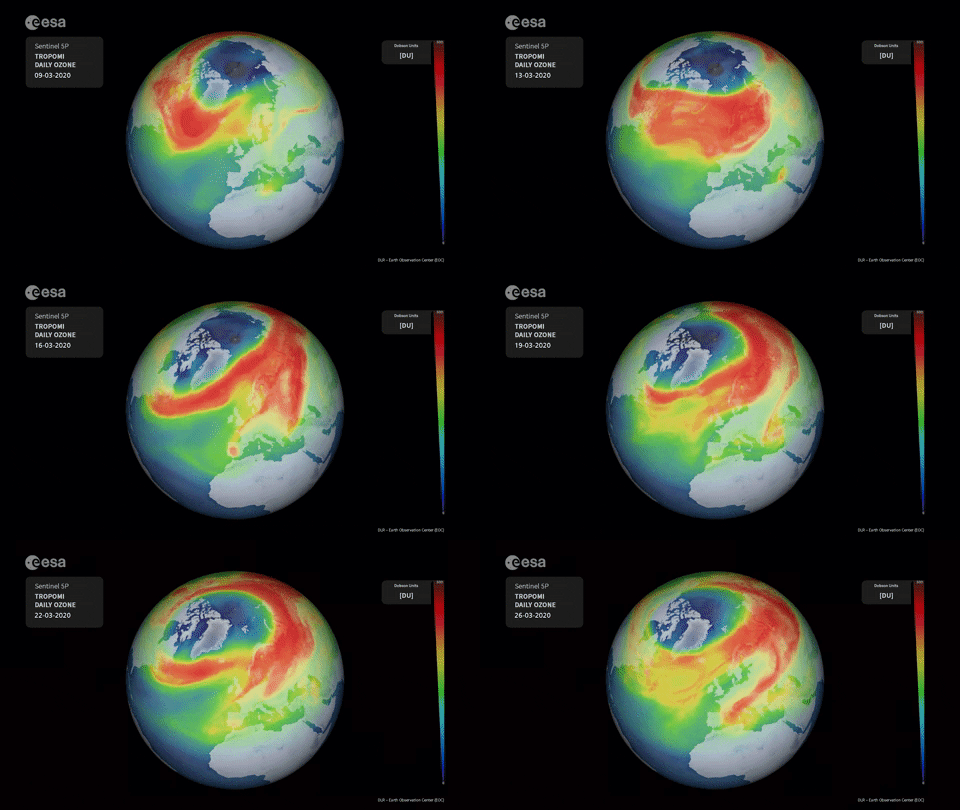
While the ozone layer problem seemed to be solved by the Montreal Protocol and industrial adoption of a new class of ostensibly "ozone-friendly" refrigerants after the halt of CFC production in the 1990s, it turns out the replacements--HFCs and HCFCs--also could damage the ozone layer, albeit much less than their CFC predecessors.
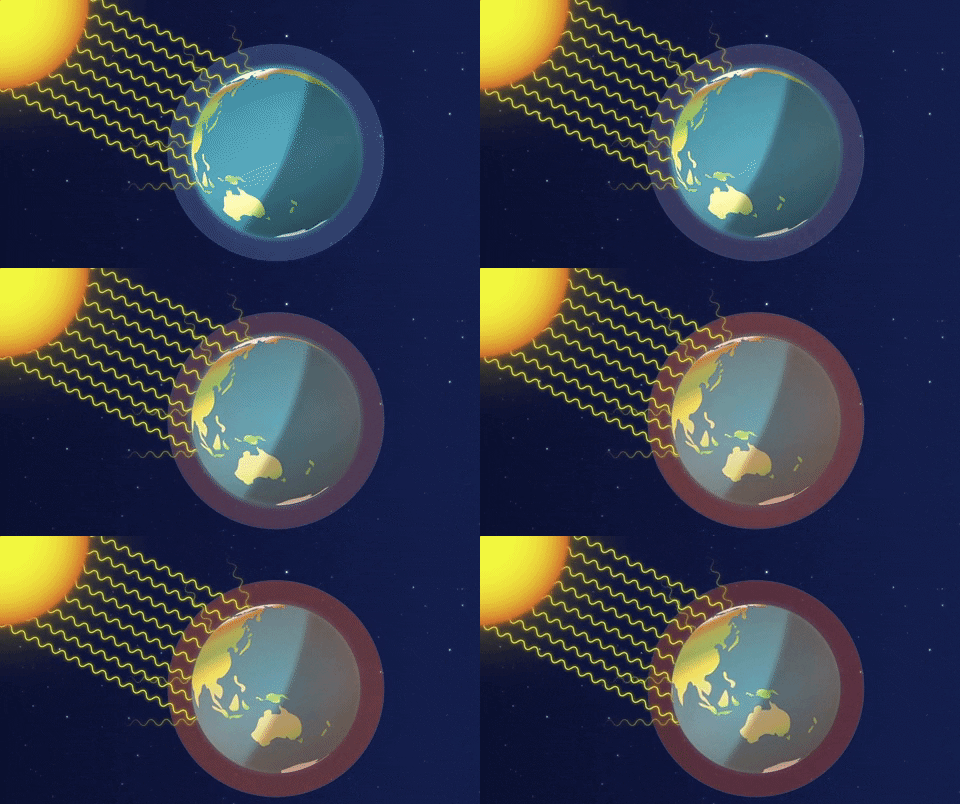
Not to mention that these ozone depleting substances were (are) really, really good at being greenhouse gases as well, better than CO2. Just one molecule of early CFCs could hold up to 11,000 times the heat that one molecule of carbon dioxide could (can). Later refrigerants not as much as CFCs, but still substantially more than CO2.
My reasoning for the various tenses in the last sentence is that there is a large underground economy for CFCs in particular. So, we cannot talk about them just as a past problem--as implied by the past tense--but as an ongoing, present problem, hence the present tense in parentheses.

Author Eric Dean Wilson's friend, Sam, worked for a company that sought to gather as much of this remaining CFC as possible for destruction, before it could enter the atmosphere and cause trouble. This narrative interweaves through Wilson's discussion of the history of refrigerants and their costs in the form of ozone depletion and climate change, things that very much still plague us in the present.
Solutions for the current global environmental crises?
Wilson does not want us all to ditch our air conditioners or go without refrigerators or makes the argument that CFC reclamation work like his friend's will be the solo needed fix. Rather, he argues for shifting our collective mindset, of investing in public cooling solutions rather than individualized ones. This shift from an individual to a more collective mindset, one that recognizes that when some of us are in danger from climate change, all of us are in danger.
Easier said than done, right? Yes, changing hearts and minds will be an exceedingly arduous process, but nevertheless an important one as we work to combat the worst effects of climate change, not only for present generations, but also future generations.

An eye-opening book. Worth the read!
-Cora
Find this book and other titles within our catalog.
After Cooling's main topic is the history of air conditioning and refrigerants in general and how it's contributed to our current climate crisis. Previously, the most I had been exposed to of the latter was learning of the ozone crisis in school.
Like most history lessons, it felt distant to me, a crisis that once happened, but was now over, solved by the world banding together in the form of the Montreal Protocol treaty to phase down and ban ozone-destroying CFCs for the good of everyone. The ozone layer was now regenerating and should be completely whole again by 2070; a major bullet had been dodged to life on Earth. We were safe now.
Color me surprised then to learn through this book that the ozone layer issue is an ongoing crisis, and that ozone layer depletion is very much connected with our current climate change crisis. (In retrospect, it should not have surprised me as much.)
As global of a problem as ozone depletion and climate change are, it is even more alarming to me that it is a symptom of a larger issue of our collective culture, institutions, and mindsets. A mindset and accompanying culture and institutions that the West has exported to more areas of the world.
But let us back up for a second from the present to contextualize the current moment.
Artificial cooling did not really take on until business realized it could be useful to increase productivity--the first major application being on facilitating increased trade on the New York Stock Exchange in 1902. It allowed for the seeming insulation of delicate manufacturing processes and workers from the whims of the weather, allowing for stable, predictable conditions in which to work (which led to profit).
It slowly spread to other businesses and then to the public on the backs of an industry-defined set of standards around comfort that translated into a powerful cultural ideal, a veritable symbol of a certain type of middle-class lifestyle. One of material comfort and insulation from the hazards of the world, an illusion of individualized safety that not everyone had access to.
Of course, there is no way to completely isolate yourself from the world. Because you are still a part of the world, there's consequences to your actions.
These consequences became apparent when it became apparent that CFCs--in particular, Freon--were destroying the ozone layer. The ozone layer is a very thin layer in the stratosphere that protects us from the most harmful of UV radiation. It very much makes life possible. (UV radiation can impair immune functions, damage DNA, and trigger cancers. Not ideal conditions for any life to survive. Maybe tardigrades could survive in such a world, but not much else.)
While the ozone layer problem seemed to be solved by the Montreal Protocol and industrial adoption of a new class of ostensibly "ozone-friendly" refrigerants after the halt of CFC production in the 1990s, it turns out the replacements--HFCs and HCFCs--also could damage the ozone layer, albeit much less than their CFC predecessors.
Not to mention that these ozone depleting substances were (are) really, really good at being greenhouse gases as well, better than CO2. Just one molecule of early CFCs could hold up to 11,000 times the heat that one molecule of carbon dioxide could (can). Later refrigerants not as much as CFCs, but still substantially more than CO2.
My reasoning for the various tenses in the last sentence is that there is a large underground economy for CFCs in particular. So, we cannot talk about them just as a past problem--as implied by the past tense--but as an ongoing, present problem, hence the present tense in parentheses.
Author Eric Dean Wilson's friend, Sam, worked for a company that sought to gather as much of this remaining CFC as possible for destruction, before it could enter the atmosphere and cause trouble. This narrative interweaves through Wilson's discussion of the history of refrigerants and their costs in the form of ozone depletion and climate change, things that very much still plague us in the present.
Solutions for the current global environmental crises?
Wilson does not want us all to ditch our air conditioners or go without refrigerators or makes the argument that CFC reclamation work like his friend's will be the solo needed fix. Rather, he argues for shifting our collective mindset, of investing in public cooling solutions rather than individualized ones. This shift from an individual to a more collective mindset, one that recognizes that when some of us are in danger from climate change, all of us are in danger.
Easier said than done, right? Yes, changing hearts and minds will be an exceedingly arduous process, but nevertheless an important one as we work to combat the worst effects of climate change, not only for present generations, but also future generations.
An eye-opening book. Worth the read!
-Cora
Find this book and other titles within our catalog.
July 6, 2021
A compelling and trustworthy voice teaches us something complex and important. Wilson takes what has likely seemed like a no-brainer ("It's hot outside. I want to cool off. I will turn on the A/C.") and shows it in the broader context we too conveniently forget or ignore. The result is something powerful, empowering, and -- somehow -- absolutely beautiful in its presentation. Everyone should read it.

August 7, 2021
There were four themes here: History of air conditioning and cooling, the ozone and climate science, the story of the author and freon purchaser who sent it for destruction, and how air conditioning highlights racial disparities. Worthwhile read.

July 18, 2021
I feel like everyone should read this book. I'm particularly thankful that this author is so aware of intersectionality and discusses how various topics effect people differently across different race, gender, and other variables. This is a very interesting topic, way more interesting to me than I thought it would be!

June 11, 2021
Interesting History Marred By Marxist Politics And Alarmist Propaganda. In the description of this book, it is claimed that we will get a look at history, science, road trip, and philosophy as it relates to Freon and its history. Well, the philosophy is avowed Marxism (even quoting Marx directly to begin one of the sections) and the "science" is mostly alarmist "Global Cooling" / "Global Warming" / "Climate Change" junk wherein he cites in part some of the very studies that Stephen Koonin's Unsettled - released just weeks earlier - shows to be problematic at best. And unlike Wilson, Koonin is an actual climate scientist, one who worked at a high level under Barack Obama, no less. Instead, Wilson outright declares that it is the stuff of nightmares to think that any form of warming is natural, that man *must* be the cause of *all* warming and that we *must* thus be able to stop it.
These factors noted - and seriously, if you can't stomach a fatal dose of Marxist ideology, don't bother reading this book - the history presented here, even while presented fully rooted in anti-white, anti-capitalist screed form, is actually interesting and worthy of discovery by those who may not be aware of it, such as myself when going into this book. The road trip episodes that frame each section are interesting in and of themselves, as Wilson tags along with a friend who is buying up stockpiles of Freon American Pickers style in order to destroy them to claim the carbon credits under California's Cap and Trade system.
There is a compelling story to tell in the need for better ways to cool and comfort, and there are promising techs and strategies that don't rely on Marxism and government mandate to achieve them. Unfortunately this book ignores all of this.
Finally, the citations and bibliography... are minimal, for such fantastical claims, accounting for barely 15% of the text, and are rarely directly cited within the narrative itself.
It is because of all of these factors that I am quite comfortable with the 2* - without the history and road trip, it would have been half even that - and would be lower than even that, were such possible on review sites. Not recommended.
These factors noted - and seriously, if you can't stomach a fatal dose of Marxist ideology, don't bother reading this book - the history presented here, even while presented fully rooted in anti-white, anti-capitalist screed form, is actually interesting and worthy of discovery by those who may not be aware of it, such as myself when going into this book. The road trip episodes that frame each section are interesting in and of themselves, as Wilson tags along with a friend who is buying up stockpiles of Freon American Pickers style in order to destroy them to claim the carbon credits under California's Cap and Trade system.
There is a compelling story to tell in the need for better ways to cool and comfort, and there are promising techs and strategies that don't rely on Marxism and government mandate to achieve them. Unfortunately this book ignores all of this.
Finally, the citations and bibliography... are minimal, for such fantastical claims, accounting for barely 15% of the text, and are rarely directly cited within the narrative itself.
It is because of all of these factors that I am quite comfortable with the 2* - without the history and road trip, it would have been half even that - and would be lower than even that, were such possible on review sites. Not recommended.

December 28, 2021
Wilson does a phenomenal job of bringing together all of the various strands of this complex issue: not just the science and the chemistry, but notably the systemic racism and exclusion at the heart. At times, I wished the book could have been three really long articles in The Atlantic; each aspect is researched and discussed in depth. But I think this is a book to be read slowly and contemplated, which may mean you need to check it out multiple times from the library.
I'll admit to being torn about AFTER COOLING. It is, unlike the title, mostly about the past and current state of cooling and air conditioning; there's little exploration, particularly at the same level of research and discussion, in the hundreds of pages that point to where we need to be going in the future. The book is short on practical solutions, except for the reinvigoration of public spaces (parks, green spaces, pools, beaches, libraries) so that we can collectively support each other through the changing climate.
But AFTER COOLING is a book you'll keep thinking about long after, as you contemplate the definition of comfort and the very narrow demographic it has been based on: "the white, middle-class American view of comfort — energy intensive material comforts defined by, and, in turn, further strengthening a sense of individualism, social status, and personal safety as ends in themselves — has become the desired model for much of the world, in part because it has overtaken and erased other ways in which humans have historically lived together as a collective." What cost to the planet, and to each other, has our desire to avoid even the smallest discomfort caused? This part of the subtitle — "the terrible cost of comfort" — is really what the book is about.
I'll admit to being torn about AFTER COOLING. It is, unlike the title, mostly about the past and current state of cooling and air conditioning; there's little exploration, particularly at the same level of research and discussion, in the hundreds of pages that point to where we need to be going in the future. The book is short on practical solutions, except for the reinvigoration of public spaces (parks, green spaces, pools, beaches, libraries) so that we can collectively support each other through the changing climate.
But AFTER COOLING is a book you'll keep thinking about long after, as you contemplate the definition of comfort and the very narrow demographic it has been based on: "the white, middle-class American view of comfort — energy intensive material comforts defined by, and, in turn, further strengthening a sense of individualism, social status, and personal safety as ends in themselves — has become the desired model for much of the world, in part because it has overtaken and erased other ways in which humans have historically lived together as a collective." What cost to the planet, and to each other, has our desire to avoid even the smallest discomfort caused? This part of the subtitle — "the terrible cost of comfort" — is really what the book is about.

December 26, 2021
In a time that seems ripe for change, it felt right to read After Cooling: On Freon, Global Warming, and the Terrible Cost of Comfort. I feel like I have been reading a fair number of books urging major re-thinks lately, and it is worth the effort. Otherwise, how am I to learn or grow as a person?
After Cooling's main topic is the history of air conditioning and refrigerants in general and how it's contributed to our current climate crisis. Previously, the most I had been exposed to of the latter was learning of the ozone crisis in school. Like most history lessons, it felt distant to me, a crisis that once happened, but was now over, solved by the world banding together in the form of the Montreal Protocol treaty to phase down and ban ozone-destroying CFCs for the good of everyone. The ozone layer was now regenerating and should be completely whole again by 2070; a major bullet had been dodged to life on Earth. We were safe now.
Color me surprised then to learn through this book that the ozone layer issue is an ongoing crisis, and that ozone layer depletion is very much connected with our current climate change crisis. (In retrospect, it should not have surprised me as much.)
As global of a problem as ozone depletion and climate change are, it is even more alarming to me that it is a symptom of a larger issue of our collective culture, institutions, and mindsets. A mindset and accompanying culture and institutions that the West has exported to more areas of the world.
But let us back up for a second from the present to contextualize the current moment.
Artificial cooling did not really take on until business realized it could be useful to increase productivity--the first major application being on facilitating increased trade on the New York Stock Exchange in 1902. It allowed for the seeming insulation of delicate manufacturing processes and workers from the whims of the weather, allowing for stable, predictable conditions in which to work (which led to profit).
It slowly spread to other businesses and then to the public on the backs of an industry-defined set of standards around comfort that translated into a powerful cultural ideal, a veritable symbol of a certain type of middle-class lifestyle. One of material comfort and insulation from the hazards of the world, an illusion of individualized safety that not everyone had access to.
Of course, there is no way to completely isolate yourself from the world. Because you are still a part of the world, there's consequences to your actions.
These consequences became apparent when it became apparent that CFCs--in particular, Freon--were destroying the ozone layer. The ozone layer is a very thin layer in the stratosphere that protects us from the most harmful of UV radiation. It very much makes life possible. (UV radiation can impair immune functions, damage DNA, and trigger cancers. Not ideal conditions for any life to survive. Maybe tardigrades could survive in such a world, but not much else.)
While the ozone layer problem seemed to be solved by the Montreal Protocol and industrial adoption of a new class of ostensibly "ozone-friendly" refrigerants after the halt of CFC production in the 1990s, it turns out the replacements--HFCs and HCFCs--also could damage the ozone layer, albeit much less than their CFC predecessors. Not to mention that these ozone depleting substances were (are) really, really good at being greenhouse gases as well, better than CO2. Just one molecule of early CFCs could hold up to 11,000 times the heat that one molecule of carbon dioxide could (can). Later refrigerants not as much as CFCs, but still substantially more than CO2.
My reasoning for the various tenses in the last sentence is that there is a large underground economy for CFCs in particular. So, we cannot talk about them just as a past problem--as implied by the past tense--but as an ongoing, present problem, hence the present tense in parentheses.
Author Eric Dean Wilson's friend, Sam, worked for a company that sought to gather as much of this remaining CFC as possible for destruction, before it could enter the atmosphere and cause trouble. This narrative interweaves through Wilson's discussion of the history of refrigerants and their costs in the form of ozone depletion and climate change, things that very much still plague us in the present.
Solutions for the current global environmental crises?
Wilson does not want us all to ditch our air conditioners or go without refrigerators or makes the argument that CFC reclamation work like his friend's will be the solo needed fix. Rather, he argues for shifting our collective mindset, of investing in public cooling solutions rather than individualized ones. This shift from an individual to a more collective mindset, one that recognizes that when some of us are in danger from climate change, all of us are in danger.
Easier said than done, right? Yes, changing hearts and minds will be an exceedingly arduous process, but nevertheless an important one as we work to combat the worst effects of climate change, not only for present generations, but also future generations.
An eye-opening book. Worth the read!
After Cooling's main topic is the history of air conditioning and refrigerants in general and how it's contributed to our current climate crisis. Previously, the most I had been exposed to of the latter was learning of the ozone crisis in school. Like most history lessons, it felt distant to me, a crisis that once happened, but was now over, solved by the world banding together in the form of the Montreal Protocol treaty to phase down and ban ozone-destroying CFCs for the good of everyone. The ozone layer was now regenerating and should be completely whole again by 2070; a major bullet had been dodged to life on Earth. We were safe now.
Color me surprised then to learn through this book that the ozone layer issue is an ongoing crisis, and that ozone layer depletion is very much connected with our current climate change crisis. (In retrospect, it should not have surprised me as much.)
As global of a problem as ozone depletion and climate change are, it is even more alarming to me that it is a symptom of a larger issue of our collective culture, institutions, and mindsets. A mindset and accompanying culture and institutions that the West has exported to more areas of the world.
But let us back up for a second from the present to contextualize the current moment.
Artificial cooling did not really take on until business realized it could be useful to increase productivity--the first major application being on facilitating increased trade on the New York Stock Exchange in 1902. It allowed for the seeming insulation of delicate manufacturing processes and workers from the whims of the weather, allowing for stable, predictable conditions in which to work (which led to profit).
It slowly spread to other businesses and then to the public on the backs of an industry-defined set of standards around comfort that translated into a powerful cultural ideal, a veritable symbol of a certain type of middle-class lifestyle. One of material comfort and insulation from the hazards of the world, an illusion of individualized safety that not everyone had access to.
Of course, there is no way to completely isolate yourself from the world. Because you are still a part of the world, there's consequences to your actions.
These consequences became apparent when it became apparent that CFCs--in particular, Freon--were destroying the ozone layer. The ozone layer is a very thin layer in the stratosphere that protects us from the most harmful of UV radiation. It very much makes life possible. (UV radiation can impair immune functions, damage DNA, and trigger cancers. Not ideal conditions for any life to survive. Maybe tardigrades could survive in such a world, but not much else.)
While the ozone layer problem seemed to be solved by the Montreal Protocol and industrial adoption of a new class of ostensibly "ozone-friendly" refrigerants after the halt of CFC production in the 1990s, it turns out the replacements--HFCs and HCFCs--also could damage the ozone layer, albeit much less than their CFC predecessors. Not to mention that these ozone depleting substances were (are) really, really good at being greenhouse gases as well, better than CO2. Just one molecule of early CFCs could hold up to 11,000 times the heat that one molecule of carbon dioxide could (can). Later refrigerants not as much as CFCs, but still substantially more than CO2.
My reasoning for the various tenses in the last sentence is that there is a large underground economy for CFCs in particular. So, we cannot talk about them just as a past problem--as implied by the past tense--but as an ongoing, present problem, hence the present tense in parentheses.
Author Eric Dean Wilson's friend, Sam, worked for a company that sought to gather as much of this remaining CFC as possible for destruction, before it could enter the atmosphere and cause trouble. This narrative interweaves through Wilson's discussion of the history of refrigerants and their costs in the form of ozone depletion and climate change, things that very much still plague us in the present.
Solutions for the current global environmental crises?
Wilson does not want us all to ditch our air conditioners or go without refrigerators or makes the argument that CFC reclamation work like his friend's will be the solo needed fix. Rather, he argues for shifting our collective mindset, of investing in public cooling solutions rather than individualized ones. This shift from an individual to a more collective mindset, one that recognizes that when some of us are in danger from climate change, all of us are in danger.
Easier said than done, right? Yes, changing hearts and minds will be an exceedingly arduous process, but nevertheless an important one as we work to combat the worst effects of climate change, not only for present generations, but also future generations.
An eye-opening book. Worth the read!

January 20, 2024
Ok, I only made it half way through. I tried multiple times to pick it back up, but eventually gave up.
His thesis appears to be the following: The mass production of air conditioning systems has conditioned humans. Air conditioning is the catalyst for the social, political, economical, and environmental issues we experience today.
It felt like a stream of consciousness about his opinions on feminism, racism, culture, etc.
It may be unfair to say this because I didn’t finish the book, but I couldn’t find anything constructive about this book.
His thesis appears to be the following: The mass production of air conditioning systems has conditioned humans. Air conditioning is the catalyst for the social, political, economical, and environmental issues we experience today.
It felt like a stream of consciousness about his opinions on feminism, racism, culture, etc.
It may be unfair to say this because I didn’t finish the book, but I couldn’t find anything constructive about this book.

July 16, 2022
This is simply a great book overall. Not a 4.5 star. A 5 star. (But, two caveats, one small, one a bit bigger, at the end.)
Between narratives of driving the country with a friend, “Sam” who buys up the original Freon, CFC-12, Wilson lays out a history of cooling, from pre-America, through pre-electricity, into electricity. He then has a first transition section.
Then, it’s the “Age of Freon,” with that first part having been “Before Freon.” I hadn’t before known that tetraethyl lead inventor, and liar about its deadliness, Thomas Midgley, was also the re-discoverer of CFC-12, first synthesized by a European chemist, Frédéric Swartz, in the 1890s, and that one of Midgley’s assistants, Albert Henne, had written about in his doctoral thesis, after Midgley realized he was looking for some sort of carbon-fluorine compound as his ideal coolant. From CFC-12, Midgely then systematically invented several other Freons (and invented the name), inventing CFCs and HCFCs as well.
From here, it’s off to the cooling of America, where Wilson really starts to show some turns of phrase.
"This desire to reject the outside is neither neutral nor natural." 178
"I can't think of a more common illusion of invincibility, of inviolacy, of the rah-rah certainty of the neoliberal individual than the car." 175
These are only two of many great turns of phrase.
In short, he's a litterateur, if you will. (and I agree with both sentiments).
Next, he turns to issues of race, class and cooling in America, and by extension, globally. He continues to hammer on neoliberal capitalism, and continues this, after the second brief transition, to the “After Freon” era.
This starts with the lead-up to the Montreal Protocol on Freons and the ozone layer, and DuPont’s lies. It also includes the acid rain amendments to the Clean Air Act, which give Wilson a good starting point to discuss the failures of cap-and-trade.
You see, he shows that acid rain hasn’t been reduced as much as claimed by many, including mainstream environmentalists in many cases. Yes, sulfur dioxide has been slashed from factories. But? The old car tailpipe is a much bigger source of various nitrogen oxides than are smokestacks.
From here, neoliberal capitalism, as well as right-wing nuttery in America, both get further bashing.
Then, he looks at the “after Freon” world. Per the above, he knows that cap-and-trade won’t work. He also says shaming won’t work. Without spelling out details, Wilson seems to indicate that, just as we have a variety of “slices” to deal with to curb climate change, so we have a mixture of approaches to take with other people on getting their buying. He also notes (as I and others have noted with “Peak Oil”) that the Freon-hooked US has more to lose than any other country. For example, yes, upper-class and even some middle-class Chinese may have home AC now. But? They’ll likely run their home thermostats at 76F, or 78F, even, not 72 or 74.
The “postlude” started out great. It transitioned from the ideas above and went from there. There’s a special twist on Sam the Freon man friend of Wilson’s and his last big customer.
But, after that, it goes off the rails to some degree. Someone who rightly calls out neoliberal capitalism repeatedly then approvingly cites wokeness, neoliberal capitalism peddlers division, “names” DeRay McKesson and Robin DiAngelo. As a leftist of some sort myself, who doesn’t think all “woke” ideas are bad, I nonetheless have little use for either.
Finally? I don’t know if it was first-book financial constraints or what, but NO pictures. Not even of Sam the Freon man, identified by last name, and without, “let’s call him Sam,” in the postlude.
A must read for people seriously concerned about our climate crisis — and seriously honest about it, as addressing the use of Freons is THE BIGGEST “slice” in the greenhouse gases control “pie,” as Wilson notes early in the book.
Between narratives of driving the country with a friend, “Sam” who buys up the original Freon, CFC-12, Wilson lays out a history of cooling, from pre-America, through pre-electricity, into electricity. He then has a first transition section.
Then, it’s the “Age of Freon,” with that first part having been “Before Freon.” I hadn’t before known that tetraethyl lead inventor, and liar about its deadliness, Thomas Midgley, was also the re-discoverer of CFC-12, first synthesized by a European chemist, Frédéric Swartz, in the 1890s, and that one of Midgley’s assistants, Albert Henne, had written about in his doctoral thesis, after Midgley realized he was looking for some sort of carbon-fluorine compound as his ideal coolant. From CFC-12, Midgely then systematically invented several other Freons (and invented the name), inventing CFCs and HCFCs as well.
From here, it’s off to the cooling of America, where Wilson really starts to show some turns of phrase.
"This desire to reject the outside is neither neutral nor natural." 178
"I can't think of a more common illusion of invincibility, of inviolacy, of the rah-rah certainty of the neoliberal individual than the car." 175
These are only two of many great turns of phrase.
In short, he's a litterateur, if you will. (and I agree with both sentiments).
Next, he turns to issues of race, class and cooling in America, and by extension, globally. He continues to hammer on neoliberal capitalism, and continues this, after the second brief transition, to the “After Freon” era.
This starts with the lead-up to the Montreal Protocol on Freons and the ozone layer, and DuPont’s lies. It also includes the acid rain amendments to the Clean Air Act, which give Wilson a good starting point to discuss the failures of cap-and-trade.
You see, he shows that acid rain hasn’t been reduced as much as claimed by many, including mainstream environmentalists in many cases. Yes, sulfur dioxide has been slashed from factories. But? The old car tailpipe is a much bigger source of various nitrogen oxides than are smokestacks.
From here, neoliberal capitalism, as well as right-wing nuttery in America, both get further bashing.
Then, he looks at the “after Freon” world. Per the above, he knows that cap-and-trade won’t work. He also says shaming won’t work. Without spelling out details, Wilson seems to indicate that, just as we have a variety of “slices” to deal with to curb climate change, so we have a mixture of approaches to take with other people on getting their buying. He also notes (as I and others have noted with “Peak Oil”) that the Freon-hooked US has more to lose than any other country. For example, yes, upper-class and even some middle-class Chinese may have home AC now. But? They’ll likely run their home thermostats at 76F, or 78F, even, not 72 or 74.
The “postlude” started out great. It transitioned from the ideas above and went from there. There’s a special twist on Sam the Freon man friend of Wilson’s and his last big customer.
But, after that, it goes off the rails to some degree. Someone who rightly calls out neoliberal capitalism repeatedly then approvingly cites wokeness, neoliberal capitalism peddlers division, “names” DeRay McKesson and Robin DiAngelo. As a leftist of some sort myself, who doesn’t think all “woke” ideas are bad, I nonetheless have little use for either.
Finally? I don’t know if it was first-book financial constraints or what, but NO pictures. Not even of Sam the Freon man, identified by last name, and without, “let’s call him Sam,” in the postlude.
A must read for people seriously concerned about our climate crisis — and seriously honest about it, as addressing the use of Freons is THE BIGGEST “slice” in the greenhouse gases control “pie,” as Wilson notes early in the book.

August 16, 2021
(LISTENED TO AUDIOBOOK)
The audiobook was read by the author, so I would like to start by saying: Eric Dean Wilson, I love you, and if you read this review, please PLEASE put me on your beta readers list because I just so thoroughly enjoyed your style and sense of humor.
As for the book, I really enjoyed this! I thought it was just going to be a scientific rundown of Freon, but it was so much more. It delved into the socioeconomic implications of Freon versus non-Freon, as well as the racial, regional, political and any gender factors associated with the use of AC through the years since its invention. All of this done in a way that it was clear the author is more liberal than not, but also clearly trying to maintain a fair stance against all political parties and their successes and failures with regulation to help the environment.
Wilson made something highly complicated accessible, and I highly recommend this to anyone at the high school level or above.
The audiobook was read by the author, so I would like to start by saying: Eric Dean Wilson, I love you, and if you read this review, please PLEASE put me on your beta readers list because I just so thoroughly enjoyed your style and sense of humor.
As for the book, I really enjoyed this! I thought it was just going to be a scientific rundown of Freon, but it was so much more. It delved into the socioeconomic implications of Freon versus non-Freon, as well as the racial, regional, political and any gender factors associated with the use of AC through the years since its invention. All of this done in a way that it was clear the author is more liberal than not, but also clearly trying to maintain a fair stance against all political parties and their successes and failures with regulation to help the environment.
Wilson made something highly complicated accessible, and I highly recommend this to anyone at the high school level or above.
December 27, 2022
One of my favorite "climate change books" yet. Wilson takes his time in exploring the subject from many angles, with many stories. I really appreciated his repeating turning of these core questions: how do our choices affect the lives of others, and what shapes those choices? Wilson makes a strong case that the contemplation of comfort is something very important for people today, especially the global upper-class, to do.
I particularly appreciate his calling to attention through numerous cases how the feeling of "comfort" is not purely innate, but dependent on many things: our clothing, our activities, the temperature we've been at for the past 2-3 weeks (heat acclimatization), how much cooling we choose to use, the conditions we've come to expect, the structures we inhabit, our knowledge of the state of the world and our impacts on it, our whole mental state, and the societal conditions that influence all the above. The historian Wilson shows how the ghosts of the long dead are in fact alive and walking among us, not merely through the inanimate technologies at our disposal but more importantly, our conception of what is important, what is good, what is wellbeing, and what is possible.
In that sense, being aware of how these things have changed throughout history not only gives us the ability to see the present more clearly, but do a more clear-eyed job of determining the future.
I did think some sentences and words could be trimmed down here and there, but it did not significantly impede the value of the book for me.
I particularly appreciate his calling to attention through numerous cases how the feeling of "comfort" is not purely innate, but dependent on many things: our clothing, our activities, the temperature we've been at for the past 2-3 weeks (heat acclimatization), how much cooling we choose to use, the conditions we've come to expect, the structures we inhabit, our knowledge of the state of the world and our impacts on it, our whole mental state, and the societal conditions that influence all the above. The historian Wilson shows how the ghosts of the long dead are in fact alive and walking among us, not merely through the inanimate technologies at our disposal but more importantly, our conception of what is important, what is good, what is wellbeing, and what is possible.
In that sense, being aware of how these things have changed throughout history not only gives us the ability to see the present more clearly, but do a more clear-eyed job of determining the future.
I did think some sentences and words could be trimmed down here and there, but it did not significantly impede the value of the book for me.

August 29, 2021
This book changed my perspective on comfort, convincing me the "ideal" inside climate is a myth (which seems obvious to anyone who has worked in an office, where half the people are too cold and half too warm). Worse, it's a myth started by big industry to sell products and pushed with the similar deceptive tactics later used by big tobacco and others: falsifying or distorting information and claiming it's scientific proof.
April 29, 2024
After a long drought, I’ve decided to write another book review! Was taking notes throughout this one and wanted to pass a few of them along to anyone interested.
Book: After Cooling: On Freon, Global Warming, and the Terrible Cost of Comfort by Eric Dean Wilson
Why I read it: I saw this book displayed at Powell’s in Portland last year, and it instantly went on my must-read list. A niche topic no one thinks about? It’s history, chemistry, as well as the global impacts it’ll have. All in one book? Yep. Plus I had read articles saying AC’s were bad for the environment and I didn’t understand why, so I hoped to answer that question.
Synopsis:
After Cooling covers the history of air conditioning and refrigerants in America. Early chillers were invented for industrial usage like textile factories and newspaper companies. They slowly spread to shopping malls, movie theaters, and other public areas. Wilson dedicates some time to cover CFC-12, better known by its brand name Freon, and its inventor Thomas Midgely Jr. After WWII, air conditioning and refrigerants had graduated into households, and by 1980 more than half of all households had air conditioning. However, this newfound comfort had a price: aerosols, air conditioning units, and building materials were emitting and leaking CFCs up to the ozone layer. There, the refrigerants’ chlorine atom prevents the oxygen molecules from reforming after UV light spilt them apart, which allows more of the sun’s ultraviolet radiation to reach Earth’s surface. Scientists blew the whistle on this phenomenon during the 1970s, however they were muzzled by chemical companies producing these lucrative refrigerants, delaying vital legislation to outlaw their production. Finally, in 1987, 11 countries met in Montreal and ratified the Montreal Protocol, which laid out a plan to end the production of harmful refrigerants like CFC-12 and to the ozone layer. 30 years later, the Kigali Amendment to the Montreal Protocol was agreed upon, forcing counties to phase down the production of HFCs, like HFC-134a, thought to be the most common refrigerant still in use today.
Wilson also sprinkles in the non-environmental impacts air conditioning has had on society throughout the book, like how we’ve changed where we comingle within our communities. It doesn’t have many personal anecdotes, but the one he does include involves following a friend who travels across the country buying Freon from business owners and collectors to destroy the refrigerant as part of a California program that gives credits to companies disposing the product. There’s a touching moment at the end of the book between the friend and a Freon evangelical who had sworn to never sell his stash for destruction, putting a human touch to a cold (pun intended) impersonal product.
Best quotation: “The public assumption [that aerosol spray cans posed a threat to human health] says a lot about how Americans perceive danger; we assume it to be direct and individual, and when it’s not, we have trouble seeing it.
Interesting observations:
Air conditioners are supposedly closed systems, which means the harmful refrigerants shouldn’t be able to escape. But over time, the refrigerant leaks out and starts its journey up to the ozone layer.
One of the first industries to incorporate air conditioning were movie theaters during the roaring ‘20s. The owners would install them to drum up more business in the summer months, and leave their doors open to entice passers-by. But since the chillers were hard to adjust, patrons were subject to frigid temperatures once inside the theaters, which pissed people off.
Analysis:
After Cooling aims to be the de facto history of refrigerants, and I think Wilson accomplishes this goal (there’s over 100 references and interviews for us sickos to go back to). He blends the history of refrigerants, from their inception to their destruction of the ozone layer, with the sociological and economic changes they have manifested in the last 100 years. It’s not going to change anyone’s mind about if AC is good or bad, that isn’t Wilson’s aim. He does caution the reader to not put too much faith in newer “cleaner” refrigerants or geoengineering solutions that’ve become more mainstream, as we’ve consistently screwed the pooch with our inventions time in and time out. Wilson ends the book willing the reader to reframe their definition of comfort from an individual sense to a collective sense, and here I agree with him. What good is it if 5 million Arizonans (sorry Arizonans) stay cool all year if it means increasing the likelihood of drought, famine, disease, and extreme weather for less affluent countries? And Wilson takes time to say the onus shouldn’t be on the individual. But it’s a tough chicken-and-the-egg situation between shifting individual desires for comfort and the broader collective social change of what comfort looks like.
This is where I’ll quickly proselytize to make you feel bad about needing AC all the time and tell you to turn it off once in a while. There I’m done! But serious question I had while reading: would you rather give up social media or air conditioning for the rest of the year? If you’re in Houston with me, it’s the first one. Do I expect to get through this next summer without AC? Absolutely not. But I’ll be more cognizant of my usage, and I’ll trust my fans and use the ice packs in the freezer more often.
Would I recommend this book? Only if you’d like to permanently remember that there is no D in refrigerant and refrigerator
Book: After Cooling: On Freon, Global Warming, and the Terrible Cost of Comfort by Eric Dean Wilson
Why I read it: I saw this book displayed at Powell’s in Portland last year, and it instantly went on my must-read list. A niche topic no one thinks about? It’s history, chemistry, as well as the global impacts it’ll have. All in one book? Yep. Plus I had read articles saying AC’s were bad for the environment and I didn’t understand why, so I hoped to answer that question.
Synopsis:
After Cooling covers the history of air conditioning and refrigerants in America. Early chillers were invented for industrial usage like textile factories and newspaper companies. They slowly spread to shopping malls, movie theaters, and other public areas. Wilson dedicates some time to cover CFC-12, better known by its brand name Freon, and its inventor Thomas Midgely Jr. After WWII, air conditioning and refrigerants had graduated into households, and by 1980 more than half of all households had air conditioning. However, this newfound comfort had a price: aerosols, air conditioning units, and building materials were emitting and leaking CFCs up to the ozone layer. There, the refrigerants’ chlorine atom prevents the oxygen molecules from reforming after UV light spilt them apart, which allows more of the sun’s ultraviolet radiation to reach Earth’s surface. Scientists blew the whistle on this phenomenon during the 1970s, however they were muzzled by chemical companies producing these lucrative refrigerants, delaying vital legislation to outlaw their production. Finally, in 1987, 11 countries met in Montreal and ratified the Montreal Protocol, which laid out a plan to end the production of harmful refrigerants like CFC-12 and to the ozone layer. 30 years later, the Kigali Amendment to the Montreal Protocol was agreed upon, forcing counties to phase down the production of HFCs, like HFC-134a, thought to be the most common refrigerant still in use today.
Wilson also sprinkles in the non-environmental impacts air conditioning has had on society throughout the book, like how we’ve changed where we comingle within our communities. It doesn’t have many personal anecdotes, but the one he does include involves following a friend who travels across the country buying Freon from business owners and collectors to destroy the refrigerant as part of a California program that gives credits to companies disposing the product. There’s a touching moment at the end of the book between the friend and a Freon evangelical who had sworn to never sell his stash for destruction, putting a human touch to a cold (pun intended) impersonal product.
Best quotation: “The public assumption [that aerosol spray cans posed a threat to human health] says a lot about how Americans perceive danger; we assume it to be direct and individual, and when it’s not, we have trouble seeing it.
Interesting observations:
Air conditioners are supposedly closed systems, which means the harmful refrigerants shouldn’t be able to escape. But over time, the refrigerant leaks out and starts its journey up to the ozone layer.
One of the first industries to incorporate air conditioning were movie theaters during the roaring ‘20s. The owners would install them to drum up more business in the summer months, and leave their doors open to entice passers-by. But since the chillers were hard to adjust, patrons were subject to frigid temperatures once inside the theaters, which pissed people off.
Analysis:
After Cooling aims to be the de facto history of refrigerants, and I think Wilson accomplishes this goal (there’s over 100 references and interviews for us sickos to go back to). He blends the history of refrigerants, from their inception to their destruction of the ozone layer, with the sociological and economic changes they have manifested in the last 100 years. It’s not going to change anyone’s mind about if AC is good or bad, that isn’t Wilson’s aim. He does caution the reader to not put too much faith in newer “cleaner” refrigerants or geoengineering solutions that’ve become more mainstream, as we’ve consistently screwed the pooch with our inventions time in and time out. Wilson ends the book willing the reader to reframe their definition of comfort from an individual sense to a collective sense, and here I agree with him. What good is it if 5 million Arizonans (sorry Arizonans) stay cool all year if it means increasing the likelihood of drought, famine, disease, and extreme weather for less affluent countries? And Wilson takes time to say the onus shouldn’t be on the individual. But it’s a tough chicken-and-the-egg situation between shifting individual desires for comfort and the broader collective social change of what comfort looks like.
This is where I’ll quickly proselytize to make you feel bad about needing AC all the time and tell you to turn it off once in a while. There I’m done! But serious question I had while reading: would you rather give up social media or air conditioning for the rest of the year? If you’re in Houston with me, it’s the first one. Do I expect to get through this next summer without AC? Absolutely not. But I’ll be more cognizant of my usage, and I’ll trust my fans and use the ice packs in the freezer more often.
Would I recommend this book? Only if you’d like to permanently remember that there is no D in refrigerant and refrigerator

March 15, 2025
This is such a mixed bag of a book that I can't exactly pin down how I feel. In general, Wilson's reach exceeds his grasp as he casts the widest net possible. The core of the book, the history of refrigerants and their environmental impact are fantastic. Also great are the travel log sections describing refrigerat reclaim trips; the story about The Iceman of Illinois is touching and human, allowing his subjects to be humanized in a way that's rare in discussions about the obstensible enemies of climate change.
Then there's the rest of the book... I want two things clear up front, I'm a career HVAC professional who has focused on executing on high efficiency and low GWP solutions; I'm also not some MAGA guy who is complaining because the book is "woke".
This book is at its worst when it tries to springboard from the HVAC industry into general issues with a society built on capitalism. It conflates symptoms with root causes in such a way that it muddies any point Wilson is trying to make. Many of these are arguments that I generally agree with, but they are presented in such a way that a reader could easily walk away with thw most bad faith reading of Wilson's thesis. It veers too far away from its subject and jumps into a very generic anti-capitalist manifesto that isn't effectively making the points it needs because it all has to tie back to Air Conditioning.
Wilson also doesn't make any real proposals for what should happen next. His solutions amount to overturning the entire social order of the Western world and then changing the comfort expectations that same world. It's a bold claim, and one that is more idealistic than practical. I was disappointed by the lack of actionable ideas presented here, nearly demonizing any interim solution without proposing alternatives. There's a near obsession with purity in any climate solution discussed, one that lets "perfect" become the enemy of progress.
It's in these sections that Wilson's outsider status in the HVAC industry is most apparent. As we get to events that happened in the recent path or proposals for the near future, he gets progressively further and further away from the reality of the situation or the motives of the existing industry. He takes an idealistic path, not a realistic one, and the work is worse for it because it leads the reader to question the entire book.
I believe with one more draft, this could have been a definitive work on the HVAC industry. I'd emphasize that there's a lot to learn here, especially about the history of the industry, but it's a flawed work and more disappointing because of it.
Then there's the rest of the book... I want two things clear up front, I'm a career HVAC professional who has focused on executing on high efficiency and low GWP solutions; I'm also not some MAGA guy who is complaining because the book is "woke".
This book is at its worst when it tries to springboard from the HVAC industry into general issues with a society built on capitalism. It conflates symptoms with root causes in such a way that it muddies any point Wilson is trying to make. Many of these are arguments that I generally agree with, but they are presented in such a way that a reader could easily walk away with thw most bad faith reading of Wilson's thesis. It veers too far away from its subject and jumps into a very generic anti-capitalist manifesto that isn't effectively making the points it needs because it all has to tie back to Air Conditioning.
Wilson also doesn't make any real proposals for what should happen next. His solutions amount to overturning the entire social order of the Western world and then changing the comfort expectations that same world. It's a bold claim, and one that is more idealistic than practical. I was disappointed by the lack of actionable ideas presented here, nearly demonizing any interim solution without proposing alternatives. There's a near obsession with purity in any climate solution discussed, one that lets "perfect" become the enemy of progress.
It's in these sections that Wilson's outsider status in the HVAC industry is most apparent. As we get to events that happened in the recent path or proposals for the near future, he gets progressively further and further away from the reality of the situation or the motives of the existing industry. He takes an idealistic path, not a realistic one, and the work is worse for it because it leads the reader to question the entire book.
I believe with one more draft, this could have been a definitive work on the HVAC industry. I'd emphasize that there's a lot to learn here, especially about the history of the industry, but it's a flawed work and more disappointing because of it.

July 30, 2025
Did you know that refrigeration management was the number one most effective way of drawing down emissions? Because I didn’t!
Framed around a way to destroy Freon, an ozone depleting refrigerant and extremely potent greenhouse gas, Eric Dean Wilson explores the history of A/C, eventually ending up at DuPont's Freon, a miracle refrigerant that wasn’t toxic, nor combustible, and hit the sweet spot of a low boiling point.
But he explores way more than that. Through After Cooling, Wilson begins to question the idea of comfort, how it was created and marketed to the masses, and where exactly AC fits in there. We keep on creating new refrigerants without asking why we need them in the first place.
“With each new wave of chemicals, we’ve shifted refrigerants without shifting anything about our infrastructure, habits, or thoughts… an unthinking acceptance of comfort has pushed the world closer toward discomfort.”
Though you have to plow through some pretty dense lessons in thermodynamics, the payoff is ultimately worth it. Wilson tells a tale of not only how AC works but also how it has shaped the modern world, with all the capitalist notions attached to it — shutting ourselves out from nature and the world, while leaning into the tech-heavy geoengineering and control of nature that seems to have dominated recent human history.
We became cocky, believing in a closed-loop system, which in fact never exists. With AC we were “perfecting our ability to control the conditions of air: purity, momentum, humidity, temperature.” But we were also leaning into this American notion of cheap energy without consequences.
But as we found out, AC definitely comes with consequences — ozone depletion and eventually climate change — creating a completely human dilemma: “Once a symbol of luxury, comfort, and capitalist dominance, the air conditioner, by the end of the twentieth century, had transfigured itself into an imperfect tool for survival.”
Something that was ultimately superfluous, became necessary, and by relying so heavily on AC, we have neglected to make buildings naturally cooler, while expanding our regional boundaries to places like the American Southwest.
We can blame ourselves for this belief, but we can also blame the ad men who promoted AC relentlessly: A way to control the safety of ourselves and our communities — by putting on AC, we were closing our windows to nature but also to each other, severing ourselves from the outside world.
The story of Freon is a cautionary tale, one that should make us question our endless pursuit of comfort and money, but also one we haven’t really learned from. We turn to tech and ignore the errors of our ways too often, without questioning it.
“The problem of the twenty-first century is the problem of the comfort line: Who gets to be comfortable and at what cost to others? … The problem is the white, middle-class American view of comfort — energy-intensive material comforts, defined by and, in turn, further strengthening a sense of individualism, social status, and personal safety, as ends in themselves — has become the desired model for much of the world.”
For anyone wonders why we’re blasted by AC pretty much anywhere we go in the US, you have to read this book. It will hopefully start the discussion internally and maybe even externally that we should have had long ago: What are the consequences of such infrastructure. And just as importantly, is it worth it?
Framed around a way to destroy Freon, an ozone depleting refrigerant and extremely potent greenhouse gas, Eric Dean Wilson explores the history of A/C, eventually ending up at DuPont's Freon, a miracle refrigerant that wasn’t toxic, nor combustible, and hit the sweet spot of a low boiling point.
But he explores way more than that. Through After Cooling, Wilson begins to question the idea of comfort, how it was created and marketed to the masses, and where exactly AC fits in there. We keep on creating new refrigerants without asking why we need them in the first place.
“With each new wave of chemicals, we’ve shifted refrigerants without shifting anything about our infrastructure, habits, or thoughts… an unthinking acceptance of comfort has pushed the world closer toward discomfort.”
Though you have to plow through some pretty dense lessons in thermodynamics, the payoff is ultimately worth it. Wilson tells a tale of not only how AC works but also how it has shaped the modern world, with all the capitalist notions attached to it — shutting ourselves out from nature and the world, while leaning into the tech-heavy geoengineering and control of nature that seems to have dominated recent human history.
We became cocky, believing in a closed-loop system, which in fact never exists. With AC we were “perfecting our ability to control the conditions of air: purity, momentum, humidity, temperature.” But we were also leaning into this American notion of cheap energy without consequences.
But as we found out, AC definitely comes with consequences — ozone depletion and eventually climate change — creating a completely human dilemma: “Once a symbol of luxury, comfort, and capitalist dominance, the air conditioner, by the end of the twentieth century, had transfigured itself into an imperfect tool for survival.”
Something that was ultimately superfluous, became necessary, and by relying so heavily on AC, we have neglected to make buildings naturally cooler, while expanding our regional boundaries to places like the American Southwest.
We can blame ourselves for this belief, but we can also blame the ad men who promoted AC relentlessly: A way to control the safety of ourselves and our communities — by putting on AC, we were closing our windows to nature but also to each other, severing ourselves from the outside world.
The story of Freon is a cautionary tale, one that should make us question our endless pursuit of comfort and money, but also one we haven’t really learned from. We turn to tech and ignore the errors of our ways too often, without questioning it.
“The problem of the twenty-first century is the problem of the comfort line: Who gets to be comfortable and at what cost to others? … The problem is the white, middle-class American view of comfort — energy-intensive material comforts, defined by and, in turn, further strengthening a sense of individualism, social status, and personal safety, as ends in themselves — has become the desired model for much of the world.”
For anyone wonders why we’re blasted by AC pretty much anywhere we go in the US, you have to read this book. It will hopefully start the discussion internally and maybe even externally that we should have had long ago: What are the consequences of such infrastructure. And just as importantly, is it worth it?
February 13, 2022
I have mixed feelings about this book, but ultimately I feel like I learned a lot and it has sparked an interest in learning more, which is the point.
The author is at his best when either describing the history of air cooling or even on his road-trip asides where he talks about his friend buying Freon to destroy. He brings a well-read background on race and social studies to bear, and while some connections may feel tenuous at first he does a solid job of making his case.
I really, really wish anyone who writes a book or article on the topic of energy would either learn the difference between power and energy or find an editor who does. It really hurts the credibility when you hear "8 MegaWatts per day" and takes me out of his argument. Similarly, giving figures that are utterly incomprehensible to the average person (how many pounds of CO2 equivalent, etc) without something more contextual (% of total CO2 equivalent, for example) isn't helpful.
There were also some passages that raised more questions than I believe he intended (talking about more deaths in one heat wave than another without specifying if this effect was eliminated when controlling for an older population, for example).
While he has interesting ideas that align with another recent read (How to Do Nothing) I think the author could do with some work on making his point more succinctly. He doesn't seem to trust that the reader gets it, and tries to find 5 different ways of saying the same thing.
All those gripes aside, the story of Freon is interesting, as is his take on its impact on our society. I'm glad I picked this (audio) book up, even if it did have me yelling at my phone a few times!
The author is at his best when either describing the history of air cooling or even on his road-trip asides where he talks about his friend buying Freon to destroy. He brings a well-read background on race and social studies to bear, and while some connections may feel tenuous at first he does a solid job of making his case.
I really, really wish anyone who writes a book or article on the topic of energy would either learn the difference between power and energy or find an editor who does. It really hurts the credibility when you hear "8 MegaWatts per day" and takes me out of his argument. Similarly, giving figures that are utterly incomprehensible to the average person (how many pounds of CO2 equivalent, etc) without something more contextual (% of total CO2 equivalent, for example) isn't helpful.
There were also some passages that raised more questions than I believe he intended (talking about more deaths in one heat wave than another without specifying if this effect was eliminated when controlling for an older population, for example).
While he has interesting ideas that align with another recent read (How to Do Nothing) I think the author could do with some work on making his point more succinctly. He doesn't seem to trust that the reader gets it, and tries to find 5 different ways of saying the same thing.
All those gripes aside, the story of Freon is interesting, as is his take on its impact on our society. I'm glad I picked this (audio) book up, even if it did have me yelling at my phone a few times!

October 30, 2021
Initially I was overwhelmed by this book as it's more all encompassing regarding climate and energy than I had foolishly anticipated, but once I acknowledged my short-sighted bias I found it quite excellent. The author weaves the story of his friend Sam's CFC-12 hunting into a fascinating and compelling story that touches on sociological and historical elements regarding the story of... comfort and cool.
I was deeply moved by his analysis and observations regarding societies (in particular privileged, mostly white society) need to truly connect and transcend existing ideas of comfort, as a critical and necessary action to change our destructive course. My one critique would be that I felt he belabored this point a wee bit at the end but perhaps I only feel this way because I already shared this perspective prior to reading.
Regardless this is a fantastic and also inspiring history of how we got here and how to get on a more sustainable and healthier path regarding climate. I learned a ton.
I was deeply moved by his analysis and observations regarding societies (in particular privileged, mostly white society) need to truly connect and transcend existing ideas of comfort, as a critical and necessary action to change our destructive course. My one critique would be that I felt he belabored this point a wee bit at the end but perhaps I only feel this way because I already shared this perspective prior to reading.
Regardless this is a fantastic and also inspiring history of how we got here and how to get on a more sustainable and healthier path regarding climate. I learned a ton.

March 30, 2022
I normally find non-fiction books a bit boring to read, but this one was an exception. Sharp writing and very informative. Doesn't shy away from sensitive issues, such as the racism present in most scientific "advancements" and decisions over the last century.
To summarize, After Cooling talks about the comfort of climate control and the terrible impact refrigeration agents such as CFCs (chlorofluorocarbons) have had on our planet in terms of their ozone-depleting potential and global warming potential (GWP). They have since been replaced with HFCs (hydrofluorocarbons), which are much more ozone-friendly, but still suffer from high GWP. Very recently, the world has started shifting towards HFOs (hydrofluoroolefins), which aim to solve both problems.
Very recommended reading for pretty much everyone. If you happen to be that person who puts the individual over the collective and instant gratification over long-term goodness, well.. change yourself. This book might help you to do so.
To summarize, After Cooling talks about the comfort of climate control and the terrible impact refrigeration agents such as CFCs (chlorofluorocarbons) have had on our planet in terms of their ozone-depleting potential and global warming potential (GWP). They have since been replaced with HFCs (hydrofluorocarbons), which are much more ozone-friendly, but still suffer from high GWP. Very recently, the world has started shifting towards HFOs (hydrofluoroolefins), which aim to solve both problems.
Very recommended reading for pretty much everyone. If you happen to be that person who puts the individual over the collective and instant gratification over long-term goodness, well.. change yourself. This book might help you to do so.

September 30, 2025
I picked this book up because I was curious about the proliferation of air conditioning in the United States. I appreciated how Wilson isn't afraid to take a multifaceted approach to considering how technology impacts people and policy (and how people and policy impact technology).
Unfortunately, this book was a tough read for me. Some may find Wilson's extremely interdisciplinary and speculative approach compelling, but I found a lot of his ideas a bit contrived. I also maybe disagreed with some of his citations? or thought they were otherwise a bit distracting (there are times where he cites and paraphrases another author's citation and paraphrase of another author, which maybe is true to his intellectual process but was a bit hard to follow). Also, there were often times where I felt aligned with him but a bit confused and overwhelmed by the ideological aspects of this book - I learned a lot about Wilson himself, which was fine, but maybe not what I expected. I honestly genuinely enjoyed all of the commentary about the history and science of cooling but felt a bit lost with some of the additional content.
I did learn some new things from this book, and I found some of the earlier chapters about the history of air conditioning and refrigerants quite interesting. I wish the rest of the book had been as entertaining as the first section!
Unfortunately, this book was a tough read for me. Some may find Wilson's extremely interdisciplinary and speculative approach compelling, but I found a lot of his ideas a bit contrived. I also maybe disagreed with some of his citations? or thought they were otherwise a bit distracting (there are times where he cites and paraphrases another author's citation and paraphrase of another author, which maybe is true to his intellectual process but was a bit hard to follow). Also, there were often times where I felt aligned with him but a bit confused and overwhelmed by the ideological aspects of this book - I learned a lot about Wilson himself, which was fine, but maybe not what I expected. I honestly genuinely enjoyed all of the commentary about the history and science of cooling but felt a bit lost with some of the additional content.
I did learn some new things from this book, and I found some of the earlier chapters about the history of air conditioning and refrigerants quite interesting. I wish the rest of the book had been as entertaining as the first section!

November 29, 2021
Overall, this book came in significantly below expectations. The book is ~1/3 about Freon, 1/3 about race, and the remainder is a collection of stories about the authors road trip with his friend Sam and political bashings.
The author doesn’t properly cite any of his references (I.e. through footnotes) which makes the lines between researched fact and the authors opinions blurry at best. He does have a “notes” section in the back, but they lack the proper footnotes tying them to the text that’s traditional with this sort of book. I don’t understand why the author would go through the effort to include all the notes and then not cite them within the book - and how was this not a red flag to the publisher?
There are a number of other issues I had with this book, but in short, I would not recommend this to anyone.
The author doesn’t properly cite any of his references (I.e. through footnotes) which makes the lines between researched fact and the authors opinions blurry at best. He does have a “notes” section in the back, but they lack the proper footnotes tying them to the text that’s traditional with this sort of book. I don’t understand why the author would go through the effort to include all the notes and then not cite them within the book - and how was this not a red flag to the publisher?
There are a number of other issues I had with this book, but in short, I would not recommend this to anyone.

October 2, 2023
There are a lot of boring, predictable books about Climate Change out there. This is not one of those books. Eric Dean Wilson uses a trip around the South collecting freon for carbon credits with a college to launch an examination of freon coolant and other CFC products that were prevalent in the latter half of the 20th century that are now banned. He uses the subject as an opportunity to interrogate American concepts of comfort, and assert how the idea of comfort has class, race, and gender ramifications. Though you might leave the book a little more hopeless, as Wilson so effectively lays out America's particular ideology of cheap violent comfort and how difficult it will be to change it, I think this book is worth reading because the author gets at a particular aspect of American psychology that just might present the greatest obstacle to achieving meaningful change.

December 31, 2023
Fantastic read, just a few chapters that are harder to get through. If I hadn’t scrubbed all memory of high school chemistry from my brain it would have likely been easier. I am rethinking the ways I will keep myself cool these coming summers, and I think that is the greatest reason to read this book. My favorite quote:
“To the climate skeptics who accept that the climate is changing but deny human causes: Are you not robbed of sleep at the thought of the world randomly forcing violence on its inhabitants and at the thought that we’re powerless to stop it? Is this not, in almost every way, a worse fate? Is it possible that we’re dealing with a psychological force far greater than denial — which is to say nihilism?”
“To the climate skeptics who accept that the climate is changing but deny human causes: Are you not robbed of sleep at the thought of the world randomly forcing violence on its inhabitants and at the thought that we’re powerless to stop it? Is this not, in almost every way, a worse fate? Is it possible that we’re dealing with a psychological force far greater than denial — which is to say nihilism?”

February 27, 2024
4.25 stars
I learned a *ton* from this book. There were portions that were a slower to get through (Wilson tends to philosophize a bit) but most of it was enthralling.
It’s organized in a mostly linear format, discussing how cooling works, the creation and the slow rise of air conditioning in the US, the introduction of CFCs, the later HFCs, and the governmental and corporate actions and inactions from the early 1800s to the beginning of the Biden presidency in 2021.
I especially appreciate Wilson’s intersectional approach and the discussion around how the consequences of our energy overuse affects the vulnerable first and foremost.
Very informative and I highly recommend it.
I learned a *ton* from this book. There were portions that were a slower to get through (Wilson tends to philosophize a bit) but most of it was enthralling.
It’s organized in a mostly linear format, discussing how cooling works, the creation and the slow rise of air conditioning in the US, the introduction of CFCs, the later HFCs, and the governmental and corporate actions and inactions from the early 1800s to the beginning of the Biden presidency in 2021.
I especially appreciate Wilson’s intersectional approach and the discussion around how the consequences of our energy overuse affects the vulnerable first and foremost.
Very informative and I highly recommend it.

July 17, 2022
Not only a look at the history of cooling, air conditioning and Freon but environmental issues across the board. Lots of interesting nuggets of information like the inventor of Freon was also the lead gasoline guy.
The only small critique is the frequent asides where the author wants to inject a small comment that doesn’t add to the story he’s telling quite well.
A book everyone needs to read but few will unfortunately.
The only small critique is the frequent asides where the author wants to inject a small comment that doesn’t add to the story he’s telling quite well.
A book everyone needs to read but few will unfortunately.

July 23, 2023
A must read!! Engaging, reflective, and comprehensive look at the history of so many things from the invention and proliferation of air conditioning to action/inaction around ozone hole reduction/climate crisis, while also providing so much thought-provoking and moving commentary around what it means to have personal comfort at the cost of global disaster, and what our world could look like we felt more responsibility to each other. So so so good

April 14, 2025
I hesitate to say “I finished,” but there isn’t a “did not finish” choice as far as I know. I wish there was a 200-page version of this book. I was interested in the history of AC, who and how we discovered the problem with CFCs, and who and how we eliminated them to the extent we have. There was just WAY too much detail to hold my attention. I did like the theme of air conditioning justice and its implications for other climate issues.

December 3, 2023
Covers history or refrigerants and air conditioning. Sets the story around a Freon reclaimer which is really interesting, while tying it all to environmental justice. Probably could have been shorter, I appreciated the analysis through the lens of environmental justice, but it can get a bit redundant. To be fair though none of the analysis was untrue or exaggerated just made it a bit harder to keep reading.

March 13, 2025
He has gotten at the key, I think, to solving the climate crisis and generally living well: thinking about things at a community level, rather than an individual level.
He writes thoughtfully, compassionately, and engagingly. His research is complemented by insider knowledge of the current CFC trade and the people involved gained through his friendship with a man who works for a company that buys CFCs and safely destroys them. A much needed history. A much needed perspective. Thank you.
He writes thoughtfully, compassionately, and engagingly. His research is complemented by insider knowledge of the current CFC trade and the people involved gained through his friendship with a man who works for a company that buys CFCs and safely destroys them. A much needed history. A much needed perspective. Thank you.

September 17, 2021
This book wanted to be a memoir but also a history book about freon. Two combination of history and memoir did not work well. Author jumps around too much and the reader stays confused or irritated.
January 15, 2022
Good book. I like the intermingling of the history of air conditioning with the trips to remote places in America to buy Freon on the black market. Eric makes a compelling case that air conditioning, more than any other invention, is the primary cause of global warming.
Displaying 1 - 30 of 45 reviews