

What do you think?

Franklin and Winston: An Intimate Portrait of an Epic Friendship
NEW YORK TIMES BESTSELLERThe most complete portrait ever drawn of the complex emotional connection between two of history’s towering leaders Franklin Roosevelt and Winston Churchill were the greatest leaders of “the Greatest Generation.” In Franklin and Winston, Jon Meacham explores the fascinating relationship between the two men who piloted the free world to victory in World War II. It was a crucial friendship, and a unique one—a president and a prime minister spending enormous amounts of time together (113 days during the war) and exchanging nearly two thousand messages. Amid cocktails, cigarettes, and cigars, they met, often secretly, in places as far-flung as Washington, Hyde Park, Casablanca, and Teheran, talking to each other of war, politics, the burden of command, their health, their wives, and their children. Born in the nineteenth century and molders of the twentieth and twenty-first, Roosevelt and Churchill had much in common. Sons of the elite, students of history, politicians of the first rank, they savored power. In their own time both men were underestimated, dismissed as arrogant, and faced skeptics and haters in their own nations—yet both magnificently rose to the central challenges of the twentieth century. Theirs was a kind of love story, with an emotional Churchill courting an elusive Roosevelt. The British prime minister, who rallied his nation in its darkest hour, standing alone against Adolf Hitler, was always somewhat insecure about his place in FDR’s affections—which was the way Roosevelt wanted it. A man of secrets, FDR liked to keep people off balance, including his wife, Eleanor, his White House aides—and Winston Churchill. Confronting tyranny and terror, Roosevelt and Churchill built a victorious alliance amid cataclysmic events and occasionally conflicting interests. Franklin and Winston is also the story of their marriages and their families, two clans caught up in the most sweeping global conflict in history. Meacham’s new sources—including unpublished letters of FDR’ s great secret love, Lucy Mercer Rutherfurd, the papers of Pamela Churchill Harriman, and interviews with the few surviving people who were in FDR and Churchill’s joint company—shed fresh light on the characters of both men as he engagingly chronicles the hours in which they decided the course of the struggle. Hitler brought them together; later in the war, they drifted apart, but even in the autumn of their alliance, the pull of affection was always there. Charting the personal drama behind the discussions of strategy and statecraft, Meacham has written the definitive account of the most remarkable friendship of the modern age.
364 pages, Kindle Edition
First published October 14, 2003
About the author
Jon Meacham
74 books3,260 followersJon Ellis Meacham is an American writer, reviewer, historian and presidential biographer who is serving as the Canon Historian of the Washington National Cathedral since November 7, 2021. A former executive editor and executive vice president at Random House, he is a contributing writer to The New York Times Book Review, a contributing editor to Time magazine, and a former editor-in-chief of Newsweek. He is the author of several books. He won the 2009 Pulitzer Prize for Biography or Autobiography for American Lion: Andrew Jackson in the White House. He holds the Carolyn T. and Robert M. Rogers Endowed Chair in American Presidency at Vanderbilt University.
Ratings & Reviews
Friends & Following
Create a free account to discover what your friends think of this book!
Community Reviews
Displaying 1 - 30 of 627 reviews

October 1, 2012
”There are memorials to Roosevelt and Churchill just inside the West Door of Westminster Abbey. The first, a gray tablet that hangs far below a window depicting Abraham, Isaac, Jacob, and the twelve tribes of Israel, reads: TO THE HONORED MEMORY OF FRANKLIN DELANO ROOSEVELT, A FAITHFUL FRIEND OF FREEDOM AND OF BRITAIN. Nearby, a large, dark green marble slab lies on the floor of the great nave, its inscription simple but profound: REMEMBER WINSTON CHURCHILL. On sunny days in London, light slips in the gloom of the ancient church, both through the stained glass and from the open doors--light from a world Roosevelt and Churchill together delivered from evil.”
It is hard not to admire these two men. They were great orators in a time when the world needed words of encouragement. They were fiercely patriotic and were able to convey that passion to nations that were being asked to sacrifice everything. It is hard to imagine anyone else having the ability to convince a nation to the hold the line, when their allies have capitulated and their capital is being bombed into dust, than Winston S. Churchill. As he was trying to hold his nation together he was looking across the water towards the Americans, hoping the nation of Immigrants would lend their resources and their optimism once again to save Europe.
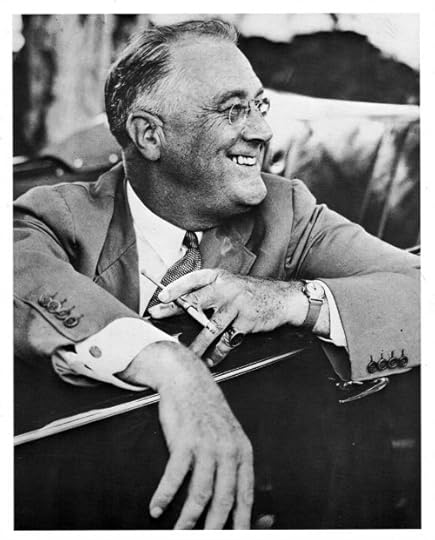
FDR
Franklin D. Roosevelt was certainly no wallflower. He played the elusive, flirtatious coquette with Churchill while trying to appease the thunderous clamour from the isolationist Republicans on the right. Roosevelt was worried about reelection, and certainly any whisper that he was intending to launch his country into another European War would have sent him home to Hyde Park. He was a charming man, but distant with family and friends, always friendly, but once he began to feel uncomfortable a veneer of coldness would appear. Churchill, on the other hand was like a puppy, once he decided he liked someone he was intensely loyal and would almost smother that person with affection. You might see how these conflicting personalities might...well...conflict. Regardless, they had a lot in common, and not to sound too dramatic the future of the world was at their feet.
We probably owe a debt of gratitude to the Japanese for attacking Pearl Harbor. Yesterday, December 7th, 1941 -- a date which will live in infamy -- the United States of America was suddenly and deliberately attacked by naval and air forces of the Empire of Japan. It is unclear when or if the United States of America would have entered the conflict. Churchill was determined not to sue for peace and it is highly likely that Hitler would have made the decision to invade England. We will never know what the US would have done under those circumstances. I would certainly like to think we would have done our best to save England, but fortunately, for the world, the decision was made for us.

Winston Churchill was credited with showing the first V sign for VICTORY
The relationships between the Roosevelts and the Churchills was at times strained. The pressure of the war was weighing heavily on everyone, but you can imagine the frustrations that were launched at those closest to the men bearing the most pressure for success. ”Despite the psychological wear and tear of the years, in times of stress the bond of marriage tended to reassert itself for both the Churchills and the Roosevelts. Churchill could be demanding, Clementine difficult, Franklin deceptive, and Eleanor wearying, but what Mary Soames once called ‘the golden thread of love’ bound each couple together.” Clementine really had her hands full with Winston. She was constantly trying to keep the mind, body, and spirit of her dynamic husband from falling to pieces. Churchill was a heavy drinker, but yet never seemed to show the signs of intoxication. ”There can be little question, however, that the cumulative effect of years of drinking was at least one factor among many in Churchill’s personality. Alcohol raised his sense of drama, removed inhibitions, and invested the ordinary with a dimension of the extraordinary. His highs seemed higher, his lows lower.”
The relationship between Franklin and Eleanor is particularly interesting. They were cousins, she did not even have to change her name when they married. He was handsome. She was particularly unhandsome in a Roosevelt family full of beautiful people. Despite lacking social grace and elegance Eleanor turned out to be the perfect wife for a man who wanted to be a successful politician. She was smart, insightful, and brutally honest. She was everything an ambitious man could want in a wife, but those good qualities also proved to be the qualities that Franklin found most unsatisfactory when he wanted to relax. Churchill never turned off, but Franklin at the end of the day wanted to put the cares of the day away and work on his stamp collection or enjoy a cocktail. Eleanor wrote for numerous magazines, not that Franklin didn’t trust her, but he did have a real fear that she would unintentionally reveal something in her writing that would turn out to be detrimental to the nation. Because of that fear he never felt like he could totally unwind around Eleanor.

Lucy Mercer and we get a glimpse of what FDR found so attractive about her.
But Lucy Mercer was a different story. She didn’t have those qualities that made Eleanor the perfect political wife, but she did have all the qualities that Eleanor was lacking. ”Eleanor had hired the twenty-two-year-old Lucy Mercer as a social secretary in the winter of 1913-1914. A charming woman with a voice, Joseph Lash remarked, ‘like dark velvet’,” Lucy became part of the Roosevelt household. ‘She knew how to please a man, ‘ wrote Lash, ‘to make his life easy and agreeable, to bolster instead of challenge him.’ Roosevelt fell in love with her.” When Eleanor discovered the affair Lucy was sacked. Lucy then married Winthrop Rutherfurd, but for the rest of Franklin’s life they stayed in touch. She was with him when he died at Warm Springs. She left immediately to avoid a scandal, but another woman in the household told Eleanor as soon as she arrived. Eleanor had to deal with two blows, the death of her husband and discovering his continued deception.
Franklin also had an ongoing intellectual relationship, no indication of a physical relationship, with Margaret “Daisy” Suckley a Hyde Park neighbor and a sixth cousin. She was someone he could confide in about events with much more comfort than he could with Eleanor. She was solicitous and brimming with confidence in his greatness. She was more of a mother figure than a girlfriend. She kept a diary and notes about her conversations with Franklin that later proved to be a treasure trove for the biographer Geoffrey Ward.
I never have heard of any sexual scandal associated with Winston Churchill. He’s seems to have been done looking for love when he met Clemmie. He was eccentric in his behavior and sometimes his mode of dress, but when it came to love he was like the most faithful of the animal kingdom gibbons, swans, black vultures, wolves, albatrosses, turtle doves or bald eagles. He was mated for life.

The BIG Three: Stalin, FDR, and Churchill.
Winston and Franklin were close, but their relationship was sorely tested when they added the last member of the big three, Joseph Stalin. Stalin was suspicious of England; and therefore, wary of Churchill, especially his oratory gifts. Stalin was a man of few words and the more Winston talked the less he listened. Roosevelt in a bit of statecraft realized that if he was going to negotiate with Stalin he needed to do it without Churchill. He had secret meetings which of course could not stay secret. Churchill was understandably hurt at being excluded. He felt that he had earned the right to be a part of any negotiations. He was the man standing up to Hitler when the other two were still playing footsy with the Germans under the table. There was in particular a painful scene, described my Meacham, where Stalin begins to pick at Churchill in bullying school boy manner and Roosevelt joins in both laughing maliciously at the expense of Winston. It may have been simply part of the plan to ingratiate himself with Stalin, but it left my stomach queasy and it was a moment that would continue to chafe Churchill clear up to the death of Roosevelt.
Meacham is a very engaging writer. I read his book about Andrew Jackson called American Lion: Andrew Jackson in the White Houseand was impressed, in both books, by his ability to flesh out these monolithic figures from our past. Highly recommended to those who love history.
If you wish to see more of my most recent book and movie reviews, visit http://www.jeffreykeeten.com
I also have a Facebook blogger page at:https://www.facebook.com/JeffreyKeeten
It is hard not to admire these two men. They were great orators in a time when the world needed words of encouragement. They were fiercely patriotic and were able to convey that passion to nations that were being asked to sacrifice everything. It is hard to imagine anyone else having the ability to convince a nation to the hold the line, when their allies have capitulated and their capital is being bombed into dust, than Winston S. Churchill. As he was trying to hold his nation together he was looking across the water towards the Americans, hoping the nation of Immigrants would lend their resources and their optimism once again to save Europe.
FDR
Franklin D. Roosevelt was certainly no wallflower. He played the elusive, flirtatious coquette with Churchill while trying to appease the thunderous clamour from the isolationist Republicans on the right. Roosevelt was worried about reelection, and certainly any whisper that he was intending to launch his country into another European War would have sent him home to Hyde Park. He was a charming man, but distant with family and friends, always friendly, but once he began to feel uncomfortable a veneer of coldness would appear. Churchill, on the other hand was like a puppy, once he decided he liked someone he was intensely loyal and would almost smother that person with affection. You might see how these conflicting personalities might...well...conflict. Regardless, they had a lot in common, and not to sound too dramatic the future of the world was at their feet.
They loved tobacco, strong drink, history, the sea, battleships, hymns, pageantry, patriotic poetry, high office, and hearing themselves talk. ‘Being with them was like sitting between two lions roaring at the same time,’ said Mary Soames.”
We probably owe a debt of gratitude to the Japanese for attacking Pearl Harbor. Yesterday, December 7th, 1941 -- a date which will live in infamy -- the United States of America was suddenly and deliberately attacked by naval and air forces of the Empire of Japan. It is unclear when or if the United States of America would have entered the conflict. Churchill was determined not to sue for peace and it is highly likely that Hitler would have made the decision to invade England. We will never know what the US would have done under those circumstances. I would certainly like to think we would have done our best to save England, but fortunately, for the world, the decision was made for us.
Winston Churchill was credited with showing the first V sign for VICTORY
The relationships between the Roosevelts and the Churchills was at times strained. The pressure of the war was weighing heavily on everyone, but you can imagine the frustrations that were launched at those closest to the men bearing the most pressure for success. ”Despite the psychological wear and tear of the years, in times of stress the bond of marriage tended to reassert itself for both the Churchills and the Roosevelts. Churchill could be demanding, Clementine difficult, Franklin deceptive, and Eleanor wearying, but what Mary Soames once called ‘the golden thread of love’ bound each couple together.” Clementine really had her hands full with Winston. She was constantly trying to keep the mind, body, and spirit of her dynamic husband from falling to pieces. Churchill was a heavy drinker, but yet never seemed to show the signs of intoxication. ”There can be little question, however, that the cumulative effect of years of drinking was at least one factor among many in Churchill’s personality. Alcohol raised his sense of drama, removed inhibitions, and invested the ordinary with a dimension of the extraordinary. His highs seemed higher, his lows lower.”
The relationship between Franklin and Eleanor is particularly interesting. They were cousins, she did not even have to change her name when they married. He was handsome. She was particularly unhandsome in a Roosevelt family full of beautiful people. Despite lacking social grace and elegance Eleanor turned out to be the perfect wife for a man who wanted to be a successful politician. She was smart, insightful, and brutally honest. She was everything an ambitious man could want in a wife, but those good qualities also proved to be the qualities that Franklin found most unsatisfactory when he wanted to relax. Churchill never turned off, but Franklin at the end of the day wanted to put the cares of the day away and work on his stamp collection or enjoy a cocktail. Eleanor wrote for numerous magazines, not that Franklin didn’t trust her, but he did have a real fear that she would unintentionally reveal something in her writing that would turn out to be detrimental to the nation. Because of that fear he never felt like he could totally unwind around Eleanor.
Lucy Mercer and we get a glimpse of what FDR found so attractive about her.
But Lucy Mercer was a different story. She didn’t have those qualities that made Eleanor the perfect political wife, but she did have all the qualities that Eleanor was lacking. ”Eleanor had hired the twenty-two-year-old Lucy Mercer as a social secretary in the winter of 1913-1914. A charming woman with a voice, Joseph Lash remarked, ‘like dark velvet’,” Lucy became part of the Roosevelt household. ‘She knew how to please a man, ‘ wrote Lash, ‘to make his life easy and agreeable, to bolster instead of challenge him.’ Roosevelt fell in love with her.” When Eleanor discovered the affair Lucy was sacked. Lucy then married Winthrop Rutherfurd, but for the rest of Franklin’s life they stayed in touch. She was with him when he died at Warm Springs. She left immediately to avoid a scandal, but another woman in the household told Eleanor as soon as she arrived. Eleanor had to deal with two blows, the death of her husband and discovering his continued deception.
Franklin also had an ongoing intellectual relationship, no indication of a physical relationship, with Margaret “Daisy” Suckley a Hyde Park neighbor and a sixth cousin. She was someone he could confide in about events with much more comfort than he could with Eleanor. She was solicitous and brimming with confidence in his greatness. She was more of a mother figure than a girlfriend. She kept a diary and notes about her conversations with Franklin that later proved to be a treasure trove for the biographer Geoffrey Ward.
I never have heard of any sexual scandal associated with Winston Churchill. He’s seems to have been done looking for love when he met Clemmie. He was eccentric in his behavior and sometimes his mode of dress, but when it came to love he was like the most faithful of the animal kingdom gibbons, swans, black vultures, wolves, albatrosses, turtle doves or bald eagles. He was mated for life.
The BIG Three: Stalin, FDR, and Churchill.
Winston and Franklin were close, but their relationship was sorely tested when they added the last member of the big three, Joseph Stalin. Stalin was suspicious of England; and therefore, wary of Churchill, especially his oratory gifts. Stalin was a man of few words and the more Winston talked the less he listened. Roosevelt in a bit of statecraft realized that if he was going to negotiate with Stalin he needed to do it without Churchill. He had secret meetings which of course could not stay secret. Churchill was understandably hurt at being excluded. He felt that he had earned the right to be a part of any negotiations. He was the man standing up to Hitler when the other two were still playing footsy with the Germans under the table. There was in particular a painful scene, described my Meacham, where Stalin begins to pick at Churchill in bullying school boy manner and Roosevelt joins in both laughing maliciously at the expense of Winston. It may have been simply part of the plan to ingratiate himself with Stalin, but it left my stomach queasy and it was a moment that would continue to chafe Churchill clear up to the death of Roosevelt.
Meacham is a very engaging writer. I read his book about Andrew Jackson called American Lion: Andrew Jackson in the White Houseand was impressed, in both books, by his ability to flesh out these monolithic figures from our past. Highly recommended to those who love history.
If you wish to see more of my most recent book and movie reviews, visit http://www.jeffreykeeten.com
I also have a Facebook blogger page at:https://www.facebook.com/JeffreyKeeten

May 13, 2020
This is not necessarily a history of WWII.....instead it is a study of the relationship between the two men whose efforts and friendship sealed the fate of Nazi Germany and Japan. Both men had great tragedies in their lives which would have stopped most; the fiasco of Gallipoli which put Churchill in the political wilderness for years; and polio, which struck Roosevelt at the age of 39 and put him in a wheelchair for the rest of his life. But they soldiered on and were the right men at the right time in history.
It is easy to be cynical about this friendship which many historians feel may be rather exaggerated. They were as different as night and day...Roosevelt was haughty, rather cold, and often went back on his word; Churchill was glib, garrulous, emotional and drank a bit too much. But somehow. although they disagreed violently on many occasions,(especially on the involvement of Stalin), they developed a relationship that defies logic and through all the ups and downs, remained friends and working partners until Roosevelt's death.
Roosevelt was with Churchill at the White House when they learned of the horrendous surrender at Tobruk and his six words to Churchill had an impression that was still talked about years later....."What can we do to help?". Britain had been standing alone and the help that the still neutral USA offered by "loaning" Sherman tanks to the British African troops saved the day.
Beautifully written, this biography of two of the most influential men in history, is revealing and the reader will learn at bit more about these leaders than they may have known previously. They certainly weren't personally perfect but they were perfect leaders for this dark period in world history. Highly recommended.
It is easy to be cynical about this friendship which many historians feel may be rather exaggerated. They were as different as night and day...Roosevelt was haughty, rather cold, and often went back on his word; Churchill was glib, garrulous, emotional and drank a bit too much. But somehow. although they disagreed violently on many occasions,(especially on the involvement of Stalin), they developed a relationship that defies logic and through all the ups and downs, remained friends and working partners until Roosevelt's death.
Roosevelt was with Churchill at the White House when they learned of the horrendous surrender at Tobruk and his six words to Churchill had an impression that was still talked about years later....."What can we do to help?". Britain had been standing alone and the help that the still neutral USA offered by "loaning" Sherman tanks to the British African troops saved the day.
Beautifully written, this biography of two of the most influential men in history, is revealing and the reader will learn at bit more about these leaders than they may have known previously. They certainly weren't personally perfect but they were perfect leaders for this dark period in world history. Highly recommended.

February 8, 2018
Fully deserving it's 4 stars! What a charming book, describing the friendship (some would say the bromance) between Churchill and Roosevelt. It's a tale of two friends, starting with Churchill's courtship to get the United States into war, where Roosevelt reluctantly tries to get the isolationists of his back. After Pearl Harbour the romance starts, but suddenly a new friend gets onto the stage in the person of Stalin, desperately trying to drive a wedge between the two friends. In the end one friend stays behind, reminiscing of the good old times. The writing style of the author is fantastic and never becomes boring.

June 19, 2023
Truth, Lies and Politics
Franklin and Winston: An Intimate Portrait of an Epic Friendship by Jon Meacham examines a unique and intimate relationship between a US president and a prime minster of the UK. Franklin D Roosevelt and Winston S Churchill spent 113 days together during the Second World War, meeting over the globe and often in private. The relationship became essential for both, as they discussed grand strategy, politics and the burden of leadership to more private matters, such as health and their families. When they were not together they exchanged over two thousand messages, which kept the intimacy going. They were two of the greatest men of the 21st century and this crucial and fascinating relationship was one of the major driving forces behind the allies road to victory.
However, as Meacham explains there are many who believe this relationship was completely overblown by WSC. Meacham isn’t convinced and the book for me shows the two leaders did get on as much as those in their position could, but ultimately politics always came first. Both were born in the nineteenth century into two of the grandest families their respective countries could offer. FDR, a Roosevelt, who’s 5th cousin Teddy had already achieved the highest office of his country in 1901 and WSC, a grandson of the Duke of Marlborough, and son of one of the most famous and up and coming politicians of his age, Lord Randolph Churchill. Both were students of history and had high hopes to climb to the top of the greasy pole. Many contemporaries did not like them, labelling them as arrogant, perhaps correctly, however they dragged their respective countries through some of the most difficult challenges they would ever face, where almost no one else could.
What became apparent for me in Franklin and Winston: An Intimate Portrait of an Epic Friendship is that this was a one sided relationship. The two were fond of each other, but were working from from different power perspectives and it is clear that WSC was the junior partner. He was not confident about the relationship and this is where FDR wanted him. FDR was always a man who kept his cards close to his chest, most likely a power play, he did this with everyone including his wife Eleanor and Churchill was certainly going to be no exception. Churchill needed FDR and the USA more than they needed him. It was in fact a miracle that Hitler declared war on the USA in 1941, as there was absolutely no tactical advantage whatsoever in doing so. Without this, it would have been politically very difficult for FDR to bring the states in. Furthermore, as the final third of the Triumvirate, Josef Stalin joined the picture, WSC was slowly moved aside. He was in the weaker position of the three, with the British Empire all but spent and the country completely exhausted, the age of the super powers was about to begin. Roosevelt knew this and practically dropped Churchill to woo Stalin.
So alas, was this relationship really that important? Was it essential to bring about allied victory? For me, it was important as for two people in their positions to get on in such circumstances is paramount. However, if they didn’t, the job would have gotten done either way, as there were so many other people involved at the top. Events and circumstance would have carried away in any such case. Germany and Japan were the enemies that needed to be defeated and the will to do this would have overcome any personalities. FDR was a political master and held onto WSC when he needed and then dropped him for Stalin. Although in the end for what? The man would compromise on nothing and The Cold War set in after hostilities ended. Churchill on the other hand had to make it work as the USA was the only hope for Britain standing alone against the Third Reich and within this it just so happened they did get on with each other. An interesting study into their relationship but I would recommend a full biography of each first.
Franklin and Winston: An Intimate Portrait of an Epic Friendship by Jon Meacham examines a unique and intimate relationship between a US president and a prime minster of the UK. Franklin D Roosevelt and Winston S Churchill spent 113 days together during the Second World War, meeting over the globe and often in private. The relationship became essential for both, as they discussed grand strategy, politics and the burden of leadership to more private matters, such as health and their families. When they were not together they exchanged over two thousand messages, which kept the intimacy going. They were two of the greatest men of the 21st century and this crucial and fascinating relationship was one of the major driving forces behind the allies road to victory.
However, as Meacham explains there are many who believe this relationship was completely overblown by WSC. Meacham isn’t convinced and the book for me shows the two leaders did get on as much as those in their position could, but ultimately politics always came first. Both were born in the nineteenth century into two of the grandest families their respective countries could offer. FDR, a Roosevelt, who’s 5th cousin Teddy had already achieved the highest office of his country in 1901 and WSC, a grandson of the Duke of Marlborough, and son of one of the most famous and up and coming politicians of his age, Lord Randolph Churchill. Both were students of history and had high hopes to climb to the top of the greasy pole. Many contemporaries did not like them, labelling them as arrogant, perhaps correctly, however they dragged their respective countries through some of the most difficult challenges they would ever face, where almost no one else could.
What became apparent for me in Franklin and Winston: An Intimate Portrait of an Epic Friendship is that this was a one sided relationship. The two were fond of each other, but were working from from different power perspectives and it is clear that WSC was the junior partner. He was not confident about the relationship and this is where FDR wanted him. FDR was always a man who kept his cards close to his chest, most likely a power play, he did this with everyone including his wife Eleanor and Churchill was certainly going to be no exception. Churchill needed FDR and the USA more than they needed him. It was in fact a miracle that Hitler declared war on the USA in 1941, as there was absolutely no tactical advantage whatsoever in doing so. Without this, it would have been politically very difficult for FDR to bring the states in. Furthermore, as the final third of the Triumvirate, Josef Stalin joined the picture, WSC was slowly moved aside. He was in the weaker position of the three, with the British Empire all but spent and the country completely exhausted, the age of the super powers was about to begin. Roosevelt knew this and practically dropped Churchill to woo Stalin.
So alas, was this relationship really that important? Was it essential to bring about allied victory? For me, it was important as for two people in their positions to get on in such circumstances is paramount. However, if they didn’t, the job would have gotten done either way, as there were so many other people involved at the top. Events and circumstance would have carried away in any such case. Germany and Japan were the enemies that needed to be defeated and the will to do this would have overcome any personalities. FDR was a political master and held onto WSC when he needed and then dropped him for Stalin. Although in the end for what? The man would compromise on nothing and The Cold War set in after hostilities ended. Churchill on the other hand had to make it work as the USA was the only hope for Britain standing alone against the Third Reich and within this it just so happened they did get on with each other. An interesting study into their relationship but I would recommend a full biography of each first.
August 15, 2026
I want to start off by saying, I’m a huge Meacham fan. This is one of Jon Meacham’s earlier books, and I’ll admit it took me a while to really get into it. I read the hardcover while also listening to the Libby audiobook, and once the relationship between Franklin Roosevelt and Winston Churchill began to take center stage, the book really came alive for me.
Franklin and Winston is something of a dual biography, but it is neither a detailed nor definitive biography of either man. Instead, Meacham focuses on their relationship—how it began, how it deepened, and how the balance of power between them changed during World War II.
That evolution was the most fascinating part of the book for me.
Early on, Churchill is very much the senior partner. Britain has already been at war, Churchill is the great wartime leader, and Roosevelt is still carefully maneuvering an isolationist United States toward greater involvement. But once America enters the war and begins flexing its enormous industrial and manufacturing muscle, the relationship gradually changes. Roosevelt increasingly becomes the senior partner.
Then Stalin enters the picture in a much bigger way, and the dynamic changes again. Churchill, who had once been at the center of Roosevelt’s wartime diplomacy, increasingly finds himself feeling like the third man in the relationship. Watching those shifting alliances and personalities unfold was fascinating.
This is not primarily a military history of World War II. The battles and campaigns provide the backdrop, but Meacham is much more interested in the people involved—their friendships, rivalries, egos, insecurities, private conversations, family relationships, and political calculations.
And there are a lot of wonderful stories along the way. Roosevelt and Churchill were both enormous personalities, and their friendship could be warm, funny, frustrating, competitive, and politically complicated—sometimes all at once.
What I appreciated most was seeing these famous historical figures as human beings rather than simply names attached to speeches, conferences, and wartime decisions. Their friendship was genuine, but it was also shaped by national interests and by the changing realities of power.
It took me a little time to settle into Meacham’s approach, but by the end I was glad I stayed with it. This isn’t the book I would choose if I wanted a definitive biography of Roosevelt, Churchill, or the Second World War. But as a study of one of the most consequential political friendships of the twentieth century, it is thoughtful, revealing, and often fascinating. Book was acquired at Palatine Library Sale. 1st edition $3.00. Audio- Northern Illinois Library Consortium
4 stars.
Franklin and Winston is something of a dual biography, but it is neither a detailed nor definitive biography of either man. Instead, Meacham focuses on their relationship—how it began, how it deepened, and how the balance of power between them changed during World War II.
That evolution was the most fascinating part of the book for me.
Early on, Churchill is very much the senior partner. Britain has already been at war, Churchill is the great wartime leader, and Roosevelt is still carefully maneuvering an isolationist United States toward greater involvement. But once America enters the war and begins flexing its enormous industrial and manufacturing muscle, the relationship gradually changes. Roosevelt increasingly becomes the senior partner.
Then Stalin enters the picture in a much bigger way, and the dynamic changes again. Churchill, who had once been at the center of Roosevelt’s wartime diplomacy, increasingly finds himself feeling like the third man in the relationship. Watching those shifting alliances and personalities unfold was fascinating.
This is not primarily a military history of World War II. The battles and campaigns provide the backdrop, but Meacham is much more interested in the people involved—their friendships, rivalries, egos, insecurities, private conversations, family relationships, and political calculations.
And there are a lot of wonderful stories along the way. Roosevelt and Churchill were both enormous personalities, and their friendship could be warm, funny, frustrating, competitive, and politically complicated—sometimes all at once.
What I appreciated most was seeing these famous historical figures as human beings rather than simply names attached to speeches, conferences, and wartime decisions. Their friendship was genuine, but it was also shaped by national interests and by the changing realities of power.
It took me a little time to settle into Meacham’s approach, but by the end I was glad I stayed with it. This isn’t the book I would choose if I wanted a definitive biography of Roosevelt, Churchill, or the Second World War. But as a study of one of the most consequential political friendships of the twentieth century, it is thoughtful, revealing, and often fascinating. Book was acquired at Palatine Library Sale. 1st edition $3.00. Audio- Northern Illinois Library Consortium
4 stars.

March 6, 2023
so far, I am familiar with most of what's in this book, except about Churchill's wife Clementine. They were quite the mismatch.
Amazing that a young Eleanor, with no confidence from her background, became a powerful historical figure.
The isolationism of that time was overwhelming, which made FDR cautious in his approach. After the War, Americans were too eager to jump in. Iraq comes to mind.
I had forgotten about this. Joseph Kennedy, ambassador to England, constantly called for FDR to "make peace." What this meant for Kennedy, an anti-semite and Nazi sympathizer, was to form a kind of fascist style gov't in the U.S. We can see that such elements exist in the U.S. now.
Many years ago, I helped found a speaker's forum in Silicon Valley called The Churchill Club. To the astonishment of us all, it lasted for 35 years. I wrote regular pieces for the club publication, The Orator. It was great fun. More recently, there was the film "The Darkest Hour" for which Gary Oldman won an Oscar in the lead role. I'd recommend it if you have interest in Churchill, acknowledging his extensive flaws, of course.
We just don't see this kind of leadership any more. Instead, it's too many trying to tear things down. Trump is more of a fascist with his pathetic cult of personality. He admires Putin and would likely admire Hitler if he lived in that era.
The three principals in the fight against Hitler all had fragile health. FDR would die in office at age 63. FDR's main emissary, Harry Hopkins, was in poor health and Churchill also in his 60's when he had an attack of angina pectoris due to blocked arteries. And, later, by a series of strokes.
Amazing that a young Eleanor, with no confidence from her background, became a powerful historical figure.
The isolationism of that time was overwhelming, which made FDR cautious in his approach. After the War, Americans were too eager to jump in. Iraq comes to mind.
I had forgotten about this. Joseph Kennedy, ambassador to England, constantly called for FDR to "make peace." What this meant for Kennedy, an anti-semite and Nazi sympathizer, was to form a kind of fascist style gov't in the U.S. We can see that such elements exist in the U.S. now.
Many years ago, I helped found a speaker's forum in Silicon Valley called The Churchill Club. To the astonishment of us all, it lasted for 35 years. I wrote regular pieces for the club publication, The Orator. It was great fun. More recently, there was the film "The Darkest Hour" for which Gary Oldman won an Oscar in the lead role. I'd recommend it if you have interest in Churchill, acknowledging his extensive flaws, of course.
We just don't see this kind of leadership any more. Instead, it's too many trying to tear things down. Trump is more of a fascist with his pathetic cult of personality. He admires Putin and would likely admire Hitler if he lived in that era.
The three principals in the fight against Hitler all had fragile health. FDR would die in office at age 63. FDR's main emissary, Harry Hopkins, was in poor health and Churchill also in his 60's when he had an attack of angina pectoris due to blocked arteries. And, later, by a series of strokes.

August 28, 2013
An utterly charming portrayal of the friendship (and disagreements) between the two men who (with Stalin) led the fight against Hitler. There is lots of inside information, reactions from people who knew them, as well as their own notes and communications. And of course there is an overview of the history.
Bottom line ... We are lucky to have had such leaders during a very fragile time for democracy.
Bottom line ... We are lucky to have had such leaders during a very fragile time for democracy.

January 19, 2016
While this book is written with the larger issues of World War II as the backdrop, it really does focus on the friendship between FDR and Churchill. While the friendship isn't presented as all roses, the author does feel that it was an actual friendship. Maybe a tad more honest on the side of Churchill that on the side of FDR, but a friendship none the less. The author doesn't pull punches and shows the best and the worst of both individuals, in a way that is rarely written about in the greater overall histories of the war.
The war and many of the individuals that normally fill the pages seems to barely make a showing on the stage of this book, since for all its epic scope and massive amount of devastation it isn't the focus of the book. The people that ran the war, managed the battles or led the troops, only appear in relation to how they affected the relationship between these two world leaders and more often in showing and commenting on the relationship from their own view. While the war isn't a primary focus the relationship between these two men had a great deal to do with the way it was conducted and their views and how they tried to convince one or the other on which route to take to victory are an important aspect of this book.
This book is well worth the reading to gain further insight into the minds and personalities of two leaders that seemed destined for greatness in a time of the worst peril their nations had ever seen.
Well worth the read.
The war and many of the individuals that normally fill the pages seems to barely make a showing on the stage of this book, since for all its epic scope and massive amount of devastation it isn't the focus of the book. The people that ran the war, managed the battles or led the troops, only appear in relation to how they affected the relationship between these two world leaders and more often in showing and commenting on the relationship from their own view. While the war isn't a primary focus the relationship between these two men had a great deal to do with the way it was conducted and their views and how they tried to convince one or the other on which route to take to victory are an important aspect of this book.
This book is well worth the reading to gain further insight into the minds and personalities of two leaders that seemed destined for greatness in a time of the worst peril their nations had ever seen.
Well worth the read.

July 4, 2020
A personality comparison between Roosevelt and Churchill attempts to show the ways in which these men were similar and in which ways they were not.
On the surface they would seemingly be incompatible but their very differences appears to be the characteristics that allowed for their camaraderie.
If you have read anything about Roosevelt &/or Churchill before there is not much new here but reading it in July 2020 is another matter entirely. It is a stark and shocking reminder of what was and what is.
In the midst of a world war (WWII) these men had the mettle to lead their countries through the worst events of world history and still leave mankind with enduring words of wisdom as true today as they were in the 1940’s.
Churchill: “There is no worse mistake in public leadership than to hold out false hopes soon to be swept away.”
FDR: “The news is going to get worse and worse before it begins to get better. The American people must be prepared for it and they must get it straight from the shoulder.”
On the surface they would seemingly be incompatible but their very differences appears to be the characteristics that allowed for their camaraderie.
If you have read anything about Roosevelt &/or Churchill before there is not much new here but reading it in July 2020 is another matter entirely. It is a stark and shocking reminder of what was and what is.
In the midst of a world war (WWII) these men had the mettle to lead their countries through the worst events of world history and still leave mankind with enduring words of wisdom as true today as they were in the 1940’s.
Churchill: “There is no worse mistake in public leadership than to hold out false hopes soon to be swept away.”
FDR: “The news is going to get worse and worse before it begins to get better. The American people must be prepared for it and they must get it straight from the shoulder.”

December 28, 2009
Continuing my attack on recent (well, this one is 2003) books covering the events and personalities of World War II, this very entertaining book by Jon Meacham (the editor of Newsweek, whom you have no doubt seen on Charlie Rose's PBS television show) adds itself to the list of those with new and interesting information because of recently declassified (or recently disclosed personal) documents. The (obvious) angle with this book is the intense personal relationship that developed between these two leaders, despite their personal shortcomings. While it's not intended to be a World War II history, it's great as an introduction or overview from the standpoint of politics. For example, there are but three mentions of the Manhattan Project, which probably reflects the actual level of attention that (relatively speaking, of course), each of the two men gave to it. This is a very engaging work, reflecting the wonderful writing style of the author (almost like he's speaking, which is what you would expect given his day job). Because of the new material from the various libraries and diaries, this one should be on the reading list of anyone concerned with anything other than the detailed military history of World War II.

February 25, 2017
I was fascinated by the degree to which the ups and downs in a relationship between two unusual people have impacted the world they left to their heirs. As rendered by the author, neither FDR nor Churchill is flawless, or even easy to get along with, but they are both compelling in their own way.

February 13, 2014
Excellent book!! Loved reading about the friendship between Franklin and Winston. Would definitely recommend this one!!

December 6, 2024
I don't read much history, but I enjoyed this book. This reads more like a weird historical romance, as the author dives deep into the details of FDR and Churchill's relationship.
I would recommend this to anyone who knows about WWII but wants to learn more about FDR and Churchill.
I would recommend this to anyone who knows about WWII but wants to learn more about FDR and Churchill.

June 21, 2017
Jon Meacham writes a more or less dual biography of Franklin Roosevelt and Winston Churchill during WWII. Aside from the opening chapter which (very) briefly charts each man's rise to prominence, and also notes their first meeting in 1918 (one that FDR remembered but Churchill forgot, much to his chagrin once FDR was President). Meacham makes full use of the great treasure trove of materials available on both men to sketch lively portraits of each, and to show the twists and turns that their relationship took as it evolved.
Churchill wrote, literally, volumes of books about his experiences during both WWI and WWII. Roosevelt never wrote a book. This partly because Churchill outlived FDR by twenty years. But also partly because Churchill was, in addition to a highly successful politician, many things, and being an astute writer was one of them. Thus, one might think that, in a book about each man, the reader would hear much more of the Churchill version of the story. Not so. Meacham mines contemporary letters, memos, memoirs from other big players, and some personal interviews to create a balanced picture of each man, neither fawning nor overly critical to either. While Meacham makes good use of Churchill's writing, he does not do so at FDR's expense. Fortunately, FDR wrote so many letters that a biographer has no shortage of material to work with. And, adding in his wife Eleanor and her correspondence, FDR is not slighted at all in this book.
FDR was an incredibly complex - and devious - man. Churchill painfully found this out during their time in power, and Meacham takes us through the snubs that he had to endure. We also see FDR making an effort to see Churchill's position and understand how to deal with him. In many respects, their relationship was based on the military and economic positions that the United States and Great Britain occupied. Prior to Pearl Harbor, Churchill was desperate for American involvement as it was basically Britain against Germany and Italy. He knew that they could not hold out forever, thus he kept trying to convince FDR to lead America into the fray. While he did meet with some success (Lend-Lease) he had to wait until Pearl Harbor for U.S. involvement. Once the U.S. did enter the war, Britain was still the stronger of the two militarily (bigger Navy, experienced fighting men, better Air Force). Thus FDR paid much more attention to Churchill's suggestions than he did later on when the U.S. became the dominant Ally and Britain was forced to rely on the U.S. for machinery and to pick up the slack in the ground forces. As the war turned in favor of the Allies, FDR was less and less inclined to heed ground to Churchill.
Their personal relations ran hot and cold, more so because of Roosevelt's deviousness and attempts to form a close bond with Stalin, who he foresaw as being the main post-war concern due to Russia's size and opposing ideology. FDR was, at times, cruel towards Churchill, ganging up on him with Stalin at Teheran and Yalta. He also tried to schedule a meeting with only Stalin, without informing Churchill of the attempt. At times he would be elusive and not respond to some of Churchill's cables. For his part, Churchill tried to mask over this following FDR's death, painting a picture of relationship that was closer in remembrances than it was at the time. Churchill also could be difficult and would pout when he wouldn't get his way, which irritated Roosevelt.
Meacham could have dug more deeply into certain areas, such as the turbulent tenure of Joseph Kennedy as U.S. Ambassador to Great Britain. Kennedy caused some major issues with appeasement talk and anti-Semitic rhetoric, but Meacham does not really mention any of this or how it may have impact the early war relationship between FDR and Churchill. Also, he talked about how dangerous it would be for Churchill to cross the Atlantic to visit Washington D.C. following Pearl Harbor. But then, suddenly, Churchill has arrived and nothing was said about his crossing. This is a really good book, very fair, and highly entertaining to read. Recommended for anyone interested in WWII, FDR, Churchill, or wartime diplomacy.
Grade: A
Churchill wrote, literally, volumes of books about his experiences during both WWI and WWII. Roosevelt never wrote a book. This partly because Churchill outlived FDR by twenty years. But also partly because Churchill was, in addition to a highly successful politician, many things, and being an astute writer was one of them. Thus, one might think that, in a book about each man, the reader would hear much more of the Churchill version of the story. Not so. Meacham mines contemporary letters, memos, memoirs from other big players, and some personal interviews to create a balanced picture of each man, neither fawning nor overly critical to either. While Meacham makes good use of Churchill's writing, he does not do so at FDR's expense. Fortunately, FDR wrote so many letters that a biographer has no shortage of material to work with. And, adding in his wife Eleanor and her correspondence, FDR is not slighted at all in this book.
FDR was an incredibly complex - and devious - man. Churchill painfully found this out during their time in power, and Meacham takes us through the snubs that he had to endure. We also see FDR making an effort to see Churchill's position and understand how to deal with him. In many respects, their relationship was based on the military and economic positions that the United States and Great Britain occupied. Prior to Pearl Harbor, Churchill was desperate for American involvement as it was basically Britain against Germany and Italy. He knew that they could not hold out forever, thus he kept trying to convince FDR to lead America into the fray. While he did meet with some success (Lend-Lease) he had to wait until Pearl Harbor for U.S. involvement. Once the U.S. did enter the war, Britain was still the stronger of the two militarily (bigger Navy, experienced fighting men, better Air Force). Thus FDR paid much more attention to Churchill's suggestions than he did later on when the U.S. became the dominant Ally and Britain was forced to rely on the U.S. for machinery and to pick up the slack in the ground forces. As the war turned in favor of the Allies, FDR was less and less inclined to heed ground to Churchill.
Their personal relations ran hot and cold, more so because of Roosevelt's deviousness and attempts to form a close bond with Stalin, who he foresaw as being the main post-war concern due to Russia's size and opposing ideology. FDR was, at times, cruel towards Churchill, ganging up on him with Stalin at Teheran and Yalta. He also tried to schedule a meeting with only Stalin, without informing Churchill of the attempt. At times he would be elusive and not respond to some of Churchill's cables. For his part, Churchill tried to mask over this following FDR's death, painting a picture of relationship that was closer in remembrances than it was at the time. Churchill also could be difficult and would pout when he wouldn't get his way, which irritated Roosevelt.
Meacham could have dug more deeply into certain areas, such as the turbulent tenure of Joseph Kennedy as U.S. Ambassador to Great Britain. Kennedy caused some major issues with appeasement talk and anti-Semitic rhetoric, but Meacham does not really mention any of this or how it may have impact the early war relationship between FDR and Churchill. Also, he talked about how dangerous it would be for Churchill to cross the Atlantic to visit Washington D.C. following Pearl Harbor. But then, suddenly, Churchill has arrived and nothing was said about his crossing. This is a really good book, very fair, and highly entertaining to read. Recommended for anyone interested in WWII, FDR, Churchill, or wartime diplomacy.
Grade: A

January 10, 2014
Meacham does a fine job dissecting the personal and political friendship of perhaps the two most important figures in the 20th century. While neither man was perfect, each must be given his due for what he accomplished for his country as well as for the world in a time of mass upheaval and danger. Students of history should acknowledge that, as Churchill & England stood on the precipice of disaster and defeat at the hands of Hitler, America watched from the sidelines, content and happy in its isolation. It was only through FDR's progressive mind that support was finally granted to the brave, defiant Brits through such legislative measures as the Land Lease program. Before Pearl Harbor, Roosevelt gently pulled his countrymen toward the acknowledgement of the greater world and America's undeniable connection to its fate. FDR was a savvy politician who was wise enough to understand that despite his personal desire to support England's cause against Germany at the time, he could not risk running ahead of public opinion too greatly. To have done so would be to have given the isolationists more weight to their claim -- that America had no business spilling their sons' blood in "Europe's War". Meacham deftly handles the question of Churchill's impatience with America's reluctance to jump into the fray by making it clear that it was Churchill's personal respect and relationship with FDR that persevered beyond his personal impatience with America's refusal to act between 1939 through to the end of '41.
To be sure, Churchill comes through as the better man when Meacham delves into the personal aspects of both men's characters. FDR did not appear nearly as warm personally as Churchill did. Having prior read biographies and histories of both men, this fact did not surprise me. Despite this, the reader gets the sense that both men understood the importance of what they were setting out to achieve once they did come together. Whether you agree with their policies, credit is due and must be given to what was accomplished during their years in office. As with any politician, it would be easy to criticize either man for his faults and political shortcomings. And, with any politician of the past, it is unfairly easy for us to judge and say that more could have been accomplished than what was. Two failings that jump off the present day page when reading about their decisions were the reluctance to do more for the Jewish population during the horror known as the Holocaust as well as their willingness to given Stalin and the Soviet more weight in the world than was wise (particularly FDR). But, to judge too harshly would perhaps be unjust. We should remember that these men were working without the benefit of hindsight and were products of their time and generation. These failings should be noted to show that both men were far from perfect in their judgments and perceptions, but it would be more correct to value their vast commitment to the common good of mankind in the 20th century. Without their commitment and actions, one shudders to think where the world might be had there not been a Franklin Roosevelt or Winston Churchill.
To be sure, Churchill comes through as the better man when Meacham delves into the personal aspects of both men's characters. FDR did not appear nearly as warm personally as Churchill did. Having prior read biographies and histories of both men, this fact did not surprise me. Despite this, the reader gets the sense that both men understood the importance of what they were setting out to achieve once they did come together. Whether you agree with their policies, credit is due and must be given to what was accomplished during their years in office. As with any politician, it would be easy to criticize either man for his faults and political shortcomings. And, with any politician of the past, it is unfairly easy for us to judge and say that more could have been accomplished than what was. Two failings that jump off the present day page when reading about their decisions were the reluctance to do more for the Jewish population during the horror known as the Holocaust as well as their willingness to given Stalin and the Soviet more weight in the world than was wise (particularly FDR). But, to judge too harshly would perhaps be unjust. We should remember that these men were working without the benefit of hindsight and were products of their time and generation. These failings should be noted to show that both men were far from perfect in their judgments and perceptions, but it would be more correct to value their vast commitment to the common good of mankind in the 20th century. Without their commitment and actions, one shudders to think where the world might be had there not been a Franklin Roosevelt or Winston Churchill.

November 25, 2009
I know a lot of people liked this book, but I found it lacking in many areas. For one the narrative is repetitious to the point of tedium. Over and over again we are told, rather than shown, that these two men, Franklin and Churchill admire and respect each other but that every element of this partnership is tinged with self-interest, or in their case the interest of their respective nations.
The books starts by jumping around through time and the author seems to be taking clippings from various sources and throwing them together to support preconception after preconception. There was definitely a thesis to the work, and the author never strays from thesis to discovery. Maybe it's just that I've read and studied too much about these two men previously to find anything new in this volume, but there isn't any new revelations or original arguments.
I just want the time back.
The books starts by jumping around through time and the author seems to be taking clippings from various sources and throwing them together to support preconception after preconception. There was definitely a thesis to the work, and the author never strays from thesis to discovery. Maybe it's just that I've read and studied too much about these two men previously to find anything new in this volume, but there isn't any new revelations or original arguments.
I just want the time back.

September 24, 2014
This book is an intimate description of a facinating relationship between Franklin Roosevelt and Winston Churchill and their personal and political relationship prior to and during World War II. It is intimate because nuch of the new material comes from diaries, correspondence and material unavailable previously. The book is almost a day to day account of their experiences during the war. It exposes both the best and worst qualities of each man including cigars, alcohol and some intimate friendships. This is far and away the best insight to the leadership of the Allies of World War II that I have read and often is so powerful that for us that view this as the only fully justified war of our time, that I often had to catch my breath to reflect on the humor or the tragedy or the possible consequences of their decisions. An excellent biography.

July 24, 2020
A Finely Sculpted Book
Well researched & documented It is based on complex archival research in both the USA and the UK, including texts of original interviews, and oral histories.
This book casts fresh light on an old friendship and its impact on society.
Not beach reading but perfect for history buffs.
Well researched & documented It is based on complex archival research in both the USA and the UK, including texts of original interviews, and oral histories.
This book casts fresh light on an old friendship and its impact on society.
Not beach reading but perfect for history buffs.

October 26, 2012
A well written book with a good focus on these 2 colossal figures. It is well balanced between the two. There is a nice analysis as to why Churchill did not attend Roosevelt’s funeral. I was also impressed that he quoted Churchill’s parliamentary eulogy to Roosevelt, which is most spell-binding.

May 30, 2018
I have always been grateful that Franklin Roosevelt and Winston Churchill were at the helm during World War II. No one person is without their flaws and I am sure that many critics can find fault with both characters. This novel showed both their strengths and their weaknesses. Well researched and written, I found out so much more about both men to respect and admire.
I always think of how my father liked FDR, Roosevelt was President for most of his childhood and teen years. He was so happy that he got a look and a wave at him when FDR was out campaigning in his convertible. A memory that he cherished always.
I always think of how my father liked FDR, Roosevelt was President for most of his childhood and teen years. He was so happy that he got a look and a wave at him when FDR was out campaigning in his convertible. A memory that he cherished always.
May 24, 2012
Why one more book about Winston Churchill or Franklin Delano Roosevelt? There are so many published, so many quoted and well-read. Manchester's "The Last Lion" started me on a lifetime fascination with Mr. Churchill. Amateur American historians all have read "No Ordinary Time: Franklin and Eleanor" by Doris Kearns Goodwin and delighted in Goodwin's excellent writing and lovely personal tidbits about the couple who shaped America and the world during World War Two.
So why this delightful little read (370 pages minus the index, notes, bibliography and appendix)?
I found it to be a charming companion on quiet evenings when I chose to reminisce about good Old Winston and Franklin. As Meacham adroitly handled each major event in the war, as well as each meeting between the two great men,I found myself nodding--remembering the same stories I'd read in other books. For me this was a great book for reviewing all I know about Franklin and Winston. I can honestly say there were no surprises within the cover of this book, but great fun visiting old friends.
So why this delightful little read (370 pages minus the index, notes, bibliography and appendix)?
I found it to be a charming companion on quiet evenings when I chose to reminisce about good Old Winston and Franklin. As Meacham adroitly handled each major event in the war, as well as each meeting between the two great men,I found myself nodding--remembering the same stories I'd read in other books. For me this was a great book for reviewing all I know about Franklin and Winston. I can honestly say there were no surprises within the cover of this book, but great fun visiting old friends.

December 31, 2024
Franklin and Winston is the first Jon Meacham novel that i’ve read, and I am already interested in buying more. This book has an insane amount of references and detail on the relationship between two of the worlds greatest wartime leaders, Franklin Delano Roosevelt and Winston Churchill. Their relationship was absolutely essential to the Allied success in World War II, and I found this relationship extremely interesting. Meacham goes into the ways in which Franklin and Winston would often admire each other, and just as often despise each other. The two leaders had an immense amount of responsibility on their shoulders at all time, and I am glad to gotten such insight on their achievements. It took me quite a while to read this book, but that extended timeframe didn’t take away from the plethora of interesting stories and anecdotes mentioned within this book. One of my favorite parts of the book was on the condition of FDR and how much he enjoyed displays of physical strength from his wheelchair, whether it be helping himself up or simply attempting to stand up straight. I also loved the many speeches given by Winston Churchill, as I have never truly studied his work. My favorite quotes are as follows:
A quote from Roosevelt on page 79: “In a military sense Great Britain and the British Empire are today the spearhead of resistance to world conquest. And they are putting up a fight which will live forever in the story of human gallantry.”
Churchill being asked about the war page 144: “‘Mr. Minister, have you any doubt of the ultimate victory?’ ‘I have no doubt whatever.’”
Motivation from Roosevelt page 169: “For eight years George Washington and his Continental Army were faced continually with formidable odds and recurring defeats. Supplies and equipment were lacking. In a sense, every winter was Valley Forge… Tyranny, like hell, is not easily conquered.”
Churchill on the US Military page 339: “Talk was of the Americans, the PM saying that there was no greater exhibition of power in history than that of the American army fighting the battle of the Ardennes with its left hand and advancing from island to island towards Japan with its right.”
These quotes, along with the infamous “We Shall Never Surrender” speech from Churchill, made this book so great. You should read it.
A quote from Roosevelt on page 79: “In a military sense Great Britain and the British Empire are today the spearhead of resistance to world conquest. And they are putting up a fight which will live forever in the story of human gallantry.”
Churchill being asked about the war page 144: “‘Mr. Minister, have you any doubt of the ultimate victory?’ ‘I have no doubt whatever.’”
Motivation from Roosevelt page 169: “For eight years George Washington and his Continental Army were faced continually with formidable odds and recurring defeats. Supplies and equipment were lacking. In a sense, every winter was Valley Forge… Tyranny, like hell, is not easily conquered.”
Churchill on the US Military page 339: “Talk was of the Americans, the PM saying that there was no greater exhibition of power in history than that of the American army fighting the battle of the Ardennes with its left hand and advancing from island to island towards Japan with its right.”
These quotes, along with the infamous “We Shall Never Surrender” speech from Churchill, made this book so great. You should read it.

October 20, 2019
Engaging book for about half the numbers of pages. Both of these men knew they were speaking for posterity in historic times and, while much about what each accomplished is to be admired and studied, the admiration society gets a little tedious. Halfway through I started looking for biographies of the men in this era who did not make the world stage as brightly as Roosevelt and Churchill, and found a Harry Hopkins biography that I am enjoying. Hopkins was pulled into the Roosevelt administration via his job as a community organizer in poor neighborhoods in NY. He wasn't born to the stratosphere in which the two world leaders dwelt, and his story is an excellent companion to this book. An intriguing bit of history I didn't appreciate until now: Roosevelt declared war on Japan on 7 December 1941. He did not declare war with Germany. He did not declare war against the axis powers until 11 December, when Hitler declared war with the USA. Those 4 days must have been some of the darkest for Churchill and the UK.

June 3, 2018
I had to give up on this book. I have been reading it for 2 1/2 weeks and haven't been able to navigate through 100 pages yet. I hate to give up, but there are too many other books out there that I know will hold my interest for me to waste any more time on this one.
March 1, 2021
United in purpose and shared conviction, this biography chronicles the alliance between two western world leaders, Winston Churchill and Franklin D Roosevelt, during World War II. Less about tactical decisions and wartime maneuvers, the book, (based upon letters, diaries, photographs and interviews about conversations and experiences shared), reveals more about the character of each leader, the regard they held for one another, and the strengths and challenges that defined them.

November 29, 2023
A splendid book in a way that only the author can write.
I finished feeling I knew these two great men as if I’d been there.
😊😊
I finished feeling I knew these two great men as if I’d been there.
😊😊
January 15, 2023
The story of the friendship that saved the world from unending darkness & oppression.

May 30, 2026
I wish Franklin hadn't been mean to Winston
August 27, 2012
A really unique book! Jon Meacham brings to life the friendship between two of the greatest men of their time: Franklin Delano Roosevelt and Winston Churchill. While Meacham stresses that his book is not a history book but rather a look at the relationship between the President and Prime Minister, one can't help but absorb the historical events surrounding the letters and meetings of these two men. Such a tumultuous time in history required the leadership of larger-than-life personalities, and these two definitely fit the bill! What began as a union of necessity against the Nazi regime gradually grew into a relationship of respect and deep fondness. Through their letters, and the letters and quotes of their intimate friends and family members, the reader discovers both the strengths and flaws of each man.
The writing is just okay for me. Unfortunately, not all transitions are seamless, and there were times when I was reading what I thought was an anecdote about FDR and had to backtrack when I realized it was really about Churchill, and vice versa. The information also is at times redundant. Overall, however, I really enjoyed this book and would recommend it for both history buffs and casual observers alike.
The writing is just okay for me. Unfortunately, not all transitions are seamless, and there were times when I was reading what I thought was an anecdote about FDR and had to backtrack when I realized it was really about Churchill, and vice versa. The information also is at times redundant. Overall, however, I really enjoyed this book and would recommend it for both history buffs and casual observers alike.

March 5, 2012
The focus is on the friendship between Franklin Roosevelt and Winston Churchill which was at times difficult and strained. I already knew a lot more about Churchill than I did Roosevelt, and saw Churchill as a greater figure than Roosevelt. I know that FDR did great things for my own country, and that he was a great figure of the 20th century, but Churchill was just a much more likable character. The book helped me understand that Churchill had a deep-seated need to be liked due to his upbringing by parents that were cold and distant. Roosevelt on the other hand was a master at being manipulative and keeping secrets. Eleanor didn't realize until after he was dead that FDR had been seeing an old flame that he had promised Eleanor that he would never see again. FDR also mistreated Churchill on several occasions for political gain when the big three - Churchill, Roosevelt, and Stalin would meet. FDR and Stalin would "gang-up" on poor Churchill. These episodes were all quickly forgiven and the two were good friends right up to the end of FDRs life. However, it did give me the impression that FDR was often kind of a jerk when he wanted to be.
Displaying 1 - 30 of 627 reviews