

What do you think?

The Trojan Women
Here is a new comic-book version of Euripides’s classic The Trojan Women, which follows the fates of Hekabe, Andromache, and Kassandra after Troy has been sacked and all its men killed. This collaboration between the visual artist Rosanna Bruno and the poet and classicist Anne Carson attempts to give a genuine representation of how human beings are affected by warfare. Therefore, all the characters take the form of animals (except Kassandra, whose mind is in another world).
96 pages, Hardcover
Published May 25, 2021
About the author
Anne Carson
92 books6,001 followersAnne Carson is a Canadian poet, essayist, translator, classicist, and one of the most distinctive contemporary writers in English. Born in Toronto in 1950, she studied Classics at the University of Toronto and has taught Ancient Greek and Classics at universities including McGill University, the University of Michigan, and Princeton University.
Carson’s work crosses conventional boundaries between poetry, fiction, essay, literary criticism, translation, drama, and visual art. Drawing extensively on Ancient Greek literature and philosophy, she frequently translates, reimagines, and places classical texts and figures in dialogue with modern life. Her writing combines scholarly erudition with formal experimentation and recurring concerns with love, desire, loss, beauty, grief, memory, and language. Her fusion of classical scholarship and literary invention has made her one of the most influential genre-defying writers of her generation.
Her major works include Eros the Bittersweet (1986), Glass, Irony and God (1992), Plainwater (1995), Autobiography of Red (1998), Economy of the Unlost (1999), Men in the Off Hours (2000), The Beauty of the Husband: A Fictional Essay in 29 Tangos (2001), Decreation (2005), Nox (2010), Antigonick (2012), Red Doc> (2013), Float (2016), Norma Jeane Baker of Troy (2019), and Wrong Norma (2024). She is also renowned for her translations and adaptations of Greek literature, including If Not, Winter: Fragments of Sappho and works by Sophocles and Euripides.
The Beauty of the Husband won the T. S. Eliot Prize, and Carson has also received the Griffin Poetry Prize, the Lannan Literary Award, a Guggenheim Fellowship, and a MacArthur Fellowship. Her 2024 collection Wrong Norma was a finalist for the National Book Award for Poetry and won the National Book Critics Circle Award for Poetry.
In 2026, Carson was awarded the Nobel Prize in Literature “for her bold and inventive oeuvre that, in playful dialogue with the classical tradition, has created new forms for contemporary literature.”
Carson’s work crosses conventional boundaries between poetry, fiction, essay, literary criticism, translation, drama, and visual art. Drawing extensively on Ancient Greek literature and philosophy, she frequently translates, reimagines, and places classical texts and figures in dialogue with modern life. Her writing combines scholarly erudition with formal experimentation and recurring concerns with love, desire, loss, beauty, grief, memory, and language. Her fusion of classical scholarship and literary invention has made her one of the most influential genre-defying writers of her generation.
Her major works include Eros the Bittersweet (1986), Glass, Irony and God (1992), Plainwater (1995), Autobiography of Red (1998), Economy of the Unlost (1999), Men in the Off Hours (2000), The Beauty of the Husband: A Fictional Essay in 29 Tangos (2001), Decreation (2005), Nox (2010), Antigonick (2012), Red Doc> (2013), Float (2016), Norma Jeane Baker of Troy (2019), and Wrong Norma (2024). She is also renowned for her translations and adaptations of Greek literature, including If Not, Winter: Fragments of Sappho and works by Sophocles and Euripides.
The Beauty of the Husband won the T. S. Eliot Prize, and Carson has also received the Griffin Poetry Prize, the Lannan Literary Award, a Guggenheim Fellowship, and a MacArthur Fellowship. Her 2024 collection Wrong Norma was a finalist for the National Book Award for Poetry and won the National Book Critics Circle Award for Poetry.
In 2026, Carson was awarded the Nobel Prize in Literature “for her bold and inventive oeuvre that, in playful dialogue with the classical tradition, has created new forms for contemporary literature.”
Ratings & Reviews
Friends & Following
Create a free account to discover what your friends think of this book!
Community Reviews
Displaying 1 - 30 of 86 reviews
![Profile Image for s.penkevich [hiatus-will return-miss you all].](https://i.gr-assets.com/images/S/compressed.photo.goodreads.com/users/1735525095i/6431467._UX200_CR0,11,200,200_.jpg)
April 1, 2025
I wish I were as cool as Anne Carson. I’m not. Nobody can be, Anne Carson is the coolest and Anne Carson does what Anne Carson wants. And I get to read it. If whatever she wants is a graphic novel “retranslation” of Euripides’s The Trojan Women, she’s gonna do it and you bet your ass I’m gonna read it. And love it, because this is so bonkers and brilliant I can’t help but gush about how cool Anne Carson and this book are. Through a loose, crude yet engaging and expressive art style from Rosanna Bruno, Carson brings Euripede’s tale from the stage to a visual landscape populated by…well dogs, cows, cats, crows and such all engaged in a Greek tragedy of suffering, slavery and societal collapse following the Trojan’s defeat in the Trojan War. You read that correctly.
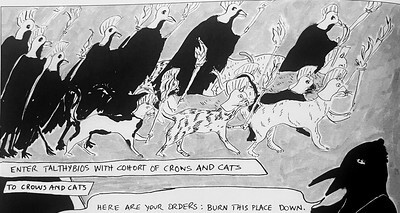
To the victors go the spoils they say, and Carson’s uniquely astute adaptation examines how horrifying a reality this is from the perspective of the women being carted off to serve the Greeks while still mourning loved one and the overall catastrophic loss of life and livelihoods in the city of Troy. It’s a harsh tale told in a harsh yet oddly hilarious and beguiling fashion that only Anne Carson could pull off.
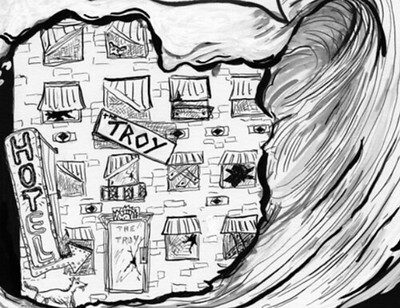
Bit of a bummer in ole Troy these days
Troy has been sacked, the men have been slaughtered, and the Greek’s are divvying up the women as their prize at the start of Carson’s The Trojan Women. The way the citizens of Troy are portrayed as gangly cows or Hekabe, the central figure of the tale, as an old, beaten down sled dog really drives home the message of the novel that the losing side are little more than cattle to the victors. Though the visual entertainment does not stop at cows and crows because we have Poseidon represented as a giant wave, Andromache and Astyanax as trees, for some reason Athene is a *checks notes* giant pair of overalls with an owl mask, Helen is a sultry dog but also a hand mirror, and Menelaos is ‘some sort of gearbox clutch or coupling mechanism.’ Why? Because Anne Carson can and Anne Carson fucking will. She’s a scholar, guys, okay? And undoubtedly the smartest person in any room she walks into, she can do what she wants.
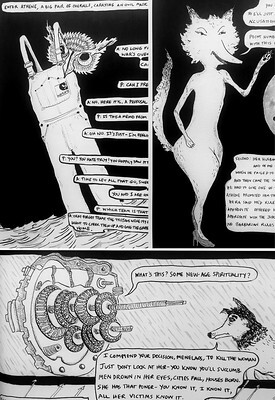
It’s kind of great and its just wild enough to work. Oh, so Kassandra isn’t an animal and is the only human character appearing…because her ‘mind is in another world’ and is being all batshit with fire and fantasizing her captive romance. Why not I guess. Because everything else is wildly bleak. And so much cruelty for the sake of cruelty. I mean, even the gods—ESPECIALLY the gods—are just going to ruin your day or kill your dad for laughs. Such as the plan between Athene and Poseidon that awaits the Greeks (no spoilers, friends who have read The Odyssey).
‘They need a lesson! Why?
Because they broke something of ours.
Because they squeak when they die.
Because we CAN.’
And yea…that’s pretty much everyone’s mentality here. NOT AWESOME. But the book? Awesome. It shouldn’t work. Like, you look at this and think “what the actual hell?” but then you remember that “what the actual hell is this?” tends to be the first reaction to anything Anne Carson. And then you remember how amazing it always is. The same applies here.
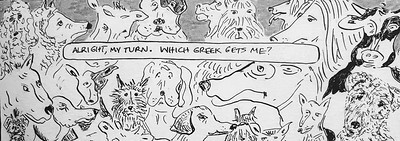
It’s a great little story where pretty much everything is horrible. Andromache is sent off to be the sexual “prize” for Pyrrhus, Achille’s douchey son, Odysseus insists that Andromache and Hektor’s little boy be killed for…morale I guess?...and Hekabe has lost literally everything including her will to live and is sustained solely on spite and hatred for Helen. Which is fair.
The Trojan Women from Anne Carson and Rosanna Bruno is a strange yet satisfying graphic novel adaptation of Euripedes that pushing into the weird as a way to allow the themes and hardships to resonate with greater range. It’s a book you’ll pick up and say “what the hell?” but then “ooooh” and “ooooo” and “aaaaaah” and, finally, “Thank you, Anne Carson, you are brilliant.” Thank you Anne Carson, you are brilliant.
4/5
To the victors go the spoils they say, and Carson’s uniquely astute adaptation examines how horrifying a reality this is from the perspective of the women being carted off to serve the Greeks while still mourning loved one and the overall catastrophic loss of life and livelihoods in the city of Troy. It’s a harsh tale told in a harsh yet oddly hilarious and beguiling fashion that only Anne Carson could pull off.
Bit of a bummer in ole Troy these days
Troy has been sacked, the men have been slaughtered, and the Greek’s are divvying up the women as their prize at the start of Carson’s The Trojan Women. The way the citizens of Troy are portrayed as gangly cows or Hekabe, the central figure of the tale, as an old, beaten down sled dog really drives home the message of the novel that the losing side are little more than cattle to the victors. Though the visual entertainment does not stop at cows and crows because we have Poseidon represented as a giant wave, Andromache and Astyanax as trees, for some reason Athene is a *checks notes* giant pair of overalls with an owl mask, Helen is a sultry dog but also a hand mirror, and Menelaos is ‘some sort of gearbox clutch or coupling mechanism.’ Why? Because Anne Carson can and Anne Carson fucking will. She’s a scholar, guys, okay? And undoubtedly the smartest person in any room she walks into, she can do what she wants.
It’s kind of great and its just wild enough to work. Oh, so Kassandra isn’t an animal and is the only human character appearing…because her ‘mind is in another world’ and is being all batshit with fire and fantasizing her captive romance. Why not I guess. Because everything else is wildly bleak. And so much cruelty for the sake of cruelty. I mean, even the gods—ESPECIALLY the gods—are just going to ruin your day or kill your dad for laughs. Such as the plan between Athene and Poseidon that awaits the Greeks (no spoilers, friends who have read The Odyssey).
‘They need a lesson! Why?
Because they broke something of ours.
Because they squeak when they die.
Because we CAN.’
And yea…that’s pretty much everyone’s mentality here. NOT AWESOME. But the book? Awesome. It shouldn’t work. Like, you look at this and think “what the actual hell?” but then you remember that “what the actual hell is this?” tends to be the first reaction to anything Anne Carson. And then you remember how amazing it always is. The same applies here.
It’s a great little story where pretty much everything is horrible. Andromache is sent off to be the sexual “prize” for Pyrrhus, Achille’s douchey son, Odysseus insists that Andromache and Hektor’s little boy be killed for…morale I guess?...and Hekabe has lost literally everything including her will to live and is sustained solely on spite and hatred for Helen. Which is fair.
The Trojan Women from Anne Carson and Rosanna Bruno is a strange yet satisfying graphic novel adaptation of Euripedes that pushing into the weird as a way to allow the themes and hardships to resonate with greater range. It’s a book you’ll pick up and say “what the hell?” but then “ooooh” and “ooooo” and “aaaaaah” and, finally, “Thank you, Anne Carson, you are brilliant.” Thank you Anne Carson, you are brilliant.
4/5
June 5, 2021
leave me with the stones. i’m made of stones. i weep stones. and when i’ve wept all the stones there are, i’ll be done.
such a unique way to present a tragedy i loved this anne carson is a genius
such a unique way to present a tragedy i loved this anne carson is a genius

May 26, 2021
Unsurprisingly excellent, I was waiting for this one. Anne Carson is a splendid Euripides translator, she understands and speaks his dramatic language, bar none; occasionally - makes it better (like in this case, due to the fact that "Trojan Women" is not exactly a masterpiece of tragedy). Loved the illustrations and overall artistic direction as well. Reimagining classics is what keeps them fresh and exciting and there is no such thing as too much great drama.

September 5, 2023
kind of messy..... just like WAR

June 25, 2022
This is Carson's interpretation of Euripides' The Trojan Women, as illustrated by Rosanna Bruno. Plays and comics have a lot in common, both being forms that marry the visuals and dialogue, and both can work with broad or small palettes. Rosanna Bruno's illustrations are loose, spontaneous and gestural: they give the play a sense of immediacy, as though the action is taking place right now, almost too quickly to be captured. Though many of the interpretations of characters are quirky or unexpected, such as Andromache appearing as a poplar sapling, or Athene as a pair of overalls, Bruno captures the poignancy of these images, as well as their irony. Carson's interpretation of this story is also admirable: her poetry is vivid and clear, and captures the atmosphere of a city devastated by war. It feels brutally relevant: these characters wait in a camp for their future to be decided by forces beyond their control, unable to protect their children. Carson presents the facts starkly and without authorial comment, making the story feel both immediate and eternal. Though there are imperfections both in the text and in the images, overall I thought this was an impressive achievement, much more so than many of the other modern interpretations of the women of Troy.

January 7, 2023
This was just meh, unfortunately.
It was amusing to see Helen turned into a fox and a hand mirror, Hekabe, “Top Bitch” a sled dog, Athene, literally an owl head in a pair of overalls.
I’m sure it’s all impossibly witty but I didn’t get it. Missed the point. Don’t care enough to dig for the point.
Also I wished the drawings had color.
It was amusing to see Helen turned into a fox and a hand mirror, Hekabe, “Top Bitch” a sled dog, Athene, literally an owl head in a pair of overalls.
I’m sure it’s all impossibly witty but I didn’t get it. Missed the point. Don’t care enough to dig for the point.
Also I wished the drawings had color.

July 18, 2021
This collaboration of an economical poetic text by the eminent classics scholar and translator Anne Carson and raw, powerful illustrations by Rosanna Bruno, was an absolute pleasure to read and absorb. The retelling of Euripides play captured the suffering and the absolute surreal existence of those who survive on the losing side of a war. I'm not sure how effective it would be for people unfamiliar with the original play, but if you have a familiarity with the original text and enjoy imagining re-interpretations of old stories, I highly, highly recommend this version: the images and the language will haunt me for a long time. It's simply a beautiful work.

September 23, 2024
The art style is either deliberately obtuse or just plain bad. Not sure it matters. Either way, it oozes laziness, and is so grating on the eye it manages to distract from and deaden the remarkably energetic and dynamic text it accompanies, which is the death of any comics collaboration.

September 7, 2021
I read a good review somewhere of this graphic version of The Trojan Women, doubtless by way of one of my classics-nerd Facebook follows. I'm a fan of both Euripides and the graphic format and I generally like an irreverent take, so I was anticipating this read with some pleasure. I read the Richmond Lattimore translation beforehand, somewhat to prepare but mostly because I'm a completist who is working his way through the tragedies, and I watched the
superb Michael Cacoyannis film
, and I'm glad to have experienced both of those, but the graphic version itself didn't really seem to have been worth anyone's time: Anne Carson's, Rosanna Bruno's, or mine.
I guess that's unduly harsh, but I found the text tin-eared and awkwardly contemporary (Ganymede is described at one point as the "buttboy" of Zeus, which is accurate enough, I suppose, but the casual homophobia is jarring and I didn't understand the point) and the drawings graceless, weird and kinda contemptuous of the text. The Trojan women are all dogs* and cows (uhh, pick one), Helen is mostly a fox (natch), but sometimes a mirror, Menelaus is a gear box and Athene is a set of coveralls and an owl mask. Aphrodite and Hera, though, look like badly drawn Disney princesses. WTF?!? Was Bruno swinging for the Maus fence? She couldn't've whiffed more completely.
So, the only good thing about this self-consciously "edgy" snooze is that it pointed me toward better versions of a terrific play that could not be more relevant right now as Afghan women experience the terrible consequences of opportunistic, West vs. East adventuring.
*I will admit that this choice sorta worked for Hecuba, who spends a good chunk of the play lying in the dirt.
I guess that's unduly harsh, but I found the text tin-eared and awkwardly contemporary (Ganymede is described at one point as the "buttboy" of Zeus, which is accurate enough, I suppose, but the casual homophobia is jarring and I didn't understand the point) and the drawings graceless, weird and kinda contemptuous of the text. The Trojan women are all dogs* and cows (uhh, pick one), Helen is mostly a fox (natch), but sometimes a mirror, Menelaus is a gear box and Athene is a set of coveralls and an owl mask. Aphrodite and Hera, though, look like badly drawn Disney princesses. WTF?!? Was Bruno swinging for the Maus fence? She couldn't've whiffed more completely.
So, the only good thing about this self-consciously "edgy" snooze is that it pointed me toward better versions of a terrific play that could not be more relevant right now as Afghan women experience the terrible consequences of opportunistic, West vs. East adventuring.
*I will admit that this choice sorta worked for Hecuba, who spends a good chunk of the play lying in the dirt.

July 9, 2021
This isn't, and doesn't pretend to be, an introduction to Euripides' play. It's almost the opposite: an obscurely witty retelling that James Joyce might have liked. For me, most of it fell a bit flat, and the overall effect was muted. I bought it based on (a) the opening page and (b) the fact that it was translated by Anne Carson. It's not Euripides' best play (Medea, Bacchae, Hippolytus - take your pick), but it didn't seem to have any power at all, awkwardly comic and obscure. Rosanna Bruno's decision to use animals/objects to represent people/gods is a divisive one, and her drawings are sketchy. The review in the TLS said the translation closely matched the playwright's style in Ancient Greek; if so, it is pretty garish in modern English. I'll read the play in a different modern translation and perhaps revisit this later.

February 6, 2022
5 stars for οιμοι love u anne carson

Read
December 25, 2022Carson är som allra bäst när hon låter sig filtreras genom de grekiska texterna. Snarare än en översättning är detta att läsa både henne och Euripedes - samtidigt och parallellt.
Dramatik i serieformat fungerar förvånansvärt bra, men som någon redan påpekat är det ju två manusbaserade medier.
Fantastisk såklart.
(Läst jämte Emil Zilliacus översättning av Trojanskorna, Euripedes kanske mänskligaste tragedi).
Dramatik i serieformat fungerar förvånansvärt bra, men som någon redan påpekat är det ju två manusbaserade medier.
Fantastisk såklart.
(Läst jämte Emil Zilliacus översättning av Trojanskorna, Euripedes kanske mänskligaste tragedi).

June 14, 2021
Otroligt fult tecknad men mot slutet var jag så förförd att jag börja gilla det med!
Did Not Finish
September 24, 2022dry, like a dull, unused knife
November 12, 2024
anne carson please leave your husband and marry me please please please

Read
January 28, 2022Video review, along with
Nox
and
H of H Playbook
: https://www.youtube.com/watch?v=xo4Mf...

June 28, 2021
Not a fan of this manifestation of the play. Although many of the insults hit their mark, such as Zeus' cupbearer Ganymede being called a "butt-boy," it still felt odd and out of place. The art style was also not for me.

August 11, 2021
Another perfect Carson translation paired with what feels like a production with some strong directorial choices. The closest thing to a play on a page.

March 27, 2022
The text by Anne Carson was amazing — she is basically God to me but I just did not love the art style.

Read
April 8, 2026what can i say? anne carson supremacy, always.
euripedes with the timeless message about the pain and grief and the infinitely pointless, immensely high cost of war.
euripedes with the timeless message about the pain and grief and the infinitely pointless, immensely high cost of war.

September 21, 2021
Anne Carson branches into graphic novels?? Effervescent. Also sad. The play is, as they say, a tragedy.
Loved Andromache as a tree split down the middle => Astyanax is a sapling cut down too soon. Athena as a pair of "Warhartt" overalls with an owl mask (this is so funny I will never not love this). Wonderful illustrations. I think this is a really good medium for plays!!! More ppl should do dramatic poetry as graphic novels pls
Loved Andromache as a tree split down the middle => Astyanax is a sapling cut down too soon. Athena as a pair of "Warhartt" overalls with an owl mask (this is so funny I will never not love this). Wonderful illustrations. I think this is a really good medium for plays!!! More ppl should do dramatic poetry as graphic novels pls

March 1, 2023
Impresionante versión, dolorosa e irónica, que demuestra el profundo conocimiento por parte de Carson de la obra de Eurípides, de cuya traducción parte para construir una nueva visión desde el s.XXI.

July 20, 2021
I enjoyed the translation--it felt fresh and it flowed and it makes me want to read another version of Euripides' "Trojan Women". I found the graphic component odd and didn't think it enhanced the text. I did not agree with many of the choices for characters.

July 27, 2026
If the play The Trojan Women is an ode to despair, line by line translation of this Euripides's work in the graphic novel is more sardonic and pitiful. The Trojan citizens are depicted as ragged-looking, well-bred dogs and dull-eyed farm animals, while the Achaeans appear as enormous black crows and cats in armours, full of tricks and bad omen.
Hekuba is portrayed as an emancipated former sled dog, who had long past her glory days, now caged in a filthy kennel, waiting to be caned and kicked by a new slave master. Cassandra, on the other hand, remains the only human character, unable to communicate across species just like the tragedy of her unheeded prophecies, while her human form and her unhinged smiles accentuate the sexual crimes inflicted upon her. Andromache is absurdly rendered as a skeletal, leafless tree, faceless and expressionless, barely able to take root in the barren soil of Troy, and ultimately having lost a sense of belonging anywhere else.
Neither Euripides nor the illustrator, Rosanna Bruno, interprets Helen as a victim despite how many modern interpretations try to force victimhood onto her character, which I’m so thankful for. Her god-tier (uh pun unintended) talent for manipulation and seduction always makes her gold-standard liar. Her shapeshifting from a white fox to an ornamated mirror is a clever take; she is what others want her to be, and what they want to be seen.
Carson's translatation is also angrier, more satirical and quipped with dark humor. Lines such as "You blame the gods to whitewash your sins" are among the coldest roasts and Hekuba’s tone is perfectly delivered, while referring to Ganymede as Zeus's "butt-boy" will live in my memory rent-free.
Hekuba is portrayed as an emancipated former sled dog, who had long past her glory days, now caged in a filthy kennel, waiting to be caned and kicked by a new slave master. Cassandra, on the other hand, remains the only human character, unable to communicate across species just like the tragedy of her unheeded prophecies, while her human form and her unhinged smiles accentuate the sexual crimes inflicted upon her. Andromache is absurdly rendered as a skeletal, leafless tree, faceless and expressionless, barely able to take root in the barren soil of Troy, and ultimately having lost a sense of belonging anywhere else.
Neither Euripides nor the illustrator, Rosanna Bruno, interprets Helen as a victim despite how many modern interpretations try to force victimhood onto her character, which I’m so thankful for. Her god-tier (uh pun unintended) talent for manipulation and seduction always makes her gold-standard liar. Her shapeshifting from a white fox to an ornamated mirror is a clever take; she is what others want her to be, and what they want to be seen.
Carson's translatation is also angrier, more satirical and quipped with dark humor. Lines such as "You blame the gods to whitewash your sins" are among the coldest roasts and Hekuba’s tone is perfectly delivered, while referring to Ganymede as Zeus's "butt-boy" will live in my memory rent-free.

August 2, 2026
That was an exciting, hilarious, and deeply moving ride. Irreverent is exactly how I like my Greeks, I guess! Anne Carson and Rosanna Bruno completely strip away centuries of stuffy academic pretense and restore the raw, bitter, and darkly funny bite that Euripides originally intended.
The visual metaphors are brilliant. Poseidon as a wave was a little obvious and boring, but Athena rendered as a floating pair of denim overalls holding up an owl mask was top-notch humor.
The women of Troy, whose horrific fate was death, slavery, or sex slavery, were appropriately represented by dogs and cows—treating them exactly like the livestock the victorious Greeks saw them as. The image of the dogs lying powerless in the dust and helplessly pawing the ground while the city burned in the background was a surprisingly effective and devastating comic panel.
The legal showdown is easily the highlight of the book. Helen is drawn as a thicc-thigh, voluptuous fox in high heels, representing herself in her own death trial and trying to blame the war on everyone else. Hecuba is the weary, fierce "top dog" alpha staring her down with massive, unadulterated “THIS BITCH RIGHT HERE”energy. If looks could kill, Helen wouldn't have made it back onto that Greek ship alive.
Highly recommend this format. It is a quick, visually striking 96-page layout that you can easily flip through in an afternoon. 4.25 stars.
The visual metaphors are brilliant. Poseidon as a wave was a little obvious and boring, but Athena rendered as a floating pair of denim overalls holding up an owl mask was top-notch humor.
The women of Troy, whose horrific fate was death, slavery, or sex slavery, were appropriately represented by dogs and cows—treating them exactly like the livestock the victorious Greeks saw them as. The image of the dogs lying powerless in the dust and helplessly pawing the ground while the city burned in the background was a surprisingly effective and devastating comic panel.
The legal showdown is easily the highlight of the book. Helen is drawn as a thicc-thigh, voluptuous fox in high heels, representing herself in her own death trial and trying to blame the war on everyone else. Hecuba is the weary, fierce "top dog" alpha staring her down with massive, unadulterated “THIS BITCH RIGHT HERE”energy. If looks could kill, Helen wouldn't have made it back onto that Greek ship alive.
Highly recommend this format. It is a quick, visually striking 96-page layout that you can easily flip through in an afternoon. 4.25 stars.

January 15, 2022
I enjoyed and was fascinated by this sophisticated and surreal adaptation of Euripides' play "The Trojan Women" by noted poet and classical translator Anne Carson and illustrator Rosanna Bruno. I did not, however, understand much of it, probably missing many references, and being puzzled by a number of the choices, but maybe one is not supposed fully understand something this surreal.
It starts out with Poseidon depicted as a wave, Troy as an old decaying hotel, and then it starts getting weirder when Athena is an empty pair of overalls. Hekabe is an old mangy dog, Helen alternates between being a fox and a mirror, Andromache and Astyanax are both trees, and then it gets really weird when Menelaos is depicted as a floating "some sort of gearbox, clutch or coupling mechanism, once sleek, not this year’s model."
The underlying play has a lot of weaknesses compared to the best of Greek drama but this was an intriguing and thought provoking way to experience it again. Unlike many simplistic graphic depictions it didn't clarify and simplify but instead moved in the opposite direction, creating some unforgettable images in the process.
It starts out with Poseidon depicted as a wave, Troy as an old decaying hotel, and then it starts getting weirder when Athena is an empty pair of overalls. Hekabe is an old mangy dog, Helen alternates between being a fox and a mirror, Andromache and Astyanax are both trees, and then it gets really weird when Menelaos is depicted as a floating "some sort of gearbox, clutch or coupling mechanism, once sleek, not this year’s model."
The underlying play has a lot of weaknesses compared to the best of Greek drama but this was an intriguing and thought provoking way to experience it again. Unlike many simplistic graphic depictions it didn't clarify and simplify but instead moved in the opposite direction, creating some unforgettable images in the process.

November 30, 2021
As an adult I’ve never read a comic before but what Anne Carson creates, I am intrigued by, so this was my first comic as an adult and wow. I was not let down, this is amazing! It is so so innovative, it really speaks to all of Carson’s strengths, her intimate understanding of classic greek texts, her ability to use colloquial language in a way that never diminishes the beauty or complexity of the text, in fact I think it allows the text to exist in a natural and organic way, her humor, her absolute genius. The choices in the illustrations are so insane and perfect, to have Athene as a fox that turns into a mirror, to have Kassandra as the only human, to have Menelaus as a gearbox, etc.
this comic beautifully and heartbreakingly explores the grief and pain of the Trojan women after Troy is conquered by the Greeks, with touching modernized images like a grave with a “#1 dad” sign.
The illustrations themselves are also so good!
Highly recommend this to anyone interested in Greek mythology.
this comic beautifully and heartbreakingly explores the grief and pain of the Trojan women after Troy is conquered by the Greeks, with touching modernized images like a grave with a “#1 dad” sign.
The illustrations themselves are also so good!
Highly recommend this to anyone interested in Greek mythology.

July 16, 2021
This the graphic novel version of the Classical Greek play by the same name. It is an anti-war statement that follows the fates of the Trojan women who survived the Greek sacking of the city. The main characters are Hecabe (the widow of King Priam), her daughter Cassandra (the prophetess of Apollo who is fated to never be believed), daughter-in-law Andromeche (widow of Hector), Helen (the cause of it all).
The author does an excellent job encapsulating the story into the abridged version presented her. Well worth the read to see her translation.
Like many graphic novels, the project goes off the rails with the artwork. Too many artists ruin the imagery with odd symbolism and drawing style. The author represented Athena as a pair of overalls, Menelaus was a set of gears, and Helen was a fox in high heels.
The author does an excellent job encapsulating the story into the abridged version presented her. Well worth the read to see her translation.
Like many graphic novels, the project goes off the rails with the artwork. Too many artists ruin the imagery with odd symbolism and drawing style. The author represented Athena as a pair of overalls, Menelaus was a set of gears, and Helen was a fox in high heels.

August 2, 2021
I hadn't read The Trojan Women by Euripides for many, many years, so I reread it before reading this graphic version. I'm glad I did.
There are things about this book I love: (Troy ". . . crouched on the plain like James Baldwin . . .") and Athene embodied as a pair of "Warhartt" overalls carrying an owl mask, not to mention Hecuba as an "ancient emaciated sled dog of filth and wrath," and my favorite, the chorus of dogs and cows. Things that are bizarre enough to be thought provoking. I had hoped to add this to my beloved collection of art books.
But, my inner English teacher rose to the surface (of Poseidon?) when I read "not" instead of "naught" and "by" instead of "my." My red pen grew enraged. I may need to consign this work of art to the Little Free Library. Alas, proofreading is dead . . .
There are things about this book I love: (Troy ". . . crouched on the plain like James Baldwin . . .") and Athene embodied as a pair of "Warhartt" overalls carrying an owl mask, not to mention Hecuba as an "ancient emaciated sled dog of filth and wrath," and my favorite, the chorus of dogs and cows. Things that are bizarre enough to be thought provoking. I had hoped to add this to my beloved collection of art books.
But, my inner English teacher rose to the surface (of Poseidon?) when I read "not" instead of "naught" and "by" instead of "my." My red pen grew enraged. I may need to consign this work of art to the Little Free Library. Alas, proofreading is dead . . .

January 8, 2024
The most haunting comic I've ever read (admittedly, not stiff competition). Anne Carson flexes once again her masterful use of language to draw out the grief and tragedy for the women at the fall of Troy. Her terse, modern style is perfectly paired with Rosanna Bruno's rough, archaic/crude illustrations, painting a troubling picture of human cattle at the end of the slaughter. I imagine dark pleasure was had by both Carson and Bruno that in visualizing the inspiring work (tragedy) as a comic (comedy), the primal Greek genres are flipped on their heads. Much like Troy, I would suppose.
While I don't think it is a work I would return to, it is a good read and an excellent catalyst for anyone who thinks that the ancient classics lack any remaining power to move us. War makes beasts of us all.
While I don't think it is a work I would return to, it is a good read and an excellent catalyst for anyone who thinks that the ancient classics lack any remaining power to move us. War makes beasts of us all.
Displaying 1 - 30 of 86 reviews