This book advances systems thinking by introducing a new philosophy of systemic knowing. It argues that there are inescapable limits to rational understanding. Humankind has always depended on extended ways of knowing to complement the rational-analytic approach. The book establishes that the application of such methods is fundamental to systemic practice. The author advocates embracing two modes of intentionality, which Western philosophy has long recognized, and non-intentional awareness, which Eastern philosophy additionally highlights. The simultaneity of these two modes of consciousness, and the variety of knowings they spawn are harnessed for a more holistic, systemic knowing. Four practices from fields related to systems thinking are two contemporary action research methodologies from the US and the UK; the Sumedhian (Indian) approach to inquiry about processes within groups; and a technique of group psychotherapy originating in Eastern Europe. Each of these systematically harnesses knowing using both modes of consciousness. Therefore, the author insists, such approaches must be included in systemic practice, in purposeful and methodical juxtaposition to rational-analytic ways. The book provides examples and guidelines for deployment. “All researchers and practitioners of systems thinking and action research must read this book...Raghav has craftfully blended Eastern and Western wisdom. He uses his immersion into Eastern ways of knowing practically, to elaborate the systems philosophy in rich detail. He has incorporated, from cooperative inquiry as action research, the idea of four ways of practical, propositional, presentational and experiential, to bolster the foundations of systems thinking”―SHANKAR SANKARAN, Professor, University of Technology Sydney, Australia; President International Society of Systems Sciences (ISSS) 2019-2020 “This is a book with the potential to stimulate the emergence of a new paradigm. Raghav shows that systems thinking can transcend rational analysis and incorporate other ways of knowing, such as arts-based methods… also, rather than be overly preoccupied with striving for change, there is value in simply abiding, which comes with a deep appreciation of the ecological relationships we are part of. It’s not that rational analysis is wrong – it’s that it is only part of a genuinely transformative practice”. ―GERALD MIDGLEY, Co-Director, Centre for Systems Studies, University of Hull; former President, ISSS (2013-14)
“Raghav Rajagopalan’s writing on generating deep appreciation for the social and ecological interdependencies ties in closely with my own work. The philosophical ideas he develops contain the tracings and essential tones of Gregory Bateson’s idea of "Mind" as a process of living complexities reaching well beyond the notion of the body. This book demonstrates outstanding erudition and deep compassion at the same time. It should delight the adventurous reader unafraid of big questions”.―NORA BATESON, President of the International Bateson Institute
Systems thinking is a field that continues to evolve as it explores the fringes of thought and practice in relation to phenomena of change, learning and life. We understand always better that 'solving global problems' requires us to fundamentally examine how we relate to and interact with the world around us. There is a call to transcend the limitations of our modern worldview. But how to question the air we are breathing? It seems a fiendishly difficult challenge. Yet we have to remind ourselves that we are not required to to invent something that goes beyond our humanity. Indeed, what if the task is to rediscover ways of knowing that have been practiced across human cultures over many centuries?
Rajagopalan's book is the result of his PhD research at the Centre of Systems Studies, University of Hull, UK. But it enfolds his rich professional experience in rural development work in his native India. The argument jumps off from where applied systems thinking is today. The author then projects this intellectual footprint on a much wider philosophical canvas (an onto-epistemology) which allows him to build a bridge from current systems practices into a number of innovative (but sometimes also very old) ways of knowing which are usually situated outside the scope of systems thinking. In this way we access the realm of immersive systemic knowing. 'Solutions' for 'wicked problems' do not hinge on our ability to wield some nifty toolbox. Instead, the task is to become aware of the air we are breathing. That is what immersive systemic knowing in its various manifestations helps us to do. Taking responsibility for our actions starts from there.
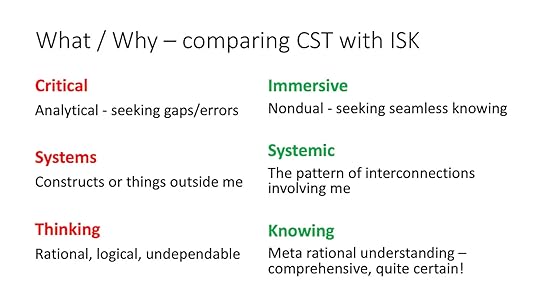
The essence of immersive systemic knowing can be grasped by studying this comparative table:
It expresses a paradigmatic shift from an analytic conception of systems thinking to a nondual perspective beyond modernism. Systems thinking bootstraps itself out of its core concept of ‘system’, as it were.
Rajagopalan's thoughts offer a springboard to explore a generative way of being 'beyond systems'.