Michael Angelo da Caravaggio (1571-1610) had an amazingly colorful and adventurous career, full of dramatic contrasts. He was a religious artist who used prostitutes and castrati as his models; a mystic with a police record; the favorite of Cardinals and the Pope's portrait painter, who committed a murder; an outlaw from the Roman hills, lionized at Naples; a Knight of Malta imprisoned in a Maltese dungeon; hunted by hired assassins in a vendetta with an unknown enemy; horribly disfigured by sword cuts in a Neapolitan brothel. Ironically, he died on a lonely Tuscan beach after receiving a pardon that would have allowed him to become an even greater painter. Based on the latest research, but largely written as an adventure story, the book concentrates on the man and his personality, without neglecting the artist. It vividly re-creates his life in early Baroque Italy and as a "monk of war" on Malta.
Desmond Seward was an Anglo-Irish popular historian and the author of over two dozen books. He was educated at Ampleforth and St, Catherine's College, Cambridge. He was a specialist in England and France in the Middle Ages and the author of some thirty books, including biographies of Eleanor of Aquitane, Henry V, Richard III, Marie Antoinette and Metternich.
In his Preface, Desmond Seward warns us that, "This biography . . . does not attempt to analyze his paintings, nor to question attributions." Rather, he writes, "It uses his pictures to peer into his mind." You really can't un-jumble that. How does one use an artist's pictures to peer into his mind and not analyze the paintings?
It doesn't matter. The author somehow managed to take Caravaggio - a genius who perfected chiaroscuro, painted for popes, slept with a dagger, fought duels, was a fugitive, evaded pirates on the high seas, was both a murderer and murderee, and whose favorite subject in painting was the severed head - and made him uninteresting. You can accomplish this by focusing on the wonderful world of Knights of Malta, writing gnarly sentences, and qualifying everything in the story.
It's my experience that you can't be a member of Ducks Unlimited without always talking about ducks. And, likewise, you can't be a Knight of Malta without making that your worldview. Seward, a Knight of Malta himself, sees Caravaggio's status as a Knight of Malta as playing a crucial role in his paintings. It certainly plays a crucial role in Seward's writing. Like when he segues away from Caravaggio and onto the history of Fra' Alof de Wignancourt, whom he describes as "One of the knights' ablest and most likable rulers." What makes someone both able and likable in Seward's view? As soon as Fra' Alof was elected grand master in 1601, it became clear that an innovator was in charge. He put real vigor into the knights' crusade against the infidel, their galleys raiding Greece, Turkey, and Syria, and North Africa, bringing back impressive booty together with quantities of slaves. You know, the good old days.
If you think I'm being selective, Seward takes on Giordano Bruno, the hero of Stephen Greenblatt's wonderful The Swerve: How the World Became Modern. I'm a sucker for freethinkers. Fra' Seward is not: While Giordano Bruno may have been a hero to Victorian freethinkers, to those few of his contemporaries who knew anything about him, as an atheist he was no better than a lunatic. In Seward's defense, that's about as gnarly a sentence as one could write. So, I stopped and tried to unravel that thought, couldn't, and then saw the next sentence: Sane men believed. Take me to the asylum.
I hate to nitpick when there are so many larger ducks to take aim at, but at one point Seward refers to 1599 as being in the last two years of the seventeenth century.
It is true that there are varying and inconsistent histories of Caravaggio and frankly not a lot can be known for certain. But it's annoying to read everything in qualifying terms. Taking just one chapter (and they are all short chapters), we get this from Seward: Perhaps . . . it seems . . . Probably . . . must have known . . . almost certainly . . . seems to have been . . . Probably . . . more than likely . . . It is unlikely . . . may explain . . . Perhaps . . . probably . . . The most likely meaning . . . probably . . . may have been . . . may well reflect . . . If . . . almost certainly . . . he appears to have . . . Probably . . . He seems . . . He may have . . . It looks as if . . . Probably . . .
It's enough to make me lose my head.
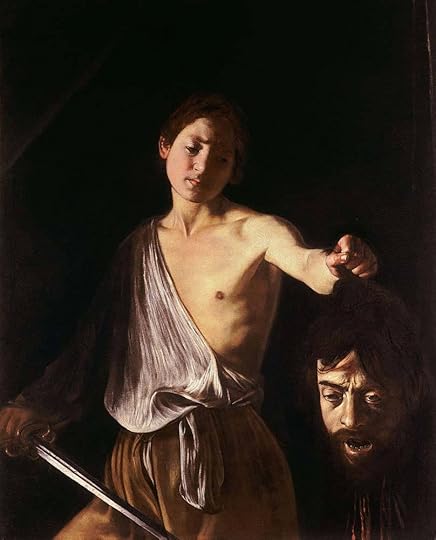
Speaking of which, we finally get to David and Goliath.
This is extraordinary. Even setting aside the brilliance of the painting itself, consider that this was painted near the end of Caravaggio's life. It was a life of genius but also great violence. Imagine the demons. And then, that both subjects are self-portraits. If there was ever a time to see an artist's works and then peer into his mind, then this is surely it.
This is what Seward gives us:
The last version of David and Goliath was inspired by his conviction that, ultimately, he would triumph over sin and death, escaping from the unhappy man he had become. Caravaggio's portrait of his own severed head, grasped by his redeemed self, was a declaration of hope.
I am fascinated by the combination in one person, of great creativity, in the service of religious ideals, with uncontrolled sexuality, violence and criminality, and depression. The relationship between these two extremes may be the modern temperament writ large. Thus, in the company of many people, I have long been interested in the art and character of the great Italian baroque artist, Michelangelo de Caravaggio (1571 -- 1610). Desmond Seward's short and readable biography, "Caravaggio: A Passionate Life" (1998) offers a good overview of a remarkable artist and deeply flawed and troubled person. Seward is an English historian who has written on the medieval and renaissance periods. He is a member of the Knights of Malta, as was Caravaggio for a brief time; and Seward's religious perspective undoubtedly has much to do with how he sees the artist. I was not convinced by parts of Seward's understanding of his subject. But he presents his materials well with room for his readers to disagree.
Caravaggio was born in the small Italian village for which he is named, and his father died a victim of the plague early in life. From 1588 -1592 he served an apprenticeship as a painter in Milan but fled to Rome, most likely as a result of killing a policeman. In Rome, Caravaggio ultimately received recognition for his extraordinary paintings but was forced to flee the city in 1606 after killing a man named Tommasoni in a duel. (He had earlier accumulated a long police record in Rome.) He received a dispensation to join the Knights of Malta but was expelled and forced to flee after another duel in which he severely wounded a superior in the Order. Caravaggio had strong defenders in Rome, greatly aware of his extraordinary gifts, and received a papal pardon. But, knowing that he had been pardoned, in 1610 Caravaggio died a miserable death en route to Rome after drinking contaminated water. During his years in Rome and thereafter, Caravaggio was an astonishing painter, creating many masterworks, mostly on religious themes. Many of his works have been lost, but some have resurfaced in recent years.
Seward gives a brief treatment of the little that is known about Caravaggio's life and makes an effort to separate knowledge from speculation in the original source material. He does a good job in putting the artist's life in the context of the Italy of his day, with its many states, cultures of endemic and pervasive violence, and susceptibility to natural disasters, such as floods, and plagues. He also discusses effectively the counter-reformation in the Catholic Church; and he places Caravaggio's paintings squarely within the goals and religious outlook of the attempt to revitalize Catholicism from the challenges of Protestantism. For all the violence and difficulties in his life, Seward stresses, Caravaggio never had doctrinal difficulties that might have interested the Inquisition.
Seward also discusses Caravaggio's major paintings (the book includes good color reproductions of 16 of them) emphasizing their naturalism -- Caravaggio's attempt to paint people and things as they were -- and, increasingly, their mysticism and religiosity. He is good at pointing out the violence in many of the paintings -- especially the scenes of beheadings -- and their use of light and of dark shadings. Seward is far less convincing on issues of sexuality. He is dismissive on issues of eroticism in Caravaggio's art, and on the artist's likely bisexual or homosexual orientation. The historical record may be sparse, but many viewers have found compelling evidence of eroticism in the paintings -- including the paintings reproduced in his book. Seward properly emphasizes, I think, the religious, mystical nature that finds expression in Caravaggio's art, but he downplays the violent, demonic, and sexual nature of the artist. Thus, while he properly subtitles his book "A Passionate Life", he gives the reader less than the whole of it.
As Seward points out, in many respects Caravaggio, with his great talent and equally great human flaws, is the prototype of the modern antihero. Undoubtedly, this combination accounts for much of the fascination the artist and his works continue to exert. Seward's book sets the stage for considering the tortured relationship between Caravaggio's life and his art; but in the end he fails to do his subject complete justice.
Trying another Caravaggio bio. Nothing very new here for me. It is interesting how much the author denies the possiblity that Caravaggio was gay. He seems to consider it a slander. One interesting point is that much of what is currently known about Caravaggio was discovered pretty recently--his paintings have been "found" in several unlikely locations, such as the Taking of Christ in Dublin in the late 1990s.
This book gives you a good feel for the times in which Caravaggio lived and reasonable idea about him as a person. It doesn't go too much into the art, except for significant pieces (the significance being that they mark an important new connection among his patrons/collectors etc) but there are plenty of The Man and his Art books out there.
Excellent book choice for a quiet Sunday morning. I am delighted with the narrative, I could not put the book down. Desmond Seward's way of telling Caravaggio's life is engaging, I heard his voice and walked the streets, I felt the stroke of swords, and the pain from the wounds half-healed in low-budget hospital care. I picked this book to enlighten my research about the beheading of Beatrice Cenci in 1599, and I found more than I expected in this book's chapters XIII and XIV. My favorite passage (not related to my research) is in page 48 where the author mentions "the happiest picture ever painted by Caravaggio." Very elegantly written and easy to read. I look forward to reading more of the many books published by Desmond Seward.
More than I ever knew about C, but this is the short recent bio, not the long one. Like with the Leonardo bio, I wonder how they can find out so much about people who lived so long ago and how much is speculation.
Firstly an admission, I had no prior knowledge of Caravaggio or his paintings. My main area of interest is military history but after seeing the beautiful cover on this book I picked it up and browsed through the wonderful colour plates. I had to have the book to read and after ordering it from Amazon.com and sat and waited. It was worth the wait! I enjoyed the story of this most interesting man, yes its a bit short (200 odd pages) but to a person like me who had no prior knowledge or interest in this subject it filled a gap in my education. This was an interesting book to read and I just loved the colour plates of the artists work (16 colour pictures). The book has sparked an interest to learn more of this man, his times and his art. For that alone the book was worth it and the author has done his job. I would recommend this book for those who want to learn a little bit more about this man and his art.
Well researched and detailed, but not that well written. However the book seeps up brilliantly the religious passion of Caravaggio when taking on his works, so fervent. One ends up forgiving the violent miscreant and worshipping the most gifted painter of all art history. I love the chapters dedicated to the stints of Caravaggio in Loreto and Messina.
This is a short, pretty fast read. It mostly fleshes out the world around Caravaggio as a man of his time: what he probably would have seen and done and known about. The author is interested in determining influences he would have drawn from. It is short on new hard facts, but evocative. We see the man was a hothead, a murderer (in a duel), and basically kind of an asshole. In one chapter the author seems obsessed with proving Caravaggio was not a homosexual, finally admitting that maybe he had a brief period of bisexuality in his youth. (Who cares? I don't see how that matters.)
Despite finding out (not exactly a spoiler after 400 years) he was a real jerk, I still think his work was beautiful. I've always loved Caravaggio's chiaroscuro ... he's the best at that gloom and shadow.
I've read Seward before & appreciate his straightforward writing style, but so much of this book is speculation it's difficult to enjoy it as a history, which is what I thought I was reading. I did learn some interesting things, but ultimately, I was in a hurry to be done with it.
The author wrote with a definite slant, that was a bit odd. He is a Knight of Malta according to book cover, and that may explain a bit.
He seems to cover three things (in addition to some minutia about the Knights of Malta) the violence and eccentricity, the patrons, and the religious feeling. Not to much about the art per se. Almost zilch about his use of light to convey passion, and structure his paintings. One of my favorites: [image error]
And definitely not about Caravaggio's sexuality, except to insist over and over again that he was not gay or bisexual, in many cases that sound like special pleading. Like those who think he was seems less concerned with it than this author who seems to have wanted a "manly" Caravaggio (albeit very disturbed, proud and unhappy). True, there was a whole institution of circulars, avisos, that were the yellow press of the day, so there were definitely false rumors being spread all the time. I guess that's no big deal, but the vibe given off by his Bacchus doesn't seem consistent with that interpretation.
There are better sources about Caravaggio than this book.
I was rather interested in the Malta angle. It is a fascinating place. And the Maltese language, which is like Arabic with a lot of its vocabulary coming from Italian (and English)--see the Wikipedia artical on the Maltese language.
Seward has written a fairly pedestrian biography of the great artist. In part this is because of the paucity of source material on major aspects of Caravaggio’s life, including his origins, the major conflicts that blighted his career, his travels during exile and his death. So there is not a lot for the author to work with. He still manages to present an intriguing story of an ambitious young man with a great deal of talent, yet also in possession of a violent temperament that caused his premature downfall. It’s an entertaining story; you can’t help but like somebody who, when a painting of his was publicly criticised, ripped it up with a knife and then went away and painted a masterpiece.
I read the Kindle version of this book, and regretted it. The plates reproducing the works that Seward refers to would have been much better in printed form.
Caravaggio had a short, busy, unsettled life, so Seward wrote a short, busy, unsettled biography of him. Parts of it were intriguing and delightful, and Seward tied many of his paintings, several of which were included in a glossy section of illustrations, with phases of Caravaggio's life. Yet in some parts, the writer seemed to both dash and limp through sections. Had I known medieval Italy and its vast number of characters (with beautiful but multi-syllabic names and titles), I would have appreciated this book more. Hence three stars instead of more.
I almost gave up on this biography. The author cannot tolerate the idea that Caravaggio might have been other than a pure-bred heterosexual male and is constantly on the defensive about it. Every other sentence uses the phrase "must have been" or "almost certainly was"-- So one has to read carefully for actual facts. However he is good about naming his sources and covering a lot of the recent research in archives that has illuminated many issues, particularly about Caravaggio's last years, after he fled Rome.
I bought this at the National Gallery of Art in D.C. I had wanted it--I saw it there and in a fit of passion, had to have it.
Caravaggio was Passion. He suffered melancholia. He reached the Mystical. He drank and brawled. Not only were his works masterpieces of chiaroscuro, he, too, was light and dark.