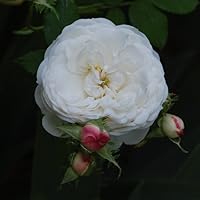
In this best-selling book Elizabeth Murray discusses the development and maintenance of Claude Monet’s Giverny estate as well as Monet’s color theories, design elements, and use of light and shade. Richly illustrated with Murray’s lush photographs of the present-day Giverny gardens, Monet’s Passion also offers full-color illustrations of the gardens drawn to scale and four Giverny-based garden plans that can be executed anywhere. 144 pages, over 50 color photographs plus black-and-white historical photos, size: 8 3/4 x 8 3/4". Quarterbound (Hardcover book) with ribbon marker.
It is pretty obvious the photos are older and so they're not the greatest in details or color. There's one that says there is a group of flowers of one color but I stared so long and couldn't see them among the other colors. The biggest problem is the captions which is usually the problems in most photo books. This problem is that there are pages with two photos but only one caption. This caption describes both of the photos but doesn't separate the two. Usually it's easy to know which part of the caption is for what photo but I still wished they were separate. These same captions sometimes have information not even related to the photos shown. Those are just the problems I had with this book which aren't really big problems. I did enjoy it and especially the pages with an overlay over flower beds so you could learn the names of the plants.
Good but I was hoping for great. The first two thirds seems to be written for people who have never been there or even seen many photos of the garden. Attractive photos but paragraph descriptions along the lines of grass is important in some sections, here contrasted by red flowers. In the last third, the how to and the glossary of plants, garden design it becomes useful. But that section is too short.
If you can, borrow from the library. It's not a keeper.
The beautiful garden photos alone make this book a worthy read. But the background story on Claude’s Monet’s breathtakingly beautiful gardens, how he came to live on and develop the few acres in Normandy, and how his fascination with the flowers, trees, and water lily ponds further inspired his paintings is inspiring.
In spring 1984, Murray (who knew no French at the time) took 10 months off from her job as a gardener in Carmel, Calif., to work in the Giverny Gardens in a small town about halfway between Paris and the Normandy coast. She worked full-time, five days a week, and without pay— a true labor of love. She discusses the timeline of the gardens, how they flourished under the painter’s loving care, then fell into neglect after the death of Monet’s son, then were gloriously restored in the 1970s, and how she was involved in the ongoing beautification of a spot that has become a major tourist attraction in France.
In 1877, at age 43, the struggling painter, trying to succeed at a time in which impressionism was new and receiving little respect, first procured the house in Giverny because he needed place for a family of eight children. Monet and his wife Camille had a small son. One of his arts collectors, Ernest Hochedé, went bankrupt and fled the country in self-exile, leaving his wife, Alice ,and their six children poor and homeless. Monet and Camille invited the family to spend the summer with them at Vétheuil. Camille had their second son, Michel, who died a year later from tuberculosis. Alice stayed on to help Monet care for all the children. (Murray does not mention that Monet and Alice eventually married after his first wife and her estranged husband died).
On a ride on a local train, Monet noticed an empty pink stucco house in the village of Giverny. In 1883, he moved his expanded family to the house at Giverny, telling the landlord he would pay him rent when he could, and in the meantime, he began developing the garden. He would work on the planting and landscaping for the last 20 years of his life. “The gardens became Monet’s passion. He considered them his greatest masterpiece” (6). Murray observes that his gardens still provide insights into the painter’s life and genius. The techniques in his paintings are seen in his various flower beds, trees, and ponds. Monet was a horticulturist and experimented with plants in his greenhouse, before introducing them to his garden. He then planted them outdoors in an artistic, organized manner. Later, he used his gardens as inspirations for his color ideas on canvas.
“Luminosity was an important in Monet’s gardens as it was in his paintings. He was a keenly observant of the effects of light shining through the petals of an iris or poppy and the reflections of the sky and surrounding landscape in his water lily pond as he was of the light illuminating the textures of a building, as he depicted in his series of paintings of the Rouen cathedral. He observed through the vistas he cut into his bamboo grove how light and shadow patterns played together, adding animation to the garden. Monet understood the magical ability of light to soften or dazzle color” (8). He often traveled in a studio boat along the Seine to capture countryside poppies, mist, and light at different times of day.
When the restoration of he gardens began, research was done to insure authenticity and all of the painters’ favorite flowers were cultivated—snow drops, bluebells, narcissus, jasmine, daffodils, tulips, pansies peonies , irises, penstamen, phlox, dahlias, delphinium, foxglove, anemones, nasturtiums, huge sunflowers, lilies, irises, wisteria, and Monet’s favorite—magnificent roses in a myriad of colors and forms. The water lily pond, which had been filled in, was dug anew and a replica of the Japanese footbridge rebuilt.
In addition to the many pictures that show the myriads of flowers in the various parts of the garden, the book provides illustrations of how gardens can be planted in the various Giverny styles. At the end of the book is index of numerous flowers, when to plant them, and where they thrive. For those of us would-be gardeners on the other side of the Atlantic, there is also a map of the United States depicting its various climate zones that indicate what and when to plant. Lastly, there is a chronology of the gardens including key moments during the restoration.
Every gardener knows about Monet’s magnificent gardens at Giverny which inspired so many of his paintings, but very few gardeners have the opportunity to visit those gardens and experience them in person. Lucky for us, Elizabeth Murray who is a gardener and photographer, has written a book about Giverny that is lavishly illustrated with her own incomparable photographs.
She spent a year as a gardener at Giverny and then returned, year after year, at different seasons to photograph the splendid landscape. The book is printed on heavy paper like a fine art book, but its text makes is a practical gardening book also.
We are treated to the story of Monet’s acquisition of the property and development of the gardens. Ms. Murray provides the information that is so important to her gardener readers of how the gardens evolved, which plants he used, where he obtained them and why he chose them. The book includes detailed diagrams of the gardens, which with the accompanying photographs, allows us to clearly visualize Monet’s designs.
Just as important, she includes information on how we can incorporate Monet’s designs into our own landscapes. Whether it is a small pond filled with his favorite water plants or “paint box” beds using the same flowers or vegetables used at Giverny, Ms. Murray offers designs and plant lists for each type of garden or container.
I may never make it to France, but thanks to Ms. Murray’s stunning photographs, I will be able to visit Monet’s garden at Giverny every time I open this book. I just have to decide how to shelve it: with my photography books or garden books.