

What do you think?

Cecily
"Rebellion?"
The word is a spark. They can start a fire with it, or smother it in their fingertips.
She chooses to start a fire.
You are born high, but marry a traitor's son. You bear him twelve children, carry his cause and bury his past.
You play the game, against enemies who wish you ashes. Slowly, you rise.
You are Cecily.
But when the King who governs you proves unfit, what then?
Loyalty or treason - death may follow both. The board is set. Time to make your first move.
Told through the eyes of its greatest unseen protagonist, this astonishing debut plunges you into the blood and exhilaration of the first days of the Wars of the Roses, a war as women fight it.
The word is a spark. They can start a fire with it, or smother it in their fingertips.
She chooses to start a fire.
You are born high, but marry a traitor's son. You bear him twelve children, carry his cause and bury his past.
You play the game, against enemies who wish you ashes. Slowly, you rise.
You are Cecily.
But when the King who governs you proves unfit, what then?
Loyalty or treason - death may follow both. The board is set. Time to make your first move.
Told through the eyes of its greatest unseen protagonist, this astonishing debut plunges you into the blood and exhilaration of the first days of the Wars of the Roses, a war as women fight it.
384 pages, Hardcover
First published July 29, 2021
About the author
Annie Garthwaite
3 books227 followersWhat can I say? I love 15th century history. No apologies, no excuses. The 100 Years War. The Wars of the Roses. All of that.
It’s not that I’m a big fan of blood and battles. Personally I can do without that sort of thing. No. It’s the women who interest me. How they negotiated their way in the world. How they managed – some of them at least, probably more than you’d think – to wield power and influence at a time when men seemed to hold most of the cards. And how others, simply, didn't.
It started in school if I’m honest, with a history teacher that kept asking me questions that, frankly, weren’t ever on the syllabus. Important questions like, ‘So why do you think she did that?’ or ‘What might have been in her mind when…?’ Or the big one: ‘But, do you think that’s true?’ My final exam mark wasn’t that impressive. I was a bit woolly on dates and politics, but very strong on character motivation.
A thirty-year international business career made me even more interested in women’s relationship with power. You can imagine. Let’s just say, I frequently found myself the only woman at the big table.
For me, the stand out character of the 15th century has always been Cecily Neville. She experienced power in both directions; wielding it and having it wielded against her. She survived eighty years of tumultuous history, mothered kings, created a dynasty and brought her family through civil war. She met victory and defeat in equal measure and, in face of all, lived on. Last woman standing, you might say.
My first novel 'Cecily' – coming your way in July 2021 – brings her story to the page.
It’s not that I’m a big fan of blood and battles. Personally I can do without that sort of thing. No. It’s the women who interest me. How they negotiated their way in the world. How they managed – some of them at least, probably more than you’d think – to wield power and influence at a time when men seemed to hold most of the cards. And how others, simply, didn't.
It started in school if I’m honest, with a history teacher that kept asking me questions that, frankly, weren’t ever on the syllabus. Important questions like, ‘So why do you think she did that?’ or ‘What might have been in her mind when…?’ Or the big one: ‘But, do you think that’s true?’ My final exam mark wasn’t that impressive. I was a bit woolly on dates and politics, but very strong on character motivation.
A thirty-year international business career made me even more interested in women’s relationship with power. You can imagine. Let’s just say, I frequently found myself the only woman at the big table.
For me, the stand out character of the 15th century has always been Cecily Neville. She experienced power in both directions; wielding it and having it wielded against her. She survived eighty years of tumultuous history, mothered kings, created a dynasty and brought her family through civil war. She met victory and defeat in equal measure and, in face of all, lived on. Last woman standing, you might say.
My first novel 'Cecily' – coming your way in July 2021 – brings her story to the page.
Ratings & Reviews
Friends & Following
Create a free account to discover what your friends think of this book!
Community Reviews
Displaying 1 - 30 of 570 reviews

February 14, 2021
Cecily Neville was one of the most intelligent women of her generation, driven by ambition and by the awareness of her status among the nobles. Mother to two future kings, wife to a powerful Duke of York, she had the skills to manipulate in order to survive despite being close to death, together with her children.
Ms Garthwaite offers a portrayal of a medievel woman, high-born, politically engaged, and married to a possible successor to Henry VI. This historical fiction does not dwell on romantic bits, it is about politics, battlefield, ability to evade death and rise high, if possible. I appreciated both learning about Cecily of whom I had rather general understanding, and about the English politics of the mid-15th century.
The mother of one of my favourite English monarchs, Richard III, is now much more than just a name.
*A big thank-you to Annie Garthwaite, Penguin General UK, and NetGalley for arc in exchange fo rmy honest review.*
Ms Garthwaite offers a portrayal of a medievel woman, high-born, politically engaged, and married to a possible successor to Henry VI. This historical fiction does not dwell on romantic bits, it is about politics, battlefield, ability to evade death and rise high, if possible. I appreciated both learning about Cecily of whom I had rather general understanding, and about the English politics of the mid-15th century.
The mother of one of my favourite English monarchs, Richard III, is now much more than just a name.
*A big thank-you to Annie Garthwaite, Penguin General UK, and NetGalley for arc in exchange fo rmy honest review.*

May 11, 2022
Historical
A surprisingly interesting and enjoyable read. Cecily Neville was an English noblewoman in the 1400s. Her family were central figures in the Wars of the Roses and she was the mother of two kings (Edward IV and Richard III).
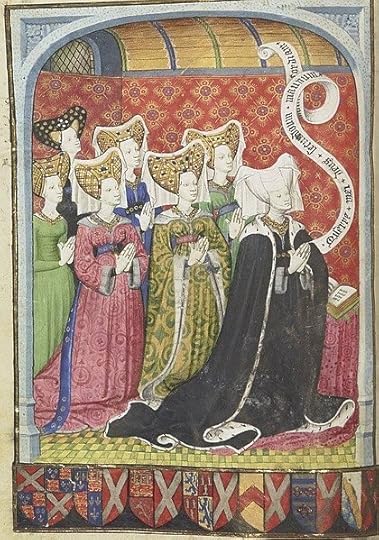
Image: Joan Beaufort, Countess of Westmorland, and her six daughters, from the Neville Book of Hours. Cecily is wearing a golden gown, with green patterns. (Source and another)
Fiction
The main plot points are dramatic and true, but it’s told from Cecily’s point of view. She’s an intelligent, bold, ambitious, and politically-savvy woman, playing the long game to secure her family’s wealth and power. She’s a shrewd judge of character and circumstance: she knows what to do to manipulate any particular person, supplies timely information (sometimes deliberately false: “It’s true if men believe it.”) to sway minds, and forges transactional (strategic) marriages for her children.
“The will of God… that any man - or woman indeed - may, according to their courage, shape His will to their purpose.”
Feminist
Cecily’s life is shown through a gently feminist lens. As she tells one of her daughters:
“Women, too, can forge alliances.”
This might involve a little modern wishful thinking - or maybe not: a real proto-feminist text, The City of Ladies, by Christine de Pizan, is mentioned a couple of times.
Maggie O'Farrell does something similar, though subtler, with The Marriage Portrait, which I reviewed HERE.

Image: Ludlow Castle, where Cecily remained, with her children, when her husband had to flee. (Source)
Historical fiction
I know enough of the history to have context, but not enough to be distracted by possible inaccuracies. The language is more contemporary colloquial than historical, but that quickly ceased to bother me: I accepted it as part of creating an accessible page-turner.
“When it is impossible to do a thing, you must simply find a way to make it appear to be done.”
It’s an action-packed narrative, with a lot of characters, some who share a name, and plenty who gain and lose titles (there are family trees at the back). Against a backdrop of continuous war, mostly with France, but also within the British Isles, there are many deaths: in battle, as well as in infancy:
“Prayer-swept souls, fledged too soon from their nests of bone.”
More contemplative passages immerse the reader in the hardships, and sometimes joyful simplicities, of the period.
My name
I rarely encounter my name in any context that doesn't refer to me personally. I've never met another Cecily (though I've met a Celia, a Cecilia, and a Cecil). As a child, I never had pens, t-shirts, or bags with my name printed on them. Perhaps that’s why my favourite Beatrix Potter was Cecily Parsley's Nursery Rhymes (which I reviewed here), and later, I was easily won over to Oscar Wilde by The Importance of Being Earnest (which I reviewed here). I’m not named after a famous Cecily from history of fiction, but after my maternal grandmother, who died in a car accident when my father was in his teens.
Quotes
• “God might anoint kings… but He can’t keep them there… Only nobles like yourself can do that.”
• “Another summer gives up the coin of its brightness, until the wind-torn colours of autumn fly… and the first frosts come shivering in to gild its trees in counterfeit silver.”
• “A man is only a traitor if he doesn’t win.”
“If a woman takes up arms, she must be very sure of winning.”
• “Velvet on velvet… It seems the scents of an Italian summer are trapped in its folds, or that, by some magic, the tiny marguerites patterned in its alternating depths carry the perfume of true flowers.”
• “She will do it for a dukedom.”
“It is for such marriages she had had daughters.”
• “A bright sword has no edge in a dull hand.”
Alternatively, from New Zealand:
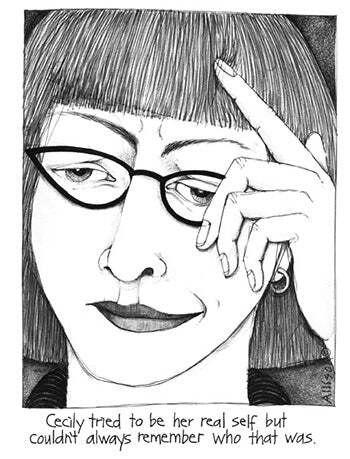
Image: Cecily, the cartoon character (Source)
A surprisingly interesting and enjoyable read. Cecily Neville was an English noblewoman in the 1400s. Her family were central figures in the Wars of the Roses and she was the mother of two kings (Edward IV and Richard III).
Image: Joan Beaufort, Countess of Westmorland, and her six daughters, from the Neville Book of Hours. Cecily is wearing a golden gown, with green patterns. (Source and another)
Fiction
The main plot points are dramatic and true, but it’s told from Cecily’s point of view. She’s an intelligent, bold, ambitious, and politically-savvy woman, playing the long game to secure her family’s wealth and power. She’s a shrewd judge of character and circumstance: she knows what to do to manipulate any particular person, supplies timely information (sometimes deliberately false: “It’s true if men believe it.”) to sway minds, and forges transactional (strategic) marriages for her children.
“The will of God… that any man - or woman indeed - may, according to their courage, shape His will to their purpose.”
Feminist
Cecily’s life is shown through a gently feminist lens. As she tells one of her daughters:
“Women, too, can forge alliances.”
This might involve a little modern wishful thinking - or maybe not: a real proto-feminist text, The City of Ladies, by Christine de Pizan, is mentioned a couple of times.
Maggie O'Farrell does something similar, though subtler, with The Marriage Portrait, which I reviewed HERE.
Image: Ludlow Castle, where Cecily remained, with her children, when her husband had to flee. (Source)
Historical fiction
I know enough of the history to have context, but not enough to be distracted by possible inaccuracies. The language is more contemporary colloquial than historical, but that quickly ceased to bother me: I accepted it as part of creating an accessible page-turner.
“When it is impossible to do a thing, you must simply find a way to make it appear to be done.”
It’s an action-packed narrative, with a lot of characters, some who share a name, and plenty who gain and lose titles (there are family trees at the back). Against a backdrop of continuous war, mostly with France, but also within the British Isles, there are many deaths: in battle, as well as in infancy:
“Prayer-swept souls, fledged too soon from their nests of bone.”
More contemplative passages immerse the reader in the hardships, and sometimes joyful simplicities, of the period.
My name
I rarely encounter my name in any context that doesn't refer to me personally. I've never met another Cecily (though I've met a Celia, a Cecilia, and a Cecil). As a child, I never had pens, t-shirts, or bags with my name printed on them. Perhaps that’s why my favourite Beatrix Potter was Cecily Parsley's Nursery Rhymes (which I reviewed here), and later, I was easily won over to Oscar Wilde by The Importance of Being Earnest (which I reviewed here). I’m not named after a famous Cecily from history of fiction, but after my maternal grandmother, who died in a car accident when my father was in his teens.
Quotes
• “God might anoint kings… but He can’t keep them there… Only nobles like yourself can do that.”
• “Another summer gives up the coin of its brightness, until the wind-torn colours of autumn fly… and the first frosts come shivering in to gild its trees in counterfeit silver.”
• “A man is only a traitor if he doesn’t win.”
“If a woman takes up arms, she must be very sure of winning.”
• “Velvet on velvet… It seems the scents of an Italian summer are trapped in its folds, or that, by some magic, the tiny marguerites patterned in its alternating depths carry the perfume of true flowers.”
• “She will do it for a dukedom.”
“It is for such marriages she had had daughters.”
• “A bright sword has no edge in a dull hand.”
Alternatively, from New Zealand:
Image: Cecily, the cartoon character (Source)

March 23, 2021
‘The Rose of Raby’ is Cecily Neville, daughter of Ralph Neville, the Earl of Westmorland. This well written and carefully researched historical fiction tells the story of strong women of late medieval times with the central focus on Cecily who marries Richard Plantagenet, the Duke of York. Their story is of love and talk as they navigate the treacherous waters of the mid fifteenth century. The book covers a thirty year period from 1431, starting with the death of Joan of Arc where Cecily demonstrates her strength of character and finishes when her son is crowned Edward IV in 1461.
I really like that the focus is on strong women, there are plenty of them in the Middle Ages but history (written for much of the time by men 😁) has chosen to ignore them until recent years. Here we have Cecily as the centrepiece, also Jacquetta who is married to Richard Woodville the first Earl Rivers and Marguerite of Anjou who marries the hapless (or is that hopeless?!) Henry VI. The characterisation is really good. Cecily is very astute politically, she’s nobody’s fool, is unafraid, she can be very ruthless when she needs to be and has earned her place in history as the mother of two kings - Edward IV and Richard III. Her marriage to Richard is strong, they have respect for each other and Richard is worthy of it. The historical backdrop takes the storytelling to France where English power is waning and Cecily guides and assists Richard in playing ‘French chess’, to England under a weak king who blows with the wind and the last voice who has hissed in his ear and also to Ireland. The turbulent times are captured well with the ruthless political machinations, greed, treachery and the politics of survival as it becomes dangerous for the couple in the form of the Beauforts and Marguerite. The beliefs such as religion and superstition, the difficulties and danger of childbirth are vividly portrayed as Cecily bears 12 (yes 12!) children. There’s treason and humiliation as ambition rises and falls, palpable grief but hope as Edward raises his ‘Sun in Splendour’ banner.
My only reservation lies in the quantity of the characters which I fully appreciate is the nature of this particular historical beast and that this is a very complex period so some historical background knowledge is really helpful although not essential.
Overall, this is a good, well written, meticulously researched and enjoyable read. I admire this strong wise woman who as the author points out in the really good epilogue that Cecily gives a good lesson in how to operate as a woman in a man’s world! I’m hoping there will be a second book as her story is not yet over .......
With thanks to NetGalley and Penguin General UK, Viking for the much appreciated arc in return for an honest review.
I really like that the focus is on strong women, there are plenty of them in the Middle Ages but history (written for much of the time by men 😁) has chosen to ignore them until recent years. Here we have Cecily as the centrepiece, also Jacquetta who is married to Richard Woodville the first Earl Rivers and Marguerite of Anjou who marries the hapless (or is that hopeless?!) Henry VI. The characterisation is really good. Cecily is very astute politically, she’s nobody’s fool, is unafraid, she can be very ruthless when she needs to be and has earned her place in history as the mother of two kings - Edward IV and Richard III. Her marriage to Richard is strong, they have respect for each other and Richard is worthy of it. The historical backdrop takes the storytelling to France where English power is waning and Cecily guides and assists Richard in playing ‘French chess’, to England under a weak king who blows with the wind and the last voice who has hissed in his ear and also to Ireland. The turbulent times are captured well with the ruthless political machinations, greed, treachery and the politics of survival as it becomes dangerous for the couple in the form of the Beauforts and Marguerite. The beliefs such as religion and superstition, the difficulties and danger of childbirth are vividly portrayed as Cecily bears 12 (yes 12!) children. There’s treason and humiliation as ambition rises and falls, palpable grief but hope as Edward raises his ‘Sun in Splendour’ banner.
My only reservation lies in the quantity of the characters which I fully appreciate is the nature of this particular historical beast and that this is a very complex period so some historical background knowledge is really helpful although not essential.
Overall, this is a good, well written, meticulously researched and enjoyable read. I admire this strong wise woman who as the author points out in the really good epilogue that Cecily gives a good lesson in how to operate as a woman in a man’s world! I’m hoping there will be a second book as her story is not yet over .......
With thanks to NetGalley and Penguin General UK, Viking for the much appreciated arc in return for an honest review.

June 12, 2022
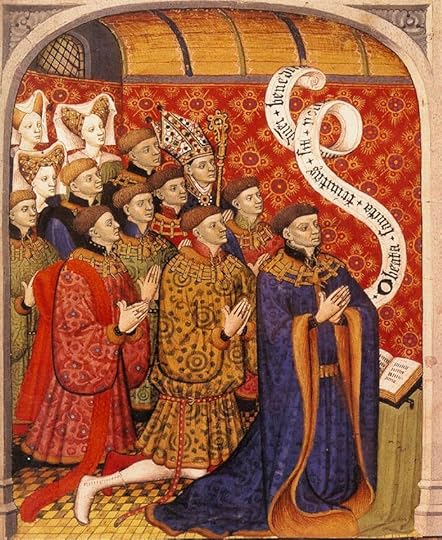
The Neville Book of Hours.
This was a surprise. But I was immediately thrilled because the blurb made a reference to Joan of Arc, whose biography I was reading in preparation for the Paul Claudel libretto Jeanne au bûcher that I wanted to read, and the opera by Arthur Honneger that I was going to watch. In the past I have done some reading on the Hundred Years War, but very little on the War of the Roses – I always found it very confusing.
The novel then starts appropriately-“1431 is a dangerous time for a woman to be defiant”. The end of one war and the seed of another one. And so Cecily Neville watches in Rouen on the 30th of May 1431 how Joan is put on a pyre. The end of one war and the seeds of the one that followed. From there we follow Cecily for thirty more years until her husband Richard the Duke of York and her son Edmond are killed, but her eldest Edward steps on the English throne in March 1461. Through these pages the reader will keep track of how this Cecily will form a family and will push through history to ensure that her loved ones take their place that she strongly believed corresponded them.
In the Afterword Annie Garthwaite tells us how she became interested in history and on the type of history that interested her. It was all thanks to one of her schoolteachers who insisted on the importance of considering that the actors in history were people with emotions and individual minds, and that when considering past events, it was crucial to try and understand the motivation behind the actions of these notorious doers. In sum, one had to try and bring them to life.
And that is exactly what Garthwaite does. Not just her Cecily, but all the nobles that enter her pages acquire a personality and stand out from the page in three dimensions. She is also a great storyteller, bringing sense and coherence to a very convoluted and complex period.
This is her first novel. I wish she would write a sequel.

August 4, 2022
4.5 stars
“Women have no swords, brother. We do our work by talking.”
Another historical novel. This time we are in the fifteenth century and looking at a woman who lived from 1415 to 1495 for what has been called a feminist retelling of the Wars of the Roses. It is certainly a study of how women made their way in the world. Cecily Neville was the wife of Richard, Duke of York and so was firmly in the Yorkist camp. She gave birth to twelve children, seven of whom lived. Two of her children became Kings of England, Edward VI and Richard III. She outlived them both. The novel covers the period 1431 to 1461, pretty much the period of her marriage. This was a slight disappointment as I would like to have followed Cecily for longer. The political situation is complex and the various alliances shift periodically. Garthwaite does a good job of charting them. The genealogies at the back are useful. There is no focus on battles or blood and gore, these take place in the background.
Garthwaite sums up her interest in Neville:
“For me, the stand out character of the 15th century has always been Cecily Neville. She experienced power in both directions: wielding it and having it wielded against her. She survived eighty years of tumultuous history, mothered kings, created a dynasty and brought her family through civil war. She met victory and defeat in equal measure and, in face of all, lived on. Last woman standing, you might say.”
All the kings and queens of England since are descended from her. This is an excellent account of a too little known character.
“Women have no swords, brother. We do our work by talking.”
Another historical novel. This time we are in the fifteenth century and looking at a woman who lived from 1415 to 1495 for what has been called a feminist retelling of the Wars of the Roses. It is certainly a study of how women made their way in the world. Cecily Neville was the wife of Richard, Duke of York and so was firmly in the Yorkist camp. She gave birth to twelve children, seven of whom lived. Two of her children became Kings of England, Edward VI and Richard III. She outlived them both. The novel covers the period 1431 to 1461, pretty much the period of her marriage. This was a slight disappointment as I would like to have followed Cecily for longer. The political situation is complex and the various alliances shift periodically. Garthwaite does a good job of charting them. The genealogies at the back are useful. There is no focus on battles or blood and gore, these take place in the background.
Garthwaite sums up her interest in Neville:
“For me, the stand out character of the 15th century has always been Cecily Neville. She experienced power in both directions: wielding it and having it wielded against her. She survived eighty years of tumultuous history, mothered kings, created a dynasty and brought her family through civil war. She met victory and defeat in equal measure and, in face of all, lived on. Last woman standing, you might say.”
All the kings and queens of England since are descended from her. This is an excellent account of a too little known character.

June 30, 2021
A strong 3***.
Before reading this book, I must admit, I had no clue who Cecily Neville was. As someone who is not particularly interested in England’s royal lines, I was drawn to this book by its focus on an influential female who is severely underrated and left out of books/teaching.
Cecily isn’t necessarily a likeable character- she’s ruthless brutal, callous and extremely ambitious. It was interesting to see her influence and manipulation on all aspects of her life: including the children, her husband and her household.
The first parts of this book follow her and Richard as they gain and fall out of favour with the current King, and the repercussions of this. I loved reading that Richard and Cecily actually seemingly loved each other, which was rare during those times when daughters and sons were married for alliances and heirs.
This book focuses on how instrumental Cecily was in manoeuvring her family and made connections, to put her family in a place of power, and eventually own the crown.
While this was a great historical fiction novel that had clearly been deeply researched, I would say that this book is maybe not for people like me, who do not have much knowledge of the royal line. I’d recommend this book to people who are interested in the war of the roses, who already know the main players, and want to see things from Cecily’s perspective.
In addition, this is very politically heavy-handed, so if you’re looking for constant action and tension, this does not pick up until the last third of the book.
*Thank you to NetGalley for providing this Arc to me.*
Before reading this book, I must admit, I had no clue who Cecily Neville was. As someone who is not particularly interested in England’s royal lines, I was drawn to this book by its focus on an influential female who is severely underrated and left out of books/teaching.
Cecily isn’t necessarily a likeable character- she’s ruthless brutal, callous and extremely ambitious. It was interesting to see her influence and manipulation on all aspects of her life: including the children, her husband and her household.
The first parts of this book follow her and Richard as they gain and fall out of favour with the current King, and the repercussions of this. I loved reading that Richard and Cecily actually seemingly loved each other, which was rare during those times when daughters and sons were married for alliances and heirs.
This book focuses on how instrumental Cecily was in manoeuvring her family and made connections, to put her family in a place of power, and eventually own the crown.
While this was a great historical fiction novel that had clearly been deeply researched, I would say that this book is maybe not for people like me, who do not have much knowledge of the royal line. I’d recommend this book to people who are interested in the war of the roses, who already know the main players, and want to see things from Cecily’s perspective.
In addition, this is very politically heavy-handed, so if you’re looking for constant action and tension, this does not pick up until the last third of the book.
*Thank you to NetGalley for providing this Arc to me.*

January 22, 2021
Sometimes a work of historical fiction comes along that transcends its genre. Cecily is one of those rare novels, written with such poetry that at times you just stop and stare at the words, yet blending the narrative drive of desperate times with a deep insight into the medieval psyche. We expect historical novelists to have done their research, but Annie Garthwaite’s writing carries that knowledge with such lightness that we cannot doubt that her understanding is profoundly expert, that her Cecily Neville is a character she knows intimately, whose skin she has worn in a labour of love. Here is a story that is both moving and unsentimental and a new type of historical heroine, a character of passion and steel who keeps us at a distance, who knows our rank and our place, who gives us no more than she wishes and leaves us as mere courtiers, waiting on the edge of her attention.

January 1, 2023
AN INTERESTING WOMAN FINALLY GETS HER VOICE
I have always had a fondness for English history, the Tudors and the Wars of the Roses. And I have long felt that Cecily Neville was a sort of shadowy figure, a woman always on the fringes of the story but never at the center. I longed for her to have her voice, to hear her story. To have her be the center of attention. Garthwaite did her proud.
👍 What I Liked 👍
Foreshadowing: As someone who has read a lot about the Wars of the Roses, I absolutely loved the little nuggets of foreshadowing sprinkled throughout this story. It felt like little Easter Eggs left for me to find. It felt almost playful without taking away from the seriousness of the subject matter. It was brilliant.
Cecily: Of course I was instantly obsessed with Cecily. I loved how Garthwaite chose to portray her. I loved the role she was afforded - not only in her own story but in the history of the Wars of the Roses and the eventual victory of her son. Garthwaite gave Cecily such autonomy, strength of character, tenacity and willpower it was a pleasure to read this version of her. I would never myself have imagined Cecily as this type of woman, but after reading this, I think it was mainly because no one else has ever given Cecily any sort of character as all. This version was both refreshing and necessary.
Scope: When I first started out with this story, I expected the main focus to be on the later period of Cecily's life - when she is the mother of two kings and grandmother of a third. But I was actually pleasantly surprised to find out that Garthwaite had chosen to focus solely on the period in Cecily's life before she was raised so high in the world. Here, we get the story of the end War of the Roses as seen through the eyes of one women who was probably closest to the action - and perhaps a greater part of it than anyone of us will ever know.
Follow me for more book loving content!
Blog ✨ Facebook ✨ Instagram ✨ Twitter
Blog Post: Which Book Should you read next based on your favourite Jane Austen Heroine
I have always had a fondness for English history, the Tudors and the Wars of the Roses. And I have long felt that Cecily Neville was a sort of shadowy figure, a woman always on the fringes of the story but never at the center. I longed for her to have her voice, to hear her story. To have her be the center of attention. Garthwaite did her proud.
👍 What I Liked 👍
Foreshadowing: As someone who has read a lot about the Wars of the Roses, I absolutely loved the little nuggets of foreshadowing sprinkled throughout this story. It felt like little Easter Eggs left for me to find. It felt almost playful without taking away from the seriousness of the subject matter. It was brilliant.
Cecily: Of course I was instantly obsessed with Cecily. I loved how Garthwaite chose to portray her. I loved the role she was afforded - not only in her own story but in the history of the Wars of the Roses and the eventual victory of her son. Garthwaite gave Cecily such autonomy, strength of character, tenacity and willpower it was a pleasure to read this version of her. I would never myself have imagined Cecily as this type of woman, but after reading this, I think it was mainly because no one else has ever given Cecily any sort of character as all. This version was both refreshing and necessary.
Scope: When I first started out with this story, I expected the main focus to be on the later period of Cecily's life - when she is the mother of two kings and grandmother of a third. But I was actually pleasantly surprised to find out that Garthwaite had chosen to focus solely on the period in Cecily's life before she was raised so high in the world. Here, we get the story of the end War of the Roses as seen through the eyes of one women who was probably closest to the action - and perhaps a greater part of it than anyone of us will ever know.
Follow me for more book loving content!
Blog ✨ Facebook ✨ Instagram ✨ Twitter
Blog Post: Which Book Should you read next based on your favourite Jane Austen Heroine

March 13, 2024
The Wars of the Roses (posthumously-named) was a bitter time in English history as cousins murdered cousins, brothers mutilated brothers and everyone grappled at the crown wanting to make it his own. Simplified into the House of York (white rose) against House of Lancaster (red rose); the descendents of Edward III never stood still: King Henry VI and his queen, Margaret of Anjou, the Beauforts, the Nevilles, Jaquetta of Luxembourg, the Tudors and of course Richard, Duke of York, his nephew Richard, Earl of Warwick (the ‘Kingmaker’) and of course… York’s wife, Cecily, Duchess of York. Cecily is always on the peripheral of both history books and historical-fiction as the wife of York and the mother to two kings (Edward and Richard III) and is hinted at as calculating, conniving and a bitch but yet she has rarely received the spotlight exploring her true role in events and her character. Anne Garthwaite spits on this shunning of Cecily and makes her the subject of a rich historical-fiction novel in, “Cecily’.
One can usually tell within the first chapter of a novel the caliber of the content be it amateur, solidly-average or masterful. Where does “Cecily” lay on this spectrum? Let’s just say ‘masterful’ is an understatement as Garthwaite doesn’t even wait an entire chapter to prove her writing skills but sparkles immediately within the first few pages instantly dropping the jaws of readers. The book is barely even opened and yet the pages spill out with colorful, vivid descriptions, beautiful scores of language, emotive events and even philosophical meanderings. If you don’t exhale a, “Holy shit!” then you are simply immovable. One would never guess that this is Garthwaite’s debut novel and well into her 50s as her writing is stunning, exceptional and soul-moving.
“Cecily” follows the course of events from Cecily and Richard’s early marriage through childbirth to future kings, the civil uprisings of the Wars of the Roses, contending with an ‘unwell’ king and onward to the bloodiest battle in English history (Towton) and Edward coming to the throne. Often times historical fiction waters down history like a thinned wine given to children on holidays and fluffs it up with a focus on period-piece entertainment. Garthwaite eschews this and focuses on the history of the period, politics, and the Wars of the Roses while intermeshing these with a character-driven drama with Cecily serving as its sun. “Cecily” is brimming with luscious historical fact and readers feel that they are a part of the plot while the tapestry is woven around them versus simply being a spectator. In fact, “Cecily” is rendered so ‘real’ (which can probably be attributed to Garthwaite’s decades-long thorough research); that one will have to pinch him/herself as a reminder that this is NOT a history text and is only based on fact.
Garthwaite’s writing is so glorious, captivating, deeply-drenched with emption and metaphorical; that she stands on-par with the historical-fiction genre’s leading authors (I need not list them here as all history buffs and English historical-fiction fans known to whom I refer). The temptation stands to take breaks from the reading in order to preserve the text and not finish too quickly. The pace is lively, drums with a life force of a universe and envelops readers even in ‘slower’ parts.
“Cecily” does fall victim to a weakness which is that of a, “As you know, Bob” – style of storytelling where the characters discuss the events (in this case Cecily and Richard) versus actually living them. Usually, this is a cause for a collective groan and dampens the credibility of the novel. Somehow,that is not an accusable trait of “Cecily”. The ‘discussions’ make sense in “Cecily” being that many women didn’t have the legal or temporal rights to engage in events first-hand and had to partake in machinations through their husbands. It also helps to sharply follow the character arc, growth and changes of Cecily’s personality. Garthwaite is able to cut out all the parts of Cecily - be it a protective mother, devoted wife, bitter political figure and eventually a yearning hand at the throne for her husband and then her son at the death of her husband. “Cecily” is both a macro and micro view of this formidable woman and showcases her entirely versus compartmentalizing her in a box.
Even if “Cecily” kept on this train track and rode it all the way to the concluding station; it would stand as a remarkable novel – but Gathwaite doesn’t rest. At approximately the 180-page mark, “Cecily” becomes even bolder, louder, invigorating and obsessively delicious as the Wars of the Roses kick into high gear and Cecily and Richard battle for the crown. This isn’t a part of history that is hidden and Richard, Cecily and the Earl of Warwick often play key roles but this is a fresh and revolved perspective. Even those staunchly history-focused and well-versed in the subject; will find themselves understanding the events in a new way and casting aside previous judgments they had of these figures. It isn’t that Garthwaite attempted to rehabilitate this cast of characters with “Cecily” but more so that her research penetrates the pages and offers a new, credible and firm view.
“Cecily” is engaging to the core until its final chapters and pages that end with fanfare and yet without “trying too hard” or simply squeezing water out of a sponge. “Cecily” is truly magnetic and breathtaking shutting its cover in a memorable way and with the ability to both entertain and educate.
Missing is a section that would explore any major derivatives from the history taken by the author which would help those new to the subject; but this isn’t a major detriment although worth noting.
“Cecily” is a dramatic, complex, riveting, tour de force of a novel that is absolutely dazzling from start to finish. “Cecily” is recommended for all English history fans, particularly of the Wars of the Roses and those with a feminist attraction to the powerful female goddesses who ‘ruled’ behind the scenes. I can only hope – nay, BEG – Garthewaite to pen another novel and not bow out now.
One can usually tell within the first chapter of a novel the caliber of the content be it amateur, solidly-average or masterful. Where does “Cecily” lay on this spectrum? Let’s just say ‘masterful’ is an understatement as Garthwaite doesn’t even wait an entire chapter to prove her writing skills but sparkles immediately within the first few pages instantly dropping the jaws of readers. The book is barely even opened and yet the pages spill out with colorful, vivid descriptions, beautiful scores of language, emotive events and even philosophical meanderings. If you don’t exhale a, “Holy shit!” then you are simply immovable. One would never guess that this is Garthwaite’s debut novel and well into her 50s as her writing is stunning, exceptional and soul-moving.
“Cecily” follows the course of events from Cecily and Richard’s early marriage through childbirth to future kings, the civil uprisings of the Wars of the Roses, contending with an ‘unwell’ king and onward to the bloodiest battle in English history (Towton) and Edward coming to the throne. Often times historical fiction waters down history like a thinned wine given to children on holidays and fluffs it up with a focus on period-piece entertainment. Garthwaite eschews this and focuses on the history of the period, politics, and the Wars of the Roses while intermeshing these with a character-driven drama with Cecily serving as its sun. “Cecily” is brimming with luscious historical fact and readers feel that they are a part of the plot while the tapestry is woven around them versus simply being a spectator. In fact, “Cecily” is rendered so ‘real’ (which can probably be attributed to Garthwaite’s decades-long thorough research); that one will have to pinch him/herself as a reminder that this is NOT a history text and is only based on fact.
Garthwaite’s writing is so glorious, captivating, deeply-drenched with emption and metaphorical; that she stands on-par with the historical-fiction genre’s leading authors (I need not list them here as all history buffs and English historical-fiction fans known to whom I refer). The temptation stands to take breaks from the reading in order to preserve the text and not finish too quickly. The pace is lively, drums with a life force of a universe and envelops readers even in ‘slower’ parts.
“Cecily” does fall victim to a weakness which is that of a, “As you know, Bob” – style of storytelling where the characters discuss the events (in this case Cecily and Richard) versus actually living them. Usually, this is a cause for a collective groan and dampens the credibility of the novel. Somehow,that is not an accusable trait of “Cecily”. The ‘discussions’ make sense in “Cecily” being that many women didn’t have the legal or temporal rights to engage in events first-hand and had to partake in machinations through their husbands. It also helps to sharply follow the character arc, growth and changes of Cecily’s personality. Garthwaite is able to cut out all the parts of Cecily - be it a protective mother, devoted wife, bitter political figure and eventually a yearning hand at the throne for her husband and then her son at the death of her husband. “Cecily” is both a macro and micro view of this formidable woman and showcases her entirely versus compartmentalizing her in a box.
Even if “Cecily” kept on this train track and rode it all the way to the concluding station; it would stand as a remarkable novel – but Gathwaite doesn’t rest. At approximately the 180-page mark, “Cecily” becomes even bolder, louder, invigorating and obsessively delicious as the Wars of the Roses kick into high gear and Cecily and Richard battle for the crown. This isn’t a part of history that is hidden and Richard, Cecily and the Earl of Warwick often play key roles but this is a fresh and revolved perspective. Even those staunchly history-focused and well-versed in the subject; will find themselves understanding the events in a new way and casting aside previous judgments they had of these figures. It isn’t that Garthwaite attempted to rehabilitate this cast of characters with “Cecily” but more so that her research penetrates the pages and offers a new, credible and firm view.
“Cecily” is engaging to the core until its final chapters and pages that end with fanfare and yet without “trying too hard” or simply squeezing water out of a sponge. “Cecily” is truly magnetic and breathtaking shutting its cover in a memorable way and with the ability to both entertain and educate.
Missing is a section that would explore any major derivatives from the history taken by the author which would help those new to the subject; but this isn’t a major detriment although worth noting.
“Cecily” is a dramatic, complex, riveting, tour de force of a novel that is absolutely dazzling from start to finish. “Cecily” is recommended for all English history fans, particularly of the Wars of the Roses and those with a feminist attraction to the powerful female goddesses who ‘ruled’ behind the scenes. I can only hope – nay, BEG – Garthewaite to pen another novel and not bow out now.
August 23, 2021
[REPOSTED FROM TUMBLR]:
TL;DR: Perhaps I’ve been especially generous with my rating. There are two possible reasons for this: a) I have a bit more of a sense of the backstory that went into this book (thanks to the afterword and the talk I attended on Zoom with her and Laynesmith) and it made me appreciate some aspects of it which I might not have otherwise - or at least understand them. b) I have been so traumatised by the abysmal and derivative writing of other books from this genre to the point that a book like this, which in other times I would have, perhaps, considered average in terms of historicity and prose, now leaves me impressed… basically I’m surprised because this book was actually really good?
When I heard it was coming out I thought there was no way I was going to buy it. A book which purports to give me a ‘feminist’ retelling of the life of a historical figure? NO WAY. It got worse when I found that the said figure purportedly ‘ignored by history’ was the same Cecily Neville who atm surpasses two of her sons in terms of volume of written material about them. Then @pythionice told me about the talk with Laynesmith and one thing led to another… not to mention the goodreads reviews were stellar and full with comparisons to Mantel’s Wolf Hall. This was highly encouraging. So I sat down with a couple of others (@nuingiliath and @feuillesmortes to name some), decided to buy the book and see what the future of TWOTR histfic has to offer…
Plot: We follow Cecily Neville Duchess of York (and only Cecily Neville Duchess of York - keep this in mind as it’s important later on) from her tween years all the way to her son Edward’s ascension in 1461. Even though I’m familiar with the first phase of TWOTR, I must confess I don’t know it historiographically like I know the York in-fighting period. Therefore, I can’t heavily comment on the inaccuracies or details. Although, at certain points I do feel like the author inserted Cecily in situations where the players were other people and in which she played no part to give her greater agency eg Cardinal Beaufort’s intercession for Jacquetta, the various meetings RoY held with his stewards and war council… etc. The first years of Cecily’s lives are skimmed over and the bulk of the story focuses on her life between the time of Richard Duke of York (RoY)‘s Norman governorship and the aftermath of Towton. While I would have preferred to have seen more of the childhood Cecily shared with RoY in Westmoreland’s home - since I would have liked to see some more ‘young Cecily’ instead of the old woman we are used to - I am happy to have once again dipped my toes into the decades prior to when York vs Lancaster became (in any way) a thing. This way I got to read a narrative more geared towards assessing the individuals one by one, as the author was prevent from falling into the red vs white rose dichotomy plot device, which I have seen swallow up too many of the weaker authors who throw subtlety out of the window because of the dramatic promise a York vs Lancaster story offers.
There is not much more to say about the plot per se. Although, I do recommend this book for anyone who wants to see RoY’s Irish lieutenancy in prose. I have no complaints about how the Irish situations was portrayed and these segments (though too few) were my absolute favourite parts. I also have great admiration for how the author managed to convey to the reader, throughout, a sense of how and why the tensions between RoY and HVI’s circle had so escalated by the beggining of the 1460s. The portrayal of this was chalk-full with history, recounting each and every minor event and external cause and their significance; painting a robust cause and effect chain for the reader to understand how the hot-war, we all know with great clarity, came to be. I believe the author’s greatest feat was managing to interweave information into the narrative by showing and never telling. I’m serious when I call this a feat. Not once did Garthwaite break out into history textbook dryness - a la Sunne in Splendour - to get the reader understanding what was going on. She also appears to have chosen her timeline well enough to not give us ‘as you know bobs’, with the main characters digest the aftermath of each news and council meeting as they came. Could the prose being in present-tense have helped? I wonder. Although it was quite a gamble as it may have cost the novel in atmosphere (more on that later).
Characterisation: Well, I suspect this is the review heading that will be most controversial. We are so fixed in Cecily’s head to the point where the plot is essentially only reachable through the filter of her opinions and personal convictions. Therefore, if you have any qualms with how history is portrayed in this book, you ought to take it up with the choices made in Cecily’s characterisation. I really do feel like Garthwaite was strong enough a writer to have established that Cecily is not wholly reliable as a narrator (this book is written in third person limited POV) - although you may disagree with me. For example, Margaret of Anjou and Jacquetta of Luxembourg (who are sort of like Cecily’s most developed antagonists/rivals ) are shown to act in ways that don’t match Cecily’s impression of them and this happens several times. They are nothing but courteous towards her when she almost faints during the My Lady of Walsingham pilgrimage in 1453/4, and they outwardly seem to be genuine while Cecily is show to have only joined them for ulterior motives. The author is unapologetic about this. We also see Cecily’s attitude towards them soften for one hot second during that chapter ; only to turn with the escalation of the political conflict after St Albans when she turns back to enmity but for good reason. Also, she is constantly shown to have underestimated Margaret of Anjou’s strength as early as when we first meet her on her way to become Henry VI’s wife. Basically, Cecily thinks she’s the most hard-ass women of the late 15th century, but the reader can keenly see that she has competition. Even Jacquetta which is a bit of a flirt and over-interested in gossip occasionally hits Cecily with a subtle remark (eg when the latter asked the former about Edward of Lancaster’s legitimacy) or is shown to read the room perfectly even when Cecily often doesn’t credit her (and sometimes she does).
In a genre like this where we get certain quasi-medieval archetypes recycled e.g. the protective lioness mother and her cubs, the ice queen, the mater dolorossa, the spunky feminist heroine, the gruff hard bitten warrior with few words to spare, the cold and ambitious chief advisor etc etc. You can, then, imagine that I found it a bit disarming yet refreshing to behold the modern, middle-class, middle aged businesswoman inserted into a 15th century setting. Genuine authenticity imo is almost impossible to achieve in this genre without a rich background in the literature and culture of this era (not to mention Catholic religiosity). Mastery of these is often a lot to ask of a regular novelist and I think that sometimes it’s good to just quit while you’re ahead. I think it’s a good strategy to unapologetically add your own twist to the story, as Garthwaite did, letting your own experiences guide the way you interpret the ambiguities in history. I loved seeing the author’s business background squirrel itself into Cecily’s characterisation and some of her speech e.g. ‘good we needed one’ (in response to one the Irish chieftains rising against RoY) or ‘they know what I tell them’ etc (these are just some of the few examples I tried to find while skimming through - but you’ll get it when you see it). The sprightly cover, present tense of this book really harmonised her business-like characterisation of Cecily with the snappiness of the prose - yet somehow this novel still felt more in-period than some other novels that try way harder? While picturing Cecily in my mind, I could hear her voice and imagine her life-like facial expressions and mannerisms as they were familiar to a 21st century ready… but what I saw was still a medieval woman and not one in a power-suit. I really like to see an author harnessing her own personal experiences, contributing her own spin to the canon of TWOTR fiction. The unapologetically modern bent on certain aspects of Cecily’s speech and views also helped me relate to her (through both her good and bad qualities) and I feel like the author’s decision to trade some of the authenticity for reader-character relatability was a strategic success.
And what of the other characters? Well, I wasn’t joking when I said this book really is rooted in Cecily’s head. Some of the other characterisations are so bare that we often get a figure reduced to one thing/personality trait - Warwick: Swaggery, Holland: His dogs, Elizabeth and Richard Woodville: their hair colour. Ngl, down the line I found the repetition of the ‘Golden Woodville’ or Holland and his slobbery dogs endearing and quite funny. I also felt like the repetition of these traits was so constant that the author was trying to show that certain figures, Cecily didn’t consider consequential in her life (although I think Warwick will get more development in the next book) so she just reduces them to one trait. This just reinforces how limited the POV is. It’s a good save for anyone who would accuse the author of being reductive/ dismissive towards certain figures - because Garthwaite surely couldn’t mean the historical Henry Holland to just be his dogs , but through Cecily we don’t get much more complexity and that’s just a limited POV thing not a statement that certain historical figures were inherently menign and we should consider them so. Contrast this to the Sunne in Splendour which does the opposite and purports to give us a full picture of every single figure that interacts with Richard III yet fails to do so leading to some portrayals which have genuinely given me second-hand offense. I already spoke about the women around Cecily, what about her husband RoY? Although I would have wanted a bit more depth, I still felt for him boomer-like and a bit naïve as he was - but by the time we got to his breaking point I would have liked to have seen a more radical change to his attitude towards the crown and a clearer turning point in characterisation in his ‘I’ve had enough’ moments. Nevertheless, I will applaud how the author showed RoY’s turn to rebellion as the culmination of a subtle and slow-burning disillusionment festering in him - but it might have been too slow and subtle in the end and I remember asking myself ‘when, when, when do we get the foolish and flamboyant Duke of Yor ?’ while I was approaching the end. Just like with the other figures - I feel like it’s safely hinted in the text that there is more to RoY than we see in the book but we are just not going all the way there. It made sense as there were many times when Cecily seemed obtuse towards him, not trying to understand the situation from his POV. P.S I really loved William Oldhall - a minor character but one I loved seeing on the page each time and really felt for when he died. Also shout-out to me feeling warm and gooey when Warwick was a proud papa at Isabel’s birth or whenever George’s Irish birth was referred to (her little Irish dragon 🥲).
Prose: Everyone who follows me for some time knows that pretty much everything flies under my nose as long as the prose in which it’s written is good enough. This is why I never miss the chance to sing Jarman’s praises no matter how often she defames my favourites or busts out with her extreme Richardianism. One of the first things I noticed about this book was the prose. It was really really good (although far different from either my style or the style of my favourite novels and not actually my ideal). Not only was the word choice great at many times (successfully conveying what I’ve been describing above) but the sentence structure was extremely varied and dynamic. The goodreads reviewers really weren’t kidding when they called it the next wolf hall (although from what I know of WH the styles are a bit different with Mantel being a bit artsier and more philosophic than Garthwaite but less clear). I’ve seen it avoid prose pitfalls we find in certain histfic classics: slamming the brakes in the plot at certain points to give us meaningless and long-winded vignettes or expositions of certain figures, their feelings (or motivation - yuck! - or events. Whenever Garthwaite does this it’s usually a tiny sentence or two and ,so, doesn’t take you out of the story. Physical descriptions of nature, people and jewellery were done with great originality and often contributed to the themes e.g. the river-emotions motif (particularly with regards to how Cecily’s attitude towards her fertility/pregnancy). The wit and snark throughout the book did not prevent certain scenes packing an emotional punch eg Cecily’s reaction to RoY’s death, her daughter Anne’s jabs at her, that one scene with the Irish stone which will forever live rent free in my mind (and served as an excellent example of how a scene can be both emotive and humorous/light-hearted), the story behind RoY’s ruby ring…
The characters really really felt real and there was not a moment where we lost sight of that even though at certain points I did feel like the book was being heavy-handed about Cecily’s excellent political qualities to the point of unrealism (she coming up with most of the plans, strategies and schemes). The dynamic, original and bold prose really saved much of this book from its weaker plot/characterisation choices and breathed life into certain plot devices (eg Woman that knows better than her husband) that had otherwise long dried up by the time of this book for overuse. The prose may not be original or rare within modern fiction as a whole (although I wouldn’t know as I only read post-1940 fiction when it’s historical fiction) , but I certainly think it is in TWOTR /medieval fiction. I’ll say it again - too often authors not particularly well versed in the cultural-literary-artistic side of this era, try their hand at constipated purple prose in an attempt to create atmosphere. I will be honest. I don’t think ‘purple prose’ can be avoided if you want to create an authentic atmosphere (you’ve surely noticed how overblown the literature and even normal speech of that time was in terms of vocabulary and adjectives when compared to ours) - minimalism and crispness wasn’t a thing in at that time. Thus far, I can only say Lytton-Bulwer’s purple prose was successful, with Jarman’s coming close as well. Everyone else I’ve read, tries their hands at medievalising their plot through prose but roots all their other aspects such as characterisation and plot arcs into their times and have failed imo. Garthwaite doesn’t even try. She sits halfway between modern-medieval in all things: characterisation, prose, plot arcs etc so we don’t end up with an awkward pastiche that reads like a bodice-ripper. Oddly by bringing her own spin to the prose by making it snappier, wittier and some of the dialogue more modern and reminiscent of a modern business environment rather than a poor attempt at Shakespeare, we end up with an overall experience that feels engaging and smart as we are both appealed to through the closeness we feel towards characters who speak and think in a similar way as we do, but are transported to a different time via the instances when medieval culture and attitude is interweaved to provide us with colour and a rich backdrop. This sets our aforementioned feeling of proximity to the historical premises making for a successful novel. It’s a self-aware book… that’s what I’m getting at. Its no Brothers Karamazov, and nor does it try to be. This makes it more unforgettable to me than its topic, which on the face of it isn’t so unique (there have been many other books written about Cecily).
… In conclusion, this author clearly put her heart into this book and it really shows that she wasn’t out to just get a quick buck. I still don’t consider it as good as Jarman and Lytton-Bulwer in terms of artistry, power or ‘quality’ so I take out one star to show this. While Lytton-Bulwer’s work is objectively superior and transcends historical fiction even when focused on the same events, this one has no ‘deeper meaning/insight into the human condition’. Neither does Jarman’s works, so I suppose my rating of this book over hers is arbitrary? I guess they are both great in different ways. However, I think the fact that certain innacuracies and oversights didn’t seem to have been made for any genuine artistic reason (this is actually also the case in Jarman’s We Speak no Treason but I’ll get to that later) I will neg a star. Having said that, while I was very pleased with this book, some of the foreshadowing made me very very scared that I won’t like the sequel nearly as much. I’ve seen too many good books utterly ruined by authors’ whose Richardianism know no limits, and I believe I am right to be scared. Well here’s hoping.
TL;DR: Perhaps I’ve been especially generous with my rating. There are two possible reasons for this: a) I have a bit more of a sense of the backstory that went into this book (thanks to the afterword and the talk I attended on Zoom with her and Laynesmith) and it made me appreciate some aspects of it which I might not have otherwise - or at least understand them. b) I have been so traumatised by the abysmal and derivative writing of other books from this genre to the point that a book like this, which in other times I would have, perhaps, considered average in terms of historicity and prose, now leaves me impressed… basically I’m surprised because this book was actually really good?
When I heard it was coming out I thought there was no way I was going to buy it. A book which purports to give me a ‘feminist’ retelling of the life of a historical figure? NO WAY. It got worse when I found that the said figure purportedly ‘ignored by history’ was the same Cecily Neville who atm surpasses two of her sons in terms of volume of written material about them. Then @pythionice told me about the talk with Laynesmith and one thing led to another… not to mention the goodreads reviews were stellar and full with comparisons to Mantel’s Wolf Hall. This was highly encouraging. So I sat down with a couple of others (@nuingiliath and @feuillesmortes to name some), decided to buy the book and see what the future of TWOTR histfic has to offer…
Plot: We follow Cecily Neville Duchess of York (and only Cecily Neville Duchess of York - keep this in mind as it’s important later on) from her tween years all the way to her son Edward’s ascension in 1461. Even though I’m familiar with the first phase of TWOTR, I must confess I don’t know it historiographically like I know the York in-fighting period. Therefore, I can’t heavily comment on the inaccuracies or details. Although, at certain points I do feel like the author inserted Cecily in situations where the players were other people and in which she played no part to give her greater agency eg Cardinal Beaufort’s intercession for Jacquetta, the various meetings RoY held with his stewards and war council… etc. The first years of Cecily’s lives are skimmed over and the bulk of the story focuses on her life between the time of Richard Duke of York (RoY)‘s Norman governorship and the aftermath of Towton. While I would have preferred to have seen more of the childhood Cecily shared with RoY in Westmoreland’s home - since I would have liked to see some more ‘young Cecily’ instead of the old woman we are used to - I am happy to have once again dipped my toes into the decades prior to when York vs Lancaster became (in any way) a thing. This way I got to read a narrative more geared towards assessing the individuals one by one, as the author was prevent from falling into the red vs white rose dichotomy plot device, which I have seen swallow up too many of the weaker authors who throw subtlety out of the window because of the dramatic promise a York vs Lancaster story offers.
There is not much more to say about the plot per se. Although, I do recommend this book for anyone who wants to see RoY’s Irish lieutenancy in prose. I have no complaints about how the Irish situations was portrayed and these segments (though too few) were my absolute favourite parts. I also have great admiration for how the author managed to convey to the reader, throughout, a sense of how and why the tensions between RoY and HVI’s circle had so escalated by the beggining of the 1460s. The portrayal of this was chalk-full with history, recounting each and every minor event and external cause and their significance; painting a robust cause and effect chain for the reader to understand how the hot-war, we all know with great clarity, came to be. I believe the author’s greatest feat was managing to interweave information into the narrative by showing and never telling. I’m serious when I call this a feat. Not once did Garthwaite break out into history textbook dryness - a la Sunne in Splendour - to get the reader understanding what was going on. She also appears to have chosen her timeline well enough to not give us ‘as you know bobs’, with the main characters digest the aftermath of each news and council meeting as they came. Could the prose being in present-tense have helped? I wonder. Although it was quite a gamble as it may have cost the novel in atmosphere (more on that later).
Characterisation: Well, I suspect this is the review heading that will be most controversial. We are so fixed in Cecily’s head to the point where the plot is essentially only reachable through the filter of her opinions and personal convictions. Therefore, if you have any qualms with how history is portrayed in this book, you ought to take it up with the choices made in Cecily’s characterisation. I really do feel like Garthwaite was strong enough a writer to have established that Cecily is not wholly reliable as a narrator (this book is written in third person limited POV) - although you may disagree with me. For example, Margaret of Anjou and Jacquetta of Luxembourg (who are sort of like Cecily’s most developed antagonists/rivals ) are shown to act in ways that don’t match Cecily’s impression of them and this happens several times. They are nothing but courteous towards her when she almost faints during the My Lady of Walsingham pilgrimage in 1453/4, and they outwardly seem to be genuine while Cecily is show to have only joined them for ulterior motives. The author is unapologetic about this. We also see Cecily’s attitude towards them soften for one hot second during that chapter ; only to turn with the escalation of the political conflict after St Albans when she turns back to enmity but for good reason. Also, she is constantly shown to have underestimated Margaret of Anjou’s strength as early as when we first meet her on her way to become Henry VI’s wife. Basically, Cecily thinks she’s the most hard-ass women of the late 15th century, but the reader can keenly see that she has competition. Even Jacquetta which is a bit of a flirt and over-interested in gossip occasionally hits Cecily with a subtle remark (eg when the latter asked the former about Edward of Lancaster’s legitimacy) or is shown to read the room perfectly even when Cecily often doesn’t credit her (and sometimes she does).
In a genre like this where we get certain quasi-medieval archetypes recycled e.g. the protective lioness mother and her cubs, the ice queen, the mater dolorossa, the spunky feminist heroine, the gruff hard bitten warrior with few words to spare, the cold and ambitious chief advisor etc etc. You can, then, imagine that I found it a bit disarming yet refreshing to behold the modern, middle-class, middle aged businesswoman inserted into a 15th century setting. Genuine authenticity imo is almost impossible to achieve in this genre without a rich background in the literature and culture of this era (not to mention Catholic religiosity). Mastery of these is often a lot to ask of a regular novelist and I think that sometimes it’s good to just quit while you’re ahead. I think it’s a good strategy to unapologetically add your own twist to the story, as Garthwaite did, letting your own experiences guide the way you interpret the ambiguities in history. I loved seeing the author’s business background squirrel itself into Cecily’s characterisation and some of her speech e.g. ‘good we needed one’ (in response to one the Irish chieftains rising against RoY) or ‘they know what I tell them’ etc (these are just some of the few examples I tried to find while skimming through - but you’ll get it when you see it). The sprightly cover, present tense of this book really harmonised her business-like characterisation of Cecily with the snappiness of the prose - yet somehow this novel still felt more in-period than some other novels that try way harder? While picturing Cecily in my mind, I could hear her voice and imagine her life-like facial expressions and mannerisms as they were familiar to a 21st century ready… but what I saw was still a medieval woman and not one in a power-suit. I really like to see an author harnessing her own personal experiences, contributing her own spin to the canon of TWOTR fiction. The unapologetically modern bent on certain aspects of Cecily’s speech and views also helped me relate to her (through both her good and bad qualities) and I feel like the author’s decision to trade some of the authenticity for reader-character relatability was a strategic success.
And what of the other characters? Well, I wasn’t joking when I said this book really is rooted in Cecily’s head. Some of the other characterisations are so bare that we often get a figure reduced to one thing/personality trait - Warwick: Swaggery, Holland: His dogs, Elizabeth and Richard Woodville: their hair colour. Ngl, down the line I found the repetition of the ‘Golden Woodville’ or Holland and his slobbery dogs endearing and quite funny. I also felt like the repetition of these traits was so constant that the author was trying to show that certain figures, Cecily didn’t consider consequential in her life (although I think Warwick will get more development in the next book) so she just reduces them to one trait. This just reinforces how limited the POV is. It’s a good save for anyone who would accuse the author of being reductive/ dismissive towards certain figures - because Garthwaite surely couldn’t mean the historical Henry Holland to just be his dogs , but through Cecily we don’t get much more complexity and that’s just a limited POV thing not a statement that certain historical figures were inherently menign and we should consider them so. Contrast this to the Sunne in Splendour which does the opposite and purports to give us a full picture of every single figure that interacts with Richard III yet fails to do so leading to some portrayals which have genuinely given me second-hand offense. I already spoke about the women around Cecily, what about her husband RoY? Although I would have wanted a bit more depth, I still felt for him boomer-like and a bit naïve as he was - but by the time we got to his breaking point I would have liked to have seen a more radical change to his attitude towards the crown and a clearer turning point in characterisation in his ‘I’ve had enough’ moments. Nevertheless, I will applaud how the author showed RoY’s turn to rebellion as the culmination of a subtle and slow-burning disillusionment festering in him - but it might have been too slow and subtle in the end and I remember asking myself ‘when, when, when do we get the foolish and flamboyant Duke of Yor ?’ while I was approaching the end. Just like with the other figures - I feel like it’s safely hinted in the text that there is more to RoY than we see in the book but we are just not going all the way there. It made sense as there were many times when Cecily seemed obtuse towards him, not trying to understand the situation from his POV. P.S I really loved William Oldhall - a minor character but one I loved seeing on the page each time and really felt for when he died. Also shout-out to me feeling warm and gooey when Warwick was a proud papa at Isabel’s birth or whenever George’s Irish birth was referred to (her little Irish dragon 🥲).
Prose: Everyone who follows me for some time knows that pretty much everything flies under my nose as long as the prose in which it’s written is good enough. This is why I never miss the chance to sing Jarman’s praises no matter how often she defames my favourites or busts out with her extreme Richardianism. One of the first things I noticed about this book was the prose. It was really really good (although far different from either my style or the style of my favourite novels and not actually my ideal). Not only was the word choice great at many times (successfully conveying what I’ve been describing above) but the sentence structure was extremely varied and dynamic. The goodreads reviewers really weren’t kidding when they called it the next wolf hall (although from what I know of WH the styles are a bit different with Mantel being a bit artsier and more philosophic than Garthwaite but less clear). I’ve seen it avoid prose pitfalls we find in certain histfic classics: slamming the brakes in the plot at certain points to give us meaningless and long-winded vignettes or expositions of certain figures, their feelings (or motivation - yuck! - or events. Whenever Garthwaite does this it’s usually a tiny sentence or two and ,so, doesn’t take you out of the story. Physical descriptions of nature, people and jewellery were done with great originality and often contributed to the themes e.g. the river-emotions motif (particularly with regards to how Cecily’s attitude towards her fertility/pregnancy). The wit and snark throughout the book did not prevent certain scenes packing an emotional punch eg Cecily’s reaction to RoY’s death, her daughter Anne’s jabs at her, that one scene with the Irish stone which will forever live rent free in my mind (and served as an excellent example of how a scene can be both emotive and humorous/light-hearted), the story behind RoY’s ruby ring…
The characters really really felt real and there was not a moment where we lost sight of that even though at certain points I did feel like the book was being heavy-handed about Cecily’s excellent political qualities to the point of unrealism (she coming up with most of the plans, strategies and schemes). The dynamic, original and bold prose really saved much of this book from its weaker plot/characterisation choices and breathed life into certain plot devices (eg Woman that knows better than her husband) that had otherwise long dried up by the time of this book for overuse. The prose may not be original or rare within modern fiction as a whole (although I wouldn’t know as I only read post-1940 fiction when it’s historical fiction) , but I certainly think it is in TWOTR /medieval fiction. I’ll say it again - too often authors not particularly well versed in the cultural-literary-artistic side of this era, try their hand at constipated purple prose in an attempt to create atmosphere. I will be honest. I don’t think ‘purple prose’ can be avoided if you want to create an authentic atmosphere (you’ve surely noticed how overblown the literature and even normal speech of that time was in terms of vocabulary and adjectives when compared to ours) - minimalism and crispness wasn’t a thing in at that time. Thus far, I can only say Lytton-Bulwer’s purple prose was successful, with Jarman’s coming close as well. Everyone else I’ve read, tries their hands at medievalising their plot through prose but roots all their other aspects such as characterisation and plot arcs into their times and have failed imo. Garthwaite doesn’t even try. She sits halfway between modern-medieval in all things: characterisation, prose, plot arcs etc so we don’t end up with an awkward pastiche that reads like a bodice-ripper. Oddly by bringing her own spin to the prose by making it snappier, wittier and some of the dialogue more modern and reminiscent of a modern business environment rather than a poor attempt at Shakespeare, we end up with an overall experience that feels engaging and smart as we are both appealed to through the closeness we feel towards characters who speak and think in a similar way as we do, but are transported to a different time via the instances when medieval culture and attitude is interweaved to provide us with colour and a rich backdrop. This sets our aforementioned feeling of proximity to the historical premises making for a successful novel. It’s a self-aware book… that’s what I’m getting at. Its no Brothers Karamazov, and nor does it try to be. This makes it more unforgettable to me than its topic, which on the face of it isn’t so unique (there have been many other books written about Cecily).
… In conclusion, this author clearly put her heart into this book and it really shows that she wasn’t out to just get a quick buck. I still don’t consider it as good as Jarman and Lytton-Bulwer in terms of artistry, power or ‘quality’ so I take out one star to show this. While Lytton-Bulwer’s work is objectively superior and transcends historical fiction even when focused on the same events, this one has no ‘deeper meaning/insight into the human condition’. Neither does Jarman’s works, so I suppose my rating of this book over hers is arbitrary? I guess they are both great in different ways. However, I think the fact that certain innacuracies and oversights didn’t seem to have been made for any genuine artistic reason (this is actually also the case in Jarman’s We Speak no Treason but I’ll get to that later) I will neg a star. Having said that, while I was very pleased with this book, some of the foreshadowing made me very very scared that I won’t like the sequel nearly as much. I’ve seen too many good books utterly ruined by authors’ whose Richardianism know no limits, and I believe I am right to be scared. Well here’s hoping.

October 8, 2021
Extremely good. When I opened the book and found it written in present tense I did think - oh, heck! But my prejudices were overcome and I found it a compelling read.
If you like your heroines strong, this is a book for you. In whisky terms, Cecily is cask-strength. In beer terms, XXXXXX Old Ale.
Is she*too* strong for the period? Too much the modern woman? This is a tough tightrope for a writer to walk, but on balance, given her high status as Duchess of York, I think not. You find her in this novel very closely involved in all her husband's projects, often helping him to make policy. She is the more ruthless of the pair, but he is not reduced to a cipher. There were however a couple of occasions when she gives direction, not advice, and I did think that a tad strong, given the era. But impossible? No.
This is a book I shall keep and read again. I hope there will be a sequel.
If you like your heroines strong, this is a book for you. In whisky terms, Cecily is cask-strength. In beer terms, XXXXXX Old Ale.
Is she*too* strong for the period? Too much the modern woman? This is a tough tightrope for a writer to walk, but on balance, given her high status as Duchess of York, I think not. You find her in this novel very closely involved in all her husband's projects, often helping him to make policy. She is the more ruthless of the pair, but he is not reduced to a cipher. There were however a couple of occasions when she gives direction, not advice, and I did think that a tad strong, given the era. But impossible? No.
This is a book I shall keep and read again. I hope there will be a sequel.

May 18, 2022
DNF at 50%.
The story of Cecily and her husband Richard Duke of York as they struggle to do right by KIng Henry VI, a religious man who was easily swayed by whoever was speaking at the time. Richard and Cecily do all that they can to hold English lands in France, brokering deals with the Dukes of Burgundy and Orleans, committing their own funds to pay the soldiers and compensate the townsfolk. But when the King is beset by Gloucester on the one hand promoting all-out war against France and her uncle Cardinal Beaufort arguing for peace, whilst also promoting the interests of his brother's sons over Cecily (his sister's daughter), Richard and Cecily are always going to be on the losing side.
I have always found this era of English history difficult to follow, not least because every other person seems to be called Henry, Edward, Edmund or Margaret so I was really hoping for an engaging historical novel to bring history to life. Sadly I didn't get that. I can only describe this book as akin to someone describing a film to someone who can't see the action, there's a lot of Cecily touching Richard's arm, looking into his eyes, watching other people but all described in such an incredibly lifeless way that it feels like a history book. The book has covered 20 years in such a matter-of-fact way that Cecily seems no older than she did at the start of the book. Indeed, the start of the book opens with Richard and Cecily watching Joan of Arc put to death - that was a harrowing read and it feels like that was the only emotive thing I've read. Wives come and go, dying in childbirth, divorced for witchcraft and it's just mentioned in passing. Cecily's life seems curiously empty, she apparently has no friends or confidants, she is ambivalent about her children, while she and Richard discuss politics and court matters he plays his cards close to his chest - what exactly does she do all day?
Overall, I was hoping that as I got further into the book Cecily would start to become a real character but sadly the novel remains like a patchwork of recorded historical events with no insights/imagination as to how Cecily felt. Accordingly, after reading half the book I don't feel inclined to continue.
I received a free copy of this book from the publisher via NetGalley in return for an honest review.
The story of Cecily and her husband Richard Duke of York as they struggle to do right by KIng Henry VI, a religious man who was easily swayed by whoever was speaking at the time. Richard and Cecily do all that they can to hold English lands in France, brokering deals with the Dukes of Burgundy and Orleans, committing their own funds to pay the soldiers and compensate the townsfolk. But when the King is beset by Gloucester on the one hand promoting all-out war against France and her uncle Cardinal Beaufort arguing for peace, whilst also promoting the interests of his brother's sons over Cecily (his sister's daughter), Richard and Cecily are always going to be on the losing side.
I have always found this era of English history difficult to follow, not least because every other person seems to be called Henry, Edward, Edmund or Margaret so I was really hoping for an engaging historical novel to bring history to life. Sadly I didn't get that. I can only describe this book as akin to someone describing a film to someone who can't see the action, there's a lot of Cecily touching Richard's arm, looking into his eyes, watching other people but all described in such an incredibly lifeless way that it feels like a history book. The book has covered 20 years in such a matter-of-fact way that Cecily seems no older than she did at the start of the book. Indeed, the start of the book opens with Richard and Cecily watching Joan of Arc put to death - that was a harrowing read and it feels like that was the only emotive thing I've read. Wives come and go, dying in childbirth, divorced for witchcraft and it's just mentioned in passing. Cecily's life seems curiously empty, she apparently has no friends or confidants, she is ambivalent about her children, while she and Richard discuss politics and court matters he plays his cards close to his chest - what exactly does she do all day?
Overall, I was hoping that as I got further into the book Cecily would start to become a real character but sadly the novel remains like a patchwork of recorded historical events with no insights/imagination as to how Cecily felt. Accordingly, after reading half the book I don't feel inclined to continue.
I received a free copy of this book from the publisher via NetGalley in return for an honest review.

October 11, 2021
This is a really outstanding historical novel. I was alerted to it by my friend Brian Wainwright, a fellow historical novelist and Ricardian and without his recommendation I might have passed it by -- scarred by trying to read (not recently) 2 terrible novels about Cecily Duchess of York. This one has everything a historical novel needs: a thorough knowledge of the history and the ability to blend it into the story so the reader doesn't feel "instructed"; superb characterisation; wit; heartbreak; goood strong writing without any fake medievalisms. This Cecily is, surely, much as the real one must have been, with strength and charm and political nous. Knowing the historical period so well, after years of the Richard III Society and researching for my own novel, Treason, cast a shadow, or foreshadowing. Cecily and her husband's love, and their understanding of each other, are so convincing that you almost hope the book will end before the inevitable. Cecily's personal story doesn't end with her husband's death, and I'd welcome a sequel, but for now this will do. I can't recommend this novel highly enough. It puts the author up with the really great writers of historical fiction.

August 15, 2021
Cecily is historical fiction at it’s best. It’s hard to believe this is a debut novel as the writing and research required to write Cecily’s story is just brilliant.
Cecily is one strong woman - feisty, intelligent and determined - she will stop at nothing to protect her own. I loved the relationship between her and Richard and thought it really interesting how much of her council he listened to. Cecily is portrayed so emotionally but her flaws aren’t hidden, meaning it makes her so much more relatable. She never apologies for who she is which makes her more stronger than ever.
A brilliant piece of history telling and one I’d recommend completely.
Cecily is one strong woman - feisty, intelligent and determined - she will stop at nothing to protect her own. I loved the relationship between her and Richard and thought it really interesting how much of her council he listened to. Cecily is portrayed so emotionally but her flaws aren’t hidden, meaning it makes her so much more relatable. She never apologies for who she is which makes her more stronger than ever.
A brilliant piece of history telling and one I’d recommend completely.

August 29, 2021
Many, many novels have been written about the Wars of the Roses, with the latest tending to focus on the women involved in the wars. Elizabeth Woodville, Anne Neville, Margaret Beaufort, Jacquetta of Luxembourg, Jane Shore, Kate Haute, Elizabeth of York, and the indomitable Margaret of Anjou. Annie Garthwaite’s novel Cecily focuses on yet another of these women – Cecily Neville, the wife of Richard, Duke of York and the mother of Edward IV and Richard III.
I was both nervous and excited about this book. Nervous because while I read a lot of historical fiction set in late medieval England, very rarely do I find that’s actually a decent read and the fact that the Wars of the Roses is often depicted in fiction with a very rigid and partisan Ricardian view. The Yorkists and Richard III may have ultimately lost the actual Wars but they won the PR battle and now I can’t go anywhere without hearing that the Tudors are all bastards, literally and metaphorically, and that Margaret of Anjou is sheer evil personified while poor Dickon III is just so maligned and It’s All Shakespeare’s Fault. But I was excited because instead of being hailed as the new Philippa Gregory (one is more than enough), Garthwaite was being compared to Hilary Mantel whose writing I just adore.
So, after all that, is it any good?
Judging by the actual technical skill of the writing, it’s awesome. The prose is gorgeous. It does something sound more “modern” than I’d expect a historical novel to but those moments are relatively few. Garthwaite’s writing is evocative and illuminative. But it’s also matched by a tight, tense plot that verges into a political thriller. It’s a compelling, taut read. I took it more slowly than I could have because I wanted to savour the book but I could’ve read this book within a day or two. There are genuinely harrowing, emotional moments – I was moved to tears, I had a pit in my stomach. I took photos of some passages so I could keep rereading them.
And then there’s the characterisations. They’re complex, they’re nuanced, the characters are allowed to be grey rather than rigidly good or bad – a common problem in a lot of woman-centric historical fiction set in this era. Cecily herself is massively flawed, snobby, a bit nasty and judgemental. This is “Proud Cis” alright.
It’s this flaw that makes Cecily’s reads of other characters more understandable – sure, she might dislike someone but she also tends to dislike everyone, especially other women. I enjoyed, in particular, the characterisations of Cardinal Henry Beaufort, Suffolk and Bedford. I really loved the take on Margaret of Anjou too – she’s depicted as a wily, very strong and sometimes sympathetic opponent for Cecily. While I would’ve liked to have seen more of Margaret’s relationship with Cecily before things go to hell in a handbasket, I was almost entirely pleased with her depiction. Special mention must be made of the depiction of Henry VI. Often, he appears in historical fiction as a tragic void, a figure to be pitied but not really seen as human, or else a figure to mocked. Garthwaite’s Henry is an enigma: a mix of the holy fool, the childlike innocent and a petty, autocratic ruler with a bald streak of misogyny. I found myself wondering just how much of the holy, childlike amiability was an act to hide behind while he played everyone off each other for his own amusement? It’s not how I personally see him but it’s so intriguing and different from what I’ve seen before.
The only downsides with the characterisations were the figures of Humphrey, Duke of Gloucester and Richard, Duke of York. I am fond of Gloucester so the “barking bully” characterisation was never going to please me even if it has become common in the work of historians working to redeem the Beauforts. I couldn’t work out why Garthwaite didn’t use the theory that York was Gloucester’s political heir and had benefited from Gloucester’s favour. It’s what suggested by the historical record and the work of Matthew Lewis, who she cites as an influence in her acknowledgements. It would also fit in more neatly with how Garthwaite’s Cecily and York view Gloucester after his death. I’m not arguing he should be their spotless BFF but at least somewhat sympathetic and liked by them.
As with York, I kept thinking there was something missing with him. He was too passive, too noble, too good, too unambitious. There is a common trope to view York as the man driven by nobility and what is “right” who can’t survive in a court of snakes (similar to “Good Duke Humphrey” in Shakespeare’s King Henry VI, Part 2 or Ned Stark in A Game of Thrones), but I have never been convinced by it and Garthwaite doesn’t sell it here either.
Garthwaite has this incredible skill for being able to draw these incredibly detailed, memorable character sketches with only a few words or lines. I found myself constantly amazed by the sheer scope of the novel, the epic cast and how much Garthwaite was able to make me feel for them especially when some only appear sporadically. Although I might wish that my (relatively) obscure favourite of the 15th century appeared a little more in Garthwaite’s novel, I also have to say Garthwaite has written by far the best depiction of Eleanor Cobham’s penance walk I’ve ever read.
To turn to Cecily as an interpretation of historical events, I was again impressed. A lot of novels I’ve read about this particular time period – the end of the Hundred Years War, the beginning of the Wars of the Roses – tend to focus mainly on the origins of the Wars of the Roses and deal with the Hundred Years War as something to be gotten through to get to the “good stuff”, even though the failures in France were what undermined Henry VI’s reign and his favourites. Happily, Garthwaite doesn’t do this – the Hundred Years War sections are dealt with marvellously and the weight of the history behind them helps to contribute to the frustrations with Henry and his court.
I did find the first half of the book more interesting than the last half. Admittedly, that might be become I’m more interested in that period of history than the later years. It also probably has to do something with the fact that I’m not a Yorkist or Ricardian, and as the story progresses past 1447, it takes a distinctive Yorkist bent in narrative choices. The first Battle of Saint Albans is all about York getting justice and the violence and intimidation of Henry VI are just brushed under the carpet while Margaret of Anjou’s army are all rapists, plunderers and brutes who are a terrifying threat to all that encounter them (a narrative that is unevidenced, cf. B. M. Cron’s work). Far from seeking power, York is pushed into it for his own survival and it kills him. We get the “gossip” of Catherine de Valois’s first Tudor son, Edmund, really being fathered by Edmund Beaufort instead of Owen Tudor (a story that first appeared in the 20th century, by the way – no one, not even Richard III when he was trying to smear Henry VII and claimed Owen Tudor was a bastard, thought Edmund Tudor was a bastard, much less a Beaufort bastard). Eleanor Talbot’s presence and beauty is emphasised in clear foreshadowing of the pre-contract story. The Yorkist propaganda that Edward of Lancaster was a bastard is made fact but at least rather than being “evil slutty Margaret has an evil affair”, it’s depicted as something she had to do to survive so Garthwaite gets a lot of points for not using it as another way to denigrate Margaret. The sack of Ludlow is presented as incredibly traumatic and harrowing while the Yorkist victories are remarkably bloodless. The Battle of Towton – renowned for its brutality and the sheer number of causalities, the largest in English history after the Battle of the Somme – is summarised in a few paragraphs as a glorious and apparently bloodless victory for York.
Look, I’m not a diehard Lancastrian, most of my favourite Lancastrians are dead by this time, and their policies were more aligned with York than Henry VI’s. I don’t really care about the Beauforts or the Tudors. I accept it’s plausible that Cecily and her children being traumatised by what happened at Ludlow. But the narratives of an evil, brutal Lancaster and the noble House of York who only seeks power to survive is just boring to me. I’ve read it a hundred times before. I’m bored, I’m sick of it, and it’s not even “historically accurate”.
In terms of historical accuracy, I only caught two main things. The first was having Humphrey, Duke of Gloucester in France for the burning of Joan of Arc and Henry VI’s coronation in Paris. He was in England the entire time, he left France in 1422 and didn’t return until 1436 to relieve Calais. He had nothing whatsoever to do with Joan of Arc and he was Regent of England while Henry VI was in France for his coronation. Having said that, I can understand it – these first chapters set up the major figures of Henry VI’s minority and Cecily and York’s relationship with them and the situation with France very well.
I was so, so, so pleased when Garthwaite avoided the classic Ricardian/Yorkist trope of having Margaret of Anjou evilly cackling while Brave Mother Cecily sheltered her Poor Traumatised Dickon (and the other ones) from the plunder, rape and killing around them because Margaret wasn’t there. So I was shocked when not only did Garthwaite inaccurately represent an evilly cackling Margaret as present at the death of York, whose body she orders despoiled, but also dragged Edward of Lancaster in there too, saying "the Queen's infant son dabbled his fingers in her husband's blood". Neither Margaret or her son were there, they were in Scotland and I really doubt that Margaret would risk taking her “infant son” (around seven years old) into battle with her. Every hope of her survival rests on him staying out of Yorkist hands, there’s no way she would risk him being killed or abducted. And I just don’t understand why Garthwaite had to cleave so tightly to this narrative. Margaret of Anjou is already incredibly well-established as a malicious figure and antagonist for Cecily, we don’t need this scene to hammer it in. Why bring in Edward of Lancaster? I can only assume it’s to foreshadow the stereotypical Yorkist view of him as a child psychopath, and Do Not Want. Again, another boring Ricardian/Yorkist narrative that I’m done with.
This was done in the space of a paragraph and honestly, it damn near ruined the book for me. Everything before had been so good. Despite the decidedly Yorkist-Ricardian bent to the story, the story was nuanced and complex, full of morally grey characters. And then. Clunk. Evil cackling Margaret and her child psychopath. You can’t excuse it with historical accuracy – it’s not. It doesn’t make the story better, Margaret’s already the villain and Cecily’s hated her for most of the book. It’s just jarringly bad and so incredibly disappointing. The only thing that rescues this moment for me is knowing that Cecily’s not much better than Margaret and I fully expect her to gloat over Margaret after Margaret’s son and husband have been killed. And unlike York, Henry VI was actually murdered.
In the end, the sheer strength of the book carries the day for me. It’s just so, so, so good and this era is so incredibly starved of good historical fiction that even that clanger didn’t ruin it totally for me. I’m hoping that Garthwaite will write a sequel – the novel seems to be heading that way and Cecily’s story has only just begun.
Disclaimer: I received a free copy to review from the publishers via Netgalley.
I was both nervous and excited about this book. Nervous because while I read a lot of historical fiction set in late medieval England, very rarely do I find that’s actually a decent read and the fact that the Wars of the Roses is often depicted in fiction with a very rigid and partisan Ricardian view. The Yorkists and Richard III may have ultimately lost the actual Wars but they won the PR battle and now I can’t go anywhere without hearing that the Tudors are all bastards, literally and metaphorically, and that Margaret of Anjou is sheer evil personified while poor Dickon III is just so maligned and It’s All Shakespeare’s Fault. But I was excited because instead of being hailed as the new Philippa Gregory (one is more than enough), Garthwaite was being compared to Hilary Mantel whose writing I just adore.
So, after all that, is it any good?
Judging by the actual technical skill of the writing, it’s awesome. The prose is gorgeous. It does something sound more “modern” than I’d expect a historical novel to but those moments are relatively few. Garthwaite’s writing is evocative and illuminative. But it’s also matched by a tight, tense plot that verges into a political thriller. It’s a compelling, taut read. I took it more slowly than I could have because I wanted to savour the book but I could’ve read this book within a day or two. There are genuinely harrowing, emotional moments – I was moved to tears, I had a pit in my stomach. I took photos of some passages so I could keep rereading them.
And then there’s the characterisations. They’re complex, they’re nuanced, the characters are allowed to be grey rather than rigidly good or bad – a common problem in a lot of woman-centric historical fiction set in this era. Cecily herself is massively flawed, snobby, a bit nasty and judgemental. This is “Proud Cis” alright.
It’s this flaw that makes Cecily’s reads of other characters more understandable – sure, she might dislike someone but she also tends to dislike everyone, especially other women. I enjoyed, in particular, the characterisations of Cardinal Henry Beaufort, Suffolk and Bedford. I really loved the take on Margaret of Anjou too – she’s depicted as a wily, very strong and sometimes sympathetic opponent for Cecily. While I would’ve liked to have seen more of Margaret’s relationship with Cecily before things go to hell in a handbasket, I was almost entirely pleased with her depiction. Special mention must be made of the depiction of Henry VI. Often, he appears in historical fiction as a tragic void, a figure to be pitied but not really seen as human, or else a figure to mocked. Garthwaite’s Henry is an enigma: a mix of the holy fool, the childlike innocent and a petty, autocratic ruler with a bald streak of misogyny. I found myself wondering just how much of the holy, childlike amiability was an act to hide behind while he played everyone off each other for his own amusement? It’s not how I personally see him but it’s so intriguing and different from what I’ve seen before.
The only downsides with the characterisations were the figures of Humphrey, Duke of Gloucester and Richard, Duke of York. I am fond of Gloucester so the “barking bully” characterisation was never going to please me even if it has become common in the work of historians working to redeem the Beauforts. I couldn’t work out why Garthwaite didn’t use the theory that York was Gloucester’s political heir and had benefited from Gloucester’s favour. It’s what suggested by the historical record and the work of Matthew Lewis, who she cites as an influence in her acknowledgements. It would also fit in more neatly with how Garthwaite’s Cecily and York view Gloucester after his death. I’m not arguing he should be their spotless BFF but at least somewhat sympathetic and liked by them.
As with York, I kept thinking there was something missing with him. He was too passive, too noble, too good, too unambitious. There is a common trope to view York as the man driven by nobility and what is “right” who can’t survive in a court of snakes (similar to “Good Duke Humphrey” in Shakespeare’s King Henry VI, Part 2 or Ned Stark in A Game of Thrones), but I have never been convinced by it and Garthwaite doesn’t sell it here either.
Garthwaite has this incredible skill for being able to draw these incredibly detailed, memorable character sketches with only a few words or lines. I found myself constantly amazed by the sheer scope of the novel, the epic cast and how much Garthwaite was able to make me feel for them especially when some only appear sporadically. Although I might wish that my (relatively) obscure favourite of the 15th century appeared a little more in Garthwaite’s novel, I also have to say Garthwaite has written by far the best depiction of Eleanor Cobham’s penance walk I’ve ever read.
To turn to Cecily as an interpretation of historical events, I was again impressed. A lot of novels I’ve read about this particular time period – the end of the Hundred Years War, the beginning of the Wars of the Roses – tend to focus mainly on the origins of the Wars of the Roses and deal with the Hundred Years War as something to be gotten through to get to the “good stuff”, even though the failures in France were what undermined Henry VI’s reign and his favourites. Happily, Garthwaite doesn’t do this – the Hundred Years War sections are dealt with marvellously and the weight of the history behind them helps to contribute to the frustrations with Henry and his court.
I did find the first half of the book more interesting than the last half. Admittedly, that might be become I’m more interested in that period of history than the later years. It also probably has to do something with the fact that I’m not a Yorkist or Ricardian, and as the story progresses past 1447, it takes a distinctive Yorkist bent in narrative choices. The first Battle of Saint Albans is all about York getting justice and the violence and intimidation of Henry VI are just brushed under the carpet while Margaret of Anjou’s army are all rapists, plunderers and brutes who are a terrifying threat to all that encounter them (a narrative that is unevidenced, cf. B. M. Cron’s work). Far from seeking power, York is pushed into it for his own survival and it kills him. We get the “gossip” of Catherine de Valois’s first Tudor son, Edmund, really being fathered by Edmund Beaufort instead of Owen Tudor (a story that first appeared in the 20th century, by the way – no one, not even Richard III when he was trying to smear Henry VII and claimed Owen Tudor was a bastard, thought Edmund Tudor was a bastard, much less a Beaufort bastard). Eleanor Talbot’s presence and beauty is emphasised in clear foreshadowing of the pre-contract story. The Yorkist propaganda that Edward of Lancaster was a bastard is made fact but at least rather than being “evil slutty Margaret has an evil affair”, it’s depicted as something she had to do to survive so Garthwaite gets a lot of points for not using it as another way to denigrate Margaret. The sack of Ludlow is presented as incredibly traumatic and harrowing while the Yorkist victories are remarkably bloodless. The Battle of Towton – renowned for its brutality and the sheer number of causalities, the largest in English history after the Battle of the Somme – is summarised in a few paragraphs as a glorious and apparently bloodless victory for York.
Look, I’m not a diehard Lancastrian, most of my favourite Lancastrians are dead by this time, and their policies were more aligned with York than Henry VI’s. I don’t really care about the Beauforts or the Tudors. I accept it’s plausible that Cecily and her children being traumatised by what happened at Ludlow. But the narratives of an evil, brutal Lancaster and the noble House of York who only seeks power to survive is just boring to me. I’ve read it a hundred times before. I’m bored, I’m sick of it, and it’s not even “historically accurate”.
In terms of historical accuracy, I only caught two main things. The first was having Humphrey, Duke of Gloucester in France for the burning of Joan of Arc and Henry VI’s coronation in Paris. He was in England the entire time, he left France in 1422 and didn’t return until 1436 to relieve Calais. He had nothing whatsoever to do with Joan of Arc and he was Regent of England while Henry VI was in France for his coronation. Having said that, I can understand it – these first chapters set up the major figures of Henry VI’s minority and Cecily and York’s relationship with them and the situation with France very well.
I was so, so, so pleased when Garthwaite avoided the classic Ricardian/Yorkist trope of having Margaret of Anjou evilly cackling while Brave Mother Cecily sheltered her Poor Traumatised Dickon (and the other ones) from the plunder, rape and killing around them because Margaret wasn’t there. So I was shocked when not only did Garthwaite inaccurately represent an evilly cackling Margaret as present at the death of York, whose body she orders despoiled, but also dragged Edward of Lancaster in there too, saying "the Queen's infant son dabbled his fingers in her husband's blood". Neither Margaret or her son were there, they were in Scotland and I really doubt that Margaret would risk taking her “infant son” (around seven years old) into battle with her. Every hope of her survival rests on him staying out of Yorkist hands, there’s no way she would risk him being killed or abducted. And I just don’t understand why Garthwaite had to cleave so tightly to this narrative. Margaret of Anjou is already incredibly well-established as a malicious figure and antagonist for Cecily, we don’t need this scene to hammer it in. Why bring in Edward of Lancaster? I can only assume it’s to foreshadow the stereotypical Yorkist view of him as a child psychopath, and Do Not Want. Again, another boring Ricardian/Yorkist narrative that I’m done with.
This was done in the space of a paragraph and honestly, it damn near ruined the book for me. Everything before had been so good. Despite the decidedly Yorkist-Ricardian bent to the story, the story was nuanced and complex, full of morally grey characters. And then. Clunk. Evil cackling Margaret and her child psychopath. You can’t excuse it with historical accuracy – it’s not. It doesn’t make the story better, Margaret’s already the villain and Cecily’s hated her for most of the book. It’s just jarringly bad and so incredibly disappointing. The only thing that rescues this moment for me is knowing that Cecily’s not much better than Margaret and I fully expect her to gloat over Margaret after Margaret’s son and husband have been killed. And unlike York, Henry VI was actually murdered.
In the end, the sheer strength of the book carries the day for me. It’s just so, so, so good and this era is so incredibly starved of good historical fiction that even that clanger didn’t ruin it totally for me. I’m hoping that Garthwaite will write a sequel – the novel seems to be heading that way and Cecily’s story has only just begun.
Disclaimer: I received a free copy to review from the publishers via Netgalley.

July 27, 2021
The book tells the story of Cecily Neville, the woman who married Richard Plantagenet, Duke of York, and bore him twelve children, many of whom sadly died in infancy. In doing so, Annie Garthwaite joins other writers of historical fiction such as Philippa Gregory and Anne O’Brian who have chronicled this period of history.
The book opens in 1431 as Cecily witnesses the burning to death of Joan d’Arc and later the crowning of the young King Henry VI of England as King of France, although his realm does not extend to the whole of France and a rival, King Charles of France, also claims that title.
This was a time when the sons and daughters of noble houses were married in childhood in pursuit of dynastic alliances, although such marriages may not be consummated until some years later. Indeed, Cecily was only nine years old herself when she was joined in marriage with Richard Plantagenet.
The image the author presents of the relationship between Richard and Cecily is one of trust, and of real and enduring love. More importantly, it’s a marriage of minds. As Cecily observes: ‘They’re natural allies. Watchers and listeners both. Thinkers, planners, weighers of words.’ And, my goodness, do they need to be because as the years roll on there is power play after power play with rival factions, and families, seeking the ear of a King who proves to be easily swayed.
Together Cecily and Richard make a formidable team with Cecily becoming more involved in events than would normally be expected of a wife. Not that she isn’t also expected to carry out the duties of a wife – running a large household and bearing children, preferably male heirs or, if not, daughters who can be used to make profitable alliances. The perils of childbirth are vividly depicted and, in fact, Cecily’s involvement in the political manouverings provides a distraction from her grief. ‘It has saved her, these past weeks, to be at the centre of his stratagems, poring over maps, drawing up plans, deciding the appointments of officers; weighing up men’s competence and ambition, where they will serve best and how far they can be trusted.’ Trust turns out to be a rare commodity.
The Cecily of the book is intelligent, perceptive, ruthless when needed but, most importantly, pragmatic. As she says at one point, ‘When it’s impossible to do a thing, you must simply find a way to make it happen’. Unfortunately that advice, given in a generous spirit, is ultimately turned against her. It’s the same unflinching pragmatism that sees her marry off her six-year-old daughter, Anne, to Henry Holland. ‘She will do it for a dukedom and for ever closer ties to the old royal house, for the network of affinity that will keep York strong.’
The book is packed with historical detail, especially in the latter stages, but as events are always seen through the eyes of Cecily, either witnessed by her directly or via letters from Richard, this helps to lessen the feeling one is sitting through a history lesson. In addition, Cecily’s shrewd appraisal of the twists and turns of events allows the reader to understand their implications. I also loved her sarcastic asides. ‘She gives her son-in-law [Henry Holland] the best of her smiles and asks after his dogs. She’d like to see them eat him, but there you are.’
With such an imposing figure as Cecily at the heart of the book, it would be easy for Richard to disappear into the background but the author convincingly conveys his natural charm, leadership skills and determination to fulfil what he believes is his and his family’s destiny. Students of history won’t be surprised at how Richard and Cecily’s story concludes. Neither will those who learned the mnemonic for the colours of the rainbow, Richard Of York Gave Battle In Vain. However, that doesn’t stop you wondering – mourning, even – what might have been.
Cecily is an absorbing story of a woman who wielded an unusual degree of power behind the scenes in events that shaped the history of England. And of course her legacy continued through her two sons, Edward and Richard.
The book opens in 1431 as Cecily witnesses the burning to death of Joan d’Arc and later the crowning of the young King Henry VI of England as King of France, although his realm does not extend to the whole of France and a rival, King Charles of France, also claims that title.
This was a time when the sons and daughters of noble houses were married in childhood in pursuit of dynastic alliances, although such marriages may not be consummated until some years later. Indeed, Cecily was only nine years old herself when she was joined in marriage with Richard Plantagenet.
The image the author presents of the relationship between Richard and Cecily is one of trust, and of real and enduring love. More importantly, it’s a marriage of minds. As Cecily observes: ‘They’re natural allies. Watchers and listeners both. Thinkers, planners, weighers of words.’ And, my goodness, do they need to be because as the years roll on there is power play after power play with rival factions, and families, seeking the ear of a King who proves to be easily swayed.
Together Cecily and Richard make a formidable team with Cecily becoming more involved in events than would normally be expected of a wife. Not that she isn’t also expected to carry out the duties of a wife – running a large household and bearing children, preferably male heirs or, if not, daughters who can be used to make profitable alliances. The perils of childbirth are vividly depicted and, in fact, Cecily’s involvement in the political manouverings provides a distraction from her grief. ‘It has saved her, these past weeks, to be at the centre of his stratagems, poring over maps, drawing up plans, deciding the appointments of officers; weighing up men’s competence and ambition, where they will serve best and how far they can be trusted.’ Trust turns out to be a rare commodity.
The Cecily of the book is intelligent, perceptive, ruthless when needed but, most importantly, pragmatic. As she says at one point, ‘When it’s impossible to do a thing, you must simply find a way to make it happen’. Unfortunately that advice, given in a generous spirit, is ultimately turned against her. It’s the same unflinching pragmatism that sees her marry off her six-year-old daughter, Anne, to Henry Holland. ‘She will do it for a dukedom and for ever closer ties to the old royal house, for the network of affinity that will keep York strong.’
The book is packed with historical detail, especially in the latter stages, but as events are always seen through the eyes of Cecily, either witnessed by her directly or via letters from Richard, this helps to lessen the feeling one is sitting through a history lesson. In addition, Cecily’s shrewd appraisal of the twists and turns of events allows the reader to understand their implications. I also loved her sarcastic asides. ‘She gives her son-in-law [Henry Holland] the best of her smiles and asks after his dogs. She’d like to see them eat him, but there you are.’
With such an imposing figure as Cecily at the heart of the book, it would be easy for Richard to disappear into the background but the author convincingly conveys his natural charm, leadership skills and determination to fulfil what he believes is his and his family’s destiny. Students of history won’t be surprised at how Richard and Cecily’s story concludes. Neither will those who learned the mnemonic for the colours of the rainbow, Richard Of York Gave Battle In Vain. However, that doesn’t stop you wondering – mourning, even – what might have been.
Cecily is an absorbing story of a woman who wielded an unusual degree of power behind the scenes in events that shaped the history of England. And of course her legacy continued through her two sons, Edward and Richard.

August 30, 2021
Realised that I never rated or reviewed this back when I read it, so here goes!
This book was good. Enjoyable and entertaining, a solid 3.5 stars. In short, a very well-researched and gripping account of Cecily's life, but one that I just wanted more from.
Even from a distance of 500 years, Cecily Neville comes across as a formidable woman. This book certainly shows that, but I think most of my issues with this book come down to the timeline. Cecily starts in the 1430s and runs until 1461. For me, this leaves out the most interesting, complex and nuanced parts of Cecily's life. Had it started in, say, 1450 or 1455 and ran until at least 1483? Lord this book could have been *incredible*. I wanted to see her *spoilers* grieve York properly, and experience all the complex emotions that come with seeing her son wear the crown that was once bound for her husband's head. I wanted to see her watch Elizabeth Woodville take everything that Cecily believed was going to be hers. I wanted to see her anguish when her sons were torn apart. Above all I wanted her reaction to Richard III's usurpation, when her youngest son spreads the rumour that Edward was a bastard. Her own son claiming Cecily had slept with an archer and given her husband another man's son... This could have given us such an insight into Cecily, and could have made for such great discussion about family, loyalty, ambition, and power in fifteenth century England. Instead this book seems to be an endless cycle of pregnancy and moving from place to place. It also runs through the thirty years covered at breakneck speed. The pace is fast, but sometimes too fast, barely giving us time to absorb and contemplate events before we are moved on. For someone well versed in the period this is fine, but I wonder if someone completely new to this would struggle.
Because the pace is so fast, major things like Cade's rebellion are dealt with quickly, and we get no real insight into the rebels, their motivations, or their connections to York. It is mentioned that they adopt the Mortimer name, but the ramifications of this are never fully explored. In the same vein, Humphrey of Gloucester is set up as the villain in the first half of this book (for no real reason), but his downfall is dealt with in a paragraph or two. Gloucester's characterisation felt especially off to me, because there really is no reason for him to have been such a villainous character. York deliberately went out of his way to align himself to Gloucester, and paint himself as Gloucester's political heir, so why on earth they were at loggerheads baffled me. It just made Gloucester a one-dimensional character, and that extends to York too. York himself is made out to be Cecily's mouthpiece and little more. Whilst I have no doubt that Cecily influenced York, let's not forget that York was a talented spinner of PR. I am a firm believer that York was exceptionally clever when it came to public opinion, and was a ruthless and canny politician. Whilst Cecily was no doubt a significant influence on her husband, York's almost devious nature is brushed over.
Apart from this, though, this was a good historical fiction. Perhaps I went into this comparing it to The Sunne in Splendour, which I've said before is the pinnacle of historical fiction for me, and perhaps that coloured my experience with this book. Overall it was entertaining, and it is very, very clear that the author knows her stuff. Sometimes she mentions more obscure things - like Osbern Bokenham's genealogy tree, or York being turned away from Beaumaris - so this book certainly does not suffer from a lack of research. It is a fine piece of historical fiction, and one those with interest in the period should read. However, for me, it is good - but not a favourite.
This book was good. Enjoyable and entertaining, a solid 3.5 stars. In short, a very well-researched and gripping account of Cecily's life, but one that I just wanted more from.
Even from a distance of 500 years, Cecily Neville comes across as a formidable woman. This book certainly shows that, but I think most of my issues with this book come down to the timeline. Cecily starts in the 1430s and runs until 1461. For me, this leaves out the most interesting, complex and nuanced parts of Cecily's life. Had it started in, say, 1450 or 1455 and ran until at least 1483? Lord this book could have been *incredible*. I wanted to see her *spoilers* grieve York properly, and experience all the complex emotions that come with seeing her son wear the crown that was once bound for her husband's head. I wanted to see her watch Elizabeth Woodville take everything that Cecily believed was going to be hers. I wanted to see her anguish when her sons were torn apart. Above all I wanted her reaction to Richard III's usurpation, when her youngest son spreads the rumour that Edward was a bastard. Her own son claiming Cecily had slept with an archer and given her husband another man's son... This could have given us such an insight into Cecily, and could have made for such great discussion about family, loyalty, ambition, and power in fifteenth century England. Instead this book seems to be an endless cycle of pregnancy and moving from place to place. It also runs through the thirty years covered at breakneck speed. The pace is fast, but sometimes too fast, barely giving us time to absorb and contemplate events before we are moved on. For someone well versed in the period this is fine, but I wonder if someone completely new to this would struggle.
Because the pace is so fast, major things like Cade's rebellion are dealt with quickly, and we get no real insight into the rebels, their motivations, or their connections to York. It is mentioned that they adopt the Mortimer name, but the ramifications of this are never fully explored. In the same vein, Humphrey of Gloucester is set up as the villain in the first half of this book (for no real reason), but his downfall is dealt with in a paragraph or two. Gloucester's characterisation felt especially off to me, because there really is no reason for him to have been such a villainous character. York deliberately went out of his way to align himself to Gloucester, and paint himself as Gloucester's political heir, so why on earth they were at loggerheads baffled me. It just made Gloucester a one-dimensional character, and that extends to York too. York himself is made out to be Cecily's mouthpiece and little more. Whilst I have no doubt that Cecily influenced York, let's not forget that York was a talented spinner of PR. I am a firm believer that York was exceptionally clever when it came to public opinion, and was a ruthless and canny politician. Whilst Cecily was no doubt a significant influence on her husband, York's almost devious nature is brushed over.
Apart from this, though, this was a good historical fiction. Perhaps I went into this comparing it to The Sunne in Splendour, which I've said before is the pinnacle of historical fiction for me, and perhaps that coloured my experience with this book. Overall it was entertaining, and it is very, very clear that the author knows her stuff. Sometimes she mentions more obscure things - like Osbern Bokenham's genealogy tree, or York being turned away from Beaumaris - so this book certainly does not suffer from a lack of research. It is a fine piece of historical fiction, and one those with interest in the period should read. However, for me, it is good - but not a favourite.

June 15, 2026
Well this was a complete surprise I wasn’t expecting it to land the way it did but I really ended up enjoying this. I found it surprising as the style of narration used isn’t one I usually resonate with. It had a more factual less fictional tone where I felt like an observer rather than an active participant. Considering we are dealing with real-life individuals and actual historical events this worked well. Having a degree of separation helped with the absorption of all that information names places dates and there was a lot of it to sink in to my brain.
Because of the nature of this and how much I needed to concentrate to comprehend everything I also probably read it at a much slower pace than usual it really isn’t a book you can skim read. I felt like I learned so much I mean I knew the bare bones naturally but this gave me a much deeper understanding and a greater appreciation for my medieval counterparts.
Having these pivotal events in history but from a woman’s POV was incredibly refreshing. I really felt like she was the one with the hidden power. Working behind the scenes she was almost like a business manager a PA even to the important men in her life. Her unique Manipulations and ability to juggle everything were inspiring and though she definitely had her faults she is definitely one you’d want on your side. She was intelligent ruthless loving selfish and so much more could play the long game and knew when to cut her losses. What a multifaceted woman she was.
In a world of men, Cecily never let her gender define her in fact she recognised the unique role women have to play and used all of that to her and her family’s advantage. Making decisions based on logic rather than emotion. This then managed to move me especially the latter half and her reactions over the loss of her husband and Son. Also Cecily’s sadness over the loss of her children but also how pragmatic she was about it all, she refused to dwell. She was essentially Richard's right hand and it was obvious he was her life and though she seemed to love her children she was also quite detached from them. More than likely because of her station. Edward was by far her favourite child and there is a degree of bias regarding him. She even acknowledges this to herself later whilst she laments her other son’s loss Whilst the daughters are used more like bargaining chips for advantageous marriages that will elevate the Yorks further.
This spans over a great period of time and covers a lot of history if you want to experience this period of unrest but with a unique voice this has you covered. I found myself really enjoying it. This is heavy with a lot to wrap your head round but the payoff was definitely worth it and I highly recommend it.
Because of the nature of this and how much I needed to concentrate to comprehend everything I also probably read it at a much slower pace than usual it really isn’t a book you can skim read. I felt like I learned so much I mean I knew the bare bones naturally but this gave me a much deeper understanding and a greater appreciation for my medieval counterparts.
Having these pivotal events in history but from a woman’s POV was incredibly refreshing. I really felt like she was the one with the hidden power. Working behind the scenes she was almost like a business manager a PA even to the important men in her life. Her unique Manipulations and ability to juggle everything were inspiring and though she definitely had her faults she is definitely one you’d want on your side. She was intelligent ruthless loving selfish and so much more could play the long game and knew when to cut her losses. What a multifaceted woman she was.
In a world of men, Cecily never let her gender define her in fact she recognised the unique role women have to play and used all of that to her and her family’s advantage. Making decisions based on logic rather than emotion. This then managed to move me especially the latter half and her reactions over the loss of her husband and Son. Also Cecily’s sadness over the loss of her children but also how pragmatic she was about it all, she refused to dwell. She was essentially Richard's right hand and it was obvious he was her life and though she seemed to love her children she was also quite detached from them. More than likely because of her station. Edward was by far her favourite child and there is a degree of bias regarding him. She even acknowledges this to herself later whilst she laments her other son’s loss Whilst the daughters are used more like bargaining chips for advantageous marriages that will elevate the Yorks further.
This spans over a great period of time and covers a lot of history if you want to experience this period of unrest but with a unique voice this has you covered. I found myself really enjoying it. This is heavy with a lot to wrap your head round but the payoff was definitely worth it and I highly recommend it.
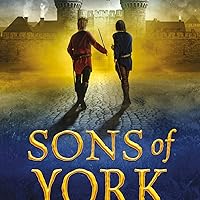
October 3, 2021
In 'Cecily', debut author Annie Garthwaite offers a vivid retelling of the first stages of the fifteenth-century Wars of the Roses, through the eyes of Cecily, Duchess of York - wife to Richard, Duke of York, mother to two kings, and one of the few major players to live through and bear witness to the entire conflict.
From the opening chapter, in which 16-year-old Cecily - already married for some years to Richard - forces herself to watch the burning of Joan of Arc to prove her husband is loyal to the king in whose name the sentence is carried out, through myriad births and (sadly) far too many infant deaths, and the navigation of the shifting sands of always-changing political alliances, to the final tumultuous scenes, we watch the growth and maturation of a strong and very complex woman through often exquisite, jewel-like prose. This isn't the medieval period retold in black-and-white - either literally or figuratively - but a colourful tapestry of characters, locations and events embroidered on a backcloth of solid historical research.
There are times when one may feel a little distant from the 'action', which perhaps is only to be expected when one is reading a woman's point of view on what is very much a politics-and-battles era of 'traditional' history (as opposed to 'herstory'), with some major incidents related through messenger or letter, when Cecily herself wasn't/couldn't be present. Yet there can be action aplenty in the 'domestic' sphere too, especially when, as in Cecily's world, the domestic sphere is so close to the political. With her husband, the Duke of York, alternatively at the heart of or banished to the margins of the political realm under the wavering King Henry VI - and the machinations of his intriguingly drawn consort, Marguerite of Anjou - politics also reaches into the bedroom, not just the solar or the great hall. And from time to time the action comes to Cecily, or she travels to it - and these visitations offer some of the most vivid, moving, heartrending, uplifting or downright triumphant moments in a mesmerizing book.
I do hope it won't be too long before Annie Garthwaite continues her portrait of this captivating, and often neglected woman, as she faces further triumphs and traumas in the next period of her long and tumultuous life.
From the opening chapter, in which 16-year-old Cecily - already married for some years to Richard - forces herself to watch the burning of Joan of Arc to prove her husband is loyal to the king in whose name the sentence is carried out, through myriad births and (sadly) far too many infant deaths, and the navigation of the shifting sands of always-changing political alliances, to the final tumultuous scenes, we watch the growth and maturation of a strong and very complex woman through often exquisite, jewel-like prose. This isn't the medieval period retold in black-and-white - either literally or figuratively - but a colourful tapestry of characters, locations and events embroidered on a backcloth of solid historical research.
There are times when one may feel a little distant from the 'action', which perhaps is only to be expected when one is reading a woman's point of view on what is very much a politics-and-battles era of 'traditional' history (as opposed to 'herstory'), with some major incidents related through messenger or letter, when Cecily herself wasn't/couldn't be present. Yet there can be action aplenty in the 'domestic' sphere too, especially when, as in Cecily's world, the domestic sphere is so close to the political. With her husband, the Duke of York, alternatively at the heart of or banished to the margins of the political realm under the wavering King Henry VI - and the machinations of his intriguingly drawn consort, Marguerite of Anjou - politics also reaches into the bedroom, not just the solar or the great hall. And from time to time the action comes to Cecily, or she travels to it - and these visitations offer some of the most vivid, moving, heartrending, uplifting or downright triumphant moments in a mesmerizing book.
I do hope it won't be too long before Annie Garthwaite continues her portrait of this captivating, and often neglected woman, as she faces further triumphs and traumas in the next period of her long and tumultuous life.

June 7, 2021
# 2 favourite book of 2021
I received this book from NetGalley in exchange for an honest review.
First of all, I would like to give heartly thanks to the publisher for offering me an arc of Annie Garthwaite's debut. I had not heard of this book and, without this great opportunity, I would have missed one of my favourite books of the year!
The novel follows Cecily Neville, married to Richard of York, and recounts through her eyes the Wars of the Roses and the rise of the Yorkist faction.
The story was, without exaggeration, spectacular. It captured me from the first page and didn't let me go until the very end.
It was written in the present tense and, although I usually prefer the past tense in historical novels, here it made the storytelling more direct and compelling. The dialogues were sharp and memorable, there was a lot of political intrigue and scheming, and, even though I knew where the story was going, I still followed every event with trepidation.
However, even though the plot was amazing, Cecily's characterization was the strongest point of the novel. She was a shrewd and formidable woman, with a great willpower and acute political acumen. I loved how she often talked politics with men and how they appreciated and listened to her opinions. I became really attached to her, I cheered for her and suffered with her, and there were many scenes which made me emotional. She had to face many difficult choices and situations, and I always understood and sympathized with her. She was beautifully complex and human.
Her relationship with Richard was also really well done. Even though romance wasn't really a part of the story, the author still created a beautiful relationship. They were equals and perfectly matched, they worked together, they completed each other.
An absolute treat if you enjoy political intrigue and strong female characters. Please check it out!
I received this book from NetGalley in exchange for an honest review.
First of all, I would like to give heartly thanks to the publisher for offering me an arc of Annie Garthwaite's debut. I had not heard of this book and, without this great opportunity, I would have missed one of my favourite books of the year!
The novel follows Cecily Neville, married to Richard of York, and recounts through her eyes the Wars of the Roses and the rise of the Yorkist faction.
The story was, without exaggeration, spectacular. It captured me from the first page and didn't let me go until the very end.
It was written in the present tense and, although I usually prefer the past tense in historical novels, here it made the storytelling more direct and compelling. The dialogues were sharp and memorable, there was a lot of political intrigue and scheming, and, even though I knew where the story was going, I still followed every event with trepidation.
However, even though the plot was amazing, Cecily's characterization was the strongest point of the novel. She was a shrewd and formidable woman, with a great willpower and acute political acumen. I loved how she often talked politics with men and how they appreciated and listened to her opinions. I became really attached to her, I cheered for her and suffered with her, and there were many scenes which made me emotional. She had to face many difficult choices and situations, and I always understood and sympathized with her. She was beautifully complex and human.
Her relationship with Richard was also really well done. Even though romance wasn't really a part of the story, the author still created a beautiful relationship. They were equals and perfectly matched, they worked together, they completed each other.
An absolute treat if you enjoy political intrigue and strong female characters. Please check it out!

February 5, 2021
I saw this on Instagram before I was even a member of Netgalley, and followed the author so I would remember to buy it. Coincidentally, I then signed up to NetGalley and I was really excited to be approved to read it early.
I love this type of feminist historical fiction, and this certainly doesn't disappoint. Cecily is a fascinating figure. We meet her at the execution of Joan of Arc and we instantly start to understand what life is like for women, how high the stakes are, and the strength of character of our protagonist. The fact that her life stretched from the death of Joan of Arc to the birth of Henry viii is amazing to me.
Cecily is a brilliant character. She's pragmatic, ruthless, loving, brave, and intelligent. The author did a great job of taking some aspects of her character that would be fairly unusual these days (her fervent religious beliefs) and make them seem authentic, and also take concepts that we're more familiar with talking about now (like post natal depression) and explore them in a historical context. Many of the other characters felt well rounded as well.
The only thing that I found challenging is that the first few chapters were full of a lot of names and locations that I could only dimly remember from history at school! I think if you were unfamiliar with that period of history you may struggle a bit, but if you get through the first few chapters you're richly rewarded.
I love this type of feminist historical fiction, and this certainly doesn't disappoint. Cecily is a fascinating figure. We meet her at the execution of Joan of Arc and we instantly start to understand what life is like for women, how high the stakes are, and the strength of character of our protagonist. The fact that her life stretched from the death of Joan of Arc to the birth of Henry viii is amazing to me.
Cecily is a brilliant character. She's pragmatic, ruthless, loving, brave, and intelligent. The author did a great job of taking some aspects of her character that would be fairly unusual these days (her fervent religious beliefs) and make them seem authentic, and also take concepts that we're more familiar with talking about now (like post natal depression) and explore them in a historical context. Many of the other characters felt well rounded as well.
The only thing that I found challenging is that the first few chapters were full of a lot of names and locations that I could only dimly remember from history at school! I think if you were unfamiliar with that period of history you may struggle a bit, but if you get through the first few chapters you're richly rewarded.

January 22, 2021
I was lucky enough to receive an advance copy of this book. The historical detail is magnificent but, more importantly, the writing is sublime. It has the immediacy of Mantel - written in first person, the book makes you feel ‘with’ Cecily, throughout her trials and triumphs.
One of my favourite elements of the book was the evolving relationship between Cecily and her husband, Richard. It was fascinating to read about two extremely different people trying to strive and survive together.
I also loved the ambition of this book. Garthwaite clearly knows her stuff, and is happy to leap across the sea to France, show you what’s happening there, leap back, drag you around castles in England, leap over to Burgundy. It’s relentless and exciting, paints the medieval world in intoxicating full-colour. Her depictions of the heads of state are great, put vivid physical descriptions and personalities to legendary names.
I’d recommend this to readers of historical fiction, certainly, but also to readers of anything. When it’s released in July, I’ll be buying lots of copies, for most of the people I know. It’s a cracker.
One of my favourite elements of the book was the evolving relationship between Cecily and her husband, Richard. It was fascinating to read about two extremely different people trying to strive and survive together.
I also loved the ambition of this book. Garthwaite clearly knows her stuff, and is happy to leap across the sea to France, show you what’s happening there, leap back, drag you around castles in England, leap over to Burgundy. It’s relentless and exciting, paints the medieval world in intoxicating full-colour. Her depictions of the heads of state are great, put vivid physical descriptions and personalities to legendary names.
I’d recommend this to readers of historical fiction, certainly, but also to readers of anything. When it’s released in July, I’ll be buying lots of copies, for most of the people I know. It’s a cracker.

July 3, 2022
I feel like I spent as much time perservering with this book as Cecily did pregnant and...that's a whole lotta time.
Connecting with characters is so crucial to my reading experience and whether I enjoy a book and I just didn't connect with Cecily, finding her incredibly one note as a character. This wasn't helped by the rather dry nature of the writing. There was just so much to cover in one reasonably average-length novel and a lot of the writing seemed quite perfunctory because of it, leaving me feeling rather cold on the whole. What I did enjoy was the focus on female machinations in this period, shining a light on the fact that while the livelihood and even safety of their families were at stake there was no chance they were sitting at home mutely churning babies out.
Also, for a book called "Cecily", I'm really disappointed by the decision to end the book where it did because *the* event I would have been interested to see Cecily's involvement in and reaction to was years later.
Connecting with characters is so crucial to my reading experience and whether I enjoy a book and I just didn't connect with Cecily, finding her incredibly one note as a character. This wasn't helped by the rather dry nature of the writing. There was just so much to cover in one reasonably average-length novel and a lot of the writing seemed quite perfunctory because of it, leaving me feeling rather cold on the whole. What I did enjoy was the focus on female machinations in this period, shining a light on the fact that while the livelihood and even safety of their families were at stake there was no chance they were sitting at home mutely churning babies out.
Also, for a book called "Cecily", I'm really disappointed by the decision to end the book where it did because *the* event I would have been interested to see Cecily's involvement in and reaction to was years later.

May 11, 2022
I’m feeling generous with the three stars. It’s not bad…but it feels like the author is trying so hard to a more intellectual Philippa Gregory. I’ve never seen a book give Cecily Neville’s POV and welcomed that especially as in so many ways she was the queen who never was. But I really don’t feel we get any depth of personality here or any particularly original take on the War of the Roses.
Honestly dump this and read the far more absorbing and incredibly well researched Sunne in Splendour. Or go trashy and read The White Queen!
Not sure why she chose to end Cecily’s story when she did - she still had three very interesting decades to live…
Honestly dump this and read the far more absorbing and incredibly well researched Sunne in Splendour. Or go trashy and read The White Queen!
Not sure why she chose to end Cecily’s story when she did - she still had three very interesting decades to live…

October 2, 2024
This book is so well written. I may not have fallen in love with Cecily as a person, but she was exciting to read about. She is no weak woman, embroidering in the background while her husband plays politics, she is plotting, manipulating, and inciting, sometimes to her own disadvantage. I loved this unique perspective on a woman left too often in the shadows.

June 23, 2024
DNF at 53%. Life’s too short to read boring books.
May 11, 2021
.
I am a relative newbie to historical fiction but I often watch films and programs set in the period of The War of the Roses, so when I saw this book about Duchess Cecily, I jumped to read it. Normally someone relegated to just a mention this book concentrates on her life.....I mean it’s no coincidence the woman was a mother to 2 kings!
.
I loved this book, the writing and how much I learnt about this interesting woman was fantastic. Not always likeable but definitely always formidable. This book wasn’t an easy read in terms of information and names. I did reach for my trusty notebook to note a few names and I even made myself a little family tree to connect the people, but it was excellent and made me reach for my iPad so I can research more on this fascinating time in history. A sign of a good book!
.
Thank you @netgalley for gifting me this book.
.
⭐️⭐️⭐️⭐️⭐️
Any book for me that makes me want to continue learning deserves a high star rating!
I am a relative newbie to historical fiction but I often watch films and programs set in the period of The War of the Roses, so when I saw this book about Duchess Cecily, I jumped to read it. Normally someone relegated to just a mention this book concentrates on her life.....I mean it’s no coincidence the woman was a mother to 2 kings!
.
I loved this book, the writing and how much I learnt about this interesting woman was fantastic. Not always likeable but definitely always formidable. This book wasn’t an easy read in terms of information and names. I did reach for my trusty notebook to note a few names and I even made myself a little family tree to connect the people, but it was excellent and made me reach for my iPad so I can research more on this fascinating time in history. A sign of a good book!
.
Thank you @netgalley for gifting me this book.
.
⭐️⭐️⭐️⭐️⭐️
Any book for me that makes me want to continue learning deserves a high star rating!

November 11, 2023
Straszna nuda


October 26, 2022
Picked this up randomly in thr half price hardback sale in january and finally got round to reading it and loved it! Love me a bit of war of the roses goss scandal and scullduggery. WE RIDE FOR THE KING !!
January 22, 2021
For too long the stories and wisdom of women have gone with them to their dark, forgotten graves. This book brings an important woman back into the light, taking the threads of knowledge we have and weaving a gripping and powerful story around them. I’m not a big reader of historical fiction but was drawn to this for its politics, it left me feeling that Cecily with all her complexity is at last acknowledged for her enormous strength, intelligence and resilience. Qualities we see in our few but fantastically successful female world leaders today. I liked that Richard is drawn through her eyes and doesn’t dominate – he’s had all the attention he needs hasn’t he? This book says it’s Cecily’s time. The writing is beautifully visual, and historical details presented with a light touch so that anyone can pick it up and understand Cecily’s story. She’s not always likeable, doesn’t always break with stifling traditions, but overcomes huge loss and shows such perseverance that you’re left with no doubt that if she were with us today, she’d be in charge.
Displaying 1 - 30 of 570 reviews