Who Goes There?, by John W. Campbell Jr., is the novella on which "The Thing", the 1982 film directed by John Carpenter, is based. It was first published in the August 1938 edition of the "Astounding Science Fiction" magazine, under the pen name Don A. Stuart.
The story is set in Antarctica, where an isolated group of scientific researchers find the body of an alien creature in the ice. They realise that its spaceship must have crashed there 20 million years before. With misgivings, they proceed to thaw the creature, which then disappears. The premise of the story is a good one, and there are lots of possibilities for tension and paranoia, all of which Campbell tries to create. However it is now sadly dated and feels extremely overwritten. Passages which should be chilling and horrific come across to a modern reader as unbelievable. In its worst excesses it is so over-the-top as to be funny,
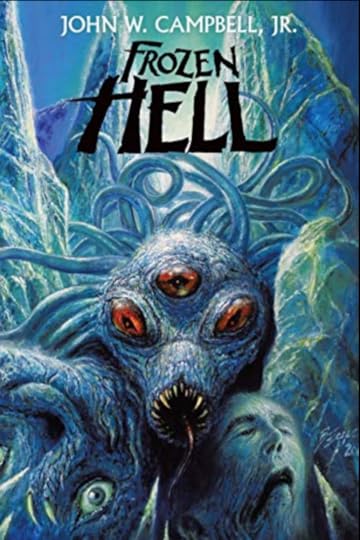
"They haven't seen those three red eyes and that blue hair like crawling worms. Crawling - damn, it's crawling there in the ice right now!"
"The broken haft of the bronze ice-axe was still buried in the queer skull. Three mad hate-filled eyes blazed up with a living fire, bright as fresh-spilled blood, from a face ringed with a writhing, loathsome nest of worms, blue, mobile worms that crawled where hair should grow -"
"The last I saw the split skull was oozing green goo, like a squashed caterpillar...wandering around with a split skull and brain oozing out...has anybody seen it coming over here?...About four feet tall - three red eyes - brains oozing out?" (presumably this last was in case anyone had spotted a different scary alien and mistook it for the first one...)
The fact that the story has been filmed several times shows that there is a good basic storyline; material for a horror film. The idea that the alien could mutate or "morph" into any other creature, is fodder for many imitations since. "Each of us with an eye on the other, to make sure he doesn't do something - peculiar." Who is the imposter? Who can you trust? And who is the alien? It fed on the paranoia of the time between the two World Wars. Here is a slightly less "pulpy" quote,
"The cells are made of protoplasm, their character determined by the nucleus. Only in this creature, the cell nuclei can control those cells at will...shape its own cells to imitate them exactly...This is a member of a supremely intelligent race, a race that has learned the deepest secrets of biology, and turned them to its use."
In the end though, this story does not live up to its expectations. Perhaps as modern readers we are now too cynical to enjoy pure pulp. Just over forty years ago, in 1973, it was voted one of the finest science fiction novellas ever written, by the Science Fiction Writers of America. But that time was slightly closer to when it was written than to the present, and the world has seen a lot of changes since.
John W. Campbell Jr., himself was a revered and influential figure in American science fiction. He was the editor of "Astounding Science Fiction" as well as a contributor, from just before this story until his death. He is generally credited with shaping what is called the "Golden Age" of Science Fiction. Isaac Asimov said that Campbell dominated the field completely for the first ten years of his editorship, calling him "the most powerful force in science fiction ever." Perhaps he should be remembered for his editorship, and this story remain firmly in its classic pulp magazine past.