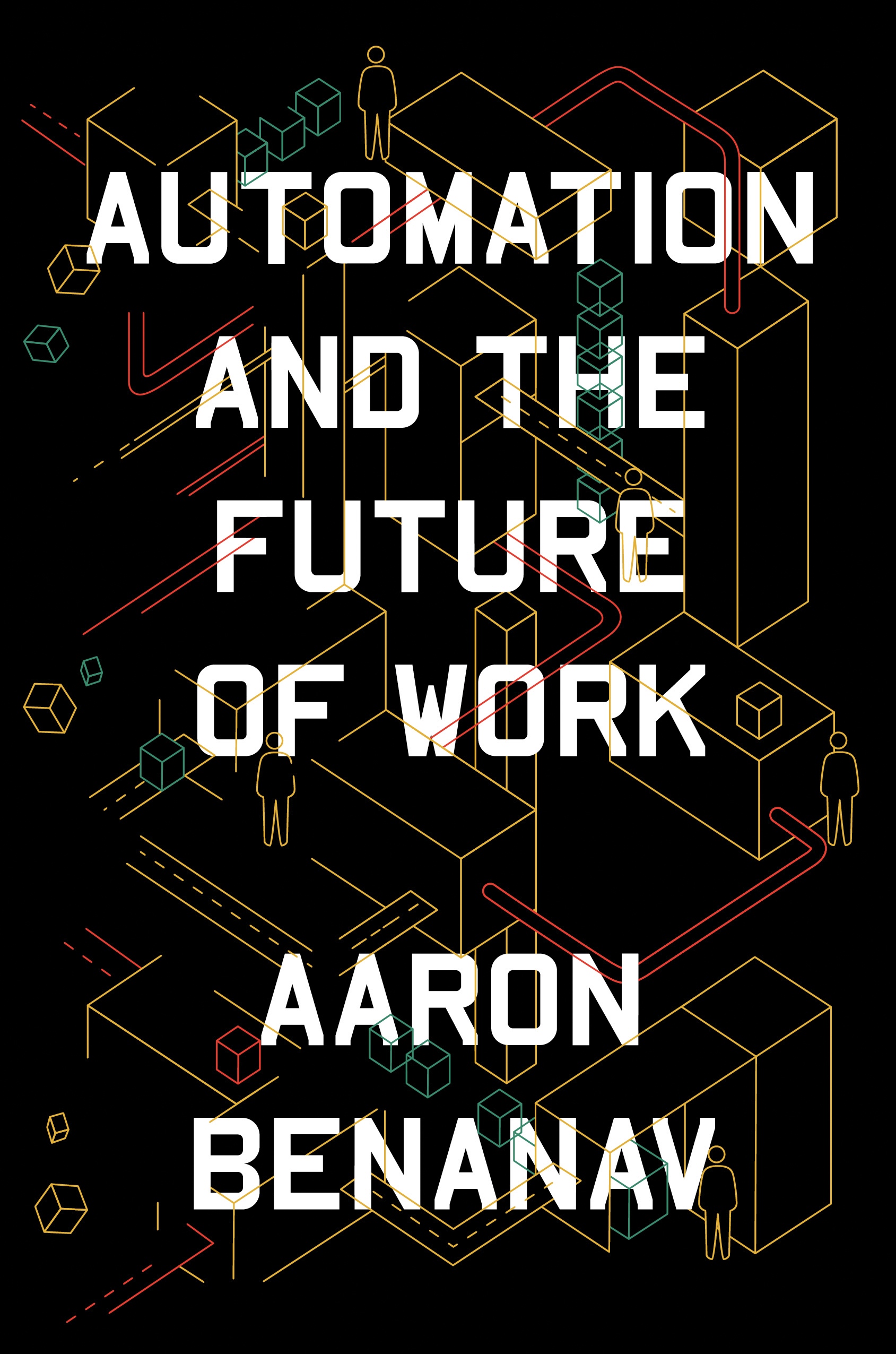
In Automation and the Future of Work, economic historian and sociologist Aaron Benanav examines the popular narrative that rapid technological advances in AI and robotics are causing widespread labor displacement. Challenging the premise that we are experiencing a technological "rise of the robots" scenario, Benanav offers a macroeconomic analysis arguing that the persistent global labor crisis—characterized by underemployment, wage stagnation, and job insecurity—is driven primarily by systemic economic deceleration and overcapacity, rather than an unprecedented acceleration in automation technology.
This has perhaps been the most interesting, and shortest, book on the likely future of work I have read, and I’ve read quite a few over the last couple of years. Central to his argument is that we need to consider how we can make work conform to human dignity, and work backwards from that vision, rather than hope technological change will make work unnecessary.
The author argues that much of the precarity of work today is due to industrial over capacity forcing workers (particularly young workers) into low productivity sectors of the economy (particularly service industries) and that ideas such as a universal basic income will not address this as 1. The right wing version of a UBI is designed to replace all other social service supports and therefore make precarity even worse, and 2. The left wing version of a UBI would see capitalism essentially commit suicide, and that is the least likely outcome (as he says, “It is a mistake to imagine that capitalists would ever agree to their own planned obsolescence.”) He also says that strong social movements are the only hope for a post-scarcity society where production focuses upon necessity and human dignity, rather than profit, and that such a society will not come via technology alone. He also thinks that while there are some hopeful signs, it isn’t at all clear where these strong social movements will come from. To quote him again: “IF NEITHER TECHNOLOGICAL ADVANCEMENT nor technocratic reform leads inevitably to a post-scarcity world, then it is only the pressure of social movements, pushing for a radical restructuring of social life, that can bring it about.”
That is, he holds that the whole idea of a no work future is a fantasy, e.g., fully automated luxury capitalism isn’t likely anytime soon. That employment (all be it underemployment) has been increasing, rather than decreasing, and that without a strong movement pushing for change, the most likely future is not one of no work, but rather of increasingly precarious under employment, enforced, as it is today, by a below poverty rate ‘safety net’ making people take any job they can, particularly young people – so, continued and increasing underemployment, but not post-scarcity fun times.
Some quotes:
“automation theorists arrive at a provocative conclusion: mass technological unemployment is coming and can be managed only by the provision of universal basic income”
“the explanation they offer—that runaway technological change is destroying jobs—is simply false.”
“Decades of industrial overcapacity killed the manufacturing growth engine, and no alternative to it has been found, least of all in the slow-growing, low-productivity activities that make up the bulk of the service sector.”
“The automation discourse rests on four principal propositions. First, it argues, workers are already being displaced by ever more advanced machines, resulting in rising levels of “technological unemployment.” Second, this displacement is a sure sign that we are on the verge of achieving a largely automated society, in which nearly all work will be performed by self-moving machines and intelligent computers. Third, although automation should entail humanity’s collective liberation from toil, we live in a society where most people must work in order to live, meaning this dream may well turn out to be a nightmare.4 Fourth, therefore, the only way to prevent a mass-unemployment catastrophe—like the one unfolding in the United States in 2020, although for very different reasons—is to institute a universal basic income (UBI), breaking the connection between the size of the incomes people earn and the amount of work they do.”
“No matter how much production increases, there will never be another telephone switchboard operator or hand manipulator of rolled steel. Here, machines have fully substituted for human labor.”
“In spite of massive accumulations of so-called human capital, in the form of rising educational attainments and healthier lives, the labor share of income in G7 countries has fallen for decades”
“First, I argue that the decline in the demand for labor of past decades was due not to an unprecedented leap in technological innovation, but to ongoing technical change in an environment of deepening economic stagnation. Second, I contend that this underdemand for labor has tended to manifest not as mass unemployment but rather as persistent underemployment. Third, I point out that the resulting world of poorly paid workers will continue to be accepted or even welcomed by elites, meaning technological advances will by no means automatically entail the adoption of technocratic solutions like universal basic income (meanwhile, even if UBI is introduced, it is much more likely that it will prop up a world of massive inequality than help dismantle it). Fourth, I explain how we might create a world of abundance even without the full or nearly full automation of production. I then project a path by which we might get there, through social struggle rather than administrative intervention.”
“This disaggregation helps explain why automation theorists falsely perceive productivity to be growing at a rapid pace in manufacturing. Productivity growth rates have been high relative to output growth rates, but not because productivity has been growing more rapidly than before—which would be a sure sign of accelerating automation. On the contrary, the key to this trend is that output has been growing much more slowly than before.”
“Instead of a reallocation of workers from low-productivity jobs to high-productivity ones, the reverse takes place. Workers pool in low-productivity jobs, mostly in the service sector.”
“From 1980 to 2018, the world’s workforce, both waged and unwaged, grew by about 75 percent, adding more than 1.5 billion people to the world’s labor markets.24 These labor market entrants, living mostly in poorer countries, had the misfortune of growing up and looking for work at a time when global industrial overcapacity began to shape patterns of economic growth in postcolonial countries.”
“firms will make do with the productive capacities they already possess: achieving cost savings by shedding labor and speeding up the pace of work for the remaining workers.”
“The median American college-educated worker earned a lower real wage in 2018 than in 2000, even though the total value of outstanding student loans rose dramatically over those years.”
“Between 1985 and 2013, the share of nonstandard employment in total employment rose: from 21 percent to 34 percent in France; from 25 to 39 percent in Germany; from 29 to 40 percent in Italy; and from 30 to 34 percent in the UK. In Japan, the “non-regular employment” share (a category similar to the nonstandard employment share) rose from 17 percent in 1986 to 34 percent in 2008, with similar trends unfolding in South Korea. Changes in the composition of employment were much more dramatic for new job offerings: 60 percent of jobs created in OECD countries in the 1990s and 2000s were nonstandard.”
“Across the OECD, real median wages rose by 0.8 percent per year between 1995 and 2013, even though labor productivity rose by 1.5 percent per year, leading to a significant upward redistribution of income (although one that was less intense than in the United States alone, where those rates were 0.5 and 1.8 percent respectively).”
“This is not to say that the poor will get poorer. In fact, the share of the world’s population suffering from the most extreme forms of poverty has declined over time, alongside the urbanization of the world’s population.49 However, poorer workers’ share of overall income growth remains much smaller than their share of the population.”
“Companies turned to debt financing not to invest in new fixed capital, but rather to engage in mergers and acquisitions, or to buy back their own stocks.”
“It is a mistake to imagine that capitalists would ever agree to their own planned obsolescence.”
“Murray’s proposal for UBI is a disturbing vision of how an ever more unequal society, marked by a persistently low demand for labor, might render this situation palatable to the poorer among its members, while at the same time freeing well-heeled market participants to enrich themselves without limit.”
“The reorganization of social life to reduce the role of necessary labor is not, therefore, about overcoming work as such; it is about freeing people to pursue activities that cannot be described simply as either work or leisure.”
“The point of this exercise is to show that it is possible to design utopian thought experiments that revolve around and prioritize people, rather than technological progress.”
“IF NEITHER TECHNOLOGICAL ADVANCEMENT nor technocratic reform leads inevitably to a post-scarcity world, then it is only the pressure of social movements, pushing for a radical restructuring of social life, that can bring it about.”
“Unless social struggles organize themselves around this historic task, the conquest of production, they will not break through to a new synthesis of what it means to be a human being—to live in a world devoid of poverty and billionaires, of stateless refugees and detention camps, and of lives spent in drudgery, which hardly offer a moment to rest, let alone dream.”
This book starts off very well, providing a summary of the discourse on automation and how theorists of both the left and right have viewed it as the coming of an age where human labour is replaced by technology.
Against this thesis, Benanav sides with the idea of the long downturn which he takes from Robert Brenner. Providing large amounts of quantitative evidence, Benanav shows that the low demand for labour is not in fact because of its redundancy due to technology, but because of global industrial overcapacity and underinvestment.
His point is convincing and turns our attention away from the technological determinism of the automation theorists and towards the structural issues of the world economy. Benanav doesn’t reject automation out of hand, showing how it will change the way we live and work, but he integrates it into his evidence on what has caused low global demand for labour so far.
After this empirical side of the book, Benanav turns to possible solutions. In such a short book it’s hard to be conclusive, but unfortunately he misses the mark a little. After justly rejecting the right-wing solutions related to UBI and exploring the theories of some left-leaning proponents of a universal income, Benanav comes to his own philosophy of what could happen.
The aims are all desirable and reasonable, but his proposals seem to not go much further than a centrally planned economy. Funnily, Benanav talks earlier in the book about the waste, inefficiency and bureaucracy of 20th century command & control economies, but then seems to suggest that problems will be resolved through dispersed, democratic control and through developing algorithms to overcome economic issues. Stranger things have happened, but it’s a pretty undeveloped theory.
I would advise people to read the book as a preliminary exploration of where this topic could lead in the future, but not as a comprehensive theory of how these changes will come about. Benanav is clearly a rigorous and innovative thinker, so I’ll be interested to read anything he comes out with in future.
Great, if quick read, that makes a strong case for rethinking the popular discourse on automation and UBI. Contrary to the alarm bells sounded by the would-be automators, the greatest threat to our economy is not massive job loss to automation but the already oversaturated global manufacturing sector's persistently slow growth. The author nonetheless speaks favorably of the utopian imagination behind many full-automation projects, while concluding (correctly, as history shows again and again) that the only path to building a new economy is through mass movement politics, not reform programs designed by academics and political consultants. "One step of the real movement is better than a thousand programs!"
A brief but stimulating read that sets out to challenge a whole set of presumptions about the rise artificial intelligence and the future of work which sees the decline of employment as a natural consequence of technological innovation. Benanav also takes on those advocating for a universal basic income and questions whether it is really the radical alternative to capitalist norms of work and livelihood that it claims to be.
The first element in his argument draws on the work of the Marxist economist, Robert Brenner, who has traced a long decline in the demand for labour back to the 1980s – long before the onset of excitement about the rise of the robots. Following Brenner, Benanav sees this as happening because of long-term economic stagnation arising from industrial over-capacity which has “killed the manufacturing growth engine.” The technological change that focusses so much attention is not so sudden as commentators claim but has been gradual and ongoing throughout the period of this decades-long environment of economic stagnation. Its consequences for employment levels have been less about the growth of unemployment, but rather the fact that under-employment is now an integral part of the structure of contemporary capitalism. This is obviously something to bear in mind when we consider the reasons for the plateauing of productivity in the new millennium.
In a chapter on deindustrialisation as a global phenomenon, Benanav sets out statistical evidence which challenges the assertion by automation theorist who see the decline of human workers as a function of the rise of machines. He points out that productivity growth – spurred by the upgrading of the workplace with better technology – was much higher in the so-called golden age of postwar capitalism being typically in the range of 5% plus a year in the highly developed countries. But this increase was surpassed by even higher levels of output as more goods flooded onto markets. As he points out, if output per worker (i.e. productivity) increase by 5% a year but the total volume of goods (output) increases by 6% then the difference between the two figures has to come from an increase in the numbers of workers on the production lines.
But in contrast to this golden age, both output and productivity rates have declined since 1973, with the former falling more rapidly than the latter. By the early 21st century productivity in manufacturing was going upwards at around 2.7% a year but output rising at a much slower 0.9%. The result has been a decline in employment of 1.7% a year.
This seems counter-intuitive given everything we are told about the entry of lower and middle income countries into manufacturing in recent decades. The figures here show that worldwide manufacturing employment rose by 0.4% between 1991 and 2016, but this has been a much slower rate than the increase in the size of the global labour force. The sense that the East is booming when it comes to job creation is partially the effect of the increase in China’s share of manufacturing jobs, but even here Benanav points to the large-scale shedding of jobs in the state-owned sector in the early 00s, which were only picked up by an expansion of private sector employment from 2010 onwards. Even so, by the mid-teens manufacturing employment began to drop again, falling from 19.3% in 2013 to 17.2% in 2018. All of the Benanav takes as evidence that the decline of demand for workers cannot be seen as a simple function of the rise productivity driven by evermore advanced technology. Other things have to be in play to explain how we have got to where we are today.
In his analysis the answer is what he calls the blight of manufacturing overcapacity. The story here is that, in the face of the perceived threat from the expansion of the Communist world after WW2 the most technologically advanced country, the United States, set about sharing its progress with countries in Europe and with Japan, which would in normal times have been involved in intense efforts to catchup through the mode of competition. The consequence of this transfer of technology was that previously low-cost producers were able to take a larger share of the markets for manufactured goods, including in the previously impenetrable US itself. More countries adopted the strategy of seeking export-led growth for their economies, leading to a greater expansion of manufacturing worldwide. In the fray of intensifying competition output growth began to fall despite the fact that there was much larger industrial capacity. Deindustrialisation began to hit the later entrants into the race, shown up most spectacularly in the aftermath of the 1982 Third World debt crisis.
Benanav sees this approach as better explaining the paradox of industrial over-capacity triggering efforts to develop labour-saving technologies and also with the expansion of gigantic labour-intensive supply chains. The key point here came in 1970s, when the penetration of lower-cost Japanese and German goods in the US market rose from 7% in the mid-60s to 16%. US producers realised at that point they could no longer rely on increased labour productivity as the way to win back market share, and that they had to respond by securing for their production a bigger slice of lower wage labour. US multinationals achieved this by shifting the most labour intensive parts of their production processes to the export-processing zones that were beginning to appear in Taiwan and South Korea.
Ironically, if national governments had had more confidence in the vitality of the capitalist system they might have considered doing precisely the opposite to what they did do as the great stagnation of the 70s onwards begin became entrenched across the globe. What was needed to kickstart the return to high growth was the reallocation of workers from low- to high productivity jobs and to compete for larger market share based on this substantial advantage. The possibility of doing this was impeded by the restructuring of the postwar economy as a system moving ever onwards to freer trade, aided by the expanded role of the dollar as the world’s money, all of which gave an advantage to lower cost producers that outweighed their lower productivity. The US could, theoretically, preserved the superiority of its technologically advanced economy by closing its doors to cheaper inputs and limiting knowledge transfer to developing regions. It was the threat of an apparent viable alternative to capitalism under the hegemony of the Soviet Union that prevented it from moving in that direction.
These narrowed options meant that the leaders of developed countries did pretty well the opposite of what capitalist rationality suggests they should have done: they moved more and more of their workforces out of well-paid skilled employment into the less productive service sector. Profits inevitably slumped under these conditions, but this more than compensated for from the standpoint of the owners of assets by opportunities to acquire higher rents made from exploiting there monopoly of control. Money flowed away from productive investment, and towards financial assets which became the basis for the ‘bubbles’ which have plagued the system from the 90s onwards.
Meanwhile the global economy became evermore disfigured by stagnation marching alongside financialisaton. The extension of supply chains into low and middle income countries inflated asset values in towns and cities that had the potential to host outsourced industries, leading to their expansion at the cost of rural populations whose economic activities, typically based around family-run farms, became de-valued as assets and were taken over by interests keen to exploit their potential as suppliers for agribusiness. People were displaced into the expanding cities and forced to compete with one another for niches as wage labour or petty traders. All this movement accounted for the fact that the global workforce expanded by 75% during these years, but with the majority of these people pressed into highly-exploitative low skilled work, or casual labour forces that offered at best, under-employment.
With this analysis Benanav makes the case for ditching the ‘rise of the robots’ thesis as the complete answer to the question about where all the jobs are going. The vision of production lines manned entirely by AI machines is real enough, but it doesn’t explain why the displacement of workers from one technologically transformed sector to a newly emerging one hasn’t happened at anything like the rate seen during earlier phases of advance – for example, as with the huge expansion of factories run on Fordist principles in the early 20th century. The reduced demand for labour has been with us for 50 years and has to be understood as a consequence of the changing structure of the capitalist system itself over this period.
What can be done, then, to deal with the worsening of the predicament facing the majority of the world’s population which has to rely on wages for its living? Benanav uses impeccable Marxist categories to set out his case but his hopes for a remedy devolve onto a Keynesian perspective. Dismissed by automation theorists who see the stimulation of demand by economic policy as being powerless to prevent the loss of jobs to machines, Benanav calls upon to think again about that if we accept his view that the real reason lies with longer-term overcapacity in production owing to the fact that too much of what we buy and consume comes from workforces that would be much more productive if the system returned to positive investment. A re-booted Keynesian intervention would aim to penalise companies which turned away from investment in capital and instead used accumulated piles of cash to fund mergers and acquisitions and buy back their own stock. The objective here would be to raise both labour productivity and output, with the latter ideally outpacing the former, so that companies were obliged to take on new hires to fulfil their order books.
This would be tantamount to a New Deal type arrangement, with an added spur to technological development come from the fact that it would have to have a large Green dimension. To be effective the state would have to be prepared to equip itself with powers that would allow it to compel positive action from business, including the prospect of taking the concern into full social ownership. It might need to be said that measures of this sort would require a huge expansion of democratic inclusion of workforces and the communities affected by policy direction of the activity of a specific business to ensure that the views of all relevant interests had been taken into account.
Finally, on the issue of universal basic income. Benanav is more than cool towards a proposal that is gathering support across a surprisingly large segment of public opinion. This is essential because he sees the measure as being informed by the pessimistic view of the future of employment that come from the automation thesis. In its most cynical expression it looks like a sop towards large numbers of people who are seen as being surplus to the needs of the economy, sufficiently large to stop people falling into unacceptable levels of hardship, but permanently marked down well below the income of owners of assets and other privileged groups. In this version it looks very much like the measure favoured by eminent neoliberals who are quite happy to isolate citizens from the potential power that they once had as workers and trade unionists. It is a good point and services to remind us that the hope for radical social change has always been bound up with the idea that control of the means of production will have to be wrestled from the grasp of the owners of capital, and this presume that the people who do this are already in situ and ready to take over. This seems far less likely to happen if people have been pushed to the margins of the system and supported, no doubt on the condition that they remain suitably passive, by a meagre dole.
His critiques of the automation theorists are important and spot on. His own analysis of our stagnant and unequal global economy, however, has some problems, overly wedded as it is to an old school Marxism. But given its short length, definitely worth a read for anyone trying to think through these issues.
a compelling narrative of the last half-century of global capitalism; a ruthless critique of keynesian and techno-utopian solutions to chronic underinvestment and its attendant social ills; an emancipatory vision of communism reengineered against the blind alleys of the 20th century; all in under 100 pages. fuckin brilliant. gonna give this one to my grandma
This is a highly lucid and convincing analysis of the structural factors behind the malaise of the global economy and the oft-cited but little understood "productivity puzzle". While I understand the need for the utopian vision of future potentiality, something more grounded within the realms of more immediate possibility would also be of great use.
A solid rejoinder to the modern iteration of the recurring Automation Discourse. No the robots (and chatbots) are not going to wipe out all jobs, what they're going to do is what they're already doing: pushing more people out of steady permanent employment into degraded, precarious forms of labor.
Benanav's development of Brenner's view of the causes of stagnation in global capitalism, that it's global overcapacity that causes a low demand for labor in a global market of infinite financial liquidity that leads to stagnating growth rates and persistent un and under employment is a helpful counter to the breathless forecasts of total technological replacement. But while his progressive outlook is welcome, I'd have been very interested to see him further engage with other analyses on this topic, like Baran and Sweezy's explanation for the inability of monopolized sectors to reinvest surplus value, to expand the implications of his thesis.
Benanav's rightful takedown of technocratic ideas like UBI or market based "solutions" to rising inequality and his recognition of the need for a revolutionary mass movement to actually make the societal transformation is laudable. But I came away frustrated that, even while recognizing this is a short sketch, he refuses to engage substantially with any of the 20th century socialist projects in any but the most cursory and derisive sense. Certainly all these political ventures have much to critique, but there is also an enormous amount to learn from, and the continued refusal of western intellectuals to do so only impoverishes our discourse and ability to chart a course to the future.
A short but enjoyable read. In Automation and the Future of Work we look at what role automation has served in the past and it's current trajectory. You may see parallels in this book to Andrew Yang's "The War on Normal People" however it tells a much different story.
Whereas TWoNP blames the USA's under employment and lack of jobs on automation in the 1900's our author in Automation and the Future of Work pulls out heaps of data to reframe the claim and show that we have been operating at overcapacity in manufacturing worldwide and are seeing a decrease in global growth of GDPs as a result.
Springboarding off of this claim we then began to think about the automation that is coming and will be the killer of many human held jobs. Both Leftist and right wing thinkers agree one viable solution here is UBI. However how we implement that has major implications. Instead of the more "right wing" approach of giving everyone 1k per month our author makes the bolder argument for UBI's of much greater value or that serve as a more expansive package of windfalls including shortening the work week and eventually reaching a post-scarcity world.
All in all this was a pleasant, data-driven read that is getting me to think much harder about UBI's Full Automation, and a possible Utopia in the future.
The trope that automation is coming for your job is a discourse trend as old as Aristotle. The discussion generally asserts automation and technology are developing at such a rapid rate that eventually all employment sectors will cease using human labor or else disappear entirely. Today the banner is carried by self-identified Futurists, Automation Theorists, and Tech Entrepreneurs whom I prefer to refer to them as Tech Bros. Not just because the overwhelming majority of them are men but also because they seem to peddle in the Stoner-Older-Brother branch of philosophy.
The recognizable cast ranges from people I find infuriating like Elon Musk or Bill Gates to people I have a lot of respect for like Robert Reich or Andrew Yang. Of course, these are just the big names, there is a whole host of academic writers and other bros who argue that jobs like truck driver, grocery store clerk, manufacturing laborer, etc are going to rapidly disappear, and indeed already are due to technological innovations.
That's all in one corner, in the other corner is Aaron Benanav; New Left Review contributor and researcher at Humboldt University of Berlin. In Automation and the Future of Work, Benanav sets out to dispel the biggest myths in the automation discourse. While he certainly appreciates the spirit and value of the post-scarcity world that the Tech Bros articulate, his skepticism is reserved for the main thrust of the proposed narrative. Automation theorists have gotten wrong what's happened, what's going to happen, and what we should do about it.
What Happened? This challenge takes up the lion's share of the argument. For one, it's really the crux of the whole premise; if automation theorists are wrong about what happened thus far, their predictions for what's to come, being based largely on that narrative, are also less likely. It's also a pervasive and widely held belief, espoused by high profile people like Barack Obama, that automation has decimated our employment sector and many jobs with it.
Not only is this largely untrue, it doesn't even make the argument the Tech Bro's often think it does. Benanave takes on two favored examples; the disappearance of jobs and the deindustrialization phenomenon.
To the extent that jobs have disappeared, human labor has not. Some ancillary and illustrative examples are in fields like sewing or construction. Robots have yet to be able to mass-produce tiny assembled components or sew garments, these jobs weren't automated out of existence in the US they were traded away, offshored, they're still done by humans at a massive scale. Construction fields still use tons of humans, while automated tools help make the jobs easier, they don't eliminate the work any more than getting a vacuum or a dishwasher means you don't have to do any labor associated with those tasks, while some skilled jobs no longer exist, a larger number of unskilled, lower-paying jobs have emerged. Using the elimination of certain jobs simply does not prove that the need for human labor is decreasing.
The trickier argument to be made is in manufacturing. Living in Metro-Detroit, it's easy to juxtapose images of hundreds of people on an assembly line piecing a car together in the past with the modern spider-like automation lines that assemble car frames with minimal human input. And to be clear, many people's jobs have been replaced with robots in this way, but the question still remains; is the reduced demand for human labor in manufacturing for that reason entirely? The fact is there are many jobs done by humans in manufacturing facilities (some are even complaining about skilled labor shortages). The real problem as Benanav's data shows is that plants don't need to hire as many people because fewer people are buying the shit we produce. Lower productivity levels mean fewer people hired, this can happen even when there is a high demand for human labor. This is called the productivity paradox, a phenomenon that would not exist if automation had obliterated a genuine need for people.
Put another way, technology has allowed us to deindustrialize while still producing a large quantity of goods, but without the accelerated demand for these goods, there is no need to hire more people or even, as GM recently showed, keep plants open. This drove many workers into the land of underemployment in the service sector, where the demand for human labor is still high.
So while technology has killed some jobs, we are still facing a massive demand for human labor as evidenced by our abundance of labor shortages; teacher shortages, truck driver shortages, engineering shortages, medical and home care worker shortages. Automation hasn't killed even a fraction of the jobs that our poor economy has and it hasn't met the demand for human labor in key employment sectors. What are the Tech Bros talking about?
What's Going to Happen? So far it seems that automation has just worsened a job distribution problem. It's killed certain jobs, but not the demand for human labor. Just because the Tech Bros were wrong about what has happened so far, doesn't mean they're wrong about what will happen. No, automated checkout stations have far from decimated the service sector, barely autonomous vehicles haven't driven armies of drivers out of their field (quite the opposite), but will rapidly emerging technologies? Benanav joins a number of commenters noting we're more likely headed to a "good jobless future" rather than a "jobless one".
Benanav draws attention to studies like those from the Oxford Martin School or the OECD that predict anywhere from 32 - 47% of jobs are "at high risk of automation". Lots of these studies are cited by the Tech Bros who hold them aloft like "the End is Neigh" signs. A lot of implications are developed from "graphs of exponentially rising computing capacities - with Moore's law of rising processor speeds standing in for technical change in general".
Benanav's central beef with what the future holds is one of the more convincing arguments in the book and is worth quoting at length:
"In reality, technological development is highly resource intensive, forcing researchers to pursue certain paths of inquiry at the expense of others. In our society, firms must focus on developing technologies that lead to profitable outcomes. Turning profits off of digital services which are mostly offered to end-users for free online, has proven elusive. Rather than focus on generating advances in artificial general intelligence, engineers at Facebook spend their time studying slot machines to figure out how to get people addicted to their website so that they keep coming back to check for notifications, post content, and view advertisements. The result is that, like all modern technologies, these digital offerings are far from socially neutral. The internet, as developed by the US government and shaped by capitalist enterprises, is not the only internet that could exist. The same can be said of robotics: in choosing among possible pathways of technological progress, capital's command over the work process remains paramount. Technologies that would empower line workers are not pursued, whereas technologies allowing for detailed surveillance of those same workers are fast becoming hot commodities. These features of technological change in capitalist societies have important implications for anyone seeking to turn existing technical means toward new, emancipatory aims. Profit-driven technolgocial advances are highly unlikely to overcome human drudgery as such, at least on their own, especially where labor remains cheap, plentiful, and easily exploited" (from page 41).
What To Do? One thing Automation Theorists get right is that losing a job in a country like the US (interestingly enough Benanav points out in European and Asian countries automation is seen as a job creator) does a substantial amount of harm. While job loss isn't an indicator of massive automation take over of employment sectors, it does hurt those most affected. The problem is that because the Tech Bros got the rest of their narratives wrong, their solutions aren't aimed in the right place.
Benanav focuses on two Tech Bro solutions; the UBI and Keynesian stimulus. I'm going to focus on UBI specifically because I've never seen anyone of any profile suggest that a Keynesian stimulus is a solution to automation in the job sector and the inclusion of this solution is weird because it would assume those making it agree that it's an economic slowdown and not automation killing the jobs in the first place.
To be clear, supporting a UBI is nothing to be too critical of, but Benanav is clear he supports it as part of a broader solution to capitalism rather than a solution to automation. The issue with the Tech Bro notion of a UBI is that it tries to answer the question; what to do with the unemployed. This seems like the right question to ask, except if masses of people aren't already permanently unemployed and they're not going to be, UBI will only address the issues of unemployed people. The rest of those who moved from the industrial sector to the service industry, or the mass of employees across the globe who are still engaged in human labor, will not stand to benefit as much if at all.
This is mainly because the Tech Bro UBI, although it's worthy of support as a distributive policy, still leaves systems of exploitation of human labor in place. It does this precisely because Tech Bros don't believe that human labor will even exist. Except it will, all over the world. Benanav's solution to the death of individual jobs is a more robust welfare state (it might even feature a UBI) for the unemployed, but also expanded worker representation, protections, and share of profits for workers across the globe who will still be doing human labor.
There are probably lots of bouts to be had in this fight. Benanav's book is short and contrarian, I've only included the more compelling arguments I found. Lots of his discussion of overcapacity in the manufacturing/industrial sector went way over my head. It's worth reading the arguments presented if only because they offer such a stark contrast to the status quo discourse
The word that comes to my mind after reading it is "mistaken". The central thesis is that there is no job loss due to automation, because if this was happening, it would show up in a faster pace of productivity growth, but instead we see a slowdown. The problem with this approach is that it equates automation with productivity. This is certainly false. I can exchange a robot for a human and achieve higher productivity, the same productivity, and even less productivity. The point is that I don't have to pay the robot, it does not go on strikes, it can operate 24/7 and in dangerous circumstances. Automation does not equal productivity. Millions of factors contribute to productivity, apart from automation. Equally, in a late chapter Benanav claims that there was no Keynesianism before the seventies, because there was growth and decreasing debt/gdp. Once again, mistaken. It's the other way around. There was growth because there was Keynesianism. He claims that Keynesian demand management came in the neoliberal era, post 70s, when debt/gdp grew. No. Debt grew because they lowered taxes and decreased incomes, and had to have debt to keep on growing. He disses UBI because you need a social movement for it. Then he paints his own utopia, which is...wait for it... the elimination of private property. Now where did we hear of this before? You can achieve THAT without a social movement, but not the UBI? :)
This book is largely responding to a lot of books that I have not read, but it does so in a way that makes me feel like I saved myself a lot of effort by skipping to this one. The key argument is that the declining demand for labor is not driven by increased automation, but by overcapacity in production (I think I have those terms right?) which, he contends, means that a UBI won’t be able to bring about the social change that automation utopia a desire. As an academic I know that correctly defining the problem is an important step, and I was moderately persuaded here that this is an improvement in defining the problem, but I still felt let down by the final link in the argument which ought to have provided a better path to post-scarcity utopia. He makes a great case for the idea that a utopian relationship to work is possible in the current world without requiring full automation of work (I was charmed by how much it mirrored LeGuin’s Dispossessed!) but seems to suggest that the way to get there is mumble-mumble labour organizing, which he also seemed to think was not a viable path. It was strange to read a book that assessed modern protests and even talked about COVID-19 but did not even mention BLM and other, you know... contemporary mass protests. Overall, it satisfied the whim with which I picked it up, but I don’t think I’ll do much more reading in this genre.
Short, punchy, and not revolutionary - the kind of Verso pamplet that sets up a debate well and has some great zingers, but which isn't going to move the conversation too much beyond where it's at now.
Short read. Was hoping for more indepth exploration of different areas of work that have been/are being automated, rather than a general world overview, but interesting nonetheless
I agreed and disagreed with a lot in this book. It’s tone, as with other left-wing books, is a little to cataclysmic for me. It essentially argues that since the 1970s, output growth has slower, the manufacturing sector is over capacity, services can’t produce high productivity growth, and thus, we have a crisis. Just as Marx predicted. Voilà!
Some of this analysis isn’t bad, and the statistics he cites are true. Manufacturing productivity growth has slowed. Output growth rates have slowed more. And this is presenting a problem for advanced economies, and more importantly for poor economies looking for a way to develop.
His explanation that automation is not the (main) cause of our modern problems is also good. But I think the Marxist frame sometimes causes the author to go off on tangents, make bold and wrong predictions, or stray from the facts (as marxists are oft to do).
For instance, he writes that pandemic recoveries are usually followed with sluggish growth and lingering high unemployment. But after COVID we saw a corresponding supply shock, record low unemployment, rising wages, and (for a time) falling inequality. It seems Keynes is not dead yet.
Nevertheless, the point about UBI is a good one. If we are going to disconnect income from work (at least partially), why not go the whole mile and engage in a broader reorganization of society that lets us work less and enjoy the fruits of human ingenuity more.
I think the most useful part of the book is when the author critiques the general approach of automation scholars, who tend to assume full automation will one day come, and then invent institutions to handle its effects. It seems more useful to envision what a better world (one with more free time, more freedom, and guaranteed access to life’s necessities) would look like, and then find the institutions and technologies that will get us there.
As with many to my left, Benanav can (sometimes) diagnose the wrong problem, but is short on policy solutions. The left always calls to “organize for a better world,” but to what end. He rejects central planning (good) but then goes on to say some sort of algorithmic, democratic planning would determine production decisions until we reach full post scarcity. Central planning didn’t fail just because the USSR was authoritarian, it failed because modern society is far too complex to turn into an algorithm (if it were, I’m sure the Chinese or former Soviets would have done so by now). The modern economy is a complex beast, and changing our institutions to ensure a dignified life for all will take a bunch of different policy changes over time. What Im always left wondering is how it can be done.
Great book to debunk common misconceptions about automation and identify systemic work shortage not with mecanisation or numerisation, but with economic stagnation and the crisis of capitalist valorisation. Too bad that a book that tries to renew a critique of work after the COVID crisis concludes its book with very crude arguments about communism taken straight from the 19th century. It isn't only about referencing the Great Men of past times, but also to have a bit more imagination than simply quoting Marx on the necessary separation of work and leisure, and discerning the label 'utopian' to actually anybody that might have criticized this dichotomy (for example).
An insightful read evaluating reasons for the lack of demand for labour - Benanav offers UBI, huge Meidner-style policy tranformation (a socialist plan devised in Sweden in the 70’s) and transfer of public ownership of capital as remedies to the economic stagnation.
“Ultimately, profit-driven technology advances are unlikely to overcome human drudgery.” Benanav poises. Robotising the workplace is hardly emancipatory when capital stays concentrated at the top (profits are recycled into share buybacks), and where workers continue to remain “cheap, plentiful and easily exploitable.”
Benanav offers a different, astute and sympathetic critique of automation theorists. I can accept his viewpoint and it is well-argumented, however, when we move on to the second part of the book, which focuses on how we can mobilize the people to achieve a post-scarcity future, he is strikingly less extensive. In all honesty, I even fathomed the outlandish idea of FLAC more easily than Benanav's moderate view on cooperative justice.
This is an interesting mix of Marxist theory and tech criticism. I think his engagement with automanist marxists like Srineck is worthwhile. He is critical of universal basic income as a solution to unemployment due to automation. He's also skeptical that it is possible to automate everything as technologists want. great book, quick read. There are a lot of interesting charts and sections in this.
Insightful critique of the automation discourse and its misinterpretation of technological progress as a driving factor behind the disappearance of jobs (instead of broader economic dynamics such as the deindustrialization that is really the reason here) - and a fantastic reminder that a better future won't be handed to the people but needs to be demanded through organizing and political struggle!
This book, which was finished when the pandemic was raging, but originally based on articles written for NLR in 2019, has a very laudable goal: question the “full automated luxury communism” discourse in some accelerationist circles, and the ideas about technology that underlined this kind of thinking. In this, Benanav is successful, but it is the way in which he goes about it that presents problems for me. So, in this review, I want to indicate some issues, empirical and theoretical, that the book has, although I share the authors view against the simplistic technocratic vision of people like Bastani.
A first problem, that I think undermines the whole endeavor, is in the use of statistics. He measures productivity in the following manner: “productivity is the ratio of output to employment”. And he defines employment as “a measure of the number of workers rather than of hours worked -the latter are typically unavailable outside of wealthier countries”. Since the thesis of the text is that desindustrialization is an important phenomenon of the last decades, we can easily see how this is problematic. Because, let’s say, if two French workers, with a 35 hour workweek, are replaced by a 996 Chinese worker, with a 72 hour workweek, for Benanav employment has gone down, while in reality it has maintained the same level. Of course, the point about available statistics is taken, but my argument here is that one data point is not in fact a replacement of the other. This is even more problematic when one takes into account the category of “underemployment” that the author thinks is a constant in the current labour market. If we take the idea of underemployment seriously, in the sense of non-registered employment that characterizes much of the Global South economies, the idea of measuring hours worked seems even more impossible.
In fact, data availability, or at least the data available to Benanav plays a larger role in the book. He is constantly focused on “wealthier countries”, the US, Japan and Germany in particular. For a text that wants to analyze the evolution of industrial production on a global manner, it is surprising that China appears in page 36, and is almost never mentioned. In fact, introducing China, which he recognizes is a kind of exception to his data, would wreck most of his argument. The non-centrality of China is also part of a wider trend. The notion of imperialism is not even mentioned once, which seems to me weird in the context of a work that is analyzing industrialization on a country level.
So, on one hand, the notion of overcapacity that underlines Benanav vision of why automation theories fail is in fact not sustained by the data, and also I think it is a very partial vision, one that is made obvious by the cherry picking of evidence that goes one. But that does not mean that the author is wrong in everything. In his attacks against automation promoters he makes several good points.
For example, he says: “Much of the debate around the future of workplace automation turns on an evaluation of the degree to which present or near-future technologies are labor-substituting or labor augmenting in character.” I think this captures well the dual trends of machine use in industry as described by Marx, and the discussion of degrees is key, since most of the bourgeois theorists on the topic have an either-or perspective: Machines destroy labor or they help labor. In fact, they do both at the same time, and it is very difficult to analyze to which degree they do each.
Another good point he makes is to say that post-scarcity does not need to wait for future technologies. It can be achieved today, and it is a political tasks involving workers control of the means of production. However, he sometimes applies this correct notion in a somewhat Trotskyite mechanic permanent revolution way. For example this paragraph was pretty funny to me:
“Facing potential insubordination from powerful actors, radical Keynesians would need to threaten firms with full socialization. In order to make good on those threats, they would need to have already developed and disseminated a clear plan for doing away with private enterprise. But then, to have any chance of securing their aims, radical Keynesians would also need to have won the backing of major social movements. Only movements that presented a truly existential threat to asset owners’ wealth would be able to bring capital to heel. Yet if those social movements were powerful enough to force capital to submit to a public-investment-driven economy, why would they not demand more? Such movements would not willingly allow for power’s further concentration in the hands of the state (instead, they would demand a devolution of power to democratic organs of the people themselves).”
The problem here is that there is a lack of concrete politics in his analysis. There are many cases in history in which powerful social movements didn’t demand more, but contented themselves with partial victories. This is because between social movement and capital there is a mediation, from the state and from political parties. If not, the history of social-democracy or the Soviet Union or the PRC would be unexplainable. It is not a coincidence that Benanav is allergic to any real socialist process, deploying the same vague criticisms about Stalinism that we are used to from liberal thinkers. This gives his text an explicit utopian character, in which it is clear which is the problem, and which is the solution, but the central question is not answered: What is to be done?
Maybe some would say that this is a short polemic text that won’t provide answers for everything. But I think that the problem is that the author is trying to tell something about “what is missing” in leftist politics. He thinks that we need more utopian thinking, we need a perspective on the future, to show how socialism can be implemented. And that is not bad in itself, but I fail to see how a beautiful picture of a beautiful future would help us if we don’t know how to get there. The author justly complains that the full automated communists have a mechanic view of history in which human agency and human action are not needed because the evolution of machines will free us from the need to make revolution. But since that is the complain, then the answer has to be a somewhat concrete plan on how to achieve that future freedom, no a mere description of how that freedom could be.
Overall, I think the books target audience is the Silicon Valley types rather than economists. While the economic data cited throughout are correct, the author’s interpretations of the data are quite off in some instances. And his understanding of Keynesian economics is superficial. He claims that with the exception of the UK, most advanced economy governments continued “Keynesian” deficit spending from the 1970s through 2019, leading to higher public debt burdens. But when you look at the actual data in his exhibit you can clearly see there were periods during this timeframe where debt burdens actually declined. He also claims that “pandemics are followed by long-lasting declines in GDP growth, rather than post-pandemic economic booms” - but here too he fails to understand that there is no historical precedent for the massive fiscal and monetary policy response to this pandemic, and as a result, his claim here also turns out to be incorrect. Finally, economists do not claim that automation is the reason for the job losses to date, as he asserts; in fact they have always pointed to globalization and economic development/advancement as having led to the loss in manufacturing jobs overseas. The automation theory has only emerged in more recent years with the rise of anti-globalization sentiment, and is focused on the future of labor rather than on past developments.
This entire review has been hidden because of spoilers.
This book has some good analysis, but too much of Benanav's argument are poorly constructed. First, for most of the book he lumps together leftist automation theorists with liberal silicon valley proponents of UBI, despite them having different rationale and different conclusions. Then he sets up a few strawmen to try and explain why their conclusion is wrong, which don't really work either. He tries to explain the separation between productivity and wages by saying that output= productivity + employment and the decrease in output causes the separation. This isn't wrong, but who cares? We know profits and capital investments have increased, while employment and wages have not. There is some good in the book, I'm not quite convinced by it, but it's: still worth a read for the argument that we will not become robots