

What do you think?

Walking the Great North Line
Robert Twigger, poet and travel author, was in search of a new way up England when he stumbled across the Great North Line. From Christchurch on the South Coast to Old Sarum to Stonehenge, to Avebury, to Notgrove barrow, to Meon Hill in the midlands, to Thor's Cave, to Arbor Low stone circle, to Mam Tor, to Ilkley in Yorkshire and its three stone circles and the Swastika Stone, to several forts and camps in Northumberland to Lindisfarne (plus about thirty more sites en route). A single dead straight line following 1 degree 50 West up Britain. No other north-south straight line goes through so many ancient sites of such significance.
Was it just a suggestive coincidence or were they built intentionally? Twigger walks the line, which takes him through Birmingham, Halifax and Consett as well as Salisbury Plain, the Peak district, and the Yorkshire moors. With a planning schedule that focused more on reading about shamanism and beat poetry than hardening his feet up, he sets off ever hopeful. He wild-camps along the way, living like a homeless bum, with a heart that starts stifled but ends up soaring with the beauty of life. He sleeps in a prehistoric cave, falls into a river, crosses a 'suicide viaduct' and gets told off by a farmer's wife for trespassing; but in this simple life he finds woven gold. He walks with others and he walks alone, ever alert to the incongruities of the edgelands he is journeying through.
Was it just a suggestive coincidence or were they built intentionally? Twigger walks the line, which takes him through Birmingham, Halifax and Consett as well as Salisbury Plain, the Peak district, and the Yorkshire moors. With a planning schedule that focused more on reading about shamanism and beat poetry than hardening his feet up, he sets off ever hopeful. He wild-camps along the way, living like a homeless bum, with a heart that starts stifled but ends up soaring with the beauty of life. He sleeps in a prehistoric cave, falls into a river, crosses a 'suicide viaduct' and gets told off by a farmer's wife for trespassing; but in this simple life he finds woven gold. He walks with others and he walks alone, ever alert to the incongruities of the edgelands he is journeying through.
320 pages, Paperback
Published April 1, 2021
About the author
Robert Twigger
29 books106 followersRobert Twigger is a British author who has been described as, 'a 19th Century adventurer trapped in the body of a 21st Century writer'. He attended Oxford University and later spent a year training at Martial Arts with the Tokyo Riot Police. He has won the Newdigate prize for poetry, the Somerset Maugham award for literature and the William Hill Sports Book of the Year award.
In 1997, whilst on an expedition in Northern Borneo, he discovered a line of menhirs crossing into Kalimantan. In 1998 He was part of the team that caught the world's longest snake- documented in the Channel 4/National Geographic film and book Big Snake; later he was the leader of the expedition that was the first to cross Western Canada in a birchbark canoe since 1793. Most recently, in 2009-2010, he led an expedition that was the first to cross the 700 km Great Sand Sea of the Egyptian Sahara solely on foot.
He has also written for newspapers and magazines such as The Daily Telegraph, Maxim and Esquire, and has published several poetry collections, including one in 2003, with Nobel Prize winner Doris Lessing.
Robert has published Real Men Eat Puffer Fish (2008), a humorous but comprehensive guide to frequently overlooked but not exclusively masculine pastimes, while his latest novel Dr. Ragab's Universal Language, was published to acclaim in July 2009. Robert now lives in Cairo, a move chronicled in his book Lost Oasis. He has lead several desert expeditions with 'The Explorer School'.
Robert has given lectures on the topic of 'Lifeshifting', an approach which emphasises the need to centre one's life around meaning-driven motivation. Drawing on experiences working with indigenous peoples from around the world, he has spoken on 'work tribes' and polymathy. He has also spoken on leadership. Some of these talks have been to companies such as Procter and Gamble, Maersk Shipping, SAB Miller and Oracle computing.
In 1997, whilst on an expedition in Northern Borneo, he discovered a line of menhirs crossing into Kalimantan. In 1998 He was part of the team that caught the world's longest snake- documented in the Channel 4/National Geographic film and book Big Snake; later he was the leader of the expedition that was the first to cross Western Canada in a birchbark canoe since 1793. Most recently, in 2009-2010, he led an expedition that was the first to cross the 700 km Great Sand Sea of the Egyptian Sahara solely on foot.
He has also written for newspapers and magazines such as The Daily Telegraph, Maxim and Esquire, and has published several poetry collections, including one in 2003, with Nobel Prize winner Doris Lessing.
Robert has published Real Men Eat Puffer Fish (2008), a humorous but comprehensive guide to frequently overlooked but not exclusively masculine pastimes, while his latest novel Dr. Ragab's Universal Language, was published to acclaim in July 2009. Robert now lives in Cairo, a move chronicled in his book Lost Oasis. He has lead several desert expeditions with 'The Explorer School'.
Robert has given lectures on the topic of 'Lifeshifting', an approach which emphasises the need to centre one's life around meaning-driven motivation. Drawing on experiences working with indigenous peoples from around the world, he has spoken on 'work tribes' and polymathy. He has also spoken on leadership. Some of these talks have been to companies such as Procter and Gamble, Maersk Shipping, SAB Miller and Oracle computing.
Ratings & Reviews
Friends & Following
Create a free account to discover what your friends think of this book!
Community Reviews
Displaying 1 - 30 of 42 reviews

November 14, 2024
The author’s intention was to walk what he calls “The Great North Line” in Great Britain. He attempts to follow observable alignments of standing stones, ancient burial sites, churches, wells and physical features like hills, sometimes called ley lines. He began at Stonehenge in the south and followed a straight line north and east as much as possible, ending on the island of Lindisfarne. It’s a walk of about 400 miles. Unfortunately for the author Birmingham and a few other larger towns had to be crossed through. That wasn’t fun for a guy in hiking boots and a heavy pack and his displeasure comes to the fore. He sees his walk as a middle-aged challenge as well as a visit to what was important to ancient Britons. The archaeology and history is non-academic and reasonably interesting. That and travel by walking drew me to the book.
It is obvious early on that the author is your typical traveling grump; it’s to be expected. Initially all his prejudices and negativity were annoying, but sometime early on it became inadvertently funny. I’m pretty sure the author didn’t intend to make himself look like such a ninny but he didn’t edit his foolishness out. His criticisms are scattershot and he looks at humanity with a dark eye. Fat women, fat men, fat children, middle-aged women, middle-aged men, women on horses, women and families on bicycles, tourists (especially Japanese, Polish and God forbid Americans who smile) the nouveau riche landowners in tweed, the poor homeless wanderers dressed not too far off from the way he’s dressed, the young who look at him arrogantly. I guess that’s just about everyone you might encounter on a 400 mile walk. Comically, he doesn’t see himself as a tourist passing through. His paranoia is hilarious and mostly unseen by himself. He spends every afternoon dreading looking for a campsite where no one will see him or confront his position as a trespasser. He thinks kids, the homeless, the well dressed and the poorly dressed stare at him in hostile ways. He worries that his bright green tent attracts attention and even cows take an unwanted interest in him. He crossed their pasture and out of curiosity they began to follow him.
His trip has all the discomforts a travel reader would expect and want in a book like this. His philosophical ruminations and name dropping can be a bit much but I enjoyed it in spite of myself. For a guy who wants to wander the old ways in simplicity he is obsessed with finding the next flat-white. I counted at least eight. Only once did a property owner confront him about trespassing and no one complained about where he camped. No one robbed him or shamed him. In fact most were very nice. He laughs at oddly named towns and businesses and bless him, his name is Twigger!
It is obvious early on that the author is your typical traveling grump; it’s to be expected. Initially all his prejudices and negativity were annoying, but sometime early on it became inadvertently funny. I’m pretty sure the author didn’t intend to make himself look like such a ninny but he didn’t edit his foolishness out. His criticisms are scattershot and he looks at humanity with a dark eye. Fat women, fat men, fat children, middle-aged women, middle-aged men, women on horses, women and families on bicycles, tourists (especially Japanese, Polish and God forbid Americans who smile) the nouveau riche landowners in tweed, the poor homeless wanderers dressed not too far off from the way he’s dressed, the young who look at him arrogantly. I guess that’s just about everyone you might encounter on a 400 mile walk. Comically, he doesn’t see himself as a tourist passing through. His paranoia is hilarious and mostly unseen by himself. He spends every afternoon dreading looking for a campsite where no one will see him or confront his position as a trespasser. He thinks kids, the homeless, the well dressed and the poorly dressed stare at him in hostile ways. He worries that his bright green tent attracts attention and even cows take an unwanted interest in him. He crossed their pasture and out of curiosity they began to follow him.
His trip has all the discomforts a travel reader would expect and want in a book like this. His philosophical ruminations and name dropping can be a bit much but I enjoyed it in spite of myself. For a guy who wants to wander the old ways in simplicity he is obsessed with finding the next flat-white. I counted at least eight. Only once did a property owner confront him about trespassing and no one complained about where he camped. No one robbed him or shamed him. In fact most were very nice. He laughs at oddly named towns and businesses and bless him, his name is Twigger!

Read
June 13, 2024Great idea--walk up the dead straight line that runs through England to Lindisfarne through a startling number of prehistoric and sacred sites--but I could not get on with it. The author's grumpy and mildly incompetent persona is fairly standard for walking books, but there's a point where the constant criticism of everyone he passes becomes wearing, especially because it seems to be mostly women (fat women, annoying women, loud women). Relatedly he's managed to quote an awful lot of male writers so far and only one woman I noted. And phrases like "the place was full of Japanese" (not "Japanese people") are funny to come across in 2020.
Also approximately every third paragraph ends in an ellipsis, and I had to bail because it was running a cheesegrater over my nerve endings. Editor where art thou.
Also approximately every third paragraph ends in an ellipsis, and I had to bail because it was running a cheesegrater over my nerve endings. Editor where art thou.

August 15, 2023
A literal and metaphorical ramble, this was my first book by Robert Twigger and I enjoyed it very much.
Robert Twigger noticed that a line connecting Stonehenge and Lindisfarne also takes in Avebury, Hadrian’s Wall, and numerous Palaeolithic sites like Meon Hill, the Swastika Stone, the Twelve Apostle Stones and Thor's Cave. Robert Twigger decided to walk from one end to the other sticking to the line as far as possible.
Wonderfully Robert Twigger manages to wild camp at most overnight stops on his 400 mile walk acknowledging his trepidation until he eventually becomes inured to it. His meandering discursive style allows for digressions into church porches, shamanism, Rumi, land ownership, water filtration, the poetry of Stephen Duck, meteorites and the virtues of the Pertex Buffalo top amongst other kit, and which ultimately gets to the big issues e.g meaning, life and family.
He's stimulating and inspiring company
4/5
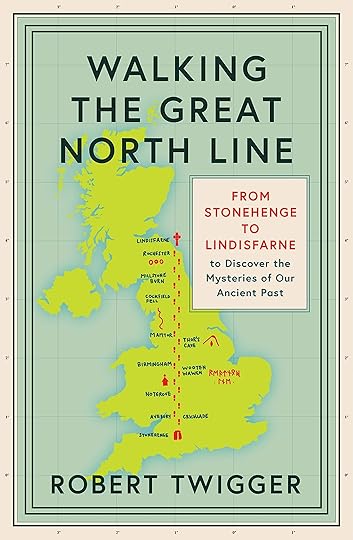
It is a very strange thing indeed. Lay out a map of Britain and something odd becomes apparent: at 1 degree 50 minutes west there is a dead straight line going true north from Stonehenge to Lindisfarne. Two of Britain's most-ancient and most-revered sites. But there is more . . .
Starting in the south, the line goes dead north from Castle Ditches to old Sarum, through Stonehenge, Knap Hill and Avebury stone circles, past ancient places in Cricklade, Bibury, Notgrove and Wootton Wawen. It goes through Long Low, Thor's Cave, Mam Tor, nearby Twelve Apostles stone circle, Ilkley Roman site, The Badger stone, ancient sites in Lanchester, Eochester, Millstone Burn, Bewick Hill and all the way to finish plum on Lindisfarne Island - one of the most ancient of early Christian sites and still a retreat and monastery.
But the significance of the Great North Line has been forgotten over time, and no one has ever walked the whole route before - at least not in the last 1,000 years. Robert Twigger has travelled this ancient line on foot, like a biologist walking a transect. Sticking as closely as possible to the meridian, he answers the questions raised by this most mysterious and ancient of British lines and discovers if it still has a power over us today.
Robert Twigger noticed that a line connecting Stonehenge and Lindisfarne also takes in Avebury, Hadrian’s Wall, and numerous Palaeolithic sites like Meon Hill, the Swastika Stone, the Twelve Apostle Stones and Thor's Cave. Robert Twigger decided to walk from one end to the other sticking to the line as far as possible.
Wonderfully Robert Twigger manages to wild camp at most overnight stops on his 400 mile walk acknowledging his trepidation until he eventually becomes inured to it. His meandering discursive style allows for digressions into church porches, shamanism, Rumi, land ownership, water filtration, the poetry of Stephen Duck, meteorites and the virtues of the Pertex Buffalo top amongst other kit, and which ultimately gets to the big issues e.g meaning, life and family.
He's stimulating and inspiring company
4/5
It is a very strange thing indeed. Lay out a map of Britain and something odd becomes apparent: at 1 degree 50 minutes west there is a dead straight line going true north from Stonehenge to Lindisfarne. Two of Britain's most-ancient and most-revered sites. But there is more . . .
Starting in the south, the line goes dead north from Castle Ditches to old Sarum, through Stonehenge, Knap Hill and Avebury stone circles, past ancient places in Cricklade, Bibury, Notgrove and Wootton Wawen. It goes through Long Low, Thor's Cave, Mam Tor, nearby Twelve Apostles stone circle, Ilkley Roman site, The Badger stone, ancient sites in Lanchester, Eochester, Millstone Burn, Bewick Hill and all the way to finish plum on Lindisfarne Island - one of the most ancient of early Christian sites and still a retreat and monastery.
But the significance of the Great North Line has been forgotten over time, and no one has ever walked the whole route before - at least not in the last 1,000 years. Robert Twigger has travelled this ancient line on foot, like a biologist walking a transect. Sticking as closely as possible to the meridian, he answers the questions raised by this most mysterious and ancient of British lines and discovers if it still has a power over us today.

April 26, 2021
I started this book hoping to be inspired and learn some things about walking in the UK. Well, I certainly did learn some interesting facts and tidbits about Britain’s ancient past, but it was all rather ruined by the author’s repetitive and problematic descriptions of people. There are only so many times you can read a character being called “fat” before it wears thin. Or weird descriptions of women he comes across, who either have to have their ethnicity or attractiveness commented on. The sentence that really got to me however was the following:
“I had always thought the aborigine indignation about mining a bit crazy. Not any more. The Earth is sacred.”
Well thank fuck this middle class, middle-aged white man finally saw the light and chose to enlighten us! A copy edit to (at the very minimum) get rid of the offensive term aborigine would have been nice.
Anyway, there’s better books to be read about walking in the UK. Am looking forward to reading I Belong Here by Anita Sethi as antithesis.
“I had always thought the aborigine indignation about mining a bit crazy. Not any more. The Earth is sacred.”
Well thank fuck this middle class, middle-aged white man finally saw the light and chose to enlighten us! A copy edit to (at the very minimum) get rid of the offensive term aborigine would have been nice.
Anyway, there’s better books to be read about walking in the UK. Am looking forward to reading I Belong Here by Anita Sethi as antithesis.

October 16, 2020
I liked this book, with the author taking seven weeks to walk to Lindisfarne. It was a bit of a slow starter but I enjoyed his descriptions of the ancient places he visited during his walk. He passes through several sites which all line up from south to north, he insists its not a ley line, but it really is! He definitely hasn't inspired me to try wild camping, going to the loo under a tree isn't for me. And I would be very miffed if I found him camping on my lawn! But a good read from the comfort of my armchair.

November 24, 2021
This book just didn't do it for me. Mainly because the author just wound me up. He didn't seem to like anyone he met, apart from 2 people. Found him to be very judgmental. It would be interesting to do a word count to look for the number of times he called people he met, tubby, fat or variations of that. He hates tourists, cyclists, Yorkshire, northerners, horse riders.....He hates people like me who live in the suburbs and work in an office. He calls himself a nomad. So I just couldn't quite get into what the author was trying to tell me knowing this. There are some interesting parts like Thor's cave and especially at the beginning was more interesting. The 2nd half of the book felt like a lot of philosophising waffle. Lots of name dropping, place dropping. He kept reminding us he is an 'author'. Could have been good but author's looking down on his audience was a big turn off for me.
September 11, 2022
I have not read Robert Trigger’s books before and came across this as an algorithmic recommendation presumably because of my interest in British early and pre- history.
I found the premise of the great north line intriguing, plausible and particularly in its geographic orientation through the South and midlands, following the watershed between Severn and Trent catchments credible.
However, my problem with the book was the intrusion of Twigger. Far too often, his prejudice, whether social or political intrudes into the story…….why do I need to hear of the sexual proclivity of a hostel resident encountered on a completely different journey in a completely irrelevant country at a different point in time…..the threads of self deprivation and reversion to adolescent coprolalia conveyed to me far more personal arrogance than gentle humour.
I am unlikely to share future journeys with him.
I found the premise of the great north line intriguing, plausible and particularly in its geographic orientation through the South and midlands, following the watershed between Severn and Trent catchments credible.
However, my problem with the book was the intrusion of Twigger. Far too often, his prejudice, whether social or political intrudes into the story…….why do I need to hear of the sexual proclivity of a hostel resident encountered on a completely different journey in a completely irrelevant country at a different point in time…..the threads of self deprivation and reversion to adolescent coprolalia conveyed to me far more personal arrogance than gentle humour.
I am unlikely to share future journeys with him.

September 23, 2022
I went into this book expecting a sort of informative but humorous middle aged 'coming of age' journey, cut from the same cloth as Simon Armitage's wonderful 'Walking Home' or one of Bill Bryson's many travel books.
Instead, what we have here is a mostly tedious, boring account of one grumpy man trudging his way across England, with very little in the way of informative tidbits on ancient history or landscape.
I could almost accept this if the book was in any way entertaining. It just isn't. Among many others I've likely (and thankfully) forgotten, the author revels in sharing cruel remarks on: -
- The young
- The old
- Women
- Fat people
- Country folk
- City folk
- People who own pubs
- People who sit in pubs
- "Horse folk"
- The poor
- The rich
You get the idea.
This is, from cover to cover, one man's nasty snarling account of how much he hates everyone else in society, told against a backdrop of walking across the country.
A particular low point was his whole passage about laughing at a "fat family" out on a bike ride, on the outskirts of a "poor, Northern town". They "speak Northern" up there, apparently.
Oh, and the delightfully degrading bit about the two women who give him directions while he is looking for the next pub.
The author could probably still get away with all of this if he was funny. He isn't.
Instead, what we have here is a mostly tedious, boring account of one grumpy man trudging his way across England, with very little in the way of informative tidbits on ancient history or landscape.
I could almost accept this if the book was in any way entertaining. It just isn't. Among many others I've likely (and thankfully) forgotten, the author revels in sharing cruel remarks on: -
- The young
- The old
- Women
- Fat people
- Country folk
- City folk
- People who own pubs
- People who sit in pubs
- "Horse folk"
- The poor
- The rich
You get the idea.
This is, from cover to cover, one man's nasty snarling account of how much he hates everyone else in society, told against a backdrop of walking across the country.
A particular low point was his whole passage about laughing at a "fat family" out on a bike ride, on the outskirts of a "poor, Northern town". They "speak Northern" up there, apparently.
Oh, and the delightfully degrading bit about the two women who give him directions while he is looking for the next pub.
The author could probably still get away with all of this if he was funny. He isn't.

May 14, 2020
Full of mini-insights along with the big insight. Full of the English countryside. The countryside you see at six on a rain filled morning. The one you see camping in crooks and crannies. Lockdown forgotten as one follows Twigger's path up the England that is the tale of the haunted owl. The owl that is echoed in other English/Irish literature/Scottish literature. It's not a walk in the park either, harsh enough in places. A lack of common land is noticed. Heart braking/breaking that so much of the land is owned. A brave walk... pulled achilles tendons, no blisters though, which seems in my walkless state a miracle. Trusty walking poles/sticks and a couple of frights. Really recommend this book. I am going to read it again. Addendum....The men who built the henges may have known something we (in general) don't know. They may not have been the sun worshipping 'primitives' 'history' and certainly I have ascribed to them. (less)

January 23, 2025
I enjoyed this and again , took my time .
I did find that his obsession with describing annoying people that he encountered along his journey was , by the end quite off putting .
However , that can be entirely overlooked as
I Loved the mystical musings and historical discussions and even the findings he’d made for good trekking and camping .
I would read this again and might , as it’s one I purchased so no fear of library re calls .
I did find that his obsession with describing annoying people that he encountered along his journey was , by the end quite off putting .
However , that can be entirely overlooked as
I Loved the mystical musings and historical discussions and even the findings he’d made for good trekking and camping .
I would read this again and might , as it’s one I purchased so no fear of library re calls .

May 18, 2020
Twigger goes walking for seven weeks from Stonehenge to Lindisfarne, around 600 km, to discover the mystical distant past of his country with the hope to be able to show that ancient man was as intelligent as modern man. The appetizing book cover shows a map over England and the distance he walks, and gets me in a very good mood for reading. Twigger's simple and funny drawings, one for each of the twelve stages, where he has noted special places, people he met and where he put up his tent, I think is a splendid idea that I intend to copy. We take part of his reflexions and uncensored thoughts during the ups and downs in landscape as well as mind. The materialism of today contrasts sharply against thousands of years old cairns and henges and shamanism. The many practical tips, like bringing a brolly for instance, I have carefully noted as I have the difficulties he had to camp wild, a right taken for granted here in Sweden.
Walking the Great North Line is a really great inspirer to get you out walking, as is Twigger's book Walking
I'll muse over the much occurring word Alignment, it's “a key aspect of shamanism. It refers to the need to be in accordance with nature, your environment, your future, your past” p. 9
Walking the Great North Line is a really great inspirer to get you out walking, as is Twigger's book Walking
I'll muse over the much occurring word Alignment, it's “a key aspect of shamanism. It refers to the need to be in accordance with nature, your environment, your future, your past” p. 9
April 27, 2020
Twigger is an errant knight, who uncovers a hidden sense of England on his walk along this mystical route. A masterful conjuror of images and ideas, he can describe a blistered toe with the same enthusiasm he brings to the wistful call of the cuckoo. He turns his bright gaze on all manner of shamanic shapes and shifting ghosts in the land and reveals much about his own innermost thoughts on writing and the journey through life itself. This is a rare book with much wisdom spun around a seemingly well known set of places.

June 29, 2020
An inspirational walk boldly executed in which the author witnesses the beauty and the horror and just keeps going. 11 out of 10.

April 12, 2022
I have a particular fondness for the rather specialist sub genre of travel writing that is the walking memoir, a lifelong love that I can trace back to reading John Hillaby’s Journey Through Britain and Journey Through Europe in my teens. There’s something about the organic pace and randomness of the encounters along the way that I find both comforting and enthralling. There’s also an element of wish fulfilment and vicarious adventure in reading about really long walks that I would like to do myself but probably never will.
Robert Twigger’s journey takes him due north along latitude 1 degree 50 west from Christchurch on the Dorset coast to the island of Lindisfarne off the coast of Northumberland. It’s a line that takes him through a remarkable number of ancient sites, including Stonehenge and Avebury and countless smaller henges, rings, forts, barrows and other early ritual landscape features, as well as towns, cities and edgelands, and these give rise to a fair bit of philosophical musing, some of which I could take or leave, but this description of the therapeutic impact of walking made a particular impact: ‘walking alters our perception of time. Sometimes subtly, sometimes drastically. It alters time; it untangles thoughts…thoughts proceed in an orderly line when we walk. Like rubber bands, they tangle the moment we stop; and the tangle gets even worse if we sit at a desk’. How true!
Robert Twigger’s journey takes him due north along latitude 1 degree 50 west from Christchurch on the Dorset coast to the island of Lindisfarne off the coast of Northumberland. It’s a line that takes him through a remarkable number of ancient sites, including Stonehenge and Avebury and countless smaller henges, rings, forts, barrows and other early ritual landscape features, as well as towns, cities and edgelands, and these give rise to a fair bit of philosophical musing, some of which I could take or leave, but this description of the therapeutic impact of walking made a particular impact: ‘walking alters our perception of time. Sometimes subtly, sometimes drastically. It alters time; it untangles thoughts…thoughts proceed in an orderly line when we walk. Like rubber bands, they tangle the moment we stop; and the tangle gets even worse if we sit at a desk’. How true!

August 15, 2024
Ah the gamble of a 99p Kindle Daily Deal…
As a walker I thought this might be right up my street.
As a northerner, I can’t decide what I’m more offended by - his description of Halifax as being akin to something from The Walking Dead, or his completely uncalled for description of a northern family out cycling together.
Even at the end (yes I somehow managed to get that far), he couldn’t resist a dig at the tourists on Lindisfarne, whilst of course refusing to pay for entry to the Castle.
I’ll research my 99p purchases a bit more carefully in future.
As a walker I thought this might be right up my street.
As a northerner, I can’t decide what I’m more offended by - his description of Halifax as being akin to something from The Walking Dead, or his completely uncalled for description of a northern family out cycling together.
Even at the end (yes I somehow managed to get that far), he couldn’t resist a dig at the tourists on Lindisfarne, whilst of course refusing to pay for entry to the Castle.
I’ll research my 99p purchases a bit more carefully in future.

September 23, 2020
A surprising and invigorating book: funny, thoughtful, filled with earthy common sense & insight. It feels like you’re walking from Stonehenge to Lindisfarne with a buddy. But this is no airy-fairy pilgrimage. Twigger doesn’t hide his warts & reactions. It reminds us that adventures lie just outside our front doors.
January 3, 2024
Well, it's a good premise: a man finds there's a straight line that runs due north from the south coast to the northern tip of England and walks it. This was going to be a good read, I thought: slow travel across England with the shifts in landscape and its people creatively captured.
What actually transpires over the 280-odd pages is one man's monologue of prejudice. It may have been pertinent to reflect on the dichotomy of the freedom-seeking nomad with the property-owning socially conservative masses, but Twigger labours this point at every opportunity. Sticking it to The Man, he would likely claim - this particular man is practically hitting you over the head repeatedly with the stick. And it's a rarity when he meets someone he actually likes (generally older, single white men that he can easily identify with). For anyone else, particularly women, they should brace themselves lest Twigger deign to notice them well enough to attach adjectives to them. "Fat" could be an objective description of someone. "Fat" is also Twigger's go-to adjective for anyone who doesn't pass muster as a wiry, energetic elder marching gamely across the countryside. A northern family who have clearly made a decision to overcome a sedentary life and take to their bikes together? Fat, wide-arsed, wobbly. A man who he encounters while filling a water bottle? Fat (impressive he had room for the adjective, so perfunctory his appearance in the narrative). A girl walking down a street with no other role in Twigger's journey? Of course you've guessed it. For someone who clearly regards himself as a master story-teller, it's somewhat surprising that this is often the only adjective he can find to describe someone and, given the clear sentiment of his descriptions, the adjective is more dog-whistle to a certain breed of misogynist or snob than it is objective description. His dislike of people for being too fat, too poor, too middle class, too fat, too rich, and (did I mention it) too fat means it's not entirely clear who, other than an army of Robert Twigger clones, could read this without feeling Twigger's opprobrium.
The book earns 2 stars purely because the feat of walking the length of England armed only with what he carried in a backpack is not to be underestimated. But Twigger has shown himself to best be avoided should you see him marching across a field towards you lest he decides to make you, too, a one-dimensional passerby in what should be described "A Privileged, Fragile Man's Guide to Hating Everyone".
What actually transpires over the 280-odd pages is one man's monologue of prejudice. It may have been pertinent to reflect on the dichotomy of the freedom-seeking nomad with the property-owning socially conservative masses, but Twigger labours this point at every opportunity. Sticking it to The Man, he would likely claim - this particular man is practically hitting you over the head repeatedly with the stick. And it's a rarity when he meets someone he actually likes (generally older, single white men that he can easily identify with). For anyone else, particularly women, they should brace themselves lest Twigger deign to notice them well enough to attach adjectives to them. "Fat" could be an objective description of someone. "Fat" is also Twigger's go-to adjective for anyone who doesn't pass muster as a wiry, energetic elder marching gamely across the countryside. A northern family who have clearly made a decision to overcome a sedentary life and take to their bikes together? Fat, wide-arsed, wobbly. A man who he encounters while filling a water bottle? Fat (impressive he had room for the adjective, so perfunctory his appearance in the narrative). A girl walking down a street with no other role in Twigger's journey? Of course you've guessed it. For someone who clearly regards himself as a master story-teller, it's somewhat surprising that this is often the only adjective he can find to describe someone and, given the clear sentiment of his descriptions, the adjective is more dog-whistle to a certain breed of misogynist or snob than it is objective description. His dislike of people for being too fat, too poor, too middle class, too fat, too rich, and (did I mention it) too fat means it's not entirely clear who, other than an army of Robert Twigger clones, could read this without feeling Twigger's opprobrium.
The book earns 2 stars purely because the feat of walking the length of England armed only with what he carried in a backpack is not to be underestimated. But Twigger has shown himself to best be avoided should you see him marching across a field towards you lest he decides to make you, too, a one-dimensional passerby in what should be described "A Privileged, Fragile Man's Guide to Hating Everyone".

January 19, 2022
I noticed this in the travel section in Waterstones and from the cover, it looked a bit like one of those jaunty travelogue pieces as a someone accepts a challenge and documents the humour, observations, things of interest on the way.
It was all these things but far exceeding that remit. There are references to other authors of interest, some philosophy, advice, wisdom from the ancients and some top draw observations on everything from other people to pubs, to coffee shops. From the half way point of the book and onwards, there appears to be a truth in every paragraph. Even when he uses Birmingham (my birth place) to justify his opinion that all great cities are based on rivers. Brum ain't got one!
The challenge is that many great UK places of antiquity - from Christchurch to Lindesfarne - exist on the a direct line. He sets off to walk them over around 9 days I think. Each section is introduced with a pretty hand drawn map.
Occasionally - such as a the start - he has company. This was when I thought it was going to be a bit "three men in a boat" as their differences and the banter is described. But in no time at all, he is alone - wild camping and discussing the societal issues that this poses.
Many standout observations. I liked it when he met Tim on Mam Tor - a randomer, who had to get to the hills once a month for his mental health. What sort of life is it that you need to take drugs (anti-depressants in Tim's case) to do a job. I liked it when he met society "outsiders". The man dedicating his days to whittling Yogi Bears out of tree trunks with a chainsaw for a living. Only sub 9 years olds would class this as a good use of time, he thinks society would state.
The writing is superb - as you would expect from a poet. Much better than the book's premise hinted at.
The longer the walk went on, the more I enjoyed Roberts company. It was a shame the journey and the book came to an end - it does rather abruptly at Lindesfarne, with no real summary chapter.
I'm not sure any of his other books are so travel related (at least in the UK) but I will certainly be dipping into his back catalogue.
It was all these things but far exceeding that remit. There are references to other authors of interest, some philosophy, advice, wisdom from the ancients and some top draw observations on everything from other people to pubs, to coffee shops. From the half way point of the book and onwards, there appears to be a truth in every paragraph. Even when he uses Birmingham (my birth place) to justify his opinion that all great cities are based on rivers. Brum ain't got one!
The challenge is that many great UK places of antiquity - from Christchurch to Lindesfarne - exist on the a direct line. He sets off to walk them over around 9 days I think. Each section is introduced with a pretty hand drawn map.
Occasionally - such as a the start - he has company. This was when I thought it was going to be a bit "three men in a boat" as their differences and the banter is described. But in no time at all, he is alone - wild camping and discussing the societal issues that this poses.
Many standout observations. I liked it when he met Tim on Mam Tor - a randomer, who had to get to the hills once a month for his mental health. What sort of life is it that you need to take drugs (anti-depressants in Tim's case) to do a job. I liked it when he met society "outsiders". The man dedicating his days to whittling Yogi Bears out of tree trunks with a chainsaw for a living. Only sub 9 years olds would class this as a good use of time, he thinks society would state.
The writing is superb - as you would expect from a poet. Much better than the book's premise hinted at.
The longer the walk went on, the more I enjoyed Roberts company. It was a shame the journey and the book came to an end - it does rather abruptly at Lindesfarne, with no real summary chapter.
I'm not sure any of his other books are so travel related (at least in the UK) but I will certainly be dipping into his back catalogue.

June 7, 2025
The basis of this travel memoir is intriguing-- walking the great leyline of England which took the author 7 weeks.
I appreciated his down to earth writing style of nature writing, he tells it like it is, he isn't flowery. When he's fed up and drenched, he doesn't celebrate the rain, he's not afraid of a good moan, he's very real about the uncomfortable lack of modcons. He's more interested in the historical sites he walks to anyway. Loved the historical facts he added about each place too as well as his knowledge for Britain's ancient shamanistic past.
Wasn't a big fan of how 'mansy' the entire book read. it felt like something you'd read in a men's fishing and outdoors magazine. He talked too much about his camping gear or describing the smell of feet or a very loud fart he did in his sleeping bag, oh and trips to local pubs for beers. Most travel memoirs also have an underlying theme as to why someone felt compelled to challenge themself to do such a thing, Twigger never really gives us that, so he walked for 7 weeks for shits and giggles? To see historical sites (which can be done by car), you never really find out so it makes it hard to bond with him on his journey.
If you're a blokey bloke who enjoys a daily moan and grump about the world and people, and you love the outdoors, this one is for you.
I appreciated his down to earth writing style of nature writing, he tells it like it is, he isn't flowery. When he's fed up and drenched, he doesn't celebrate the rain, he's not afraid of a good moan, he's very real about the uncomfortable lack of modcons. He's more interested in the historical sites he walks to anyway. Loved the historical facts he added about each place too as well as his knowledge for Britain's ancient shamanistic past.
Wasn't a big fan of how 'mansy' the entire book read. it felt like something you'd read in a men's fishing and outdoors magazine. He talked too much about his camping gear or describing the smell of feet or a very loud fart he did in his sleeping bag, oh and trips to local pubs for beers. Most travel memoirs also have an underlying theme as to why someone felt compelled to challenge themself to do such a thing, Twigger never really gives us that, so he walked for 7 weeks for shits and giggles? To see historical sites (which can be done by car), you never really find out so it makes it hard to bond with him on his journey.
If you're a blokey bloke who enjoys a daily moan and grump about the world and people, and you love the outdoors, this one is for you.

February 7, 2021
What I liked the most were the ruminations on the larger world, ancient history, and other themes. My eyes were opened on the learnings from shamanism. I found it strange that we are in some ways unlearning what we have learned in the past few decades and centuries. The opening of the book I thought was a bit too lad-dy for me, but I was rewarded when I kept reading. I found the transitions from the mundane about the rigors of walking, to the more intellectual moments, a bit jarring at first, but got used to them and then appreciated the contrasts. I read a book that detailed another long walk, but found it very narcissistic and inward looking. In contrast, I found Robert interested in others and the world and observant, even if he didn't always engage with them. The lovely thing about discovering a new writer is when you realize there are more books to read and the adventure doesn't have to stop. If you liked this book, I might recommend Tony Perrottet's Route 66 AD.

November 3, 2021
I was pretty much intrigued to learn about the straight line running from the south of England to the very north – passing through 42 ancient sites en route, connecting Stonehenge and Lindisfarne. And even more to read that someone actually crossed it all on foot! Two reasons enough to read a book about it.
It seemed a rather slow start but easy to read. It's so evident the man likes to ramble and share his thoughts. I would like to applaud him for this seven week walk, camping in the wild and showing us what a true traveller is, but some of his observations did not really sit well with me. Wandering in nature usually makes me observe the world so I reckon it must be happening to many of us, including the author himself but his mind went everywhere, literally, that it kind of spoilt the fun for me in the end.
‘Freedom also includes not paying for things that are ours by rights, by the right of ancient England.’
It seemed a rather slow start but easy to read. It's so evident the man likes to ramble and share his thoughts. I would like to applaud him for this seven week walk, camping in the wild and showing us what a true traveller is, but some of his observations did not really sit well with me. Wandering in nature usually makes me observe the world so I reckon it must be happening to many of us, including the author himself but his mind went everywhere, literally, that it kind of spoilt the fun for me in the end.
‘Freedom also includes not paying for things that are ours by rights, by the right of ancient England.’
June 4, 2022
Interesting read. I have to say that I found it 10% annoying, 10% silly and some of the rest was very interesting /OK. Some of the jokeyness was too heavy handed for me. At times quite contradictory views were expressed which grated with me. The hand drawn maps were helpful at times. However places (apparently ancient sites) were on the map but not in the text. Equally there were places in the text that were not on the map...
Other than that the fundamental idea of a Line and what was on it was very interesting. Certainly the author debunked some silly ideas about ancient structures appropriately to my mind. There were places I hadn't heard of that interested me. How much shamanism might have to do with it all might be a matter for debate I think.
Quirky, quite readable if the basic idea interests but be prepared to grit your teeth at times.
Other than that the fundamental idea of a Line and what was on it was very interesting. Certainly the author debunked some silly ideas about ancient structures appropriately to my mind. There were places I hadn't heard of that interested me. How much shamanism might have to do with it all might be a matter for debate I think.
Quirky, quite readable if the basic idea interests but be prepared to grit your teeth at times.

June 21, 2025
‘But you never know if it’s you or the place. Sometimes you arrive with a special vibe that people respond positively too(sic). And other times it’s the reverse.’
Usually the reverse in Robert Twigger’s case. He walks the length of England weighed down by a large chip on his shoulder and suspicious and dismissive of almost everyone he meets along the way. At times I wasn’t sure if he was navigating from ancient site to ancient site or from flat white to flat white.
Purile humour - he farts as much as possible into a sleeping bag that is the wrong size.
Misogynistic to the core - all women are fat unless they are ‘hot looking chicks’. What makes him think that any woman would spare the breath to pass the time of day with him except from courtesy or pity?
He sees himself as on a shamanic journey, I kept reading to the end just to see if he cheered up
Spoiler: He didn’t
Usually the reverse in Robert Twigger’s case. He walks the length of England weighed down by a large chip on his shoulder and suspicious and dismissive of almost everyone he meets along the way. At times I wasn’t sure if he was navigating from ancient site to ancient site or from flat white to flat white.
Purile humour - he farts as much as possible into a sleeping bag that is the wrong size.
Misogynistic to the core - all women are fat unless they are ‘hot looking chicks’. What makes him think that any woman would spare the breath to pass the time of day with him except from courtesy or pity?
He sees himself as on a shamanic journey, I kept reading to the end just to see if he cheered up
Spoiler: He didn’t

September 18, 2022
I really want to like Robert Twitter's work. I did love his book WALK. But this book, like his exploration of learning Aikido in Japan, Angry White Pyjamas, was... tedious.
He walks the great north line, a sort of path linking a bunch of ancient sites in England. I kept listening for a reason. Why? What was the motivation? None materialized. It seems like he walked it in order to later write a book. The result is a rather meandering, repetitive travelogue. He complains a lot, making him, as the narrator, kind of unappealing (I imagine he was shooting for humanizing, but the result was annoying).
He goes into some detail, context and background of some of the sites he visits, but this is a bit slapdash.
I don't know. I guess I just expected better...
He walks the great north line, a sort of path linking a bunch of ancient sites in England. I kept listening for a reason. Why? What was the motivation? None materialized. It seems like he walked it in order to later write a book. The result is a rather meandering, repetitive travelogue. He complains a lot, making him, as the narrator, kind of unappealing (I imagine he was shooting for humanizing, but the result was annoying).
He goes into some detail, context and background of some of the sites he visits, but this is a bit slapdash.
I don't know. I guess I just expected better...

June 28, 2020
A wonderful account of a long distant yomp from Chichester to Lindisfarne - all connected by the same line of longitude and linking many ancient sites across the country, including Stonehenge, Averbury and the stone circles on Ilkley Moor. A good read, that kept up some good pace to. The danger with books about long walks is they start to become repetitive, but this account just about avoids that. I was disappointed with Twigger's views on some of the places he passed through, mis-judging the character of some locations that he'd effectively just whizzed through.

February 9, 2021
A phenomenal read, especially in quarantine! Twigger paints a humorous and unromantic narrative of hiking Britains Northern Line trail that inspires wanderlust and adventure. Full of helpful tips for walking the trail or any long distance hike, this book is a fast and fun read. You travel alongside the author as he camps his way through his home country, making friends and overcoming obstacles along the way. Twigger also includes historical anecdotes about the sites he visits which helped me appreciate the purpose of this walk (as someone unfamiliar with Britain's neolithic history).

April 14, 2023
Robert Twigger writes yet another terrific 'travel' book;
this one right near-to-home, as it were, in Britain. The author
is following up a path that seems to indicate, possibly, that
there has been some intention to 'follow a line'...a straight one,
that can be viewed as running through numerous sacred sites, or at
least locations that the ancients appear to have found to be of
special interest. Refreshingly, one finds little, I would say
'none', of the sort of cosmic fluff one might expect here. This
is, without doubt, however, a book of dimensions, and one
enjoyable such dimension is the frequent and ongoing wry-to-
whimsical commentary about people and places he encounters
or happens upon during his long hike. Overall, very enjoyable
to read and thought-provoking as well.
June 22, 2024
A tale of agency, achievement and belonging
Agency, achievement and belonging; Robert Twigger claims all of these, in his account of the journey he makes from the south of England to Lindisfarne. I love the geographical, historical and personal detail of his account. I also love the point he makes about freedoms to choose and claiming what is rightfully ours for free. Sometimes his grouchiness is grating but is almost always redeemed through his own awareness if such and his compensatory generosity. I recommend.
Agency, achievement and belonging; Robert Twigger claims all of these, in his account of the journey he makes from the south of England to Lindisfarne. I love the geographical, historical and personal detail of his account. I also love the point he makes about freedoms to choose and claiming what is rightfully ours for free. Sometimes his grouchiness is grating but is almost always redeemed through his own awareness if such and his compensatory generosity. I recommend.
January 9, 2025
I enjoyed this. Had to do a bit more research on some of the sites that were mentioned though. The author was slightly negative about humankind and it could be off putting, but then by the end of the book I found myself agreeing to some extent. I too think people have lost the magic of looking at the nature around us and instead gravitate toward shopping centres to do yet more shopping. The UK has some wonderful mysterious areas to explore and visit.
This book has definitely highlighted places I need to visit and cemented those I already wished to.
This book has definitely highlighted places I need to visit and cemented those I already wished to.
August 31, 2021
This was an interesting read although disappointing to learn of the author’s opinion on Yorkshire and some towns I like. I liked that he used an umbrella and did wild camping. A real character, a sort or middle aged rebel without a cause. Not nearly as good as my favourite Robert Macfarlane, this was almost a spoof on long distance walking. It does cover a significant distance though which is impressive.
Displaying 1 - 30 of 42 reviews