En underhållande släktsaga från en annan del av världen Somlata är ung när hon gifter in sig i en fin bengalisk familj. Hela släkten Mitra bor tillsammans i ett stort vackert hus, och för att upprätthålla den lyxiga standarden säljer de av sitt guld och sina ägodelar en efter en. När den bitska matriarken Pishima plötsligt dör är Somlata den som hittar henne. På något märkligt vis verkar den döda tala till henne och berätta i förtroende var hennes smyckeskrin finns gömt. Hon kräver också att Somlata ska gömma guldet för resten av släkten. Och trots att Pishima är död är det som om hon ändå fortsätter styra släkten från andra sidan. Hemligheter kommer upp till ytan, festmåltider blir på oväntade sätt förstörda, inget går familjens väg. Och när de nästan har blivit utblottade är det upp till Somlata att lösa allt. Änkan som vägrade dö är en underhållande berättelse om tre generationer kvinnor i familjen Mitra, ett smyckeskrin och en släkt på ruinens brant. Shirshendu Mukhopadhyay föddes i nuvarande Bangladesh och har varit verksam som lärare, journalist och författare. Änkan som vägrade dö skrevs ursprungligen på bengali och är numera en omtyckt klassiker i hemlandet. Boken har också filmatiserats.
শীর্ষেন্দু মুখোপাধ্যায় একজন ভারতীয় বাঙালি সাহিত্যিক।
তিনি ব্রিটিশ ভারতের বেঙ্গল প্রেসিডেন্সির অন্তর্গত ময়মনসিংহে (বর্তমানে বাংলাদেশের অংশ) জন্মগ্রহণ করেন—যেখানে তাঁর জীবনের প্রথম এগারো বছর কাটে। ভারত বিভাজনের সময় তাঁর পরিবার কলকাতা চলে আসে। এই সময় রেলওয়েতে চাকুরিরত পিতার সঙ্গে তিনি অসম, পশ্চিমবঙ্গ ও বিহারের বিভিন্ন স্থানে তাঁর জীবন অতিবাহিত করেন। তিনি কোচবিহারের ভিক্টোরিয়া কলেজ থেকে মাধ্যমিক শিক্ষা সম্পন্ন করেন। পরে কলকাতা বিশ্ববিদ্যালয় থেকে বাংলায় স্নাতকোত্তর ডিগ্রি লাভ করেন। শীর্ষেন্দু একজন বিদ্যালয়ের শিক্ষক হিসেবে তাঁর কর্মজীবন শুরু করেন। বর্তমানে তিনি আনন্দবাজার পত্রিকা ও দেশ পত্রিকার সঙ্গে জড়িত।
তাঁর প্রথম গল্প জলতরঙ্গ শিরোনামে ১৯৫৯ খ্রিস্টাব্দে দেশ পত্রিকায় প্রকাশিত হয়। সাত বছর পরে সেই একই পত্রিকার পূজাবার্ষিকীতে তাঁর প্রথম উপন্যাস ঘুণ পোকা প্রকাশিত হয়। ছোটদের জন্য লেখা তাঁর প্রথম উপন্যাসের নাম মনোজদের অদ্ভুত বাড়ি।
What a great, lovely, quirky, fun, sad & interesting book to read!! Very recommended! And oh, I think I reached the end of my 2019 challenge, yeah! :-)
This is the story of Somlata, who marries at a young age into a noble Bengali family that used to be very rich and now has to pawn off all family valuables to keep up appearances. When Pishima, the embittered matriarch dies, Somlata is the first to discover her body, and her sharptongued ghost, who tells her to hide her gold from the family's prying hands, which she does, and who keeps bugging her around the house with embittered advices. Meantime, as the family teeters on the brink of bankruptcy, Somlata sets out to fix it, but starting up businesses. At first the family opposses, but then it turns out, it's working. And there's her daughter, Boshon, strongwilled, taking a claim in this story. And what about the hidden gold...? Entertaining!
The Mitras used to be zamindars, feudal landlords in East Bengali but now household funds were dwindling. " The household runs with the money that comes from selling land and gold...the men in the family were not keen on employment or business...I have never considered employment-I can't be a clerk...I can't start a business-that's for shopkeepers".
When Somlata married Fuchu, she was eighteen, he was thirty-two. According to Somlata, "...my parents were so poor that it would be an indulgence to make a fuss about the groom's age or employment status". "Family gold is sacred, family land, too. I've heard it's not right to sell off either of these". Somlata's cloistered life, based on social convention, was about to change. Taking baby steps, she would be the wind beneath her husband's wings, shaping, ever so carefully, her husband and a winning business enterprise.
It started with Pishima, the "defacto" head of the family. married at seven, widowed at twelve, she was shut away. She was angry, bitter and full of rage. Passing Pishima's room one day, Somlata froze. Pishima sat still...eyes open...lips unmoving...but "[Somlata] could clearly hear her speak, 'Yes, I'm dead...the wretch is finally gone...take the keys from...my sari...go to the north room...find...a wooden box...hide it in your room...my favorite jewelry...nothing must be touched'."
Where was Pishima's jewelry? Family members discussed its disappearance or possible theft. After all, they had expected to continue to live off the wealth created by Pishima's cache. Not so fast! Pishima might have died, but her ghost lives on. She appears to Somlata, dressed in a white sari, creating chaos and meting out advice...Cooking mutton?...smells divine...It'll be delicious, but you've forgotten the salt. Put plenty...that night everyone said the mutton was excellent, but there was too much salt".
Somlata's daughter, Boshon represented a new generation. "I knew everything was guided by rules. I would have to tear myself away from this freedom, this abandon, this fantasy walk amid nature under an exquisite moon, and return home. Just as I will have to dress up in wedding finery one day and take my place on the bride's seat. I feel I will get by without a man".
With humor and a push back against social convention, the reader meets three generations of Mitra women in "The Aunt Who Wouldn't Die" by Shirshendu Mukhopadhyay. It was a joy to read the positive voices of these women who question the old aristocratic mores which will eventually give way to freedom and encourage forward thinking women.
Thank you HarperCollinsPublishers-Harper Via and Net Galley for the ARC in exchange for an honest review.
The aunt who wouldn't die honours women's strength and portrays their responsibilities in family and society at various points in history, both before and after independence.
It's a witty and fascinating story about three Bengali women from three generations apart. Somlata, the Chowdhury family's freshly wedded daughter-in-law, transforms the path of her financially disadvantaged family with her sensible actions and foresight. Roshomoyee, Somlata's widowed aunt-in-law, offered an emotional and melancholy panorama of child widows' lives, as well as the dreams and desires of unfulfilled youth. Boshon, Somlata's daughter and the apple of the Chowdhury family's eye, is depicted as a modern independent woman who questions and challenges the old age customs of society.
Boshon is the show's star in my opinion; I enjoyed her storey and her modern approach on love and marriage. I'm both perplexed and amazed by the way she describes her relationship with solitude. I can't help but relate with her. One of my favourite scenes from the novel is when she is sitting in the moonlight.
The rich language, which included a few regional phrases and honorifics, created a vivid and lively picture of the scenario and brought the characters to life. We can safely say that the translation was accurate.
The writing was fast-paced and almost lyrical. There was not a single dull moment throughout the story. The conclusion was fantastic; I adored and appreciated it.
If you like family fictional drama which is both short and meaningful this book is for you.
This is a short but fabulously entertaining read about women from different generations providing a thought provoking picture of their lives, culture, social change, family, and patriarchy. The smart and shrewd 18 year old Somlata marries into what her impoverished family believed is an upstanding, reputable and wealthy Bengali family, the Mitras. Only this turns out to be far from the truth, with the men unwilling to engage in work, believing it is beneath them. The family has kept up appearances by living off family gold and the sale of their lands but this is no longer a viable option. When a bitterly resentful aunt dies in odd circumstances, she is rather reluctant to move on and returns to haunt Somlata as a ghost, wreaking havoc in the process, whilst imparting her 'advice' to Somlata. In the narrative there is a mysterious jewellery box, and a entrepreneurial Somlata, displaying the virtues of hard work that drives the much needed change that the family is desperately crying out for. Somlata's daughter, Boshon, is the picture of the modern woman, independent and fiercely determined. A brilliant read, beautifully written that takes in the harrowing horrors of the past, including child brides and more and how things have changed as we can observe with Boshon. Many thanks to John Murray Press for an ARC.
This book is such a masterpiece! I feel more so because it's been translated so well. Well done!
First of all, the writing! It sucked me in right away! It's written without any kind of pretension and it is what it is kind of delivery that it's almost impossible to put down the book and do anything else. It's been quite a while since I read something this appealing, enthralling and enticing. Again, heartfelt appreciation to the translation.
I like the plot so much. I really cannot believe how relevant and liberating the storyline is written in such a way mixed with wit, charm, capturing the unpredictable turn of emotions that would follow while reading through the behaviour of the characters and the subsequent turn of events.
The story started out really good, strong and vivid. It's short but it's more shorter because it's just too good! I just couldn't stop reading the book once I started it. No waste of words. Whatever tiny twist in the storyline worked out so well and there was never a dull moment.
It's the story of a rather big dysfunctional family which changed drastically in one generation because of the tragedy of a woman and the willful tactics of another.
Also, the plot goes in alternate timelines, one of the past generation and one of the next generation. But one main concept remains similar in how the women characters, young or old, has been portrayed with such strength and determination. It's so damn liberating to read something like this which was written decades ago!
The story remained utterly fascinating till the end. It ended too soon I say! I want more.
The display of emotions, the various restrictions of the society (starting from our own families), the difference in attitude and how it matters, the different realistic personalities, the changes we need to make them happen in order to improve our lives (kudos to the author!), the various family dynamics and the dilemma a married woman faces, how a woman can change the world around her, how unrequited love breaks people and, on the other hand, how unbound love and care can change everything have been etched out so beautifully.
Be warned of some creepy paranormal things as well as some stern, strong words from the aunt who just wouldn't die!
Three generations in a crumbling Bengali townhouse. You might think that’s enough of an occupation, but there is a ghost too. The women and the ghost (woman as well) are the important characters. The once wealthy and important family is now neither. The lassitude is smothering the men and at the start the women cannot overtly take charge. New blood stimulates this crowd. Somlata is the new bride in the household. She has energy and brains. Then there is the ghost upstairs. What a terrific character! Bitchy and bitter. Why not? She married into the clan at seven and was widowed by 12. In her generation this meant living death. Although she lived to old age she’s stuck upstairs, must wear white clothing, eat bland food and never go outside. The ghost auntie grasps onto Somlata alternately giving advice and cursing her. Somlata must be careful as the advice is not always good. Ultimately there is a new baby girl born to Somlata and her husband—the third generation of women has arrived to negotiate life in modern times.
The story isn’t strictly linear and you must be ok with an Indian kind of magic realism. I became completely invested in these characters.
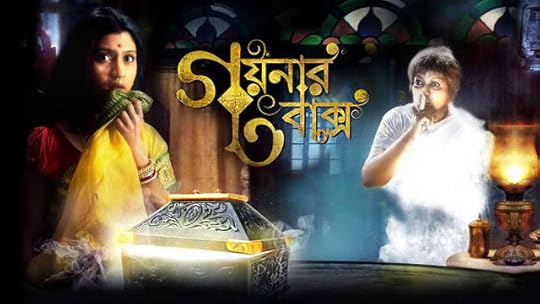
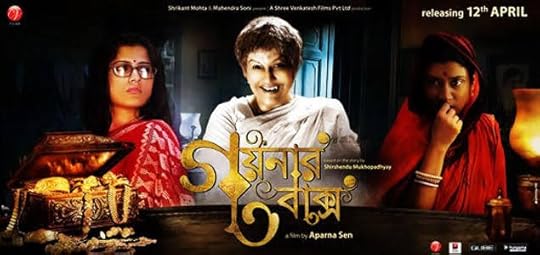
There is a Bollywood movie made from this book called Goynar Baksho that gets a 7.1 rating on IMDB (pretty good). It’s preview makes it look to be a bit dated in style—silly and exaggerated but I’ll probably give it a try.
One of those novels where much is packed in a short book. I really enjoyed the book. It shows 3 generations of women — a widow aunt who dies and later haunts a young bride as a ghost, a new bride into the family of crumpling wealth, and the daughter. It shows women and the power they hold in different generations. The aunt is revered for her treasure box even though she is a widow (she became a widow at 12 and has since known no pleasure, in body or through food). The new wife is industrious, she aims to make the men in her family work and revive the financial condition of the family. She weans off the men in the family from their lovers. The daughter is maybe what you can call someone from present day. Each woman needs the other to remind them to be selfless at times and not forget about oneself. Also many giggles and twists in this short read
Much thanks to Bee Books for a copy of the book. All opinions are my own.
This is a surprisingly short family epic that is surprisingly fun, recounting the changing lives of three generations of Bengali women in the post-independence era in India. Somlata, a poor 18-year-old woman who marries into the once wealthy Mitra family, is the main character. She is first terrorized by the Mitra family matriarch, her husband's great aunt Roshomoyee, and then haunted and taunted by her ghost. The book concludes with Somlata's strong, independent, teen-aged daughter Boshon charting a different course for her life. I enjoyed the frequent humor and insights into Bengali society and culture.
I read this book in a single sitting and I loved every minute of it 😍 A masterpiece of a novella, only a 140 pages long, but it conveys so much in such less number of pages. ~ Young Somlata is married into a once wealthy zamindar family, but are not so wealthy anymore and have to sell their land and gold to make ends meet. There is a belief in the house that men don't have to work, so they live off their dwindling riches and just loiter around the whole day. Somlata is unable to witness the decline of the family and that the men do nothing to help around the house. She helps her husband stand on his feet and helps stabilizing the household. Roshomoyee, the Pishima (maternal aunt), is a child widow and lives in her brother's house, she has a jewellery box which she is very attached to and never lets anyone have a peek inside or touch it. She dies mysteriously one day, and the family's attention moves to her jewellery box. Only Somlata is able to see her and knows the secret of the jewellery box. Roshomoyee haunts Somlata with her mischiefs, gives her advice and facetious suggestions. ~ Mukhopadhyay has written eloquently about three generations of women of a family and the soceital hurdles they had to overcome. Roshomoyee, was married at the tender age of 11 and widowed at 12. Somlata, a fierce woman, is enterprising and strong. Boshon, Somlata's daughter is a headstrong woman and we are able to relate with her very much. The development of the story was brisk and I loved how unnecessary details were avoided and the story stuck to it's point. The translation by Arunava Sinha was top notch. I loved how he gave a sneak peek into Mukhopadhyay's style of writing. I loved reading about the aristocratic lives of the zamindars of Bengal. A generous 5⭐ to this one.
Zanimljivo iz jednog dela sveta o kome ne znam mnogo. Banglades, porodicni odnosi, smena starog i dolazak novog, pomesano sa malo natprirodnog. Avaj bese kratko, trebalo mi je jos, taman sam se navikla na vreme i mesto, kad ono kraj. Steta...
A quick, quirky and entertaining read The Aunt Who Wouldn't Die is a short book, less than 200 pages but has plenty to say. It's about three generations of women - a bitter child widow great aunt Pishima, the daughter in law, Somlata, gentle yet headstrong and a devout wife, and her daughter Boshon, a rebellious, book loving fierce feminist teenager. There is a bit of magical realism too that works beautifully with the storyline.
Somlata, a smart young girl marries into a wealthy, aristocratic family of landowners and is completely unaware that her new family is on the brink of bankruptcy and surviving only by selling gold and family land. The men in the family are extremely lazy, lack ambition and believe that working for livelihood is beneath them. Somlata is determined to make a change. But, it's a bit challenging with the great aunt Pishima's grudge-holding angry ghost constantly haunting her and providing her with ill fated advice. How does Somlata cope? Is she able to change anything? What's with the ghost? Did I mention there's also a box of gold in play?
What follows is a fantastic story of customs and culture, family and freedom, social convention and patriarchy. There are giggle worthy scenes, a few unexpected twists and some excellent social commentary in the background. A quick, crisp read that has plenty of laugh out loud moments despite some serious underlying themes.
I finished it in a single sitting and would highly recommend this eloquent entertaining novella.
**A free finished copy was provided by Harper Via in exchange for an honest review. All opinions are my own. **
The title says it all, just not with the usual understandings!
Cautionary tale, mythology, philosophical reader, a traditional story feminist? Maybe all, some or. One of the above. One thing is true, this is definitely not funny. Kismet? Reincarnation? Or making choices pushed on by changing times, a ghost, your own set of beliefs, or simple taking up the mantle of survival? Bride Somlata marries into the Mitra family. She is from a poor but determined family. Traits that will stand her and her new family in good stead. Then there's the aunt/sister-in-law Pishma, a child widow locked in her own set of rooms buoyed up by her anger at the Mitras, and a cache of jewelry. A cache she alerts Somlata about in a rather unexpected way. Somlata's daughter Boshon floats through life, rebelling against her culture. She likes being alone and testing people. Her relationship with a poorer boy who returns from America shows her lack of empathy. The last test she executes is rather horrid but fits in a weird way with what has gone before. Is this then a moral tale? I'm unsure, maybe. But it is a story with gravitas. Magic realism adds to this culturally imbedded story of a Bengali family told from the perspective of three generations of women. Delicately written, despite some of the harsh happenings, an unassuming and rewarding read.
The story takes the readers back in time to the post-Independence era. Set in a feudal family with dwindling resources, we meet three women Roshomoyee, the aunt (Pishima), Somlata, the new bride and Boshon, the gem of the Chowdhury hosehold.
Pishima, widowed at childhood, has only one thing dearest to her, her dowry of Gold that she never got to relish. Nor could she revel in youthful affection or feast on delicious dishes. You get a glimpse of the misery when Lata, while cooking fish, asks Pishima “Do you like the smell?” To which Pishima replies, “I’m a widow, remember? How can I say I like it? It’s a sin…”
Chhoto Bouma Somlata is a devoted wife but also, a perceptive entrepreneur on whom falls the responsibility of running the household as the men folk continue to shrug off responsibilities.
But who is Boshon? A Radical Feminist? Or an incarnation of a great aunt? Oh yes! Didn’t I tell you? There is a ghost that haunts the pages of this story and tells us all about the dominant Patriarchal System, the hypocrisy behind it and about the burden of a pretentious aristocratic lifestyle.
If you are interested in family drama, read this tale of three enigmatic women who in their own imperfect ways tried to rebel against the ‘socially approved’ system.
The Aunt Who Wouldn’t Die is an intergenerational narrative about three women of the Mitra family at the fag end of an earlier feudal era. The men in the family live on the money that comes by through the sale of land and jewellery since getting a job is beneath their dignity while the women are to remain in the shadow of the men.
The underlying tone of the book is how the three women takes charge over their position in the family and their own personal lives in terms of their desires and needs. The ‘aunt’ Pishima, a child bride widowed at 12yrs staying at her parental house lives devoid of love and physical desires that leaves her cranky, bitter and resentful. Somlata of very humble roots married to a man years older than her, is the younger daughter in law of the Mitra family. Somlata knows her exact position in the family and the wisdom to manoeuvre her way to get things done without going into any confrontations.
Interestingly, Pishima’s spirit is the only ‘character’ that threatens to pull Somlata towards the wrong path. The irony of Pishima pulling the strings in the Mitra family after her death even as she had remained suppressed when she was alive makes for poetic justice that makes you laugh in delight. Boshon, the third generation, and Somlata’s daughter is educated, has a mind of her own and is free spirited. She scoffs at the nature of her young lovelorn friends who thirst romantic overtures and cannot quite fathom why she cannot take the lead in reaching out to a boy. How the story plays out is something you should read yourself. The plot devices are sure to leave readers chuckling away. I can only recommend you to read this gem of a book with the guarantee that you will love it.
My heart thumps louder with the receding distance,
His incessant pursuit threatens to break my resolve, mark my pristine mind.
This book is a celebration of women power, the driving force behind every household,the soul of all families. The story of many aristocratic families who lost their land lordship, but still lives in a golden dream, refuses to embrace the reality and work for sustenance. The blue blooded menfolk with all their good looks and vices take pride in living off the finances acquired through selling the remnant few ancestral properties rather than putting their education to any good use as no job is good enough for them.
Somlata, the newly married daughter-in-law of the Chowdhury’s discover their weak financial condition.The progressive enterprising Somlata found an ally in her Shasuri/ mother-in-law who egged her to take hold of the wayward situation.The way she changes the fate of the family with her wise decisions and farsightedness is inspiring.
Roshomoyee, the widowed aunt-in-law of Somlata plays an important role in the story.She encompasses the pain, sadness of the coarse life of child windows.The unfulfilled wishes masked in the stingy barbs she mouths now and then echos the endless torture they undergo in life.The unspent youth gone waste following the rigorous rituals of a colorless life.
Boshon, the doted daughter of the family embodies the modern independent woman who questions the age old thought process,the dependence of women on men and the vitality of love under dire conditions.She does not only resemble her grandmother Roshomoyee in appearance but in her independent thoughts too who unflinchingly questions the autocracy of males.
The author did a splendid job capturing a whole era where land lordship was on decline,the new wave of transformation was making noise taking in its fold old and youth alike. A strong plot-line seamlessly moving between two different timelines, rich language peppered with colloquial language and fast paced story make it an wonderful piece.The fine detailing of the characters and the vivid descriptions brought alive the tale,I could witness the antics of pishima/aunt-in-law, the exchange between her and Somlata,the anguish of Boshon and feel the pain of Sreemoyee.
The writer effortlessly reflected the social system of the time, the state of women,their plight, the onset of change, the dynamics of a joint family and the close bonding between relations.The climax was highly emotional quite unexpected,my heart missed missed a beat for a moment.A befitting ending to an amazing story.
I would recommend the book to all the fiction lovers especially to those who has a thing for family dramas.
An unusual tale... Lots of food for thought . Story of a Bengali aristocratic joint family which falls in hard times, and recovers only due to diligence and cleverness of one of its daughters in law. There is a family ghost,. And we are also shown the new generation, with totally different idea The beginning didn't impress much , but the story grew upon me
What an absolutely delightful quick read this was! This book squeezes so many topics within its small size. An aunt dies yet her ghost stays back to haunt her in-laws family for letting her stay a child widow all her life. A patriarchal society dealt with by a poor woman who is wed into a family of Zameendars (Land owners), The Aunt Who Wouldn’t Die is your perfect weekend read when you don’t want to move an inch! . #theguywiththebookreview presents The Aunt Who Wouldn’t Die by Shirshendu Mukhopadhyay . I was surprised by the Magic Realism in the book, I had not read the blurb (I trusted @sumaiyya.books as she gifted this to me, 🥰) . I loved how the book portrayed so much about typical Indian society with its patriarchal setup and how women are not thought of as much. How it did have some stereotypical characters and yet made the book have a positive end to it. It definitely had its moments of social commentary and the most surprising element was how hilarious it could get in the most tense of situations! . The characters hold the book together perfectly and you can not deny how expertly the book reaches a climax. . You can find more bookish talk from me on Instagram on my page: (at)theguywiththebook
How do you review a book when you have no idea what was going on?
Somlata is a young lower caste girl married into the upper class, but destitute, Mitras family. The family are so dissolute they don't even consider the possibility of getting a job. Somlata is also terrorised by Pishima, an elderly bitter widow in the family. When Pishima dies suddenly her ghost urges Somlata to hide her jewellery, jewellery that the rest of the family covets. From then on Somlata is haunted by Pishima's ghost which seems to wish ill on the family, but perversely it seems to empower Somlata to galvanise her husband into opening a shop.
I liked the writing style, very different to that in a western novella, but I have to say I failed to understand the point of the novella, for that reason I split my rating between four for the writing and two for the plot.
I received a free copy of this book from the publisher via NetGalley in return for an honest review.
I enjoyed this classic feminist ghost story, translated from Bengali to English. I recommend reading the note from the translator at the back of the book before diving into this story; different cultures can create unique challenges for translations.
In The Aunt Who Wouldn’t Die, three generations of Mitra women present a sweeping portrait of the changing landscape of socio-cultural, economical, and political relations in post-Independent India. The first of these women is Somlata, who’s born into a penurious family but a twist of fate sees her married to the younger son of the feudal family of the Mitras. The Mitras are perceived as a wealthy, reputed family by the society but the truth is quite to the contrary. With the feudal system being outlawed, the erstwhile zamindars are forced to sell their ancestral gold and lands for survival. Having lived off on easy, accumulated wealth for so long, the men in the family have turned into sloths with no intention or inclination to work. It’s the enterprising Somlata who comes to the family’s rescue, saving them from descending into poverty by cajoling and scolding her husband in turn to get him to start a business.
While Somlata is a picture of perspicacity and composure, Roshomoyee (the eponymous aunt) is a resentful and quibbling woman. She was a child-widow and societal norms forced her to practise an austere lifestyle. She had no say in the decisions that were taken regarding her life, leaving her embittered and vengeful even after her demise. Yes, you read that right! Roshomoyee returns from the grave to haunt Somlata. We see her voice her desires and wants as a spirit, wielding a freedom that was denied to her in life. The third woman in the novella is perhaps the most modern one, the most unconventional (for the time) in her thoughts and ways. It’s Boshon, the daughter of Somlata. She has a severe dislike for men’s flirtatious ways, she spurns marriage proposals and feels uneasy at the thought of being caged by the life of the household. Instead, she dreams of books and the moon, wishing to go to college for higher education.
My review may make you think that this is a novel spanning pages and pages but this is a quick, crisp novella that’s guaranteed to give you many laughs.
Not only is this book entertaining and funny, it is also able to discuss topics like women's freedom and agency in ways that feel meaningful and engaging. I prefer Somlata's sections over Boshon's, which feel slightly uneventful.
Book Review: The Aunt Who Wouldn't Die by Shirshendu Mukhopadhyay. Translated by Arunava Sinha
Only 140 odd pages long, this novella was so much fun to read. The plot is unwavering, the narration, gripping. The translation is spot on. 4.5/5 ⭐
My reviews are not a summary of the book, it is more like my reading experience and what I extract from reading it. The story revolves around 3 generations of women of the same family, their struggles and actions in the face of double whammy of patriarchy and feudal household. The "aunt" was married at 7, widowed at 11, made to live "the life of a widow" with no joy, even enjoying a favourite dish would be considered a sin. So naturally she's furious with everyone and everything, calling the hypocrisy of men and women in her family, all the time cursing and hungry for revenge. Only after she's dead. (What is dead may never die 😂) The supernatural part in the story comes so naturally in the plot that it feels quite normal.
Then there's the protagonist of the story, a newly wed young woman who finds that her in-laws live an idle life, selling ornaments and land to make the two ends meet. (That's the story of feudal families throughout Indian subcontinent post-Independence.) She's upright and principled, loving yet shrewd, helps family set up a business, knows that two wrongs won't add to become right. Is kind to people who aren't, to her.
The third generation of the family, a teenager, is sceptical of men, wants a world only full of women, except her father and grandfather. Is willing to burn the world down for feminist rights, is also sceptical of men's "love," finds it only skin deep.
There's so much "between the lines" in this novella, so many layers. Three strong feminist women, so different from each other, all fighting patriarchy in their own, imperfect ways. That's the beauty of this short story, no one's perfect. So real!
If I had to describe how I felt after finishing this book, I would say terrific, satisfying and effortless. And this description encompasses the writing and characters and the translation.
With only 140 pages long, this novella gives us three women, who are poles apart yet connected in the most ordinary ways. Somlata- a newlywed has a difficult time getting in terms with her in-laws, especially her pishima (father-in-law’s sister)- Roshomoyee. In a twisted and mysterious turn of events, this particular pishima entrusts her precious jewelry box to Somlata. But she does that after she has died, as a ghost basically.
Somlata, after hiding her new acquisition, falls back into her daily routine, only to be taunted again and again by the ghost. Somlata’s story is of a woman who takes charge of her failing household and brings back the lost prosperity and happiness through hard work and well-made decisions. Pishima, on the other hand, was widowed at a very young age and as a rule, was restricted from most worldly pleasures. She wanted to be free and live her life on her own terms, but little did she know that fate had other plans.
The final character to look out for is Boshon- Somlata’s daughter. She is fierce and free as the wind, detached from the world and opinionated as well as independent. Her story is hers to tell and I will leave it at that.
***5.0*** We follow a family and particularly women from 3 generation. A widow Roshomoyee, the Pishima (maternal aunt) who dies and haunts a new young bride as a ghost. A new bride Somlata, who is determined to not let the family's wealth dwindle. A daughter Boshon, Somlata's daughter who is modern, educated and has a sense of not being free.
A fabulous read with lots of giggles and insight into the transition of culture with in few decades in India. I give hats off to the translation. Highly recommended.
I’ve been admiring this book from afar since it’s publication and I finally put aside a couple of hours today to read it.
A beautifully written novella about a tragic matriarch whose ghost influences all aspects of a family’s fortunes and future, this is definitely a tale to read in one sitting. My only caution would be not to rush it. Every word and detail is calculated and integral to the beauty of the storytelling.
Perhaps you can tell ... I thought it was more than worth the wait!
I read it in a single setting, and it was certainly a page-turner. But, at the end, I'm left with no strong feelings whatsoever, and it didn't really have a conclusion, just a stopping point. Maybe I just didn't get it. Maybe I'm missing cultural context. I dunno.
It was a pretty short book I finished it in around an hour. The translation was flawless, I never felt that it was translated from Bengal. I just felt it got over soon, I wanted more. The open ending didn't help either, I wanted closure. Definitely worth a read for the interesting characters
The Aunt Who Wouldn't Die | Shirshendu Mukhopadhyay | 08Jan2022 Translated from Bengali by: Arunava Sinha ------------------------- One-Sentence Review Sometimes the smallest of things can pack the biggest of punch. --------------------------- Published/Pages : 28Jul2020 (Bengali: 19Aug2017) | 160 pages Location: Bengal (India) Genre: Historical Fiction, Magical Realism TW: hints at toxic masculinity
Premise: 8/10 Introduction: 9/10 Number of Characters: 8/10 Character Development: 8/10 Backup History for the Story: 8/10 Fiction Quality: 9/10 Pace of the Story: 8/10 Dramatic Effect: 7/10 Climax: 7/10 Impact it Made: 8/10
TOTAL: 80/100 (8.0 Stars = 4.0 Stars = ★★★★) -------------------------------- Review I tend to get a bit averse when I see male authors writing books about female characters and their stories and journeys, because more often than not things tend to slip into the mansplaining zone and it just puts me off from the fundamental point of the book. When I picked this up, I was worried about another hurdle and that was the fact that it was a translation from a phenomenally evocative language i.e. Bengali to a somewhat edgier one i.e. English. And many-a-times deep seated cultural references that are unique to a certain part of the world tend to be ingrained in the vernacular.
But, come to think of it, my doubts were rather pleasantly alleviated, thanks the champion penmanship by Shirshendu Mukhopadhyay and an (assumingly) impressive translation by Arunava Sinha. This story of three women from three different generations of an aristocratic Bengali family was woven together with the most skillful of hands and the most thoughtful of minds. The character study in this book, be it the seething yet sad (and now deceased) Roshomoyee, or the naïve yet astute Somlata, or the free yet unsure Boshon is a wonderful representation of its times and how women have always had to be subjected to ever-present patriarchy while being far more aware, awake, and alert to the realities of life.
I was particularly impressed by the portrayal of Roshomoyee (Pishima), the 70-year old aunt-in-law who was wed when she was 7 and widowed when she was 12; and unfortunately that is all her identity was all her life, because she lived in a society where a widowed woman really is a nothing but a living vegetable, with zero agency in life. So, the fact that Pishima spend all her life being a nobody in the society's eyes where all her urges, needs, wants, wishes meant nothing is a stark reality check of how autocratic this patriarchal society was. The deep rooted anger that Pishima has against all of this, the searing resentment she has against her own family for literally leaving her to waste away is impeccably palpable. She is crass because she is hurt, she is loathsome because she is lonely, she is positively evil because she was never looked at as a fellow worthwhile human - even when this character does not have a point-of-view in the book, Mr. Mukhopadhyay manages to maintain her presence through every turn of the page because really the world conveniently relegated her to the background, but her inner turmoil continued to seep through no matter what.
Somlata's contrary foil to Pishima's rage, where a generation later she gets a tiny bit more freedom to at least be able to voice an opinion, is an earnest depiction of how patriarchy managed to portray its magnanimity, albeit in the service of the man and his ego. Boshon, Somlata's daughter, is the newer generation where there are hints towards equality. But even here, a women's happiness, worth, and needs somehow all circle back to the acknowledgement from the man. I did feel though that this third generation perspective was a little less developed and was left with a bigger want to be elaborated. There is a beautiful moment of interconnect between the three generations, and a more study on that journey would have added a bit more gravitas to this story. The true impact of how things "progressed" with the generations was slightly undermined because of this and I would have loved to see what happens with Boshon at the point where the book abruptly finishes.
Having said that, I can without a shadow of a doubt say that this book is an excellent example of the power of women in an indolent, insipid, ineffectual masculine world. But, the biggest irony remains that it has always a "man's world" that caters to the whims, wishes, and wants of the male; and almost always these are fulfilled by the inert, innate, innocuous strength of these women. It's time we truly see them for their worth - time to have the truly powerful wield the power.