Peter Milligan and Duncan Fegredo’s under-the-radar story of ’90s teenage ennui is collected for the first time! The team that brought you Enigma reunites to tell the story of 15-year-old Simone Cundy, a resident of the aptly named Bollockstown. Simone has two useless parents and a general distaste for her life, so much so that she’s planning on taking some rat poison and ending it all-and then something changes. Can Simone find purpose in her life-and escape the town that’s been holding her back?
Librarian note: There is more than one author in the GoodReads database with this name
Peter Milligan is a British writer, best known for his work on X-Force / X-Statix, the X-Men, & the Vertigo series Human Target. He is also a scriptwriter.
He has been writing comics for some time and he has somewhat of a reputation for writing material that is highly outlandish, bizarre and/or absurd.
His highest profile projects to date include a run on X-Men, and his X-Force revamp that relaunched as X-Statix.
Many of Milligan's best works have been from DC Vertigo. These include: The Extremist (4 issues with artist Ted McKeever) The Minx (8 issues with artist Sean Phillips) Face (Prestige one-shot with artist Duncan Fegredo) The Eaters (Prestige one-shot with artist Dean Ormston) Vertigo Pop London (4 issues with artist Philip Bond) Enigma (8 issues with artist Duncan Fegredo) and Girl (3 issues with artist Duncan Fegredo).
This was a crap book. Simone is a British teenager living a shitty life with a shitty family in the shitty projects with a vivid imagination. So vivid, in fact, that as the reader you have no idea what's real and what's imagined. It's frustratingly hard to follow, made even more frustrating by the heavy Cockney accents. I hate written accents. It means I have to read the book out loud and then listen to myself to actually pick up on what's being said. Duncan Fegredo is a very talented artist, even if Peter Milligan is an obtuse, overrated writer.
A young, intelligent girl stuck in a shitty town with a shitty family. The father has a shitty job and spends all his money on "crap food, fags, and cigarettes". She's home-schooled (on account of bullying), a virgin, and has no friends. So she has a very vivid imagination, one that goes a bit too wild at times.
I love Duncan Fegredo's artwork, he's always interesting and story-orientated - he's images allow the reader greater insight into the characters and the world they live in, which is the whole point of having a story illustrated - to transcend words.
It's extremely difficult to tell which part of the story is reality, and which part is the protagonist's imagination. (The difficulty is part of the story, not my criticism).
This is another solid Milligan book. I've read a few of his, but I really want to read much more. I'd also recommend 'Face', 'Enigma' and 'Skin'.
Purposely confusing to throw you off, making you question what is real and what isn't. The story is basic. A 15 year old girl is trying to deal with a shitty life, with shitty parents, while also talking about her virginity and throughout the story we find clues that she might have been rape, might be in her head, might be she saved someone who was being raped, and her dealing with all the emotions and issues that come with being a teenager.
A somewhat interesting tale but being so confusing to the point of questioning the point hurt it for me. A 2.5 out of 5.
This is a story about a girl name Simone Cundy who, quite frankly, just has a shitty life. Her parents are shitty, her "friends" are shitty (and very few), and this of course makes her shitty. Her life keeps taking downturn after downturn after meeting another girl that looks like her but blonde. She has to keep guessing what is real or not, as the lines between reality and fantasy become increasingly blurred.
I'm a fan of Milligan normally, but this was just.... not the best. It tries hard to be witty and abrasive, but comes off as forced and obtuse. This actually felt like Milligan trying to write John Constantine as a young girl without magic. I think every writer has his up and downs, and this one in my opinion is not an up.
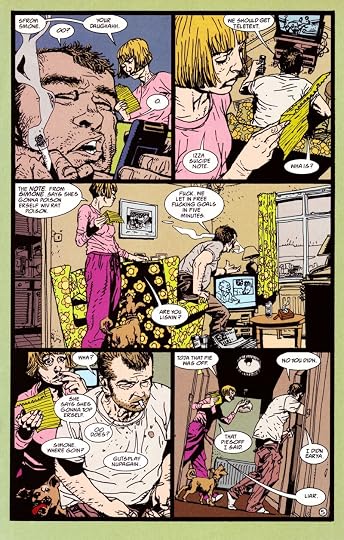
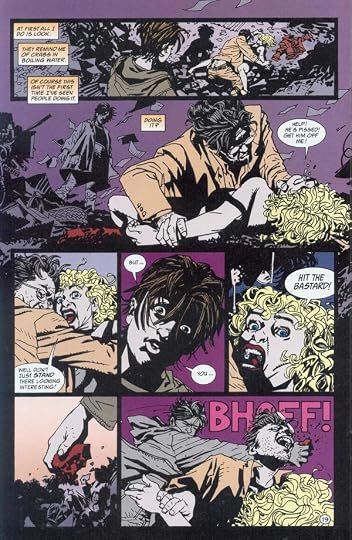
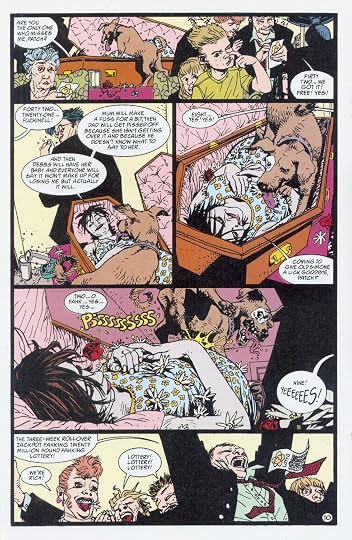
I gave it an extra star for the Duncan Fagredo art, which actually was really good. The ugly style of his art work for this one matched the tone perfectly, as everything seemed soiled and unattractive. He brings the world to life with the art, even if the story doesn't really match in terms of quality.
Unless you're a huge fan of Milligan, I would say skip this one.
A mediados de 1996 Peter Milligan cerraba una importante etapa de su vida. Acababa de terminar su larga andadura de siete años en Shade, el hombre cambiante, también había finiquitado su maxiserie Egypt –ambas para Vertigo– y justamente antes de emigrar casi en exclusiva durante un tiempo a Marvel publicó una pequeña miniserie de tres números en la línea, a modo de un largo “hasta luego” que duraría hasta finales de 1998 (fecha en la que comenzaría The Minx y, acto seguido, Blanco Humano). Esa miniserie se llamó Girl y fue publicada en un subsello llamado Vertigo Verité que “pretendía evocar el realismo del Cinéma vérité francés” despojando a las obras de la línea de los tradicionales elementos fantásticos que la habían marcado hasta el momento. Acompañando al irlandés se encontraba a los lápices Duncan Fegredo, un viejo conocido del guionista desde los tiempos de Enigma y Shade (aquí podéis apreciar su currículum). Y como era de esperar, en Girl Milligan volvió sobre sus pasos para introducir –otra vez– el que probablemente sea su motivo conceptual más emblemático y recurrente: la identidad. El cómic en cuestión nos cuenta, en base a una estructuración de capítulos cortos y narración en primera persona, la historia de Simone, una chica asocial que vive en el deprimido barrio de Bollockstown inmersa en un mar de depresión económica. Sus amigos malviven, sufre acoso escolar y su familia es el paradigma de la disfuncionalidad. No estamos, empero, ante un drama: Simone afronta la realidad con cinismo, ironía malsana y una firme determinación de evadirse a través de la imaginación. Sea como fuere, un día conoce a una chica que está siendo violada en un vertedero, la salva, y acaba dándose cuenta de que el parecido físico entre ambas es extraordinario excepto por el color del pelo (‘Simmy’ es morena y la rescatada Polly es rubia). A partir de aquí, tendremos una sucesión de extravagantes acontecimientos que dirigen a nuestra protagonista, de forma imparable, cuesta abajo y sin freno. En este punto es interesante comentar que lo más curioso de todo este asunto es que la fecha de publicación en Estados Unidos del tebeo coincide con la irrupción de dos obras con las que guarda no solo similitudes, sino también un gran parecido en lo que concierne a subtextos conceptuales: El club de la lucha de Palahniuk y la Trainspotting de Boyle (pese a que la novela de Welsh se publicase en 1993). De hecho podríamos imitar fácilmente los típicos sumativos temáticos y decir que Girl se obtiene sumando la protagonista de Juno al contexto social de Trainspotting, los desvaríos de Tyler Durden en El club de la lucha y el juego de identidades de la Vertigo de Hitchcock. La mezcla resultante es una ácida comedia tan sofocante como divertida, crítica y sugestiva. A los lápices un efectivísimo Duncan Fegredo que con su trazo sucio, su línea irregular y su expresivo uso del entintado clava lo que pedía Milligan para ilustrar su guión. Acompañado, hay que reconocerlo, por una estupenda paleta de Nathan Eyring que se muestra simple pero efectiva en su uso de colores sucios. El cuadro se completa con una composición con espacio interviñeta conservado –negro– y viñetas casi cuadradas, panorámicas o rectangulares verticales a razón de 5-6 por página (con puntuales y llamativos efectos formales).
Ah, the delightful weirdness of 1990s Vertigo comics. There's just nothing like it. This is a perfect example of the type of odd miniseries Vertigo used to publish during that time. The art was the blueprint of this type of series.
As far as the series itself goes, it was very much what I expected. It's weird, and some people find it confusing, and it was at times, but really when this ended I had a better idea of what happened than many Vertigo series of the time.
It's a weird story of a teenaged girl in the UK who has vicarious fantasies and uses her imagination to rise above her boring, dead-end life. It is odd in the sense that I'm not entirely sure what the purpose of the series was, but I suppose that's a question that you could raise about most fiction.
Overall to me it was nothing special, but it wasn't bad either.
Read this again after 19 years- still have the 3 comics. I didn't remember the story but I do remember the sensations I had while reading it- trying to separate the real from the imagined. the graphics are veeerryy "mid 90s indie" - overly dark and rough but so is the story. The story of fight club kind of reminds me of this book.
2.5 stars I wanted to like this more than I did. It’s a slightly reality-bending coming-of-age story set in 90s lower working class England that feels like watered-down Irvine Welsh. I enjoyed the phonetic Cockney dialogue, but the rest of the story ultimately feels similar to a lot of other (better) alternative films/books/comics of the era without amounting to anything compelling itself.
This miniseries tells the story of fifteen-year-old Simone Cundy, a punkish British girl who doesn't believe in God, but believes in the holy trinity -- her head, her heart and her hymen, and all are still unbroken (this is a cool line!) Anyway, she's quite the antisocial wallflower and spends her days living vicariously through her rather vivid dreams. Her family situation's shitty, friendships suck and she lives in a town called Bollockstown. So yeah, teen angst is apparent. I didn't go into this with any high hopes, but it was a fun enough read to pass a dull Sunday evening over. Not bad, not exhilarating either. The artwork's dope (Duncan Fegredo's mad talented!), the story is familiar, sometimes corny, and despite the dream-sequences creating a kind of non-linear narrative, the story's coherent enough to follow, for the most part. My biggest problem with this is the accented speech. I can't stand it most of the time.
Always interesting to see how others respond to a book (or a series - has this comic actually been collected? I found the original three issue miniseries while sorting through some old comic boxes and reread them today).
Honestly, didn't find this a bit confusing. It's all pretty much spelled out in the end. Milligan paints an amplified picture of a family lost in economic and social ruin, with their bright, but battered daughter Simone struggling to cope with her reality. So she makes her own. But it all comes out in the end (except maybe the ending? I like to read that as another flight of fancy, although that does then call into question everything preceding it.).
Girl is a dark satire, written with exaggerated sharpness and drawn in a dynamic and chaotic style by the terrific Duncan Fegredo.
Uma típica história no tom cru que a Vertigo trouxe aos leitores nos anos 90. Uma adolescente, vivendo num bairro periférico sem grandes perspetivas, procura compreender a sua identidade face a um mundo que quer rejeitar, entre efabulações e partidas da vida. Pete Milligan segue com o seu habitual estilo ácido, e a ilustração de Duncan Fegredo sublinha o tom cru da história. O livro só peca por um demasiado óbvio final feliz, que tem ainda o condão de subverter todo o esforço de construção de identidade da personagem, que se centra no tipo de pessoa que quer a todo o custo ir além do
La distorsión de lo que consideramos real - premisa frecuente en lo escrito por Milligan - se enfoca en una adolescente de los barrios bajos a quien ciertos hechos domésticos trastocan su cotidianeidad, retorciéndola y añadiendo mayor caos a sus días. Humor negro y una estructura acotada convierten a Girl en una historia que al menos sus lectores terminan con satisfacción.
I have no shelves for this...The art work was great. I love such sharp lines. The city drawings seemed full of the chaos I feel in a city sharp, edgy loud. The story was good, but the whole book seemed to be gritty and edgy for me right now. I will try again at a later date.
The characters are pretty good and it leads up to the end very nicely and was pretty much wrapped up perfectly until the last page summarization.Could've been a lot better but was a good read nonetheless for something you can finish reading quickly.
Che dire ...anni 90 in pieno, acido, punk e fuori di testa .....
Pieno di plot twist che girano la frittata..... Il fumetto è un crescendo secondo me, rovinato dal finale troppo buonista, cosa che si scontra in pieno con la filosofia del fumetto.
La protagonista è caratterizzata benissimo, come il periodo storico e la realtà in cui è ambientata la storia, tutto orchestrato benissimo da Milligan, che nella vignetta "preservativo o siringhe" che viene ripetuta più volte racchiude perfettamente lo spirito della storia.
Resta una lettura carina ma assolutamente non memorabile .
Interesting reprint from 1996. It’s very much a 90s comic in every aspect. And as such it does contain problematic stuff. But interesting to see what got made back then.
arts nice, rlly like the cover. the story is eh. i feel like they were trying to do something like perfect blue (movie) but it just didnt work out. maybe because it wasnt long enough ??
Quick and highly entertaining. Since this was also written my Milligan, I can use this space to say, once more, that it is a crime the rest of Shade the Changing Man has not been collected in trade.
We're lucky to read anything Duncan Fegredo draws. I liked this a lot more the second time, just going with the flow instead of trying to figure out what exactly was going on moment to moment
Personally 2.0 Technically 3.5 I do recognize that technically this is a good story and great art. But the story definitely went too dark for me. Not really my jam.
Releer para escribir una reseña que valga la pena. Según recuerdo, estuvo muy buena pero no al nivel de Minx, otra serie del mismo autor con temática ligeramente similar. Además, como que queda muy cortita y resuelve algunas cosas a los ponchazos. De todos modos, lo sabré juzgar mejor cuando lo relea.
At the beginning it was confusing . . . but I think that was because they needed to have that plot twist in the end. It had a lot of potential, it felt short.