In Yelena Moskovich's spellbinding new novel, A Door Behind A Door, we meet Olga, who immigrates as part of the Soviet diaspora of ’91 to Milwaukee, Wisconsin. There she grows up and meets a girl and falls in love, beginning to believe that she can settle down. But a phone call from a bad man from her past brings to life a haunted childhood in an apartment building in the Soviet Union: an unexplained murder in her block, a supernatural stray dog, and the mystery of her beloved brother Moshe, who lost an eye and later vanished. We get pulled into Olga’s past as she puzzles her way through an underground Midwestern Russian mafia, in pursuit of a string of mathematical stabbings.
Yelena Moskovich is a Soviet-Ukrainian American and French writer and artist. She immigrated to America with her family as Jewish refugees in 1991. After graduating with a degree in playwriting from Emerson College, Boston, she moved to Paris to study at the Lecoq School of Physical Theatre, and later for a Masters degree in Art, Philosophy and Aesthetics from Université Paris 8. She co-founded her own theatre company, La Compagnie Pavlov in Paris in 2009 (since inactive). Her plays and performances have been produced in the US, Canada, France, and Sweden. She has also written for Vogue, Frieze, Apartamento, Times Literary Supplement, Paris Review, amongst others. In 2018, she served as a curator and exhibiting artist for the Los Angeles Queer Biennial. She lives in Paris
‘To get to Hell,’ he says in a low voice, ‘they take you through America. There is a door behind a door.’
Olga, happily settled in the USA, receives a phone call from a man she hasn’t seen for many years: Nikolai, who went to prison as a teenager for stabbing a woman in the Soviet housing block where he and Olga both grew up. This is the starting point for a story told in fragments, one that switches perspective and moves beyond the possibilities of reality, one in which death means displacement rather than a definite end. Sex and violence are entwined in the piercing sentences of A Door Behind a Door, written with the dreamlike lucidity characteristic of Moskovich’s work. Despite all that, this may be the most conventional novel she’s written thus far, with its dysfunctional families and loop-like structure: its experimental touches are anchored by moments of both the banal and the tragic.
I received an advance review copy of A Door Behind a Door from the publisher, Influx Press.
I’m not sure I entirely understood what I just read but I really enjoyed it. A Door Behind A Door deals with the themes of immigration (from the former USSR), queer desire, death, and unresolved feelings. The format of the book is unique and the story has this dreamlike surreal quality to it. Some of the scenes are quite visceral and there’s also an undertone of sadness and grief throughout. Overall, a very phantasmagorical read dripping with mystery and symbolism. Definitely lends itself to a re-read.
A vaguely interesting premise undermined by the execution of the second half of the novel. I was all in for the first part, a sort of grimy, underworld-ish mystery. It had a real Twin Peaks vibe to it that started when someone from Olga's past calls her in the middle of the night--someone she hadn't seen or heard from since she and her family left Ukraine when she was eleven. In Ukraine he was a boy that murdered an upstairs neighbor; in the US, he has information on the location of her missing brother? She has to let herself get arrested at the diner gig she just got, and jail/holding cell is...in another dimension? I liked the first two long sections of the book, focusing on Olga's POV, once in started switching in the second half, to Tanya, Louie, the dog (??), it felt a lot more jumbled and disjointed. In the second half, the sections I really liked concerned Tanya and a childhood friend that was murdered (right?) by Moshe, Olga's brother, then more bouncing around and a confusing end. I'm pretty sure I liked it more than I was confounded by it.
This entire review has been hidden because of spoilers.
“To get to Hell,” he says in a low voice, “they take you through America. There is a door behind a door.”
Han Smith's shortlistee interview for the Goldsmiths Prize in the New Statesman was a wonderful paean for 'fiction that takes risks' and when asked to nominate a retrospective prize she called out, astutely, Anna Burns's Milkman and Exquisite Cadavers by Meena Kandasamy, two novels the prize overlooked and, deliberately stretching the eligibility rules: And if I can have a more international one too, it goes a thousand times over to any of Yelena Moskovich’s books, which are all so unstoppably wild in both form and language.
Which immediately prompted me to try one of them, this, published in the UK by Influx Press and Two Dollar Radio in the US.
From an interview at the time of her previous novel at STET, Moskovich was asked "Does theater have a specific significance in your prose?" and replied:
Definitely. Theater as a space for earth, heaven, and hell. Theater as a false space, a space for communal belief and disbelief. The intimacy and interactivity with the viewer/reader. The spatial language: ways to tell stories through movement, dynamics, incantation, sensual narrative. These are all things that I take with me into prose.
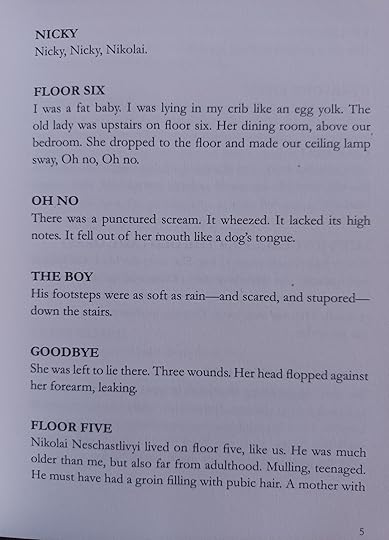
And the first page of the novel give some idea of how this impacts form:
The narrator, at least for the first third of the novel, is a young woman Olga. She is part of the post Soviet diaspora, and with Georgian father and Jewish mother, the family left for the US in the early 90s. She now lives in Wisconsin with her lover Angelina. The memories on the opening page are from her early childhood, when Nikolai, a teenager 13 years older than her, who lived on the same floor, was convicted of the knife murder of an older lady who lived above them in the block of flats. These memories are, or were, buried in her past, a story she has never shared with Angelina:
BESIDES LIFE DID NOT STOP After the old lady was murdered. There were daily worries to tend to. There was my father's shaky position at the agricultural engineering plant. And my mother's intellectual affair with her colleague. And then my baby brother Misha was born with weak lungs. And Miss Anya from floor one accused my mother of trying to seduce her husband (before she almost killed him herself with the stray brick). My mother had to explain that she wanted nothing to do with that first-floor grunt of a man in a polite and convincing manner. Still there were those who sided with Miss Anya. My mother was Jewish and beautiful and couldn't be trusted. My father was Georgian and stubborn. I had my mother's looks and my father's character. My little brother Misha had ghostly eyes and took long, winded breaths. I tried to look after him.
MISHA AT EIGHTEEN I won't get into the details, but at eighteen, Misha had only one functioning eye. Otherwise he was perfectly healthy. A miracle - I mean, his lungs.
But are brought to the surface when she is phoned, out of the blue, by Nikolai, who is also now in the US, and who tells her brother Misha, who now goes under the name Moshe after he 'got Jewish' and broke off contact with the family, is in danger, himself accused of a fatal stabbing, and needs Olga to help him.
Olga finds herself going through the door behind the door into a Hellish world, one featuring literal ghosts from her past, a literal rather than criminal underworld, populated by the victims of crime, the realism of the first pages of the novel giving way to the logic of nightmares.
After around a third of the novel in Olga's voice, the narrative perspective switches more quickly between other characters, dead and alive, but also a dog, a bathtub and a sailboat from a famous poem, a key reference throughout the novel Mikhail Lermontov’s Парус (The Sail), That poem about the lone sailboat that leaves the safe waters and goes willingly into the heart of a storm:
A lonely sail is flashing white Amdist the blue mist of the sea!… What does it seek in foreign lands? What did it leave behind at home?..
Waves heave, wind whistles, The mast, it bends and creaks… Alas, it seeks not happiness Nor happiness does it escape!
Below, a current azure bright, Above, a golden ray of sun… Rebellious, it seeks out a storm As if in storms it could find peace!
WAVES I don't know if it's the waves of hunger. Or the waves of nausea. Or the waves, in her eyes. Tanya. She's looking at me- her eyes waver like water. Distant upheaval. Her irises reciting that poem. Lermontov's Parus odinokiy.
THE LONE SAILBOAT That poem about the lone sailboat that leaves the safe waters and goes willingly into the heart of a storm.
BECAUSE What is life, if you cannot willingly go into the heart of the storm. What is life, if you cannot willingly storm someone's heart. What is life, if you cannot willingly leave safe waters.
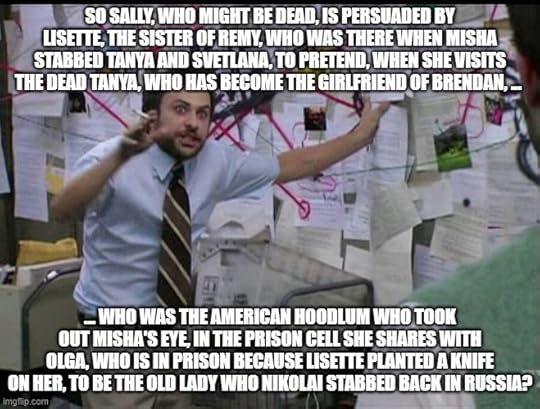
Not a book for lovers of the genre crime - things get less clear as the novel progresses, even who exactly stabbed who. At one point my attempts to make sense of the connections between those appearing, resembled those from the meme:
Although as Nikolai is a mathematician, this meme might be more appropriate:
But one which "particularly effective in conveying the radical sense of disjuncture at the heart of both the migrant and the queer experience" (as the Guardian said of her previous novel Virtuoso).
Impressive and thanks to Han Smith's interview for introducing me to a what I suspect will become a favourite author. 4.5 stars.
Moskovich has done it again! I really enjoyed her last novel VIRTUOSO, so I was jazzed to hear about A DOOR BEHIND A DOOR. This novel is like an enigmatic dream as we follow Olga, who lives in the midwest but formerly the Soviet Union. immigrating in '91 as apart of the Soviet dispora that occured. Olga grows up the US, falls in love with a girl, and hopes to settle down and leave her haunted childhood behind her. But when a man who used to be a neighbor in her childhood apartment building oddly calls Olga with news of her estranged brother she ends up in a tangled web of turmoil.
Muscovitch's spellbinding writing style breaks the traditional boundaries of novel writing. She is a true artist of her craft! This beauty comes out May 18th! Thank You @twodollarradio for sending this #Arc my way opinions are my own. • For more of my book content check out instagram.com/bookalong
Nobody writes like Yelena Moskovich. She breaks all the rules, strings together wild scenarios, and pretty much does whatever she wants stylistically--and I'm all in for it! This can definitely play around with the clarity from time to time--same with my experience with Virtuoso--but damn, I don't think I'll ever miss another book from her. She's capable of changing my worldview on any page, so I might as well keep flipping.
Holy moly. I absolutely devoured this book in one sitting - granted it is a fairly short book. It is no better put than to say that reading this felt like a fever dream - a very dark & visceral dream. Wow. I’m stunned.
my head is spinning, this is a fever dream of a novella. olga’s soviet childhood catches up with her in wisconsin, in an artful but ultimately depressing surrealist explosion of desire and violence. recommend 😃
Someone needs to explain to me what the fuck I just read!!! This book falls clean into the category of “weird for weird’s sake”, and I gave myself a migraine trying to make sense of it.
Like what is going onnnnnnn?? Olga and her brother were in the same prison which is maybe just the afterlife which is maybe a portal they can enter through a diner??? I am not certain whether some of these characters are ghosts or living humans experiencing split personalities, but I did manage to gather that they are most certainly DL!!! Also, the summary said something about the Russian mafia—where in the world was that?!? With the locker in the diner?!?!?
It’s surprising, because even though I am utterly confused, I was never disinterested while reading this book. It feels like a clusterfuck that could become a beloved puzzle with a second or third read. I am actually looking forward to book club tomorrow, where hopefully we can work as a team to piece together what in the world happened here.
Until then, would recommend to anyone who has Aquarius or Gemini placements!!! Y’all are the only people wacky enough to enjoy this outright.
I liked the play with voice and language. The first extended section involving Olga is especially tense and riveting. The later sections seem to rehash earlier events from different POVs (a kind of afterlife?), and seemed less compelling to me.
Dark, erotic Lincoln in the Bardo?! It had some Disco Elysium qualities as well. I was hoping the weird ingredients would result in a truly explosive alchemy — in the end it didn't go beyond interesting art piece — but still enjoyed its sharp edges.
The writing style and the fragmented format were interesting, but halfway through the book I lost track of who was who and how and when and why or why not 😵💫
There was a lot to be said about bodies— the discomfort of the human body, feeling trapped within in, unsure of existing as it— in this book. I suppose the idea of one universal human body is something Moskovich was interested in portraying in A Door Behind a Door. I also imagine that she is saying something about how the queer body cannot be left (allowed) to simply settle down, per society; Olga, content with her life with girlfriend Angelina, has settled into a mostly comfortable domesticity, only to have her life uprooted by Nicky, a boy who lived in the same Soviet apartment building as Olga when she was born. He finds her in Milwaukee a couple of decades after her family leaves the USSR to tell her that her brother Misha, now Moshe, is in trouble.
There is also extreme, seemingly unspecific, sometimes deadly, violence that befalls queer bodies, as well as the death of a child and an elderly woman. What makes these specific bodies targets?
After the first, longest section, first person narrated by Olga, the POV switches frequently. These switches and the ambiguities around character— who is this? Are these two people the same person? Why is this person narrating?— play into a kind of chaotic, dream-like, satirical drama written in tiny sections with subheadings (not sure if I’d call them vignettes). It was a wild ride and I enjoyed it, but am still unsure what Moskovich ultimately means for the reader to walk away with.
Whatever you think a book can be, Moskovich knows it can be more. The understated pyrotechnics of the prose are the nuclear fusion of this book, powering the reader through each page. Without being needlessly flashy, a world is built and dismantled in jags at once confusing and then clear, unsettling the reader right along side the protagonist -- no easy feat. In a world of two extremes: either spartan, utilitarian prose or the mystifyingly experimental, Moskovich lands solidly in this intriguing middle-ground called compelling. And if it hooks you -- like it did me -- you'll certainly want for more of it when you close A Door Behind a Door.
No reveal here, but, the last line of this book is' "I don't want it to end, I don't want it to end," and, at that point, I felt exactly the opposite. But I will try her highly praised "Virtuoso."
dreamy, rhythmic, poetic, beautiful. i don't know what exactly happened but i enjoyed this. i read most of it aloud and it made my reading experience better.
Changed the rating 4 times. Wanted to like this more than I did. There were parts I really liked, but the parts I didn't overpower the rest of the novel.
My favorite thing is stumbling across a book with an interesting cover in the library and taking a wild chance on it. In my experience, it often turns out great! I had never heard of this author or the publisher before.
It’s a fever dream of a book, written by and featuring an immigrant to America from the Soviet Union. It’s one of those books where you’re not really sure what’s going on half the time but it’s enthralling nonetheless. It’s visceral and violent, brimming with lust and desperation. I’ve never read anything quite like it… maybe the closest thing is Ana Kavan’s Ice. Which I didn’t like very much, but I do like this. I like this very much.
In America, there is a door behind a door, and it leads to Hell. A group of Russian immigrants end up on the wrong side of the door. Written in an energetic, innovative style, this novel does not take its reader anywhere they expect to go. It's engaging and compulsively readable: I could not put it down. It offers a range of snapshots into different, interconnecting lives, and the Hell theme is interesting, although not always fully realised. I enjoyed reading this a lot, and I really like Moskovich's innovations, but I wasn't full satisfied by the story as a whole. Given its brevity and complexity, a second reading might be no harm.
Beautifully written and poetically phrased, I really enjoyed the act of reading this book but I can’t say I loved the story, because, I still have some trouble really getting at WHAT happened. Immigration and a brother caught up in a murder, love, work, coming to terms with sexuality and exploring yourself. So much happens but very little I can be sure about, which creates this dreamlike world of pain and a continuous path to walk toward something that doesn’t seem all that good.
I enjoyed this. The style was interesting and I was following along but then she lost me. I tried to read some reviews to see if I could shed some light. Apparently, there is a section narrated by a bathtub. Yep.