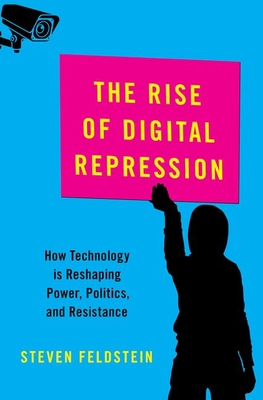
The world is undergoing a profound set of digital disruptions that are changing the nature of how governments counter dissent and assert control over their countries. While increasing numbers of people rely primarily or exclusively on online platforms, authoritarian regimes have concurrently developed a formidable array of technological capabilities to constrain and repress their citizens.
In The Rise of Digital Repression, Steven Feldstein documents how the emergence of advanced digital tools bring new dimensions to political repression. Presenting new field research from Thailand, the Philippines, and Ethiopia, he investigates the goals, motivations, and drivers of these digital tactics. Feldstein further highlights how governments pursue digital strategies based on a range of factors: ongoing levels of repression, political leadership, state capacity, and technological development. The international community, he argues, is already seeing glimpses of what the frontiers of repression look like. For instance, Chinese authorities have brought together mass surveillance, censorship, DNA collection, and artificial intelligence to enforce their directives in Xinjiang. As many of these trends go global, Feldstein shows how this has major implications for democracies and civil society activists around the world.
A compelling synthesis of how anti-democratic leaders harness powerful technology to advance their political objectives, The Rise of Digital Repression concludes by laying out innovative ideas and strategies for civil society and opposition movements to respond to the digital autocratic wave.
Steve Feldstein is a senior fellow at the Carnegie Endowment for International Peace in the Democracy, Conflict, and Governance Program. His research focuses on technology and geopolitics, U.S. foreign policy, war, and democracy.
He has published research on digital technology’s impact on war, the role of artificial intelligence is reshaping repression, the geopolitics of technology, China’s advancing digital authoritarianism, and new patterns of internet shutdowns.
Previously, Feldstein was the holder of the Frank and Bethine Church Chair of Public Affairs and an associate professor at Boise State University. He has served in multiple foreign policy positions in the U.S. government. He was a deputy assistant secretary in the democracy, human rights, and labor bureau in the U.S. Department of State under President Obama. Prior to that role, he served as the director of policy at the U.S. Agency for International Development, and also worked as counsel on the U.S. Senate Committee on Foreign Relations under Chairmen Joseph Biden and John Kerry.
He is a graduate of Princeton University and Berkeley Law. He was born and raised in Bloomington, Indiana.
Really interesting study into digital repression. Author explains the different means, pros/cons clearly and backed up by data, and then presents three very different country case studies for real context and thought. Well written and insightful.
“The Rise of Digital Repression” is a worthwhile read for anyone, who is interested in the topic of the political effects of technological development.
In the early 21st century, digital technologies have become a double-edged sword for autocratic regimes. On the one hand, digitalization brings about significant economic boons, which contributed to the regime’s performance-based legitimacy. On the other hand, post-Soviet Color Revolutions as well as the Arab Spring Movement have demonstrated how digitalization may empower political opposition through the mechanism of the free circulation of critical information. This conundrum that autocrats face is described in the literature as the “dictator’s digital dilemma”.
A new book by Steven Feldstein, “The Rise of Digital Repression”, addresses exactly this problem as well as the question of how digital technologies can be used by both democratic and non-democratic regimes to maintain political control and guarantee their own survival. The book’s strongest asset is that it represents a pioneering work that bridges the gap between literature streams on comparative politics, digitalization, and development. Previous works in this area have been largely based on the extensive case studies of China (an outlier case, which is particularly advanced in digital repression). Feldstein’s book offers a much broader outlook due to a combination of both large-N and small-N research methods.
The book consists of four main parts. The first part proposes a new conceptualization of “digital repression”. Feldstein defines it as “the use of information and communications technology to surveil, coerce, or manipulate individuals or groups in order to deter specific activities or beliefs that challenge the state” (p. 31). The book’s attempt to draw attention to the phenomenon of covert immaterial repression is certainly commendable, yet the definition of digital repression as a phenomenon separate from “offline repression” does not seem to be entirely plausible from a conceptual point of view. In practice, differentiation between offline repression and digital repression is very hard when it comes to their outcomes (e.g., a question of how to classify offline prosecution of online activists discovered by the state through non-digital means remains open). This problem also plagues the emerging typologies trying to differentiate between offline and online political control (see e.g., Earl, Maher, and Pan 2022). At the same time, with the well-established differentiations between covert and overt repression types as well as material and immaterial repression, one wonders whether there is a need to reinvent the wheel.
The second part of the book offers measurement tools such as the indexes of digital repression and digital repression capacity. These certainly have great value because the indexes provide a succinct but very fine-grained measure of covert/digital repression. Feldstein has developed those indexes while taking into consideration different repression strategies that the governments use (e.g., social media monitoring and censorship; Internet shutdowns; dissemination of false information; persecution for the posting of political content online, etc.) At the same time, the dataset is easy to use and disaggregate. Based on his indexes, Feldstein paints a global picture of digital repression patterns. For example, he explains which digital repression strategies are correlated with which regime types. Some strategies such as surveillance are widely used by both liberal democracies and autocratic regimes. Other strategies such as arrests of online users for political content are typical only for autocracies. Most interestingly, Feldstein points out that while democracies do not use digital repression as actively as autocracies on average, they do exhibit a much higher digital repression capacity.
The third part of the book examines the technology flow patterns at the national level and tests the hypothesis of whether China is really the main spreader of repression technologies. To better illustrate how digital repression works in practice Feldstein turns to the case studies of Thailand, Ethiopia, and the Philippines. Under each of these cases, Feldstein examines not only digital repression strategies but also the factors that explained the high levels of digital repression in those countries. His empirical evidence demonstrates that the previous history of repression along with the scale of digitalization are the most important determinant factors for the scale of digital repression. Perhaps, the most curious and upsetting finding is that not only China but many Western companies share the burden of responsibility for the spread of digital repression technologies around the world. Feldstein attributes the problem to the lax export control regimes in most democracies. The exploration of the factors leading to high levels of digital repression, however, remains largely uncovered.
While I found the index and case studies very useful, Feldstein does not go deeper into the institutional underpinnings of digital repression and does not build any theoretical framework upon his findings and the rich empirical material that he has collected. A similar sentiment was shared by many of my colleagues doing research in the field of political economy.
Finally, the last part of the book discusses the possible response tactics at different levels – ranging from grassroots-level NGOs to the role of citizens and businesses. That part of the book is short but excels at delivering the policy message – the need to pay attention to the exports of high-tech from advanced democracies to autocratic regimes. The discussion of possible strategies at the grassroots level is also well-structured and is based on the evidence derived from the previous parts.
Overall, the book certainly deserves a lot of praise as it examines not just a relevant but also an understudied topic, which is becoming increasingly important both in democratic and autocratic contexts. It also provides other researchers with the tools and data to build upon in follow-up studies. While there are areas for some potential conceptual or measurement improvements, they do not diminish the theoretical contribution of the book as well as its policy relevance.
I read this book at my son's request; it isn't a book I would normally pick up. However, I'm glad that I read it because it raised my awareness of how governments around the world use technology to repress populations. Feldstein first explains what digital repression is and how it is enacted; he then provides case studies of three countries'--the Philippines', Thailand's, and Ethiopia's--strategies of digitally repressing their citizens. Feldstein is careful not to go into great detail about digital repression in the U.S., but the book does point out that our "freedom index" fell under the Trump regime and that digital repression--particularly in the areas of social manipulation and disinformation--is alive and well in the United States. Feldstein also explains the role that China plays in the increasing use of digital repression, and at the end of the book provides strategies for combatting it. The book was extensively researched (containing over a thousand footnotes) and written in an academic style, which isn't normally the type of reading to which I gravitate. However, ignorance, in the case of digital repression, is not bliss. At the moment we live in a liberal democracy and free country, but there are forces out there who would like to change that. Be aware.
A bit too poli-sci for my taste: definitions, "objective" measurements, scales, ranks, and so forth. Still, the book is impressively well-researched and it is an important contribution to the study of new forms of authoritarianism in the 21st century. The violence and brutality of 20th century dictators in the Global South has given way to much more sophisticated authoritarianism in the 21st. If I had time (and more disciplinary sympathy), I might read the rest. Instead, I skimmed the chapter on Thailand and read the chapter on the Philippines. I may well use the latter in my teaching.
Compared to most books and articles on technology and repression, this book is a MUCH more comprehensive and nuanced analysis of how different governments are using technology to control people and suppress the human rights. It's not just about China, and it's not just about surveillance cameras and online surveillance.
Perhaps the clearest, most direct book about how technology enables political authoritarianism, well written with a strong focus on how existing authoritarian organizational structure influences choices in the digital arena, as well.