Jump to ratings and reviews
Rate this book

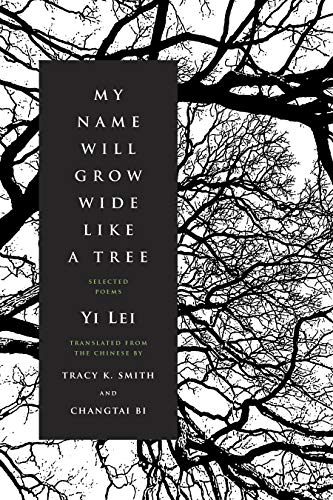
My Name Will Grow Wide Like a Tree: Selected Poems

Rate this book
One of China’s most significant contemporary poets, co-translated by former US Poet Laureate Tracy K. Smith

*Shortlisted for the 2021 Griffin Poetry Prize*

Yi Lei published her poem “A Single Woman’s Bedroom” in 1987, when cohabitation before marriage was a punishable crime in China. She was met with major critical acclaim—and with outrage—for her frank embrace of women’s erotic desire and her unabashed critique of oppressive law. Over the span of her revolutionary career, Yi Lei became one of the most influential figures in contemporary Chinese poetry.

Passionate, rigorous, and inimitable, the poems in My Name Will Grow Wide Like a Tree celebrate the joys of the body, ponder the miracle of compassion, and proclaim an abiding reverence for the natural world. Presented in the original Chinese alongside English translations by Changtai Bi and Pulitzer Prize–winning poet Tracy K. Smith, this collection introduces American readers to a boundless spirit—one “composing an explosion.”

192 pages, Kindle Edition

First published November 3, 2020

19 people are currently reading
548 people want to read

About the author

Yi Lei

70 books3 followers

Ratings & Reviews

What do you think?
Rate this book

Friends & Following

Create a free account to discover what your friends think of this book!

Community Reviews

5 stars
70 (36%)
4 stars
92 (48%)
3 stars
21 (10%)
2 stars
8 (4%)
1 star
0 (0%)
Displaying 1 - 30 of 44 reviews
Profile Image for s.penkevich [hiatus-will return-miss you all].
1,573 reviews14.8k followers
May 6, 2025
Humanity creates, ghosts endure.

The poetry of Yi Lei (伊蕾 1951-2018) is a breathtaking balance between serenity and explosiveness. Though one of China’s most provocative female poets, she was little known to English speakers until now with this bilingual compilation, My Name Will Grow Wide Like a Tree, translated in a unique collaboration between former US Poet Laureate Tracy K. Smith and Changai Bi. While this volume is a bit slim for a selected poetry collection, it is nonetheless overflowing with beauty, compassion, rebellion and love. Through alignment with nature, criticism of oppressive laws and deep investigations of interpersonal relations, Yi Lei is a brilliant poet who shows us how ‘all things ache for love.

Living World, carry me
In your mouth.
Slip on your frivolous shoes
And dance with me. My soul
Is the wild vine…

-from Nature Aria

Yi Lei shocked the literary world with her 1987 poem, A Single Woman’s Bedroom, detailing a pre-marital cohabitation which, at the time, was still a punishable crime in China. The long form poem, comprised of fourteen sections, is revolutionary for openly depicting women’s sexuality and desires was well as a critical flouting of law.
Law
Squints out from its burrow, jams
Its quiver with arrows, it shoots
Like it thinks: Never straight. My Thoughts
Escape.

The poem becomes less a story of an individual person, even with the refrain of ‘you didn’t come to live with me,’ showing her disappointment with the relationship. Instead it becomes more symbolic, being less about romantic love and more about the liberation of desire and freedom.

This call for freedom permeates her work. There is a bold and brave appeal to progress in her poetry that rings as loud and clear today as when it was written and reminds us that hope is possible as long as we are willing to fight and sacrifice for it. ‘Today, I die for a crime,’ she writes in Nightmare, ‘tomorrow, / people will be crowned for it. / My name will grow wide like a tree.

Sacrifice is a common thread in these poems, fighting against repression and a fear that ‘the language of reality will be silence’ Knowing the criticism she would face, she wrote on anyways because ‘I woke with these words / Burning my lips.’ Which is a powerful depiction of poetry as words we know we must get out into the world no matter the cost, the poet a revolutionary armed with prose to attack the battalions of oppression restricting the People. Or simply ‘a flower / that refuses to wilt.

I am as clear and thus as virtuous as glass.
To see through me, you need only glance.
Smash me to shards with the rap of a fist.
But to reach me, to really enter in,
You must travel an unfathomable distance.


Yi Lei’s poetry is infinitely empowering, reminding us that we can grow and love and fight for freedoms. A particular favorite is another of her long poems, Beseiged, with each part ending in the refrain ‘I’m boundless.’ She casts off any shackles like bloodlines or nationality and declares herself limitless in this really gorgeous poem that makes the reader feel they too are boundless.
The sky
Poured through me.
I encompassed eternity.
I’m boundless

There is kinship to the works of Walt Whitman in her work and themes, as well as several references to lines from him and a poem written to him. An exploration and affinity with the natural world grows within every poem, with philosophical musings on existence sprouting from the natural world like blessed monuments.

Stranger, who can measure the distance between us?

The story of the translation is just as interesting as the poems themselves. In the introduction (which can be read here at Lit Hub), Smith asked Yi Lei ‘instead of being faithful to the literal features of the poem, I sought to build a similar spirit or feeling for readers of American English,’ to which the poet agreed. Working with Changai Bi (who goes by David), he would do a direct translation into English and she would re-envision it in a way that worked best. ‘My strategy,’ Smith says, ‘was to ask the surrounding features of the poem to suggest a continuity that might guide me forward.’ The result is wonderful.
Our manner of collaborating was this: working from David’s literal translation of a manuscript of Yi Lei’s poems, I would listen to the poem’s statements and the images, essentially trying to visualize the poem’s realm, and to align myself with the feeling and logic of the work. Then, I’d attempt to re-envision and re-situate these things in English. Occasionally, this was a matter of shifting toward smoother, more active, evocative language. Often, it entailed locating a relationship between verbs and nouns and aligning those features within a new metaphor or image system

Though Yi Lei sadly passed away before the completion of this collection, she worked with Tracy K. Smith along the way approving or offering suggestions as to better render the English versions (which are more retellings than strict translations anyways). The original Chinese versions of the poems are collected in the second half of the book. My only complaint, and it is minor, is that I wish there were more poems but what we have are phenomenal.

Yi Lei is outstanding. She explores life in a way that amplifies existence to demonstrate exactly how ‘one minute can straddle / a hundred year.’ These poems are a breath of fresh air and so completely compelling that I have not been able to put this collection down over the past few weeks. Each reading uncovers something new, be it a clever phrase that realigns my thinking or a bold statement on life. The unique translation is also quite fascinating, making a collaborative work that is its own form of art as well. A lovely collection.

4/5

When life ends,
Memory endures.
When memory ends,
What persists
Attests to the spirit.
Profile Image for J.
631 reviews10 followers
October 17, 2020
This was such a beautiful collection of poems filled with desire and defiance. I just wish there were more poems for me to read, or at least the ability to read Chinese and put the English translation side-by-side with the original. I found the way translation worked out for this collection fascinating, with Changtai Bi providing the direct translation from Chinese to English. Tracy K. Smith steps in to provide a more poetic translation that had a similar aura of the original. As a result, the words may not seem faithful to the original, but I appreciated the care Smith put into each poem to evoke what Yi wanted.

It was clear that this translated collection was essentially a conversation between Smith and Yi, as though they were dancing together to draw out a particular musicality from words that were in harmony with the subject matters. I imagine the original poems had a particular melody and rhythm to them, since Smith’s co-translated poems had a near-singing quality to them. The repetition of words also created a particular rhythm throughout the collection that made for an immersive experience.
Profile Image for Jana.
906 reviews117 followers
Read
January 8, 2021
This is my 3rd subtext poetry subscription book from Elliott Bay Book Co. This is a challenge and a struggle. Again, I took my time and read most of these twice. But sometimes I just do not feel it. Then I turn to a two page poem called Mother. And I’m shattered.

I think I’m getting better at reading poetry.
Profile Image for Ellis ♥.
996 reviews10 followers
March 14, 2023
In questa silloge, la poetessa cinese Yi Lei si affida alla Natura, accostando a degli elementi naturalistici i suoi turbamenti e la struggente passione che le si agitano in petto. In tanti dei suoi componimenti emerge questa connessione reciproca e se ne serve per far vacillare le leggi liberticide della Cina contemporanea ed esplorare diverse sfaccettature delle relazioni sentimentali.

I encompassed eternity.
I’m boundless.

Profile Image for October Hill Magazine.
30 reviews6 followers
April 16, 2021
Review by Julianna Björkstén, Assistant Poetry Editor and Book Reviewer October Hill Magazine

My Name Will Grow Wide Like a Tree is a collection of selected poems written by the revolutionary Chinese poet Yi Lei and reimagined in English (with the help of a translator) by the 22nd poet laureate, Tracy K. Smith. Lei, who passed away in 2018, was one of the most influential Chinese poets of the 1980s, in part because of her defiant, critically acclaimed poem, “A Single Woman’s Bedroom,” which is included in this collection. Despite her prominence in Chinese poetry, Lei is largely unknown to readers outside of Asia. In Smith’s hands, My Name Will Grow Wide Like a Tree offers an entry point for a new, wide-reaching audience to engage with Lei’s sharp, fearless poetry.

In the collection, Lei’s sweeping body of work is presented chronologically, enabling readers to become acquainted, over the course of an afternoon, with the tonal and aesthetic evolution of her decades-long career (1982-2017). While the objects of her poems range broadly—orgasms, waterfalls, political unrest—her most poignant verses are celebratory self-portraits...[read the rest of the review in October Hill Magazine's Winter 2020 Issue]
Profile Image for Brittany.
1,093 reviews1 follower
November 6, 2021
I wish I was better at understanding poetry. The poems in this book that I understood are worthy of five stars. I docked one star due to me not understanding them all, not because they're good vs. great.

Of course you know her.
She is one and many,
A multitude flashing on, then off,
Watching out from the blank
Of her face. She is silent, speaking
With just her mind. She is flesh, a form,
But also flat, a mute screen.
What she offers you, by no means
Should you accept. She belongs to no one.

I read materialist philosophy -
Material is peerless.
But I'm creationless.
I don't even procreate.
What use does the world have for me
Here beside my reams of cockeyed drafts
That nick away at the mountain of
Art and philosophy?

Should I give birth,
Secure humankind's place
On the earth?
All men are me,
And all women.
Why should I burden a son
To forsake all other mothers?
How cruel to saddle a daughter
With love's cost
And its promise of loss.
Love me, love. How lonely.
Why must I birth a baby?
Why must a bloodline cage me?
I belong to no territory. I resolve to rove.
I'm boundless.

I walk the barren wilderness
Where flame has glinted and danced.
I pass heaps of fallen leaves.
I pass from flesh to ash.
My brittle heart gleams.
Far off, out beyond the visible,
I listen to the melting of ice and snow.
I lay myself upon the waters.
I glow. Virginal, absolved.
Profile Image for Elizabeth.
2,032 reviews66 followers
August 18, 2022
My Name Will Grow Wide Like a Tree is a gorgeous collection of poetry, beautifully translated by Changtai Bi and Tracy K. Smith, with the former providing literal translations and the latter ensuring the poetry maintained the feeling of the originals. So many of the poems in this collection are absolutely stunning, but my favourites were probably A Single Woman's Bedroom, Nightmare, Love's Dance, Postperpetual, and Mother--. I would highly recommend this dual-language collection, and Yi Lei is a poet whose work I would love to revisit after this (and honestly has me ready to finally get around to the original work of Tracy K. Smith as well).
Profile Image for Joseph Anthony.
58 reviews9 followers
February 17, 2024
This is a gorgeous collection of poems Translated by Tracy K. Smith & Changtai BI.

Yi Lei writes movingly about love, loss, grief, & joy. Her ability to describe the spirit of the natural world is touching and also raw, tapping into a realm of beauty within the feral. At times, full of desire, she channels an internal voice to praise, challenge, and inquire about the nature of God, heaven & prayer.

Being unfamiliar with Chinese poets, I loved peering in at her experience of being a woman, a daughter, a woman being viewed through her own eyes and through the prism of glances cast by others. Lei does this with brilliance, painting a beautiful picture of her experience and with the passion of a true aesthete. Within her words she seemlessly dips into darkness and then just as quickly back into the light.

This is a quick read, as half of it is in Mandarin and therefore unable to me. Even so, it’s beautiful to look at the characters on the page.

Yi Lei wrote A Single Woman’s Bedroom in the late 80’s when living with your lover, unmarried wasn’t legal in China. From that poem, she received loads of praise, as well as stirred plenty of controversy from astonished readers. She was a revolutionary to her people then and is still one in the current day. In the introduction, TKS talks about Lei’s desire that the translation of ASWB moves away “from the liberation of sensual love to an urgent insistence upon the individual’s freedom from unjust institutions. The pined-for beloved, as the poem progresses, is no longer a man but an essential concept.”

A few lines…

I imagine a life in which I possess
All that I lack. I fix what has failed.
What was, I build and seize.
It’s impossible to think of everything,
Yet more and more I do. Thinking
What I am afraid of to keeps fear
And fear’s twin, rage, at bay. Law
Squints out from its burrow, jams
It’s quiver full with arrows. It shoots like it thinks: never straight. My thoughts escape

From Besieged:

What binds the boundless?
Are Tiny mines will come to grief
Trying to imagine what lies past it.
Unfathomable. To ponder it
Will cost me no small wedge of eternity,
But for that time, I’ll be boundless,
And my spirit, accordingly, boundless.

In her poem, Nightmare, she writes about being burnt at the stake along with Michael Severetus, a Spanish renaissance humanist from the 16th century, accused of heresy:

What Sparks true today, blinds tomorrow. Today I die for a crime. Tomorrow, people will be crowned for it. My name will grow wide like a tree.

I’m in love with these poems! The translation is thoughtfully nuanced and beautiful phrased.
Profile Image for Christina.
24 reviews
January 12, 2025
“I waited day and night for summer to gather me in its net. Waited for my wrongs to be sloughed away. One night, in a storm, I swallowed thunderbolts and fallen flowers. Now my soul is broken but fragrant. Nobly, I proceed, my bright hair overgrown as weeds.”

An absolutely stunning collection, translated with such depth and care.
Profile Image for R.
117 reviews3 followers
July 9, 2022
I can't read the original to know of her subtleties in her own speech, but in translation these poems succeed in delivering surprising sentences and unexpected turns, always a feat when we're writing about something very ordinary that humans share, like desire. Apparently, a bit of a infamous figure during a period of intellectual suppression in China, for being a woman writing about pretty tame lustful thoughts, primarily through metaphor, she was heavily attacked as being immoral and pornographic. By our standards, I don't find anything to be shocking in it at all, but I do find the sophistication of emotion that one would hope to find in a collection of poems.

Moral policing is something that perhaps a writer most of all is subject to. A medium that aims to create a lasting record in words, a writer faces certain increase in risk for going on the record, embracing the feather of creating a kind of truth, and it's not so easy to sidestep your own work if the culture investigators come around. But it's not truth that poses the main risk to the writer - most of the banned books in the world are fiction. It's perhaps a trick of the imagination, after all it's said the reader provides 90% of the images and the writer simply lines them up with the view. This trick manifests as the reader feeling they have some kind of ownership over the author and their work, that by giving attention, the author owes attention to them. Of course, one can find a book in a dusty old tomb, its author gone thousands of years, and then the blame becomes weirder, where the translators seem to be the ones held to the fire by readers who feel possessive about what they read. So too, we remember that activists are disappeared, journalists are threatened, musicians are arrested, and paintings and artwork are sold off to fund secret alliances, but the writer especially of has the curious shadow cast upon them, of having copies of their books burned. It's almost as though the old superstition of spirits being the cause of every physical ailment, has been replaced by a new superstition that writers are invoking mass hysteria simply by having the hubris to type some of their inner noise. Of course, if everyone tried to understand the writer, they might instead encounter something more like a rowboat that has sprung a leak, and you are reading whatever fancy swamps them. Others, if they could storm the writer's world the way the Capitol was stormed this January, would probably invent some new pseudo-psychology where anyone who has the ability to write more than one character of more than gender or background, is automatically a split personality, and that fiction was proof of demonic possession or schizophrenia, preferably both if it contains a kissing scene.

It's in books that we encounter some of the greatest bravery among the creative modes available to humans, and they deliver some of the most interesting tales of struggling between predicted outcomes of self-expression, and the desire to forget the world enough to put one's thoughts into form.
Profile Image for Alex.
852 reviews1 follower
Read
February 19, 2023
‘All things ache for love… A small voice belts out the saddest song. Year after year, flowers thrive. Sea gives way to land, land to sea. Humanity creates, ghosts endure. The soul in the cloud dances quietly.’

‘Fistfuls of rain fall hard, fill my heart with mud. An old wind may still come chasing in. Resurrection fire. And me here laughing… entreating the earth to bury me.’

‘… falls the torrent, the monsoon in which a woman exalts, day and night, her face danced upon by rainwater.’

‘… let in the music. Something in everyone echoes.’

‘I busy my hands collecting sunlight.’

‘One night, in a storm, I swallowed thunderbolts and fallen flowers. Now my soul is broken but fragrant.’

‘Tell me, Love: how have I come to this lonesome world where nothing will accept my devotion?’

‘… when I die, let me drift like a dandelion…’

‘Who am I? And why haven’t you come to see the woman I am, the one I still seek to become?’

‘… newcomer from nowhere, why am I here? Where was I before? There was a purpose, but it was nebulous. A kind of death. Yes, death was the terminus, but must I let it have me? Must I let it have at me gradually?’

‘… music is the soul singing. Music pushes back against pain. Solitude is great (but I don’t want greatness).’

‘… my body, now, is like a paper sack that has been crumpled and smoothed flat, creased every which way and packed with sorrow. Why? Why has my life gone on so long? I am ready to set down all of it - today, tomorrow, yesterday - to set it down and walk away.’

‘God is ravenous unending fright... safe on the shore, or high up on the cliff overlooking every sea: forget me.’

‘… belief is a country that eludes us.’

‘… how would I leave this labyrinth of rubble? And whom do I tax with my burden of being lost? Ahead is the black swirl of what I’ll never see, which also follows me.’

‘… when you’re near, you open your mouth and a fence plants itself in rock. The sirens - voices so pure they could save me from the anguish of the real - are silenced by the pleasure of our talk.’

‘… the heart’s ore buried miles deep, and for what? I shrink even from myself. I wish to get out from under the sky, which handles me with an infuriating familiarity. But that day - your hand - what happened deep in the mountain of me. And then the mine in collapse. The shaft choked with smoke. Voice burying voice. An absence of air, preponderance of pitch. I don’t want to know, or understand, or be restored to reason. In the wake of certain treasons, I am still domitable, a claim in wait. I am possessed of my depths. I am willing still.’

‘… the song sung softly in my heart… It aches, this fate, this wish…’

‘… maybe we need only strike a match for my world to flicker in your sky…’

‘… great stones of whitewater hammering, hammering down - eviscerate me. My soul won’t plant itself in this deep black soil… my soul hangs with all that water, thousands of years’ worth… up on the edge of that cliff.’

‘… and I know you are bound to unravel me, but how can I not lift my head and look you in the eye? How can I fail to greet you, though my living gown will soon be battered to threads? Better this lashing - flesh burst open, ransacked by air - then to live ambushed by loneliness.’
Profile Image for Ben Platt.
88 reviews6 followers
April 25, 2023
This is probably more of a 3.5 rather than a 4, but largely due to the questions surrounding this translation that arose in my mind during and after reading this collection. Lei's short collection of work here certainly stands out as distinct, especially, from what I understand, from the writing of earlier Chinese poets that preceded her - she writes directly and passionately about desire, the self, and the erotic body while entangling the self with the natural world in a way that can't help but draw comparisons to Walt Whitman, even if Lei herself hadn't explicitly put her poetry in conversation with Whitman herself. The imagery can be striking, but I couldn't help but be nagged by questions as I was reading it.

Tracy K. Smith, one of two collaborators who translated the work, is up front about her translation decisions in a preface to the collection - this is far from a literal translation, and rather attempts to (with Lei's approval) "build a similar spirit or feeling for readers of American English," resulting in deviations not only in vocabulary but even in the formal elements of the poems. With such a sparse set of poems from such a wide range of time, and with no other translations to compare to, I'm not sure how well that translation approach works. Sometimes the presence of Smith in the poem felt extremely clear, and I couldn't help but wonder where exactly the line was in the poetry I was reading between Smith, Lei, and Changtai Bi, the third collaborator in this translation who served as the intermediary translator between Lei and Smith. Translation is always tricky in this way, the translator is always present in the text, but I'm not always as aware of their presence or left with so many questions about the qualities of the translation. The messiness of the process of translation feels like it's on display here in a way that I'm not often consciously aware of. Without the context of other work translated into English from other translators, I don't have a way of answering these questions either, although I've certainly gained some insight from writers like Andrew Chan in his review at 4Columns (https://4columns.org/chan-andrew/my-n...)
Profile Image for Michelle.
1,136 reviews18 followers
January 15, 2021
I loved the first half of this collection. The second half not as much. I read them on different nights. Could that have mattered?

The concept of translation here is fascinating. Smith created new "versions" of the poems from literal translations. I wish I could read in both languages!

Quotes (not formatted)
"I envied Yi Lei's ability to claim the fact of that love, and to embrace the joy and upheaval it led to without apologizing for it or turning against it...." (ix)
"'Love is innocent,' she said." (x)

"But—to stumble into you, or you into me—wouldn't it be sweet? In reality, I keep to myself. You keep to you. We have nothing to rue. So why does remorse rise almost to my brim, and also in you?" (5) Between Strangers

"I don't yet know what to want, what I will be called on to grieve, but I know this bliss will leave." (15)

"It is tempting to believe something significant is ending. It is." (18)

"My body, now, is like a paper sack that has been crumpled and smoothed flat, creased every which way and packed with sorrow." (19)

"But how can I be a woman if he is a child? What can come of that union?" (23)

"Solitude is great (but I don't want greatness)." (24)

"But desire is a new trick, a ride along a slick ridge in a little car whose brakes have long since given way." (63)

12. Lost
I lost myself on an unnamed day.
I was stumped, hunting myself down
And turning up only remnants: dusty books,
Their revelations rancid, love letters
On yellowed paper. I got close many times,
But my tracks were faint, crisscrossed
By countless others.
My breath was everywhere.
But I was nowhere.
I got so tired I couldn't lift my feet,
Had to lie beneath the sky
Until I was drained of memory.
Then I felt it. Me.
The earth gave. The sky
Poured through me.
I encompassed eternity.
I'm boundless.


Profile Image for Juliano.
Author 2 books38 followers
January 20, 2025
“History tells me to guard my distance / When I pass you on the street, and I obey.” Yi Lei’s book of selected poems, My Name Will Grow Wide Like A Tree, presents a thirty-five year spread of Lei’s poems, translated into English by Tracy K. Smith and Changtai Bi. Lei’s knack for emotive and incisive observations, which Smith and Bi bring to life with such vigorous, animated glory, make these poems endlessly fascinating. These are poems moving through “the gloomy rooms where no one spoke”, in which “belief is a country that eludes us.” Lei’s (arguably) most famous poem, the personal, political ‘A Single Woman’s Bedroom’, asks us: “Can any of us save ourselves? Save another?” Elsewhere Lei proclaims vividly and viscerally: “Eviscerate me. / My soul won’t plant itself in this deep black soil, / Recoils from eternity, like a thief.” Her poems are knowing, almost painfully self-aware, observing that “I was / Circling around something, yes”, and asking “Who will cross Hell’s parlor to seize the key? / And by what light? / Is there yet light?” But it’s the beauty of ‘Love’s Dance’ — a poem whose lines “Music falls measure by measure / To the floor, but desire is a striptease / Performed in reverse” were my first exposure to Lei’s work, and my incentive to read this collection — that most captivated me, with so many lines I can’t stop thinking about: “Loving you shed light on the catastrophes of history. / Still, certain questions continue to saddle me.”
Profile Image for Pita Gabby.
69 reviews4 followers
October 1, 2024
My Name Will Grow Wide Like a Tree is a groundbreaking work that challenged societal norms and paved the way for a new era of feminist expression in China. Published in 1987, when cohabitation before marriage was a punishable crime, the collection's frank exploration of women's erotic desire and critique of oppressive laws was met with both acclaim and outrage.

Yi Lei's poems celebrate the joys of the female body and challenge traditional notions of femininity. She fearlessly explores themes of sexuality, desire, and empowerment. The collection offers a scathing critique of oppressive laws and social norms that restrict women's freedom. Yi Lei's poems are a call for social and political change. The natural world serves as a source of inspiration and solace for Yi Lei. Her poems often explore themes of nature, spirituality, and the interconnectedness of all things.

Yi Lei's poetry is rich in imagery and symbolism, creating vivid and evocative descriptions of the world around her. Her poems are characterized by their emotional intensity and passion. Yi Lei's writing is deeply personal and heartfelt. She is not afraid to experiment with poetic form and language, pushing the boundaries of traditional Chinese poetry.
893 reviews6 followers
March 27, 2021
Review: My Name Will Grow Wide Like a Tree: Selected Poems (Yi Lei) This is a bilingual edition, but of course I couldn't read the original Chinese, but I thoroughly enjoyed the wonderful translations created by Tracy K. Smith, who explains in the introduction how she came about to translate these poems, working with interpreter Changtai Bi and meeting with the poet. Any collection of poetry needs to be read multiple times to savor. Yi Lei became well-known after her publication in 1987 of the poem "A Single Woman's Bedroom", skirting the authorities, proclaiming passions and yearnings in a China where is remained illegal to cohabit outside of marriage. There is much pain in these poems, but also much seeking of emotional breadth, of wishing to be subsumed into nature, of expressing deeply held traumas. My favorite line: "Music is the soul sighing." That is from the very long poem mentioned above which launched her into fame.
Profile Image for Somi reads.
73 reviews
August 6, 2025
Hot. Having burned me but also Warmed me.


You bring in a handful of grass, Saying: This is truth.
I bring in an armful of winter jasmine, Saying: This is truth.
Wind eddying in from the sea is truth.


I died in summer, and to summer I’ve returned.


I’ve spent my whole life shining for others.
You alone bask in your own light.


Summer wears down by the day.
Is summer dying?
I sit in summer’s passing, taking root.
Will I rise and leave when summer goes?


When life ends, Memory endures.
When memory ends, What persists Attests to the spirit.


To wander the heavens like a star.
I pray for a day each year when we might collide.
In still water I search for your eyes.


How could you have lived once and not forever?
How have we not gone everywhere together?


I see you on your cloud, A shadow above this impossible city.
I hurl my voice at the sky—Mother!
And what answers back is the absence of everything That isn’t you.
Profile Image for Alex M.
41 reviews1 follower
March 27, 2023
This is an extremely beautiful poetry collection. I loved how Yi Lei intertwines eroticism and nature, particularly with her numerous references to flowers. Additionally, I think her reflections on womanhood and what it feels like to be both trapped by social expectations and liberated by one's own desires is more truthful than many other works I've seen that try to do the same.

I appreciate the translator's introduction, although I felt this collection could have also included the direct translations from Mandarin by Changtai Bi. Since I can't read Mandarin, seeing the changes Tracey Smith made to each transliterated poem would have been very interesting. However, this may be my bias as a student of classics and perhaps the editors did not consider the exploration of the translation itself to be as interesting as the poems.
Profile Image for Thesincouch.
1,194 reviews
July 12, 2022
This poetry collection blew my tiny mind. First of all, I'm fascinated by the process where this came to be. Smith got Lei's poetry translated word for word by Bi, translated by meaning rather than literally, and Bi translated that back to the Chinese so Lei could approve it or make her suggestions. This conversation that I'm sure must have been at some point like playing the broken telephone game produced one of the best books of poetry I've ever read.

Lei is such an evocative poetess - I read her poems twice so I could get all the meaning I could. A collection to savour slowly and read bit by bit.
Profile Image for Andres Eguiguren.
372 reviews3 followers
July 3, 2021
I ordered this from the library thinking I would enjoy reading a Chinese poet. The fact that it was co-translated by Tracy K. Smith, former Poet Laureate of the U.S., and the very positive blurbs from Yiyun Li and Jhumpa Lahiri on the back cover only increased my expectations, but these were not my cup of tea. The poems are primarily from the 1980s, though there is one from 2017, the year prior to her death. This is a bilingual edition, by the way, so slim even by the standards of most poetry collections.
Profile Image for Lauren Hegedus.
215 reviews6 followers
January 10, 2022
Based on this small anthology alone, I think Yi Lei dethrones John Keats as my favorite poet. Every poem in this book is perfection in my opinion, but two of my absolute favorites would be “Between Strangers” and “Love’s Dance”. I borrowed this from the library originally, but I 100% will be buying myself a copy as soon as I am able.

It’s also SUPER cool that the book includes the original versions of the poems, which are all written in Chinese. A real banger of a poetry read to begin 2022.
Profile Image for Kristen.
89 reviews46 followers
Read
April 21, 2024
The history of Yi Lei’s poems and this book is really inspiring: “her frank embrace of women’s erotic desire and unabashed critique of oppressive law”

I do wish there was a section of the book with the literal Chinese translation, but I appreciate the relationship and effort put into this bilingual edition.

This New Yorker article has some great insight into the history of Yi Lei and her work:
www.newyorker.com/books/under-review/...
Profile Image for N.
64 reviews
October 3, 2025
"Better to be ravaged straightway in youth / Than to live out another year’s quiet undoing."

"I don’t want to know, or understand, or be restored / To reason."

"My flesh forsakes itself. Strangers’ eyes / Drill into me till I bleed. I beg God: Make me a ghost."

"Besieged, I sink / Into a dark world."
Profile Image for Sophie.
133 reviews8 followers
November 11, 2025
i was worried reading this that i would like the tracy k smith of it all and not fully be able to appreciate or get a sense of yi lei. in reality yi lei’s point of view and aesthetic sensibility, more so than any particular word choice or line break, was the thing that was most distinctive about this collection to me. i really loved it!
Profile Image for G.
49 reviews6 followers
December 7, 2020
“I had been dreaming of dancing—just us two,
Here, where threat is the very weather
And tragedy a soaring currency. [...]
I want to feel Civilization flourish and fall.
And I want to live to tell.”
Profile Image for Alis.
55 reviews4 followers
April 5, 2021
This was a lovely collection. I longed for more of Yi Lei's later work. As always poetry in translation is as much the poetry of the translator as the translated, and a poet is always the best translator of poetry. When the poems caught me breathless I was delighted, when they didn't I moved on.
Profile Image for Collin Kavanaugh.
60 reviews2 followers
August 15, 2021
Absolutely beautiful. The translators’ loyalty to the source material paired with their own artistic expression melds perfectly into a work that is at once incredibly grounded and eternally ephemeral.
Profile Image for Maja Teref.
70 reviews2 followers
June 2, 2022
Excellent translation though T k Smith did it with a native speaker of Chinese. She’s brilliant but as a literary translator I have a problem with her saying the translation is hers when it also belongs to the cotranslator.
1,259 reviews14 followers
November 3, 2020
These beautiful poems capture nature, desire, frustration with self, desire for freedom, and anguish of oppression with equal deft elegance. These poems are or should be considered classics.
Profile Image for Therese Kennelly Okraku.
62 reviews5 followers
January 16, 2021
Amazing collection! Such a joy to read and learn about the history of these beautiful poems. Thank you Elliott Bay Bookstore for the introduction via your poetry subscription box!
Displaying 1 - 30 of 44 reviews

Can't find what you're looking for?

Get help and learn more about the design.