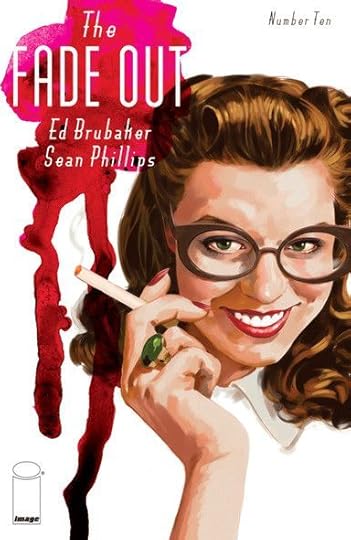
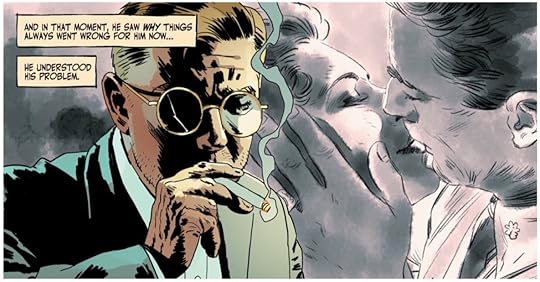
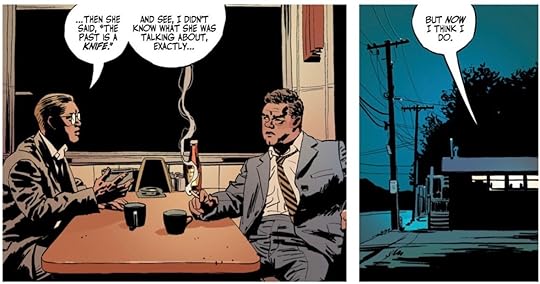
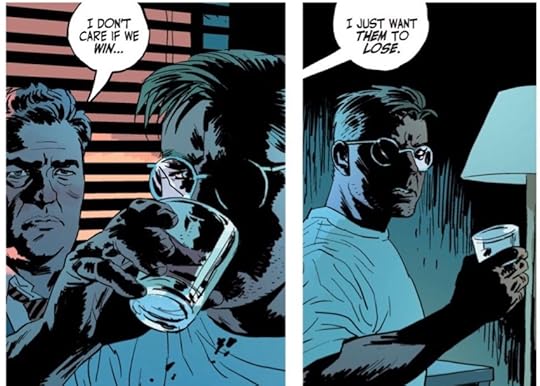
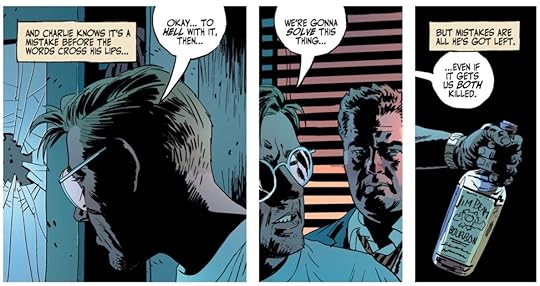
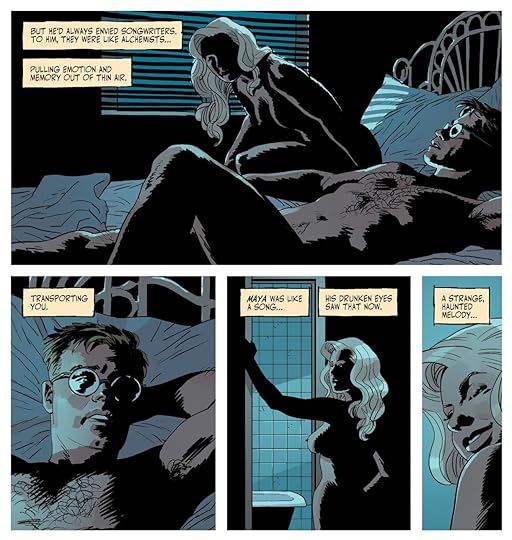
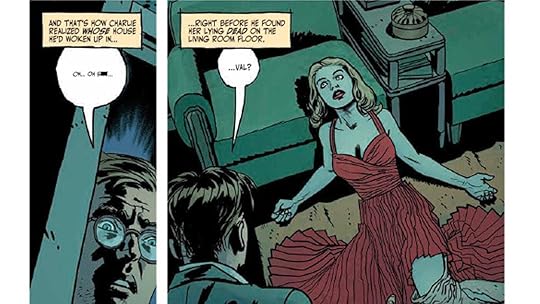
Hollywood, 1948: Noirový film uvízlý v nekonečných přetáčkách. Scenárista pronásledovaný nočními můrami z války. Podezřelá smrt filmové hvězdičky. Podezřelá minulost její náhradnice. Filmový magnát a šéf jeho bezpečnosti, kteří jsou ochotni udělat cokoliv, jen aby se kamery nezastavily – zatímco Rudá panika a černá listina začínají trhat město na kusy.
Ed Brubaker (born November 17, 1966) is an Eisner Award-winning American cartoonist and writer. He was born at the National Naval Medical Center, Bethesda, Maryland.
Brubaker is best known for his work as a comic book writer on such titles as Batman, Daredevil, Captain America, Iron Fist, Catwoman, Gotham Central and Uncanny X-Men. In more recent years, he has focused solely on creator-owned titles for Image Comics, such as Fatale, Criminal, Velvet and Kill or Be Killed.
In 2016, Brubaker ventured into television, joining the writing staff of the HBO series Westworld.
If you don't already know, The Fade Out is Brubaker's (rather excellent) graphic novel about the seedy underbelly of Hollywood in the 1940s.
It takes the form of a murder mystery, but to be brutally honest, I wasn't all that impressed with the mystery aspect, especially the conclusion.
Don't get me wrong, I would absolutely recommend this to anyone who likes crime novels, particularly ones with noir settings. I guess what I'm trying to say is that it's the way the characters and all of their failings come to life that makes this story shine, and not so much the whodunnit. <--does that make sense? The main protagonist is a functioning alcoholic with writer's block, who has a thinly veiled obsession with "celebrity" that manifests itself in his day job as a screenwriter. Ish. The story opens with him waking up in the same house as a dead starlet, minus any memory of the night before. Doesn't exactly make him the most sympathetic character, you know? But Brubaker manages to make you not only care about this extremely flawed guy, but also the rest of the cast of damaged people.
On top of the regular smarmy movie mogul stuff, you also have Hoover's FBI on a witch hunt for communism in the Hollywood community. It was just an extra layer of interesting that added to the smokey/boozy/cool vibe that oozes off the pages.
I loved that you got a glimpse of some famous faces mixed up in this, too. Just...well done.
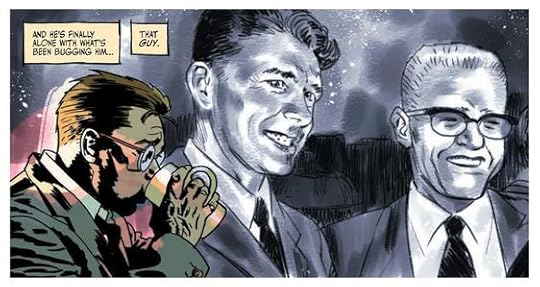
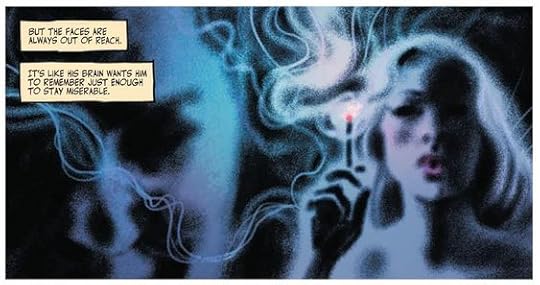
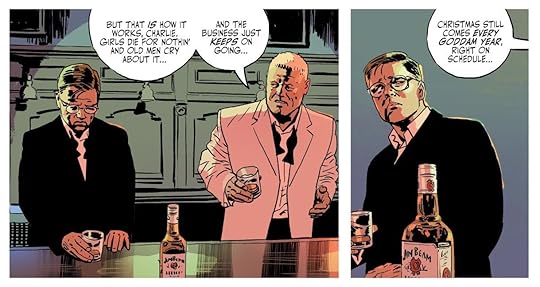
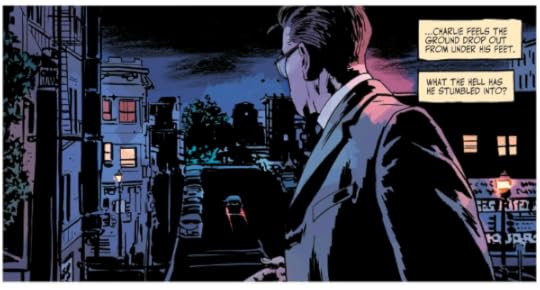
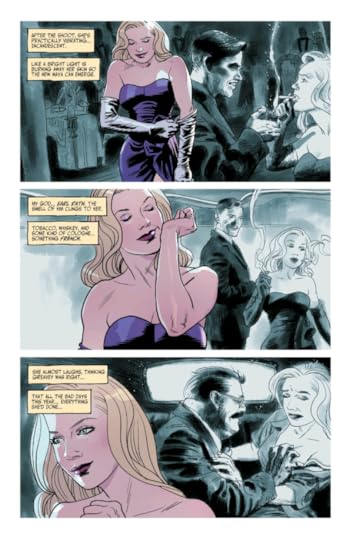
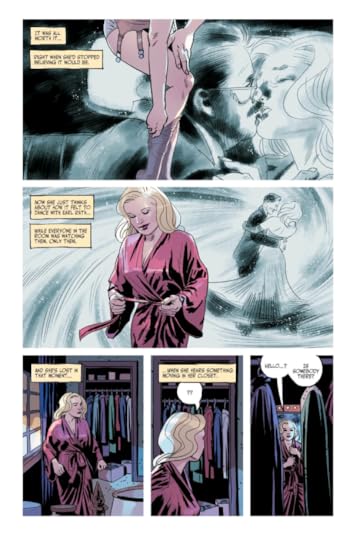
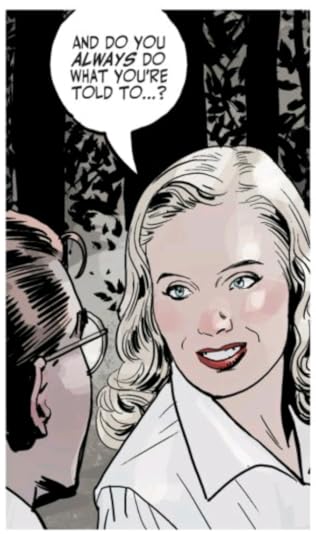
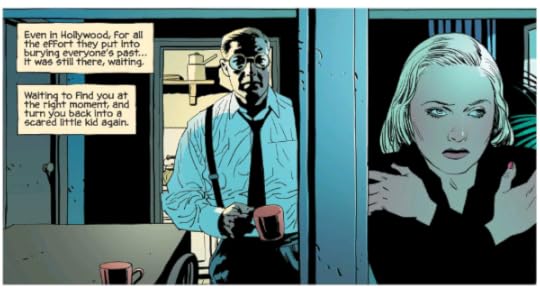
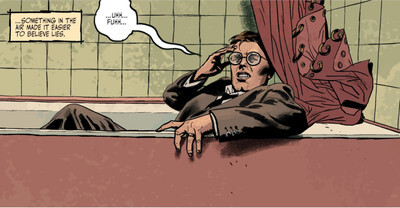
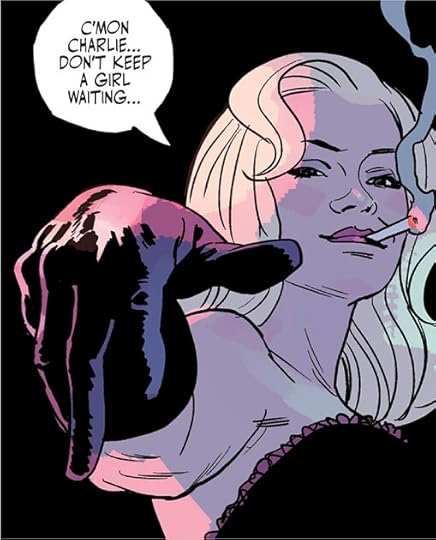
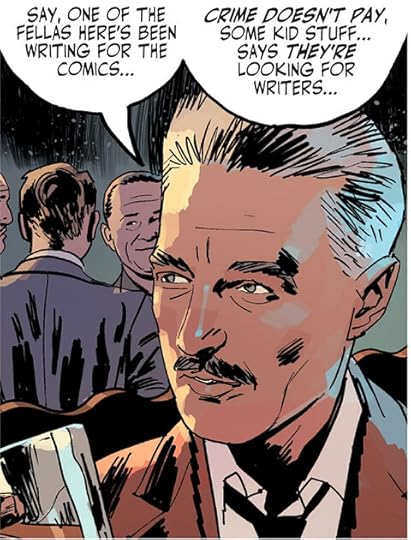
And the art? Everything about it was pretty much a perfect compliment to the story. I had a hard time not putting up more images because there are just so many moments that stand out visually.
So, this wasn't a perfect 5 star story for me, simply because the ending to the mystery felt kinda flat and rushed. But it was otherwise pretty amazing. Highly Recommended.
Because of its format some might say that this is fantastic crime comic. That’s true, but I’m going to take it a step further and say that it’s some of the best noir I’ve ever read which I’d rate right up there with the likes of James Cain or Jim Thompson.
Seriously, it’s that good.
It’s got the ultimate noir setting of post-war Los Angeles, and the plot involves a screenwriter with a drinking problem knowing about the cover up of the murder of an actress that the studio fixer has made look like a suicide. With that as a starting point we meet a variety of characters from despicable producers, publicists who put a glossy coat of paint over ugly truths, movie stars with secrets, blacklisted writers, commie hunting Feds, and even appearances from real people like Clark Gable and Dashiell Hammett.
There’s been no shortage of wannabe James Ellroys who try to do the old school Hollywood thing, and very often it feels just like bad actors putting on fedoras and trench coats so they can mouth clichéd tough-guy dialogue with a cigarette in the corner of their mouths. What really impressed me about this is that Ed Brubaker didn't fall into that trap but instead wrote an ACTUAL noir in which everyone is compromised, nobody is interested in the truth, and seeking justice is a fool’s errand.
Brubaker’s regular partner Sean Phillips does his usual brilliant job of making the art be a perfect marriage to what the story needs, and colorist Elizabeth Breitweiser adds a richness to it that is way more interesting than just a black-and-white comic which is what lesser talents might have done for something like this. This collected edition of the entire run of the title also has some great extras including high quality reproductions of the amazing covers as well as some interesting behind-the-scenes features of how it was all put together from the researching stage to the writing and artwork.
I got this as a present last Christmas, and I’m ashamed that I let it set in a stack of unread stuff for almost a year before getting to it since it’s one of the best things I’ve read in 2017.
Moody dark atmospheric noir wrapped in clouds of cigarette smoke and flavored with freely flowing alcohol, with deeply pessimistic disillusionment.
Yup, Brubaker knows how to noir properly.
This is definitely a story that should be read as a whole and not in volumes. At least I firmly believe so, having had barely lukewarm feelings about Volume 1. But eventually it grew on me (or maybe I got second-hand alcohol intoxication from the pages) and by the time we got to the end I actually liked it.
It’s a story of a covered up murder of a Hollywood starlet in 1948 which leads to the discovery of a whole bunch of secrets extending beyond the expected low-level cutthroat unpleasantness on the background of relentless obsession with “commie scare” paranoia in Hollywood. Corruption, sexism, crimes, greed and endless coverups because power - of course - corrupts anyone.
Don’t go to this if you want anything pleasant or life-affirming. Don’t expect a happy ending ending either. The bleak resignation mood is very consistent, and it actually works, making everything feel tense and hopeless and strangely interesting.
I was not enamored with the art though. There seemed to be a bit of inconsistency in the rendering of our protagonist which was a bit distracting, and I found the entire palette a bit dark — but really, that palette was needed for the proper mood so I just need to stop being picky.
3.5 stars overall, with my impression improving steadily by the end, so rounding up to 4 stars.
Ed Brubaker is better because he digs deeper. This ambitious graphic novel I read in three separate volumes previously, three "acts" of a story now in one large gorgeous volume, illustrated perfectly by the amazing Sean Phillips, colored by the also amazing Elizabeth Breitweiser, with . Brubaker's uncle was a successful Hollywood screenwriter, and he heard all the cynical Hollywood backstories from him. He's also a noir comics and film fan, in addition to writing his own noir comics with Phillips such as his ongoing Criminal series. Like an iceberg, underneath this story, sometimes brimming to the surface, is years of research on Hollywood dirt/dish.
This fictional story weaves in actual Hollywood "stars" with Charlie Parish, an alcoholic fictional screenwriter mixed up in the murder of an actress during the time of The House Un-American Activities committee, and the blacklisting and backstabbing that attended that era. Dirty secrets, hidden crimes, fictional identities and romance created for the media, sexism, homophobia, many of the things you know. Lots of booze and cigarettes and crazy parties. And murder. With a cast of characters that include Charlies also alcoholic screenwriter friend Gil; Brodsky, the security chief making sure only the right news makes it in the news, former (and abused) child stars. Along the way we meet Clark Gable, Dashiell Hammett, and a guy, Tyler Graves, who is a stand-in for Mongomery Cliff.
In a way this feels like a fairly typical tell-all Hollywood noir story, with few surprises, everything familiar to me, in a way, but it is just done so well. What's just barely below the surface of the shiny surface? A Hollywood noir murder mystery with glamorous, dysfunctional actresses!
I reviewed each of the three volumes that make up this story if you want a close look at the story.
Yet another masterpiece by the Ed Brubaker/Sean Phillips creative team. It might get a bit old now, all this praise I keep heaping on these guys. Like Criminal and Velvet before it, The Fade Out is an indelible piece of art not just in the comic book world but in crime fiction in general. Many crime writers have tried to recapture the feel of old "seedy-underbelly" Hollywood noir intrigue and this book does it with ease and without feeling forced and disingenuous like many others. Part of the reason is how they prioritize placing compelling and honest characters in this world instead of focusing on playing up the time period. I'm so impressed with the amount of detail in the book and how many different story elements are included here in such a relatively short page-count. Brubaker touches on the Red Scare/McCarthyism, Pearl Harbor, the changing studio system, the casting couch, cut-throat publicity, alcoholism, the price of stardom, and even the psychological effects of war, all in just three acts, without it feeling overcrowded or diluted. The creators have a real grasp of this material and it's on full display here. It's an engaging and dramatic classic crime story that feels of-the-time but avoids feeling dated at all. The Fade Out stands up alongside the work of James Ellroy, Dorothy B. Hughes, or classic Megan Abbott. And damn, this hardcover edition is gorgeous!
And those of you who know me will know how much it poisons me every time I have to say that. One of these days I’m just going to turn to stone. Ah but seriously, for you noir lovers out there it really doesn’t come any more smartly, authentically written than The Fade Out. This is a story that sizzles and understands at the heart of every noir tale is a fucking tragedy. This is a period piece and I lapped up the historical details like heavy cream. The characters are flawed just as we’ve come to expect in noir but retain a humanity that makes their pain a tangible breathing thing. And the dialogue is aces, I tell you.
To be completely honest, if I had only bought the first volume of this, I’m not sure I would have continued with it. It took me some time to get into and it never quite reached the level of Velvet, the other book I’ve read by the author. But in the end, I really enjoyed this one too.
Set in 1948 this story starts with the main character, a screenwriter, waking up with a severe hangover and discovering the dead body of an actress.
Charlie was friends with Val and is trying to piece together what has happened to her while we get slowly introduced to his fucked-up life.
The story, besides the obvious, is mainly about Charlie dealing with the effects the war had on him and about all the dirt behind the shiny façade of Hollywood. Especially the atrocious treatment of women that has carried on for much too long.
What makes this a very good book again is the great atmosphere and the interesting characters. Charlie, who himself is a broken man, seems to be a magnet for beautiful women that are equally broken as him. And then there’s Gil, another screenwriter who’s an alcoholic, and his wife. The three of them share a friendship that runs deep but is also very fragile for reasons we learn of later.
Ultimately I was more invested in the characters and their relationships than the mystery. But that’s alright.
The artwork is weird, though. It is so inconsistent that I’m still contemplating whether this was on purpose. It goes from indistinct to very good in close-ups, the characters' appearance changes all the time and when one guy went from having a mustache in one panel to not having one in the next it appeared to me that this might be a stylistic choice. But for the life of me, I can’t see why.
Fucking Brubaker and Sean have GOT to be one of the best duos of all time in comics. Knock it out the goddamn park int his one.
What's "The Fade Out"? Well you can all the descriptions but the meat of it is a actress is mysteriously murdered. However, the hollywood movie company who hired are is trying their darnest to cover it all up. In doing so we get to see how dark and twisted a big corporation can be, especially back int he day like this.
Charlie, our main hero here, wakes up in the same room as the dead actress and quickly runs home to his friend Gil, who has been writing screenplays for him for the last few years since he himself has been blacklisted. Once the two start breaking down both emotionally and physically over the death and cover up things get heated up when they decide to solve the case.
Good: The art...man...the fucking art here is amazing. Yes, it's always damn good in Criminal and Kill or Be killed but so damn good here. I also loved the pacing in here. Just when it slows down enough to give human moments or sad moments or tender moments it starts speeding up again with something terrible happening in the background. I also thought the characters were all morally broken and it kept me very interested as it gave a human vibe. The ending is downright sad but works so perfect for the overall topping to the story.
Bad: Some of the last moments in the comic felt a bit rushed.
Overall this was fantastic. Art to writing, Sean and Ed are really one of a kind. I loved this, maybe my 2nd favorite story behind kill or be killed. A 4.5 out of 5 but I'll bump it to a 5.
A murder mystery in Los Angeles 1948, the time when Hollywood was ruled by the big studio bosses, who believed they were above the law, at the start of the Communist witch hunts for un-American activities. Maybe not the most original concept from Ed Brubaker and a bit muddled from throwing everything and the kitchen sink into the recipe, but with a graphic artist in top form [Sean Phillips] and with a lot of familiar characters to fans of old movies and noir novels.
Screenwriter Charlie Parrish wakes up after a wild studio party next to the corpse of the movie’s starlet and panics. He runs away because Charlie has his own secrets to protect – like the fact that he had an affair with the young woman and that he has writer’s block, after witnessing the horrors of a world war. Charlie is in fact acting as a cover for his blacklisted friend Gil Mason, an alcoholic who is secretly writing the script Charlie claims for his own. The studio sends its own fixer, a brutal ex-cop to smooth things over with the police, but Charlie is angered at the cynical cover-up of murder and tries to solve the mystery on his own, despite his own alcoholic memory lapse of events from the fatal night.
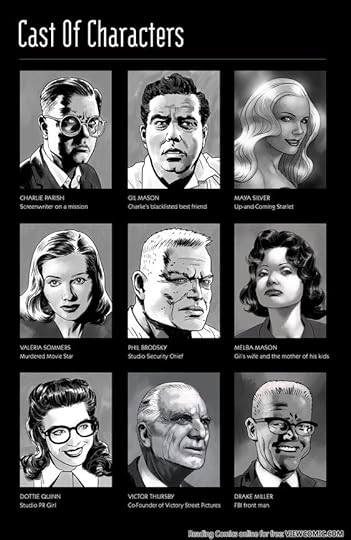
The show goes on, the dead actress is immediately replaced with an almost carbon copy new starlet hungry for the big break. Studio heads, the German director, the older leading man, the new heartthrob, the perky executive secretary, the mentally deranged former boss, a corrupt photographer, a Latino Jazz player and a secretive government agent are all put into play with predictable, but still entertaining results. I actually loved the fact that the hardcover edition starts with a double page cast of characters right after the cover. They are in black and white and showcase the real talent of Phillips with facial expression and mood. The inside panels feel sometimes more rushed and sketchy, but that is normal for most of the comic albums published today, and in general the Brubaker-Phillips projects have higher production quality than the norm. I think the colorist here also deserves a lot of praise for the use of primary colors alternating with Black & white inserts.
I did feel the authors were a little lazy, with most of these portraits being easily recognised as actual actors from the period, with minimal changes to the physiognomy. I think this was a deliberate choice, and a way to pay homage to the era. The most blatant rip off is Tyler Graves, the rising male star, who not only looks identical to Montgomery Clift, but has a carbon copy scandal with a car accident and a made-up girlfriend in this storyline.
Other highlights include cameo appearances from Clark Gable and Dashiell Hammet, the last one with an interesting commentary about the rising popularity of the comic strips.
Maybe there were too little surprises for me in the hardcover edition, but I’m a sort of outlier in the readership profile, being a major geek regarding older, black & white Hollywood movies and classic noir novels. I still think the project deserves four stars for the killer combination of writer and graphic artist and for their willingness to challenge themselves in new storytelling territories, like supernatural horror, classic pulp, whodunits or modern crime. I think I will read the Criminal full story arc next, because it was unfinished when I first gave it a try.
El dibujo, la edición y los extras son maravillosos, pero el guión no me ha terminado de convencer. Aunque tenemos una ambientación bastante conseguida, creo que es principalmente por el color y el dibujo.
Another outstanding addition to this team's body of work. Like most of Brubaker's crime stories, you quickly become engrossed in the mystery and/or the characters. The story is slightly predictable and the ending may not be what most people are looking for, but for me, it's usually the journey that is the most enjoyable and the top quality all around that earns the stars for this book.
Phillips' art is once again outstanding. I think he's in danger of reaching this point where his work is always excellent, causing people to just take it for granted.
What most amazed me about this book was the coloring by Breitweiser. If you look at how she colored it, she actually provided lighting to various scenes. Being a photographer, lighting is everything. If you look closely at some of the interior scenes and pay attention to the light sources, you can see she created rim lighting or highlights where they should be. I don't think I've ever noticed that in a noir comic before and it really enhances the mood of the story.
I think this may be my favorite of Brubaker and Phillips' noir series, and that's really saying something. It's at least right up there with Sleeper and Criminal, my previous two favorites. And this time, like with Criminal, there's no additional genre element added in. It's just a straight-up character-driven noir loaded with atmosphere and darkness.
Maybe I love this so much because I've always been intrigued by the seedy underbelly of Old Hollywood, and this paints everything about that period in a bleak, desperate light that really feels more accurate than the glitz and glamour we often see associated with the era. This isn't about stars living lavish lives and tangled romances. It's about people being taken advantage of by the powerful, having their dreams dangled in front of them and then being ripped away. It's about the Blacklist and cover-ups and a horrible vein of scandal running through the entire industry. It's almost more of a portrait of this time period than it is a murder mystery, though the mystery is compelling in and of itself.
I can't recommend this book enough. It's the most thematic, grand-scale story I've ever read from Brubaker, and it still manages to all be told through the POV of one lowly writer. This is a true work of noir art, and I imagine I'll be reading it several times.
Psát o tom, že Brubaker kriminální noir případy umí by bylo nošení dříví do lesa. A tady to dokazuje poctivě hutným příběhem z Hollywoodu padesátých let. Doba McCarthismu tu funguje jako dokonalé pozadí hledání pravého viníka vraždy hlavní ženské hvězdy z připravovaného filmu. Hlavní hrdina se totiž probudí po řádně propité noci ze které si nic nepamatuje a nachází mrtvolu. A vy můžete věřit tomu, že v továrně na sny, kde má úplně každý nějaké to temné tajemství nebude mít hledání pravdy ani trochu jednoduché. Rozjezd je sice trošičku pomalejší a ve všech těch postavách, aby se člověk na první dobrou vyznal, ale parádní kresba hodně rychle vyčaruje tu správnou atmosféru a vy se můžete spolu s hlavním hrdinou vydat po stopách toho, co se vlastně onu osudnou noc stalo, proč musela Val zemřít a proč se z té smrti okamžitě oficiálně stala sebevražda. A pokud je vám tenhle typ příběhů blízký, tak rozhodně nebudete zklamaní.
Mohlo by se vám líbit, pokud: - máte rádi kriminální příběhy a ty noir obzvlášť - vám učaroval Hollywood padesátých let a jeho atmosféra
Spíš vás zklame, pokud: - v historii plavete stejně jako Halda - kriminálky, kde není mrtvola skoro na každé stránce pro vás nejsou kriminálky
Hollywood, 1948: una película de género negro atrapada en una serie de interminables repeticiones de escenas. Un guionista acosado por las pesadillas de la guerra. Una estrella femenina que muere de forma sospechosa. El pasado turbio de su sustituta. Y un magnate y su jefe de seguridad, dispuestos a hacer cualquier cosa para que las cámaras sigan rodando, mientras la Amenaza Roja y la lista negra empiezan a desgarrar la ciudad.
Misterio épico que trata de mucho más que un asesinato, The Fade Out es la novela gráfica más ambiciosa de los maestros del noir Ed Brubaker y Sean Phillips, acompañados de la aclamada artista del color Elizabeth Breitweiser. Esta edición especial recoge toda la historia en un solo volumen, con dibujos, articulos y textos sobre cómo se hizo.
The ultimate dark Hollywood noir from the team behind Sleeper, Incognito, Criminal, and Fatale. Brubaker and Sean Phillips are an amazing duo and I'd follow them just about anywhere. This is a dark tale of Hollywood corruption, set during the time of the blacklist and the ongoing search for Communist infiltration. Our main character is a writer, who's been struggling with writer's block since returning from the war, and acting as a front for his blacklisted friend and mentor. After a particularly wild party, he awakens in a studio bungalow, only to find the dead body of one of the studio's stars in the making. Aware that to report the incident is to implicate himself, he stays quiet, only to discover the whole thing hushed up, staged to look like a suicide. He tells his friend and the two of them commence their own haphazard investigation that uncovers child abuse, murder, and other perversions. This is a dark, dark story and would make a heck of a movie. But it is also a standout graphic novel on its own as well. Great, atmospheric artwork from Phillips, and the story by Brubaker has its roots in stories a screenwriter uncle shared with him growing up. Really good stuff.
A jet-black noir mystery taking place during the golden age of Hollywood. The story never holds your hand or condescends, so those looking for a paint-by-the-numbers mystery will have to look elsewhere. If you want a dark crime tale, though, this very much fits the bill.
I devoured this fantastic series in a single sitting. A brilliantly gritty LA noir crime story that reads like one of James Ellroy’s novels. Brubaker and Phillips have created a really compelling work of art here.
The murder of a starlet and her "screenwriter" friend's search for the truth
In this noir comic, the writer-artist duo of Ed Brubaker and Sean Phillips delves into 1940s Hollywood and gifts the readers a murder mystery with excellent character development. Elizabeth Breitweiser must be praised for her beautiful colouring. I had come to know of her through Velvet and had been mesmerised by her work.
The book rewards the readers for their attention. If one looks closely enough, one will find that there are certain moments in the later parts of the story which were alluded to in the beginning.
This edition also contains articles by various writers about the lives of the actors and screenwriters of those times. I was moved by the story of Judy Garland who was on a diet of amphetamines and barbiturates from her childhood and how she was fat-shamed by MGM and forced to be on a diet of black coffee, chicken soup and 80 cigarettes a day.
This was one of those books where I felt sad to leave the characters once it was over. Highly recommended for noir fans and anyone who wants to know more about the Golden Age of Hollywood.
La caza del comunista y la lista negra, los abusos sexuales de las actrices y los más jóvenes, la homofobia y el racismo de la época, las grandes bacanales y el alcoholismo... Brubaker mete en el alambique todos los excesos del Hollywood de la postguerra y destila una historia muy clásica que, si bien no sorprende, tampoco falla. Lo peor que puedo decir de ella es, también, lo mejor: es el cómic entre criminal y negro que Brubaker y Phillips llevan bordando desde Sleeper. Además esta vez el final, anticlimático, se ajusta a la perfección al desarrollo y su protagonista. Mención especial merecen la narrativa de Phillips, más engrasado y efectivo que nunca, y el color de Elizabeth Breitweiser, que potencia la atmósfera de cada escena con una gama muy apropiada a los ambientes nocturnos donde se desarrolla la mayor parte de la historia. Las fiestas, las habitaciones lóbregas y sucias, las carreteras apenas iluminadas por los faros de los coches, los estrenos, la oscuridad de una arboleda... Espectacular.
Wow this was a lot darker than I expected. I mean, I expected a mature modern take on a noir but damn. This wasn't a fade-out, more like a hard cut to black.
The art is by far the best part of this piece. The colors are done in a gorgeous watercolor style that contrasts well with the deep black inks of the penmanship. The telltale evidence of digital postproduction irked me-- some pages had illustrations that varied in their default line width, betraying that the panels had been produced individually and composed in photoshop. There were also several instances of 'memory flashbacks' that utilized a godawful gaussian blur. But other than that, top notch art.
The story, however, there wasn't much there. I guess the theme at the end of the day was that everyone and everything is shitty. The main character is more of a bastard than anyone, and I finished the book with an awful taste in my mouth. This is a depiction of a dark underbelly and there's not much redeeming about the world to come back for.
I enjoyed this book as I read it, but it did not deliver on all the potential and set-up it had, and the ending just fell flat. Great atmosphere goes far, but it cannot cover up a thin sketch of a plot.
I was really looking forward to rereading The Fade Out as this was my first Brubaker/Phillips book. And the best thing was that I couldn't remember the ending.
The story is set in 1948 in Hollywood. The WW2 is over and Red Scare is coming. A perfect setting for a murder mystery. I won't spoil a thing for you but this is a true masterpiece. I loved every bit of it and you can see the massive research behind this book.
If you are looking for a true noir story look no further.
An incredible crime noir based on 40s Hollywood, with some gorgeous artwork and amazing writing, that falls just short of 5 star rating because of the ending that felt flat.
I was gifted this volume a while back but put off reading it as I always had library loans on the front burner.
Well, what a chump I was, see? A proper rube, a real square. Because this was GREAT!
For real, Jack!
If you like noir of any variety check this out. I won't say much more apart from the fact some of the art and subject matter is pretty "mature" so don't leave it lying around where your kiddos can grab it, can you dig?
Splashed for the deluxe one-volume edition and it’s a gorgeous object. The story is cobbled together from any number of noir tropes but it kind of holds together until the ending and it has some moments of excellence. Ultimately it suffers from noir’s traditional trouble of style over substance but there was enough there to justify the fancy packaging.
THE FADE OUT: THE COMPLETE COLLECTION by Ed Brubaker and Sean Phillips, illustrated by Elizabeth Breitweiser is not my usual grimdark fair. However, grimdark is the fantastic cousin to film noir and detective fiction. Much like LA NOIRE, the subject matter deals with Los Angeles in the 1940s. It is a fantastic time to write stories about because the glamour and sleaze of Hollywood contrasts with the post-World War 2 trauma as well as economic boom.
The Fade Out is a twelve issue comic book series that I recommend people just purchase the complete collection of rather than the three individual parts. The story works extremely well as a single narrative and quite a lot of jokes as well as clues dropped in the earlier books find payoff later in the story. It is a fantastic read from beginning to end that has some elements that need to be warned about for readers but, otherwise, is one of my favorite reads for 2022. Hell, despite reading it in December, it may be my favorite read of 2022.
The premise is Charles Parish is a World War 2 veteran who has come back completely dry of ideas as a Hollywood screenwriter. PTSD (or shell shock as it was known then) has robbed him of his creative juices. He has delegated all of his writing, instead, to blacklisted fellow screenwriter Gil Mason. Gil is an alcoholic with a self-destructive streak who told Charles to name him to the House Unamerican Activities (HUAC) board in order to save the latter's career. No one knows this and Charles is considered a pariah by Gil's old friends despite the fact he's the only reason the man still has an income.
This already interesting premise is supplemented by the fact that Charles goes home with a beautiful starlet one evening, having both gotten inebriated at a party for a rich friend, and wakes up to her horrible murder. Unable to deal with the possibility that he could be implicated in their death, he covers up his presence and heads out the door. The next morning, he finds out her death has been labeled a suicide (despite clearly not having been) and the studio's primary concern being that her picture be finished.
What follows is equal parts murder mystery and examination of the decadent controlled world of 1940s Hollywood. A place where the mores of society are completely cast aside behind doors but you are subject to total control of the dying studio system. Where the only thing that had threatened the studios in recent years was the power of the federal government and for nonsensical charges. After all, if there's any more capitalist place on Earth with its worship of wealth, fame, and power then I point out Las Vegas is still in its infancy.
Charles is an interesting protagonist because he's not technically trying to solve the starlet, Val's, murder. For the most part, he's trying to shove the event under the proverbial rug and forget about it but can't bring himself to do it. If Charles has any unbelievable qualities, it's the fact that the female cast seems to trip over themselves in order to sleep with him. Gil's wife, the studio PR head, Val's replacement on the picture, and even a singing cowboy picture dancer are among those who want our Peter Parker-esque antihero.
Which does get to one element that is noticeable in this book and that is the copious fanservice and nudity. Ed Brubaker takes advantage of the lack of censorship at Image comics and Elizabeth Breitweiser's skill at rendering characters to throw quite a lot of it at the reader. It's noticeable enough to be distracting but nothing that couldn't be shown on HBO were it to be adapted to a miniseries. Speaking of the art, the realism of the work is amazing and I really felt I was watching a film in print form.
Much of the story also takes time to share horrible stories from real life Hollywood and the utter ridiculousness of it all. Some of the stories are touching like Clark Gable's insistence on volunteering for WW2 and Dashiell Hammett's raising money for blacklisted Hollywood figures. Others are more disturbing like the fact a studio director had honest-to-goddess SECRET PASSAGEWAYS installed into the closets of the dressing rooms of his starlets. Apparently, Betty Davis almost stabbed him one time.
Indeed, sometimes the characters that Ed Brubaker introduces are toned down versions of their real life counterparts. Phil Brodsky is a Hollywood fixer who beats up the boyfriends of gay Hollywood stars, bribes people to look the other way, and is otherwise repulsive. However, he has nothing on Eddie Mannix the real life personage who possibly murdered George Reeves, star of the Superman television show.
The supporting cast is great for the book as well with a number of extremely interesting characters both good, bad, and somewhere in-between. I don't go with the idea a character is "believable" in my fiction but I feel like all of these characters are authentic with many layers. Even the fixer, Brodsky, has some lines that he won't cross as a studio enforcer.
The ending, oof, is pretty bleak and perfect for grimdark fans. Just be warned it's a real gut punch. If you liked LA Confidential, The Black Dahlia, LA Noire, or Mulholland Drive then this is the kind of comic book for you. It is dark, well-written, and full of twists. It may be my favorite comic by Ed and he created the Winter Soldier.