

What do you think?

A New History of Korea
The first English-language history of Korea to appear in more than a decade, this translation offers Western readers a distillation of the latest and best scholarship on Korean history and culture from the earliest times to the student revolution of 1960. The most widely read and respected general history, A New History of Korea ( Han’guksa sillon ) was first published in 1961 and has undergone two major revisions and updatings.
Translated twice into Japanese and currently being translated into Chinese as well, Ki-baik Lee’s work presents a new periodization of his country’s history, based on a fresh analysis of the changing composition of the leadership elite. The book is noteworthy, too, for its full and integrated discussion of major currents in Korea’s cultural history. The translation, three years in preparation, has been done by specialists in the field.
Translated twice into Japanese and currently being translated into Chinese as well, Ki-baik Lee’s work presents a new periodization of his country’s history, based on a fresh analysis of the changing composition of the leadership elite. The book is noteworthy, too, for its full and integrated discussion of major currents in Korea’s cultural history. The translation, three years in preparation, has been done by specialists in the field.
- GenresHistoryNonfiction
518 pages, Paperback
First published January 1, 1984
Ratings & Reviews
Friends & Following
Create a free account to discover what your friends think of this book!
Community Reviews
Displaying 1 - 12 of 12 reviews

Read
May 13, 2014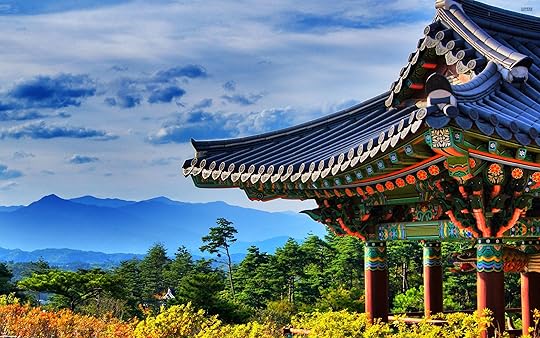
Naksan Temple, founded in 671 and repeatedly destroyed and rebuilt
A New History of Korea: A one volume history of Korea till 1960, starting with the Paleolithic Age.(!) So, much is left on the cutting room floor and everything depends on the interests and judiciousness of the author, Korean historian Lee Ki-baik, who is primarily concerned with political history in this book, though aspects of social, economic and cultural history do receive some serious attention. Those conversant with European history will recognize the ever shifting struggle for power between monarchs, their relatives, the aristocracy and ambitious generals, but there is another element in the Korean mix - though generally less important and less broadly drawn from the population than it was in China, the class of cultured government officials was occasionally a crucial factor in political and nearly always in cultural developments.
Though early in their history the Koreans had no compunction about dominating their weaker neighbors, most of Korean history has been marked by striving to survive in the face of aggression by much stronger and more populous peoples. And when they weren't fighting with the Chinese, Mongols, Manchurians or Japanese, they were fighting with each other. There hasn't been much time for moments like this:
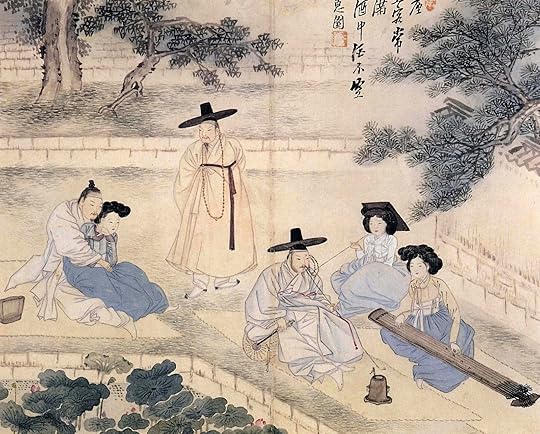
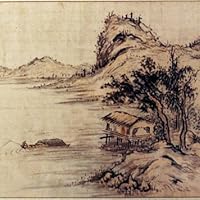
Shin Yun-bok (1758-after 1813)
It was always mysterious to me why Korea was called the "Hermit Kingdom" in the USA, since it was Japan that closed itself to nearly all foreign contacts for nearly three centuries. Witnessing uneasily what the Western powers were doing to China and Japan and how fast Catholicism was spreading in Korea, the Korean government closed the gates to all foreign contacts (excepting the Chinese) in 1866. This led to clashes with contingents of the French navy in 1866 and of the American navy in 1871. But the Western powers were too occupied slicing up China to invest serious effort in the little Korean peninsula. So it was the Japanese who slowly imposed their hegemony upon the Koreans, culminating in the annexation of Korea into the Japanese Empire in 1910 accompanied by a thorough attempt to stamp out the Korean culture entirely until the liberation of the peninsula in 1945, quickly followed by further horrors.
A New History of Korea was written by a Korean for Koreans, which has its advantages and its disadvantages. One of the disadvantages was ameliorated by the translator, Edward W. Wagner, who interpolated explanations of matters of common knowledge to Koreans but not to the rest of us. Because nearly all of the sources Lee employed are yet untranslated, Wagner replaced Lee's extensive bibliography with an annotated but relatively modest bibliography of texts available in English. In 1984, when the translation was completed in synchronization with another of the multiple revisions Lee made as new discoveries piled up, not much was available in English, though the situation has improved a bit in the intervening years. Nonetheless, most histories of Korea in English still are principally concerned with the 20th century. Not this book. Lee's text is still regarded as one of the best syntheses. But it's just a beginning...
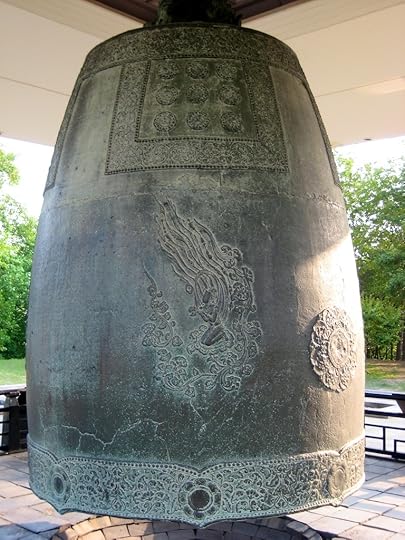
Bronze bell cast in 771 (3.33 meters high)
Rating
http://leopard.booklikes.com/post/107...
July 26, 2023
3.5/5
Here's another book where I'm not quite sure why I committed to it in the first place or how I was able to stumble across a copy at a local library. It seems like the kind of book that would have been incentivized by some long ago review of particularly persuasive power that managed to kindle the barest trace of interest. At any rate, while I was a bit unsure going in whether I would be able to engage with the text with any significant rate of success, this intensive crash course ended up being very helpful when it came to further grounding myself in the big picture of international history, as well as giving me a lot of context for any Korean TV show I try out from now on. I'm not saying that I remember 0.01% of the names/dates or that my eyes didn't glaze over when the listing of examples monotonously rolled on, but in terms of certain questions such as, the appeal of Christianity versus Confucianism, the origins of the Sino Japanese war, the development of the 38th parallel, and how Korea went from Japanese colony to Han Kang, my understanding augmented enormously. My comprehension would've benefitted even more if the history hadn't cut off at 1960, but by the time I got to the end of the text and saw that the last 130 pages was a skippable index and list of citations, I was more than happy to take what surprising wealth of info I could benefit from and leave my next deep dive into Korean history to an as of yet unknown, more contemporary publication whose newness wouldn't prevent it from having scholarship comparable to that of this work. All in all, definitely not a work for those who have little grounding in Korea beyond Kpop and Korean BBQ, but if you have a head for economics and ethical paradigms, plus no small appetite for historical context that treats with white people as the periphery that they rightly are, you are in for an extensively well documented (if a tad nationalistic, although the author didn't pull any punches in describing the ravages of the US/oligarchy on South Korea) treat.
Here's another book where I'm not quite sure why I committed to it in the first place or how I was able to stumble across a copy at a local library. It seems like the kind of book that would have been incentivized by some long ago review of particularly persuasive power that managed to kindle the barest trace of interest. At any rate, while I was a bit unsure going in whether I would be able to engage with the text with any significant rate of success, this intensive crash course ended up being very helpful when it came to further grounding myself in the big picture of international history, as well as giving me a lot of context for any Korean TV show I try out from now on. I'm not saying that I remember 0.01% of the names/dates or that my eyes didn't glaze over when the listing of examples monotonously rolled on, but in terms of certain questions such as, the appeal of Christianity versus Confucianism, the origins of the Sino Japanese war, the development of the 38th parallel, and how Korea went from Japanese colony to Han Kang, my understanding augmented enormously. My comprehension would've benefitted even more if the history hadn't cut off at 1960, but by the time I got to the end of the text and saw that the last 130 pages was a skippable index and list of citations, I was more than happy to take what surprising wealth of info I could benefit from and leave my next deep dive into Korean history to an as of yet unknown, more contemporary publication whose newness wouldn't prevent it from having scholarship comparable to that of this work. All in all, definitely not a work for those who have little grounding in Korea beyond Kpop and Korean BBQ, but if you have a head for economics and ethical paradigms, plus no small appetite for historical context that treats with white people as the periphery that they rightly are, you are in for an extensively well documented (if a tad nationalistic, although the author didn't pull any punches in describing the ravages of the US/oligarchy on South Korea) treat.
June 9, 2011
This book takes a lot of flak because of its style, which I would describe as deliberate. That is regrettable, because the book is quite informative, and actually very interesting. A New History of Korea was written by a serious historian for people who are prepared to take it seriously. If you're looking for a survey history of Korea, I'd suggest wikipedia. If you want a detailed account of the development of society, culture, and politics on the Korean peninsula - then Ki-Baik Lee is your man and this is your book.
If you think you can handle it.
If you think you can handle it.

July 29, 2019
The leading survey of Korean history. One professor called Yi Ki-baek the dean of Korean historians. In his work, he takes a nationalist perspective on Korean history and for the most part, it has a thorough and balanced viewpoint. This is a good introduction to Korean history.
January 24, 2023
I'm just starting my self-directed study on the history of Korea. Comparing this to a few other books written by non-Korean historians, this has consistently come up as the most comprehensive. It is a translation of the original book written in the 1960/61 with some updates by the original author based on deeper research he was able to obtain access to after the first edition was published.
This book is written in the old Romanization format so you will want to have a book written/translated post-2000 handy to keep the names and locations organized if you are new to Korean history. For example, one of The Three Kingdoms is sometimes spelled as Baekje, Paekje. This book spells it with a "P". There are other instances where the letter 'o' has a character above it like a smiley face; Joson but today's Romanization spells this as Joseon, I think. Sometimes you will see someone's name as T' aego but the more modern version is Taego.
I can confirm that I found this to be extremely comprehensive. The author bounces a little in the chronological events based on the categorization of the information. For example, there is a rich section on trade, fine art, music, literature that he presents relative to a dynasty. That means some of the wars and political struggles surf a bit. Once you get the hang of this it's not disruptive as it sounds. If you were watching this a film there'd be, "Meanwhile back in...," that would appear on the screen or a flashback. You get the hang of it and it is kind of nice when you start connecting the dots. This became a moment that reminded me how massive the history of a country is and that a million things are happening all at once sometimes.
This is a history book that gives you more than just wars and politics. There is mythology that reminded me of Greek mythology. Given the history of Korea dates back 5000 and the many times the peninsula was burned, invaded, and governed it shouldn't come as a surprise that we can know what was going on in 300 BCE (before common era). But the author tries to help share evidence to defend where folk and for-real exists from archaeological digs.
If you're looking for an anti-Japanese study, this isn't it. While we do learn more about how occupation happened you're not going to get a lot of horrible stories. You will get factual protests, policy changes, and political struggle that helps set the stage. But it's the overall context that is the most important, IMO.
If you want a solid study that gives you context as well as factual dates, names, events, and people, this is a great place to start.
This book is written in the old Romanization format so you will want to have a book written/translated post-2000 handy to keep the names and locations organized if you are new to Korean history. For example, one of The Three Kingdoms is sometimes spelled as Baekje, Paekje. This book spells it with a "P". There are other instances where the letter 'o' has a character above it like a smiley face; Joson but today's Romanization spells this as Joseon, I think. Sometimes you will see someone's name as T' aego but the more modern version is Taego.
I can confirm that I found this to be extremely comprehensive. The author bounces a little in the chronological events based on the categorization of the information. For example, there is a rich section on trade, fine art, music, literature that he presents relative to a dynasty. That means some of the wars and political struggles surf a bit. Once you get the hang of this it's not disruptive as it sounds. If you were watching this a film there'd be, "Meanwhile back in...," that would appear on the screen or a flashback. You get the hang of it and it is kind of nice when you start connecting the dots. This became a moment that reminded me how massive the history of a country is and that a million things are happening all at once sometimes.
This is a history book that gives you more than just wars and politics. There is mythology that reminded me of Greek mythology. Given the history of Korea dates back 5000 and the many times the peninsula was burned, invaded, and governed it shouldn't come as a surprise that we can know what was going on in 300 BCE (before common era). But the author tries to help share evidence to defend where folk and for-real exists from archaeological digs.
If you're looking for an anti-Japanese study, this isn't it. While we do learn more about how occupation happened you're not going to get a lot of horrible stories. You will get factual protests, policy changes, and political struggle that helps set the stage. But it's the overall context that is the most important, IMO.
If you want a solid study that gives you context as well as factual dates, names, events, and people, this is a great place to start.

August 13, 2026
I got this book to learn more about Korea, since my daughter in law is from there. I was impressed by how old Korean civilization is and how the stories of China, Japan, and Korea are so intertwined from the beginning. Unfortunately, this book has the flaw of many history books: a compilation of lists, events and names with very little story to bind them together. For someone unfamiliar with the history of this country, it made it difficult for me to follow.
The highlight of the book was the depiction of the Japanese colonization and the Korean War. The dispassionate historian now became indignant with the atrocities of the Japanese and later of the authoritarianism of Syngman Rhee. This part of the book was most interesting and left me wanting more.
The highlight of the book was the depiction of the Japanese colonization and the Korean War. The dispassionate historian now became indignant with the atrocities of the Japanese and later of the authoritarianism of Syngman Rhee. This part of the book was most interesting and left me wanting more.

Read
July 13, 2023This is not a very good book. Its coverage of early Korea is confusing. It's coverage of the 20th century (through the formation of the dictatorships) is highly unobjective. And it urgently needed an introductory chapter on Korean geography. Don't know what to recommend instead, though

May 3, 2011
I learned a lot, and will hopefully remember some of it. I thought this book gave a good overview of the entirety of Korean history. Overall though, I did find this book hard to read because the time line of the narrative was very circular jumping back and forth a couple decades and sometimes even centuries. My favorite part of the book was the last 100 pages or so when they start talking more about modern Korean history. This section definitely seemed more in depth and a little less circular with it's time line.
July 1, 2007
This is informative but almost unbearably dry. I'm looking for something else that covers the same material in a more interesting fashion.

February 9, 2014
it was very interesting to go through korean point of view on their own history but it was not very informative and sometimes too random.
September 10, 2015
Ho trovato questo manuale davvero completo. Analizza tutti i momenti della storia coreana sotto tutti i punti di vista, approfondendo.

December 30, 2014
A good introduction to korean history I read around a decade ago. Covers all relevant eras.
Displaying 1 - 12 of 12 reviews