Jump to ratings and reviews
Rate this book

Lotus in the Stone: Sacred Journeys in Eternal India

Rate this book
A travelogue like no other, A guidebooks to India and its temples and hidden gems that you will cherish. Lotus In The Stone takes us on a journey to the dizzying array of deities, temples, festivals, rituals, art, architecture, applied sciences and living traditions of India, that is Bharat, bringing us to an understanding of the sublime, advanced society her culture nurtured. With her experiences and adventures in crisscrossing India for decades, the author shows us how ancient India's surviving heritage and living traditions are a testimony to her history, and the invisible threads and sacred geography that bind her people together.

166 pages, Kindle Edition

First published October 25, 2020

24 people are currently reading
139 people want to read

About the author

Anuradha Goyal

15 books140 followers

Ratings & Reviews

What do you think?
Rate this book

Friends & Following

Create a free account to discover what your friends think of this book!

Community Reviews

5 stars
52 (71%)
4 stars
11 (15%)
3 stars
4 (5%)
2 stars
4 (5%)
1 star
2 (2%)
Displaying 1 - 30 of 35 reviews
Profile Image for Bharath.
953 reviews634 followers
June 17, 2022
While temples, of course, hold deep religious significance for Hindus, I am sure all open minded people look at the grand architecture of many of India’s temples with respect and awe. Similarly, when I see other places of worship, especially old ones, I am always curious about their history and spiritual significance.

Anuradha Goyal brings alive the deep significance, architecture, location and building process of temples in her book. A very honest, respectful, informative and first hand telling of her travels to many temples across India and some outside as well. As she points out, the temples reinforce a spiritual experience by delving deep into religion, history and mythology. The coverage of temples is very extensive. A few observations though are a bit speculative. I liked how she explained the varnas - very unambiguously.

Some subjects which have acquired a political overtone find only sketchy mention (thankfully), and her commentary is mature. As Joseph Campbell said, true peace is in respecting the sacred - importantly not just of your own traditions.

Much recommended if you want to obtain a deeper view of India’s grand temples.
Profile Image for Ashish Iyer.
873 reviews635 followers
February 12, 2022
Beautiful book.
Some books are meant to be read to get the experience. This book is one of them. This book will come in handy when I explore some of those places mentioned in this book. Its a brilliant travelogue combining with author experience, sharing tons of information regarding temples, various deities, culture, festivals and rituals. Even the writer have various knowledge regarding Hindu scriptures which is helping us in understanding the backstories and reasons behind certain things. Hope Anuradha ji writes more books like this. I have been an ardent follower of her travel blog (Inditales) and her book blog (Anu reviews).

It just speaks of how well and intricately author have traveled. As one reads the book "Lotus in the Stone", you can list out the temples one by one, one is supposed to visit in life time.
Do read this book. You will love it.
Profile Image for Sudha.
21 reviews9 followers
December 22, 2020
This is a lovely book to be read by anyone who wants to understand the cultural connect that spreads through India. The author, through her extensive travel shares her experiences, going through the history, culture and heritage of our beautiful land. Her spiritual connect at various holy kshetras and her interactions with people around her, make this book a good read.
2 reviews
December 20, 2020
Brought back memories of childhood

I am in IT, and have been raising my child outside of India. I really underestimated the importance of cultural moorings and strong roots for oyr next generation. Thanks to Anuradhaji, i realized the role of my elders in imbibing joy in my growing up years. Unless you know your culture, you can never appreciate what you will lose.

I owe it to my next generation to pass on our unique sanatan dharma culture and traditions.

Thanks for a kick-in-the-gut fact-check..
Humbled.
Profile Image for Swapna Peri ( Book Reviews Cafe ).
2,217 reviews82 followers
April 8, 2021
Book Name: Lotus in the Stone - Sacred Journeys in Eternal India
Author: Anuradha Goyal
Format: Kindle

About The Book:
This book by Anuradha Goyal, Lotus in the Stone Sacred Journeys in Eternal India, is about India's spiritual centres- temples, rituals, importance, relevance and influence they have on the people. This is also one of the good books that delve into the country's rich culture and varied heritage.
About The Author:
Anuradha Goyal is a prominent blogger and is known for her excellent reviews. The Mouse Charmers is her debut book which has been received very well. She is a travel enthusiast, and her travel blogs are not to be missed.

Inside The Book:
Lotus in the stone is a well-articulated book. It is divided into chapters, where each chapter is unique and informative. The book thus gives a feeling of a well-researched travelogue along with a good amount of spiritual wisdom. The book is well written that talks about the favourite gods, the beliefs, spiritual system, the philosophies of Advaita, and much more history attached to it. Across the country, from every corner, each sacred place is intensely researched and presented with ample information.

The book also gives the readers many stories picked up from the Puranas or the ancient sacred texts. The thought of explaining the Upanishads involving every generation is one of the interesting aspects. The book talks about places, cities, rivers, temples, building descriptions, geographies, festivals, rituals, histories attached to every place. The book also explains how and why the devotees feel attached to the rhythms, bhajans, gods incarnated into the stones and the omnipresence belief.

About Author's Writing:
Author Anuradha Goyal has chosen the simple English language with general vocabulary to let the readers sync themselves more with the underlying emotion of the book's intent. The inclusion of her travel and spiritual experiences added more flavour to the book.
She has also focused on not so commonly known facts about the places. It is a general trait that tourists are guided in a format from which the explorer or a traveller differs. Anuradha Goyal, though, gave a travelogue with the scent of spirituality; the traveller in her provides the readers with more interesting facts less known to common people or the regular tourists. This book can also be used as a ready reference and guide when anyone plans to the listed places.

My Review:
The book is divided into eleven chapters. Each chapter is based on the author's visits to various spiritual and divine places. For example, chapter one gives the readers a detailed experience of her visit to various temples, the perspective and indigenous concept of Kumbh Mela etc. The explanation of her experience with Ayodhya is interesting. Likewise, many places, including Kerala, Goa and Kashi, all have different yet interesting stories. The intrinsic details while explaining stands out. Though the book is a work of non-fiction, the writing entertains the readers to a greater extent.

Rating:
5/5


Profile Image for Ishan Agrawal.
946 reviews48 followers
January 10, 2021
Remember Bacon's famous words: "Some books are to be tasted, others to be swallowed, and some few to be chewed and digested." And this certainly falls in the latter category. With the advent of technology and influence of western culture clubbed with the propaganda spread through social media, the current generation is swiftly forgetting the essence of Santana Dharma and the values imbibed in it. It is of utmost importance that wherever one goes, he or she should never forget the roots and ought to stay close and binded by it.

'Lotus In The Stone' is not just a book but truly a pilgrimage, a travelogue to the hidden ornaments of our nation which are yet to be explored by most of the population . It takes you on a voyage to impeccable work of architecture and such beautiful temples with their artistic beauty and a characteristic flair that one will cherish forever.

The book in its purest form, introduces the readers to the true Bharat, it's culture, traditions and the background stories of the valour shown by so many followers of Hinduism in the past that has kept our nation's and in turn our dharma's sanctity in place.

What makes this book a must read for one and all is the outstanding narration and the way, Anuradha ji has described the monuments and inculcated the aesthetic and ethical values through it speaks volumes of her as a person and leaves one truly spellbound in awe of her storytelling skills. The intricate treatment of the tale and a keen observant attitude with extraordinary precision with which the entire marvel is carried out makes it one of the best books ever written as a tribute to our motherland.
Profile Image for Swapna Sanand.
10 reviews1 follower
April 23, 2021
From Kumbh Mela to Ayodhya to Varanasi and many more sacred temples across India, Anuradha Goyal's travelogue 'Lotus in the Stone' feels like a pilgrimage of the body, mind and soul to the realms of the Infinite that stand as a testimony to India's living civilisation. At a time when we are stuck in narratives that treat travel as an elitist luxury experience, here is an author who travels to the interiors of the country as part of her sacred journeys, conversing with people on the ground and documenting their local and unknown narratives of temple traditions and bhakti. Though an avid reader and traveller, I have not read any book like this related to sacred journeys, the history and living strands of civilization and the thoughts of a traveller rooted in Dharma. A gem of a book that takes you on a journey like no other. 
14 reviews6 followers
November 24, 2020
This is the most lucrative book that i have ever read about Indian Rituals and culture.
4 reviews
March 7, 2021
book worth reading

lucid and captivating style. after reading this book I realised my india is so vast that I can't explore her in one life, has a past so much hoary that I cant keep track of her, has so many Patriots and innovators that it is difficult or well nigh impossible to memorize them. every citizen of india should read this book as an introduction at an early age so that they can get to start understanding our beloved motherland before it is too late.

thanks to the author for sharing her hard earned knowledge, it is people like this who have not pawned their intellect that make our country great. your way of addressing time in the book is admirable.
1 review
March 30, 2021
A wonder indic travel book - the lotus in the stone is at once both a personal and universal account of Indian temples and pilgrimages. The book is a refreshing look at the sacred in India. The writing is fresh and youthful in its approach of the subject at hand. It is obvious that the writer is both well read and well travelled, and a passionate person at heart. This is one of the best temple journey books to come out of India. The book is talented reflection on what it means to worship in today's times. Kudos to the author for this wonderful narrative.
Profile Image for Pankaj Verma.
21 reviews
January 25, 2021
This book is a must read for everyone. The author explores her roots and nicely takes us along her in that journey.
Profile Image for Chandra Sundeep.
262 reviews26 followers
December 13, 2021
Lotus in the Stone: Sacred Journeys in Eternal India by Anuradha Goyal is a beautiful well-researched Indic travelogue taking the readers on a pilgrimage, exploring the sacred and eternal in India. It is the story of a journey undertaken across the length and breadth of India to understand the sacred threads tying our land together.

“Stories from India’s past are scattered across her geography, the very same geography that was an integral part of these stories. Through the lived experience, you can see a perfect mapping of these historic stories on the geography where they took place. This pattern is not very apparent till you step out and travel to these places and experience the rootedness of these stories in the places associated with them. Until you visit them, these are mythical places and mythical stories belonging to another space and time. Once you step foot on these lands, you realize that these stories are alive in much the same way we are living and breathing descendants of our ancestors of the same space and time these stories were set in. You see glimpses of long-standing traditions in every aspect of life there—be it the way people dress, the way they speak, or the way they relate to the presiding deity of the land. If my history books gave me disconnected and disoriented bites to chew, my travels joined the pieces together as a single narrative, like a beautiful fabric fluttering in the sky, with a million stories lending their colors to it.”

Anuradha Goyal has catalogued her travels, cultural and spiritual experiences in this book. The author narrates not only the famous stories from Shastras, Puranas, Vedas or Upanishads, but also the relatively unknown stories tying together our holy sites, rivers and temples. Goyal provides in-depth insight into the sacred geographies of India; the traditions, cultural nuances, rituals and festivals. I could feel her passion as she describes the devotion and attachment people have towards their favourite gods and highlights the spiritual practices and beliefs, their historical context and the associated philosophies.
Apart from the spiritual aspect, the author has also highlighted the engineering and architectural aspects of the temples of Bharat. The temples are an engineering marvel to say the least, and Goyal beautifully narrates the different aspects of temple architecture, motifs, styles and stories engraved in stone all over the country.

Reading this book was an enriching experience, as I got to learn so much about the sacred spaces of India. Often we visit temples, perform the pujas and leave. We hardly stay around to explore and appreciate the finer nuances. We rarely listen to the stories of our fellow pilgrims or even put in efforts to understand the underlying strands of our traditions and cultural heritage.

Lotus in the Stone: Sacred Journeys in Eternal India is an informative travelogue and a must read for anyone looking to understand India’s sacred landscape and the spiritual threads connecting us to roots lying deep in the ancient past.
Profile Image for Ujjwala Singhania.
221 reviews69 followers
January 10, 2022
This is my first travelogue read. And it turned-out to be a beautiful experience. The author has created such a colorful and rich tapestry of our temples, our beliefs and our culture through her stories and anecdotes.
As she shares her experiences and her findings, the reader gets pulled-in in her traveling. She takes us with her and one sees that a Temple is not merely a place where our Gods reside. It is not that simple, its more nuanced. A temple is the history of the time it was built in, the story of the people who built it, the love of the devotees for their God living there. Each temple and/or temple town tells its own story, they are Lotus in the Stone. One has to be open to accept all it has to offer when one visits them, be a true seeker and one will hear the song reverberating through the ages.
163 reviews10 followers
May 17, 2023
An impulsive pick as part of a pack, this book intrigued me, both for content and the author. I had read about the author in multiple online threads, but hardly had read or followed her. With mystery & no expectations, I started the book. The book starts with the author’s journey from her childhood to her formative years to her first set of travels as part of her work. Her experiences at her varied places of stay & the start of travelling as a passion becomes quite apparent. Travelling coupled with blogging & documentation fuels the fire to explore the world & expand her horizons. With passing paragraphs, the reader is clear that this will be a historical travelogue viewed through the eyes of the author.

The narration picks up pace and the reader is magically transported to the various temples that the author has described in the first chapter. The experience with Ram Lalla at Ayodhya is something that shouldn’t be missed. In the chapter “Beneath the Veneer”, the author has described her personal journey, experiences across various temples & the connect or bond that is established between Bhaktas. As an avid temple visitor with a penchant for historical & puranic significance, I can could totally relate to the author’s experiences across her multiple & unique visits across the various temples in the country. In the next chapter, the author unravels the mysteries of the genetic memory contained within individuals, societies & civilisation that is revealed with time. The experiences of the author in Goa & Indonesia is truly enlightening & definitely gives a lot of food for thought. The ancient wisdom of wax modelling or wall graffiti that transcends time & geography makes for quite an interesting read.

The history behind the Kopeshwar Mahadev temple & open-to-sky architecture of this place and its significance in the Shiva-Shakti story is quite illuminating & fascinating. How do cows identify the spots where Murtis are hidden? Why do certain vigrahas get established at certain places? Is there a relationship between human behaviour & energy fields? The author explores these & many more questions through her multi-varied experiences. The part about Mahabharatha trail is quite fascinating. The chapter on “Where History meets Geography” is very illuminating as it takes the reader on a divine journey across the length & breadth of Bharatha desha exploring various sites of significance from Ramayana & Mahabharatha. The chapter on “When Deities too Travel” details various accounts where the divine deities live a more humane life amongst their subjects.

The chapter on Devi is an absolute must read on the culture and history of this great land, which celebrates the feminine divinity in the most devotional way across all the spheres of life. The anecdote relating to Rukmini’s letter to Krishna was fascination & astonishing to say the least. The chapter on the design of various structures like step-well & water management structures makes one proud about the engineering acumen of our ancestors. The details on the various ancient bridges is sure to pique the curiosity of impressionable minds, specially the living roots bridge. One of the finest sections of the book is about the language of time & space, where the ancestral wisdom is captured in forms that talks about a different dimension that it’s intended to be. The portion about pradakshina / Parikrama is quite revealing. The best part was to learn that Kashi Naresh plays himself in the Ramlila. The devotion transcends eons & generations. Befittingly, the book ends with a wonderful explanation of Dharma & its implication in human life.

In short, a very informative, enriching, MUST READ book. I would highly recommend this as gift to young & old alike.

Profile Image for Veena.
5 reviews
September 6, 2021
This book is a very good introduction to the temples of India, how our murthis are constructed, which Gods are worshipped in which regions, etc. I liked this book though there were a couple of wording choices I would have selected slightly differently. For example, Goyal ji said that Krishna Dev "abducted" Rukmini. In truth, He eloped with her. Another thing is for the rashis, I would have given their Sanskrit names instead of their English names. I wish she gave her full list of references instead of a selected list. It would be nice to look into said references. This is a good book for people who are learning about Hinduism. I wish I had read it as a kid. I would really love to see this book turned into a course, degree plan, or thesis. That is how much depth there is for this subject.
Profile Image for ✨Rashi✨.
89 reviews16 followers
January 16, 2022
I don't really read travelogues or travel related books because I just don't like travelling much. Lotus in the Stone by Anuradha Goyal however was incredibly engaging and I finished reading this book in a day. The book starts with the Kumbh Mela and I loved the author's description. Although I've never been to one it still makes you awestruck at the shear number of people who participate. The author describes it as :

At the Kumbh Mela, artists of all kinds presented their poems, songs, and art works of all kinds, be it in the streets or inside the well-equipped tented auditoriums. Books and libraries were never far away. This was the world’s largest conference happening in autopilot mode. Imagine how many ideas can take birth here.

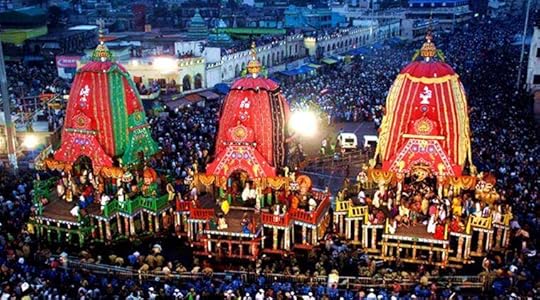
The author takes you along to a journey of all the temples and sacred sites she has visited and the history associated with it. The author's ability to write such an enchanting description of ancient architecture is truly admirable. I love how the book also focussed on how these sacred sites are a continuation of our rich heritage and how the culture is still preserved such as the yearly Rath Yatra of Puri
Jagannath Rath Yatra

The author also talks about the architectural marvel of ancient India and the way several temples have been built so much in harmony with nature. The book also talks about water harvesting technologies being incorporated with monuments for e.g Rani ki Vav

They not only understood the need to conserve every drop of water for survival in relatively dry places, but they built these stunningly beautiful stepwells that mesmerize you even in their ruins. I wondered if the exquisite beauty of the sculptures at Rani ki Vav owes to the fact that this stepwell was built by a woman—Rani Udaymati. It is said that she built it in the memory of her husband. What a lovely approach to building a memorial! This is one that is not just beautiful, but also serves the most basic needs of the public. Walking through the Rani ki Vav, I was looking for the bust of Rani Udaymati; as per my research, this used to exist at the stepwell. However, I could not find it either at the site or at the museum next door; but it made me contemplate about the monuments that women have built in India.

The author also comments on the rich culture of story telling and oral tradition of passing knowledge:

India can well be called a land of stories and storytellers— you find them written in stone, on walls, on rocks, as weaves and on palm leaves, though none of them beat the oral rendition through the innumerable storytelling traditions across the land

Until you visit them, these are mythical places and mythical stories belonging to another space and time. Once you step foot on these lands, you realize that these stories are alive in much the same way we are living and breathing descendants of our ancestors of the same space and time these stories were set in.

The fusion of selfless art, poetry and culture is truly enthralling for example, here, the author talks about an ancient inscription describing a cloud burst:

The description of this incomplete inscription is poetic even when it talks about the devastation created by the cloudburst. It does not seem to be recording a bare factual statement about a climatic disaster for the meteorological department of its times. The inscription says it all so poetically, even while incorporating all the scientific data and facts needed to be communicated to us, the future generations, about the state of the environment in the region then. If those ancestors were to read our public records today, they would certainly be disappointed!

It has also been noted how the textbooks often ignore the advancements of ancient culture such as the practise of Panchang which all of us use at our homes and how precisely it marks the movement of stars as well as planets. I've also writen an article on Ancient Indian Astronomy aa few months back and then too I realised how little we actually are taught. Here's the article : Sky and Infinity

I also found out about the living root bridges of Meghalya through this book and it is really interesting that since the bridges are made of living tree roots they will only strenghten as time flows. The author also talks about the way ancient tempels can also be read as water markers and help the people evacuate in time.
bridge across a river made of tree roots

It is commendable how even in face of invasions for hundreds of years and attempts by the invaders to destroy the culture of India, India survived through countless sacrifices of people such as the naag sadhus who sacrificed themselves while protecting the kashi Vishwanath temple from Aurangzeb. There are also, countless nameless people who protected the temples and idols during Islamic Invasions although it could have cost them their lives.The author also writes about this in her book:

Today, if the culture surrounding these deities is preserved, it is because of these unknown ancestors of ours who did everything possible in their capacity for the survival of our deities and the traditions associated with them.
Profile Image for Aditya As.
16 reviews
February 22, 2022
The book had potential to be richer with the amount of travel the Author has done. Most of her experience in travels kinda finish in the earlier chapters. And towards the last chapters the book deviates from her travels and attempts defines Hinduism and its subset of sects. For me the last pages was better if I skimmed through which i didnt expecting some detail to emerge. I would have not had a problem with that but the book is titled Sacred Journeys, and the author should have put more of her journeys through it.
Still the book has some places which interested me very much and arouse the traveler in me.
Profile Image for Saravana Sastha Kumar.
229 reviews4 followers
May 12, 2022
A very important book. Falls comfortably between a travelogue and essays on dharmic topics. Does a fabulous job in 200 odd pages in instilling the thirst to travel around the sacred geography that is India. It's a must in personal collection. Though I've read in Kindle, I've ordered a physical copy as well now.
Profile Image for Madhurya Yadunath.
39 reviews24 followers
September 24, 2022
This book is a treasure. So much information packed into a small book. I have so much to read further and lot of places to visit. Totally in awe of Anuradha Goyal's travel and experience. Will be rereading, it makes me happy.
5 reviews
May 25, 2022
Excellent read. Loved the perspective presented by Anuradha Goyal about Indian temples, their art, architecture and the folklores.
Profile Image for Bookish Indulgenges with b00k r3vi3ws.
1,617 reviews259 followers
June 12, 2021
Anuradha Goyal has been a prominent name in book blogging world for quite a while because of her in depth and insightful reviews. I have also followed her travel blog from time to time. When she made her debut as an author with The Mouse Charmers, I was sure that it was an interesting and informative book. I did give it a miss as I am very selective about the non-fiction books that I read. I was glad when I realized that she had written a Travel book - a non-fiction book that did call to my own passion of traveling.

Lotus in the Stone is a carefully curated book. Divided into chapters based on individual topics, the content page gives you an idea of what the book has to offer. This is where I will also freely admit that I dove into the book with 'Devi and the Roots of Feminism in India' because in my mind this was a chapter that would make or break it for me. Unsurprisingly, I loved the chapter because the author presents us facts, her own experiences and take on things. Kumari Puja (referred to Kanya Puja) was hyped a lot on social media in the last few years by the 'woke' public, but my own experiences of it were completely different. I could relate to author's experiences regarding the same and then I also learnt quite a few more things that gave me a wider outlook.

Read the full review on Bookish Indulgences with b00k r3vi3ws
51 reviews3 followers
October 14, 2021
A must read book for every one who wishes to see Bharata and understand it. The love and understanding the author has for & of Bharata, its traditions, culture and history is very apparent and you can't help but fall in love once again with this country and be in awe of what we have inherited as a citizen of this country. It also makes you realize you have a duty to pass on these stories and traditions to the next generation. It is the sort of book you go back to again and again, to read and reread and better understand.
3 reviews
December 26, 2021
Insightful

Brings out so many unknown facts about so many temples and introduced the reader to so many unknown temples. Has really inspired me to do my own temple run! Thank you so much Ma'am!
Profile Image for Preetam Chatterjee.
7,060 reviews382 followers
July 11, 2024
We are told that culture has two categories – material and non-material. The first comprises technologies, instruments, material goods, consumer goods, household design and architecture, modes of production, profession, commerce, welfare and other social activities.

The latter includes norms, values, beliefs, myths, legends, literature, ritual, art forms and other intellectual-literary activities. The material and non-material aspects of any culture are usually interdependent on each other. Sometimes, however, material culture may change quickly but the non-material may take longer time to change.

As stated by Indologists, Indian culture stands not only for a customary social code but also for a spiritual foundation of life. Indian culture is an irreplaceable possession of our society. Indian culture is the oldest of all the cultures of the world. Inspite of facing many ups and downs Indian culture is shinning with all it’s glory and splendor.

Culture is the soul of a nation. On the basis of culture, we can experience the prosperity of its past and present. Culture is collection of values of human life, which establishes it specifically and ideally separate from other groups.

This most wonderful book is a journey through the avenues of Indian culture. In the pages of this book the reader discovers the sacred and the eternal in India. You would be introduced with the invisible threads that connect and sew India together. One would come face to face with the fact that cultural development is a historical process.

Our ancestors learnt many things from their predecessors. With the passage of time they also added to it from their own experience and gave up those which they did not consider useful.

We in turn have learnt many things from our ancestors. As time goes we continue to add new thoughts, new ideas to those already existent and sometimes we give up some which we don’t consider useful any more. This is how culture is transmitted and carried forward from generation to next generation.

The travels undertaken by the author keeps introducing her to the knowledge she inherited characteristically by taking birth in this land, and by living in numerous unalike portions of this country.

From the Jain caves at Khandagiri and Udayagiri, Bhubaneswar, the Sun Temple at Konarak, the Jain Temple of Dilwara, Golden Temple of Amritsar, the Gurudwara Sisganj of Delhi, to the banks of the Ganges and the Christian Church in Goa, India lives flamboyantly.

Each step the author takes on the outside opens up voluminous spaces on the inside for her. All those expeditions keep retelling her and the reader that we are a part of a gamut whose truncheon is in our hands at this moment, a truncheon we must pass on after tallying our individual involvements to the gamut.

Please read this book. It is fabulous.
Profile Image for Dipankar Bhadra.
666 reviews60 followers
April 29, 2025
Lotus in the Stone is a book about India's special temples and spiritual places. The author, Anuradha Goyal, shares her experiences visiting these places and explains their importance. She talks about rituals, beliefs, and stories that make these places special.

Anuradha Goyal is a blogger who loves to travel. In this book, she writes about her trips to different temples and spiritual sites in India. She shares interesting facts and stories that she discovered during her travels.

The book is divided into chapters, each focusing on a different aspect of India's spiritual heritage. Anuradha Goyal's simple and engaging writing style makes it easy for readers to connect with the book's message.

Whether you are a traveler or just curious about Indian culture, Lotus in the Stone is a great book to learn about the spiritual side of India. It's like taking a spiritual journey through the country's most sacred places, guided by the author's experiences and insights.
Profile Image for Vigyan Om.
Author 2 books2 followers
July 15, 2023
Lotus in the stone is one of the finest works I have ever seen. Anuradha Goyal ji has done very beautiful and amazing work in bringing the stories of the age-old glorious places of worship that were once the center of our devotion and even after the brutal acts of destruction and plundering stand tall by the grace of Ishwara and brave bhaktas (devotees).

The book pictures many divine places that surely must be in your bucket list of visits. It gives you a sense of connectivity and visualization when you go through the lines describing those amazing khsetras.

It's truly a masterpiece.
Profile Image for Ishani Chowdhury.
156 reviews
December 2, 2023
This was a joyous read. It felt like a celebration of the Indian Culture that is ingrained into the minds of all Indians. Yet we fail to admire the its grandeur and exuberance. The book put light upon various facts such as the phases of life, varna system in a new manner. I also enjoyed the relations that the author made with the existing landmarks such as the flood markers in form of riverside temples and its probable utility in the past.
Displaying 1 - 30 of 35 reviews

Can't find what you're looking for?

Get help and learn more about the design.