A New York Times Bestseller A Wall Street Journal Bestseller A New York Times Notable Book of 2020 A New York Times Book Review Editors’ Choice Shortlisted for the Financial Times and McKinsey Business Book of the Year A New Statesman Book to Read
From economist Anne Case and Nobel Prize winner Angus Deaton, a groundbreaking account of how the flaws in capitalism are fatal for America's working class
Deaths of despair from suicide, drug overdose, and alcoholism are rising dramatically in the United States, claiming hundreds of thousands of American lives. Anne Case and Angus Deaton explain the overwhelming surge in these deaths and shed light on the social and economic forces that are making life harder for the working class. As the college educated become healthier and wealthier, adults without a degree are literally dying from pain and despair. Case and Deaton tie the crisis to the weakening position of labor, the growing power of corporations, and a rapacious health-care sector that redistributes working-class wages into the pockets of the wealthy. This critically important book paints a troubling portrait of the American dream in decline, and provides solutions that can rein in capitalism's excesses and make it work for everyone.
"When it comes to people whose lives aren’t going well, American culture is a harsh judge: if you can’t find enough work, if your wages are too low, if you can’t be counted on to support a family, if you don’t have a promising future, then there must be something wrong with you. When people discover that they can numb negative feelings with alcohol or drugs, only to find that addiction has made them even more powerless, it seems to confirm that they are to blame. We Americans are reluctant to acknowledge that our economy serves the educated classes and penalizes the rest."
Great review from a doctor-writer, Atul Gawande, at The New Yorker explaining the meat of the book.
"Poor whites were co-opted by the rich, who told them that they might not have much, but at least they were white. As Martin Luther King Jr. summarized, “The southern aristocracy took the world and gave the poor white man Jim Crow,” so that when he had no money for food, “he ate Jim Crow, a psychological bird that told him that no matter how bad off he was, at least he was a white man, better than a black man.”
Whether or not you read this book, you should read Dr. Atul Gawande's long, detailed review: https://www.newyorker.com/magazine/20... Excerpts: "Between 1999 and 2017, more than six hundred thousand extra deaths — deaths in excess of the demographically predicted number — occurred just among people [in the USA] aged forty-five to fifty-four. . . White men without a college degree account for most of these excess deaths. "Among the men, median wages have not only flattened; they have declined since 1979. The work that the less educated can find isn’t as stable: hours are more uncertain, and job duration is shorter. Employment is more likely to take the form of gig work, temporary contracting, or day labor, and is less likely to come with benefits like health insurance."
Case & Deaton argue that "the United States has provided unusually casual access to means of death. The availability of opioids has indeed played a role, and the same goes for firearms (involved in more than half of suicides); we all but load the weapons of self-destruction for people in misery. The U.S. has also embraced automation and globalization with greater alacrity and fewer restrictions than other countries have." And they argue that "our complicated and costly health-care system" is another major factor.
Whether or not you agree with the authors (and/or Gawande) about the best way to solve this, it is a major, ongoing problem. "The blighted prospects of the less educated are a public-health crisis, and, as the number of victims mounts, it will be harder to ignore."
It is difficult, at least for me, to think about these issues. I felt, and feel, powerless against the forces of inequality and despair, as I am sure most do. But, averting our eyes isn't doing us any good either. This book has armed me with more information and more arguments and ideas for policy solutions, and for that I am thankful to it's authors for taking this subject on.
This is an awful book. I feel defrauded. This book provides no meaningful analysis of the tragedy of capitalism's victims. It instead reads as a neoliberal defence of capitalism in spite of the human toll the book is supposed to be looking at.
This book is also tinged by racism, classism and sexism which makes it painful to read, take this passage on women and marriage:
"For the women, one might wonder why they make the choices they do; it is no secret men are no longer bound by the old rules, and that, if a woman has a child she is likely to face a cycle of economic hardship, emotional instability, and lack of support from which some will find it hard to escape. Yet they may have limited choices. When so many women are prepared to engage in sexual relationships outside marriage, it undercuts the bargaining power of those who would prefer to wait."
Don't waste your time reading this, don't borrow it from the library and DEFINITELY don't buy it and support these horrible authors.
The book irked me from the preface. The authors are pro-capitalism economists and although they don’t make their politics explicit (and should), socially conservative (the ‘on demand abortion’ line gives them away). While I am sure they’re fine economists, they aren’t really equipped to discuss this topic beyond the most shallow readings of the data. There are multiple points - especially the breakdown of unions and political ramifications - that require more thorough investigation. I feel like this is the worst version of a story I’ve heard told from other analysts and disciplines. Very disappointing book, but I think it’s because I’m not the intended audience.
If you read one book this year, make it this one. 'Deaths of despair' is a phrase that should change educational and health policy, and raise key questions about intimate personal relationships and the value of families, in their many forms.
The book demonstrates that the gap between those that hold a four year degree and those who do not has never been wider and more damaging socially. Yet this maxim is at its most destructive when applied to the white working class, no longer in work, no longer in well paid or stable work, and no longer with health care. This group are now activating deaths of despair: suicide, alcoholism or oxy abuse. The rate of the increase in these deaths is absolutely horrific. The white working class no longer in work are medicating themselves to death.
The social consequences are also great. White working class men are not marrying, which impacts on their health and sense of safety and emotional evenness. Therefore the reduction in rates of marriage are a proxy for destructive social isolation.
This book demonstrates the deathly impact of capitalism on the white working class, and how their desire to blame immigrants, citizens of colour, the gay and lesbian community, feminists or 'communists' all miss the mark. The decline in work, and the decline in well paid work, is killing them. Not citizens of colour. The stark and increasing inequalities of capitalism.
Ehh. First half was 5 stars, second half was 1. They do a good job highlighting how bleak the US is at this point, and how things went wrong. But the recommendations and conclusion section? Really just bows out and doesn’t offer substantial challenge to rent seeking and capitalism. For spending so long excoriating the woes of inequality, the “let’s hope things can be more fair in the future” attitude of the ending rang especially empty. I saw another GR review say this could have been a long editorial, and I probably agree. But it is an important thing that the authors really took to task the idea of prosperous capitalism and goodness in this country, and offered plenty of evidence as to the current state of things. And I did enjoy reading it, after all. So three stars, but really only useful insofar as it offers context.
The book presents a detailed, clear, easily understandable argument that problems in the political and economic system are causing people to turn to alcohol and drug addiction and suicide to escape their pain, and that this is killing hundreds of thousands of white people ages 45-54. From this description, you may think it is a critique of the system that produced them—capitalism. Or you may think that at least the authors call for broad changes in society as a principled, normative stand to honor the dead by preventing more from joining them.
Not so.
I will set the fact that the trends demonstrated could have been summarized in an article instead of devoting chapters to two graphs at a time aside. I have four critiques.
First, the book makes the strange decision of focusing only on the white population, ignoring or minimizing the experience of people of color. It dedicates quite a bit of attention to the experience of black people, though it seems dedicated more to minimizing oppression rather than confronting it. They say with their full chest on page 5 “There is less overt discrimination now than there was in 1970. There has been a black president” and it really is downhill from there. Though they care enough to temper in word their clear minimization of the oppression of black people in America, their true face is revealed in that they dedicate no attention to any other group of people of color. Black people are singled out and treated as representative, despite the use of qualities of other groups as theoretical evidence. I wonder if the inspiration for the book and its aggressive attack on American healthcare was “Sir” Deaton being mad that getting a surgery here was hard and it’s better in Britain and we should do that (but not as much, it’s too expensive) and he is gonna show all of you by writing it down in a book because he’s a Nobel prize winner.
Second, this book is frequently a confusing rant that draws on very little statistical evidence or literature to make very broad claims about culture and values. They make reference to the degradation of the family as a supposed social ill without evidence and with the acknowledgment that they lack evidence. Other commenters picked up on these aspects more than I did, because I stopped paying the book that much attention by that point. Consider that they harbor extremely conservative views on abortion, sex, the roles of women, and don’t even mention LGBTQIA people in their chapter on marriage. Obergefell was 7 years old at the time of its writing. It makes me wonder what it is like being an LGBTQIA student in these professors’ classes at Princeton, or being a woman who dares to have sex outside of marriage, or being a person who does not go to church. Perhaps they don’t teach, and if so, that is certainly for the best.
Third, on the back of the book it sure makes it seem like the decline in labor power is causing this death. The decline in labor power is given very little history, especially compared to the opioid epidemic, in which the writers did a little homework. For all the lip service given to the social benefits of unions, they dismiss this as the path forward to stop this epidemic of deaths. It’s called unrealistic that union power in America can come back. At the time I wrote this review, the leader of the Amazon Union, a man named Chris Smalls, met with the President. We’ve got a long way to go and nothing is guaranteed, but labor power can come back and come back better, more inclusive and more intersectional, just like the people who work. Discouraging people from trying to organize and agitate for the power and enrichment they deserve in their work is just the writers fearing the change that would come when the people can emancipate themselves. Grouches.
Fourth, the final chapter on policy is a contradiction to the rest of the book and shows the writers’ true colors. The failed healthcare system is killing people, yes, but Medicare for all is too expensive, so let’s have Medicare for some. Automation and outsourcing are causing economic harm to everyone in the workforce, yes, but if you distribute the benefits to everyone they might choose not to work, so we should raise the minimum wage to a mere $15 an hour. The authors explicitly deny inequality to be a bad thing even as they criticize “rent seeking behavior” that is only possible and inevitable in a political environment created by economic disparity. This is because they fear redistribution. They fear the people imagining other systems, other worlds, than the neoliberal capitalist system, and overturning the hierarchy that enriches some and impoverishes all. In their final breaths on the last page of the book, they reveal this purpose by strawmanning alternative economic systems as a “fantastical socialist utopia in which the state takes over industry.” This is the book for coffee shop brunch liberals to read that takes a societal calamity affecting people they don’t really know or care about and frames it in a way that they do not have to challenge self-serving beliefs by ever confronting reality. And that is a disappointment, because they seemed to speak to issues that matter to me and other people willing to accept seeing the world as it is and confront problems as they are.
At moments, this book has so much promise, so much potential, but unfortunately it is the last whimper of an economist pair attempting to defend the systems that brought them tremendous power and success as their mortality—and obscurity—grows near. It reads like the frantic efforts of devotees to a system facing obsolescence and contradiction attempting to minimize the problems they are forced to acknowledge and beg for the world to change as they refuse changing their worldview. It wasn’t worth writing much of this. It isn’t worth reading any of it. Someone linked a review in the New Yorker that hits all the main points better than this book did. Read that instead and save yourself time.
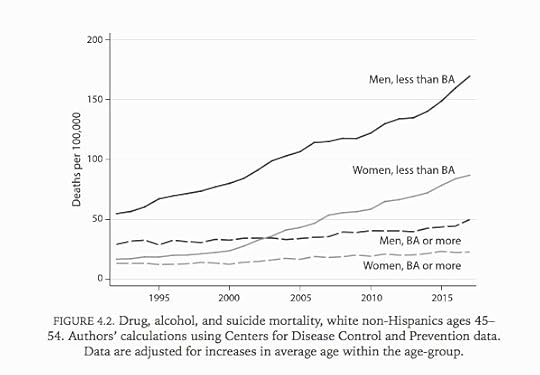
In deaths of despair, the authors discuss the rising trend of three types of fatalities: drugs, alcohol, and suicide. In most of the first part of the book, the authors break apart the trend, but all you really need to know is the graph above. (must be on computer to view) Since 2000, deaths in this category have nearly tripled across the country, and the trend is accelerating. For some in America, Trump's vision of American carnage is real.
"When it comes to people whose lives aren’t going well, American culture is a harsh judge: if you can’t find enough work, if your wages are too low, if you can’t be counted on to support a family, if you don’t have a promising future, then there must be something wrong with you. When people discover that they can numb negative feelings with alcohol or drugs, only to find that addiction has made them even more powerless, it seems to confirm that they are to blame. We Americans are reluctant to acknowledge that our economy serves the educated classes and penalizes the rest."
What the book criticizes is not American capitalism itself, but some of the perverse incentives and systems of upward redistribution (sheriff on nottingham redistribution) that help the affluent at the cost of those in need of the most help. The causes listed are not new, though I was surprised at the relative weight the author gives them:
1. America's healthcare system. (20% tax on GDP, costs have gone up, disproportionately hurt the poor) 2. International wage competition and automation. (the usual boogeyman for this sort of book, not as much the focus as I expected) 3. More oligopolies, less competition, and more economic surplus going to corporations. (Authors make a good argument for increasing the minimum wage here)
While the data and proposed causes are not novel, the authors package them in a way that I found convincing.
In The Man Who Fell to Earth, an alien comes to a demoralized, largely unemployed Earth. When Newton tries to warn the US government of the problems the US faced and encouraged it to change its course, he was ignored.
That was science fiction. Deaths of Despair is nonfiction, written almost sixty years after The Man Who Fell to Earth, by a pair of economists, one of whom has won a Nobel Prize. Anne Case and Angus Deaton see increases in deaths due to suicide, alcohol abuse, and drugs among people who have not earned a college degree – collectively, what they call deaths of despair – but not among college earners. They convincingly argue that this breakdown is caused by a lack of opportunity and meaning afforded to people without college degrees as jobs were outsourced, sent abroad, or performed by robots, and as the cost of health care ate up increasingly large amounts of an employee's potential salary. In this first figure, for example, people without a bachelors have increasing rates of deaths of despair across time, while men and women with a bachelors have a low and stable rate.
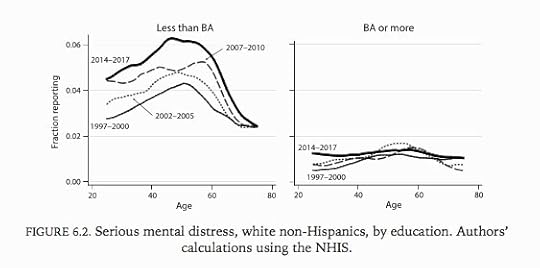
The differences between people with and without bachelor's degrees have been increasing across time in the US (some of these patterns are also beginning to show up in the UK, but not other countries). And, more recent birth cohorts of people without a bachelors are showing more serious mental distress, suicide rates, physical pain, and ill health across time. These deaths of despair are canceling out increased longevity due to improvements in cardiac outcomes, such that overall longevity has actually been dropping in recent years, after consistent increases throughout the 20th century. In this next figure, for example, people without a bachelors degree report more serious mental distress across time at each age, while people with a bachelors have rates that have remained stable across time and over their lifespan.
Rather than considering the public good or the good of ordinary people, increasingly business has been concerned with their stockholders, a sort of reverse Robin Hood, with captured riches going to support those already well-off. As Case and Deaton conclude:
Destroy work and, in the end, working-class life cannot survive. It is the loss of meaning, of dignity, of pride, and of self-respect that comes with the loss of marriage and of community that brings on despair, not just or even primarily the loss of money. (p. 8).
Deaths of Despair is a well-written book, but I struggled with the more economic and business sections and wished that I was reading it with a group. Nonetheless, if you're like me and enjoy nerding out with numbers and figures, Deaths of Despair is the book for you. If you like reading or thinking about politics, this is the book for you, as they argue, "the fundamental problem is unfairness, that the great wealth at the top is seen as ill-gotten in a system that gives no chance to many" (p. 262). If you care about making the world a better place, this is the book for you.
Obviously not a happy book, given the subject matter, but oddly optimistic that there are solutions that are neither terribly complex nor terribly utopian. Written clearly, but a bit repetitive, and crammed with a bit more facts and figures than I really needed to believe them.
(It's past 1am as I'm writing this so hopefully what I'm about to write makes some sense)
Boring, unconvincing and disappointing.
As the authors themselves note in the book, the book ought to be called "Deaths of despair and The Future of American Capitalism" as the whole book only addresses the problems in America and does not discuss capitalism globally. This book revolved around highly unsurprising statistics on drug addiction, suicide and alcoholism so I didn't gain much from it. The brief comparisons with European countries may be shocking to Americans but as a European the failings of the American system were glaringly obvious and I was expecting the book to go deeper into analysis rather than overexplaining statistics one can find with a simple Google search.
I understand that this is non-fiction and isn't meant to be a page-turner but someone please tell the authors non-fiction doesn't need to be so damn boring! This book was painful to read in other ways too. The mention of "on-demand abortions" sounds highly conservative and sexist, and the language often seemed ableist. I understand the authors are probably talking about the perspective of suicidal people but sickness and disability does not equal "lives less worth living". Yikes.
As someone who lives in the UK I wasn't a fan of the idealisation of European countries such as Britain, the NHS in particular, as an example for the United States to aspire to. If they'd actually done their research they'd know Europe is far from a utopia, Britain especially. The NHS has long been underfunded and overburdened, especially when it comes to seeking help with mental health.
I was utterly unconvinced by the proposed solutions, which were weak and insufficient. The authors' solution to capitalism is.... capitalism 2.0. Even with a decent national benefits system, capitalism does and will have its victims, that is, the underpaid workers in developing countries who produce the food, garments etc. that Americans use. The authors propose a "modest" increase in minimum wage (to $15/hour) and are against the idea of a Universal Basic Income. According to a recent Finnish trial, a UBI did NOT have a negative effect on unemployment. Granted, this study had not been published when the book came out but I'm sure it is not the first or only one of its kind.
Overall, I wasn't impressed. I understand the book's focus is on data around "deaths of despair" as the authors call them, but this seemed like a too-long and too surface level book to give a comprehensive understanding on the negative effects of capitalism. I would have appreciated discussion on disability benefits, for example, alongside discussion on health care.
Utterly baffled as to how people can study capitalism in this way and still support it. The authors’ single mention of racism represents a huge oversight of how structural economic racism created this whole situation.
This is a reread. After the recent presidential elections, I decided that rather than feeling depressed or “crying in my beer” over the results, I would go back and read more about the situations faced by other voters. This book is a combination of a first rate economic study with a perspective that was seeking to understand the world faced by the destroyed American non college degree holding middle class the Case and Deaton profile so effectively. As the authors explain eloquently, things affecting so many people do not come about all at once or change overnight. The second time through this, the distinction the authors make about two different Americas seemed on target and disturbing. But above all, it seems correct. I have spent much time teaching students who fit into somewhat different boxes than the ones discussed here. That does not diminish the reality facing the people who Case and Deaton profile. It just makes it harder to see how to move forward constructively in such a sharply divided environment.
More thinking and more work is needed.
Needless to say, I strongly recommend the book, even more the second time around. It is not a fun read but is certainly worth the effort.
My original review follows below.
This is a book by a husband-wife team of distinguished economists at Princeton, one of whom was a recent Nobel prize winner. The purpose of the book is to explore, explain, and expand upon one empirical pattern that the authors had identified in an earlier 2015 paper. What pattern? That since 2000, there has been a significant decline in life expectancy among working class white Americans between the ages of 45 and 54 who lack a college degree. The cause for this decline has been a clear increase in this group of what the authors call “deaths of despair” due to suicide, drug overdose, and kidney related diseases. This pattern is not a continuation of past tendencies. It is not shared by whites of the same age but with a college degree or higher education. It is not shared by others in different ethnic groups of similar ages. It is not present in other industrialized countries.
Isn’t this like what happened to African American communities in the 1980s and 1990s? Yes, in some ways although not in others. Case and Deaton link their analysis to work by Willian Julius Wilson on the hollowing out of black communities (The Truly Disadvantaged). However, they are focusing on a more recent development, one which is not occurring in African American communities.
Think about this effect. Life expectancy does not decline in the US, long one of the richest countries in the world. One has to go back to 1918-1919 and the Spanish Flu to see the last example (not counting wars, of course). This is not a result that occurs in Western developed economies. It is a very unusual statistical “fact” that they set out to explain and not a pleasant one to consider.
Many will no doubt claim that this cannot be correct, that there must be a data problem, that something has been left out, or that in some other way, this is an artifact rather than a finding with a basis in any social reality. Rest assured - the authors have all or most of the data and know how to use the data. The book clearly examines all sorts of data and analysis related issues. Given the people who reviewed the book (see the acknowledgements), if there were these sorts of problems, the authors would have been informed if they did not catch them on their own. This appears to be a real result. Some might complain about the lack of experimental results to nail down the analysis, but those sorts of more macro issues do not follow laboratory schedules and to expect that they would comes across as phony at best.
There is considerable craft that goes into a good economic study. But if it is solely an economics study, the result tends to seem overly complex, abstract, and a bit dry. Since the world is complicated, a good study will not just do the economics well but will also link to other aspects of the world that help explain what is going on. Case and Deaton tell a complex story. Issues of suicide, addictions, and self-destructive behavior have tended to resist efforts at rational explanation. Case and Deaton recognize this and link with both health care and management-labor dynamics, in addition to the more expected explanatory lines of automation, globalization, outsourcing, and the “knowledge economy”. The explanatory story is one that ties together many of the conventional explanations into a general account of how the way of life of the American working class has changed since 1970. It is well worth reading.
The authors conclude with policy recommendations that are general and that reflect the complexity of changing social policy in the highly contextualized US situation. Besides, the policy discussion is heads and tails above current discussions by policy makers and I am fine with that.
This is not just an “academic” discussion for me. When you encounter suicides among the people you grew up with or when you see firsthand how alcoholism and drug abuse can destroy families, your attention gets focused sharply on the broader costs of “deaths of despair” - and you appreciate those with the skills and courage to write about them.
This is an extraordinary book.
As a coda, I can only wonder how the consequences of the current plague (COVID-19) is going to affect the dynamics chronicled in this book, but I suspect that they will.
***I just saw that Case and Deaton have an opinion piece in the NYT Sunday Review (4/19) on health care reform that raises many of the points they raise in their book.
This is a very poignant and disturbing examination of the effects of late-stage Western capitalism, although the authors probably wouldn’t call it that, on the less-educated white population in the U.S. Time and again, those with less than any college education are disadvantaged; this can lead to grim life chances, and the deaths of despair of the title.
Two factors figure prominently in this book: the opioid crisis and our terrible healthcare system. The last chapter is, to my mind, a bit of a disappointment. After delineating all that is wrong with our system, one might think that a call to the barricades would be appropriate, but that isn’t the case here. The authors propose to attempt to fix the injustices one at a time, which might be good. And, of course, they could not have anticipated our present crisis. Everything that is discussed is now multiplied by ten. So, what now?
I wonder if the authors will need to augment the arguments in this book due to our current circumstances; not only the crisis of the coronavirus, but the discussions around the issue of racial equality.
The main conclusion of this intriguing look at the United States loss of life expectancy and wage stagnation is the US is messed up, particularly on healthcare. We spend more and get worse outcome on our medical system than anywhere else in the world. As an employer, I know that after payroll, my biggest cost isn't rent, supplies, technology, or anything else, it is health insurance.
The current protests for Black Lives Matter and the Covid-19 outbreak show several of the fundamental flaws in the current system. Medical care cannot be relegated to a market system and work effectively, but it is important to note that the US system is not a free market, but a highly regulated market that has effectively removed all cost control and bargaining power for the people.
The book left me wanting more analysis looking at the problems in healthcare other than a cursory look at the opiate crisis.
These economists (one of them a Nobel Prize winner) show that our current economic system has been leaving some people behind-- specifically whites that didn’t go to college. Blacks that didn’t go to college are also in the same boat economically, but haven’t been affected by the same deaths of despair (suicide, drug overdose, alcoholic liver failure).
There is quite a bit of fascinating data analysis here, as well as very a reasonable discussion of causes and solutions. These guys are not anti-capitalists, but they are concerned that our system is leaving many people in a state of distress, and we should be able to do better.
There have been a number of very useful reviews already written about this book, so I’m not going to delve into the details, but instead I would encourage everyone to read Atul Gawande’s excellent review from the New Yorker: https://www.newyorker.com/magazine/20...
Once again, I was growing increasingly tired, annoyed, and frustrated seeing articles and news stories blaming social media for depression and anxiety. So, I revisited the best book written with actual data about the reason for deaths of despair. Deaths of despair are deaths from suicide, overdoses, and alcohol-related health issues. Deaton and Case are economists (one is a Nobel prize winner), and they’ve found that good ol’ capitalism is the reason for all of these preventable deaths.
I can’t recommend this book enough. By reading this, you’ll understand the true causes of why so many people are miserable and losing hope. It’s not social media ruining our children, it’s overworked, underpaid parents who are too busy and stressed to properly parent these kids. This book will show you the actual root of the problem, and you need to go get it now if you haven’t read it yet.
Very good. Only real complaints are that sometimes Case and Deaton take a very limited view of ways to resolve some of the crippling problems they observe in American society; examples include the entertainment of a public option as a viable alternative to the current system instead of single payer healthcare (when they themselves acknowledge that the only way that insurances can be made to work efficiently is by pooling as much risk as possible, in other words, not carving out a place for the parasites that are private insurers to thrive by dumping sicker people into the public health plan and only taking healthier people), they also support UBI (which sounds good in theory, but it would probably be cheaper to have free healthcare and education instead). In no uncertain terms, the authors take a too optimistic view of the future prospects for capitalism; even as the social democracies they use as positive examples come under assault by concerted attacks from the wealthy and how standards of living continue to decline in contrast to previous generations in terms of wealth disparity, the disintegration of communities and environmental quality. The text also suffers an explanatory gap when it comes to meaningfully covering... Anything having to do with African Americans, Hispanic populations, etc. Which seems like a big thing to overlook given how people in less advantages communities have also been hard-hit by some of these problems (such as fentanyl, unstable job prospects and a relatively low educational attainment).
All that being said, very important data that helps one understand why the Trump phenomenon took such a firm root in the United States. Crippling educational inequality, opioid addiction, male dis empowerment among white populations where relative privilege existed (the decline in unions, the destruction of traditional families with no alternative social arrangements to take their stead accelerated this process) combined with rapid deindustrialization (with no social safety net or opportunities to find solace), broken communities, etc. All led to the rise of a social movement that has galvanized support for nascent fascism and deeply entrenched white supremacist in much of rural America.
Obviously, a very research-heavy book, which is good! But it also makes this very hard to get through, so I ended up skimming a lot, although there wasn't anything "groundbreaking" to me - so I don't know what that says about me.
It will otherwise be a good reference in the future since it does have such great research and clearly, Case and Deaton put in a lot of work here.
pretty cogent, i would hope so with a nobel in economics winner as an author. writing “we don’t find inequality to be the fundamental problem. we think it’s unfairness” makes sense from the perspective of the book but man it reeks of some weird high school debate switcheroo
A study found that U.S. soldiers in Vietnam were using heroin. 34% had tried it and as many as 20% were addicted, 38% used opium, and 90% used alcohol. Those who tested positive were detoxed and urine tested before they were allowed to go home. Once they got home, only 12% of those who were addicted to opium returned to it. In most of those cases, the readdiction was brief. This is by far the most successful detox I have ever heard of, but this probably highlighted the true nature of addiction. See, most of these soldiers used opioids because "it was enjoyable and made life in service bearable." They were under a lot of stress and were bored out of their minds, but when they returned home there were other people in their lives, other means of enjoyment, so there was no need for opium. This highlights that the true cause of addiction isn't necessarily the drug, or even the person, but rather the environment in which they live.
This one example should give us an idea of how to approach understanding addiction. Life expectancy has fallen in the U.S. (Even before COVID), and Angus Deaton and Anne Case determine deaths of despair are the main contributors. Deaths of despair include deaths from drug addiction, alcoholism, and suicide. This fall in life expectancy was only happening in the U.S. It wasn't because we were the only ones with opioids circulating, or that we have more people prone to addiction. The environment that certain Americans live in (especially the less educated) leads people to seek the euphoria that drugs can temporarily offer.
Angus Deaton and Anne Case found that these deaths of despair are largely among the uneducated (those with a high school degree or less). These individuals have faced a prolonged decline in wages and job decline. When jobs aren't as plentiful and wages are falling, the market is signifying that it doesn't need any more workers. This leads many to leave the workforce altogether. Of the jobs that are popping up, there are few opportunities for advancement either due to college degree requirements or the fact that these are low-wage contracting jobs that prevent that employee from rising within a company. Jobs are not just a source of income but can be a source of purpose for a lot of people. Many people blame globalization and the advancement of new technologies that replace workers and make uneducated workers less valuable. These do have an effect on the labor market, but globalization and technological progress aren't to blame for the rise in deaths of despair. Globalization and technological progress are happening all over the world, but the U.S. is the only country seeing this uncharacteristic rise in deaths.
The unique thing about America is that it has a healthcare system that doesn't support the poor and unemployed. In the U.S., healthcare isn't universal, is often tied to employment, and relies on a free market where there is a legal obligation to make a profit off of sick people. Also uniquely American is the drastic shift in value from labor to capital that results from a concentration of market and political power that drive down wages.
This rise in deaths of despair is not a collection of individual failures, but a societal one.
Angus Deaton and Anne Case write this story of death and addiction through a scientific lens. For such a dark and personal topic, they rarely tug on the heartstrings. They are economists, and they do a fantastic job of walking you through all the possible variables that contribute to these rising deaths, but they don't highlight the personal struggle very well. This book seeks to inform more than it does to motivate, and I think that is a missed opportunity. Tightrope: Americans Reaching for Hope by Nicholas Kristof explains this story of deaths of despair, but better balances the pathos, logos, and ethos of the subject. But if you enjoy going through the scientific method to understand complex issues, you would be satisfied by this book.
President Trump's shocking victory in 2016 launched an endless series of articles examining the demographic that pushed him over the edge: the white working class. Why did these men and women, who had supported Democrats as recently as four years before, pulled the lever for a New York reality TV star? Why did Trump's anger and dark vision of the country resonate so much with them? To an urban sophisticate, it all seemed so baffling: After the Great Recession, the country really did seem to be doing better. But was it?
Earlier, during the last years of the Obama presidency, the U.S. passed a grim milestone: life expectancy began to fall. If there was ever a statistic that advertised things not going well, it's this one. Yet the news didn't click for the Americans for whom the notion of perpetual progress had become an article of faith.
Deaths of Despair is an attempt to get to the bottom of this phenomenon. Angus Deaton and Anne Case, a husband-and-wife duo from Princeton, find that the white population in America is now split between those with a college degree and those without. Forty years ago, it was still possible for Americans to graduate from high school and find steady employment in the manufacturing sector. Now, these jobs no longer exist. Many of the factories that formed the heart of communities across America left for China, or Mexico, or somewhere else. And many of those factories that remained replaced their workers with robots. Americans with college degrees found gainful employment in the country's still-thriving service sector. But the poorly-educated were left behind. And as the jobs fled, families began to fall apart. Young men and women desperately sought an escape in the form of opiates, pushed by unscrupulous companies like Purdue Pharma. And so when a presidential candidate came along and told them that their problems could be blamed on immigrants, or our black president, or the hated cultural elite in the coastal cities — none of which were, of course, true — these people were ready to listen.
If this story sounds familiar, it's because the same thing happened decades earlier to inner-city black Americans. Lured to cities during the first half of the 20th century, black Americans found themselves bereft of employment when manufacturing shifted to distant suburbs. Broken families and drugs, in the form of crack cocaine, became a massive social problem. And because of racism, commentators mused that there must be something intrinsic to African Americans that they simply couldn't figure it out.
The phenomenon afflicting America's left behind people is not unique to the United States. But the problem is exacerbated by our broken social welfare system. Even those Americans who manage to prosper are afflicted by an affordability crisis: housing in major cities is prohibitively expensive, and a single hospital visit will all but wipe out the uninsured. The infusion of money into politics has fueled corruption on a gargantuan scale, and those responsible for immiserating the poor almost never face any consequences.
Case and Deaton do not write like academics. This is a compliment. Deaths of Despair is a bracing read, succinct and insightful, and free from jargon. Anyone who tells me, in good faith, that they don't understand why anyone would vote for Trump would be well-served by reading it. Anyone who just wants to understand America should do the same.
In the book's last chapter, Case and Deaton offer some policy proposals that would ameliorate this crisis. They may not be as radical as some would like — they pour cold water on Andrew Yang's universal basic income scheme, for example — but they would represent a clean break from the cronyism seen in Trump's White House.
Will they happen? Even the most optimistic liberal knows that the answer is probably no — at least not yet. But we can at least be sure that if Trump wins again, this time we'll have a better sense of why.
As a piece of academic research, this book checks all the boxes--it presents some very interesting, comprehensive data and spends a lot of time evaluating many facets of the phenomenon and addressing what is and isn't the cause in their view. As a book and narrative, I find it somewhat lacking. What works in academia comes across as scattered in book form--the organization and structure of the book isn't as coherent to telling a national story as I would like. They documented the trends and phenomenon of deaths of despair very well, but when it came to follow through on the causes and policy recommendations, it became very lukewarm. The authors seem hesitant to commit to anything substantial, other than a puzzling diatribe about the American healthcare system. Don't get me wrong, American healthcare sucks, but for as wide sweeping an issue as this, focusing narrowly on healthcare as an issue seems to ignore the very real systemic and structural issues that pervade all facets of society and social despair. There's also the issue of how the authors gloss over race as an issue altogether--obviously, their focus is on the White working class and that is fine--but that doesn't preclude a very basic acknowledgement that class and race work together, rather than one over the other. The object doesn't have to be to somehow argue that the White working class are struggling more than African Americans, a silly claim to most people with a passing familiarity of race relations in America, but simply that they are also struggling. Overall, this kind of reads like economists do sociology, and while I'm happy to see economists acknowledge the issues of free market capitalism, I must say sociologists do it better.
What exactly are "deaths of despair", and why has this term been used so much in the 21st century to specifically describe white, middle-aged men with less than college education? Despair has been around forever in one form or another. Why does it seem to be more prevalent in America today than in the past? This worrisome trend has been noticed since the 1990's, and has contributed to the US life expectancy numbers to actually go down for the first time in over a century. What's going on, and why are middle-aged white men the most affected by this malady?
These questions and more are covered in this fascinating book by Anne Case and Angus Deaton, both economic professors at Princeton University. Deaton won the Nobel Prize in Economics in 2017, and both authors have been at the forefront of reporting on this disturbing trend.
Deaths of despair are defined by the authors as premature deaths caused mainly by three unnatural causes- alcoholism, drug abuse, and suicide. The authors go into great detail about the statistics that surround the increasing unhappiness that leads to these self-destructive behaviors, and try to come up with an explanation for what's been happening. Other nations in the world have not noticed the same trend, and the authors point to several uniquely American problems that make it much worse here than anywhere else.
Case and Deaton point the finger specifically at our dysfunctional healthcare system as one reason why deaths of despair are on the rise, which is odd because the Affordable Care Act, passed in 2010, was supposed to help. While the Great Recession of 2008 caused disruption in many lives and an increase in general stress and uncertainty, America's lack of a social safety net, especially in the area of health care, has exacerbated the problem for many lower-income Americans. Small ailments, noticed in middle-age, can mushroom into major sources of pain and suffering when left untreated.
They also point the finger at the drug industry, specifically those who created the opioid epidemic in the past ten years that is ravaging rural America particularly. Drug companies pushed pain-killing medicines on unsuspecting patients, ignoring the risks of addiction. These uniquely addictive drugs like Oxycontin and Fentanyl were grossly over-prescribed for even minor aches and pains and have led to greater and more serious addictions. Even after the drugs were more regulated in the past few years, the genie is out of the bottle, and illegal sources of more and more powerful opioids are cheap and plentiful, leading to an epidemic of overdose deaths across America.
While all races are subject to deaths of despair, whites had seemed immune up until the turn of the century, while economic forces of globalization and automation in many areas has caused especially men to question whether they serve any purpose anymore. States in the South and Appalachia are particularly hard hit, while states like California and New York, with more resilient economies and stronger safety nets, have seen less impact. White Americans are feeling increasingly threatened as their privileged place in the American hierarchy has eroded with progress being seen by women and people of color. The election of Barack Obama in 2008 was a watershed moment for many white voters, and the rise of racism since then is a visceral reaction to the perceived threat that whiteness will no longer guarantee status or privilege in the future. Another factor in racial resentments is that economic growth is slowing, and whites are increasingly seeing the economy as a zero-sum game in which when one group gains, they lose.
Why are people so unhappy, and why is it happening specifically in middle age? Middle age can be a pivotal time in a person's life. The years 40-60 appear to present the most vulnerability, because men and women notice a peaking of many abilities- earning potential, sex, social networking- and it's all downhill from there. Rather than adapt to the inevitable declines of aging, or re-evaluate their careers after doors that were once open begin to shut, many people turn to resentment, bitterness, and fear. This is where drugs and alcohol step in, and when they can't do the job anymore suicide becomes more and more of an option. If we can survive middle age, surveys show that happiness rises significantly among the elderly surprisingly.
There have been many books (Bowling Alone is a great one) written about the decline of social capital in American society, and the neighborly emphasis of the 20th century has given rise to a more go-it-alone ethos in the 21st century. Fewer people attend church, join unions, volunteer, participate in local politics, or show much interest in their neighbors than did in the 1950's, when community pride peaked. More people are tied to screens- television, computers, and cell phones- which provide hours of entertainment but little in the way of meaningful connection. The Covid-19 epidemic has made this isolation even more troubling. Families are less cohesive, and marriage is less common, all of which leads to more individualism and less understanding.
Case and Deaton paint a well documented picture of the many factors leading to the increase in deaths of despair, but their proposed solutions seem unlikely in an age when polarization rules and not much gets done. They propose a fairer tax system, an overhaul of the American healthcare system, better safety nets, breaking up big monopolies, raising the minimum wage, improving graduation rates and a huge clamp down on the drug industry and all opioids. All of these reforms seem reasonable to me, and I've seen them many other places, so perhaps if enough books like this get written things will finally start to happen.
The second part of the title "and the Future of Capitalism", is where a lot of the emphasis of this book lays, and it's clear that capitalism has failed many people to the point where they see no place for themselves. The harsh judgments still felt by people who fail to thrive in the high-tech, individualistic economy lead to withdrawal from the world and the vicious cycle of despair leads to death of despair. Only people who have given up on life turn to drugs, booze, and suicide as ways to avoid the pain of loneliness, hopelessness, and alienation. In a way, whites are catching up to people of color, who have dealt with despair for many more years in a nation that has treated them as second-class citizens. Perhaps now that the problem is more widespread and visible, things will finally start to happen.
I recommend this depressing, infuriating book, and plead with anybody who is feeling hopeless to seek out help (and hope) because it's out there. They may have to look hard, but it is out there. We need more action and fewer lost souls if we want to prosper together as a healthy nation.
An in-depth look at data generated by a variety of sources to trace the rise in what the authors call 'deaths of despair': death from suicide, drug overdoses (accidental or otherwise) and alcoholism.
These data, briefly brake down between those with a bachelors degree or higher and those who don't. The latter category be overly represented among those in the south-east and mid-west who generally vote Republican.
This is a depressing report and should be required reading for every member of congress and state legislatures, since the authors provide policy suggestions for alleviating the suffering of millions of Americcans.
Thanks to Zanna’s prof who assigned this, and thanks to Zanna who left this in the free library at the School Street park. I appreciated her purple annotations. Zanna’s a great annotator.
People in America are dying at an alarming and increasing rate at a time when technology and the economy would predict the opposite. What is more surprising is that they seem to be killing themselves. The trend is not spread across all sectors of the population, but instead most pronounced in one sector: white men without a college degree.
Anne Case and Angus Deaton spend the first three parts of this masterpiece laying out the background and the data that supports their thesis. For the past century or so death rates in any particular age group have been falling as people live longer. For 100 years, progress in technology, medicine, transportation, product automation, electronics, information technology, and just plain better science has progressively improved lifespans, and decreased death rates in all age groups. They focus on the 45 to 54 year olds because early middle age is a turning point in life, past the childbearing years, but still in the normally working productive years not quite yet prone to specific diseases of old age. Across many countries, across races, across incomes the data show decreasing death rates for 100 years.
In 2000 there is a change. The death rates for certain kinds of death -- suicide, drug overdose, and alcoholism -- start rising to be today many times what it was in 2000 or any any year earlier. American life expectancy actually DECREASED for three years in a row, something that has never happened before since America started recording lifespan. Why? Why do other similarly advanced nations NOT show this trend for increasing deaths?
These kinds of deaths -- suicide, drug overdose, and alcoholism -- are called deaths of despair because they might all be a kind of suicide. When a person overdoses on drugs it is never quite certain whether it was a suicide or not, and kinds of drugs killing them -- mostly opiates -- are often associate with people trying to escape their own situation. Alcoholism is also used to escape the world. While some of these deaths are pure accidents, most of the people dying this way are in one way or another GIVING UP on life.
These deaths are correlated to level of education and to race. White men without a college degree show the most pronounced trend. White women without education as well increased, but women kill themselves at a fraction of the rate the men do. Hispanic men and women do not show this increase, nor do those of asian descent. Blacks do not show the trend either, at least not until 2013, and then to a smaller extent. White men & women with a college degree seem to escape the problem. The book is filled with enough charts and graphs to delight the most nascent budding economist in any reader. It is truly astonishing that having a college degree makes such a pronounced difference in death rates.
"economists seek to explain why people choose to commit suicide, while sociologists explain why they have no such choice."
The big question is: why is this happening? There is more pain in general today. More drinking, and certainly more opium. Arthur Sackler (drug magnate) and his brothers (exclusive promoters of OxyContin) were compared to the key players in the Opium War between China and England: huge piles of money were made in both cases, people were knighted and celebrated officially in both cases, and there was a huge toll on life of civilians in both cases.
"As religion faltered, opioids became the opium of the masses."
"Doctors may not even know that their patients have died from drugs that they have prescribed."
The opioid crisis looms as a huge ugly problem, but why does it hit this particular economic sector? The authors carefully eliminate poverty itself as a cause, because there are plenty of poor people who don't show rising deaths of these types, particularly poor hispanic. The great recession came and went, yet the death rates of white non-eduducated men show no particular rise in those years. Rising inequality is a big problem, but that alone does not explain the problem.
Part 4 of the book delves into causes and solutions: The leading cause is the American healthcare system itself. The second cause is that "corporations have accumulated market power that is increasingly used against both workers and consumers."
"The cost of healthcare is like a tribute that Americans have to pay to a foreign power"
"The US healthcare system absorbs 18% of GDP . . . about four times what the country spends on defense, and about three times what is spends on education"
"American healthcare is the most expensive in the world, and yet American health is among the worst among rich countries."
You have heard of "Robin Hood" style redistribution of money? The authors introduce a new term: "Sheriff of Nottingham style redistribution of money." Stealing from the poor and giving to the rich. Hospitals are consolidating and eliminating competition giving them a monopoly over a given area. "Surprise bills" support the predatory behavior of hospitals and emergency response. "This sort of predation is a prime example of a system that transfers money upward."
"health insurance is less about protecting your health than about protecting your wallet against the healthcare system"
Aggregate state spending on healthcare grew from 20% in 2008 to 30% in 2018, while spending on education fell from 22% in 2008 to 29.6% in 2018.
Healthcare proponents like to think that healthcare is a free market, but that is far from the truth. Drug companies are given monopolies and absolutely no price controls. The healthcare lobby is the largest lobby in Washington, with more than 5 lobbyist for every member of congress. The supply of doctors is controlled and greatly limited by the AMA.
"The industry that is supposed to improve our health is undermining it, and Congress . . . is supporting the shakedown."
Other rich countries do not have this problem because the most disadvantages are still protected by a safety net. The insufficiency of this in America has been hardest felt by those without a college degree now being squeezed by robotic automation and global trade. Corporate greed has been left to run amok with ample collusion by the government. Hiring practices for gig-style work has eaten away at worker protections that citizens used to count on.
What to do? The culmination comes (naturally) in the final chapter -- and excellent read well supported by all the hard date preceding it in the book. There are no easy solutions. It will take a combination of:
* Opioids are like gasoline showered on a smoldering despair. Opioid addiction treatment would prevent a lot of deaths, but the underlying problem is that the pharma industry is free ranging, government supported system for exploiting American citizens and needs to be reigned in.
* Americans should follow other rich countries in providing universal insurance and controlling healthcare costs. This would free up literally trillions of dollars that could be spent on other necessary improvements in the country.
* A comprehensive reform of US corporations including employee representation on boards would be good but challenging to do. Outsourcing firms should not exist simply to cut wages or benefits. Non-compete clauses should be outlawed everywhere.
* They are not in favor of universal basic income in the current situation, but believe there are changes that could prevent the worst of the laws that ravage the poor and make work difficult.
* Action should be taken to reduce monopsony -- market power on labor markets -- which allows employers to pay less than a competitive wage.
* A national minimum wage of $15 is long overdue. Lobbyists spread fear that raising the lowest wages will reduce employment or hurt companies, however there is sufficient well researched evidence that this is baseless fear mongering.
* Patent protection should be reduced. "Much of patent protection is unnecessary and against the public interest"
* College education needs to be more open to all people. There are creative answers, but what is clear is that less-skilled workers are no longer in demand.
* "We must somehow stop of reverse the decline of wages for the less educated Americans."
"The fundamental problem is UNFAIRNESS, that the great wealth at the top is seen as ill-gotten in a system that gives no change to many. We argue that limiting rent-seeking and reducing plunder will rein in the rich and reduce the unfair top incomes without high taxes on income or wealth that is widely seen as fairly earned."
The geographical map of where people are dying from deaths of despair happens to match closely the geographical areas for Trump voters. This is evidence of a deep pain that those of us educated people may not see or hear of. As we close in on the 2020 presidential election, it is important to remember that Trump did not bring these problems. They existed long before, and will survive after he is replaced. The real job is correcting these systemic problems and we must not falter.
"Democracy in America is not working well, but it is far from dead."
I don't agree with a lot of the suggestions as I don't see government as a great solution. The book was pro capitalism, which I agree. Their clear despise of the healthcare system has some valid arguments. I believe the opioid epidemic is the real problem that was allowed to take root in the US due to lax and corrupted government. Other countries have more sensible checks and balances. Absent the opioid problem, deaths of despair doesn't happen at anywhere near the same scale.
The author does, in my opinion, try to argue for what ought to be, not what is with regard to government. The ought to be is both unattainable and not even closely related to the motives and purpose of government. Government redistributes to their inner circle first/always, then a little greater circle, and last, as a by product if at all, to the general public. This is constant and unchanging since before Jesus. Human nature trumps altruism in politics(and most aspects of life).