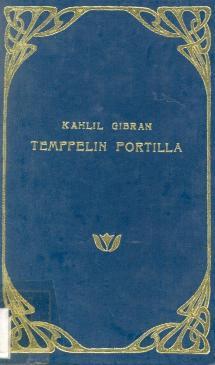
Kahlil Gibran (Arabic: جبران خليل جبران) was a Lebanese-American artist, poet, and writer. Born in the town of Bsharri in modern-day Lebanon (then part of Ottoman Mount Lebanon), as a young man he emigrated with his family to the United States where he studied art and began his literary career. In the Arab world, Gibran is regarded as a literary and political rebel. His romantic style was at the heart of a renaissance in modern Arabic literature, especially prose poetry, breaking away from the classical school. In Lebanon, he is still celebrated as a literary hero. He is chiefly known in the English-speaking world for his 1923 book The Prophet, an early example of inspirational fiction including a series of philosophical essays written in poetic English prose. The book sold well despite a cool critical reception, gaining popularity in the 1930s and again, especially in the 1960s counterculture. Gibran is the third best-selling poet of all time, behind Shakespeare and Lao-Tzu.
I really loved this collection of Gibran’s earlier works. You can evidently see the development of his writing, and the depth of his profound efforts. It was a beautiful experience reading his lyrical prose. As someone familiar somewhat with Arabic poetry, I could very much see the traces of that poetic insight and thoughts in translation easily. I hope one day I’m able to read the original works in their native language, because I know it will be breathtaking.
This is no match for the Prophet, but there are some gems. Namely “The Poet” toward volume’s end- great visuals and allusions to the season of the witch in that one. A lovely foreword, and for as cerebral and heavenborne as this collection is you can’t beat the heavy meditation behind something like “Night”.
The young Kahlil Gibran writes beautifully in this book of poetry which was translated to Finnish not from the original Arabic but from English. Gibran's language is poetic, romantic and emotional and thus suits well my taste.
This is the first book by Kahlil Gibran that I have read that was not written by him in English. Prose Poems is a collection that was originally written in Arabic and so I do not know how much of what I have to say applies to the translator and how much applies to Gibran himself.
In the foreward, I learned that this book is a collection of "earlier works" by the author, and the impression I got while reading was that these were the efforts of a yet undeveloped talent. This collection of prose poems reminded me of nothing so much as a young artist's sketch book, wherein he tries his hand at a variety of subjects, some only partially completed, focusing on this detail or that, more with the intention of honing a particular skill than of creating complete piece of art. The subjects of the young artist's interests might be clear from what he's done, but the full scope is still beyond even his understanding; his style may be finding its delineations, but is presently inchoate nonetheless. Such are these prose poems for the young author: the skill and spiritual insight that would produce his later masterpieces are certainly in evidence, but their maturity and expert deployment are still yet points on the horizon.
Though Gibran's prose reads like poetry, his poetry takes his message of love and hope to a higher level. They are more lyrical and spiritual than moralizing like his prose often is. His sensitivity to the human condition really comes through.
"But now I have learned to listen to the silence, To hear its choirs singing the songs of ages, Chanting the hymns of space, and disclosing the the secrets of eternity." - Kahlil GIbran, My Soul Counselled Me
The style is unmistakably his, despite that this book is of early poems of Kahlil Gibran. Gibran has a unique way of telling a story or fable, or providing and insight, with his prose poems.
Some of the poems are not as good as others, but some are simply excellent.
3.5 A rather repetitive yet uneven collection which nonetheless has some insightful reflections and observations contained within. I found it good to practice my reading voice with this collection.
But now I have learned to listen to silence, To hear its choirs singing the songs of ages, Chanting the hymns of space and disclosing the secrets of eternity.
Why I gave 4 stars: 1. This book is a translation from Arabic. 2. It is his earlier prose poems. 3. He was still a Christian. 4. Compared to his other works, this one is very young. So I gave 4 stars, instead of 3.
Another great little collection by Gibran who always finds a way to skillfully navigate both the external and internal dimensions of life, body, spirit and mind.