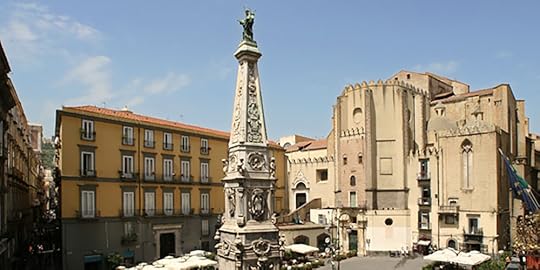
Three exhilarating novellas--The Secret Dead, The Academy of Secrets, and The Dead of Winter--following the early adventures of young priest Giordano Bruno in the dramatic days of sixteenth century Italy.Even the dead have a story to tell ...Naples, 1566. During a sweltering summer, eighteen-year-old Giordano Bruno takes his final vows at San Domenico Maggiore and is admitted to the Dominican Order--despite doubts over his tendency to ask difficult questions.Assisting in the infirmary, Bruno witnesses an illicit autopsy performed on the body of a young woman. Her corpse reveals a dark secret, and Bruno suspects that hers may not have been an accidental death.His investigation leads him to a powerful figure who wants to keep the truth buried--and Bruno is forced to make a choice between his future in the Order, and justice for an innocent victim and her grieving family.
S.J. Parris began reviewing books for national newspapers while she was reading English literature at Queens' College, Cambridge. After graduating, she went on to become Deputy Literary Editor of The Observer in 1999. She continues to work as a feature writer and critic for the Guardian and the Observer and from 2007-2008 she curated and produced the Talks and Debates program on issues in contemporary arts and politics at London's Soho Theatre. She has appeared as a panelist on various Radio Four shows and on BBC2's Newsnight Review, and is a regular chair and presenter at the Hay Festival and the National Theatre. She has been a judge for the Costa Biography Award, the Orange New Writing Award and the Perrier Comedy Award. She lives in the south of England with her son.
With this release of three novellas in the Giordano Bruno series, fans can enjoy two previously published pieces and a new story, just in time for Christmas. While I binged the entire series earlier this year, I was eager to return for a little more Bruno and his cunning ways. The reader learns a little more about the early days of Bruno’s time as a monk, including the struggles that face him. There is the curious Bruno who finds the confines of priory rules slightly troublesome, causing him to write his own. The final story has Bruno being called to Rome to answer for some of the antics he’s undertaken, though the young monk does not feel that he has offended anyone, at least those with an open mind. S. J. Parris does a masterful job, particularly for series fans, as she explores those early days, when Bruno was still captivated with serving God above all others!
The Secret Dead
It is Naples in 1566 and the city is in the middle of a stifling heat wave. Giordano Bruno is all of eighteen and has recently entered the monastery to devote himself to God. He is known not to be completely on the straight and narrow, having issues listening to those in authority. However, when Bruno is called away one night to help Fra Gennaro, he goes with all the curiosity that he can muster. Gennaro admits that he wishes to share something with Bruno that must be kept highly secret, taking him to the site of a body. This is a young whore who appears to have been strangled, though the reasons are as yet unknown.
During the anatomising of the body (one might call it early autopsy work), Bruno and Gennaro discover that she was pregnant, which only adds to the drama. While Bruno vows to keep this to himself, he cannot help but try to piece it all together, trying to determine who would have done this to a young woman, even if she held an unwanted offspring. This is surely the spark that led to the great crime solving work of Giordano Bruno in the years to come, all while holding up his end of a monastic life.
The Academy of Secrets
It is Naples in 1568 and a young Giordano Bruno is the rising star at the priory, though his penchant for seeking knowledge outside of the strict role of a monk has become apparent to many. Fra Gennaro, another monk and the local medical professional, takes him under his wing and introduces Bruno to a group of philosophically-minded men, headed by Don Giambattista. These men call themselves the Academy of Secrets, meeting to discuss mental and physical experiments that they have been undertaking, as well as recommending reading—a great deal of which lies outside that permitted by the Church. Bruno takes an especially great interest and Giambattista agrees to grant the young monk access to his libraries.
Juggling his time at the priory, and with the help of Fra Gennaro to cover for his absence, Bruno makes his way there to expand his knowledge. His arrival is met with another surprise, the young and attractive niece to Don Giambattista. Bruno’s work is shelved as he and Fiammetta engage in something a tad more carnal. Bruno slips away and heads back to the priory, keeping his secret to himself, but another of the young monks seems to have discovered that there is something amiss. While Bruno continues to make daily trips to the library and to see Fiammetta, the Academy of Secrets is in jeopardy. When Bruno is kept from his daily journey on one occasion, things turn deadly and questions arise. With his weakened connection of the priory already clear, some must wonder if Bruno took matters into his own hands.
A Christmas Requiem
It is Naples in the late autumn of 1569. A young monk of 21, Giordano Bruno, is continuing his studies and showing just how sharp his mind can be. Honing a parlour trick of sorts, Bruno can recite any of the psalms, forwards or backwards, in a number of different languages. This has caught the eye of some of the senior officials, but it is another missive from Rome that really causes a stir. Bruno’s presence is requested at the Vatican to see His Holiness, Pope Pius V. This must be a joke, right?
When Bruno makes it to Rome, just in time for the Christmas season, he is unsure what awaits him. However, being a young and still somewhat lustful man, Bruno finds himself caught in the web of desire with a woman. This woman, while also highly beautiful, has ecclesiastical connections that could ruin Bruno if he’s not careful. Still, lust is one temptation not easily dissipated by prayer.
When the Holy Father meets with Bruno, the topic at hand is heresy. It is not only the goings on in England under Queen Elizabeth that is causing ire, but Bruno’s repeated conflicts over banned publications by Protestants that has the Pope up in arms. When it’s discovered that Bruno can recite the psalms, much consternation is levelled against the young monk and he’s lucky to escape with his life. Might the pious life not be the best thing for Giordano Bruno after all, if he cannot express himself and expand his mind?
I have come to love the books in this series, not only for the mysteries they present, but also because there is so much history for the reader to enjoy. Parris does well developing her stories effectively and peppers them with fact and massaged fiction to tell a great tale. As with her novels, these novellas proved highly entertaining and are written so as to make the reader feel they have gone back in time. The novellas can, if one chooses, be read as standalone, though I am not sure why anyone would want to deprive themselves of such a wonderful series in its entirety. S. J,. Parris has much to offer and one can only hope that there are more books to come to keep series fans excited.
Kudos, Madam Parris, for an exciting collection of stories that remind me how much I enjoy Giordano Bruno. I cannot wait to see what else you have to offer soon.
Three short historical mysteries, set in Italy, the 1560s before the first main book of Giordano Bruno (Heresy).
"I took the name Giordano, though most people just called me Bruno. I took my vows as a friar of the Dominican order in the great convent of San Domenico Maggiore, the city’s most influential religious house."
Giordano Bruno was eighteen years old when takes his final vows. He has gifts, a prodigious memory system, and gets himself into trouble.
The Secret Dead (Giordano Bruno #0.5) Naples in the summer of 1566, Giordano is a witness of an autopsy of a body, a girl, who told is nobody. He couldn't accept that, but the question is, could he do something about it?
The Academy of Secrets (Naples, 1568) Giordano meets a secret group of the weighty outlaw who wants to reveal the secret of the world. He has a secret now which should be protected, but is it ready for any consequences?
A Christmas Requiem (Naples, 1569) Although I enjoyed all the stories, this was more interesting and challenging, wallowing in guilt, unappeased conscience. "They told me the Pope wanted to see me, my first thought was that it must be a joke. My second was that it must be a trap." I only can say that this wasn't a joke!
This is not a simple mystery that there is someone who is guilty, and other, the smarter one, and most of the time a good one, after suspending and twisting will find the evil person and send to punishment. No, this wasn't a great mystery though so much beautiful from another point of view.
Is the killer really guilty? Could the victim's life be saved or even bring justice in her/ his death? Are we the right people for performance justice or even allowed to do that? What is above another, a friend vow or bring justice? Always revenge deserve punishment? Is it any different to take a life for justice, revenge, accident, war, or even self-defense?
This is not always so easy, right and wrong, good or evil, white or black, this book is about so many shades! It reminds me of one of my favorite poems, Are you black with white stripes, or white with black stripes ...
Giordano Bruno is my new favorite character in continuous stories. I really enjoyed reading this book, an amazing plot, great writing style, wonderful narration, and touching.
Are you good and do bad things Or are bad and do good sometimes?
Undying Thanks to HarperCollins UK via NetGalley to give me a chance to read The Dead of Winter (Three Giordano Bruno Novellas) by S. J. Parris, I have given my honest review.
Tipa amatierdetektīvs, bet 16. gs. Nezināju, ko gaidīt no šīs grāmatas, bet sanāca tā, ka visai labi patika, var teikt, ka nobindžoju. Ok, “Rozes vārds” tas, protams, nav, bet ja kādreiz gribas kaut ko ne pārāk sarežģītu un ar vēsturisku piesitienu, tad šī var būt laba izvēle. Droši vien iemēģināšu arī pārējo sēriju, kad atkal būs pareizais noskaņojums.
This novel provides a great introduction to Friar Bruno Giordano, a young and clever Dominican monk, living in 16th century Naples; a city of political intrigue with danger lurking round every corner. We learn that he is sometimes too clever for his own good and this gets him into serious trouble with his religious and political masters at a time when to think for yourself and learn outside strict boundaries could have severe implications, including interest from the Inquisition.
The novel is divided into three different stories (novellas) in each of which we follow Bruno in his escapades. In 'The Secret Dead', he is obliged to help the monastery's infirmarian dispose of a dead body and intuits who killed her and why. In 'The Academy of Secrets' he is introduced to a secret and dangerous organisation. In 'A Christmas Requiem' he is called to Rome; an even more dangerous city than Naples it seems, to meet the Pope.
Throughout his adventures, Bruno has to rely on his wits to survive difficult situations though sometimes it is his very intelligence that threatens his life and puts him and the monastery in some precarious positions.
The book provides a real flavour of the dangers of living in a city under severe oppression but has a lot of light hearted moments as Bruno negotiates his way through them. It's a good place to start the series and I'm looking forward to reading more.
Loved this one. I'll be reading all the Bruno Dominican path in Naples and Rome of the 16th century. So elemental and yet intrinsically Enlightenment. Bruno also walks the line that most of us in the past did. But he does it better.
The writing is succinct and exact. Precisely as I appreciate it. He only gaps in awe within the Sistine Chapel for just under a page. Brava!
Three novellas including a Christmas themed story featuring Giordano Bruno. I somehow missed this book of novellas when published this time last year. Yes, I am a fan of this author's stunning work.
This is an excellent starting point for someone looking for another series dealing in Elizabethan times (there are quite a few of us). Obviously, because of publication timelines and the fact that no one tells me what to do, I read the series out of order, then finished up with this. Never mind! It is a useful explanation of where everyone’s favourite excommunicated Italian monk came from, how he lived in the monastery, as with his later adventures, always courting trouble, or it finds him, to be more exact. Being 3 short stories, dealing with the issues of the time (body snatching/secret autopsies, secret societies with dangerous ideas, and staring one’s enemy in the face - in this case, the Pope and his henchmen), it’s an ideal way to get a 16th century fix, without committing to a large novel. I found that as the stories are shorter, the writing seemed somehow lighter, as the need for getting into depth of character and back stories wasn’t as necessary.
I’ve read all the books in S. J. Parris’s Giordano Bruno series – Heresy, Prophecy, Sacrilege, Treachery, Conspiracy – with the exception of the latest, Execution. I was therefore delighted to receive The Dead of Winter as a birthday present from my husband. The Dead of Winter comprises three novellas – The Secret Dead, The Academy of Secrets and A Christmas Requiem, along with an excerpt from Execution. Readers should be aware that all three stories have been published individually in ebook format: The Secret Dead in June 2014 and The Academy of Secrets in March 2020. Only A Christmas Requiem is a new story although it is also available separately as an ebook.
The fact the first two novellas are repackaged versions of previously published standalone stories probably accounts for the fact there is some repetition in their opening pages. Also it was only when I consulted Goodreads that I realized I’d already read The Secret Dead back in 2015. Fortunately, given the lapse of time, I didn’t recall much of the story.
Giordano Bruno’s escapades in The Secret Dead and The Academy of Secrets reveal the characteristics that readers of the series will have come to know: his interest in furthering his knowledge of anatomy and science, often only to be found in forbidden texts; his habit of asking questions and challenging the established teaching of the Church; and his impetuous nature. As he admits, “I already knew what it meant to harbour secret beliefs in your heart, beliefs that could lead you into the flames…”. The opportunity to gain access to a secret library containing many of those forbidden texts proves irresistible. As it turns out, it’s not the only thing that proves irresistible.
A Christmas Requiem in which Giordano Bruno is summoned to Rome by Pope Pius V was my favourite of the stories, not only because of the location but also because of its seasonal setting. I enjoyed witnessing Giordano’s wide-eyed reaction to seeing the Eternal City, including the ceiling of the Sistine Chapel. I especially liked the section in which he attends Cardinal d’Este’s Christmas Eve party which, as well as presenting him with temptations of the flesh, allows him to witness the lavish lifestyle of those who preach the virtues of abstinence and self-denial to others. “There were stews of boar, beef and venison; plates of fish and shellfish; fresh pasta stuffed with cheeses and pine nuts; pies and pastries; roasted game birds and songbirds in thick sauces of cream and herbs; seven different kinds of bread.” Unsurprisingly, Giordano Bruno soon finds himself caught up in the personal rivalries between powerful men – and women. It’s a pattern that will be repeated in years to come.
Although the three novellas are more accounts of the escapades of the young Giordano Bruno than murder mysteries in the manner of the full length novels, for fans of the series they give an insight into the formation of the character they have come to know from the books. And for new readers, unsure about whether to embark upon the series, they provide a tasty appetizer.
S. J. Parris’ seven-book series of 16th Century historical mysteries, built around the real-life figure of Giordano Bruno, an Italian philosopher, poet, alchemist, astronomer, cosmological theorist, and esotericist, has been recommended to me repeatedly, so I decided to sample the series by reading three novellas , written as prequels to the first book, starting when Giordano Bruno first entered the Dominican Order at the monastery of San Domenico Maggiore in Naples in 1566.
Originally published separately, the three novellas are now available in a single volume called ‘The Dead of Winter’. I think they work well together. Giordano Bruno developed over the course of the three novellas, and my picture of the world he lived in grew progressively darker.
I’m now keen to read the Giordano Bruno novels so I can see how he fares in the court of Elizabeth I.
THE SECRET DEAD
This was an enjoyable introduction to Giordano Bruno. He immediately felt real to me.
I was surprised that he was a Dominican, given their role as Inquisitors at this time, but S. J. Parris did a good job of showing it as a pragmatic choice for a young man with no fortune.
The story has a strong sense of place and time, depicting Naples as a violent, choleric city with too many people squeezing into too small a space, all of them living in the shadow of both of Versuvious and the occupying Spanish forces. It’s a rich city where life is cheep, everyone carries a knife and the gap between what people do and what Church and State demand of them is wide enough for a man easily to fall into it and lose himself.
The mystery was straightforward but well-told. The autopsy scene was graphic without being exploitative. Investigating the murder of the young woman also set Bruno on the path towards heresy, prompting him to put more trust in his own scientific investigations than in the brutally enforced dogma of the Church.
I liked how the mystery demonstrated the power structures in Naples and the pressures to conform that Bruno was under. The ending was credible and made me cheer.
THE ACADEMY OF SECRETS This novella rounds out Bruno’s intellect and rebellious nature by entangling him with a secret society devoted to the understanding of Natural Magic (Science).
This story demonstrates that, although Bruno is an intellectual prodigy, he can put himself and others in danger because he has no patience with, or understanding of, politics, and is in the grip of a young man’s strong passions.
I admired how S. J. Parris evoked a world where the pursuit of forbidden knowledge could be fatal and where a person with no rank is at the mercy of the nobility.
In this story, the people were more important than the plot, but the plot still delivered some tension and excitement.
A CHRISTMAS REQIUM This was the longest, darkest and best of the novellas. I was fascinated and appalled, but not surprised, by the Rome described in the novella.
I admired S. J. Parris’ skill in helping me see the Cardinals and the Pope as real people, with passions, ambitions and character flaws rather than pieces on a theocratic chessboard. Making them more human actually made them much more frightening.
In this story, the twenty-one-year-old Bruno discovers the hazards of being clever and flippant in the presence of men who can have you tortured and killed for the beliefs you hold and the books you’ve read. I liked that Bruno is both exceptionally bright and remarkably stupid. His naivety, arrogance and lack of impulse control got him into an astonishing amount of trouble in Rome in a very short time.
Part of what made this story so dark was knowing that the real Giordano Bruno was eventually killed by the Inquisition in Rome in 1600, thirty-one years after the events in this novella; he was burned at the stake in Rome in the Campo dei Fiori. S. J. Parris foreshadows this by having Bruno sneak out of the Dominican headquarters in Rome during a time of fasting. He finds something to eat at a café in the Campo de Fiori. He enjoys his meal up to the point where he spots a pole on the centre of the market used for the tormento della cordia, a torture devi
S.J. Parris' Giordano Bruno mysteries are favorites of mine. They're meaty and complex, and Bruno is an interesting character straddling, as he does, the worlds of faith and science. The Dead of Winter is not a mystery novel—instead, it's a collection of three novellas, all set when Bruno was in his early twenties and newly admitted to the religious house San Domenico Maggiore. He's already asking the questions that will lead to accusations of heresy and his flight from Naples: first to Geneva, then Paris, then London.
While there's no central mystery, those familiar with the mystery novels will find The Dead of Winter an interesting read. This is a younger version of Bruno than readers have met before. Seeing him it his role as young Fra Bruno, our understanding of his personality—and of the underground scientific community in Naples—is much enriched.
I don't know if these novellas will appeal as much to readers who haven't read any of the mystery novels. The stories are reasonably engaging, but they may be less so for those who don't have a sense of who Parris' version of Bruno is and who don't have a motivation to be spending more time with him. My advice would be to read at least one of the mysteries before taking on these novellas. You'll enjoy them more—and be introduced to a very well researched, complex series.
My one complaint: I am tired of the trope of earnest the man being hounded by a lascivious woman whose advances he has spurned. I have no historical data on how often women of the upper classes threw themselves at monks, or how often those who did were rejected and then tried to take revenge, but I suspect it was a rare occurrence. Yet here is that device popping up again as it does in so many stories about men. (This isn't a spoiler, so don't worry that I've ruined the novellas for you.)
I received a free electronic review copy of this title from the publisher via EdelweissPlus; the opinions are my own.
Enjoyed, however as they are three novellas the usual in depth creation of the plot is of course shortened substanially. J S Parris though does her homework and entwines personalities and historical fact into a good read!!!
I’ve read and very much enjoyed all the books in S. J. Parris’s Giordano Bruno series – Heresy, Prophecy, Sacrilege, Treachery, Conspiracy and Execution. Bruno, the son of a soldier, is from a poor family and is drawn to the church not entirely because of his religious calling but more for the opportunity to study – he is open to ideas and philosophies that are heresy to the Church and to discuss them openly could lead to investigation by the Inquisition and a very painful death. The Dead of Winter comprises three Novellas that sit before the six novels and are set in Naples in the 16th century where Bruno is in training at San Domenico Maggiore. Parris describes the atmosphere in Naples as being overcrowded, violent and full of tension where people jostle with each other on the crowded streets and ill-temper frequently turns to fighting. Within the city sits the monastery which again, is well described. Rather than quiet prayer, study and contemplation, the brothers are often found sneaking out at night to enjoy the pleasures of the city, albeit within a veneer of compliance and devotion. Of the three novellas, I enjoyed the Secret Dead the most. It is the shortest and very tightly written within just over 50 pages. The body of a young woman in the monastery, leads Bruno to actions and encounters that bring him into conflict with other members of the house and those outside too. I read it in a single go and in no more than about 4 breaths (phew)! The Academy of Secrets and A Christmas Requiem allow Bruno to develop his thirst for knowledge but also put him in dangerous and threatening situations. Although Bruno is clever, he is not wise and is prone to talk too much, drink too much and be diverted by members of the opposite sex. In the final story, Bruno meets the Pope who concludes ‘that boy is headed for the pyre, sooner or later, but let him walk there with his own two feet’. I loved these stories, not least because they reminded me how much I had enjoyed the Bruno novels, the last of which I read a number of years so.
The early adventures of Giordano Bruno, these also chronicle his interests in medicine and science, astronomy and mathematical theories, that lead to him being regarded as holding heretical views. Book one, introduces Bruno to the dissection of a body, this knowledge becomes vitally important in his later career as a spy. Book two, The Academy, Bruno becomes involved in the critical thinking regarding scientific theories of the nature of God, and he realises that the R/C church may not hold all the answers he is searching for. Book three, Bruno has an audience with the Pope, which reminds him that heretical beliefs can bring a person to the unwanted attention of the Inquisition. Although these are short novellas, they are the perfect introduction to Bruno, a young monk, who gradually realises that he is unsuited for a life of quiet contemplation and in later, full length novels, becomes a spy in the court of Queen Elizabeth Tudor. I have read all these novels, except for Execution, these brief stories have reminded me of how good they are, and so I find I must purchase this missing book for my collection. My thanks go to Netgalley and Harper Collins publishers, for my advance copy, given in exchange for my honest review. I have rated this as 4 stars.
Anything which allows me to spend more time with Bruno is a winner for me. I love his character, the fantastic sense of period and place and I appreciated finding out more of his backstory. It was lovely to spend some time in Italy with him with a knowing nod to the future when Queen Elizabeth receives a tongue-in-cheek mention. Fab.
What a difference from Treachery, the fifth Giordano Bruno novel which I finished two weeks ago. This book is a collection of three novellas that take place in Bruno’s youth when he’s still a friar in Naples. They show how his thirst for knowledge and impetuous character have always been a part of who he is.
The novellas explore the life of the friary and the routine of the brothers, many officious in the knowledge of their righteousness, convinced Bruno is skirting heresy and should be brought before the Inquisition. One friar, however, lives to expand his knowledge - he’d hoped to be a physician but ran out of money and had to go into orders. He mentors Bruno and tries to protect him from himself; Bruno’s cleverness and need to show off are always getting him into trouble.
I really was disappointed in Treachery, in which Bruno has somehow become a bumbling idiot, not the brilliant spy we’ve known in the previous books. These novellas were refreshing, depicting the Giordano Bruno I’d come to love. I’m going to read Execution, the sixth (and last) book in the series, and hope it’s as good as these novellas were.
I enjoy the Bruno novels. 16th-century Sherlock Holmes stories giving a great sense of the period - the sights, sounds, smells - combined with a healthy dose of cloak and dagger.
This book provides our hero's back story. To the author's credit, Bruno's well-tuned abilities of observation are still being tuned. Bruno is a little clumsy and tone-deaf when it comes to reading a room. In these three novellas we see a little evolution of the character. This is back story, however, and I found this book a little more challenging to read (read: sleep-inducing). The 3rd story has more plot; was a little more kinetic; had more entertaining situations. A fun way to end the back story.
This was a very enjoyable and informative read. The first novella “The Secret Dead” was a text very similar to something I had read earlier, but nonetheless a good story line. The other 2 novella’s were well written and grasped my attention throughout. Naples and Rome in the 1550’s must have been difficult times and the author captures and describes the political/religious cultures at that time in fascinating detail.
Loved this introduction to Giordano Bruno. S. J. Parris is a featured author at Bloody Scotland so I tried this as an introduction. Well written novellas that kept my interest throughout. I will read the rest of the series and I highly recommend this book as a start.
Although it is part of a series, no conclusions are met and neither are there any cliff hangers. The overall lack of development in both the plot and characters seemed disappointing.
A perfect set of three short stories to complement the Giordano Bruno books. The author has taken us back to Bruno's early life as a novice monk in Naples. She has crafted the stories very cleverly, and completely convincingly brings out the character of Bruno in his youth. [I have noticed that other authors who have tried to do this - giving their ever ageing historical characters further adventures set at an earlier time - are not quite so adept at creating the younger man]. In his later life, Bruno is very worldly wise - with the exception of his understanding of women, who always seem to be his Achilles heel, and which is firmly reinforced here. It's made very clear that his "elders and betters" approach him rather like an errant schoolboy, giving him as much leeway as they can while trying to guide him wisely to cope with the complex political machinations of Italy at the time. Needless to say he is oblivious to their tolerance, and indeed, acting much like an errant schoolboy. He always seems to believe that he will be able to persuade some influential (and rich) figure to sponsor his ground-breaking academic research and writings, when it is pretty clear that anyone achieving power and influence at that time cannot afford to see him as anything but a heretic. Sadly that seems to be wholly true of the real character on which the author bases her stories, right through to the end of his life. The three stories work well read together in sequence, and can be enjoyed whether or not you have read any of Bruno novels previously. If you like historical fiction, you will love these stories.
The Dead Of Winter is a welcome return to the early years of Giordano Bruno in the form of three novellas. To me this reads best after you've read the rest of the series as a wonderful explanation of how Bruno came to be as he was. The author's recapturing of Bruno as an enthusiastic, confused, intelligent yet foolish and impetuous young man is so well done. We see him following his heart to learn more about the world around him yet trying desperately to learn the wisdom and circumspection that will keep him safe from the inquisition. Knowing older Bruno so well, we see the sometimes foolish Bruno stepping in where angels would fear to tread and can almost hear older Bruno cringing at his foolishness.
Which has said nothing of the mysteries within! There are deaths and investigations of course, and they are satisfying, particularly The Secret Dead. I think this was my favourite of the three as it hints at how and why Bruno ends up taking the path he does and becoming such seeker of truth.
Recommended to anyone that is already in love with the series, but if you've not read any before (what a treat you have before you!) I would start with Heresy.
I really enjoyed seeing Bruno in his younger days. You can see how his personality has changed from these novellas to the full-length novels which I find really realistic in how he would develop and learn to change his ways slightly.
The Secret Dead - 5 stars I have read this one three times now and I really enjoy it every time. It is my favorite within this collection. The structure and mystery are great and I could read it over and over.
The Academy of Secrets - 3 stars I didn't really see the point in this one other than to introduce one character. I didn't really enjoy it and was definitely the weakest story for me.
A Christmas Requiem - 4 stars I thought this was fun to watch Bruno get himself into all sorts of trouble in Rome. He is such a chaotic kid.
Overall, this was a quick read and I'm always up for Bruno getting himself into trouble but I prefer S.J. Parris's full-length Bruno novels.
Three novellas brought together in one place, giving Bruno fans some of his backstory. I would have liked to claim this as three books for my 2020 reading challenge. Each story essentially stands alone and as such, there is some repetition as we learn of Bruno's struggles at age 20 and 21 in the Dominican order in Naples. There are murders, intrigues and undercover work and plenty of knowing nods to Bruno's later life (covered in the Parris books) and ultimate demise. I enjoyed Bruno's trip to Rome the most (the final instalment), where he skates on very thin ice with the papal authorities. Diverting but not as good as the longer stories.
Giordano Bruno, son of a mercenary soldier, is an excellent scholar in the Dominican order. His education includes reading tracts banned by the Inquisition so he is forever treading a fine line between learning and heresy. When the body of a young woman is found in the Friary, Bruno is involved in an autopsy and determines to find her killer. This is a set of three short novellas which many reviewers claim to have read in other forms. Luckily I haven't! I really enjoy Parris' longer novels and these were an amusing divergence, being quick to read and quick simplistic. In terms of fleshing out the Bruno back-story they were good but left me wanting more.
I have wanted to start reading S. J. Parris’ historical crime thrillers centred around real-life figure Giordano Bruno for a long time. My wife adores them, we own all of them, and before we had children, we listened to the first novel in the series “Heresy” together as an audiobook. It has been a while since I have considered delving into the world of Bruno, but I was delighted to discover that the collection of three prequel novellas, collectively titled “The Dead of Winter” was available on Kindle for a bargain price of 99p. Given that, and that we are now in the run-up to Christmas, I gladly waded back into the world of sixteenth century heresy and murder.
The collection is broken up into three novellas, with each being deliciously devilish and brutally lyrical. The overall collection is magnificent and feels like the perfect introduction to the world of Bruno, as we see him develop over three years (and stories). I have broken down my thoughts on each story below.
The Secret Dead
The first tale in this collection follows an eighteen-year-old Bruno as he is pulled into a shadowy and unpleasant situation. Immediately, S. J. Parris ramps up the tension by placing Bruno in a precarious scenario; he secretly attends the dissection of a recently deceased young woman, advised by his mentor that she is a murder victim who won’t be missed. Right away, Parris paints a brutal and unsettling picture of life in Naples for the young friar. Before too long, the situation has escalated, and Bruno finds himself at the centre of a murder-mystery as he investigates the circumstances surrounding the woman’s death. The revelations aren’t particularly unsurprising, but the impact this has on Bruno as a character is clear. His deductive mind and ability to solve the crime are key features of Parris’ full-length novels and this story sets up this aspect of Bruno wonderfully.
The Academy of Secrets
Set a year after the previous story, the second tale in the collection sees Bruno invited into a secret society of philosophers. As the story progresses there is a budding mutual respect and admiration between Bruno and a young woman within the society; they have a lot in common, they grow closer, but before long things take a dark turn. A rival friar, driven by jealousy and hatred, makes moves against Bruno that increase the tension tenfold. Parris’ ability to inject tension and uncertainty into her writing, even when presenting us with a prequel story, is remarkable. While not as intense or tightly paced as the first story, this second entry still manages to build suspense right up until the final moments.
A Christmas Requiem
The third and final story in this collection is a tale set at Christmas; Bruno is summoned to Rome to stand before the Pope and immediately it is clear that his heretical studies and beliefs could cast him in an unfavourable light. Parris delightfully weaves tension and strife through Bruno’s activities in Rome as he is pulled into a Christmas Eve celebration with individuals under the watch of Papal spies. Before long accusations are thrown about and Bruno finds himself in an impossible situation. Out of the three tales, this final entry is the most concerned with Bruno’s supposed heresy and the secrets he is forced to keep; arguably the most violent of the three stories in the collection, Parris gives us a glimpse of Bruno’s soul through her elegant prose.
As a collection and an introduction to Giordano Bruno, “The Dead of Winter” is a captivating and quick read; clocking in at just over 200 pages in total it manages to whizz through the early years of this outstanding protagonist and allows S. J. Parris the opportunity to flex her storytelling muscles away from the chunkier narratives of the standard novels in the series. I am thoroughly impressed by this and can’t wait to come back for more in the coming months.
I absolutely love SJ Paris' series of books featuring her monastic but dangerously curious Tudor-era protagonist, Giordano Bruno.
This book is a compilation of three shorter stories which give us some vivid background for the character we'll meet in her other books. 'The Secret Dead', 'The Academy of Secrets' and 'A Christmas Requiem' make up this trilogy of novellas.
Beginning in Naples in 1566, eighteen-year-old Giordano is notorious for asking difficult questions and helps out in the infirmary where an older monk, Fra Gennaro, steers him in his quest for knowledge. An illegal autopsy on a murdered girl both enthrals and terrifies him. Was she really the vagrant his mentor claims, or is there more to this than meets the eye? A mystery presents itself and Giordano Bruno is drawn into the possibility of solving it.
Two years later, and still asking questions which would arouse the interest of The Inquisition, Bruno is introduced to a group of scientist-philosophers, each with their own area of expertise; a clandestine meeting of minds who are intrigued by his knack for memory. The young monk can recite any Psalm on demand both forward and backwards and in Hebrew – surely an indication of one who dabbles in the dark arts...? Don Giambattista leads this group and invites Bruno to visit his library including a secret room of banned texts. Meeting his mesmerising niece brings the young monk to the brink of disaster and exposure.
In 'A Christmas Requiem', Bruno is summoned to Rome in 1569 to meet the Pope as interest in his extraordinary memory tricks has caused quite a stir in such elevated circles. Is he there to be admired or humiliated by someone with a grudge?
An easy and intriguing way into the Giordano Bruno series. Absolutely worth reading, probably more than once.
These are 3 short origins stories of the master spy Giordano Bruno, I’ve read some long form books with Bruno in, and I have to admit I thought this was one long novel when I picked it up second hand. Instead I found 3 short stories which were great to read snugged up in bed or in front of the fire.
They follow Dominican novice Giordano Bruno in 16th Century Naples and we discover some of his back story. Although they are short novellas, my attention was held across very few pages and I was transported back to Naples with ease.
In the Secret Dead we learn of his relationship with Gennaro, his mentor, how he first experiences anatomising a body and his first steps to becoming a spy and investigator. Some of the scenes were not that easy to read, the anatomising of a woman’s body could be triggering for some so be warned. With Secret Societies, Bruno having to walk a fine line to prevent himself being sent to the Inquisitors, even murder. We discover some of what makes Bruno the man we find in the long novels.
This was a quick and easy read and although I was disappointed to find that I hadn’t in fact found a new long novel, I found it entertaining enough
The Dead of Winter isn't the type of book I would usually consider reading, but I decided to give it a try. I've seen some people saying this may be more interesting to you if you've read the rest of the series, which I have not, so keep that in mind :). It consists of 3 short stories; The Secret Dead, The Academy of Secrets, and A Christmas Requiem. Personally, I liked The Academy of Secrets the best, it was the most intriguing to me and I liked the plot. A Christmas Requiem followed closely behind, they were both good. This was quite out of my comfort zone, I don't tend to read historical fiction (or short stories) very often. There is a lot of mention of religion and talk of heresy - which makes sense because the main character lives in a monastery. Bruno was quite a nice character, his antics proved to be entertaining and I liked how he always seemed to be doing something he shouldn't. There is not too much mystery in these novellas, though I've heard there is in the rest of the series. I was expecting more of it though, so it seemed a bit slow at some points. Needless to say, it was pretty good, but I'm not itching to read the rest of the series straight away. Quite a nice change from my usual books!
I’ve really enjoyed all of the S J Parris (aka Steph Merritt) Giordano Bruno novels. They stand by themselves and don’t need a backstory but the opportunity to read about young Bruno is delicious nonetheless. I wonder whether Merritt had these stories prepared before writing the main Bruno novels; did it help her work out what motivated him? They certainly address his interest in fighting injustice, desire for knowledge and attitude to women. The Secret Dead is a great introduction to the ‘simmering human soup’ that is Naples, then and now. It touches on the persecution of conversos and high-handedness of the rich and aristocrats. The novice master at the priory of San Domenico marks Bruno out as having ‘trouble submitting to authority and a taste for difficult questions’. That’s our man right there. I like the inclusion of famous people in these books, not least Bruno himself. I was intrigued to read about the polymath Giambattista della Porta (The Academy of Secrets) and the d’Este family (A Christmas Requiem). And I enjoyed the lovely bit of foreshadowing when he shows ignorance of and indifference to England, place of his future adventures.