Maxim Gorky is the pen name of Aleksei Maksimovich Peshkov -- orphaned at the age of nine, he was raised by his grandmother, a story-teller, who imprinted on him a love for tales and travel. All of his varied jobs and the places, people and situations he encountered on his way can be found in his stories. From the introduction by Ivan Strannik: "The interest of these stories does not lie in the unraveling of an intricate plot. They are rather fragments of life, bits of biography covering some particular period, without reaching the limits of a real drama. And these are no more artificially combined than are the events of real life. Everything that he relates, Gorky has seen."
Russian writer Aleksei Maksimovich Peshkov (Russian: Алексей Максимович Пешков) supported the Bolshevik revolution of 1917 and helped to develop socialist realism as the officially accepted literary aesthetic; his works include The Life of Klim Samgin (1927-1936), an unfinished cycle of novels.
This Soviet author founded the socialist realism literary method and a political activist. People also nominated him five times for the Nobel Prize in literature. From 1906 to 1913 and from 1921 to 1929, he lived abroad, mostly in Capri, Italy; after his return to the Soviet Union, he accepted the cultural policies of the time.
Back in high school, my teacher listed the step-by-step plot development of Guy de Maupassant’s The Necklace, telling us this was a perfectly constructed short-story.
For years I have been looking for comparable perfection in a short-story. I found it! Maxim Gorky’s Twenty-Six Men and a Girl is simply breathtaking. As I reread over and over again I can almost not believe my eyes. Such stark social realism combined with the mythic, how art and beauty and love are at the very core of infusing our lives with depth and meaning; particularly love, just how much we as humans love one another, and how we hold on and sacrifice for love’s tender beauty.
The story begins: “There were six-and-twenty of us--six-and-twenty living machines in a damp, underground cellar, where from morning till night we kneaded dough and rolled it into kringels. Opposite the underground window of our cellar was a bricked area, green and moldy with moisture. The window was protected from outside with a close iron grating, and the light of the sun could not pierce through the window panes, covered as they were with flour dust.”
Maxim Gorky grew up an orphan and was sent out by his grandfather to work at the age of eight, such jobs as errand-boy, dishwasher, icon painter, kitchen help. Frequently beaten by his employers, nearly always hungry and ill clothed, as a teenager Gorky hit the road to live the life of a tramp. Reading over the details of his hardscrabble life, it strikes me Gorky the lowlife tramp wanted to write as much as a drowning man wants air. Thank goodness he succeeded!
Back to the story. The narrator tells us how music was a large part of men’s lives in the cellar, “Then, all six-and-twenty of us would be singing; our loud, harmonious song would fill the whole cellar, our voices would travel outside and beyond, striking, as it were, against the walls in moaning sobs and sighs, moving our hearts with soft, tantalizing ache, tearing open old wounds, and awakening longings.” So, so telling. When all appears to be dank and dismal, sublime music to the rescue.
And, then, alas, we read how there is a ray of beauty in their lives come from the outside world, “Tanya, a little maid-servant of sixteen. Every morning there peeped in through the glass door a rosy little face, with merry blue eyes; while a ringing, tender voice called out to us: "Little prisoners! Have you any knugels, please, for me?"
Oh! Those Russians! They were literary giants, even when writing in the short story format. And I still have so much of their terrible landscapes (geographical and spiritual) to explore.
I confess I was a blank page when it comes to Maxim Gorky, and I am now a fan after only a few pages of this more bitter (that's how you translate 'gorki', a pseudonim, from Russian) than sweet fairytale. Associating fables with socialist realism might sound counterintuitive, but this is exactly how I feel about the present story. The title itself suggested an over-ambitious Snow White kind of princess who thinks seven adoring dwarves are not nearly enough for her ego. The opening lines reinforce my original idea :
There were six-and-twenty of us -- six-and-twenty living machines in a damp, underground cellar, where from morning till night we kneaded dough and rolled it into kringels.
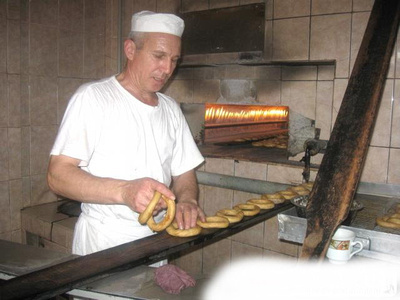
[Side note : these kringels or 'covrigi calzi' are still extremely popular in Romania, and if you are lucky you can still find places where they are baked right in front of you: the dough hand twisted, boiled in big vats and then flipped on long wooden paddles into those big ovens whose mouths open like the gate to hell (the image taken directly from Gorky's story.]
Ugly, diseased, uncouth, untalented - these men are literally at the bottom of the social ladder, little better than slaves, their wits dulled by repetitive labour, their horizon limited by the walls of their cellar where even the high windows are covered with grime and permanently closed by iron grates to prevent strangers from coming and begging for free samples. Yet such a visitor makes a habit of sneaking in every morning, descending from one of the upper floors where seamstresses work with gold thread and brocades, for an apron full of the hot pretzels. Fifteen year old Tanya - pretty, perky, blonde, with a smile and a kind word for eveyone - becomes the sole ray of sunshine in the 'dwarves' bleak existence. She is praised, cherished and adored like one of those holy icons with a golden halo you can spot in all Orthodox churches. No harsh words, not even one dirty thought is allowed to be associated with the sunny Tanya. There's nothing they wouldn't do for their beautiful angel.
Painful and terrible it is when a man goes on living, while nothing changes around him; and when such an existence does not finally kill his soul, then the monotony becomes with time, even more and more painful.
And still, in this eternal battle between light and darkness, why do we still find it so hard to abandon our baser instincts? Why do we need to scratch at the glittering surface, trying to find fault in beauty and to bring idols down to our own level of envy and mistrust?
Sometimes a man's life is so poor, that he is driven instinctively to prize his vice and to live by it; one may say for a fact that often men are vicious from boredom.
The bakery men will put Tanya to a test, to see for sure whether she is made of gold or tinsel. It will not be her faults that are revealed but their own greed and pettiness. Gorky's harsh, bitter assessment of human nature has lost none of its poignancy in the hundred-plus years since he first put it down on paper. The parting words of Tanya ( "Ah, you miserable prisoners!" echo painfully the final words of another masterpiece of the short form by Melville:
Absolutely amazing !!. One of the best short story collections I've ever read in my life. Maxim Gorky's tales are so vivid and full of life. Each of these stories tells us a great deal about how much these people have suffered to earn a living, coz most of his characters represents the working class of Russia.
تلك الفتاة كتلك القشة التي قد يتمسك بها الغريق لينقذ نفسه ففي تلك اللحظة يراها أكثر و أكبر من قشة لكنها في الحقيقة تبقى قشة و سرعان ما يتبين ضعفها في لحظة انقطاع النفس
و لعل الأمل الصغير كأمل الغريق بالقشة يعطيه معنى لحياته في تلك اللحظة و رغبة في محاولة إنقاذ نفسه
لكنها لحظة فقط لا تتعدى ذلك
بالنسبة لي الفتاة كالدنيا التي نعيشها بما فيها من أفكار و شخوص و ملهيات و شهوات سرعان ما ندرك أنها بلا قيمة في اللحظة الاختبار كالخوف و القلق و الموت و ما بعد الموت ...
I downloaded this book after I read a review of the title story by someone I follow on GR. Apart from the title story, there are 2 others “Tchelkache” and “Malva”, plus an introduction with some interesting background on Gorky’s life. Placed in an orphanage in childhood, he subsequently drifted in and out of various apprenticeships and jobs, as a shoemaker, an engraver, an ikon painter, assistant to a gardener, cook’s boy, baker’s assistant, dockworker, sawmiller, apple-seller, gatekeeper, and as a seller of the mildly alcoholic drink called kvass.
Gorky draws on his background for his stories, particularly in the title story and in “Tchelkache”, both of which feature the desperate working conditions of Russia’s urban poor at the end of the 19th century. Gorky’s job as a baker’s assistant in the city of Kazan was apparently one he always recalled with bitterness, and in “Twenty-Six and One” he sets the scene thus:
“There were twenty-six of us – twenty-six living machines, locked up in a damp cellar, where we patted dough from morning till night, making biscuits and cakes. The windows of our cellar looked out into a ditch, which was covered with bricks grown green from dampness, the window frames were obstructed from the outside with a dense iron netting, and the light of the sun could not peep in through the panes, which were covered with flour dust. Our proprietor stopped up our windows with iron that we might not give his bread to the poor or to those of our companions who, being out of work, were starving; our proprietor called us cheats and gave us for our dinner tainted garbage instead of meat.”
The only brightness in the workers’ day comes with a brief daily visit by a cheerful 16-year-old chambermaid, Tanya. Starved of any other female contact, the dehumanised workers all adore this young girl, and place her on a pedestal. When one of the higher ranked bakers boasts to the workers that he can seduce any girl he wants, the workers respond by saying that he could never seduce “their” Tanya. Trouble lies ahead.
“Tchelkache”, is set among the dockworkers in a Black Sea port. Again, Gorky provides an eloquent description of the brutal lives of the workers. The story has only two significant characters; Grichka Tchelkache, “an old jail bird”, (I understand “Chelkash” might be a more modern rendering of the name in the Latin alphabet) and a naïve young man whom Tchelkache inveigles into an expedition to steal bales of silk. I found the first half of this story exciting, but the ending seemed melodramatic. This may have been a translation issue.
The last story, “Malva” features a father-son rivalry over the affections of a rather manipulative young woman. A clever, well-written story.
For me the title story was the best of the three, but overall, an enjoyable collection.
An exceptional short story on social realism and lost ideals. This is Maxim Gorky's most famous short story and reveals the interplay of collective frustrations about social iniquity against the prejudices of that era and how these men too become victims of a similar kind of prejudice, when faced with a similar scenario.
Maxim Gorky is one of the finest authors of Russian Literature. His books are psychological portrayal of his contemporaries, especially of those hailing from the lower strata of the Russian people. He is the best when he tries to understand and write about the tales and travails of the laity belonging to the lower rung of society, the peasants, the labourers and the workers. He has an eye for detail as well as for the plight of the poor. All stories in this book are great, but the 26-men story gets itched in your memory, never to leave your mind and heart. The story is a poignant reminder of the workers, busy like bees in the bakery, where the sight of a girl is a silver lining in the cloud, even as she gets attracted towards a rich army officer, who misleads and tempts her, and all the hopes of the working men, for whom she is an epitome, not only of hope and beauty, but also of wisdom, get shattered.
Being a limited fan of fiction, I could not get into this work as I had hoped. In its native tongue, it would be different for its readers, I am sure. For fiction (and historical fiction) readers who love tales involving the sea, action, etc., this may be just the piece of cake for which you are searching. Maksim Gorky's plots are simple: "Sometimes, there are only two personages: an old beggar and his grandson, two workmen, a tramp and a Jew, a baker's boy and his assistant, two companions in misery... Everything that he relates, Gorky has seen... Therefore, his tramps are strikingly truthful."
It is reported that Gorky’s literary style improved over time, retaining its original defects, defects of working on the reader’s nerves by the piling up of emotive adjectives, of excessive striving for effect, a tendency to overstate, and demonstrating his weakness for philosophical digressions.
Gorky, however, possessed the ability to make his characters come alive, augmented by his knowledge of the Russian lower realms of life. Gorky was the only Soviet writer whose work embraced the prerevolutionary and postrevolutionary period so exhaustively and he remains an important literary figure of his period.
- CONTENTS - Preface Twenty-Six and One Tchelkache Malva
- Excerpts:
"He moved away from her and was silent. Squatting on the sand, with her legs drawn up to her chin, Malva balanced herself gently to and fro, idly gazing with her green eyes over the dazzling joyous sea, and she smiled with triumph as all women do when they understand the power of their beauty."
"In the distance, on the sea, was opening out the pink fan formed by the rays of the rising sun. The glowing orb was already emerging from the water. Amid the noise of the waves was heard from the boat the distant cry: 'Draw in!'"
Other works that may interest readers:
-London Labour And The London Poor (Four Volume Set) by Henry Mayhew -Inconvenient People: Lunacy, Liberty and the Mad-Doctors in Victorian England by Sarah Wise -Mansions of Misery: A Biography of the Marshalsea Debtors’ Prison by Jerry White -The Workhouse by Norman Longmate
Twenty-Six Men and a Girl" is a socio-psychological exploration of the oppressive conditions of industrial labor, where Gorky intricately dissects the paradox of human desire and alienation within a stratified, capitalist framework. The narrative unfolds within the claustrophobic confines of a candle factory, where twenty-six male proletarians, each an archetype of desolation and physical degradation, endure relentless, mechanized toil that strips them of individuality and reduces them to mere cogs in the industrial machine.In stark contrast, the titular girl—an emblem of bourgeois indifference—embodies an objectified ideal of beauty and purity, whose detachment from the workers' plight underscores the dehumanizing gulf between the social classes. These men, burdened by existential loneliness and stifled by their oppressive environment, project their repressed emotional yearnings onto this unattainable figure, fantasizing about her as the epitome of salvation and transcendence.However, the girl, while serving as the locus of their collective desires, remains indifferent, a symbol of the alienating effects of capitalist structures that commodify human interaction. Her obliviousness to their romanticized affections exposes the futility of their emotional aspirations, highlighting the chasm between their aspirations and the reality of their social and economic impotence. Gorky, through this microcosmic drama, critiques the systemic exploitation of the working class while subtly unraveling the profound human longing for connection, tragically thwarted by the rigid constraints of class hierarchy.The story thus becomes a poignant reflection on the ideological dissonance between the proletariat’s idealism and the relentless forces of commodification and social inequality, with the girl serving as both an emblem of unattainable purity and a tragic metaphor for the emotional starvation imposed by the mechanized world of labor.Unindividual reciprocity of dehumanization :(
Twenty-Six Men and a Girl by Maxim Gorky is a powerful short story that explores human psychology, perspective, and moral judgment. Set in a harsh sweatshop-like bakery cellar, the story follows twenty-six exhausted men whose only comfort is the presence of sixteen-year-old Tanya, whom they idealize as something pure and angelic. When a new baker—a soldier—enters their world and later seduces Tanya, that fragile illusion collapses.
What struck me most was how differently the same person is seen through different minds. Tanya is first worshipped, then harshly condemned—not because she changes, but because the men’s expectations are shattered. This made me feel that human perspectives are never fixed; what seems right or wrong often depends on time, situation, and personal belief.
I appreciated Gorky’s honest portrayal of both male and female thoughts, shaped by their social conditions and era. The story quietly reminds us that judgment says more about the judge than the one being judged.Twenty-Six Men and a Girl and Other StoriesMaxim Gorky
(Only had opportunity to read Twenty-Six and One) Well… that escalated 😅 I absolutely loved how Gorky set the scene. His descriptions were beautiful, easily five star material, wasn’t it that the story was just too short to have it have a satisfying resolution.
I have so many questions and it has so much unused potential that’s just a shame. I’m looking forward to try his much longer work The Mother to hopefully find a story with the beautiful writing of the start and the depth longer novels generally provide
Fave quote #1: There were twenty-six of us—twenty-six living machines, locked up in a damp cellar, where we patted dough from morning till night, making biscuits and cakes.
Fave quote #2: Our proprietor stopped up our windows with iron that we might not give his bread to the poor or to those of our companions who, being out of work, were starving; our proprietor called us cheats and gave us for our dinner tainted garbage instead of meat.
Three short stories in which Gorky explores the personal conflicts of workers, laborers, fishermen, and tramps. In his hands, the work, living conditions, and struggles are real. Each story deals with how individuals deal with temptations. Sometimes the main character does the right thing, or, as in the title story, what is dished out comes back.
मैक्सिम गोर्की की ट्वेन्टी सिक्स मेन एण्ड ए गर्ल कहानी संग्रह का हिन्दी अनुवाद पढ़ा। इस संग्रह में चार कहानियाँ है
तानिया या 26 मेन एण्ड ए गर्ल
बेड़े पर
सफर का साथी
डाकू और किसान
सारी की सारी कहानियाँ एक पर एक है। मानवभाव को समझना अपने आप में बहुत बड़ी बात है और उससे भी कठिन है कागज पर उसे उतार देना। गोर्की क्यों इतने महान है यह उनकी कहानियों को पढ़ने से स्पष्ट हो जाता है। हर लाईन अनमोल है जो की मानव हृदय को खोल कर रह देता है। 26 गुलाम पुरुष एक ब्रेड के फैक्ट्री में काम करते है जहाँ एक लड़की हर दिन ब्रेड लेने आती है। अमानवीय परिस्थियों में काम कर रहे गुलामों के लिए सारे दिन में एकमात्र जीवंत समय होता है जिसके बारे में वो हर दिन बात कर सकते है। गोर्की की कहानियों की खास बात यह रहती है की कहानियों का प्लॉट इतना साधारण होता है की वह रोजमर्रा का जीवन होता है किन्तु वर्णन इतना मानवीय और भावनात्मक होता है की हम चकित रह जाते है।